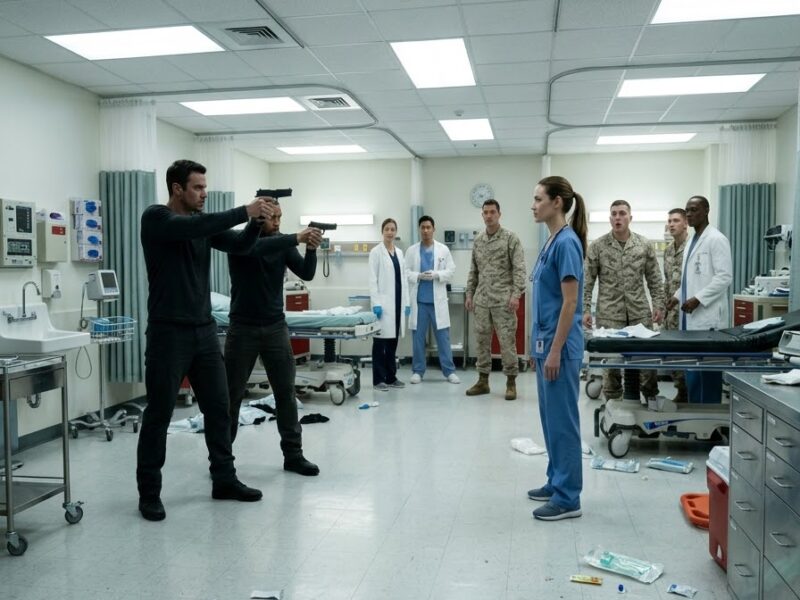
The armed men stormed the military hospital in San Diego just as I was being mocked by senior nurses for being a rookie
“Get out of my way, rookie,” Nurse Captain Miller snapped, her sharp voice cutting through the humid air of the San Diego Naval Hospital emergency ward. She shoved past me, her elbow striking my shoulder hard enough to send a tray of sterile syringes rattling against the stainless steel cart I was pushing.
I lowered my eyes immediately. “I’m sorry, Captain. I’ll clear the aisle.”
“Just don’t drop anything else today, Carter,” she muttered, rolling her eyes toward a pair of senior corpsmen leaning against the nurses’ station. They chuckled, watching me struggle with the heavy cart’s squeaky wheel.
To Captain Miller, to the corpsmen, and to every patient in Ward 4, I was Emily Carter: a shy, clumsy twenty-eight-year-old nurse who flinched at loud noises, stumbled over medical jargon, and spent her lunch breaks sitting alone in the far corner of the cafeteria. For three months, I had played the part of the fragile novice perfectly. I wore oversized scrubs that hid my frame, kept my hair pulled back in a loose, messy bun, and made sure my voice never rose above a soft, hesitant whisper.
They saw a girl who couldn’t handle the pressure of a busy military hospital. They didn’t see the thick, ropy scar running from the base of my neck down to my left shoulder blade. They didn’t know that my hands, currently trembling as I wiped down a plastic tray, were trained to strip a sniper rifle in pitch darkness in under twelve seconds.
They had no idea that before I became Nurse Carter, I was Operator Raven—a operative assigned to DEVGRU, the Navy’s premier SEAL unit. For seven years, I lived in the shadows of Helmand, Kunduz, and places that don’t exist on official maps. I left that life behind after a bloody night in the Hindu Kush mountains, bound by a final, desperate promise to a dying teammate to disappear and protect the innocent from the inside.
A low groaning sound drew my attention to Bed 12. A young Marine corporal, fresh out of surgery from a training exercise accident, was trying to sit up. His face was pale, beads of sweat dripping down his temple. Beside his bed sat a little boy, no older than six, holding a plastic action figure and looking up at his father with wide, terrified eyes.
“Easy, Corporal,” I said softly, stepping toward the bed. My voice lost its timid edge for a fraction of a second, settling into a calm, authoritative tone. “You’ve got two torn ligaments in your knee. If you put weight on it now, you’ll split the sutures.”
“My son… Tommy,” the Marine grunted, clutching his side. “He was supposed to be in the waiting room…”
“He’s right here,” I reassured him, gently guiding the corporal back onto the pillow. I knelt down to Tommy’s eye level, giving him a warm, quiet smile. “Your dad is going to be just fine, Tommy. He just needs to rest his leg.”
The boy nodded slowly, clutching his toy tighter.
Suddenly, the overhead fluorescent lights flickered once, twice, and died.
The entire hospital ward was plunged into dim blue emergency lighting. A second later, a deep, bone-rattling explosion thundered from the basement level. The floor shook beneath our feet. Glass vials shattered against the tile floor. Patients screamed in panic, and Captain Miller shrieked, dropping her clipboard.
“Backup generators should have kicked in immediately,” Miller yelled, her voice laced with rising hysteria. “What is going on down there?!”
Before anyone could answer, the heavy double doors at the main entrance of the ward were blown inward with a deafening crack. Heavy smoke rolled into the hallway.
Through the haze, six figures burst into the ward. They moved with terrifying precision—wearing unmarked black tactical gear, night-vision goggles flipped up, carrying suppressed carbines.
“EVERYONE ON THE GROUND! NOW!” the lead gunman barked, his voice amplified through a tactical mask.
A young Marine guard standing near the nurse station reached instinctively for his sidearm. The lead attacker didn’t hesitate; he raised his rifle and fired a short burst into the acoustic ceiling tiles above the Marine’s head. Plaster rained down.
“Touch that holster and the next one goes through your skull!” the gunman roared.
The room went dead silent, save for the rhythmic, terrified sobbing of patients. Captain Miller dropped to her knees behind the central desk, covering her head and shivering violently.
I didn’t drop to the floor. My heart rate, instead of spiking, plummeted into the icy, hyper-focused calm that only comes from years of combat. My eyes automatically scanned the attackers, instantly calculating their numbers, equipment, and movement patterns.
These weren’t desperate criminals or political extremists throwing a chaotic raid. Their footwork, weapon discipline, and cross-coverage angles were elite. They were military trained.
Then I saw Tommy.
The six-year-old boy had been knocked off his chair by the shockwave of the door opening. He was lying frozen in the middle of the open aisle, crying silently, completely exposed. One of the gunmen was advancing down the central hallway, his heavy boots marching straight toward the boy, his rifle lowered toward the floor.
Something ancient and lethal flared awake inside my chest.
Without thinking, I grabbed the heavy stainless steel medical cart. I slammed my weight into it, sprinting across the polished floor.
“Hey! Stay down!” Captain Miller screamed at me in a hysterical whisper.
I ignored her. I drove the metal cart right into the center aisle, positioning it as a physical shield between the advancing gunman and the child. The metal wheels shrieked against the tile.
TAK-TAK-TAK.
Suppressor-muffled rounds hit the cart’s thick steel framing, sending sparks showering across the floor and shattering the hanging IV bags behind me. Liquid medicine and blood spilled onto the floor. I dropped to my knees behind the metal barricade, wrapped my arms around Tommy, and pulled him tightly into my chest.
“Stay low, sweetie,” I whispered into his ear. “I’ve got you.”
“Target acquisition! Sector two!” the lead gunman shouted, ignoring us and pointing toward the east corridor—the path leading directly to the hospital’s high-security VIP surgical wing.
They weren’t raiding the pharmacy for narcotics. They were sweeping the facility for a specific target.
My mind raced. Two days ago, a high-ranking foreign intelligence official had been secretly admitted to the third-floor VIP suite under heavy armed guard. If these men reached that room, it wouldn’t just be an assassination—it would be a massacre of every medical staff member and patient standing in their way.
“Emily! Are you crazy?!” Captain Miller sobbed from behind her desk, watching me hold the child behind the bullet-dented cart. “They’re going to kill us all!”
I turned my head slightly, eyeing the lead attacker as he barked orders to his men. He turned his profile toward the emergency lights.
A jagged, thick scar cut across his left jawbone, running up toward his ear.
My blood turned to pure liquid ice. The air left my lungs.
I knew that scar. I had watched the man who bore it press the detonator of an improvised explosive device twelve years ago in a narrow alley in Kandahar—the trap that had ambushed my first operational team. I had seen his face in intelligence dossiers for a decade. He was Victor Vance, a former rogue paramilitary operator thought to have been killed in a drone strike six years ago.
He was alive. And he was standing thirty feet away from me.
Down the hall, a squad of armed hospital guards—active-duty Marines—were assembling behind a doorway, weapons drawn, waiting to breach the main hallway. The Marine commander, a scarred Gunnery Sergeant, was preparing to order his men to open fire into the crowded ward.
If they opened fire now, crossfire would shred every civilian stuck in the middle.
“Hold your fire!” I yelled toward the Marines, my voice tearing through the silent room like a thunderclap. It wasn’t the voice of Nurse Emily. It was the command voice of a Navy SEAL Team Leader.
The Gunnery Sergeant hesitated, his eyes widening in shock as he looked at me.
I reached down to the floor where an injured guard had dropped his tactical radio. I grabbed it, flipped the frequency dial three clicks to the left with a flick of my thumb, pressed the push-to-talk button, and spoke into the microphone.
“Echo Three, this is Raven. Execute protocol Blackout. Divert all kinetic fire from Ward 4. I repeat, hold your fire.”
The Gunnery Sergeant dropped his jaw. His hands shook as he looked down at his own radio. “That call sign… Raven?”
The lead attacker, Vance, froze. He spun around slowly, his rifle dropping an inch as his dark eyes locked onto mine.
The silence in the hallway felt heavier than the gunfire that had preceded it.
Every eye in the room was fixed on me—the timid, awkward nurse currently crouching in a puddle of spilled saline and shattered glass, holding a child in one hand and a military radio in the other.
Captain Miller stared at me as if I had suddenly transformed into an alien species. “Emily… who are you talking to? What is ‘Raven’?”
I didn’t answer her. The soft, hesitant girl they had mocked for three months was gone, replaced by the lethal operative forged in the fires of black-budget warfare.
“Gunnery Sergeant!” I snapped, turning my gaze to the Marine officer standing at the end of the hallway. “Cover the west egress! These men are using a standard three-man wedge formation. They are going to clear Ward 4 and blow the breach doors to the VIP suite in ninety seconds. Move your men to the service stairs now!”
The Marine commander, a veteran of Fallujah who recognized real combat command when he heard it, didn’t hesitate. “You heard her! Move! West stairwell, go, go, go!” The Marines melted back into the shadows of the side corridor, executing the repositioning order without question.
Vance’s eyes narrowed into slits as he stared at me through the drifting smoke. “Raven,” he rasped, his voice sounding like grinding stones. “The ghost of DEVGRU. They said you died in the mountains of Kunduz.”
“They lied,” I said coldly, standing up slowly from behind the medical cart. I gently set Tommy down beside his father’s bed. “Leave the civilians out of this, Vance. Your contract is upstairs. You step toward those rooms, and you don’t leave this building alive.”
One of Vance’s men, a tall gunman standing near the door, snorted in laughter. “It’s just a woman in scrubs, boss. Let me take her out.”
The gunman raised his suppressed carbine toward my chest.
He made three critical mistakes. He stepped too close, he lowered his balance, and he assumed my uniform defined my capability.
Before his finger could put six pounds of pressure on the trigger, I lunged.
I closed the ten-foot gap between us in a fraction of a second. My left hand struck the barrel of his rifle, deflecting it upward just as he fired—a single bullet tearing into the ceiling tiles. With my right hand, I slammed an open palm upward into the base of his nose, crushing his nasal bone into his sinuses.
He gagged, stumbling backward. I grabbed his rifle strap, twisted my hips, and threw him over my shoulder. He slammed hard onto the concrete floor. Before he could recover, I drove my knee into his ribs, snatched his sidearm—a Sig Sauer P226—from his tactical holster, racked the slide, and fired three precise shots.
PAK. PAK. PAK.
The bullets struck the light fixtures above the remaining attackers, plunging their immediate sector into pitch blackness.
“Suppressive fire!” Vance roared, firing his weapon blindly into the corridor.
The air filled with lead and flying concrete dust. I rolled behind a heavy concrete support pillar, my back pressed against the cold stone, holding the captured Sig Sauer against my chest.
Behind the central desk, Captain Miller was hyperventilating, tears streaming down her face as she watched me reload the pistol with terrifying efficiency. “Emily… you… you killed him…”
“He’s unconscious, Captain,” I said without looking at her, my eyes sweeping the hallway for target shadows. “Keep your head down and stay away from the glass.”
“You’re a nurse!” she whimpered.
“Tonight, I’m security,” I replied coldly.
Through the tactical headset I had taken from the downed gunman, I heard Vance barking orders to his remaining three men. “Forget the primary target! Raven is the priority! If she gets to the command center, she’ll lock down the entire complex. Flush her out!”
They were coming for me. Perfect. That meant they were no longer targeting the helpless patients in the beds around us.
I popped out from behind the pillar, acquired the chest silhouette of the second gunman advancing through the smoke, and pulled the trigger twice. Two rounds caught him in the center of his body armor, knocking him backward off his feet and leaving him gasping for air on the floor.
The third gunman charged forward, spraying full-auto fire across the nurse’s station. Wooden splinters and paper files burst into the air like confetti. Captain Miller screamed in horror as a stray bullet shattered the computer monitor inches above her head.
I ducked beneath the counter, swept my leg across the floor, and kicked the heavy steel trash receptacle straight into the attacker’s shins. He tripped, falling forward over the counter. I stood up, grabbed his tactical helmet, and slammed his face hard against the marble desk surface, knocking him cold instantly.
The ward fell silent again, save for the hum of the emergency wall lights and the ragged breathing of the terrified staff.
Three men were down. Only Vance remained.
I stepped out from behind the desk, sidearm raised, sweeping the dark corridor. The heavy steel door leading to the VIP surgical wing was hanging open, its electronic lock melted by thermite charges.
Vance was gone. He had pushed deeper into the facility.
I advanced down the dark hallway, my boots stepping silently around the glass shards. Blood dripped from a shallow cut on my forearm where a piece of flying metal had grazed me, but I didn’t feel the pain. The adrenaline surging through my veins was an old friend.
As I reached the threshold of the surgical wing, the Gunnery Sergeant and his squad of Marines rushed up behind me, their rifles trained on the dark interior.
“Raven!” the Sergeant called out, his voice filled with newfound reverence. “We’ve locked down the perimeter! Backup is five minutes out!”
“Five minutes is too long,” I said softly, my eyes fixed on the bloodstains leading down the VIP corridor. “Vance is moving to eliminate the target.”
The Gunnery Sergeant stared at me, his eyes catching the light of the emergency lamps. He looked down at my neck, noticing for the first time the faded, jagged scar peeking out from beneath my torn scrubs—the signature mark of the elite DEVGRU unit that had operated in the darkest corners of the globe.
Slowly, without a word, the hardened Gunnery Sergeant brought his hand up to his brow, snapping a crisp, formal salute. Behind him, the four active-duty Marines followed suit, standing at full attention in the blood-stained hallway for a nurse they had patronized only an hour ago.
“We follow your lead, Ma’am,” the Sergeant said firmly.
I didn’t have time to process the gesture. I snapped the pistol’s slide back, verifying the final rounds in the magazine. “Cover my flanks. We end this now.”
I stepped into the VIP wing, stepping into the darkness where my past was waiting for me.
The VIP corridor was a graveyard of broken glass and silent, dark rooms. The scent of copper and burnt cordite hung thick in the air.
With the Marines providing flank security behind me, I moved with fluid, predatory grace, my weapon held at eye level. Every door frame, every shadow was a potential death trap, but my mind was completely detached from fear.
Twelve years ago, in the brutal terrain of Afghanistan, my squad—Task Force Alpha—had been guided into an isolated canyon based on high-level intelligence. We were told we were capturing a high-value target. Instead, we walked into a crossfire set by thirty heavily armed mercenaries led by Victor Vance.
My entire team was wiped out in twenty minutes. My spotter, Marcus, died in my arms while I tried to plug the wound in his chest with my bare hands. His last words weren’t a curse at the enemy; they were a plea: “Don’t let them win, Raven. Protect the people who can’t fight back.”
I had survived only because a mortar blast threw me into a ravine, burying me under debris until a rescue team found me two days later. Official reports claimed Vance was killed in a retaliatory strike a week later.
They were wrong. He had been protected. He had been allowed to disappear.
A sudden, metallic thud echoed from Operating Room 3 at the far end of the hall.
I signaled the Marines to hold their positions at the door frame, using hand signals to instruct them to set up an perimeter constraint. They nodded instantly, executing my orders with absolute precision.
I stepped up to the reinforced glass door of OR 3. The electronic lock was shattered. Inside, the emergency back-up lights cast long, distorted shadows across the surgical equipment.
In the center of the room, strapped to an operating table and hooked up to a heart monitor, lay the target: an elderly foreign diplomat whose testimony was set to break open a massive international corruption scandal next week.
Standing over him was Victor Vance.
He had his suppressed rifle pressed directly against the old man’s forehead. In his other hand, he held a remote detonator.
“Step into the light, Raven,” Vance called out without turning around. “Or I blow the C4 charges attached to the structural columns of this wing. The whole roof comes down on us, your Marine friends, and every bedridden patient in this building.”
I pushed the door open smoothly, stepping into the room with my Sig Sauer locked onto his head. “Put the gun down, Vance. You’re out of options. The building is surrounded.”
Vance laughed—a dry, raspy sound that made the hair on my arms stand up. He slowly turned his head to face me. Up close, his face was a roadmap of brutal violence, dominated by the scar I had given him with a combat knife during our final struggle in the Afghan dirt.
“Surrounded?” Vance sneered. “I don’t care about escaping, Raven. This isn’t an extraction. It’s a clean-up job.”
“Who hired you?” I demanded, my grip on the pistol tightening. “Who gave you the clearance codes to bypass the military hospital’s perimeter security?”
“You still don’t get it, do you?” Vance laughed, stepping around the operating table while keeping his weapon aimed at the diplomat. “You spent twelve years believing you were a hero who lost her team to an enemy ambush. You thought you were the tragic survivor of a tragic war.”
My heart gave a heavy, sickening thrum. “Speak clearly, Vance.”
“Your team wasn’t ambushed by chance, Raven,” Vance hissed, his eyes glinting with malicious triumph. “You were sold out. Your coordinates, your evacuation route, your radio frequencies—they were handed to me on a silver platter twelve hours before your boots even touched the dirt in that canyon.”
“Lie,” I whispered, though a cold dread was already spreading through my gut.
“Why do you think I’m here tonight?” Vance continued, stepping closer, using the unconscious diplomat as a shield. “This diplomat has the financial ledgers. He has the bank routing numbers. He was about to prove that high-ranking officials in your own defense department were funding private military contractors to prolong the war—and selling out elite teams like yours whenever they got too close to discovering the truth.”
The room seemed to tilt beneath my feet. The faces of my dead teammates—Marcus, Leo, Jackson—flashed through my mind. For twelve years, I had carried the crushing weight of survivor’s guilt, believing I had failed to protect them.
“Who?” my voice cracked, raw with a decade of buried rage. “Who gave the order?”
Vance smiled, a hideous, yellow-toothed grin. “He’s currently sitting in an office in Washington, wearing three stars on his shoulder. And he’s the one who sent me here tonight to close the final loop. Starting with this old man… and ending with you.”
Before he could pull the trigger on the diplomat, I fired.
I didn’t target his head—he was using the diplomat as a human shield. Instead, I aimed for the tiny exposed target of his right wrist.
PAK!
The bullet shattered his wrist bone. The suppressed rifle flew from his hand, clattering across the floor. Vance roared in pain, dropping the remote detonator.
He didn’t surrender. Driven by blind rage, he drew a combat knife from his chest rig with his left hand and lunged across the operating table, hurling his massive frame directly at me.
The momentum of Vance’s tackle slammed me backward into a glass cabinet full of surgical instruments. The glass shattered into thousands of sharp fragments, raining down around us as we crashed to the floor.
Vance was a brute, outweighing me by nearly eighty pounds, and his rage made him terrifyingly fast. He mounted me, his left hand driving the six-inch combat blade straight down toward my throat.
I caught his wrist with both hands, locking my fingers around his forearm. The point of the steel blade hovered barely two inches above my neck, reflecting the dim blue emergency lights.
“You should have stayed dead in Afghanistan, Raven!” Vance snarled, pressing his entire body weight down onto the knife.
“I died in Afghanistan!” I gasped through gritted teeth, my abdominal muscles burning as I fought to keep the steel at bay. “What’s left is just the promise I made!”
Using a technique drilled into me through thousands of hours of hand-to-hand combat training, I bridged my hips upward violently, throwing Vance’s center of gravity off balance to the right. As he shifted, I snapped my left leg over his head, locking his arm in a tight triangle choke.
I twisted my body, leveraging my leverage against his shoulder joint. A sharp CRACK echoed through the operating room as his arm dislocated.
Vance screamed, dropping the knife.
I rolled out from beneath him, instantly springing to my feet. Before he could recover on his knees, I delivered a spinning heel kick directly into his jaw—the exact spot where his old scar lay.
The impact sent him flying sideways into an anesthesia machine, which overturned with a deafening crash of heavy metal and tearing oxygen hoses.
Vance lay groaning on the floor, coughing up blood, his right wrist shattered and his left shoulder useless. He looked up at me with venomous eyes as I picked up my dropped Sig Sauer from the floor and pointed it directly between his eyes.
“It’s over, Vance,” I said, my voice cold, steady, and completely devoid of mercy.
The door to the operating room burst open, and the Gunnery Sergeant and his squad of Marines poured into the room, their weapons raised. They froze when they saw the scene: the overturned machinery, the shattered glass, the defeated legendary mercenary on the floor, and the young nurse standing over him with a smoking gun.
“Ma’am!” the Sergeant gasped, looking at Vance. “We’ve secured the floor. Military Police and federal authorities are entering the building now.”
“Get a medical team in here for the diplomat,” I ordered, not taking my eyes off Vance. “And secure this man with double heavy restraints. He has a remote detonator somewhere on the floor—find it and render it safe.”
“Right away!” two Marines moved forward, pinning Vance to the floor and securing his wrists with heavy tactical zip-ties.
As they dragged Vance to his feet, he wiped blood from his mouth and looked at me with a twisted smile. “Shoot me, Raven. Do it now. Because if I go into federal custody, I’ll be dead before I reach the arraignment. And you’ll never get the name of the man who sold out your team.”
I stepped closer to him, lowering my weapon until the barrel was inches from his face.
“You’re not going to federal custody, Vance,” I whispered so softly that only he could hear. “You’re going to a black site under my authority. And you’re going to tell me every single name, every bank account, and every order that was ever given.”
For the first time since the attack began, fear flickered in Vance’s dark eyes. He realized that the woman standing before him wasn’t just a soldier following rules. She was a phantom with nothing left to lose.
I turned away from him as the Marines dragged him out into the corridor.
The chaos in the hospital was beginning to settle. The distant wail of police sirens and emergency vehicles echoed through the broken windows. The emergency lights were replaced by the warm, steady glow of the primary power grid coming back online.
I walked back down the hallway toward Ward 4.
The corridor was filled with doctors, nurses, and military personnel attending to the wounded. As I stepped through the double doors into the ward, the room suddenly fell completely silent.
Every eye turned to me.
The staff stood frozen. Captain Miller was sitting on a chair near the nurse’s station, a blanket wrapped around her shoulders. Her face was pale, and her eyes were wide with a mix of shock, awe, and deep embarrassment.
I walked past her toward my cart, picking up my discarded clipboard from the floor.
“Emily…” Captain Miller stammered, her voice trembling. She stood up slowly, looking at my blood-stained scrubs and the calm, stoic expression on my face. “I… I don’t know what to say. I treated you like…”
“You treated me like a rookie, Captain,” I said calmly, placing the clipboard back on the hook. “That was the point.”
“Who are you?” she asked, tears welling in her eyes. “Really?”
Before I could answer, little Tommy ran across the room, wrapping his arms tightly around my waist. “Nurse Emily! You saved my dad! You beat the bad men!”
I softened immediately, dropping to one knee and wrapping my arms around the boy. “Your dad is safe, Tommy. That’s all that matters.”
His father, the wounded Marine corporal, looked at me from his bed, placing a hand over his heart and giving me a slow, profound nod of respect.
I stood up, adjusting the collar of my scrubs to cover the faded scar on my neck.
I knew my time at San Diego Naval Hospital was over. My cover was blown. The quiet life I had built to escape my past was shattered into pieces.
The Gunnery Sergeant walked into the ward, carrying a secure satellite phone. He stopped in front of me, held out the phone, and gave a sharp salute.
“Ma’am. It’s the Director of Special Operations in Washington,” the Sergeant said quietly. “He says he knows who you are… and he’s waiting for your report.”
I took the phone. I looked around the room one last time—at Captain Miller, at Tommy, at the patients who were safe because I had chosen not to hide in the shadows.
“This is Raven,” I spoke into the phone, my voice echoing clearly across the silent room. “Prepare an interrogation room. I’m coming home.”
Three weeks later. Washington D.C.
The rain poured heavily against the tall glass windows of the Pentagon’s upper executive suites, casting blurred reflections across the polished mahogany table.
Sitting behind the massive desk was General Richard Vance—no relation to the mercenary Victor Vance, but his ultimate handler. General Vance was a decorated three-star military icon, wearing a chest full of medals, his hair neatly silvered, looking every bit the untouchable titan of the American defense establishment.
He was pouring himself a glass of scotch, his hands completely steady, when the heavy oak doors of his private office clicked open.
He didn’t look up. “I told my secretary I wasn’t to be disturbed until the press conference regarding the San Diego hospital incident.”
“Your secretary is currently locked out of the floor’s security system, General,” a calm, familiar voice spoke from the doorway.
General Vance froze. He slowly set his crystal glass down on the desk and turned his head.
I stood in the center of his office.
I wasn’t wearing nurse scrubs, and I wasn’t wearing a military dress uniform. I wore a crisp, dark tactical suit. My hair was pulled back tightly, and the scar on my neck was fully visible. In my hand, I carried a black leather briefcase.
“Emily Carter,” General Vance said smoothly, leaning back in his leather chair, though his eyes narrowed slightly. “Or should I say, ‘Raven.’ I heard you were in town. I was wondering when you’d build up the courage to seek an audience.”
“This isn’t an audience, General,” I said, stepping forward with deliberate, measured strides. “This is an audit.”
I set the leather briefcase down on his mahogany desk, unlatched the silver clips with a sharp CLICK, and flipped it open facing him.
Inside lay stacks of encrypted hard drives, printed bank wire transfers tracing back to offshore accounts in the Cayman Islands, and signed confession statements stamped with federal intelligence seals.
General Vance looked down at the documents, his face remaining entirely expressionless. “What is this supposed to be?”
“This is the paper trail,” I replied coldly. “Twelve years ago, you authorized Operation Silver Spear in Kandahar. You sent Task Force Alpha—my team—into an isolated canyon knowing Victor Vance’s mercenary group was waiting for us. You sold our coordinates for forty million dollars paid into your private shell corporations.”
General Vance let out a soft, dismissive chuckle. He picked up a pen and began tapping it casually against his desk. “You’re a broken soldier suffering from severe post-traumatic stress, Carter. You think a court-martial panel is going to believe the ramblings of a rogue operative over a three-star general?”
“They won’t have to believe my word,” I said softly.
I reached into my jacket pocket, pulled out a small black recorder, and placed it on the desk between us.
“Victor Vance gave a full, sworn confession three days ago at a black site in Virginia,” I continued. “He gave up the encryption keys to your private server. He gave up the routing numbers. He gave up the audio files of your voice authorizing the hit on the VIP diplomat in San Diego to cover your tracks.”
For the first time, the color drained from General Vance’s face. The pen in his hand slipped, rattling against the glass surface of his desk.
“You think you can destroy me?” he spat, his voice losing its calm veneer, replaced by a sudden, ugly venom. “Do you have any idea how many powerful people are connected to those accounts? You reveal this, and you pull down the entire foundation of the defense apparatus! They will hunt you to the ends of the earth!”
“Let them try,” I said, leaning over the desk until I was inches from his face. “I’ve been living in the dark for twelve years, General. You’re the one who should be afraid of the daylight.”
The heavy doors behind me swung open again.
This time, it wasn’t my doing. Four armed officers from the Military Criminal Investigation Division (NCIS) stepped into the office, led by a high-ranking Federal Prosecutor holding a signed federal arrest warrant.
“General Richard Vance,” the Prosecutor announced loudly, his voice echoing in the grand office. “You are under arrest for high treason, conspiracy to commit murder, and grand embezzlement against the United States Government. Stand up and place your hands behind your back.”
General Vance sat paralyzed in his chair, staring at the hand-cuffs being unclipped by the NCIS agents. His legacy, his power, his untouchable status—all vanished in a single breath.
As the agents stepped forward and pulled the disgraced General to his feet, he looked at me with pure, unadulterated hatred. “You’re a ghost, Carter! You’re nothing!”
“I’m a nurse,” I corrected him softly, watching as they led him away in chains. “And I just cleaned up the trash.”
An hour later, I stood on the steps of the Pentagon, looking out at the rain falling over the Washington Monument. The air was cool and crisp against my face.
For the first time in twelve long years, the heavy, crushing weight on my chest was gone. The spirits of Marcus, Leo, Jackson, and the rest of my fallen team were finally at peace. The promise I had made in that bloody Afghan canyon was kept.
My satellite phone buzzed in my pocket. I pulled it out and answered.
“Emily?” a soft voice came through the speaker.
It was Captain Miller. Her voice sounded hesitant, nervous, but deeply genuine.
“Captain,” I replied, a small, rare smile gracing my lips.
“We… we fixed up Ward 4,” she said quietly. “The walls are repainted. The windows are replaced. But… the cart has a squeaky wheel again. And the staff is short-handed.”
She paused, taking a deep breath.
“We need a good nurse, Emily. Someone who knows how to keep people safe. If… if you ever want to come back home.”
I looked up at the clearing sky as the rain began to taper off, revealing rays of late afternoon sunlight breaking through the dark clouds over the city.
“Keep the cart ready, Captain,” I said softly, my heart feeling lighter than it had in a lifetime. “I’m on my way.”
The end.









