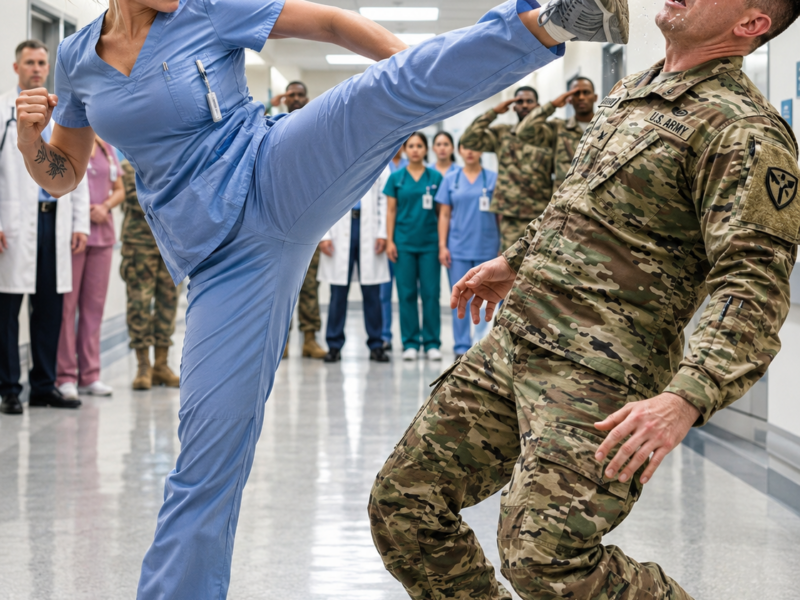
The arena went silent when Staff Sergeant Callum Reeves shoved the woman backward
The monitor began sounding an alarm.
Avery Callahan looked at the numbers again.
Blood pressure: 74 over 40.
Heart rate: 138.
Oxygen saturation: falling.
Staff Sergeant Callum Reeves lay on the trauma table beneath the harsh white lights of Hargrove-style emergency care equipment at Fort Cassell’s medical unit. His uniform had been cut away. Blood stained the sheet beneath his torso.
The paramedic who had brought him in was still giving his report.
“Vehicle rolled twice. He was pinned briefly before the recovery team got him out. Blunt trauma to the chest and abdomen. He was conscious when we loaded him, but he’s been deteriorating since.”
Avery listened while checking the patient’s neck and chest.
His breathing was shallow. His neck veins were distended. His skin had taken on a pale, gray color that suggested his circulation was failing.
She recognized the pattern.
Possible tension pneumothorax. The possibility of cardiac tamponade also had to be considered. Either could become fatal quickly.
“Get the physician on the phone,” she said.
“Already called,” Hartman replied. “Twelve minutes out.”
“Twelve minutes is too long.”
Hartman looked at her.
He had worked in military medicine for more than three decades. He knew the difference between a nurse who was worried and a nurse who had identified a problem that could not wait.
“What do you need?”
“Ultrasound. Chest decompression equipment. Blood products ready. And get the second medic to prepare the next bay.”
Hartman moved immediately.
Avery leaned closer to Reeves.
“Staff Sergeant, can you hear me?”
His eyes opened slightly.
For a moment, he seemed unable to understand where he was.
Then he recognized her.
His expression changed.
“Callahan?”
“Don’t try to talk. I need you to concentrate on breathing.”
He tried to say something, but the effort made him cough.
Avery placed a hand near his shoulder.
“Stay with me.”
The irony of those words wasn’t lost on her.
Six days earlier, Reeves had stood in front of hundreds of people and told her she didn’t belong in the arena. He had threatened her career, tried to intimidate her, and then attacked her outside the rules.
Now his survival might depend on her ability to remain calm.
She had no interest in making that personal.
A patient was a patient.
And he was in trouble.
Dr. Yael Nosi arrived eight minutes later.
She entered the trauma bay still fastening her coat, took one look at the monitor, and moved directly to the bedside.
“What have we got?”
“Vehicle rollover. Severe blunt trauma. Hypotension, tachycardia, distended neck veins, worsening respiratory distress,” Avery reported. “I’m concerned about obstructive shock. We need immediate imaging if he can tolerate it, but I don’t think we have much time.”
Nosi examined Reeves.
She checked his chest, listened to his breathing, and looked at the ultrasound image Hartman had prepared.
Her expression tightened.
“Possible pericardial effusion.”
Avery nodded.
“That’s what I’m concerned about.”
Nosi looked at her.
“Get the surgical team on standby. Prepare for emergency intervention.”
The next several minutes were controlled chaos.
Hartman coordinated the equipment. The second medic prepared blood products. Nosi worked through the available findings, determining the safest immediate intervention while the team prepared for the possibility of surgery.
Avery stayed beside the patient.
She monitored the changes in his condition, relayed the numbers, and anticipated what the physician needed before she asked.
At one point, Nosi looked at her.
“Callahan, how did you recognize that so quickly?”
“His presentation.”
“That’s not what I asked.”
Avery kept her eyes on the monitor.
“I’ve seen similar cases.”
Nosi didn’t press her.
There were more important things to do.
When Reeves’s condition deteriorated again, the team moved quickly. Nosi performed the emergency procedure while Avery assisted, watching the monitor and responding to each instruction.
The room became quiet except for the equipment.
Then the numbers began to change.
The blood pressure rose.
The heart rate slowed.
His breathing improved enough for the team to stabilize him for transfer.
Hartman let out a breath.
“That’s better.”
Nosi looked at the monitor, then at Avery.
“Good catch.”
Avery removed her gloves.
“He’s not out of danger.”
“No,” Nosi agreed. “But he has a chance.”
Reeves was transferred to the regional military medical center later that evening.
The initial report identified multiple injuries, including serious chest trauma and a significant knee injury. His condition remained serious, but he was stable enough for continued treatment.
Avery finished her shift shortly after midnight.
She washed her hands, changed out of her scrubs, and sat alone in the small staff break room.
She wasn’t thinking about Reeves.
She was thinking about the meeting with Voss.
Grey Line.
Twelve weeks.
A position that didn’t officially exist.
For four years, she’d worked in environments where the difference between a good decision and a fatal one could be measured in seconds. She’d seen people survive things they shouldn’t have survived. She’d also seen people fail to come home.
When she transferred into nursing, she had wanted something different.
Not easier.
Different.
She wanted to use her hands to keep people alive without spending every day waiting for the next operational briefing.
She had found that in the medical unit.
She had found a routine.
She had found colleagues who were beginning to understand her.
And now the past was knocking again.
Her phone vibrated.
A message from Dana.
Heard Reeves made it through surgery. You okay?
Avery typed a response.
I’m fine. Just tired.
Dana replied almost immediately.
You always say that.
Avery looked at the message for a moment.
Then she put the phone away.
The following morning, Lieutenant Commander Sasha Ferrara called her into the legal office.
Avery arrived at 0900.
Ferrara was reviewing a stack of documents when she entered.
“Sit down, Petty Officer.”
Avery took the chair.
“I’ve received the preliminary medical report from last night,” Ferrara said. “You were involved in Reeves’s treatment.”
“Yes.”
“Was there any conflict?”
“No.”
Ferrara looked up.
“You understand why I’m asking.”
“Yes.”
“Good. Because the last thing we need is someone suggesting you acted improperly because of the tournament incident.”
“I treated him as a patient.”
Ferrara studied her for a moment.
“I believe you.”
She closed the folder.
“The review board has formally dismissed Reeves’s complaint against you. That part is finished. His disciplinary review is still active, and the additional complaints are being investigated separately.”
Avery nodded.
“There’s something else,” Ferrara continued. “Specialist Ortega came forward.”
Avery looked at her.
“Luis Ortega?”
“He submitted a statement about an incident involving Reeves during his training assignment last year. Apparently, he had been reluctant to speak because he believed nothing would come of it.”
Ferrara slid a document across the desk.
“He wasn’t the only one. Two other service members have also contacted the legal office since the review began.”
Avery read the first page.
The statements described conduct that went beyond ordinary intimidation. They included allegations of threats, professional retaliation, and pressure to withdraw complaints.
None of it was new to the people who had experienced it.
What was new was that they were finally being heard together.
“Will anything happen?” Avery asked.
Ferrara leaned back.
“That depends on the investigation. I won’t promise you an outcome. But the records are being reviewed, and the people who submitted statements are being given a formal opportunity to be heard.”
Avery returned the document.
“That’s what matters.”
Ferrara nodded.
Then her expression changed.
“Voss contacted me this morning.”
Avery waited.
“He wants to know whether you’re still considering the Grey Line program.”
“I haven’t made a decision.”
“He asked me to remind you that your 72-hour window is still open.”
Avery stood.
“Understood.”
Ferrara watched her reach the door.
“Callahan?”
She turned.
“You know you don’t have to prove anything to those people, right?”
Avery considered the question.
“I know.”
“Then make the decision for yourself.”
Avery nodded once and left.
That afternoon, she went back to the ward.
The medical unit was busy. Two new patients had arrived, one with a fractured wrist and another with a respiratory infection that had complicated an existing condition.
Hartman was at the intake station, reviewing paperwork.
He looked up when Avery approached.
“Back again?”
“I’m assigned to the afternoon shift.”
“Good. Bed six needs an assessment. Bed eight needs medication. And somebody has misplaced the portable monitor.”
“I’ll find it.”
“Of course you will.”
There was no ceremony.
No announcement.
No one gathered around to congratulate her.
The ward simply continued.
And that was exactly what Avery wanted.
She spent the next few hours doing what she had always done: checking patients, reviewing medication schedules, helping a young specialist understand his discharge instructions, and making sure a frightened patient had someone to talk to before a procedure.
At 1730, she stopped by bed nine.
The patient there was a young servicewoman named Corporal Elise Morgan, recovering from a training injury.
Morgan had been quiet all afternoon.
“You need anything?” Avery asked.
“No, ma’am.”
Avery checked the monitor.
“Your numbers look fine. But you don’t look fine.”
Morgan gave a small, embarrassed smile.
“I’m okay.”
“That’s not the same thing.”
For a moment, Morgan looked down at her hands.
Then she said, “I heard about what happened with Reeves.”
Avery didn’t respond immediately.
“People are talking,” Morgan continued. “Some of us have had problems with him.”
“I know.”
“I thought nobody would do anything.”
Avery pulled the chair closer.
“Have you spoken with the legal office?”
Morgan shook her head.
“I’m not sure I want to.”
“That’s your decision.”
“They’ll know it was me.”
“Possibly. You should ask the legal officer about confidentiality and what protections are available before deciding.”
Morgan looked at her.
“Do you think it matters?”
Avery thought about the question.
She remembered the unsigned note beneath her door. The padlocked locker room. Reeves’s quiet threat about her evaluations.
She also remembered the three people who had voluntarily submitted statements after the match.
“Yes,” she said. “I think being heard matters.”
Morgan nodded slowly.
Avery stood.
“Get some rest. I’ll check on you later.”
As she walked away, she realized something.
The arena had been full of people watching her fight.
The ward was full of people who needed someone to stand beside them.
Those were very different things.
At 1400 the next day, Avery returned to building 3.
Voss was waiting with the same three colleagues.
The woman who had explained the program introduced herself as Dr. Helena Ward. The other man was Daniel Cross, whose role was described only as operational assessment.
Voss gestured toward the chair.
“Petty Officer Callahan.”
“Mr. Voss.”
He noticed the slight tiredness around her eyes.
“We heard about the incident involving Reeves.”
“Then you know he’s alive.”
“We do.”
“Good.”
Ward opened her folder.
“We’d like to discuss your decision.”
Avery sat.
“I’ve been thinking about it.”
“And?”
“I have questions.”
“That’s reasonable,” Ward said.
Avery looked at Voss.
“Why me?”
“You’ve already asked that.”
“I want a better answer.”
Voss accepted the challenge without taking offense.
“Your record shows four years in special operations medical support. It also shows a successful transition into a clinical role. You’ve maintained your medical qualifications, kept your tactical skills current, and demonstrated an unusual ability to make decisions under pressure.”
He paused.
“Your performance in the arena confirmed some of that. Your response to Reeves’s medical emergency confirmed something else.”
“What?”
“That your judgment doesn’t disappear when the person in front of you has treated you badly.”
Avery was quiet.
Ward took over.
“Grey Line is designed around personnel who can operate across two demanding disciplines. We need people who understand clinical medicine but can also function in environments where conventional medical support may be unavailable.”
“Where would I be stationed?”
“That information is provided during the assessment process.”
“What happens if I fail?”
“You return to your current assignment.”
“And if I pass?”
“You may receive an offer for an operational position. Selection does not guarantee assignment.”
Avery considered that.
“What about my medical career?”
“Your clinical qualifications remain yours. The program doesn’t require you to abandon them.”
“Does it require me to leave Fort Cassell?”
“Potentially.”
Avery looked down at the folder.
There were several pages of information, most of them marked with classification notices. The details were limited, but the implications were clear.
This wasn’t a temporary training course.
It was an invitation back into a world she’d deliberately left.
Voss leaned forward.
“We’re not asking you to become the person you were seven years ago. We’re asking whether you want to use the skills you still have in a different capacity.”
Avery looked at him.
“Why now?”
“Because the program is expanding, and because the need for people with your background is growing.”
He paused.
“And because people like you don’t usually announce themselves.”
Avery almost smiled.
“That’s probably true.”
Voss slid a document across the table.
“You have until tomorrow evening.”
She picked it up.
“I’ll give you an answer.”
That night, Avery walked the perimeter road alone.
The Wyoming sky was clear. The mountains to the west were dark shapes against the fading light.
She thought about her father.
Warren Callahan had never encouraged her to seek recognition. He had taught her to be observant, patient, and prepared. He had never told her that she needed to be the strongest person in a room.
He had told her that the important thing was knowing what to do when strength wasn’t enough.
When she was seventeen, he had built a training scenario that seemed impossible to win. She had studied it, found the one opening he hadn’t protected, and used it.
He hadn’t celebrated.
He had simply nodded.
“Good,” he’d said. “You saw what was there.”
She remembered that more clearly than almost anything else.
Avery stopped near the edge of the road.
The choice in front of her wasn’t about whether she could return to operational work.
She knew she could try.
It was about whether she wanted to.
She had built a life in the medical unit. She had colleagues who trusted her. She had patients who recognized her face and knew she would come when they called.
There was value in that.
There was also value in using her skills where they might be needed most.
Neither choice was a betrayal of the other.
She took out her phone and called Dana.
“Are you awake?”
“Unfortunately,” Dana said. “What’s wrong?”
“Nothing’s wrong.”
“That’s suspicious.”
Avery smiled faintly.
“I have a decision to make.”
“About what?”
“An opportunity.”
“Good opportunity?”
“Complicated opportunity.”
Dana was quiet for a moment.
“Do you want it?”
Avery looked toward the mountains.
“I don’t know yet.”
“Then don’t decide because someone expects you to.”
Avery listened.
“Decide because you can live with the answer.”
It was a simple thing to say.
It was also the most useful thing anyone had told her all day.
“Thanks,” Avery said.
“Don’t thank me. Just get some sleep.”
The call ended.
Avery stood there another minute before walking back toward the housing block.
The following morning, she went to the medical unit before her shift.
Hartman was checking the supply inventory.
He looked up.
“You’re early.”
“I wanted to talk.”
He put down the clipboard.
“Go ahead.”
“I may be leaving Fort Cassell.”
Hartman studied her face.
“Orders?”
“Not yet. An opportunity.”
“Medical?”
“Partly.”
He gave a small nod.
“I see.”
Avery waited for a question.
It didn’t come.
Finally, Hartman said, “You’re one of the better nurses we’ve had through here.”
“Thank you.”
“Don’t make that face. I’m not giving you a retirement speech.”
She almost laughed.
“I haven’t accepted anything.”
“Then I suppose we still have you.”
He picked up the clipboard again.
“Bed four needs an assessment. And the portable monitor is still missing.”
Avery nodded.
“I’ll find it.”
Hartman watched her walk away.
“Callahan.”
She turned.
“Whatever you decide, make sure it’s yours.”
She thought about Ferrara’s advice.
Then she smiled.
“I will.”
At 1800, Avery entered conference room B for the final time.
Voss, Ward, and Cross were waiting.
She placed the folder on the table.
“I’ve made my decision.”
Voss looked at her.
“Go ahead.”
“I’ll accept the assessment.”
Ward nodded.
“Understood.”
“But I have conditions.”
Cross looked up.
“Let’s hear them.”
“My current medical assignment must remain documented as a legitimate service position. I don’t want the people I’ve worked with treated as if this part of my career doesn’t matter.”
Voss listened.
“Second, I want my clinical qualifications maintained during the program. If I’m going to be evaluated as both a medical professional and an operator, I need to keep both sets of skills current.”
Ward made a note.
“Reasonable.”
“And third,” Avery continued, “I want a clear understanding of the medical authority and patient-care protocols before deployment. I’m not going to compromise patient safety to satisfy an operational timetable.”
There was a brief silence.
Then Voss nodded.
“Those are appropriate conditions to raise.”
Avery looked at him.
“Then we understand each other.”
Voss closed the folder.
“Welcome to Grey Line, Petty Officer Callahan.”
He held out his hand.
She shook it.
There was no applause.
No crowd.
No dramatic announcement.
Just a handshake in a quiet conference room.
For Avery, that was enough.
The next two weeks moved quickly.
The program arranged her initial assessment schedule. Her medical command received the necessary transfer paperwork. Ferrara confirmed that the legal review concerning Reeves would continue independently of Avery’s new assignment.
Before leaving Fort Cassell, Avery visited the ward one last time.
Hartman stood at the nurses’ station.
“You’re packed?”
“Mostly.”
“Good. Your replacement starts Monday.”
Avery nodded.
“Make sure she gets the patient notes.”
“I know how to hand over a ward, Callahan.”
“I know.”
Hartman looked at her for a moment.
Then he extended his hand.
“You did good work here.”
Avery shook it.
“So did you.”
He grunted, which was as close to an emotional farewell as she expected from him.
Dana was waiting outside the medical building.
She had brought two coffees.
“Figured you could use one.”
Avery accepted it.
“Thanks.”
“So this is really happening?”
“Yes.”
Dana looked at her for a moment.
“Are you scared?”
Avery thought about it.
“A little.”
“Good.”
Avery raised an eyebrow.
“Good?”
“It means you understand what you’re walking into.”
They stood together for a moment, watching the morning traffic move across the base.
Then Dana reached into her jacket and handed Avery a small envelope.
“What’s this?”
“Open it later.”
Avery slipped it into her bag.
“Thank you.”
Dana nodded.
“Don’t disappear completely.”
“I won’t.”
The assessment facility was not listed on any public base map.
Avery arrived with two other candidates, both of whom had backgrounds in military medicine and operational support.
The first week was primarily evaluation.
They assessed physical conditioning, medical decision-making, communications, team coordination, and the ability to function under stress.
The second week focused on clinical scenarios.
The third involved extended field exercises.
Nothing was presented as a game.
Every exercise had a purpose. Every mistake was reviewed. Every decision was examined.
Avery performed well, but she wasn’t perfect.
During one scenario, she spent too long attempting to stabilize a simulated casualty before moving the team to a safer position.
The instructor stopped the exercise.
“Callahan, what was your priority?”
“Patient survival.”
“And what was the team’s priority?”
“Maintaining operational safety.”
“Those are not separate things.”
Avery looked at the instructor.
“No, sir.”
“Then don’t treat them as separate things.”
She took the criticism seriously.
The following week, she made the adjustment.
Her assessments improved.
By the end of the first month, the instructors had stopped referring to her as the former nurse candidate.
They called her Callahan.
That was progress.
Back at Fort Cassell, the investigation into Reeves continued.
His disciplinary review examined the tournament footage, witness statements, and earlier complaints.
The allegations were considered separately, and the people who had filed them were given the opportunity to provide formal accounts.
Reeves remained suspended from his instructor duties while the process continued.
Avery received no special updates.
She hadn’t asked for any.
She knew that an investigation had to stand on evidence, not on her personal feelings about the man involved.
One evening, she received a message from Ferrara.
The review is progressing. Your statements and the additional witness accounts remain part of the record. You did the right thing by reporting what happened.
Avery read it, then put her phone away.
She didn’t need to know every detail.
She needed to keep doing the work in front of her.
At the end of twelve weeks, the candidates gathered in a small briefing room.
Only two of the original three remained.
Avery sat in the second row.
Voss entered with Ward and Cross.
He placed a folder on the table.
“The assessment period is complete,” he said. “Your performance has been reviewed across all required disciplines.”
He called the first candidate’s name.
The candidate stood.
Then he called Avery.
“Petty Officer Avery Callahan.”
She rose.
“You have successfully completed the Grey Line assessment.”
For a moment, the words didn’t register.
Then Ward continued.
“You are being offered a position within the program’s operational medical support structure, subject to final administrative processing and assignment requirements.”
Avery nodded.
“Thank you.”
Voss handed her a sealed document.
“Your next briefing is scheduled for Monday.”
She accepted it.
There was no dramatic reaction.
No celebration.
Just a quiet acknowledgment that a door she had once closed was now open again.
On Sunday evening, Avery sat alone in her temporary quarters.
She opened Dana’s envelope.
Inside was a photograph of the medical unit team.
Hartman stood in the center, looking as though he’d been forced to participate against his will. Dana stood beside him, smiling. Several of the other nurses and medics were gathered around them.
On the back, Dana had written:
You don’t have to be in the same place to still belong somewhere.
Avery read it twice.
Then she placed the photograph beside her bed.
She thought about the arena.
The shove.
The crowd.
The illegal kick.
The men in the gallery.
The patient who had once threatened her career and later depended on her hands to survive.
She thought about the ward, too.
The people who had stood by her when it would have been easier to remain silent.
She understood something then.
Her life had never been defined by the uniform she wore or the title attached to her name.
She had been a nurse.
She had been an operator.
She had been a daughter who learned from her father.
And she was still Avery Callahan.
The next morning, she reported for her briefing.
Voss was waiting outside the room.
“Ready?”
Avery adjusted the strap of her bag.
“Yes.”
He opened the door.
Inside, a large screen displayed the outline of a new operational assessment.
Avery stepped forward.
The work ahead would be difficult. There would be new places, unfamiliar people, and decisions that would demand everything she had learned.
But she wasn’t walking into it to prove that Reeves had been wrong.
She wasn’t walking into it to impress the people who had watched her in the arena.
She was going because the work mattered.
And because she had chosen it.
The arena had taught 500 soldiers that strength didn’t always look the way they expected. Grey Line would teach Avery what came next.
She took her seat, opened the folder, and began reading.
Quietly.
Without needing anyone to watch.
The end.









