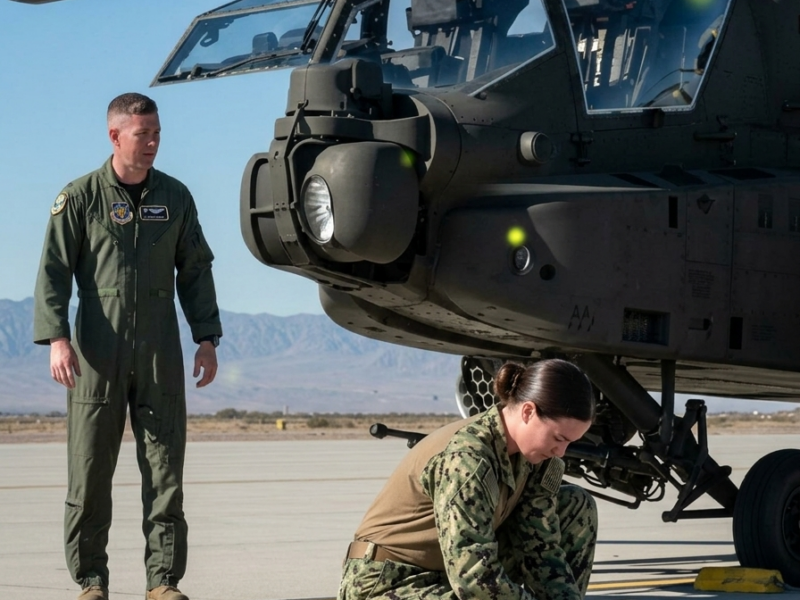
The Apache pilot laughed when he found me scrubbing hydraulic fluid from his helicopter at Fort Campbell, calling me “just the SEAL girl,”
The smell of hydraulic fluid is something you never really wash off. It sinks into the pores of your hands, burrows under your fingernails, and lives in the heavy fabric of your coveralls. I kept my head down, a rag tightly gripped in my fist, scrubbing at a stubborn grease stain on the landing gear of the AH-64 Apache. The hangar at Fort Campbell was quiet this late in the afternoon, the ambient hum of the base bleeding through the corrugated steel walls.
The Apache pilot laughed when he found me there. He was a tall, lean captain with the arrogant, relaxed posture of a man who spent his life looking down at the world through a targeting reticle. He had made a few offhand comments over the past week, calling me “just the SEAL girl,” a sarcastic nod to a rumor he had heard from the maintenance chief. I never corrected him. I let him think whatever he wanted.
I continued cleaning, dragging the rag over the metal struts.
“That’s not your job,” he said, his boots clicking against the concrete as he walked closer.
“I know,” I replied softly, my voice barely echoing in the vast, empty space.
He walked around the nose of the Apache, shaking his head with a mixture of amusement and confusion. “Then why are you here? The mechanics went home an hour ago. You’re a contractor. You don’t get paid overtime for detailing landing gear.”
“Because nobody else wanted to do it,” I said, not looking up.
He laughed quietly. That was normal. People saw a young woman in a dirty maintenance uniform and assumed she was harmless. They saw the grease on my cheeks and the simple ponytail, and they categorized me as background noise. They didn’t know where I had been. They didn’t know the sand I had swallowed or the blood I had washed off my hands in places that didn’t exist on standard maps. They didn’t know why I never talked about Afghanistan, or why a sudden loud noise made my heart rate drop instead of spike.
And they definitely didn’t know about the patch.
I reached up to wipe my forehead with the back of my sleeve. As I did, the heavy canvas of my coveralls shifted. The fabric tore slightly near the shoulder a week ago, a jagged rip I hadn’t bothered to sew. Beneath the gap, stitched directly onto the undershirt hugging my shoulder, was a faded black patch. It bore no flag, no standard insignia, just a pale, heavily stylized trident wrapped in a chain. It had belonged to a SEAL team that officially never existed. A ghost unit.
I had carried it for six years.
The pilot stopped pacing. His boots went still. I felt the sudden shift in the air, the abrupt evaporation of his arrogance. I slowly lowered my arm, turning to face him.
His expression had changed completely. The color was draining from his face, leaving his skin a pale, sickly gray. His eyes were locked on my shoulder, wide and terrified.
“Where did you get that?” his voice was barely a whisper.
I froze, my grip tightening on the rag. “Get what?”
He pointed a trembling finger at my shoulder. The old black patch was barely visible, but to someone who knew what it meant, it was as bright as a distress flare. His voice dropped an octave, losing all its previous mockery.
“Who gave you that?”
I stood up slowly, tossing the dirty rag into a nearby bucket. The relaxed, unassuming maintenance worker vanished. I squared my shoulders, feeling the familiar, cold edge of my training slide into place.
“My brother,” I answered evenly.
The pilot swallowed hard, his Adam’s apple bobbing. “What was his name?”
“Daniel Carter.”
The pilot’s clipboard slipped from his hand, clattering loudly onto the concrete floor. The sound echoed violently in the empty hangar, but neither of us looked down. I watched the last traces of color leave his face. He looked like a man who had just seen a ghost.
“You… you knew him?” I asked, stepping forward, closing the distance between us.
He didn’t look at me. He looked past me, his eyes darting toward the heavy, closed hangar doors. Panic was settling into his posture.
“I flew the helicopter that went down,” he breathed out.
My chest tightened so painfully I thought my ribs would crack. For six years, the official narrative had been my only truth. Everyone had told me Daniel died that night in the Korengal Valley. They told me there were no remains, no witnesses. Just a classified, heavily redacted report stating the aircraft had been completely destroyed by enemy anti-aircraft fire. A tragic, unavoidable loss.
I took another step closer, invading his space, my voice dropping to a dangerous whisper. “What aren’t you telling me?”
He swallowed again, his eyes finally meeting mine. “Your brother wasn’t supposed to be on that mission.”
“Then why was he there?”
He looked directly into my eyes, the fear in his gaze solidifying into a bleak, terrible certainty. “Because someone ordered him to rescue a prisoner.”
My heart stopped. The world around me seemed to tilt. “Who?”
He didn’t answer. Instead, he turned sharply, walking back to the Apache. He reached into the open cockpit, feeling around beneath the pilot’s seat. There was a sharp click, and he pulled out a small, flat metal case, the kind used for storing sensitive navigational chips.
“I’ve kept this for six years,” he said, his voice raw. “I didn’t know who to give it to. I didn’t know who was watching.”
He handed it to me. My hands trembled as I took the cold metal. I unlatched the clasp and opened the lid. Inside, resting on a bed of old foam, was a silver ring. A wedding ring.
My brother had never been married.
Beneath the ring was a folded, glossy photograph. I set the ring aside and unfolded the heavy paper. It was a picture taken at night, illuminated by the harsh flash of a tactical light. Daniel stood beside three men in full combat gear. One was the pilot standing in front of me, looking six years younger. The second was a man with a scarred jaw line I recognized immediately from old intelligence briefings—a CIA paramilitary fixer known only as ‘Trench’.
But the third man made the breath catch in my throat. He was standing slightly behind Daniel, a hand resting on my brother’s shoulder. It was my former commanding officer. Colonel Vance. The exact same man who had personally signed Daniel’s death report and handed me the folded flag.
I looked up, the betrayal burning in my chest like acid. “Why would he lie?”
The pilot stared at the photograph in my hands. “Because Daniel came back alive.”
My knees nearly gave out. I reached out, grabbing the cold metal strut of the Apache to steady myself. “Where is he?”
The pilot’s eyes filled with something I couldn’t name—regret, sorrow, utter defeat. “That’s the part I’ve spent six years trying to find out.”
Then, his radio suddenly crackled. It wasn’t the standard base frequency. It was a heavy, static-laced burst of encryption. A distorted, digitally altered voice came through the speaker clipped to his tactical vest.
“Tell her to stop looking.”
The pilot went completely still. His eyes widened in absolute horror.
I stared at him, the hairs on the back of my neck standing up. “Who was that?”
He slowly looked at me, his mouth opening but no words coming out.
Then the radio spoke again, the digital voice devoid of any human emotion.
“She already knows too much.”
And somewhere just beyond the thin steel walls of the hangar, the deep, guttural roar of an Apache engine suddenly screamed to life.
The sound of the engine wasn’t spooling up—it was already at full throttle, a deafening, violent roar that shook the corrugated metal walls of the hangar. Apaches don’t just start in an instant; they require a pre-flight sequence. Which meant whoever was out there had been sitting on the tarmac with the rotors spinning, waiting in the shadows. Waiting for us.
“Get down!” I screamed, lunging forward and shoving the pilot hard against the concrete floor.
A split second later, the hangar doors disintegrated.
A barrage of 30mm chain gun fire ripped through the thick steel doors like tissue paper. The deafening roar of the rounds impacting the concrete floor was apocalyptic. Shrapnel, sparks, and chunks of shattered cement exploded into the air, filling the hangar with blinding light and choking dust. The rounds chewed a path of absolute destruction, tearing through the maintenance carts and ripping massive, jagged holes into the fuselage of the Apache we had just been standing next to.
I covered my head, pressing myself flat against the cold, vibrating floor. The air was instantly thick with the suffocating smell of cordite, vaporized hydraulic fluid, and burning metal.
“Move!” I grabbed the pilot by his collar, dragging him toward the heavy steel maintenance trench that ran beneath the center of the hangar. “Get in the trench!”
He was frozen, staring in shell-shocked horror at his destroyed helicopter. I didn’t give him time to process. I threw him over the edge of the trench and vaulted in right behind him, just as another volley of high-explosive rounds tore through the roof above us, raining a shower of sparks and burning debris down onto the tarmac.
We landed hard in the shallow, oil-slicked trench. I crawled over to him, grabbing his face with both hands to force him to look at me. His pupils were blown wide.
“Listen to me!” I shouted over the deafening roar of the rotors hovering just outside the ruined doors. “They know you talked! They aren’t trying to scare us; they’re wiping the slate clean! Do you have a weapon?”
He blinked, the training finally fighting through the panic. He nodded frantically, reaching to the holster on his right thigh and unclicking the retention strap. He pulled out a standard-issue M17 pistol.
“Give it to me,” I ordered.
He didn’t argue. He handed the weapon over. I checked the chamber, the smooth, cold metal grounding me. One magazine. Seventeen rounds. Against an armored gunship. It was worse than a joke, but it was all we had.
“There’s an emergency access tunnel at the end of this trench,” the pilot yelled, pointing toward the far wall of the hangar. “It leads to the old armory sub-level. It hasn’t been used in years!”
“Go!” I shoved his shoulder. “Keep your head down and move fast!”
We scrambled on our hands and knees through the dark, cramped trench, splashing through puddles of stagnant water and grease. Above us, the attack helicopter shifted its position. The heavy, rhythmic thump-thump-thump of its rotors vibrated in my teeth. The pilot outside was adjusting his angle, looking for an opening to fire directly down into our cover.
A massive spotlight suddenly pierced through the dust, scanning the hangar floor in sweeping, frantic arcs.
We reached the end of the trench. A heavy, rusted iron grate blocked the tunnel entrance. The pilot grabbed it, pulling with all his strength, but it wouldn’t budge.
“It’s rusted shut!” he panicked, his fingers bleeding against the iron.
I looked up. The beam of the spotlight swept past the destroyed Apache and was tracking straight toward the trench line. We had exactly three seconds before the gunner saw us.
“Move back!” I barked.
I raised the M17, aimed squarely at the heavy brass padlock securing the grate, and fired twice. The deafening cracks echoed tightly in the trench. The lock shattered. I kicked the grate inward, grabbed the pilot’s tactical vest, and threw him into the dark tunnel, diving in headfirst right behind him.
The exact spot we had been occupying vanished in a hail of explosive 30mm fire, shaking the tunnel walls and showering us with pulverized rock.
We crawled furiously through the pitch-black pipe, the sounds of destruction fading slightly as we moved deeper underground. We finally tumbled out into a damp, dimly lit concrete corridor. Emergency lights flickered weakly, casting long, erratic shadows.
The pilot collapsed against the wall, gasping for air. “They’re going to kill us,” he choked out. “Colonel Vance. He’s tying up loose ends. Six years… I thought I was safe.”
“Nobody is safe,” I said coldly, ejecting the magazine to check my ammo. Fifteen rounds left. “What’s your name, Captain?”
“Hayes,” he wheezed, wiping dirt and grease from his face. “Captain David Hayes.”
“Alright, Hayes. You’re officially AWOL, and I’m officially a dead woman walking. Which means we have an advantage.” I walked over to him, pulling the folded photograph from my pocket. “They think they can bury this. But they made a mistake. They missed.”
I tapped the face of the second man in the photo. The CIA fixer. Trench.
“You said Daniel was ordered to rescue a prisoner,” I pressed, my voice echoing in the dead corridor. “Where did Trench fit into this? Why was he on the ground with my brother?”
Hayes swallowed, looking at the picture. “Trench wasn’t just on the ground. He was the architect. The mission wasn’t a rescue. It was an extraction. The prisoner Daniel was sent to get wasn’t a friendly. It was a high-level asset. Someone who had dirt on Vance and half of the Pentagon’s black budget operations.”
“And Daniel found out,” I realized, the pieces violently clicking into place.
“Daniel found the manifest,” Hayes confirmed softly. “He realized the team was being used as a personal hit squad. He secured the asset, but instead of handing him over to Trench… Daniel went rogue. He hid the asset. He hid the evidence. And he vanished.”
“So they shot his bird down to silence the rest of the team,” I said, a cold, murderous fury settling into my veins. “And they captured Daniel.”
“Vance couldn’t kill him,” Hayes said. “Not until Daniel gave up the location of the asset and the data drive. They’ve been holding him, torturing him, for six years. I never knew where. But Trench… Trench is Vance’s attack dog. If anyone knows where the black site is, it’s him.”
“Where is Trench now?” I asked, my grip tightening on the pistol.
Hayes looked at me, a grim, terrifying realization dawning in his eyes. “He’s not overseas. He retired a year ago. He runs a private logistics firm out of a heavily guarded compound in Kentucky. About two hours from here.”
I tucked the photo away and chambered a round. “Show me the way out of this armory. We need a vehicle.”
“You’re crazy,” Hayes breathed, pushing himself off the wall. “We have one pistol. Trench’s compound is a fortress. We can’t just walk in there.”
“We aren’t going to walk,” I said, stepping into the dark corridor. “We’re going to hunt.”
The stolen military surplus Jeep tore through the winding, rain-slicked backroads of Kentucky. The heavy downpour hammered against the canvas roof, a relentless drumming that matched the tension coiled in my chest. Hayes was driving, his knuckles white against the steering wheel, his eyes fixed firmly on the narrow beam of the headlights cutting through the darkness.
It had taken us an hour to slip off the base undetected. Fort Campbell was in full lockdown mode, sirens blaring and MPs searching every perimeter gate. But my years in the ghost unit had taught me how to disappear. We navigated the drainage systems, bypassed the electronic sensors, and hotwired the Jeep from a motor pool lot just outside the blast zone.
“Two miles out,” Hayes muttered, breaking the long silence. “The compound is built into an old limestone quarry. High walls, electrified fences, and at least twenty private contractors patrolling the grounds. All ex-military. All heavily armed.”
“Do they have thermal imaging on the perimeter?” I asked, checking the slide of the M17 for the fifth time.
“Yeah. And motion sensors.” Hayes glanced at me, his face pale in the dashboard light. “Maya… if we get caught, they won’t hand us over to the authorities. Trench makes people disappear. Permanently.”
“Then we don’t get caught.”
I reached into the duffel bag we had liberated from the motor pool. It wasn’t an armory haul, but it was enough. A pair of night-vision goggles, a crowbar, two smoke grenades, and a spool of heavy-duty copper wire. It was a scavenger’s kit, but I had taken down high-value targets with a lot less.
“Pull over here,” I ordered, pointing to a thick cluster of pine trees bordering a steep embankment.
Hayes killed the headlights and eased the Jeep off the asphalt, letting it roll to a stop in the deep mud, completely hidden from the road. We killed the engine. The silence of the forest immediately pressed in, broken only by the steady hiss of the rain.
We moved on foot. The mud sucked at our boots as we hiked up the ridge overlooking the quarry. When we reached the crest, I dropped to my stomach, pulling the night-vision goggles over my eyes. The world shifted into a sharp, monochromatic green.
Below us, nestled in the carved-out rock of the quarry, was Trench’s compound. It was a brutalist structure of concrete and steel. Four guard towers monitored the perimeter. Two contractors in heavy tactical gear were walking the fence line, their assault rifles slung casually over their chests.
“I see the thermals,” I whispered, pointing to the small, rotating sensor nodes mounted on top of the electrified fence. “They’re staggered every fifty yards.”
“How do we get past them?” Hayes asked, crouching beside me.
“We don’t. We let them invite us in.”
I grabbed the spool of copper wire and the crowbar. I moved fast, sliding down the muddy embankment until I was ten yards from the fence line, perfectly hidden in the thick underbrush. I waited for the two-man patrol to pass my position. Once their footsteps faded, I unspooled the copper wire, tied a heavy rock to one end, and threw it perfectly over the top wire of the electrified fence. I jammed the other end of the wire into the wet, muddy earth using the crowbar.
Zap. Crackle.
The ground instantly grounded the circuit. Sparks violently showered from the fence, and a loud, localized alarm began to wail across the compound. The floodlights abruptly shifted, converging on my section of the perimeter.
“Breach on Sector Four!” a voice yelled over a megaphone. “Investigate!”
I scrambled back up the ridge to where Hayes was waiting. “They’re going to check the short circuit,” I said, breathing heavily. “They’ll open the main gate to send a response team outside the perimeter. When they do, we slip in.”
Hayes looked terrified, but he nodded. We moved silently along the ridge toward the front entrance. Below, massive steel gates groaned open. An armored SUV rolled out, filled with contractors rushing to find the source of the alarm.
As the gates began to slowly close behind them, I sprinted.
I didn’t hesitate. I flew down the embankment, keeping low, my boots barely making a sound against the wet gravel. I hit the gap between the heavy steel doors with less than two seconds to spare, sliding on my knees across the slick concrete floor of the compound’s inner courtyard. Hayes was a second behind me, diving through just as the metal gates locked with a heavy, final thud.
We immediately ducked behind a stack of shipping containers.
“Inside,” I whispered, pointing toward the main administrative building.
We moved like ghosts. The courtyard was mostly empty, the guards distracted by the false breach outside. We slipped through a side maintenance door, entering a brightly lit corridor. The walls were lined with surveillance monitors and server racks. This wasn’t just a logistics company; it was a private intelligence hub.
“Trench’s office is on the top floor,” Hayes whispered, pointing to a stairwell.
We climbed the stairs, the M17 raised in my hands. The top floor was completely silent. At the end of the hall stood a heavy oak door. I kicked it open, sweeping the room.
The office was lavish. A massive mahogany desk sat in the center, lined with computer terminals. But the room was empty.
I lowered the gun, a cold knot forming in my stomach. “Where is he?”
Before Hayes could answer, a calm, deeply resonant voice echoed from a hidden speaker in the ceiling.
“You’re very predictable, Maya.”
I spun around, aiming the pistol at the corners of the room. A massive flat-screen monitor on the wall suddenly flickered to life. The face of the man from the photograph—Trench—appeared on the screen. He was sitting in a dimly lit room, smoking a cigar, looking completely unbothered.
“I have to admit,” Trench’s voice purred through the speakers, “when Vance told me you were poking around the base, I didn’t think you had the nerve to come to my home. It’s a shame I’m not there to greet you in person.”
“Where is my brother?” I demanded, my voice cold as ice.
Trench chuckled, a dry, raspy sound. “Daniel? Oh, Daniel is exactly where he belongs. Deep underground. Paying for his treason.”
“He didn’t commit treason,” I snarled. “He found out you and Vance were running black operations and selling assets. You framed him.”
“We are patriots, Maya,” Trench said dismissively. “We do the ugly things required to keep the machine running. Your brother was a Boy Scout who couldn’t stomach the truth. He stole our data. But… he finally broke.”
My breath hitched. “What do you mean?”
Trench leaned closer to his camera, a cruel smile twisting his scarred lips. “Six years of interrogation, and he never gave up the location of the drive. But yesterday, we found his weak point. We told him that if he didn’t give us the encryption key, we would order an Apache strike on a certain maintenance worker scrubbing landing gear at Fort Campbell.”
Tears pricked my eyes. Daniel had broken his silence to save my life. That’s why they sent the helicopter. Not just to kill me, but because they finally had what they needed, and I was just a loose end.
“He gave us the location,” Trench continued. “Vance is at the black site right now, extracting the drive. And once he has it, Daniel’s usefulness is officially over. He’ll be executed within the hour.”
“Where is the site?” I yelled, aiming the pistol at the screen.
“Goodbye, Maya,” Trench said. “Enjoy the compound. You won’t be leaving it.”
The screen went black. A heavy, metallic clank echoed through the walls. Thick steel shutters violently slammed down over the windows and the office door, sealing us inside.
A high-pitched hissing sound filled the room. White, acrid gas began pouring from the ventilation shafts.
The gas burned the moment it hit the air. It wasn’t smoke; it was a neurotoxin. My eyes instantly began to water, and a sharp, metallic taste coated my tongue. Panic flared in Hayes’s eyes as he backed away from the vents, violently coughing.
“We’re dead!” he choked out, dropping to his knees. “It’s halon gas. It’s going to suck the oxygen right out of the room!”
“Don’t breathe deeply!” I snapped, pulling the collar of my coveralls up over my nose and mouth. It was a pathetic filter, but it was all I had.
I scanned the room frantically. The heavy oak door was barricaded behind a slab of solid steel. The windows were reinforced and completely shuttered. We were in a vault, and the air was rapidly turning into a lethal fog.
My eyes landed on the massive mahogany desk in the center of the room. Beneath it, running into the floor, were thick bundles of fiber-optic cables and power lines feeding the server racks Trench used. If this was a secure hub, it had to be hardwired into a subterranean mainline.
“Hayes! The desk! Help me!” I screamed, my voice muffled through my shirt.
He crawled over, his face pale and slick with sweat. We both grabbed the edge of the heavy desk and heaved. With a groaning scrape of wood against concrete, we flipped it onto its side. Beneath the desk was exactly what I was hoping for: a grated floor panel covering the server maintenance chute.
I didn’t have time to unscrew it. I grabbed the pistol, aimed at the heavy bolts holding the grate in place, and fired my remaining rounds. The noise was deafening in the sealed room, but the bolts shattered. I kicked the grate loose, exposing a narrow, dark shaft dropping straight down.
“Go!” I shoved Hayes.
He scrambled into the hole, sliding down the cabling. I dove in right after him, pulling the grate back into place just as the office completely filled with the lethal white gas.
We slid down the rough, narrow shaft in total darkness, the friction burning through the fabric of my coveralls. We hit the bottom hard, tumbling out into a subterranean maintenance tunnel beneath the compound. The air here was damp, smelling of earth and ozone, but it was breathable. I ripped my collar away from my face, gasping for lungfuls of oxygen.
Hayes was hyperventilating beside me, staring at the ceiling. “We made it. We actually made it.”
“We’re not done,” I said, pushing myself up. I checked my empty pistol, cursed silently, and shoved it into my waistband. We were effectively unarmed.
I looked down the dark, cavernous tunnel. A series of thick power cables ran along the ceiling, pulsing with a faint hum. They were all converging toward a heavy, reinforced blast door at the far end of the corridor.
“Trench said Vance is at the black site right now,” I muttered, my mind racing. “But Trench is a logistics guy. He wouldn’t risk moving a high-value prisoner like Daniel across the country. The risk of exposure is too high.”
Hayes looked at me, realization dawning. “You think the black site is here?”
“The compound up top is a front,” I said, pointing toward the blast door. “The real operation is underground. This whole quarry is a tomb.”
We moved silently down the tunnel. The heavy steel blast door was locked, secured by a biometric keypad. I examined the scanner. It required a retinal scan and a keycode. Bypassing it conventionally would take hours.
“We can’t get through that,” Hayes whispered.
“We don’t need to,” I said, pointing to the massive industrial ventilation duct running above the door. It was secured by a simple wire mesh. “Boost me up.”
Hayes cupped his hands, and I stepped into them, launching myself upward. I grabbed the edge of the duct, pulled out my combat knife—the one tool I never took off, hidden in my boot—and sliced through the wire mesh. I hauled myself into the cramped metal shaft and reached down to pull Hayes up.
We crawled through the dusty, echoing ventilation system. Beneath us, through the grated vents, the true scale of Trench’s operation revealed itself. We were crawling above a massive subterranean bunker. Fluorescent lights illuminated rows of holding cells, interrogation rooms, and heavy blast-proof server vaults. Heavily armed guards patrolled the catwalks.
“Look,” Hayes breathed, pointing through a grate.
Below us was a brightly lit interrogation room with a glass wall. Inside, strapped to a heavy steel chair, was a man. His head was slumped forward, his clothes practically rags, his body covered in dark bruises and dried blood.
My heart completely shattered. It was Daniel. Six years had aged him decades, but it was unmistakably my brother.
Standing in front of him, holding a small, silver data drive, was Colonel Vance. He was wearing pristine military dress uniform, looking as immaculate and untouched as the day he had handed me Daniel’s folded flag.
“The encryption key worked, Daniel,” Vance was saying, his voice drifting up through the vent, smooth and arrogant. “I have the ledger. I have the offshore accounts. You endured six years of hell to protect this, and all it took to break you was the threat of killing your little sister.”
Daniel slowly lifted his head. His eyes were swollen, but the fire in them was still absolute. “You’re a dead man, Vance. You just don’t know it yet.”
Vance laughed coldly. “I’m untouchable, son. But you? You’re a ghost. And ghosts don’t leave bodies.” Vance turned to a guard standing by the door. “We’re done here. Execute him and burn the remains in the incinerator.”
“No,” I whispered.
I didn’t think. I kicked the ventilation grate with both boots. The metal snapped, and the grate plummeted, shattering the glass roof of the interrogation room.
I dropped through the opening, falling ten feet and landing perfectly on top of the armed guard before he could even raise his weapon. I drove my elbow into his temple, instantly knocking him unconscious, and ripped the assault rifle from his hands in one fluid motion.
I spun around, leveling the rifle directly at Vance’s chest.
Vance froze, the silver data drive clutched in his hand. His arrogant smirk completely vanished, replaced by sheer, unadulterated shock.
“Maya?” Daniel rasped from the chair, his eyes wide with disbelief.
“Hello, Colonel,” I said softly, my finger resting heavily on the trigger. “You should have made sure the pilot actually hit me.”
Silence stretched in the shattered interrogation room, thick and suffocating. The alarm klaxons hadn’t sounded yet. The sudden violence of my entry had been entirely confined to this glass box.
Colonel Vance stared at the barrel of the rifle, his immaculate posture stiffening. He was a man used to giving orders, unused to facing the barrel of a gun he didn’t control.
“Lieutenant,” Vance said, his voice terrifyingly calm. He was trying to assert authority, trying to reign in the chaos. “Lower the weapon. You are deeply out of your depth. You don’t know what you’re interfering with.”
“I’m interfering with a traitor,” I said, stepping closer. I didn’t take my eyes off him as I spoke to my brother. “Daniel, are you okay?”
Daniel offered a weak, bloody smile. “I’ve been better, kid. How did you find me?”
“I had a little help,” I said.
From the ceiling above, Hayes dropped through the broken grate, landing awkwardly but managing to stay on his feet. He immediately moved to the unconscious guard, unholstering the man’s sidearm and taking a defensive stance by the door.
Vance’s eyes shifted to the pilot. “Captain Hayes. I should have known you were a coward. You broke protocol.”
“No, sir,” Hayes said, his voice trembling but his aim steady. “I fixed it.”
“Give me the drive, Vance,” I ordered, gesturing with the barrel of the rifle.
Vance tightened his grip on the small silver rectangle. “You think taking this means anything? This drive contains the names of politicians, generals, defense contractors. If this gets out, it will tear the intelligence community apart. They will hunt you to the ends of the earth. You will never sleep. You will never have a life.”
“I died six years ago, Colonel,” Daniel rasped from his chair. “Maya died the day you handed her my flag. We don’t need a life. We just need to watch you burn.”
“The drive. Now,” I repeated, racking the bolt of the rifle to emphasize the point.
Vance hesitated, weighing the cold steel of my eyes against his own arrogance. Slowly, agonizingly, he placed the silver drive onto the metal table.
“Cut him loose,” I told Hayes.
Hayes holstered his pistol, pulled out a tactical knife, and quickly slashed through the heavy zip-ties binding Daniel to the chair. Daniel groaned as he stood up, his legs shaking violently beneath him. He was emaciated, deeply scarred, but he refused to lean on Hayes for support. He walked over to the table and picked up the drive.
“We need to move,” Hayes warned, glancing nervously through the shattered glass door into the corridor. “Trench is going to send a security team down here the second he realizes we aren’t dead in the office.”
As if on cue, the heavy, metallic wail of the subterranean alarm system began to shriek. Red strobe lights flashed violently in the corridor.
“They know,” Vance sneered, a cruel smile returning to his face. “You’re trapped in a bunker three hundred feet underground. You aren’t getting out.”
I stepped forward and slammed the butt of my rifle directly into Vance’s jaw. The Colonel collapsed like a puppet with cut strings, out cold before he hit the floor.
“We don’t go back up,” I said, turning to Daniel. “Tell me you know another way out of here. Six years, you had to have mapped this place in your head.”
Daniel wiped blood from his mouth and nodded, his eyes sharpening with the old SEAL intensity I remembered. “There’s an underground river system. Trench uses it for covert smuggling out to the Ohio River. There’s a submersible dock at the sub-level.”
“Lead the way,” I said.
We burst out of the interrogation room, taking a hard right down the corridor. Daniel could barely run, his boots dragging heavily on the concrete, but adrenaline was keeping him moving. Hayes took the rear, providing cover.
We reached a stairwell just as a squad of heavily armed mercenaries rounded the far corner.
“Contact rear!” Hayes yelled, raising his pistol and firing three rapid shots.
The mercenaries returned fire, a hail of automatic bullets sparking against the steel bulkheads around us. I grabbed Daniel, shoving him through the stairwell door, and laid down a wall of suppressive fire with the assault rifle. The deafening roar of the 5.56 rounds tore through the hallway, forcing the mercenaries to take cover.
I backed into the stairwell, slamming the heavy blast door shut and jamming my rifle barrel through the handle mechanism to lock it in place.
“Down! Go!” I yelled.
We descended rapidly into the dark, damp bowels of the bunker. The air grew cold, smelling strongly of river water and diesel fuel. We hit the bottom floor, pushing through a rusted iron door, and stepped onto a concrete dock.
Black, churning water rushed past us in a subterranean tunnel. Tied to the dock was a sleek, black stealth speedboat. It wasn’t a submarine, but it was fast, low-profile, and heavily armored.
“Get in!” Daniel wheezed, practically falling into the passenger seat.
Hayes jumped into the driver’s seat, frantically searching the console. “The keys! There are no keys! It’s a biometric ignition!”
I heard the heavy blast door at the top of the stairwell groan as the mercenaries began breaching it with explosives. We had seconds.
“Daniel!” I shouted.
Daniel leaned over the console, pulling a small, frayed wire cluster from beneath the dashboard. Six years in a cell hadn’t dulled his mind. He stripped the wires with his teeth, twisting them together in a rapid, frantic blur of motion.
A massive explosion shook the facility above us. The stairwell door had blown. Boots pounded down the metal stairs.
“Come on, come on!” Hayes panicked.
Daniel jammed the wires against a conductive plate. The boat’s twin high-performance engines roared to life with a deep, guttural thrum.
I jumped onto the back deck, pulling the heavy tarp off a mounted .50 caliber machine gun. As the mercenaries burst through the dock doors, raising their weapons, I gripped the handles of the massive gun and pressed the thumb trigger.
The heavy rounds tore the dock apart, obliterating the concrete and sending the mercenaries diving for cover.
Hayes threw the throttle entirely forward. The boat surged into the dark tunnel, throwing a massive wake of black water behind us. We shot through the cavern, the roar of the engines echoing off the stone walls, leaving the bunker, Trench, and Vance far behind.
Ten minutes later, we burst out from the subterranean tunnel, the boat launching onto the open, moonlit waters of the Ohio River. The storm had broken, leaving the night sky clear and brilliant with stars.
Hayes slowed the boat, cutting the engine down to a quiet hum.
I walked to the front of the boat, dropping to my knees beside my brother. Daniel was looking up at the sky, tears silently streaming down his dirt-streaked face. For the first time in six years, he was breathing free air.
I reached into my pocket, pulling out the faded black ghost patch. I pressed it into his palm.
“I kept it safe,” I whispered.
He looked at the patch, then at me. He closed his fist tightly around it, pulling me into a desperate, crushing embrace.
“We have a lot of work to do, Maya,” Daniel said, his voice raw but unyielding. He held up the silver data drive. “We have an entire corrupt empire to dismantle.”
I looked out at the dark water ahead, feeling the cold wind on my face. I was no longer a maintenance worker. I was a ghost again.
“Then let’s get to work,” I said.
The end









