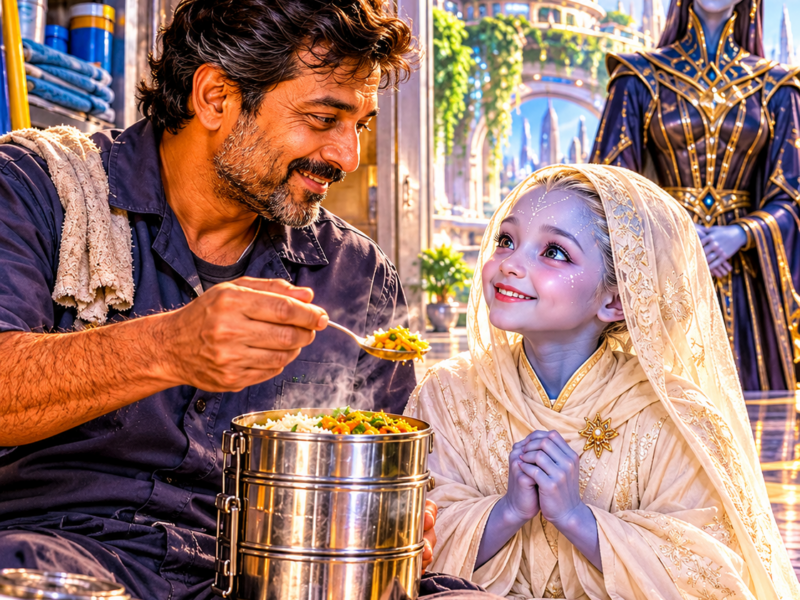
“The Alien Queen had dismissed twelve royal physicians after her daughter refused every meal for nine days
The physician’s scanner continued flashing, its warning reflected in the polished walls of Princess Elyra’s bedroom.
“Your Majesty,” he said carefully, “this is not merely an unfamiliar recipe. The soup contains a living biological compound.”
Queen Seraphina stepped closer. “Explain.”
The physician, Dr. Veyr, adjusted the scanner. “There are traces of an organism in it. A harmless one, apparently, but it matches a classification that was removed from our medical archives three centuries ago.”
I looked down at my lunchbox.
My mother had never mentioned anything about ancient alien biology when she taught me to make chicken soup.
She had only told me that whenever someone was sick, you fed them something warm and stayed until they felt less alone.
“Can it hurt her?” the Queen asked.
Dr. Veyr hesitated.
That hesitation frightened me more than the warning.
“I cannot say,” he replied. “But I strongly recommend that the princess receive no more of it until we understand what it contains.”
From the bed, a tiny voice interrupted him.
“Please don’t take it away.”
Elyra’s eyes were barely open. Her cheeks were pale beneath the faint silver markings that ran along her temples, and one small hand had emerged from beneath the blanket.
She was reaching for my lunchbox.
Queen Seraphina immediately moved to her side. “Sweetheart, you need to rest.”
“I don’t want the white food anymore,” Elyra whispered. “I want the warm one.”
Dr. Veyr stepped between us.
“Your Majesty, the child is confused. Nine days without proper nutrition can affect her judgment.”
Elyra turned her face toward the wall.
It was the first time I’d seen her look defeated.
And I couldn’t stand it.
“Doctor,” I said, “what if we test a tiny amount first?”
He looked at me as though I’d suggested feeding the princess floor cleaner.
“You are a maintenance employee.”
“I know. I clean the floors outside this room.”
“Then you understand that you are not qualified to make medical recommendations.”
“I understand that she’s asking for food.”
The room went quiet.
Queen Seraphina studied me for a long moment.
Then she looked at her daughter.
“Prepare a sample,” she ordered.
Dr. Veyr’s jaw tightened. “Your Majesty—”
“Not a full meal. A single spoonful. Every test you require, every precaution you consider necessary. But my daughter has asked for food for the first time in nine days, and I will not ignore her.”
The physician bowed stiffly.
I watched him draw a small amount of soup into a transparent testing capsule.
The scanner hummed.
A thin blue line crossed its display, then split into three.
Dr. Veyr frowned.
“What is it?” Seraphina asked.
He didn’t answer immediately.
Instead, he turned the screen toward the Queen.
Three words appeared in a language I couldn’t read.
The physician translated them in a voice that had suddenly lost its confidence.
“Ancestral symbiotic culture.”
Queen Seraphina gripped the edge of the bedside table.
“That’s impossible.”
“Apparently not,” he replied.
Then he looked at me.
“Mr. Brooks, I need to know exactly where your family learned to make this soup.”
I swallowed.
“My mother taught me. Her mother taught her.”
“How far back?”
“I don’t know. Generations, I guess.”
The physician stared at the scanner again.
“Then your family may be carrying a piece of our history that the Empire has spent three hundred years trying to erase.”
I didn’t understand what he meant.
But Queen Seraphina did.
She walked to the bedroom door, ordered the royal guards to seal the corridor, and told Dr. Veyr to bring every surviving record of the old medical archives.
Then she turned to me.
“Daniel,” she said, her voice quieter now, “if this is what I think it is, my daughter may not be the only person in this palace who is in danger.”
I glanced at Elyra.
Her little hand was still reaching toward the lunchbox.
And for the first time since I’d started working in the palace, I wondered whether the most dangerous thing in the room was the illness that had made the princess stop eating—or the people who had spent centuries making sure nobody remembered how to cure it.
Dr. Veyr sealed the sample capsule and carried it to the medical station adjoining Elyra’s bedroom.
I stayed beside the door, suddenly aware of my stained work shirt, my scuffed boots, and the red lunchbox sitting on a royal bedside table.
The Queen didn’t seem to notice any of it.
“Bring the historical records,” she repeated into her wrist communicator. “Every surviving reference to the ancestral symbiotic culture. I want the original documents, not the summaries approved by the medical council.”
A guard acknowledged her order.
Dr. Veyr turned sharply. “Your Majesty, those records are restricted for a reason.”
“Then you should have no difficulty explaining that reason.”
He lowered his eyes, but his fingers tightened around the capsule.
I looked toward Elyra.
She had fallen quiet again, her face turned toward the soup.
“Could she have another spoonful?” I asked.
Dr. Veyr answered before the Queen could.
“Absolutely not until the analysis is complete.”
“Then how long?”
“Several hours.”
Elyra’s fingers slipped beneath the blanket.
I had spent eleven months cleaning the palace’s lower residential wing. I knew the sounds of its doors, the patterns of its lights, and which guards secretly slept during the night shift.
I also knew the sound of a child trying not to cry.
“Doctor,” I said, “she might not have several hours.”
The Queen looked at me.
For a moment, I thought she would order me out.
Instead, she pulled a chair closer to her daughter’s bed.
“Find out how long the test will take,” she told Dr. Veyr. “And don’t leave anything out.”
He departed with the sample.
The room felt larger without him, but not safer.
Seraphina sat beside Elyra and gently brushed the hair from her forehead.
“I’m here, little star.”
Elyra didn’t answer.
I picked up the lunchbox, intending to put it away, but the Queen raised one hand.
“Leave it.”
“Your Majesty?”
“Please.”
Her voice had changed. It no longer sounded like the command of a ruler.
It sounded like a frightened mother asking someone not to take away the only thing her child had wanted in days.
I set the lunchbox down.
A few minutes passed before Seraphina spoke again.
“Does your mother still live on Earth?”
“Yes. In Ohio.”
“Does she know you work here?”
“She does. She thinks the palace is probably cleaner than it is.”
A faint, exhausted smile touched the Queen’s face.
“Your mother sounds sensible.”
“She’d be horrified to know I brought her soup into a royal bedroom without permission.”
“Then perhaps we should keep that between us.”
It was the first almost-normal conversation I’d had since entering the room.
Then Elyra stirred.
“Daniel?”
I stepped closer.
“I’m here.”
“Did your mother make the soup?”
“Every winter.”
“Why?”
I glanced at the Queen before answering.
“Because people get sick in winter. She says warm food makes it easier to remember you’re going to feel better.”
Elyra considered that.
“Does it work?”
“Not every time.”
Her mouth moved in what might have been the beginning of a smile.
“But she keeps making it,” I added.
The princess closed her eyes.
“I like your mother.”
I had to look away for a second.
Then the door opened, and two royal archivists entered carrying a sealed metal case.
Behind them came Dr. Veyr.
His expression told me the test had not gone the way he expected.
The Queen stood.
“What did you find?”
“The organism is active,” he said. “It appears to attach itself to the digestive lining and help process certain complex nutrients.”
“Is it dangerous?”
“Not in the sample. But we need to understand how it interacts with Zyrathian physiology.”
He hesitated.
“And there is something else.”
Seraphina’s eyes narrowed.
“Say it.”
“The princess’s recent medical treatment may have disrupted the same system.”
The Queen looked down at Elyra.
“What treatment?”
Dr. Veyr glanced at the archivists.
“The royal restorative regimen. The nutrient infusions and sterilizing agents we have administered since the fever began.”
“You prescribed those treatments.”
“Yes.”
“And you told me they were necessary.”
“They are standard protocol.”
“Then explain why they may have made her worse.”
He opened his mouth, then closed it.
One of the archivists stepped forward.
“Your Majesty, the records you requested.”
Seraphina turned away from the physician.
“Open them.”
The case released a soft hiss.
Inside were old data tablets, brittle sheets of preserved fiber, and a small book bound in dark brown material.
The archivist lifted the book with both hands.
“This was recovered from the sealed medical collection beneath the eastern palace. It predates the current medical council.”
Seraphina stared at the cover.
A symbol had been stamped into it: a silver tree with three roots.
“I know that mark,” she whispered.
Dr. Veyr looked uncomfortable.
“It was used by the old household physicians.”
The Queen opened the book.
The pages were filled with handwritten notes in an older form of the Zyrathian language. Some passages had been crossed out, others marked with official seals.
She turned several pages, then stopped.
“Read this.”
The archivist leaned over the text.
“It describes a condition called the Hollowing. A fever followed by loss of appetite, digestive weakness, and progressive failure of the body’s natural nutrient cycle.”
The Queen’s hand tightened around the page.
“Elyra’s symptoms.”
“Yes, Your Majesty.”
“And the treatment?”
The archivist scanned the next lines.
“Restoration of the ancestral culture through fermented grains, root broth, and living microbial preparations.”
Dr. Veyr shook his head.
“Those methods were abandoned centuries ago. They were unreliable.”
“Were they abandoned because they failed?” Seraphina asked.
He didn’t answer.
The archivist turned another page.
There, beneath a faded illustration of a bowl, was a list of ingredients.
I recognized several words from the translator’s notes, but one line caught my attention.
“That’s garlic,” I said.
Everyone looked at me.
I pointed to the symbol beside the drawing.
“Or something close to it. The shape looks like the old word for garlic in the recipe book my mother keeps.”
The archivist’s face changed.
“Your mother has a written recipe?”
“Not an old book from Earth. Just a family notebook.”
“Can you show it to us?”
“It’s back home.”
“Could you contact her?”
The Queen looked at me.
“Daniel, I need you to do that.”
I took out my communicator.
My hands were slightly unsteady as I called the only person I knew who could explain why a family soup recipe had appeared in a three-hundred-year-old alien medical record.
My mother answered on the fourth ring.
“Danny? It’s late. Are you all right?”
“I’m okay, Mom.”
“Your voice says otherwise.”
I looked at the Queen, then at the little girl in the bed.
“I need you to find the old family recipe notebook.”
There was a pause.
“The blue one?”
“Yeah.”
“Why?”
“It’s complicated. I’m at the palace, and a little girl is sick. The doctors think our soup might help her.”
My mother went quiet.
Then she asked a question I didn’t expect.
“Did they say the name Mara?”
I looked at the old book.
“Not yet. Why?”
“Because that’s the name written on the first page of the recipe.”
The Queen stepped closer.
“Ask her what Mara was.”
I repeated the question.
My mother exhaled slowly.
“Grandma used to say Mara was a woman who came from the stars. She said our family had been keeping her recipe safe for generations.”
I glanced at the Queen.
Her face had gone still.
“Mom, do you know where Mara came from?”
“No, sweetheart. I thought it was a story. There was a little drawing in the notebook, though. A silver tree with three roots.”
The archivist made a small sound.
The Queen reached for the book.
“Ask her to send us a picture.”
My mother did.
A moment later, an image appeared on my communicator.
The drawing was faded, but unmistakable.
A woman stood beside a small vessel beneath a strange sky. Her hair was dark, her clothes simple, and her hand rested on a child’s shoulder.
Behind them was the same silver tree.
Beneath the drawing, in my grandmother’s handwriting, were five words:
Mara brought the first bowl.
The Queen sat down.
For several seconds, she didn’t speak.
Then she turned the old book toward me.
“Daniel, Mara was not a legend.”
The archivist bowed his head.
“She was the human physician who helped save the royal family during the Hollowing.”
I looked at the drawing again.
A human woman.
On an alien world.
Three hundred years ago.
And somehow, her recipe had survived in my family.
“How?” I asked.
The Queen’s eyes moved to the final page of the book.
“Because the first bowl was never meant to belong to the palace.”
She read the passage aloud.
“When the royal household refused the aid of outsiders, Mara carried the treatment to the servants, the children, and the families living beyond the walls. She taught them to preserve the culture so no ruler could ever make its survival dependent on permission.”
The room was silent.
Dr. Veyr stepped forward.
“That is a disputed account.”
Seraphina looked up.
“Then why was the entire chapter sealed?”
“The old council believed the treatment was unsafe.”
“Yet the record says it saved the heir.”
“It was a different era.”
“Then why did you erase the physician’s name?”
Dr. Veyr’s expression hardened.
“Your Majesty, I must remind you that these records are incomplete. It would be irresponsible to act on them without proper review.”
Elyra stirred again.
“Mommy?”
Seraphina immediately went to her.
“I’m here.”
“Is the soup ready?”
The Queen looked at me.
I lifted the lunchbox.
“It’s still warm.”
Dr. Veyr moved to block me.
“No. We need a controlled trial.”
“Then let’s do one,” Seraphina said.
She faced the archivists.
“Prepare the smallest possible dose using the historical protocol. Test every ingredient. Compare it with the sample Daniel brought.”
The physician’s mouth tightened.
“And if it causes a reaction?”
“Then we stop.”
“And if it doesn’t?”
The Queen looked at her daughter.
“Then we let her eat.”
The next hour passed in a blur of tests.
The soup was divided into tiny samples, its ingredients isolated and compared against the old medical record. The scanner found traces of the ancestral culture in the broth, but it could not explain why the princess’s body seemed to recognize it.
The archivists located another passage.
It described the Hollowing as a collapse of the digestive ecosystem after a fever. The old physicians believed that certain living cultures helped restore the body’s ability to process food.
But the final lines had been damaged.
The only readable phrase was:
The culture must be introduced gently, before the body forgets the taste of life.
I didn’t know whether that was medicine or poetry.
Maybe, three hundred years ago, the people who wrote it hadn’t seen a difference.
At last, Dr. Veyr returned with a small sealed cup.
“The sample has passed the initial toxicity screening,” he said. “There is no evidence of a harmful compound.”
“Then give it to her,” I said.
He ignored me.
“Your Majesty, I recommend a single measured dose. We should monitor her response continuously.”
Seraphina nodded.
“Do it.”
She sat on the edge of the bed and lifted Elyra carefully.
The little girl was so weak that her head rested against her mother’s shoulder.
“Sweetheart,” Seraphina whispered, “we’re going to try something.”
Elyra looked at the cup.
“Is it the warm food?”
“It is.”
“From Daniel?”
I smiled.
“From my mother’s kitchen.”
The princess accepted the spoon.
She smelled it first.
Then she tasted it.
Nothing happened.
The room remained still.
Elyra swallowed, looked at the spoon, and opened her mouth again.
The second spoonful went down more easily.
By the third, a little color had returned to her face.
Seraphina pressed her lips together, fighting to keep her composure.
“Does it hurt?”
Elyra shook her head.
“It’s warm.”
“I know.”
“It feels like the dream.”
The Queen looked at me.
“What dream?”
Elyra rested her cheek against her mother’s arm.
“There was a lady in the dream. She had dark hair, and she gave me a bowl. She said I should remember the taste.”
The archivist glanced at the old drawing.
“Could she mean Mara?”
The princess was already drifting toward sleep.
But before she closed her eyes, she whispered, “She said the bowl was for everybody.”
Seraphina kissed her forehead.
For the first time in nine days, her daughter fell asleep without the strain of hunger pulling at her face.
I thought that was the end of it.
I was wrong.
The scanner began to sound.
Dr. Veyr rushed to the monitor.
The readings were changing.
The ancestral culture was attaching to the princess’s digestive lining, but the pattern was not spreading evenly. It was gathering around a cluster of damaged cells near the base of her throat.
“What’s happening?” Seraphina asked.
Dr. Veyr studied the numbers.
“The culture is responding to something.”
“Is that good?”
“I don’t know.”
He enlarged the image.
A thin gray structure appeared inside the tissue, almost like a thread woven through the cells.
The Queen gripped the bedrail.
“What is that?”
The physician’s face went pale.
“A suppressor.”
“A what?”
“A medical compound. It appears to have been introduced during the restorative treatments.”
Seraphina stared at him.
“You said the treatments were safe.”
“They are standard.”
“You keep saying that.”
He looked at the monitor again.
“The compound was designed to suppress foreign biological activity. It may have been intended to prevent infection.”
“May have?”
He didn’t answer.
The archivist had moved to the old book.
“Your Majesty,” she said, “there’s another passage.”
She turned the page toward the light.
The old writing was faint, but the translation system slowly reconstructed it.
The Hollowing returns when the living culture is denied.
The royal household must not use the white draught, for it will silence the body and the memory together.
The Queen read the words twice.
Then she looked at Dr. Veyr.
“What is the white draught?”
He swallowed.
“The name may refer to an obsolete treatment.”
“Is that what you gave my daughter?”
“It was part of the restorative infusion.”
Seraphina stood.
“You knew.”
“No, Your Majesty. The modern formulation is not the same.”
“Then show me the ingredients.”
Dr. Veyr hesitated.
That was enough.
The Queen ordered the guards to take him into custody.
He didn’t resist.
But as they led him away, he turned toward me.
“You don’t understand what you’ve brought into this palace.”
I held the lunchbox against my side.
“Maybe not.”
His eyes narrowed.
“The ancestral culture was abandoned because it was unpredictable. It cannot be controlled, measured, or standardized. The old council learned that the hard way.”
“Then why did you keep suppressing it?”
He looked toward the sleeping princess.
“Because the palace cannot survive another collapse.”
The guards took him out.
Seraphina remained standing in the middle of the room.
Her daughter’s breathing was soft and steady.
The old book lay open on the table.
And for the first time, the Queen seemed to understand that the illness had not simply arrived at her door.
It had been invited there by a system that had forgotten what it was supposed to protect.
The next morning, Elyra woke up hungry.
Not ravenous, not suddenly restored to her old self, but hungry enough to ask whether there was more soup.
I had slept in a chair beside the door.
My back hurt, my shirt was wrinkled, and I had no idea whether the palace would still employ me after the night I’d just had.
But when I heard her ask for breakfast, none of that mattered.
Seraphina smiled through tired eyes.
“Daniel’s mother would be very pleased.”
“She should come here,” Elyra said.
“I don’t think she can make it before breakfast.”
“Then you should call her.”
The Queen looked at me.
I laughed softly.
“I’ll tell her she’s been requested by the princess.”
The following days were not a miracle.
Elyra did not leap out of bed or recover all her strength in a single night. Her body had been weakened by the fever and by the treatments that followed it.
There were setbacks.
There were days when the soup was all she could manage, and others when she ate a few bites of soft bread or fruit.
But the ancestral culture continued to restore the balance her body had lost.
The palace physicians worked under the supervision of a new medical team, using the old records and modern testing together.
They discovered that the white restorative infusion had been suppressing a natural digestive symbiosis that some Zyrathian bloodlines still carried. The fever had disrupted it, and the treatment had prevented it from recovering.
The old method had not been a cure for every illness.
It had been a way to help the body recover from this particular one.
That distinction mattered.
The Queen refused to let anyone call the soup a miracle medicine.
She insisted that it be studied, tested, and made available to families who needed it.
The medical council’s sealed archives were opened.
Its leaders were investigated.
And Dr. Veyr, after several days of questioning, admitted that he had known the modern restorative infusion contained a suppressor derived from the old white draught.
He claimed he had believed the risk was acceptable.
The records suggested otherwise.
For years, the palace had treated the ancestral culture as a threat because it could not be patented, centralized, or controlled by the medical council.
The old treatment had survived among ordinary families, passed quietly from one generation to the next.
The council had called it superstition.
My mother had called it chicken soup.
A week after Elyra first tasted the broth, I was summoned to the royal archive.
Seraphina stood beside a display containing the old drawing of Mara.
The archivist had enlarged the image.
There were details I hadn’t noticed before: a small metal container at Mara’s feet, a cloth wrapped around its handle, and a bowl in her hands.
The container was red.
Not exactly like mine, but close enough that I stared at it for a long time.
“Your family may descend from the people Mara taught,” the Queen said.
“Maybe.”
“The records show that she returned to Earth after the crisis. She carried a copy of the recipe with her.”
“Why would she leave?”
Seraphina looked at the old book.
“Because she believed the knowledge belonged to everyone. She refused the royal offer to become the palace’s exclusive physician.”
I thought about my mother, who had never charged a sick neighbor for a container of soup.
I thought about the dented corner of my lunchbox.
“Sounds like her,” I said.
The Queen’s expression softened.
“There is something else.”
She placed a small sealed envelope on the table.
Inside was a handwritten note, preserved between two sheets of transparent material.
The archivist translated it.
Mara had written it before leaving Zyrath.
To the family who carries this bowl:
If you have found these words, then someone has remembered.
Do not let the powerful make a gift into a privilege.
Feed the hungry first. Ask for permission later.
I read the note twice.
Then I looked at Seraphina.
“She knew this might happen again.”
“I believe she feared it would.”
The Queen folded the note carefully.
“I want to honor her.”
“You already opened the archives.”
“That is not enough.”
She turned toward the window.
Beyond it, the palace gardens stretched beneath the pale morning sky.
“I have spent my life believing that protecting my daughter meant keeping danger away from her. I never considered that some dangers were already inside the walls.”
I didn’t know what to say.
She looked back at me.
“Your mother taught you to make that soup. Mara taught someone in your family to preserve it. And you carried it into this room without knowing what it meant.”
“I was just bringing my lunch.”
“I know.”
Her voice softened.
“That may be why it mattered.”
A month later, Elyra was strong enough to walk through the lower gardens.
She still tired easily, and the doctors had given her a careful recovery plan, but the shadows beneath her eyes were gone.
The first time she saw me pushing a cleaning cart near the fountain, she ran toward me.
“Daniel!”
I set the cart aside just in time for her to wrap both arms around my waist.
“Careful,” I said, laughing. “I’m not as sturdy as the armor guards.”
“You’re sturdier than the chairs.”
“That might be true.”
She looked up at me.
“Did you bring your lunchbox?”
I tapped the red metal container hanging from my cart.
“Always.”
“Is there soup?”
“Not today. Turkey sandwich.”
She thought about it.
“Can I have some?”
I looked toward the Queen, who was walking behind her daughter with two guards at a respectful distance.
Seraphina nodded.
“If Daniel is willing to share.”
I opened the lunchbox.
Elyra took a small piece of sandwich and chewed carefully.
Then she smiled.
“Your food tastes like home.”
The words caught me off guard.
I had spent months thinking of the palace as a place where I worked, slept, and counted the hours until I could call my family.
But that afternoon, standing beside a fountain on an alien world, I understood that home was not always a place you were born.
Sometimes it was a taste someone remembered when they were afraid.
A few weeks later, the palace held a ceremony in the old medical hall.
The sealed records were returned to public access, and the ancestral culture was added to the official medical curriculum. Families across the Empire were invited to learn the history of the treatment and how to prepare it safely.
There was no grand statue of me.
I was glad.
The Queen placed a small silver plaque beside Mara’s restored portrait.
It read:
MARA OF EARTH
PHYSICIAN, TEACHER, AND KEEPER OF THE FIRST BOWL
She then invited my mother to speak through a live transmission.
Mom appeared on the display in her kitchen, wearing the same faded sweater she’d worn when she taught me the recipe.
She looked overwhelmed by the palace, the guards, and the hundreds of alien faces watching her.
“I don’t know much about history,” she said. “I just know that when somebody’s sick, you make them something warm. And you don’t make them eat alone.”
The hall remained silent for a moment.
Then the Queen rose.
She bowed her head to my mother.
Every person in the room followed.
My mother blinked at the screen.
“Danny,” she whispered, “what on Earth have you gotten me into?”
I laughed so hard that the archivist beside me had to pretend not to hear.
After the ceremony, Seraphina found me in the corridor.
“You could ask for anything,” she said. “A position in the royal household. A home here. A place among the palace staff that doesn’t require you to clean floors.”
I looked down at my hands.
They were still rough from work.
“I don’t need a title.”
“Then what do you need?”
I thought about it.
“I’d like to keep working here. But I’d also like to visit Earth. My mother deserves to see the place her recipe came from.”
Seraphina smiled.
“That can be arranged.”
“And maybe we could bring her back here someday.”
“Elyra would insist on it.”
From behind the Queen, a familiar voice called out.
“I heard that!”
Elyra came around the corner, carrying a small wooden bowl.
Inside was a portion of soup.
Not mine.
Hers.
The palace kitchen had learned the recipe from the old records, and she had insisted on helping prepare it.
She held the bowl toward me.
“I made it with the cooks.”
I accepted it carefully.
“Looks pretty good.”
“I put in the garlic.”
“Excellent choice.”
“And the black pepper.”
“Even better.”
She leaned closer and whispered, “I told them not to make it too fancy.”
I took a spoonful.
It was a little too salty.
The carrots were cut unevenly, and the broth was thinner than my mother’s.
But it was warm.
And it tasted like someone had made it because they wanted another person to feel better.
“It’s perfect,” I told her.
Elyra beamed.
That evening, I called my mother from the palace kitchen.
She asked whether the princess was eating, whether the doctors were being careful, and whether I was getting enough sleep.
I answered every question.
Then she asked the one I knew was coming.
“Did you save the old lunchbox?”
I looked at the red metal container on the counter.
The dent was still there.
The paint was scratched, and the handle had loosened a little, but it had survived the journey from Earth to a royal palace on another world.
“Yeah, Mom. I still have it.”
“Good. Don’t replace it.”
“I wasn’t planning to.”
“Some things are worth keeping.”
I glanced through the kitchen doorway.
Elyra was sitting beside her mother, finishing the last of her dinner. Seraphina was watching her with the kind of quiet attention I’d once mistaken for royal formality.
Now I knew better.
“Mom,” I said, “I think you would’ve liked Mara.”
“I think so too, sweetheart.”
After we hung up, I closed the lunchbox and carried it back to my room.
The next morning, I found a small silver tree painted on its lid.
Three roots.
A little bowl beneath the branches.
And in careful, uneven letters, Elyra had written:
FOR EVERYONE.
I ran my thumb over the words.
The lunchbox had crossed an ocean, then a planet, then three centuries of forgotten history.
It had carried a simple meal into a room where a little girl had almost forgotten what hunger felt like.
And somehow, it had brought an entire empire back to the oldest promise my mother had ever taught me:
When someone needs warmth, you don’t ask whether they deserve it.
You make enough for one more.
THE END.









