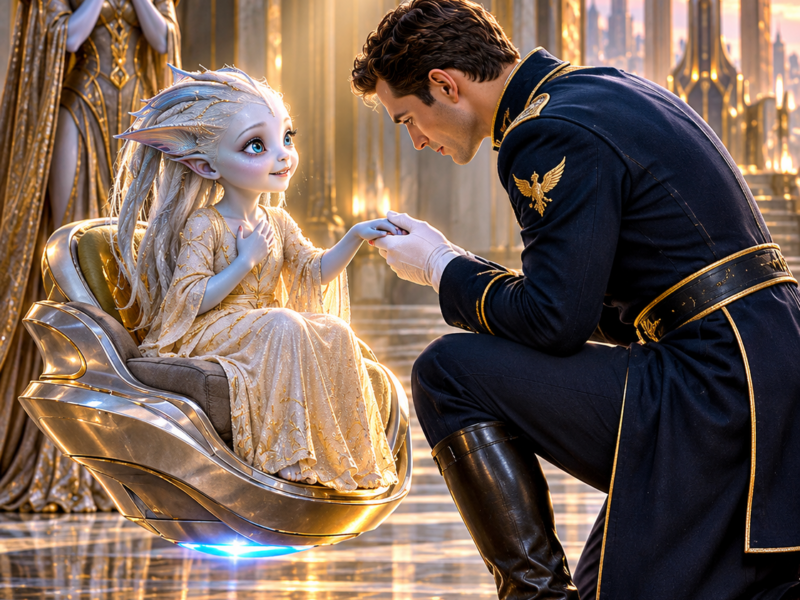
“The alien queen brought her disfigured daughter before the human delegation expecting awkward silence and carefully disguised pity
The queen did not answer her daughter.
For several seconds, the entire eastern gallery seemed to hold its breath.
The guards stood motionless beneath the silver banners.
The ministers watched from the far end of the hall, pretending not to listen.
And Princess Elara stood beside me, holding the little metal object in her trembling hand.
“Mother,” she repeated, quieter this time. “What did you promise never to lie about?”
Queen Auralis looked at me.
There was no longer any diplomatic warmth in her expression.
“Leave us, Ambassador.”
I should have obeyed.
I was a guest in her palace, and every instinct developed during my years of diplomatic service told me that challenging a monarch in front of her court was a terrible idea.
But Elara had stepped closer to me.
Not behind me.
Beside me.
That small distinction mattered.
“I think,” I said carefully, “the princess deserves an answer.”
Auralis’s eyes narrowed.
“You are not qualified to decide what my daughter deserves.”
“Perhaps not,” I replied. “But I know what it looks like when someone is being kept from the truth.”
The queen raised one hand.
Two guards approached.
Elara did not retreat.
“Stop.”
Her voice was weak, but the guards stopped immediately.
She looked down at the object again.
Its surface was dark with age, its edges worn smooth. A small circular indentation sat near one corner, surrounded by markings that looked almost like scratches.
I had recognized the language before.
Not modern English.
Not exactly.
It was an early form of Terran military identification code, used before humanity had established contact with the Veyran system.
And beneath it was a name.
MARCUS VALE.
I had seen that name in a classified archive.
A name connected to a mission that official human history claimed had never existed.
“Elara,” I said, “where did you find this?”
“Under the palace.”
The queen closed her eyes.
“There is no need to continue this.”
“Then tell us what it is,” Elara said.
Auralis opened her eyes again.
“It belonged to your father.”
The princess stopped breathing.
I felt the words land like a physical blow.
“Your father?” she whispered.
The queen looked away.
“He was a human.”
For a moment, I thought I had misunderstood her.
The Veyrans were an old civilization, proud of their bloodlines and their long-standing traditions. Their royal family had maintained strict isolation for centuries.
A human father would have been more than a scandal.
It would have changed the history of their entire dynasty.
“His name was Marcus Vale,” I said.
Auralis nodded.
“An explorer. A physician. A man who arrived here during a period when your species had barely developed faster-than-light travel.”
I stared at the object.
“That’s impossible. The first human expedition to this region was recorded eighty-seven years ago.”
“Your records are incomplete.”
“Or deliberately altered.”
The queen’s expression told me I had found the right answer.
Elara turned toward her.
“You told me Father died before I was born.”
“He did.”
“You said he was Veyran.”
“I said he belonged to this world.”
“You let me believe he was one of us.”
The queen’s voice broke.
“I wanted you to have a chance.”
Elara gave a small, bitter laugh.
“A chance to do what? Pretend I looked like everyone else?”
Auralis flinched.
The princess touched the scar running from her cheek toward her clouded eye.
“You hid me because I reminded you of him.”
“No.”
“Then why did you keep me out of the court? Why did you forbid the physicians from discussing my condition? Why did you tell everyone my injuries were a punishment from the gods?”
The queen took one step forward.
“Because I was afraid they would kill you.”
The silence that followed was different from the first.
This time, even the ministers stopped pretending not to listen.
I looked at Auralis.
“Who?”
She glanced toward the ceiling.
“Not here.”
“Then where?”
“The old observatory.”
Elara shook her head.
“No more secrets.”
Her mother seemed to age before my eyes.
“The people who built this palace,” she said, “did not build it for the Veyran royal family. They built it to protect something.”
She pointed toward the metal object.
“Your father discovered what that something was.”
“Tell me.”
Auralis looked at the guards.
“Clear the gallery.”
No one moved.
Then she spoke with the authority of a queen.
“Everyone out.”
The ministers left first.
The guards followed, though two remained near the doors.
When the gallery was empty, Auralis led us through a narrow passage behind the royal portraits.
We descended a spiral staircase that grew colder with every step.
The walls changed as we went down.
The polished silver panels gave way to dark stone.
Then came strange geometric patterns, cut into the rock with such precision that they looked less like decoration and more like writing.
At the bottom stood a circular door.
It opened when Elara approached.
A soft blue light spread across the floor.
I stopped.
The symbols were not Veyran.
They were human.
Not modern human, either.
They resembled markings from the earliest days of Earth’s space program, mixed with mathematical symbols that had no business appearing on a planet our species supposedly discovered less than a century ago.
“Who made this?” I asked.
“Your ancestors,” Auralis replied.
I turned toward her.
“That is impossible.”
“So you keep saying.”
She placed her palm against the wall.
A section of stone moved aside, revealing a chamber filled with transparent cylinders.
Inside each cylinder floated a small metallic sphere.
There were dozens of them.
At the center stood a larger structure, shaped like a tree with branches made of silver wire.
Elara approached it.
“What is this place?”
“The first human settlement on Veyra.”
I stared at her.
Auralis continued.
“Thousands of years ago, a human vessel arrived here. Its passengers were not explorers in the way your historians understand the word. They were refugees.”
I looked at the cylinders.
“How many?”
“Two hundred and twelve.”
“Where are they now?”
“Gone.”
“Dead?”
“Not exactly.”
The queen touched the central structure.
A faint pulse moved through its branches.
“They came from a world that was dying. Their ship carried the knowledge and genetic material needed to preserve their civilization. They hoped to establish a home here.”
“And the Veyrans?”
“Did not exist yet.”
Elara looked at her mother.
“Then where did we come from?”
Auralis hesitated.
I already knew the answer before she spoke.
“The refugees changed the world.”
She pointed to the cylinders.
“Their technology altered the atmosphere. Their medical systems adapted local organisms. Over generations, their descendants mixed with the native life that eventually became the Veyran people.”
Elara stared at her hands.
“So we’re human?”
“Not entirely.”
Auralis’s voice was barely audible.
“You are the descendants of both.”
I moved toward the nearest cylinder.
There was a name engraved on its base.
M. VALE.
My stomach tightened.
“Marcus Vale was one of the last descendants of the original settlement?”
“No. He was born on Earth.”
“Then how did he get here?”
“He came through the gate.”
The queen pointed toward the tree-shaped structure.
I understood then.
The chamber was not a memorial.
It was a machine.
A transportation system.
“Your people have a gate connecting Veyra to Earth?”
“Not anymore.”
“What happened?”
Auralis looked at her daughter.
“Your father happened.”
Elara stepped closer.
“Tell me everything.”
The queen took a long breath.
“When Marcus arrived, he discovered that the royal family had been concealing the truth for generations. The ancient settlement had left behind a system designed to protect both worlds. It could restore the connection between them, but only if someone with the original genetic markers activated it.”
“Someone like me,” Elara said.
Auralis nodded.
“Your father believed the gate should be opened. He thought Veyra and Earth deserved to know their shared history.”
“And you disagreed?”
“I was afraid.”
“Of what?”
“Of losing you.”
Auralis looked down at the floor.
“The court had already begun to suspect your heritage. Your father’s arrival had divided the royal council. Some wanted to welcome him. Others believed that revealing the truth would end the monarchy.”
“What did they do to him?”
The queen did not answer.
Elara’s face changed.
“What did they do to my father?”
Auralis’s hands began to shake.
“They tried to kill him.”
I looked at the queen.
“Did they succeed?”
“No.”
Auralis turned toward the cylinders.
“He activated the gate before they could reach him. But the system was damaged. The energy surge destroyed much of the lower palace.”
I remembered Elara’s scars.
The damaged arm.
The clouded eye.
The old stories about a royal child cursed by the gods.
“Wait,” I said. “Elara was there?”
Auralis nodded.
“She was only three years old.”
Elara stared at her mother.
“You told me I was injured in a childhood illness.”
“I know.”
“You told me my father had abandoned us.”
“I know.”
“You told me I was a shameful reminder of a past I should never discuss.”
The queen began to cry.
“I know.”
For the first time since meeting her, I saw no monarch standing before me.
Only a mother who had spent seventeen years trying to protect her child with a lie.
But the truth was still not complete.
“Where is Marcus Vale now?” I asked.
Auralis looked at the central structure.
“He never returned to Earth.”
“Then where did he go?”
She pressed a small control beneath the machine.
A light appeared inside the largest cylinder.
A human face slowly formed across its surface.
An older man.
Dark hair touched with gray.
A thin scar across his forehead.
His eyes opened.
“Hello, Elara.”
The princess stumbled backward.
I caught her before she fell.
She stared at the face.
“Father?”
The image flickered.
“I am sorry I took so long.”
Her lips trembled.
“Are you real?”
“As real as the machine allowing us to speak.”
“Where are you?”
“Inside the gate.”
I felt a chill travel down my spine.
Marcus continued.
“When the system collapsed, it transferred my consciousness into its preservation network. I have been here ever since, waiting for someone who could safely restore the connection.”
Elara moved closer.
“Why didn’t you come for me?”
“I tried.”
His voice broke.
“Every time I attempted to reach the palace systems, the royal council blocked me. Your mother eventually sealed this chamber.”
Auralis lowered her head.
“I thought I was saving her.”
“I know,” Marcus said.
Then he looked directly at Elara.
“But you were never something that needed to be hidden.”
The princess pressed her fingers against the transparent cylinder.
“Why did you leave me with these scars?”
Marcus’s expression crumpled.
“I didn’t leave you with them, sweetheart. I saved your life.”
He explained that the gate had been designed to recognize a specific biological signature.
When the royal council tried to destroy it, Elara had been caught in the energy discharge.
Her body had absorbed part of the system’s protective field.
The scars were not signs of weakness.
They were evidence of what had kept her alive.
“The machine repaired what it could,” Marcus said. “But it couldn’t reverse everything.”
Elara touched her cheek.
“Can it repair me now?”
“I don’t know.”
For a moment, the old man looked more frightened than anyone else in the room.
“I won’t promise you something just to make you feel better.”
I liked him immediately.
Elara looked at her mother.
“Did you know?”
Auralis nodded.
“I knew the truth about your injuries. I knew the machine had saved you. But I was afraid that if the court learned what you could do, they would use you.”
“What can I do?”
The machine answered before the queen could.
A series of lights appeared across its surface.
A voice spoke in ancient Terran.
“Original lineage confirmed. Restoration sequence available.”
I stared at the display.
“Restoration?”
Marcus’s expression changed.
“The gate can be repaired. But it requires a living operator to complete the connection.”
Elara looked at the machine.
“Me.”
“Yes.”
Auralis immediately stepped forward.
“No.”
“Mother—”
“I have already lost your father to this machine. I will not lose you too.”
Marcus lowered his eyes.
“I don’t want you to do it either, Elara. Not unless you understand the risk.”
“What risk?”
“The gate will draw energy from your nervous system. It could cause permanent damage.”
The princess looked at the scars on her hand.
Then at the old man inside the cylinder.
Then at her mother.
“And if I don’t?”
Marcus answered softly.
“The connection will remain closed. Both civilizations will continue believing they have no shared history.”
I understood the danger.
If the truth remained buried, the Veyran royal council could continue using it to control the throne.
If the gate opened, the monarchy might collapse.
But something else could happen.
Two worlds could finally meet without the lies that had separated them.
Elara looked at me.
“Daniel, what would you do?”
I thought about my own world.
About the first time humanity had looked into the stars and assumed that every unfamiliar civilization was waiting to be discovered.
I thought about how easily history could be rewritten by those who controlled the records.
“I would make sure the decision was yours,” I said.
“Not your mother’s. Not the council’s. Not mine.”
Elara nodded.
Then she stepped toward the machine.
The queen grabbed her wrist.
“Please.”
Elara turned.
For the first time, she looked at her mother without anger.
“I know you were afraid.”
Auralis’s face crumpled.
“But you made me afraid of myself.”
She gently pulled her hand free.
“I can’t spend the rest of my life living inside that fear.”
The machine brightened.
The silver branches began to unfold.
I moved toward the control panel.
“Marcus, what do you need?”
“Three things. A stable power source, a manual release from the outer chamber, and the operator’s authorization.”
I looked around.
“Where is the manual release?”
Auralis pointed to a narrow panel on the far wall.
“Behind that stone.”
I pulled it open.
Inside was a lever surrounded by red warning lights.
“I’m guessing this is it.”
“Pull it when I say,” Marcus replied.
Elara placed both hands against the central structure.
The machine responded immediately.
A low vibration rolled through the chamber.
The lights above us flickered.
Then the old voice returned.
“Operator authorization required.”
Elara looked at the glowing symbols.
“What do I say?”
Marcus smiled faintly.
“Your name.”
She swallowed.
“Elara Vale.”
The machine went silent.
Then a single blue light appeared.
“Authorization recognized.”
Auralis covered her mouth.
I gripped the lever.
“Marcus?”
“Not yet.”
The silver branches began to twist.
A pattern of light moved beneath Elara’s skin, tracing the scars on her cheek and hand.
She gasped.
I started toward her.
“Don’t,” Marcus warned.
“She needs to maintain contact.”
Elara’s knees shook.
The machine grew brighter.
“Power threshold reached.”
The entire chamber trembled.
Auralis stepped toward her daughter, but I held out my arm.
“Let her finish.”
The queen looked at me with desperate eyes.
I had no right to stop her.
But I also knew that if she touched the machine, she might interrupt the sequence.
Elara clenched her teeth.
“I’m ready.”
Marcus looked at me.
“Now!”
I pulled the lever.
A shockwave burst through the chamber.
The silver branches unfolded like a metal flower.
Light filled every corner.
For one terrifying second, I thought the machine had consumed Elara.
Then the glow faded.
She collapsed.
I caught her before she hit the floor.
“Elara!”
Her eyes were closed.
The queen dropped beside us.
“Please. Please, wake up.”
I checked for a pulse.
It was there.
Weak, but steady.
Then Elara opened her eyes.
Both of them.
The cloudiness in her left eye had cleared.
The scars remained, but the tension in her face had eased.
She looked at her mother.
“I’m still here.”
Auralis pulled her into an embrace.
This time, the princess did not resist.
The machine made a soft chime.
A circular doorway appeared in the air.
Beyond it was a familiar sight.
Blue sky.
White clouds.
A distant coastline.
Earth.
I stared at the image.
It was not a recording.
It was live.
Auralis stood slowly.
“After all these centuries.”
Marcus’s voice filled the chamber.
“Welcome home.”
But the moment was interrupted by the sound of boots above us.
The royal guards were coming.
Auralis turned toward the stairs.
“They know.”
“How?” I asked.
“The council monitors the lower systems. They will have detected the gate.”
Elara stood.
“Then let them come.”
We climbed the staircase together.
When we reached the gallery, the royal ministers had gathered beneath the silver banners.
At their center stood Lord Veyr, the queen’s chief adviser.
He was tall, dressed in ceremonial armor, with a thin gold line running from his temple to his jaw.
His eyes went immediately to Elara.
“You have activated the ancient system.”
Elara raised her chin.
“Yes.”
“You have endangered the kingdom.”
“I have given it the truth.”
Lord Veyr looked toward the queen.
“Your Majesty, order the human arrested. The princess must be confined until the council determines her fitness to rule.”
Auralis said nothing.
For years, the council had controlled her through fear.
They had threatened her daughter.
They had hidden the history of their world.
And now they expected her to continue obeying.
She looked at Elara.
Then she looked at me.
“Daniel,” she said, “is there a way to transmit the gate’s records to Earth?”
“Yes.”
“Can you do it?”
“If the system remains stable.”
Auralis turned toward the ministers.
“Then let the entire galaxy hear what happened here.”
Lord Veyr’s face hardened.
“You cannot do this.”
“I am the queen.”
“You are a queen whose throne was built on a lie.”
Auralis stepped forward.
“Then perhaps it is time the throne was rebuilt.”
Lord Veyr signaled to the guards.
Several soldiers moved toward us.
But before they could reach the gallery, the ancient machine spoke through the palace speakers.
“Historical archive transmission initiated.”
Every screen in the hall came alive.
Images appeared.
The original human settlement.
The first Veyran families.
The arrival of Marcus Vale.
The attempted destruction of the gate.
The council’s orders to conceal the truth.
And finally, the royal records documenting the deliberate exile of anyone who questioned the official history.
Lord Veyr stared at the screens.
His face had lost all color.
The guards lowered their weapons.
They had sworn loyalty to the throne.
Not to a council that had falsified the history of their own people.
“You have no authority to release those records,” Veyr said.
Auralis looked at him.
“You had no authority to erase them.”
The ministers began arguing.
Some demanded that the council be dissolved.
Others called for an emergency vote.
But Elara stepped forward before the noise could swallow the moment.
“My name is Elara Vale,” she said.
Her voice carried across the gallery.
“I am the daughter of Queen Auralis and Marcus Vale. I am not a mistake, a curse, or a shameful secret.”
She touched the scars on her cheek.
“These are part of my history. They do not make me less worthy of standing here.”
No one spoke.
“I will not ask you to love me. I will not ask you to forget what you were taught. But I will ask you to stop punishing people for being different from the story you were given.”
The oldest minister slowly lowered his head.
Then another followed.
And another.
Lord Veyr remained standing.
For a moment, I thought he might draw his weapon.
Instead, he removed the golden insignia from his chest and placed it on the floor.
“I served the kingdom,” he said.
“No,” Auralis replied. “You served your own fear.”
The guards escorted him from the gallery.
The council was dissolved before the next sunrise.
The queen did not surrender her crown immediately.
She insisted that the transition be handled through a public assembly, with representatives from every region of Veyra.
For the first time, people who had never been allowed inside the palace were invited to speak about their future.
And Elara refused to be hidden away again.
Three days after the gate opened, I stood with her on the eastern balcony.
The palace was crowded with visitors, historians, physicians, and engineers.
Some had come to see the ancient human technology.
Others had come to see the princess.
She wore no ceremonial veil.
Her scars were visible.
Her left arm still needed mechanical support, though the engineers had begun studying ways to improve it.
The healing of her eye had been unexpected.
Marcus believed the gate had restored some of the damage caused by the original accident, but he warned that it might not be permanent.
Elara did not seem worried.
“I spent seventeen years wishing I could look different,” she told me.
“Now?”
“Now I want to see what the world looks like.”
I smiled.
“That seems like a reasonable ambition.”
She leaned against the balcony rail.
“Do you think Earth will accept us?”
I looked toward the gate.
Beyond it, the blue sky of my home planet shimmered in the distance.
“Some people will welcome you. Some will be afraid. Some will try to make money from the discovery.”
“That sounds familiar.”
“It is.”
She laughed.
It was the first time I had heard her laugh without trying to hide it.
A few days later, the first human delegation arrived.
Their leader was a woman named Commander Sera Mitchell, who had spent most of her career studying the possibility of ancient contact between Earth and distant civilizations.
When she stepped through the gate, she looked at the palace, the Veyran people, and the royal banners.
Then she saw Elara.
For several seconds, neither of them spoke.
Finally, Commander Mitchell lowered her head.
Not in submission.
In respect.
“Princess Elara,” she said. “On behalf of Earth, I am honored to meet you.”
Elara glanced at me.
I gave her a small nod.
She stepped forward.
“Welcome to Veyra.”
The commander smiled.
“Thank you for opening the door.”
Elara shook her head.
“It was already here. We just stopped pretending it wasn’t.”
That sentence appeared in every news report for the next month.
But the most important moment happened later.
I was preparing to return to Earth when Elara asked me to visit the lower chamber one last time.
The ancient machine was quiet now.
Marcus’s image remained inside the central cylinder.
He looked healthier than before, though still translucent.
“Are you leaving?” Elara asked.
“I have to report what happened.”
“Will you come back?”
“If the diplomatic service lets me.”
She gave me a skeptical look.
“Then make sure they let you.”
Marcus laughed softly.
“I think she has learned how to give orders.”
“I had a good teacher,” Elara replied.
Then her expression changed.
“Father, can you come out?”
Marcus looked at the machine.
“I don’t know.”
“Can we find out?”
He hesitated.
“The system was never designed to restore a person who has been preserved this long. But the gate has more power now. There may be a way to transfer my consciousness into a physical body.”
Elara took his hand through the transparent surface.
“Then let’s try.”
The process took six weeks.
Human physicians worked beside Veyran scientists.
They studied the preservation network, mapped its connections, and developed a synthetic body compatible with Marcus’s original genetic structure.
There were complications.
The first attempt failed.
The second damaged part of the memory archive.
The third succeeded.
When Marcus Vale opened his eyes in a medical chamber beneath the palace, Elara was holding his hand.
He looked at her for a long time.
Then he whispered, “You have your mother’s eyes.”
Elara smiled through her tears.
“And your stubbornness.”
He laughed.
It was a small, unsteady sound.
But it was real.
Queen Auralis watched from the doorway.
She did not enter until Marcus looked up and reached for her.
Their reunion was not simple.
Seventeen years of grief could not be erased by a single embrace.
They had to speak about the lies, the fear, and the years they had lost.
They had to learn how to become a family again.
But they began.
And that was enough.
Months later, the Veyran Assembly voted to replace the old royal council with a representative government.
Auralis remained as a ceremonial monarch during the transition, then stepped aside voluntarily.
Elara refused the crown.
Instead, she accepted the position of first ambassador between Earth and Veyra.
She said that she had spent too much of her life being told what she was supposed to become.
Now she wanted to choose.
The last time I saw her before returning to Earth, she stood at the entrance of the eastern gallery.
The same place where I had first met her.
A group of young Veyran students surrounded her.
One asked about her scars.
Another asked whether her mechanical arm hurt.
A third asked if she was really half human.
Elara answered every question without embarrassment.
Then she noticed me.
“Ambassador Daniel.”
“Princess.”
She smiled.
“You still call me that?”
“Would you prefer something else?”
She considered it.
“Elara is fine.”
I nodded.
“Elara, then.”
She looked toward the children.
“They used to tell me that a person could only be important if they looked the part.”
“And now?”
“Now they ask me what I think.”
She paused.
“I like that better.”
I looked at the young faces around her.
They were not staring at her scars anymore.
They were listening.
For a moment, I remembered the queen’s first words to me when I had entered the palace.
She had expected pity.
Perhaps she had even expected disgust.
Instead, I had offered her daughter the simplest thing I could.
A chair at the table.
A place beside the powerful.
The courtesy of being treated as someone whose thoughts mattered.
I had not known that such a small gesture would lead us to a buried civilization, a hidden father, and the truth behind an entire royal bloodline.
But I had learned something I would carry home.
Dignity was not a reward for perfection.
It was not something a crown could grant or a council could take away.
It belonged to people before anyone gave them permission to claim it.
Elara extended her hand.
I shook it.
Then she turned back to the students, and I walked toward the gate.
Behind me, the palace bells rang.
Ahead of me, Earth waited.
For the first time in thousands of years, the two worlds were no longer strangers.
And somewhere between them stood a young woman who had once been hidden because of the way she looked.
Now, no one could look at her without seeing who she truly was.
THE END.









