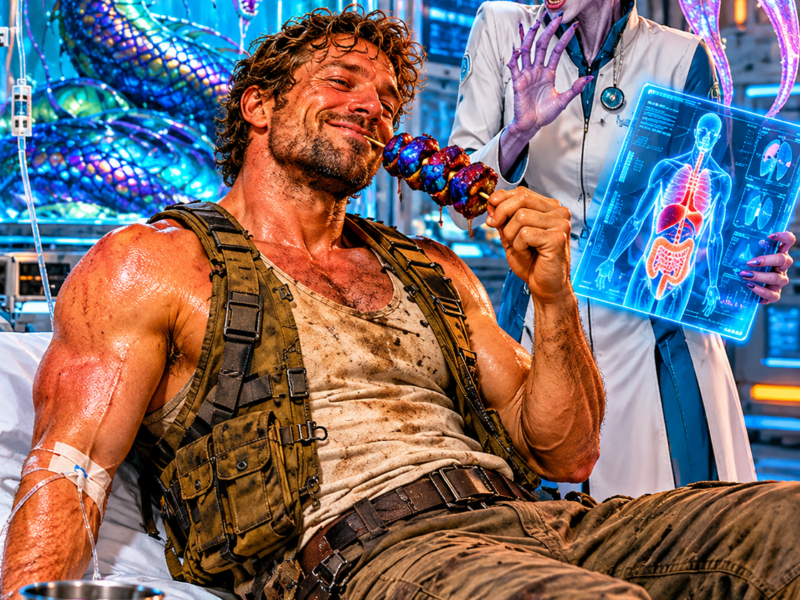
“The alien doctor slammed his six-fingered hand against the quarantine glass and told me that no living species in the known galaxy had ever survived a second
The medical chamber doors locked with a heavy metallic click.
Dr. Threx stood between me and the only exit, his four eyes fixed on the restricted file hovering above his console.
“Before I answer your question,” he said, “I need you to understand that the information you are about to hear has been classified by the Galactic Medical Authority for nearly six months.”
I shifted against the restraints.
“Doctor, I have about a hundred questions, and I don’t think I have six months.”
He didn’t smile.
“The Kharax specimen recovered from Veyra-9 was not dead when it arrived.”
I looked at the medical display.
“Your records say it was.”
“That is what the public report states.”
“What does the private report say?”
Dr. Threx hesitated.
Then he enlarged an image.
It showed the same creature that had attacked me, suspended inside a transparent biological container. Its six legs were folded beneath its armored body. A metal identification tag hung from the container.
I recognized the number.
KX-441.
It was the specimen we had been told had been destroyed before our arrival.
“Six months ago, a research vessel brought this organism to the station,” Threx explained. “It had been captured on a moon where three research colonies had disappeared.”
“Disappeared how?”
“Every inhabitant was found dead. Their bodies showed signs of the same venom.”
I stared at him.
“And you brought it here?”
“We believed the organism could provide a breakthrough in biological medicine.”
“That sounds like a very expensive way to get people killed.”
His upper hands tightened.
“The specimen was placed in containment. It appeared to be dead. Its metabolism had become undetectable, and all biological activity had stopped.”
“Apparently not.”
“No. Apparently not.”
He changed the display.
A series of security recordings appeared.
The first showed a laboratory technician entering the specimen room.
The second showed the technician leaving twelve minutes later.
The third showed an empty containment chamber.
The creature was gone.
“Why wasn’t the station evacuated?” I asked.
“Because the station commander ordered the incident concealed. The specimen was classified as an equipment malfunction.”
I stared at him.
“People were working here.”
“Yes.”
“People could have died.”
“Yes.”
His answer was quiet.
That somehow made it worse.
I looked at the security recording again.
“How did it get to the canyon?”
“We don’t know. We suspect it entered the station’s waste transport system and escaped through an exterior maintenance tunnel.”
“And the people who knew?”
“Three researchers were reassigned. One resigned. The station commander ordered the remaining files sealed.”
I swallowed.
“So I was bitten by an organism your station lost.”
Dr. Threx lowered his head.
“Yes.”
For several seconds, the only sound was the steady pulse of the medical monitor.
Then I noticed something.
The restricted file had another section.
It was labeled HUMAN ADAPTIVE RESPONSE.
I pointed at it.
“What’s that?”
Threx immediately closed the window.
Too quickly.
“Nothing relevant to your treatment.”
“Doctor, my blood is currently doing things your entire medical department doesn’t understand. Everything is relevant.”
He looked at me.
Then he opened the file again.
The first document contained a series of blood samples from previous human volunteers.
My eyes moved across the dates.
The earliest sample was from eleven years earlier.
The latest was from three months ago.
“What are these?”
“An experimental study.”
“On humans?”
“Yes.”
“Did they know?”
He didn’t answer.
I looked closer.
Each sample was labeled with a different alien biological toxin.
Some came from poisonous plants. Others came from venomous creatures. One was identified as a substance used in military chemical warfare.
I read the next line twice.
SUBJECT RESPONSE: INCOMPLETE.
Then another.
SUBJECT RESPONSE: UNSTABLE.
Then a third.
SUBJECT RESPONSE: TERMINATED.
My mouth went dry.
“How many people?”
“Seven.”
“How many survived?”
“Six.”
I stared at him.
“Where are they?”
“Earth.”
“Do they know what happened to them?”
“Some do. Others were told they had participated in ordinary medical research.”
I pulled against the restraints.
“Who authorized this?”
Dr. Threx looked toward the locked door.
“The station commander.”
“Name.”
He remained silent.
I leaned forward as far as the restraints allowed.
“Name.”
“Commander Voss.”
I knew the name.
Commander Elias Voss had been in charge of our expedition.
He had personally approved my team’s mission.
He had even shaken my hand before we departed Earth.
I remembered his words.
“Humanity needs people willing to take risks for the future.”
At the time, I had thought he was talking about exploration.
Now I wasn’t so sure.
“Why me?” I asked.
Dr. Threx enlarged another document.
My personnel photograph appeared beside a series of medical readings.
“Your genetic profile was included in a research database three years ago. The project was designed to identify humans with unusually adaptable immune responses.”
“Who submitted my profile?”
“The military medical division.”
I remembered the incident.
Three years earlier, I had been hospitalized after treating a wounded alien soldier on a mining colony. I had suffered a severe infection, but recovered without complications.
The doctors had called it an unusual immune response.
I had signed a stack of consent forms before leaving the hospital.
Apparently, I had signed more than I understood.
“Was this mission arranged because of my blood?”
“Your assignment was approved after your profile matched the project’s criteria.”
I felt something cold settle in my stomach.
“You sent me here knowing there was a chance I’d encounter that creature.”
Dr. Threx looked away.
“I did not know the specimen had escaped.”
“But you knew the research.”
“Yes.”
“And you said nothing.”
He lowered his head.
“I was ordered not to.”
I wanted to shout.
Instead, I looked at the monitor.
The dark particles were still gathering around my blood cells.
The pattern had changed again.
“Doctor, forget the paperwork. What is happening to me?”
He returned to the display.
“Your immune system is producing a response we have never observed in any other species.”
“Meaning?”
“The venom is attempting to alter your cells. Your cells are identifying the changes and adapting around them.”
“Can you stop it?”
“I don’t know.”
“Can you reverse it?”
“I don’t know.”
“Can you at least tell me why the monitor says secondary exposure?”
He went very still.
Then he enlarged the warning.
A second signal was appearing in my bloodstream.
It wasn’t the original venom.
It was something else.
A different biological signature.
Dr. Threx examined the chemical pattern.
His breathing apparatus slowed.
“This cannot be correct.”
I was getting tired of hearing that sentence.
“What now?”
“The venom is releasing a second compound.”
“Is that bad?”
“It should be.”
“That’s not reassuring.”
“It is a compound designed to prevent the host’s immune system from learning.”
I stared at him.
“Designed?”
He nodded slowly.
“The first compound attacks the body. The second suppresses adaptation. Together, they make the venom almost impossible to survive.”
“Then why am I still alive?”
Dr. Threx looked at my blood.
“Because your immune system appears to have learned how to recognize the second compound as well.”
The display changed.
For the first time, the dark particles began breaking apart.
One by one.
The assistant stepped closer.
“Doctor, the cellular activity is increasing.”
Threx studied the readings.
“Increase the imaging resolution.”
The hologram sharpened.
The particles weren’t simply disappearing.
They were being absorbed by the cells around them.
My blood was changing.
I looked at the doctor.
“Does that mean I’m getting better?”
He didn’t answer immediately.
Then he said something that made me wish he had.
“It means the venom is losing control of your body.”
I let out a long breath.
“Good.”
“But we have another problem.”
Of course we did.
Dr. Threx pointed to a new set of readings.
The venom’s biological signature was appearing in a second location.
Not inside my bloodstream.
Outside my body.
It was coming from the medical chamber’s ventilation system.
“Is that possible?” I asked.
“The organism’s venom can remain biologically active outside a host for several hours.”
“How did it get into the ventilation?”
Threx looked at the assistant.
“Seal the medical wing.”
The assistant hurried to the control panel.
A red warning flashed across the wall.
CONTAINMENT FAILURE.
Then the station lights went out.
Emergency lighting flooded the chamber.
Somewhere beyond the glass, an alarm began repeating the same three words.
BIOLOGICAL BREACH.
Dr. Threx moved to the console.
“Do not remove your restraints.”
“Wasn’t planning to.”
He opened the station’s security network.
A camera feed appeared.
It showed the corridor outside the medical wing.
At first, I saw nothing.
Then something moved behind a maintenance panel.
A long, pale shape slipped across the floor.
The camera flickered.
The shape disappeared.
Dr. Threx whispered a word in his native language.
“What?”
“The Kharax.”
I looked at the empty corridor.
“You mean another one?”
“No.”
He zoomed in on the camera footage.
A small creature emerged from beneath the maintenance panel.
It was no bigger than a house cat.
Its body was translucent, with six tiny legs and a narrow head.
I recognized the shape immediately.
It was a juvenile Kharax.
The assistant stumbled backward.
“How did it get aboard?”
Threx didn’t answer.
The creature turned toward the camera.
Then it opened its mouth.
A thin, silver filament extended from between its jaws.
The feed went black.
I looked at the doctor.
“Tell me that was the only one.”
He didn’t respond.
That was answer enough.
***
The next twenty minutes were a blur of alarms, emergency procedures, and medical staff rushing through the station.
Dr. Threx finally released my restraints when the neural readings stabilized.
My left arm was swollen, and my muscles felt as though I had spent a week lifting cargo containers, but I could move.
I sat up slowly.
“Can I walk?”
“Possibly.”
“That’s a very alien answer.”
“Your motor functions have returned to ninety-two percent of their previous capacity.”
“Then I’ll take ninety-two.”
He handed me a thermal blanket.
I noticed his fingers trembling slightly.
“Doctor, are you afraid of me?”
He looked at my arm.
“I’m afraid of what the research council might do if they discover what your body can accomplish.”
“Why?”
“Because they will want to reproduce it.”
I stood.
“And they won’t ask?”
His silence answered that question.
The chamber door opened.
Two security officers entered, carrying pulse rifles.
Their uniforms bore the insignia of Commander Voss.
One of them looked at me.
“Mr. Carter. Commander Voss wants you in the command center.”
I glanced at Threx.
“Does he know I’m alive?”
“Apparently.”
“How?”
The officer tapped his communication device.
“The commander has been monitoring your medical status.”
I looked at the doctor.
“You told me the medical records were restricted.”
“They were.”
“Then someone gave him access.”
The officer stepped closer.
“Please come with us.”
I looked at the rifle.
“Do I have a choice?”
“Not at this time.”
Dr. Threx moved between us.
“His condition is unstable. He cannot be transported.”
The officer raised his weapon slightly.
“That is a direct command from the station commander.”
Threx’s voice became harder.
“And I am the chief medical officer. Until I release this patient, no one removes him.”
For a moment, neither side moved.
Then a message appeared on the wall display.
It was from Commander Voss.
His face filled the screen.
“Dr. Threx, step away from the patient.”
Threx didn’t move.
Voss looked directly at me.
“Daniel. I’m glad you’re recovering.”
I stared at him.
“You knew.”
He sighed.
“I knew the specimen had been contained.”
“You knew it was alive?”
“We believed it was biologically inactive.”
“You sent us into that canyon.”
“Your team’s mission was important.”
“Was it important enough to risk my life?”
Voss leaned toward the camera.
“Your survival could change medicine across the entire galaxy.”
I laughed once.
Not because anything was funny.
“That’s what you call this?”
“Daniel, listen to me. You have something inside your body that no laboratory has been able to reproduce. It could save millions.”
“Then why didn’t you tell me?”
“Because you would have refused.”
At least he had the decency not to lie.
“Yes,” I said. “I would have.”
Voss’s expression hardened.
“You’re thinking like a soldier. I need you to think like a human being.”
I looked at Dr. Threx.
Then at the security officers.
“Funny. That’s exactly what I was doing when I asked you to save my life.”
Voss ended the transmission.
The officers stepped forward.
Dr. Threx reached for the medical console.
“Don’t,” I said.
He stopped.
I had seen something on the commander’s screen before the transmission ended.
A small notification.
TRANSFER AUTHORIZATION.
Destination: Research Vessel Helix.
Scheduled departure: 0400.
Patient: Daniel Carter.
I turned toward the doctor.
“What’s the Helix?”
His expression changed.
“It is a biological research vessel.”
“How many people are aboard?”
“Normally, forty.”
“And where are they taking me?”
“To an orbital laboratory.”
“Against my will?”
He didn’t answer.
I looked back at the officers.
“Then I think we have a problem.”
***
We reached the command center just before the station’s emergency power failed again.
The security officers escorted me through a corridor lined with observation windows.
Behind the glass, researchers were packing equipment into sealed containers.
Some looked exhausted.
Others wouldn’t meet my eyes.
At the end of the corridor stood Commander Voss.
He was a broad-shouldered man in his late fifties, with silver hair and the kind of calm expression that made people trust him without knowing why.
He had once recommended me for a medal.
Now he looked at my arm as though it belonged to a laboratory specimen.
“Daniel.”
“Commander.”
He dismissed the officers with a gesture.
Dr. Threx remained beside me.
Voss studied him.
“Doctor, I appreciate your assistance, but this is a military matter now.”
“His medical condition remains under my authority.”
“Not anymore.”
Voss tapped his wrist display.
A legal authorization appeared.
It carried the seal of the Galactic Research Defense Council.
Threx read it.
His shoulders lowered.
“They cannot transfer a patient without informed consent.”
“They can when the patient is classified as a biological security asset.”
I looked at Voss.
“I’m a person.”
“Of course you are.”
“Then stop calling me an asset.”
He exhaled.
“Daniel, I don’t expect you to understand the scale of this discovery.”
“Try me.”
He walked toward the large observation window.
Beyond it, the planet Veyra-9 glowed beneath the station.
“Your immune response may be the key to developing treatments for biological threats that have defeated entire civilizations. The Kharax venom has killed thousands across the outer systems. If we can understand how your body adapts, we could prevent future catastrophes.”
“Then study my blood.”
“We need more than blood samples.”
I stared at him.
“What else?”
“Repeated controlled exposure.”
The words hung in the air.
I looked down at my arm.
“Another dose.”
“Under carefully monitored conditions.”
“Your first dose nearly killed me.”
“And yet you survived.”
“Because I got lucky?”
Voss didn’t answer.
Dr. Threx stepped forward.
“Commander, a second exposure could overwhelm his immune system. We have no evidence that adaptation is permanent.”
“Your medical readings suggest otherwise.”
“My medical readings suggest uncertainty.”
Voss turned to him.
“Doctor, you have spent twenty-seven years studying this venom. Imagine what we could accomplish with a living human subject.”
Threx’s eyes narrowed.
“I am looking at a living human subject.”
For a moment, Voss said nothing.
Then he turned back to me.
“You have a choice, Daniel. Cooperate voluntarily, and you will be treated as a partner in the research. Refuse, and the council will authorize containment.”
“That’s not a choice.”
“It’s the reality of the situation.”
I thought about Emily.
She had sent me a message before our expedition began.
A photograph of the old family house, where we had grown up.
The roof was finally repaired.
She had written, “Mom would have loved seeing you out there.”
Our mother had died when I was twenty.
She had spent the last months of her life in a hospital, asking doctors to explain things they didn’t have answers for.
I remembered how frightened she had been.
I remembered promising Emily that I would never let someone else’s ambition turn a human life into a number on a chart.
I looked at Voss.
“No.”
His face barely moved.
“Think carefully.”
“I have.”
He nodded to the officers.
“Prepare the transfer.”
Dr. Threx grabbed my shoulder.
“Daniel, wait.”
I turned.
He was holding a small data device.
“I found something in the original Kharax research files. The information was removed from the public archive.”
“What information?”
“The second compound.”
He glanced at Voss.
“Commander, you know what I’m talking about.”
Voss’s expression changed.
Only slightly.
But I saw it.
“What second compound?” I asked.
Threx handed me the device.
“Before you were bitten, the Kharax venom contained a chemical inhibitor. It prevented immune adaptation. The research team believed it was a natural part of the venom.”
He opened the file.
A molecular structure appeared.
Then another.
The second structure was identical to the one detected in my blood.
But there was something written beneath it.
SYNTHETIC COMPOUND.
MANUFACTURED ORIGIN.
I looked up.
“Someone modified the venom?”
Threx nodded.
“The original Kharax venom does not contain this inhibitor. It was introduced during laboratory experimentation.”
I turned toward Voss.
His face had gone completely still.
“Why?” I asked.
He didn’t respond.
Threx continued.
“The first recorded deaths on the moon occurred after the specimen was exposed to the synthetic compound. The research team wanted to increase the venom’s lethality so they could study immune responses under extreme conditions.”
I felt sick.
“You made it more dangerous.”
Voss’s voice sharpened.
“We were studying a potential biological weapon.”
“And people died.”
“Those were unfortunate losses.”
I stepped toward him.
“Those were people.”
He looked at me with a coldness I had never seen before.
“Do you think the galaxy is safe because everyone follows your personal moral code? Entire worlds are threatened by biological warfare. We cannot afford to remain weak.”
I looked at Dr. Threx.
“Did you know?”
Threx’s silence was painful.
“I suspected,” he said. “I didn’t have proof.”
“How many others?”
He lowered his eyes.
“Three research colonies.”
I looked at the security officers.
Neither moved.
For the first time, I realized they might not know what they were protecting.
I raised the data device.
“Does this record include the original experiments?”
“Yes,” Threx replied.
“And the names of everyone involved?”
“Yes.”
Voss reached for the device.
I stepped back.
“Don’t.”
His voice dropped.
“Daniel, give me that.”
“No.”
The station shook.
A warning sounded.
The main display changed to show the exterior maintenance corridor.
A biological breach had been detected near the command center.
Voss turned sharply.
“What happened?”
A security officer checked his weapon.
“Unknown movement in the lower ventilation system.”
Then the lights flickered.
A second alarm began.
The Kharax had reached the command center.
***
The first creature emerged through the ceiling panel.
It dropped onto the floor between two security officers.
One officer fired.
The pulse struck the creature’s armored back and sent it sliding across the floor.
It recovered almost immediately.
Its mouth opened.
A silver filament shot toward the nearest officer.
He screamed as the filament wrapped around his arm.
The second officer fired again.
Dr. Threx pulled me behind a control station.
“Stay down!”
I grabbed the emergency medical kit attached to the wall.
“Where are the others?”
“Evacuating the lower levels.”
“How many creatures?”
“I don’t know.”
The creature on the floor began moving toward the command center’s ventilation shaft.
Then I saw another shape behind the observation window.
A larger Kharax.
Its body was almost three times the size of the juvenile.
The armor along its back was cracked and covered in pale scars.
It struck the glass.
The window vibrated.
Voss stumbled backward.
“Seal the command center!”
A security officer ran to the control panel.
The door locks activated.
But the observation window began to fracture.
I looked at the medical readings still displayed on my wrist monitor.
My blood chemistry had changed again.
The dark particles were gone.
In their place was a pattern of red and white cellular structures moving in coordinated waves.
I remembered what Dr. Threx had said.
My immune system was learning.
“Doctor,” I shouted, “can the Kharax sense the venom in my bloodstream?”
He looked at me.
“Possibly. Their sensory organs detect chemical signatures.”
“Then why are they coming toward me?”
His eyes widened.
“Because your bloodstream contains the modified venom.”
I looked at the creature outside the glass.
It struck the window again.
The cracks spread.
“Can we use that?”
“Use what?”
“My blood.”
He shook his head.
“Absolutely not.”
“Listen to me. The creature is responding to the chemical signature. What if we can use that to draw it away from the station?”
“Your blood is not a weapon.”
“No. But maybe the venom inside it is.”
The glass cracked again.
Voss grabbed my arm.
“Do not attempt anything.”
I pulled away.
“You had your chance to make decisions for me.”
I turned to Threx.
“Can you make a concentrated sample?”
He stared at me.
“Your immune system has neutralized most of the original venom. There may not be enough active compound.”
“Then use the secondary compound.”
“The synthetic inhibitor is extremely dangerous.”
“To humans, yes. But the Kharax produced it.”
Threx understood what I was suggesting.
He looked at the molecular display.
Then at the creature.
“If the inhibitor is part of their chemical communication system…”
“It might attract them.”
“Or trigger an aggressive response.”
“Either way, we need them away from the people.”
He looked at the medical equipment.
Then he made a decision.
“Give me five minutes.”
Voss stepped forward.
“You’re not doing this.”
Threx turned toward him.
“For twenty-seven years, I have treated the consequences of your experiments. I will not allow another person to die because you refuse to admit what you have done.”
He moved to the medical station.
I watched him extract a small sample from the remaining venom traces in my bloodstream.
The machine separated the synthetic inhibitor from the other compounds.
A warning appeared.
SAMPLE STABILITY: 68 PERCENT.
Threx connected the sample to a portable chemical dispersal unit.
“Once released, this will create a strong biological signal. If the creatures respond as we expect, they will follow it.”
“And if they don’t?”
“We will have made the situation worse.”
I nodded.
“Sounds familiar.”
He handed me the dispersal unit.
I looked at him.
“Why me?”
“Because the creatures have already identified your chemical signature. They may follow you more readily than anyone else.”
Voss stepped between us.
“You’re not leaving this room.”
The observation window exploded.
A wave of glass fragments struck the floor.
The larger Kharax pushed its armored head through the opening.
Its mouth opened.
The security officers fired.
One was thrown against the wall.
I grabbed the dispersal unit and ran.
“Daniel!” Threx shouted.
I reached the emergency access door and forced it open.
The corridor beyond was filled with red warning lights.
The creature turned toward me.
I activated the dispersal unit.
A thin mist spread into the air.
The Kharax stopped.
Its head tilted.
Then it followed.
I ran toward the maintenance corridor.
Behind me, the creature dragged itself through the broken window.
Its claws scraped against the metal floor.
The other creatures emerged from the ventilation shafts.
All of them turned toward the chemical signal.
For a moment, I thought it was working.
Then the larger Kharax moved faster.
It caught the back of my suit with one of its legs.
I fell hard.
The dispersal unit rolled across the floor.
The creature lowered its head toward me.
Its mouth opened.
I raised my injured arm instinctively.
A silver filament struck my wrist.
The medical monitor screamed.
NEW TOXIN DETECTED.
The Kharax had injected me again.
I tried to pull away, but its leg held me against the floor.
My vision blurred.
Then something unexpected happened.
The creature stopped.
Its body began to tremble.
A dark pattern spread across its translucent mouth.
The same cellular structures visible in my bloodstream were appearing along its exposed tissue.
It released me.
Then it backed away.
The other creatures began doing the same.
They were reacting to something inside my blood.
Not attacking.
Retreating.
I heard footsteps.
Dr. Threx appeared at the end of the corridor with two medical assistants.
He stared at the creature.
“Your immune response…”
I tried to sit up.
“Can we discuss it after I get off this floor?”
He rushed toward me.
The Kharax retreated into the maintenance shaft.
The corridor became quiet.
For several seconds, I could hear nothing but my own breathing.
Then the station computer announced that the biological breach had been contained.
The dispersal unit was still releasing the chemical mist.
But the creatures were no longer following it.
They were leaving.
***
I woke up six hours later in the medical wing.
My arm was bandaged.
A medical monitor hovered above my bed.
Dr. Threx sat beside the window, studying a series of blood samples.
I shifted.
“Did we win?”
He turned.
“Define winning.”
“Are we alive?”
“Yes.”
“Then I’ll take it.”
He approached the bed.
“Your second exposure produced a different result from the first. Your immune system recognized the synthetic inhibitor and began breaking it down almost immediately.”
“Does that mean I’m immune?”
“No.”
I frowned.
“That’s disappointing.”
“It means your immune system can adapt to certain biological threats. It does not mean you are invulnerable.”
He paused.
“And it does not mean you should ever allow anyone to expose you to another dose.”
I looked at him.
“Good. Because I wasn’t planning on making that a hobby.”
He almost smiled.
Then he showed me the latest results.
My blood cells had produced a protein that interfered with the Kharax venom’s ability to attach to nerve tissue.
It wasn’t an antidote in the traditional sense.
It was a biological defense mechanism.
And the strange thing was that the protein remained active even after the original venom had been neutralized.
“Could it help other species?” I asked.
“Possibly. We will need years of research to understand its limitations.”
“Years?”
“Perhaps longer.”
I looked at the ceiling.
“Well, I suppose I can finally take a vacation.”
Dr. Threx didn’t answer.
Instead, he showed me a new message.
It came from Earth.
Emily had sent it eleven minutes earlier.
“Daniel, I don’t know what’s happening out there, but the military just contacted me. They said you’re being transferred to a classified research facility. Please tell me you’re okay.”
I read it twice.
Then I asked for a communication terminal.
Threx handed me one.
I typed slowly.
“I’m alive. I’m coming home. And I have a lot to explain.”
I sent the message.
For the first time in two days, I felt like the future might contain something other than another medical test.
Then the door opened.
Commander Voss entered with two representatives from the Galactic Medical Authority.
His uniform was damaged.
A bandage crossed his forehead.
He looked older than he had the night before.
“Daniel,” he said.
I didn’t respond.
One of the representatives placed a data tablet on the table.
“Commander Voss has been relieved of his authority pending an investigation.”
Voss looked at me.
“You have no idea what you’ve done.”
I sat up.
“I stopped your experiment.”
“You’ve compromised years of research.”
“You mean the research that killed people?”
He looked away.
The representative continued.
“Dr. Threx has submitted the original laboratory records, including the synthetic venom modifications, the concealed deaths, and the unauthorized human testing program.”
I looked at Threx.
He stood beside the window.
For once, he wasn’t looking away.
“The evidence has been transmitted to the Galactic Medical Authority,” he said. “It cannot be erased.”
Voss stared at him.
“You would destroy your career over this?”
Threx answered quietly.
“My career was never worth another human life.”
The representatives escorted Voss out.
He didn’t struggle.
At the doorway, he turned toward me.
“You think this ends with me?”
I met his eyes.
“No. I think it starts with the truth.”
The door closed behind him.
***
Three months later, I was back on Earth.
The investigation had uncovered more than any of us expected.
The Kharax project had been funded through several military research divisions. The synthetic inhibitor had been developed to increase the venom’s effectiveness, supposedly for defensive applications.
The deaths on the three colonies had been recorded as natural biological disasters.
The seven human volunteers had never been told the real purpose of their participation.
The six survivors were eventually located and offered independent medical care, legal assistance, and compensation.
One of them was a retired engineer in Ohio.
Another was a young nurse in Oregon.
They had spent years wondering why their health records contained unexplained abnormalities.
When they learned the truth, none of them wanted to meet the researchers.
I understood.
The Galactic Medical Authority suspended the Kharax program and ordered the destruction of all unauthorized specimens.
Commander Voss was charged with concealing biological incidents, violating medical consent regulations, and authorizing illegal experimentation.
Dr. Threx faced his own investigation for failing to report what he suspected.
He didn’t defend himself.
He submitted every document he had.
He also testified against the people who had funded the project.
His medical license was suspended for six months.
When I asked whether he regretted it, he said something I never forgot.
“I spent twenty-seven years believing that knowledge was the highest form of responsibility. I was wrong. Knowledge without compassion is simply another way to harm someone.”
After the investigation, the medical authority offered me a position as a consultant.
I declined.
I wasn’t interested in becoming a laboratory attraction.
Instead, I returned to emergency medicine.
I wanted to do the work I had always done.
Help people who were hurt.
Treat the ones everyone else had given up on.
And go home at the end of the day.
But I agreed to one thing.
My blood samples could be used for research, provided every study was independently reviewed and every human participant gave informed consent.
The first official medical study began eight months later.
It was conducted by a team of doctors from Earth, Veyra-9, and three other civilizations.
They eventually developed a treatment that prevented the Kharax venom from attacking the nervous systems of most known species.
It wasn’t perfect.
Some species required different formulations.
Others remained vulnerable.
But for the first time in recorded history, a Kharax attack no longer meant certain death.
Dr. Threx led the medical team.
When the first successful treatment was administered, he sent me a message.
It contained only one sentence.
“One human life has helped save thousands.”
I read it while sitting on the porch of my sister’s house.
Emily came outside carrying two cups of coffee.
She looked at the message over my shoulder.
“Is that your alien doctor?”
“Yes.”
“Does he always talk like he’s writing a medical report?”
“Pretty much.”
She sat beside me.
For a while, we watched the sun disappear behind the trees.
Then she asked the question I had avoided for months.
“Did you really think you were going to die?”
I looked at my left arm.
The scars were faint now.
Most people would never notice them.
“Yes.”
She reached for my hand.
“Why didn’t you tell me?”
I thought about the canyon.
The first injection.
The countdown.
The moment Dr. Threx told me no species had ever survived the venom.
“I didn’t want you to spend those last minutes being afraid with me.”
Emily shook her head.
“You don’t get to decide that for me.”
She wasn’t angry.
That made it harder to answer.
“I know.”
She leaned her head against my shoulder.
“Mom used to say you always thought being brave meant handling everything alone.”
I smiled faintly.
“She said a lot of things.”
“She was usually right.”
We sat there until the coffee went cold.
A week later, I received an invitation from Dr. Threx.
He was returning to Earth to attend the opening of a new interspecies medical research center.
The facility would be named after the seven human volunteers who had been denied the right to make informed decisions.
He had requested that I attend the ceremony.
I almost declined.
Then I remembered the first time I had seen him standing outside my containment chamber.
The doctor who had told me no species could survive the venom.
The doctor who had believed the data more than the person lying in front of him.
And the doctor who eventually chose to tell the truth.
So I went.
The research center was filled with doctors, scientists, and representatives from dozens of worlds.
Dr. Threx stood near the entrance.
He looked much the same, although his breathing apparatus had been replaced with a newer model.
When he saw me, he raised one of his upper hands.
“Human Carter.”
“Doctor.”
He studied me for a moment.
“How is your arm?”
“Attached.”
“I was asking about the nerve function.”
“Still attached, too.”
This time, he laughed.
It was a strange clicking sound.
But I recognized it.
He handed me a small silver plaque.
It contained the first medical image of my blood during the Kharax infection.
The dark particles were visible around the red cells.
Beneath the image was a sentence written in both English and Vornak.
NO SPECIES SHOULD BE JUDGED BY THE LIMITS OF ANOTHER.
I ran my thumb across the inscription.
“Who wrote this?”
“I did.”
I looked at him.
“That’s surprisingly poetic for a man who once gave me eleven minutes to live.”
He lowered his head.
“I was wrong about many things.”
“Yeah.”
“I have spent considerable time thinking about what you said that night.”
“Which part?”
“The part where you asked me to find something that could save you.”
I waited.
He continued.
“I believed I was looking at a biological problem. I had forgotten that I was looking at a person.”
I didn’t know what to say.
So I simply nodded.
A few moments later, a young alien patient was brought into the center.
She was small, with translucent skin and four delicate limbs.
Her parents stood behind her.
The attending physician explained that she had been exposed to a toxin from a newly discovered species.
The symptoms were progressing quickly.
The old treatment protocol offered little hope.
Dr. Threx examined the readings.
Then he looked at me.
“Would you like to observe?”
I glanced at the child.
“Will she survive?”
He studied the display.
“I don’t know.”
I remembered the words he had spoken on Veyra-9.
No species survives that venom.
This time, he didn’t pretend to know the answer.
“Then let’s find out,” I said.
We entered the treatment room together.
The young patient was frightened.
Her mother held her hand.
Dr. Threx approached slowly and spoke in her native language.
I stood beside the medical console, watching the readings.
The first treatment began.
For several minutes, nothing changed.
Then one of the abnormal markers began to fall.
The attending physician leaned closer.
“Doctor?”
Threx examined the results.
A small smile appeared beneath his breathing apparatus.
“Continue the treatment.”
The child’s mother began to cry.
Not because she had lost hope.
Because, for the first time that day, she had a reason to keep it.
I watched the numbers stabilize.
And I understood something I hadn’t understood in that canyon.
My survival had never meant that humans were stronger than every other species.
It had meant that one person had survived long enough for others to learn something that could save them.
I had asked for a second dose because I thought there might be an answer hidden inside the poison.
I never expected the greater discovery to be hidden inside the people who had been studying it.
That evening, I called Emily.
She answered on the second ring.
“Are you coming home for dinner?”
I looked through the window at the research center.
Dr. Threx was still working.
The little girl was asleep, her parents sitting beside her.
“Yes,” I said. “I’ll be home.”
And for the first time since leaving Earth, I knew exactly what that promise meant.
THE END.









