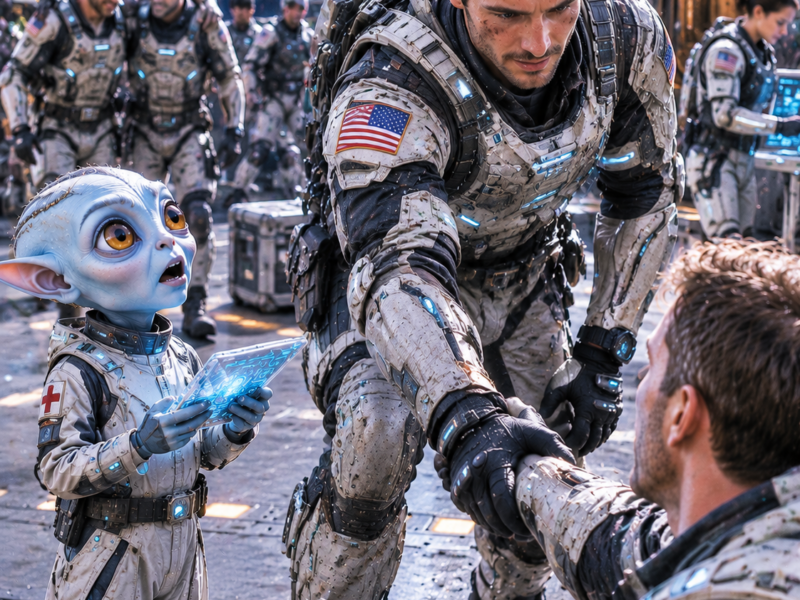
“The alien doctor had treated thousands of species across the galaxy, but when he was assigned to a human infantry battalion
The transmission crackled again.
“Tell the doctor… the children are safe.”
Then came a sound I had never heard from Sergeant Mason Reed before.
Fear.
Not fear of death. I had seen humans face death with disturbing calm. This was different. It was the fear of someone who knew others might die because he could no longer protect them.
“I can’t get back up.”
I stared at the communications officer.
“Where is he?”
“Lower access corridor, beneath Survey Station Delta. The stairwell collapsed during the second bombardment. We’re trying to locate another route.”
“Then find one.”
Captain Elena Brooks looked at me. Her uniform was torn, one shoulder dark with blood. “Doctor, the entire lower level is unstable. We can’t send another squad down there.”
“Then send me.”
She shook her head. “You don’t understand. The ceiling is coming down.”
“I understand perfectly. There is a wounded soldier beneath that ceiling.”
“And thirty-two civilians who are already out of immediate danger because he got them there.”
“Then we have thirty-three people to rescue.”
For several seconds, nobody spoke.
I had spent most of my life believing that medicine was a discipline of calculation. A physician identified the injury, assessed the resources, and chose the course of action most likely to preserve the greatest number of lives.
Humans appeared to operate differently.
They saw one person in danger and moved toward them, even when the mathematics were terrible.
I had called that primitive.
Now, standing in a ruined command shelter with Sergeant Reed’s bloodstained identification tag in my hand, I found myself wondering whether my mathematics had been missing something.
“Captain,” I said, “show me the structural map.”
Brooks studied my face.
“You’re not a combat medic.”
“No. I am a physician.”
“You won’t last five minutes down there.”
“Then I will make those five minutes useful.”
She held my gaze, then turned toward the communications officer.
“Get me the rescue team. And tell engineering to bring every support strut they have.”
The journey to Delta took nine minutes.
It felt like nine hours.
Our transport crawled through a landscape that had once been a research settlement. The Dravik bombardment had turned its buildings into broken silhouettes. Fires burned in the distance, and clouds of gray dust drifted between the wreckage.
I sat beside Captain Brooks, reviewing the medical equipment strapped across my chest.
A human combat medic named Private Alvarez checked my emergency oxygen supply.
“Never been outside the base during an attack, Doc?”
“No.”
“Then here’s a tip. If somebody tells you to get down, get down.”
“I am familiar with the concept of gravity.”
Alvarez gave a short laugh.
“Good. You’ll fit right in.”
Captain Brooks didn’t laugh. She was staring at a small display showing the positions of the surviving soldiers.
“Reed’s beacon is still active,” she said. “But it’s fading.”
“How long?”
“Maybe twelve minutes.”
I looked at the display.
“Then we have eleven.”
The transport stopped two hundred meters from the station. Its main entrance had been destroyed, leaving a jagged opening in the western wall. Human soldiers were already clearing debris.
A young engineer hurried toward us.
“Captain, the upper corridor is gone. We found a maintenance shaft on the north side, but it’s barely wide enough for one person.”
“Can it support a rescue line?”
“Not without reinforcement.”
“Reinforce it.”
The engineer hesitated.
“Ma’am, the structure could collapse while we’re inside.”
Brooks stepped closer.
“Sergeant Reed went in there for thirty-two civilians. He got them out. We’re not leaving him behind.”
The engineer nodded and ran.
I followed the rescue team toward the maintenance shaft. Its entrance was hidden behind a fallen section of wall. The air that emerged from it smelled of hot metal, burned insulation, and something I recognized immediately.
Blood.
Human blood.
The shaft descended at a steep angle. A rescue cable had been secured to a support beam, and two soldiers were preparing to enter.
I moved toward them.
“I’m going first.”
Captain Brooks caught my arm.
“Doctor—”
“If Reed is alive, he may have internal injuries. Every minute matters.”
She studied me for a moment.
Then she handed me a small human flashlight.
“Stay on the line. Don’t be a hero.”
I looked at her.
“I believe I have already explained that I am a physician.”
“Yeah,” she replied. “That’s what I’m worried about.”
I climbed down.
The shaft was so narrow that my medical pack scraped against both walls. Twice, the ceiling groaned above me. Dust fell into my eyes. My species had evolved on a world with lower gravity, and the strain of climbing through the cramped passage made my muscles tremble.
I continued.
At the bottom, the shaft opened into a maintenance chamber. A damaged emergency light flickered overhead. Beyond it, a corridor had collapsed beneath a mass of concrete and twisted support beams.
“Reed?” I called.
Static answered.
Then, faintly:
“Here.”
I moved toward the sound.
“Sergeant Reed, this is Doctor Threx.”
A weak laugh came through the rubble.
“Didn’t think you’d come.”
“I am beginning to suspect you have a poor understanding of medical responsibility.”
“That’s fair.”
I found him beneath a fractured support beam.
His right leg was trapped. Blood covered his uniform, and his left arm hung at an unnatural angle. His face was pale beneath the dust.
But his eyes were open.
He looked at me and tried to smile.
“Doc. You look terrible.”
“I have been told that humans appreciate honesty. You look worse.”
He laughed, then grimaced.
“Kids?”
“Safe,” I told him. “They are waiting at the evacuation point.”
His eyes closed.
“Good.”
I activated my medical scanner. The results were alarming. A fractured femur, probable internal bleeding, two broken ribs, and a deep wound beneath his left side. His oxygen saturation was dangerously low.
“Sergeant, I need you to remain conscious.”
“Trying.”
“Try harder.”
“Bossy for a doctor.”
I prepared a stabilizing injection.
The support beam shifted.
A sharp cracking sound echoed through the chamber.
I froze.
Reed opened his eyes.
“That’s not good.”
“No,” I said. “It is not.”
A piece of concrete fell from the ceiling and shattered beside us.
I pressed the stabilizer into Reed’s neck.
“Your condition requires immediate surgery.”
“Can you do it here?”
“Not safely.”
“Then you’re going to have to get me out.”
“That is the current plan.”
I connected a portable monitor to his chest and began applying a pressure seal over his wound.
The rescue team arrived minutes later.
Captain Brooks crawled into the chamber with two engineers and a pair of soldiers. They examined the beam, then looked at Reed.
“Can we lift it?”
The lead engineer shook his head.
“Not without bringing the ceiling down.”
“Can we cut it?”
“Possibly. But the vibration could trigger a collapse.”
I looked at Reed’s trapped leg.
“His circulation is failing. We cannot leave him here.”
The engineer examined the beam again.
“There is another option. We can transfer its weight to the wall supports. It would take at least fifteen minutes.”
“Do it.”
The engineer began issuing instructions.
Reed looked at me.
“Threx?”
“Yes?”
“If it comes down…”
“Do not finish that sentence.”
“Just listen.”
“I am listening.”
“Make sure the kids get off this planet.”
I felt something tighten inside my chest.
“You will take them yourself.”
He shook his head slightly.
“Doc, I know what I’m asking.”
“And I am refusing.”
He smiled weakly.
“You humans are stubborn.”
“I have been observing that.”
The engineers worked in silence. Metal struts were pushed beneath the fractured ceiling. A hydraulic brace was positioned against the wall. Each movement sent another shudder through the chamber.
The beam lifted.
Reed screamed.
I grabbed his shoulder.
“Look at me. Focus on my voice.”
His breathing became shallow.
“Hurts.”
“I know.”
“Don’t… let go.”
“I am not letting go.”
The beam rose another few centimeters.
The soldiers pulled Reed’s leg free, and I immediately sealed the wound with a medical clamp. His body went limp.
“Reed?”
No response.
I checked his pulse.
It was there, but weak.
“Get him moving!”
The rescue team secured him to a stretcher. Captain Brooks took the front handle while I stayed beside his head, maintaining his airway and monitoring his heart.
We reached the surface as the station began to collapse behind us.
The transport was waiting.
Alvarez helped load Reed into the medical compartment. I climbed in after him and began emergency treatment while the engines roared.
“Captain,” I called. “We need the surgical unit ready.”
“Already preparing it.”
“His blood loss is severe.”
“Do what you can, Doctor.”
I looked down at Reed.
For the first time since arriving on Vardos-6, I was afraid of failing a patient.
Not because of the medical consequences.
Because I could no longer imagine returning to the battalion without him.
The operation lasted three standard hours.
I repaired the damaged vessels, stabilized the fractured leg, and removed fragments of metal from the tissue around his abdomen. Human biology was astonishingly resilient, but resilience was not immortality.
Twice, Reed’s heart stopped.
Twice, I brought him back.
When the final surgical seal was closed, I stood beside the operating table, unable to move.
Captain Brooks waited outside.
“Is he alive?”
“Yes.”
“Will he stay that way?”
“I cannot promise.”
She nodded, as though she had expected that answer.
“Thank you.”
I looked at her.
“Why?”
“Because you went down there.”
“I was treating a patient.”
“No,” she said quietly. “You were doing more than that.”
She left before I could ask what she meant.
I remained beside Reed until the first shift of artificial dawn.
During that time, I watched the humans who came to check on him.
Alvarez brought a cup of bitter liquid he called coffee.
The engineers left a small metal emblem on the bedside table.
Captain Brooks visited twice, each time pretending she had only come to review the casualty report.
One soldier placed a folded piece of paper beneath Reed’s identification tag.
It was a child’s drawing.
Three figures stood beneath a yellow sun. One wore a helmet. Another had a red cross on his chest. The third was drawn with a large head and four eyes.
Beneath them, in uneven letters, were the words:
THANK YOU FOR SAVING US.
I stared at the drawing for a long time.
I had studied human psychology for years. I had read their medical journals, military histories, and philosophical debates.
Yet I had never understood how a species could turn gratitude into something so simple and powerful.
On the second day, Reed opened his eyes.
I was reviewing his scans when his fingers moved.
“Sergeant?”
His eyelids fluttered.
“Hey, Doc.”
I leaned closer.
“You are awake.”
“Seems like it.”
“Your recovery will be difficult. You are not permitted to move without assistance.”
“Good morning to you too.”
I adjusted his monitor.
“You nearly died.”
“Yeah. Heard that happens.”
“You are not amusing.”
“Captain says otherwise.”
I considered informing him that Captain Brooks had not smiled once since his operation.
Instead, I said, “You are fortunate.”
He looked toward the bedside table.
“What’s that?”
“A drawing from the children you rescued.”
He studied it.
For several seconds, he said nothing.
Then his eyes became wet.
“Those little monsters.”
I did not understand why he was crying.
So I did what I had learned from the humans.
I stayed.
Over the next several days, Reed’s condition improved. His leg would require months of rehabilitation, and his internal injuries would leave permanent scars, but he would live.
I began spending more time with the battalion.
At first, I told myself it was for medical observation. Their physiology was unusual, and their reactions to pain continued to challenge my assumptions.
But I started learning their names.
I learned that Alvarez sang badly while cleaning surgical instruments. I learned that the communications officer, Private Chen, kept a photograph of her family inside her helmet. I learned that Captain Brooks had lost her brother during an earlier campaign and never spoke about it.
I learned that Sergeant Reed remembered the name of every civilian he had helped evacuate.
And I learned that humans did not simply endure pain.
They gave it meaning.
Three days after Reed regained consciousness, the Dravik attacked again.
This time, they did not target the settlement.
They targeted the evacuation corridor.
The alarm sounded across Forward Base Meridian. Human soldiers rushed toward their positions while medics moved wounded personnel into reinforced shelters.
I was preparing an emergency station when Captain Brooks entered.
“Doctor, I need you in the command center.”
“Why?”
“We’ve received a distress signal from the northern ridge.”
“Another station?”
“No. A civilian transport.”
The display showed a small evacuation shuttle carrying forty-seven passengers. Its engines had been damaged, and it was descending toward a valley controlled by Dravik forces.
“Can they land?” I asked.
“Not safely. They’re going to crash.”
“How long?”
“Six minutes.”
I examined the terrain.
“There is a clearing near the eastern ridge.”
“Too exposed.”
“Then they will die before reaching the ground.”
Brooks looked at the display.
“We have a squad nearby. But the Dravik are moving into the valley.”
I understood what she was considering.
The squad could reach the shuttle, but it would be surrounded.
“Send them,” I said.
She looked at me sharply.
“That’s not your decision.”
“No. But I am the battalion physician. If those passengers crash, we will have forty-seven casualties. If your soldiers reach them, we may save all of them.”
“And if my soldiers are killed?”
I had no answer.
Then a voice came through the command channel.
“Reed here. I can lead the rescue.”
Captain Brooks turned toward the communications display.
“You’re supposed to be in medical recovery.”
“I’m aware.”
“You can barely stand.”
“Still better than most of the people in that shuttle.”
“Sergeant, that’s an order. Stay where you are.”
There was a pause.
Then Reed said, “Ma’am, I spent a long time under that station thinking about what I would have done differently. I don’t intend to let another group of people die because I stayed comfortable.”
I stared at the display.
He was still injured.
His leg was held together by surgical supports. His body had not recovered from the blood loss.
And yet he was asking to go.
Captain Brooks closed her eyes.
“Reed, you’re not going.”
“Understood.”
I thought the conversation was over.
Then I stepped toward the communications unit.
“Captain, I will accompany the rescue team.”
She turned.
“Absolutely not.”
“I am the only physician currently available who has operated on the shuttle’s emergency oxygen system.”
“That’s not true.”
“It is true that I am the only one who knows its medical interface.”
She looked at me.
I had learned from humans that sometimes the correct response was not to argue.
It was to wait.
Finally, she turned to the communications officer.
“Tell the rescue squad to hold at the ridge. I’m sending a medical team.”
Then she looked at me.
“Doctor, if you get yourself killed, I will personally find a way to report you for misconduct.”
“I appreciate your concern.”
“Don’t.”
The shuttle struck the valley floor in a burst of fire.
Our transport reached the crash site as the Dravik opened fire from the ridge.
Human soldiers moved through the smoke, returning fire while medics pulled passengers from the wreckage.
I found a young human girl beneath a collapsed seat. Her leg was pinned, and her breathing was shallow.
I stabilized her airway and prepared a pain suppressant.
She grabbed my wrist.
“Where’s my brother?”
I looked around.
“Which one?”
“Tommy. He’s little.”
I scanned the wreckage.
No movement.
I turned toward Alvarez.
“Find the child.”
He nodded and disappeared into the smoke.
The girl began to cry.
“Please don’t leave him.”
I remembered the drawing on Reed’s bedside table.
Three figures.
A soldier.
A doctor.
An alien.
I looked into the girl’s frightened eyes.
“I will not leave him.”
We found Tommy in the rear compartment, trapped beneath a section of the shuttle’s emergency frame.
He was unconscious but alive.
I used a cutting tool to free him while the medical team stabilized the girl.
The Dravik advanced.
Captain Brooks called for an immediate withdrawal.
We had rescued forty-five passengers.
Two remained unaccounted for.
I found the final passenger beneath the shuttle’s damaged cockpit.
He was an elderly human man with severe chest injuries.
His pulse was fading.
I reached for my medical kit.
A warning sounded.
The Dravik had moved into the valley.
We had less than two minutes before they reached our position.
Alvarez looked at me.
“Doctor, we have to go.”
I looked at the patient.
“Help me move him.”
“Threx, he’s not going to survive the transport.”
“Then we will make the transport possible.”
We lifted the man onto a stretcher.
The first explosion threw us against the shuttle.
The second destroyed the road behind us.
I felt something strike my shoulder. My vision blurred, and my breathing became difficult.
Alvarez grabbed my arm.
“Doctor!”
“I am functional.”
“You’re bleeding!”
“Then stop it.”
He wrapped a pressure bandage around my shoulder while the other soldiers carried the stretcher.
We reached the transport just as the Dravik emerged from the smoke.
Captain Brooks was waiting beside the open ramp.
“Move!”
The soldiers loaded the passengers.
I climbed aboard last.
The transport lifted under fire, its hull shaking as it escaped the valley.
When we returned to Meridian, forty-seven passengers were alive.
The elderly man survived surgery.
The little girl and her brother were reunited.
And I discovered that my shoulder injury was considerably worse than I had believed.
Captain Brooks found me in the medical ward.
“You know,” she said, “most doctors don’t volunteer for combat rescue.”
“Most doctors have never worked with your battalion.”
She looked at me for a moment.
Then she smiled.
It was small, tired, and genuine.
“Welcome to the family, Threx.”
I did not know what to say.
So I asked a question.
“Why do humans call a military unit a family?”
Brooks leaned against the doorframe.
“Because sometimes they’re the only people who understand what you’ve been through.”
She glanced toward Reed’s room.
“And because when one of us goes down, the others come back.”
I looked at the people moving through the ward.
The soldiers who had carried strangers through gunfire.
The medics who had worked until their hands shook.
The captain who had risked her entire unit to save civilians.
The sergeant who had gone beneath a collapsing building for children he had never met.
For the first time, I understood that human strength was not simply physical.
It was not measured by how much punishment a body could endure.
It was measured by how much suffering someone was willing to face so another person would not have to face it alone.
Several weeks later, the Dravik assault ended.
The remaining enemy forces withdrew beyond the northern ridge, and evacuation operations resumed.
Sergeant Reed began rehabilitation. He hated every minute of it.
I discovered that humans could be more difficult patients than any species in the medical database.
“Your leg requires rest,” I told him one morning.
“I’ve been resting for three weeks.”
“You are expected to continue.”
“Can I at least walk to the mess hall?”
“No.”
“Can I walk to the door?”
“No.”
“Can I stand?”
“Sergeant, I can sedate you.”
He grinned.
“Now you’re talking.”
I threw a medical towel at him.
He laughed, then winced as his healing ribs protested.
I pretended not to notice.
That afternoon, the battalion gathered near the central memorial wall. The names of the fallen had been engraved into a metal panel.
There were nineteen names from the attack on Delta.
I stood beside Captain Brooks and watched the soldiers place small objects beneath the wall.
A broken compass.
A photograph.
A child’s drawing.
A strip of medical fabric stained with blood.
I recognized several names.
I had treated some of those soldiers.
I had spoken with others.
I had not known how to grieve them.
In my culture, death was acknowledged through silence. The family withdrew, the physician recorded the final condition, and life continued.
The humans did not withdraw.
They spoke about the dead.
They laughed about them.
They remembered their mistakes, their jokes, their courage.
They made sure nobody became merely a name.
Captain Brooks placed a small insignia beneath the memorial.
Then she turned to me.
“Would you like to say something?”
I hesitated.
“I am not human.”
“No one asked you to be.”
I looked at the names.
Then I stepped forward.
“I arrived on Vardos-6 believing that humans were medically undisciplined. I considered your willingness to risk yourselves irrational. I believed that survival was the highest purpose of medicine.”
I paused.
“I was wrong.”
The wind moved through the memorial courtyard.
“I have seen humans enter collapsing buildings to rescue strangers. I have seen wounded soldiers return to battle because someone else needed help. I have seen a captain refuse to abandon her people, even when the odds were impossible.”
I looked toward Reed, who stood with the assistance of two crutches.
“I have also seen a sergeant who could barely walk insist that a child should never be left behind.”
Reed lowered his head.
“I still believe that saving lives requires calculation,” I continued. “But I now understand that calculation must never become an excuse to stop caring.”
Nobody spoke.
Then Alvarez began to clap.
One soldier joined him.
Then another.
Soon the entire battalion was applauding.
I felt an unfamiliar warmth spread through my chest.
It was not a medical reaction.
It was something else.
A month later, my reassignment orders arrived.
The Galactic Medical Directorate wanted me back on the central research world. They had reviewed my reports and requested a full evaluation of human battlefield medicine.
The document described the 77th Infantry Battalion as a unit exhibiting unusual psychological cohesion and an exceptionally high willingness to accept personal risk.
It recommended further study.
I read the report twice.
Then I looked at the transfer order.
My return transport would depart in two days.
Captain Brooks found me outside the medical facility.
“You got your orders?”
“Yes.”
“Congratulations.”
“I have not accepted them.”
She raised an eyebrow.
“Why not?”
I looked across the courtyard.
Reed was teaching a group of young soldiers how to use a walking support. Alvarez was arguing with a supply officer. Somewhere nearby, a child was laughing.
“I believe my work here is unfinished.”
Brooks studied me.
“Your assignment was temporary.”
“I am aware.”
“You could return to the Directorate. Continue your research. Publish your findings.”
“I could.”
“And?”
I handed her the transfer order.
“I would like to request permanent attachment to the 77th.”
She stared at the document.
“You want to stay?”
“Yes.”
“After everything that happened?”
“Because of everything that happened.”
For a moment, she said nothing.
Then she extended her hand.
“Welcome aboard, Doctor.”
I took it.
Her grip was firm.
Human greetings remained unnecessarily forceful.
I had grown accustomed to them.
That evening, I visited Reed.
He was sitting beside the window, looking at the sunset beyond the northern ridge.
“Captain says you’re staying,” he said.
“Yes.”
“That’s good.”
“I have a question.”
“Shoot.”
“Why did you go back for those civilians at Delta?”
He looked at me as though the answer should have been obvious.
“Because they were trapped.”
“That is not an explanation.”
He leaned back.
“Maybe it is.”
I waited.
He looked toward the horizon.
“Back home, when I was a kid, my father used to say that you don’t measure a person by what they can do when everything is easy. You measure them by what they do when someone needs them and walking away would be simpler.”
He glanced at me.
“I guess I just remembered that.”
I considered his words.
“Were you afraid?”
“Terrified.”
“Yet you went.”
“Yeah.”
“Why?”
He smiled faintly.
“Being afraid doesn’t mean you stop caring.”
I thought about that for a long time.
Then I looked at the small drawing on his bedside table.
The three figures beneath the yellow sun.
“I believe I understand now,” I said.
Reed shook his head.
“Don’t worry, Doc. Took me thirty years to figure it out.”
Outside, the evening lights of Forward Base Meridian began to glow.
Beyond them lay a wounded planet, a recovering settlement, and a galaxy that still regarded humanity as a young and unpredictable species.
I had come to Vardos-6 to observe them.
I had expected to find a primitive military force.
Instead, I had found a people whose greatest weapon was something no medical scanner could measure.
Their refusal to leave one another behind.
Months later, I submitted my final report to the Galactic Medical Directorate.
It was considerably shorter than the document they had requested.
I wrote that human battlefield medicine was not defined solely by technology, training, or biological resilience.
It was defined by the relationships between those who treated the wounded and those who refused to abandon them.
I wrote that human soldiers did not always make the safest decisions.
They sometimes risked too much.
They sometimes ignored pain.
They sometimes attempted impossible rescues.
But I also wrote that the most remarkable feature of humanity was not its capacity to survive terrible injuries.
It was its determination to prevent others from suffering alone.
At the bottom of the report, I included a recommendation.
Do not evaluate human courage as a medical defect.
It is the foundation of their greatest strength.
The Directorate requested clarification.
I sent them a recording from the memorial ceremony.
Then I returned to my duties.
On my first official day as the permanent physician of the 77th Infantry Battalion, a young soldier arrived in the medical ward with a fractured wrist.
He sat on the examination table, looking embarrassed.
“Sorry, Doctor. I know you’re busy.”
I scanned the injury.
“You are not interrupting anything.”
“I just didn’t want to make a big deal out of it.”
“Your wrist is fractured.”
“Yeah, but it’s not that bad.”
I stared at him.
Then I recognized the expression.
The same expression Reed had worn beneath the collapsed station.
The same stubborn refusal to admit pain that had once made me question human intelligence.
I sighed.
“Sergeant Reed.”
From the next room, Reed called back.
“Yeah, Doc?”
“Please explain to this soldier that ignoring an injury is not a demonstration of courage.”
A moment later, Reed appeared in the doorway with his crutches.
He looked at the young soldier.
“Listen to the doctor. He’s scary when he’s right.”
The soldier laughed.
I began preparing the splint.
And as the 77th Infantry Battalion continued its work across the stars, I finally understood the assignment I had never known I was receiving.
I had been sent to study humanity.
Instead, humanity had taught me how to be a doctor.
THE END.









