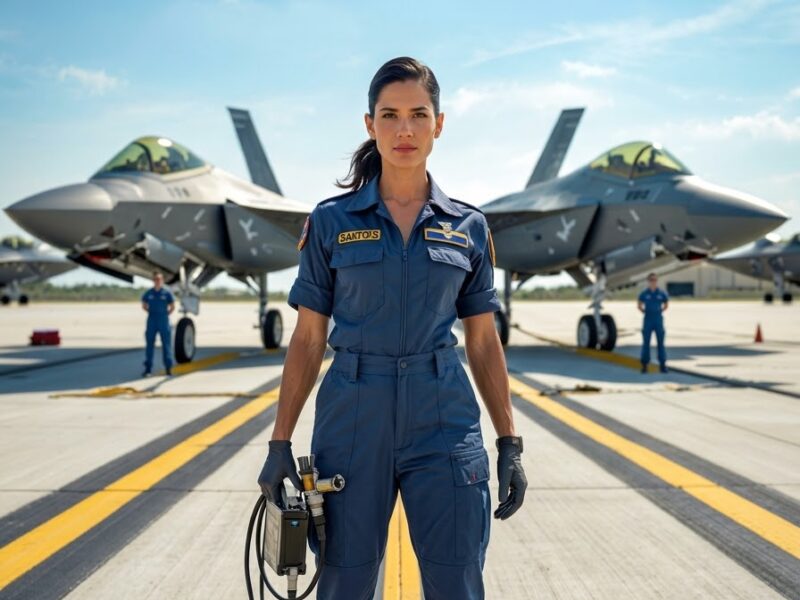
The airbase commander laughed when I was ordered to serve coffee to two F-35 pilots, but the moment they heard my forgotten call sign over the emergency radio
The porcelain ceramic shattered against the polished epoxy floor of the Falcon Ridge Airbase briefing room, sending dark liquid pooling across the pristine white surface and splattering the shins of my khaki utility pants.
Commander Reeves didn’t even look up from his tactical tablet at first. He just let out a heavy, long-suffering sigh, the kind of dismissive breath reserved for incompetent junior staff or civilian contractors who got in the way of military efficiency.
“Can you clean that up before the pilots arrive, Maya?” Reeves asked, his voice dripping with mild irritation. “We have two Strike Fighter Squadron officers coming in for a classified pre-flight brief in ten minutes. I don’t need them slipping on dark roast.”
“Yes, sir,” I said quietly, keeping my head bowed as I knelt to gather the larger jagged shards of porcelain.
For three long, agonizing years, I had been Maya Vance: a quiet, middle-aged ground support staffer who kept her head down, refilled coffee pots, wiped whiteboards, and organized flight logs at an isolated testing facility in the high desert of Nevada. My hair was pulled back into a tight, sensible bun, free of any military flair. My uniform bore no patches, no ribbons, and no wings. To Reeves, to the mechanics, and to every hotshot aviator who swept through Falcon Ridge, I was invisible—a piece of office furniture that happened to breathe.
None of them knew I was a graduate of the United States Navy Strike Fighter Tactics Instructor program—Top Gun.
None of them knew that before I was Maya Vance, my call sign had been Blackbird, a name once whispered with reverence and awe across flight lines from Miramar to Okinawa.
And none of them knew the real reason I had traded the canopy of an F/A-18 Super Hornet for a mop and a clipboard.
The heavy steel door of the briefing room hissed open. Two aviators stepped inside, their flight suits crisp, g-suits slung loosely over their shoulders, and helmet bags in hand. They carried themselves with that distinct, arrogant swagger unique to fifth-generation fighter pilots—men who flew the F-35 Lightning II and believed they owned the sky.
Neither of them glanced at me as I bent over the spill with a wad of paper towels. To them, I was just background noise.
“Commander Reeves,” the lead pilot said, offering a crisp head nod. “Lieutenant Alex ‘Ghost’ Hayes, and my wingman, Lieutenant Marcus ‘Vandal’ Vance. Ready for the low-altitude radar evasion run through the Shadow Canyon complex.”
I froze for a fraction of a second, my hands tightening around the sharp piece of broken ceramic until the edges dug into my skin. Hayes. The name hit my heart like a physical impact, but I forced my expression to remain blank, carefully placing the broken pieces into a small plastic trash bin.
Before Reeves could open his mouth to brief them, the red emergency strobe mounted on the ceiling began to flash violently, filling the room with a silent, pulsing crimson light. A second later, the primary air defense siren shrieked through the facility’s PA system, its high-pitched tone cutting straight through the concrete walls.
“All personnel, emergency scramble! Tactical Air Control Center reports an active airborne emergency in Sector 4!”
Reeves snatched his radio off his belt. “Control, this is Reeves. What’s the situation?”
“Sir, we have a rogue weather system dropping fast over the Ridge,” the voice of the young controller came through the speaker, laced with rising panic. “A test flight from the 412th lost pitch control during a high-altitude supersonic maneuver. He’s spiraling into the restricted mountain range, and his avionics are completely fried!”
Ghost and Vandal immediately turned toward the door, their instincts kicking in. “We can launch,” Ghost said, his hand already on his helmet bag. “We’re fueled and ready on Pad Two. We can vector in and escort him down.”
“Do it,” Reeves ordered. “Get airborne now!”
The two pilots sprinted down the hallway toward the hangar bay. I quietly slipped out of the briefing room behind them, moving toward the Tactical Air Control Center at the far end of the corridor.
Five minutes later, the roar of twin Pratt & Whitney F135 engines shook the foundation of the base as the two F-35s tore into the sky. But above the desert, the weather had turned into a monster. A sudden, unpredicted microburst of dense ion-charged cloud cover—a byproduct of high-altitude atmospheric testing—swept over the mountain range, blinding both optical sensors and radar.
Inside the control room, the primary radar displays flared with heavy green static.
“Command, this is Ghost!” the radio crackled with intense interference. “We’ve lost visual on the deck! Our primary GPS guidance is cycling! Navigation systems are unresponsive! We are blind up here!”
“Vandal here—I’ve got red warnings across my primary flight display! Spatial disorientation! I can’t tell the canyon walls from the horizon!”
The young controller at the main desk froze, his hands hovering over his headset, sweating pouring down his temples. “Ghost, turn left… no, wait, vector three-two-zero! No, standby, radar is flickering!”
“You’re sending them into the canyon wall!” Reeves shouted over the controller’s shoulder. “Get them out of there!”
“I can’t see them, sir! The static is swallowing their telemetry!”
I stood in the doorway, my chest tight. I closed my eyes for a single second, listening through the room’s overhead speakers to the rhythmic hum of the radio static, searching for the underlying atmospheric frequency.
Then, buried deep beneath the roaring white noise, I heard it.
Click-click… click.
Three short, rapid radio pulses. A specific manual squelch rhythm.
My blood ran cold. It wasn’t a standard military distress signal. It was an emergency formation protocol developed for ultra-classified, low-observable tactical operations—a signal used by only one elite, phantom squadron in military history.
Squadron 13. The Nightwraiths.
The squadron that officially ceased to exist over the open waters of the Pacific twelve years ago. The squadron I had commanded.
I stepped forward, my boots clicking firmly against the floor tiles, crossing the room until I stood directly behind the panicked controller.
“Give me the headset,” I said. My voice wasn’t loud, but it carried an absolute, unwavering weight that cut through the panic in the room.
Commander Reeves turned toward me, his brow furrowed in disbelief. “Maya? What the hell are you doing? Step back from the console!”
“Give me the headset, Commander,” I repeated, looking him dead in the eye.
Reeves let out an angry chuckle. “You’re a ground support employee! You clear tables and organize paperwork! Step away from the radio before I have security escort you out!”
Through the speakers, Ghost’s frantic voice broke through the static, edged with mortality. “Command! Unknown aircraft closing fast on our six! We can’t identify! We’re losing control!”
I didn’t wait for permission. I reached down, ripped the headset off the young controller’s head, and snapped it over my ears. I jammed the push-to-talk pedal down with my boot.
“Viper Two, this is Ground Control,” I spoke into the microphone, my voice dropping into the crisp, perfectly flat, razor-calm cadence of a veteran flight instructor. “Bank thirty degrees east immediately. Hard stick, push through the buffet, and hold your altitude at four thousand feet. Do it now.”
Silence gripped the radio channel for two long seconds.
“Who… who is this?” Ghost’s voice came back, hesitant, confused, but instinctively responding to the sheer authority in my tone. “Who is on this frequency?”
I leaned closer to the mic, closing my eyes, visualizing the geometry of the canyon from memory—every peak, every rock wall, every thermal draft.
“You’re turning into the west wall of Shadow Canyon, Ghost,” I said softly. “Listen to my voice. This is Blackbird.”
The entire Tactical Air Control Center went dead silent.
Behind me, Reeves froze mid-sentence, his jaw dropping slightly. On the other side of the glass, the two F-35 pilots up in the storm seemed to lock up.
“Blackbird?” Ghost whispered through the radio, the professional detachment slipping from his voice, replaced by pure shock. “That… that call sign is impossible. Blackbird was killed twelve years ago.”
“I’m right here, kid,” I said grimly. “And if you don’t execute a four-g pull to vector zero-nine-zero right this second, you’re going to join the ghosts.”
For the next eight minutes, I didn’t need radar. I didn’t need a working GPS feed. I used the raw atmospheric audio, the altitude reports called out by the pilots, and my own mental map of Nevada’s deadliest terrain—a map burned into my brain over a decade of classified tactical flying. I guided both F-35s and the damaged test jet through a needle-threading formation maneuver, pulling them out of the storm’s blind pocket and lining them up perfectly with Falcon Ridge’s primary runway.
When the three jets broke through the cloud deck, landing gears locked down and tires screaming against the wet tarmac, the control room erupted into a wave of relieved gasps and quiet cheers.
I took the headset off, set it carefully on the desk, and turned around.
Commander Reeves was staring at me as if I had just transformed into a stranger before his eyes. “Maya… who the hell are you?”
I didn’t answer. I turned and walked out of the control room, stepping back into the quiet corridor.
I was leaning against the wall near the briefing room when the heavy double doors at the end of the hallway burst open. Ghost and Vandal walked in, their flight suits soaked in sweat, their helmets held under their arms.
They didn’t look at Reeves. They didn’t look at the control room staff. They walked with long, deliberate strides straight toward me.
Ten feet away, both men stopped. In perfect, flawless unison, they snapped their boots together, brought their right hands up to their brows, and held a crisp, formal salute.
“Ma’am,” Ghost said, his voice trembling slightly.
I slowly stood up straight, returning the salute with a tired, solemn nod. “At ease, Lieutenants.”
Ghost lowered his hand, his eyes wide as he stared at my face, searching every feature. “My… my father flew with you.”
I swallowed hard, feeling a lump form in my throat. “Who was your father, son?”
“Major Daniel Hayes,” he whispered. “Call sign ‘Raptor’.”
The name struck me like a physical bullet to the chest. Daniel. My wingman. My best friend. The man whose F/A-18 I had watched plummet into the burning waters of the Pacific twelve years ago during a mission that the Pentagon had classified under top-secret executive authority, erasing our entire squadron from official Navy logs.
“Daniel is dead,” I said, my voice barely more than a whisper. “I watched his aircraft go down.”
Ghost reached inside the breast pocket of his leather flight jacket. He pulled out a small, worn plastic sleeve containing a physical photograph and handed it to me.
My hands began to tremble as I took it.
The photograph showed Daniel Hayes standing beside a strange, delta-winged aircraft with no military markings, parked inside an unmarked hanger. He was wearing a dark grey flight suit, alive, smiling, and holding up a newspaper.
The date on the newspaper was clearly visible: October 14th, six months after the Pacific crash.
On the back of the photograph, written in Daniel’s distinct, jagged handwriting, were three lines:
She was right about the program. If you ever meet Blackbird, give her this. Tell her the cage is opening.
“Before he vanished for good five years ago,” Ghost said, his eyes locking onto mine, “my father told me if I ever found you, I had to tell you that the mission never ended.”
My breath hitched in my throat. Before I could ask another question, the base emergency alarm suddenly changed tones—from a high-pitched wail to a deep, rhythmic, terrifying air-defense klaxon.
CLANG! CLANG! CLANG!
“Attention all personnel! Base lockdown initiated! Threat condition DELTA!” Commander Reeves’ voice screamed over the hallway speakers. “All external blast doors are sealing!”
Every heavy steel door along the corridor slammed shut with a deafening hydraulic bang. The main overhead lights died, replaced by dim, amber emergency strobes.
I reached out, snatched the radio off a nearby wall mount, and jammed it to my ear.
The emergency channel—the old, encrypted channel used exclusively by Squadron 13—crackled to life through the speaker. A low, distorted voice whispered four words through the static:
“Blackbird… they’re coming back.”
I ran to the reinforced observation window at the end of the hallway, looking up into the dark, storm-wracked desert sky.
Three black, radar-absorbent radar signatures flickered into visual range, descending silently through the clouds without landing lights, flying in a tight, inverted V-formation.
It was a formation pattern I had only seen once in my life.
The exact same formation that had ambushed my squadron over the Pacific twelve years ago.
The three dark shapes descended through the low-hanging cloud deck like jagged knives cutting through silk. They made no noise—no high-pitched jet turbine whine, no low thunder of afterburners—just a soft, atmospheric hiss as they displaced the damp desert air. Their fuselages were matte-black, angular, and completely devoid of national insignia, tail numbers, or landing lights.
“What the hell are those?” Vandal whispered, his hand instinctively dropping to the sidearm holstered at his hip as he leaned against the observation window beside me. “Those aren’t air force assets. They aren’t on any defense registry I’ve ever seen.”
“They’re not supposed to be,” I said, my eyes fixed on the lead aircraft as its landing gear deployed with a mechanical click. “They’re called Aegis-9s. Advanced stealth reconnaissance and strike platforms built under an unacknowledged black-budget program in the early 2010s. Officially, the project was canceled due to structural failures during prototype testing.”
“And unofficially?” Ghost asked, his jaw set hard.
“Unofficially, six of them were built,” I replied, turning away from the window. “And twelve years ago, two of them opened fire on my squadron over international waters.”
Behind us, the heavy steel security door at the end of the corridor hissed open. Commander Reeves marched through, flanked by four heavily armed Military Police officers wearing full tactical gear, their M4 carbines held at low ready.
“Lieutenant Hayes, Lieutenant Vance, step away from that woman!” Reeves ordered, his face red with anger and sweat. “You are to report to the hardened briefing shelter immediately!”
Ghost didn’t move an inch. He stepped directly between Reeves and me, his tall frame blocking the commander’s path. “Commander, with all due respect, what is going on here? Whose aircraft just landed on our runway?”
“That is classified above your pay grade, Lieutenant!” Reeves snapped, gesturing to the MPs. “Secure the perimeter! Maya Vance—or whatever your real name is—you are being detained under suspicion of breaching national security protocols and unauthorized access to restricted military frequencies!”
I didn’t flinch. I looked past the MPs, taking in the subtle details of their equipment. Their uniforms were clean, but their arm patches carried a small, distinct emblem—a silver compass rose crossed by a black dagger.
It wasn’t the emblem of the Air Force Security Forces. It was the mark of the Special Activities Division of the Defense Intelligence Agency—the private enforce arm of the men who had buried my past.
“You knew they were coming, didn’t you, Reeves?” I asked softly. “That’s why you were so eager to keep me in the background cleaning tables. You weren’t hiding me from the pilots. You were keeping me pinned down until your handlers arrived to finish the job they started twelve years ago.”
Reeves’ eyes twitched nervously. He reached for his sidearm holster. “I don’t know what you’re talking about, Maya. You’re an unstable former officer suffering from combat-induced psychosis.”
“Don’t touch that weapon, Commander,” Vandal said, his voice dropping an octave as he slid his own body forward, matching Ghost’s defensive posture. “You touch that holster, and we’re going to have a very serious jurisdictional problem in this hallway.”
The four MPs raised their carbines, pointing them directly at the two young pilots. The air in the narrow corridor turned razor-thin, loaded with lethal tension.
“Stand down!” Ghost shouted, stepping forward. “We are active-duty Navy aviators under the direct operational command of Pacific Fleet! You have no authority to hold us or this officer!”
“In this facility, Lieutenant, my authority is absolute,” Reeves sneered.
Before the standoff could erupt into gunfire, the base radio on Reeves’ belt crackled with high-frequency static. A cold, female voice—crisp, educated, and completely devoid of emotion—echoed through the speaker.
“Reeves. Secure the Blackbird asset immediately. Do not engage the Navy pilots unless necessary. Bring her to Hangar 4.”
Reeves gritted his teeth, looking at Ghost and Vandal. “You heard the order. Step aside.”
“No,” Ghost said calmly.
I reached out, placing a firm hand on Ghost’s shoulder, pulling him back half a step. “It’s alright, Alex. Let them take me to Hangar 4.”
Ghost turned his head, staring at me in shock. “Ma’am, if you go with them, you aren’t coming back out. You know what they do to people who know about these programs.”
“I know,” I whispered, leaning in close so only he could hear. “Which is why I need you and Vandal to get to the main maintenance bay. In the floor locker beneath Bay Three, there’s an old tactical flight suit and a maintenance override keycard with my old clearance code printed on the back. Get it, get to your jets, and be ready when the power cuts.”
“Power cuts?” Ghost asked, brow furrowing.
“Trust me,” I said softly.
I stepped past the two pilots, holding my hands out toward the MPs. “Lead the way, Commander.”
Reeves smirked, snapping iron handcuffs around my wrists before shoving me roughly down the corridor. The four MPs fell into formation around us, escorting me through the subterranean access tunnel that connected the main terminal to Hangar 4—the oldest, most secluded facility on Falcon Ridge.
Hangar 4 was vast, dark, and freezing cold. The scent of high-grade jet fuel, ozone, and old hydraulic oil hung heavy in the air.
In the center of the massive concrete room sat one of the three matte-black Aegis-9 aircraft that had just landed. Its triangular wing structure swept back into sharp, predatory edges, its canopy dark and opaque like polished obsidian.
Standing at the base of the boarding ladder was a woman in her late fifties, wearing an immaculate charcoal-grey suit. Her silver hair was pulled into a severe knot at the back of her head, and her eyes were cold, light grey, and completely calculating.
Director Eleanor Vance—head of Special Defense Projects for the Department of Defense, and, as I knew all too well, Vandal’s estranged aunt.
“Captain Maya ‘Blackbird’ Vance,” Eleanor said, her voice echoing softly off the corrugated steel walls of the hangar. “Or should I say, the ghost who refused to stay dead.”
“Eleanor,” I said, my voice steady as I stood ten feet away from her. “I see you’re still flying unauthorized aircraft on government fuel.”
Eleanor let out a soft, dry chuckle, stepping closer. “Always so self-righteous, Maya. You were the finest tactical pilot this nation ever produced. Top of your class at Top Gun, undisputed master of carrier landings, brilliant tactical mind. And yet, you blew your entire career—and ruined your life—because you couldn’t understand the big picture.”
“The ‘big picture’?” I spat, taking a step forward until an MP shoved his rifle barrel into my ribs. “You were selling advanced radar-evasion telemetry to foreign defense syndicates! You were setting up shadow funding accounts through front companies in Zurich! My squadron found the digital paper trail during an escort sweep over the Pacific, and when Daniel Hayes tried to report it, you ordered those black aircraft to shoot us down!”
“We were securing the future of American air dominance!” Eleanor snapped, her cool demeanor cracking for a single second, her eyes flaring with fanatic intensity. “The Pentagon was bogged down in bureaucratic red tape! Congress was cutting funding for sixth-generation fighter development! We took the technology we built, monetized it on the private market, and used every dollar to build these!” She gestured proudly to the matte-black jet behind her.
“You murdered four pilots in my squadron, Eleanor,” I said, my voice dropping to a dangerous whisper. “You murdered Daniel.”
“Daniel Hayes was an acceptable casualty of operational security,” Eleanor replied coldly. “And he didn’t die that day over the Pacific. He was smart enough to realize he couldn’t win. He spent seven years working in our subterranean research facility in New Mexico before he managed to escape with a copy of our master encryption key.”
She stepped right up to me, leaning in until her face was inches from mine. “Where is the drive, Maya? Where did Daniel hide the master ledger?”
I stared into her cold grey eyes, a slow, dark smile spreading across my lips.
“Daniel didn’t hide it, Eleanor,” I whispered. “He gave it to his son.”
Eleanor’s eyes widened in sudden, absolute terror. “What?”
“Now,” I said softly.
I slammed my head backward, my skull cracking hard against the nose of the MP standing behind me. He staggered back with a bloody groan, dropping his carbine.
In the exact same second, I kicked my right boot upward, driving my heel straight into the knee joint of the second MP, snapping the bone with a sickening crack.
Before the remaining two guards could react, every light in Hangar 4—and across the entire Falcon Ridge installation—went completely pitch black.
The sudden, absolute darkness in Hangar 4 was instantly filled with the chaos of shouting men, the metallic clatter of dropped weapons, and the blind, panicked movement of security personnel who had lost all situational awareness.
“Lights! Get the emergency backup generators on!” Commander Reeves screamed into the dark, his voice bouncing off the high steel rafters. “Contain the asset! Shoot on sight if she moves!”
I didn’t wait for his guards to adjust to the gloom. The moment the power cut—a scheduled sixty-second auxiliary power recycling sequence I had memorized during my three years working as a maintenance clerk—I dropped flat onto the cold concrete floor, rolling beneath the low belly of the Aegis-9 stealth jet.
A burst of muzzle fire lit up the gloom—thwack-thwack-thwack—as one of the MPs fired blindly toward the spot where I had been standing a second prior. The bright flashes illuminated the hangar for fractions of a second, casting long, grotesque shadows against the walls.
I reached up into my sleeve, pulling out a sharp piece of the shattered porcelain coffee cup I had hidden in my cuff three hours earlier. Working frantically behind my back, I sawed the sharp ceramic edge against the thick plastic zip-tie binding my wrists.
Slice. Slice. Snap.
My hands came free.
I scrambled along the dark underside of the aircraft toward the nose gear assembly. I reached up into the wheel well, my fingers searching in the pitch-black space until they brushed against a small, magnetic emergency access panel—a standard design feature built into all high-altitude prototype airframes.
My fingers found the manual release latch. I pulled it hard.
A soft pneumatic hiss echoed beneath the jet as an auxiliary terminal screen lit up with a faint blue glow, illuminating my face.
AEGIS-9 SYSTEM BOOT… ACCESS DENIED.
ENTER CLASS-1 SECURITY PASSCODE:
I pulled out the maintenance override keycard Ghost had retrieved from Bay Three—the card Daniel had left behind years ago. I swiped the magnetic strip through the terminal slot.
The blue screen flashed yellow, then green:
OVERRIDE ACCEPTED: WELCOME, COMMANDER HAYES.
LOCAL MESH NETWORK DETECTED: CONNECTING TO ALL UNITS…
“She’s under the aircraft!” an MP shouted from twenty feet away, his flashlight beam sweeping across the concrete deck, locking onto my boots. “I have visual! Moving in!”
“Cover me!” another voice barked.
I didn’t try to run. I tapped four quick commands into the maintenance terminal screen, entering the master tactical override code Daniel had embedded in his son’s photograph.
EMERGENCY PROTOCOL ‘BLACKBIRD’ INITIATED.
UPLINKING AVIONICS TO TACTICAL DATA LINK 16…
Above us, the heavy steel hangar doors—powered by independent mechanical counterweights—began to grind open, revealing the stormy, moonlit sky outside. At the same time, the emergency auxiliary generators kicked in, bathing the hangar in pulsing, deep-red alarm lights.
Down the main runway, the roar of two F-35 engines erupted into the night air—a deafening, high-pitched scream of twin afterburners being pushed to maximum military power.
Ghost and Vandal had reached their jets.
“What is that noise?” Eleanor shouted, shielding her eyes as the wind from the opening hangar doors blew dust and papers across the room. “Reeves! Secure those runways! Don’t let those F-35s take off!”
“Too late, Director,” I called out, stepping out from beneath the Aegis-9’s wing, holding a heavy 9mm sidearm I had stripped from the disarmed MP on the floor.
Reeves turned toward me, raising his weapon, but before he could squeeze the trigger, a blinding beam of light swept into the hangar from the open runway outside.
One of the F-35s—flown by Ghost—was taxied directly outside the open doors of Hangar 4, its massive engine intake vacuuming air, its nose gear cannon pointed directly into the building’s interior. The roaring jet blast behind it slammed into the hangar structure, tearing loose metal siding and blowing over equipment racks.
Through the radio headset I had snatched off the floor, Ghost’s voice came through loud, crystal clear, and completely uncompromising.
“Director Vance, Commander Reeves—this is Lieutenant Alex Hayes. You are currently targeted by an AGM-121 tactical air-to-ground missile. Lower your weapons and step away from Captain Vance immediately, or I will level this facility.”
Reeves froze, his face draining completely of color as he looked into the dark, lethal nose cone of the fifth-generation fighter jet idling fifty feet away.
“You… you wouldn’t dare,” Eleanor stammered, her voice shaking for the first time. “This is a federal testing facility! You will be court-martialed for treason!”
“My father gave twelve years of his life to your shadow games, Director,” Ghost replied coldly over the loudspeaker. “I think a court-martial is a price I’m willing to pay.”
“Maya! Get in!”
I turned to see the second F-35, piloted by Vandal, sitting on the taxiway thirty yards behind Ghost, its canopy cracked open, its ladder deployed.
I didn’t look back. I sprinted out of Hangar 4, my boots slamming against the wet tarmac as rain began to pour from the sky. I scrambled up the boarding ladder of Vandal’s jet, sliding into the rear instructor’s cockpit, pulling the heavy flight helmet over my head and snapping the oxygen mask over my face.
“You okay back there, ma’am?” Vandal asked over the internal intercom as he cycled the canopy closed, sealing us inside the pressurized cockpit.
“I’ve been better, Vandal,” I gasped, strapping the harness tight across my chest. “Where’s the drive?”
“Ghost has it,” Vandal said, swinging the F-35 around to line up with the main runway. “He plugged Daniel’s flash drive directly into his jet’s secure tactical data link before we launched. The moment we reach ten thousand feet, the avionics suit will automatically broadcast the encrypted ledger to every naval air station and defense server in the Pacific Fleet.”
“They won’t let us reach ten thousand feet,” I warned, watching the tactical radar display on the main panel.
On the screen, two black icons suddenly flared to life—the remaining two Aegis-9 stealth fighters parked at the far end of the airfield were already rolling toward the taxiway, their automated systems powering up without human pilots, controlled remotely from Eleanor’s subterranean terminal.
“They’re drone-configured,” I said, my blood running cold as I recognized the flight telemetry. “They don’t have human g-limits. They will pull fifteen g’s to intercept us before we can complete the data transfer!”
“Ghost, you hear that?” Vandal called out over the flight lead frequency.
“I hear it,” Ghost’s calm voice answered from the lead jet ahead of us. “Let them come. We’ve got Blackbird in our back seat.”
Ghost pushed his throttle forward into full afterburner. A pillar of blue flame shot out from his tailpipe, and his F-35 shot down the runway, lifting into the stormy night sky like a spear of fire.
Vandal slammed his throttle forward a second later. The g-force slammed me back into the ejection seat as Falcon Ridge Airbase fell away beneath us, swallowed by clouds, rain, and dark mountain peaks.
We climbed through five thousand, six thousand, seven thousand feet—racing toward the clear air above the storm.
DATA LINK UPLINK: 42%… 58%… 61%… Ghost’s automated system reported.
Suddenly, the threat receiver in my helmet began to scream—a high-pitched, continuous warble that meant only one thing.
RADAR LOCK. HARD LOCK.
“Break left! Break left now!” I screamed into the intercom.
Two black shapes burst through the cloud layer beneath us, climbing vertically at insane speeds, their stealth fuselages cutting through the rain like dark phantoms. They didn’t fire missiles. They were angling their heavy, reinforced wing edges directly toward Ghost’s tail section—preparing to mid-air ram his aircraft to destroy the hard drive before the upload could finish.
The two Aegis-9 drones closed the distance with terrifying, unnatural speed. Free from the physiological limits of a human pilot—unburdened by the threat of blackouts, organ failure, or structural fear—they maneuvered through the turbulent storm air with cold, mathematical perfection.
“They’re closing fast on your six, Ghost!” Vandal yelled, hauling his stick hard to the right to roll our F-35 into a steep, high-g defensive turn. “They’re angling for a kinetic kill! They want to chop off your vertical stabilizers!”
DATA LINK UPLINK: 78%… 82%…
“I can’t dive!” Ghost responded, his voice strained as he fought the intense g-forces pulling against his body. “If I drop altitude back into the cloud deck, the atmospheric density will interrupt the satellite uplink! I need ninety more seconds at this ceiling!”
“You don’t have ninety seconds!” I shouted through the intercom from the rear seat of Vandal’s jet. “Vandal, hand control over to me!”
Vandal hesitated for a fraction of a second. “Ma’am?”
“I flew against these exact airframe prototypes twelve years ago, Vandal!” I snapped, my hands gripping the twin flight controls in the rear cockpit, feeling the familiar, electric hum of an aircraft stick beneath my palms for the first time in over a decade. “I know their guidance algorithm! Hand over control!”
“Aircraft is yours, Blackbird!” Vandal barked, taking his hands and feet off the flight controls.
The moment the aircraft became mine, the three years of wiping tables, refilling coffee, and hiding in the shadows vanished completely. My mind crystallized into pure, lethal tactical geometry. The sky ceased to be a chaotic storm; it became a three-dimensional grid of vectors, speeds, and kill zones.
I slammed the throttle back into military power, popping the speed brakes for a fraction of a second to force a sudden, violent deceleration. The heavy F-35 shuddered as the air resistance hit us like a brick wall.
The lead Aegis-9 drone, over-anticipating our forward momentum based on standard flight algorithms, overshoot us by less than fifty feet, its matte-black fuselage flashing past our canopy like a dark bullet.
“Vandal, arm the 25mm internal cannon!” I ordered, kicking the rudder pedal hard to line our nose up with the drone’s exposed exhaust nozzle.
“Cannon armed! Sight tracking!” Vandal reported.
I squeezed the trigger on the stick.
BRRRRRRRRRRRRRRRAT!
The high-rate-of-fire rotary cannon roared beneath our feet, spitting forty rounds of armor-piercing high-explosive ammunition into the sky. The tungsten rounds tore clean through the drone’s left engine intake. The black aircraft instantly exploded into a massive fireball of burning jet fuel and carbon-fiber fragments, spiraling down into the storm clouds below like a dying comet.
“One bandit splashed!” Vandal cheered.
“Keep your head in the game!” I warned. “Where’s the second one?”
“It’s on Ghost!” Vandal shouted, his excitement turning to terror. “It’s locked onto his wing!”
I snapped my head to the left. The second Aegis-9 had matched Ghost’s climb rate, sliding into a tight, side-by-side formation less than fifteen feet from his starboard wingtip. Its automated flight computer had realized it couldn’t get behind him in time, so it was preparing to execute a roll maneuver, slamming its heavy carbon fuselage straight down onto Ghost’s cockpit canopy to crush him mid-air.
“Ghost! Roll inverted! Now!” I screamed into the radio.
“I can’t! If I invert, the satellite array on my spine loses tracking alignment!” Ghost grunted, his voice ragged as he tried to hold the jet level while pulling maximum climb angle.
DATA LINK UPLINK: 91%… 94%… 97%…
“Ten seconds, Ghost!” I yelled, pushing our F-35 into a terrifying, dangerous descent, aiming our jet’s nose directly into the narrow gap between Ghost’s aircraft and the attacking drone.
“Blackbird! What are you doing?!” Vandal gasped, his hands hovering over his emergency ejection handle as he saw the black metal of the drone filling our entire windscreen. “We’re going to collide!”
“Hold on!” I roared.
I didn’t shoot. I didn’t pull away. I used our F-35’s massive aerodynamic wake—the powerful, swirling vortex of low-pressure air created by our wings at high angles of attack—and swept our wingtip mere inches above the drone’s sensor nose.
The sheer kinetic force of our wake turbulence slammed into the lightweight stealth drone like an invisible sledgehammer. Lacking human intuition to correct for sudden, extreme aerodynamic disruption, the drone’s flight computer went into an automated sensor overload. Its flight surfaces fluttered wildly, its nose pitched down violently, and it flipped into an unrecoverable supersonic flat spin.
The drone tumbled out of the sky, plunging into the deep, dark expanse of Shadow Canyon three miles below, detonating against the granite cliffs in a brilliant orange flash that briefly lit up the entire mountain range.
At that exact microsecond, a sweet, high-pitched tone chimed inside our flight helmets.
DATA LINK UPLINK: 100% COMPLETE.
BROADCAST CONFIRMED: PACIFIC FLEET COMMAND, DEPARTMENT OF JUSTICE, AND NAVAL CRIMINAL INVESTIGATIVE SERVICE RECEIVED.
FILE DECRYPTED: MASTER LEDGER – PROJECT BLACKWING.
“It’s done,” Ghost gasped through the radio, his breathing heavy and ragged as his aircraft leveled off at twelve thousand feet, breaking out of the top of the cloud deck into the brilliant, clear, star-filled night sky. “The transfer is complete. The whole world has the ledger.”
I leaned my head back against the headrest, closing my eyes beneath my visor, letting out a long, shuddering breath I felt like I had been holding for twelve years.
“Good flying, Ghost,” I whispered softly. “Your father would have been proud.”
“We’re not finished yet, ma’am,” Vandal said quietly from the front seat, pointing to the primary tactical display.
On the screen, three high-altitude, long-range radar signatures had just entered Nevada airspace from the west, moving at Mach 3.
They weren’t drones. They weren’t black-budget stealth fighters.
They were three standard Navy F/A-18F Super Hornets from the Strike Fighter Squadron 122 out of Naval Air Station Lemoore, flying under direct orders from the Commander of Pacific Fleet.
A deep, booming voice cut through our open radio channel—a voice that carried the absolute, unyielding authority of the legitimate United States Navy.
“Unidentified aircraft over Falcon Ridge, this is Strike Group Alpha Leader, Admiral Thomas Vance,” the voice commanded. “We have received the decrypted files and verified the emergency transmission. All personnel at Falcon Ridge Airbase are ordered to cease fire and surrender to military authorities immediately. Stand down, I repeat, stand down.”
I opened my eyes, looking across the clear, moonlit sky toward Ghost’s jet flying alongside us.
“We did it,” Ghost whispered.
“No, Alex,” I said softly, looking down at the clouds beneath us as the dawn light began to paint the eastern horizon in shades of deep gold and fiery crimson. “Daniel did it. We just finished his flight.”
The morning sun broke over the high desert plateau with a breathtaking, golden brilliance, burning away the lingering storm clouds and painting the crags of Shadow Canyon in rich shades of amber and red.
Below us, Falcon Ridge Airbase was surrounded.
Eight massive CH-53E Super Stallion transport helicopters sat on the main runways, their rotors spinning down, while dozens of armed Federal Marshals, Naval Criminal Investigative Service agents, and US Marines deployed in tight, disciplined tactical formations across the tarmac.
The dark, shadow world that Eleanor Vance and Commander Reeves had operated in for over a decade was being violently dragged into the harsh, unyielding light of day.
Vandal eased our F-35 onto the primary landing strip, the tires screeching softly against the concrete, followed closely by Ghost’s jet. We taxied slowly toward the main ramp, where a fleet of black SUVs and military command vehicles had set up a staging area.
As the canopy swung open, the cool, crisp morning air filled the cockpit, carrying the fresh, clean scent of rain and wet desert sand.
I unclipped my helmet harness, lifted the heavy helmet off my head, and let my hair tumble down around my shoulders. I stepped down the boarding ladder, my boots touching the ground with a firm, solid thud.
Standing near the lead command vehicle was a tall, silver-haired man in a white Navy dress uniform, surrounded by armed guards. He bore a striking resemblance to Vandal—broad shoulders, stern jaw, and sharp, piercing blue eyes.
Admiral Thomas Vance—Vandal’s father, and Eleanor’s younger, honorable brother—walked slowly toward us.
“Dad,” Vandal said, stepping forward and offering a sharp salute.
The Admiral returned the salute, but his eyes immediately shifted past his son, locking onto me. He stopped three feet away, staring at my face, his expression a mixture of profound shock, deep sorrow, and overwhelming respect.
“Maya…” Admiral Vance whispered, his voice cracking slightly. “My God… it really is you.”
“Hello, Thomas,” I said quietly, offering a tired smile.
The Admiral stood at attention, bringing his right hand up to his brow in a slow, formal salute—not as a superior officer to a subordinate, but as a sailor honoring a living legend. “For twelve years, we were told you were a traitor who died trying to steal prototype technology. We were told your squadron was a disgrace.”
He lowered his hand, his eyes shining with unshed tears. “The files we just received… the transcripts, the flight logs, Daniel’s journals… they prove everything. You weren’t traitors. You were the only ones who stood up to protect the integrity of the service.”
He stepped aside, gesturing toward the main hangar bay.
Two NCIS agents were leading Eleanor Vance out in heavy iron handcuffs, her charcoal suit torn and dusty, her face pale as death. Behind her, Commander Reeves was being shoved into the back of an armored van, his military career, his freedom, and his reputation obliterated forever.
“Eleanor’s entire network is being dismantled as we speak,” Admiral Vance continued. “Raids are currently underway at front companies in Washington, Zurich, and Tokyo. Every officer involved in Project Blackwing is being taken into custody.”
He reached into his breast pocket and pulled out a small velvet case, holding it out toward me.
Inside the case sat a pristine set of Navy Senior Aviator Wings—the golden insignia of a Command Pilot—alongside a gleaming Navy Cross, the nation’s second-highest military award for valor under fire.
“The Chief of Naval Operations signed these five minutes ago,” Admiral Vance said formally. “Your rank of Captain is restored, Maya. Full back pay, full reinstatement, and a public apology from the Secretary of Defense will be issued by noon today.”
I looked down at the golden wings resting in the black velvet. They reflected the bright morning sunlight, gleaming like pure fire.
Slowly, I reached out and closed the velvet box, pushing it gently back toward the Admiral’s chest.
Thomas frowned slightly, confused. “Maya? You earned these. You fought twelve years for this.”
“I fought twelve years for the truth, Thomas,” I said softly, looking up into his eyes. “Not for the metal. My flying days ended twelve years ago over the Pacific. I don’t need a uniform to know who I am.”
I turned around to look at Ghost and Vandal, who were standing side by side beside their aircraft, their flight suits covered in soot and sweat, their young faces filled with quiet pride.
Ghost stepped up to me, reaching inside his jacket one last time. He pulled out his father’s old, tarnished dog tags—the ones Daniel had worn on his very first flight with Squadron 13—and held them out.
“He’d want you to have these, Captain,” Ghost whispered.
I took the cold silver tags, wrapping my fingers tightly around them, holding them against my heart. I looked up at the young pilot, seeing his father’s brave, unbreakable spirit shining bright in his eyes.
“You’re a fine aviator, Alex,” I said, my voice thick with emotion. “Your father would be immensely proud of the man and the pilot you’ve become.”
“Where will you go now, Maya?” Admiral Vance asked, stepping up beside us.
I looked out across the vast, open desert, watching the morning sun illuminate the highway that stretched out into the infinite horizon—a road leading away from military bases, shadow programs, and buried secrets.
“Somewhere quiet, Thomas,” I said, a genuine, peaceful smile spreading across my face for the first time in twelve long years. “Somewhere where I can watch the sunset without having to count radar vectors.”
I turned and began walking slowly toward the base exit gate, leaving the flight line, the F-35s, and the military apparatus behind.
As I reached the perimeter fence, the roar of twin jet engines echoed from the runway behind me. I turned around one last time to look up at the sky.
Ghost and Vandal’s F-35s swept high into the clear morning air, climbing vertically toward the heavens, their wings tipping in a synchronized, majestic salute before disappearing into the endless blue.
I held Daniel’s dog tags tight in my hand, pulled my coat around my shoulders, and stepped out onto the open road, finally free.
The end.









