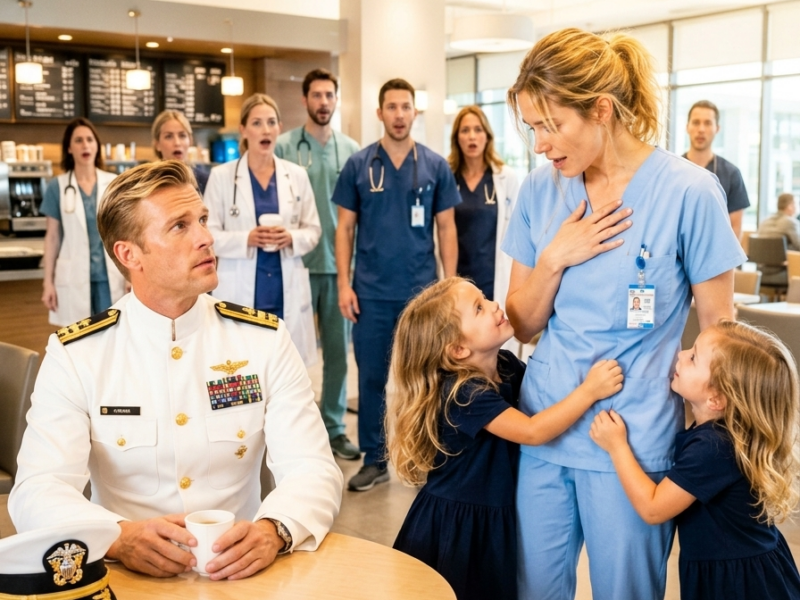
The admiral’s twins suddenly pointed at me in the emergency room and shouted my forgotten Navy SEAL codename in front of thirty people
The chart in my hands felt like paper, thin and disposable, yet my fingers gripped it so hard the cardboard backing creaked. The emergency bay of Naval Medical Center San Diego smelled of damp wool, rubbing alcohol, and the sharp copper trace of an evening trauma rotation. Outside, an unseasonable late-winter storm lashed against the heavy tinted windows facing Bob Wilson Drive. The wind was howling off the bay, tossing palm fronds across the asphalt, but inside, the rhythm had been steady: fractured wrists from recruit depots, feverish infants from junior enlisted housing, a retired master chief complaining of angina.
Then the sliding glass intake doors hissed back, accompanied by a gust of freezing maritime rain, and everything came apart.
Two six-year-old children broke into a sprint across the clean linoleum. They wore matching yellow rain slickers, soaked through until the vinyl was slick as seal skin, their dark hair plastered against pale foreheads. A girl and a boy. Fraternal twins. Behind them, his stride long, stiff, and authoritative, came Admiral Thomas Reed.
He was a commanding presence even in civilian attire: graying temples cut razor-sharp above his collar, a heavy wool peacoat over dark slacks, his posture rigid from decades on bridge decks and in Pentagon conference rooms. I had treated him twice over the last eighteen months—once for a minor tendon tear suffered in the base gymnasium, once to draw post-surgical labs after an uncomplicated appendectomy. To him, I had always been Nurse Miller. Maya Miller. A quiet contract nurse who never made small talk, never asked about ship deployments, and kept her gaze fixed on vitals charts and syringe calibrations.
He did not look at me. He was reaching forward to catch his son’s shoulder, his low baritone carrying across the nurses’ island. “Leo, Maya, stop running. Walk.”
The little girl froze three feet from my station. She did not slip on the damp tile. She planted her red rubber boots, lifted her chin, and stared directly into my eyes. Her irises were a clear, startling hazel—the exact shade of sea glass.
Beside her, the boy stopped too, grabbing his sister’s small sleeve. He didn’t look at the reception desk, the triage sign, or the security guard sitting behind the tempered glass. He looked only at me.
“That’s Raven,” the girl said.
Her voice was not loud, but it had the pure, penetrating clarity only a child’s voice carries.
The nurses’ station went dead. An orderly wheeling an empty gurney stopped mid-stride. A corpsman entering vitals into a terminal paused, fingers hovering over the keys. Across the waiting area, half a dozen active-duty sailors and their spouses turned their heads.
The cold hit the base of my skull first, then plunged down my spine like ice water injected straight into an artery. My lungs locked. Eight years. For two thousand nine hundred days, that callsign had been scrubbed from every database, removed from every roster, wiped from every unit history maintained by Naval Special Warfare Command. Raven was dead. She had died in the gravel and black rock of the Hamun-e Jaz Murian basin in southeastern Iran.
“Maya, hush,” Admiral Reed said sharply, stepping between his daughter and the counter. He looked down at the girl, irritation tightening his jaw. “What did you say?”
“That’s Raven,” the boy repeated, nodding firmly, pointing a wet finger right at my chest. “Mom said she wears the gold pin.”
My hand instinctively moved to the lapel of my scrubs. It wasn’t a military pin. It was a tiny, generic caduceus I had bought at a civilian medical supply store in Chula Vista. But under the lapel, hidden by a fold of stitched cotton, was a faint half-inch scar from an exit wound that no civilian nurse should have survived.
Admiral Reed’s head snapped toward me. His eyes, usually calculating and distant, narrowed into two points of cold steel. “How do you know that name?”
“I don’t,” I said. My voice came out flat, carefully modulated to match the neutral tone of an underpaid triage nurse dealing with an eccentric patient. “Sir, the children are wet and cold. Let me get them some blankets from the warmer while we set up an intake bay.”
“Mom said you saved Dad,” the boy insisted. He wasn’t crying. He wasn’t throwing a tantrum. He spoke with the terrifying, stubborn certainty of a child repeating a bedtime story he had heard a hundred times.
I couldn’t draw air. My throat felt like it had been packed with dry sand.
Their mother was Elena Reed. Formerly Lieutenant Elena Vance, Naval Intelligence. She had been the tactical liaison assigned to our joint recovery cell eight years ago. And two years ago, her official obituary had been printed in the Navy Times: a single-car rollover on Interstate 5 outside Camp Pendleton during a rainstorm. Closed-casket funeral. Full honors at Fort Rosecrans.
Except Elena had been a driver trained in high-speed evasion by the CIA’s ground branch. She didn’t skid on wet pavement.
Two base security officers, attracted by the sudden silence and the presence of a three-star flag officer, drifted over from the lobby entrance. Their hands rested lightly near their service belts.
“Admiral?” the senior guard asked. “Everything all right here, sir?”
Reed didn’t blink. He kept his eyes fixed on my face, reading the tension in my shoulders, the way my balance had imperceptibly shifted toward the balls of my feet, preparing for a threat vector from the left or right. A civilian nurse would have shrunk back. A trained operator assumes an athletic stance without realizing it.
“Take her to an interview room,” Reed said quietly.
“Sir?” the corpsman at the desk stammered. “Nurse Miller is on duty, she—”
“Take her to the secondary interview room in the west annex,” Reed repeated, his voice dropping into the register that brooked no debate on an aircraft carrier’s bridge. “Now.”
“I can walk myself, Admiral,” I said evenly.
I stepped around the counter, keeping my hands visible, fingers loose. I didn’t resist. Resistance in a crowded naval hospital would bring the base provost marshal, lock the sector down, and trigger facial recognition protocols that my forged credentials could not withstand.
The west annex was a quiet corridor used for casualty notifications and chaplain consultations. The room was sterile and soundproofed: four padded chairs, an oval laminate table, a box of tissues, and an acoustic ceiling that dampened every breath.
The security guard stood outside the glass door. Admiral Reed walked in alone, pulled the door shut until the latch clicked, and engaged the privacy blind. He didn’t sit down. He reached into the inner breast pocket of his peacoat, withdrew a worn manila envelope, and dropped it onto the table.
Inside was a photograph.
My pulse thrummed behind my ears. The photo was printed on commercial matte paper, edges frayed from being carried in a wallet. It showed a sun-bleached expanse of clay and cracked earth under a harsh Middle Eastern sky. In the background stood the burnt-out frame of an unarmored Land Cruiser. In the foreground were two women.
One was Elena Vance, younger, wearing desert digital fatigues, her forearms splattered with dark, oxidized blood. The other was me. My tactical vest was torn open at the collar, my cheek swollen and purple from an impact, my dark hair matted with dirt. We were both looking at the camera not with triumph, but with hollow, shell-shocked exhaustion.
I turned the photograph over with a steady thumb.
Written in blue ballpoint ink, in Elena’s unmistakable cramped handwriting, were four words:
Trust Raven. Not Thomas.
I looked up from the print directly into the face of the man married to the woman who had written it.
“Where did you get this?” I asked, dropping the civilian nurse cadence entirely. My real voice was lower, sharper, scraped raw by years of disuse.
Reed’s jaw worked. “Elena had a safety deposit box in La Jolla. Unregistered. No record in her estate filings. It was set to trigger a notification to an offshore legal firm if her death certificate wasn’t re-verified by her own thumbprint every eighteen months.”
“She didn’t trust you,” I said.
He didn’t flinch. Instead, he pulled a second, smaller item from the envelope. It was a sheet of ordinary construction paper, folded in quarters. He unfolded it and smoothed it flat beside the photograph.
It was a drawing made with colored markers. Two small stick figures holding hands, standing next to a taller figure wearing dark fatigues, a tactical vest, and a black face gaiter. In crude, blocky letters across the bottom, written in a child’s unsteady print, were the words:
Mom said Raven would come back.
My hands, which had held arterial clamps in the back of moving helicopters under mortar fire, began to shake. “Elena told them about the mission?”
“She told them about you,” Reed said, leaning over the table, his knuckles resting on the laminate surface. His face was inches from mine. “She knew her car didn’t slide on the five. She knew someone cut the brake lines and flooded the vehicle’s electronic control module. She survived the impact long enough to spend four hours in the trauma unit before the embolisms took her. She made me swear on our children’s lives.”
“Swear what?”
“She said that if the people who burned Task Force 7 ever traced her back to San Diego, they wouldn’t stop with her. She said they would come for the children. And she gave the twins one instruction, repeated to them every night before sleep.”
“What instruction?”
Reed looked toward the small glass window in the door. “If Raven ever appears again, do not let anyone know she has returned. Because the moment her name is spoken in public, the perimeter is breached.”
The silence in the small room became deafening.
“Then why did they shout it?” I whispered.
“Because they’re six years old, Miller,” Reed said, his voice cracking with sudden, raw terror. “They saw your face. They recognized the gold caduceus Elena drew for them. And they thought… they thought you had come to take them home.”
A dull click resonated through the ceiling tiles.
The overhead fluorescent tubes flickered once, buzzed violently, and died. The room plunged into the pale amber glow of the battery-operated emergency fixtures.
Down the hallway, past the closed door, someone shrieked—a high, panicked sound cut short by the wet thud of an impact.
The magnetic locks on the annex doors fired with a heavy, synchronous thump, sealing the corridor.
Through the narrow glass panel of the door, where the security guard had been standing seconds before, the floor was slick with red. The guard was gone.
Walking down the center of the tiled corridor, under the flickering amber backup lights, was a man in service dress blues. He wore the rank insignia of a Navy Commander. His stride was measured, unhurried, his hands gloved in black leather.
I knew that walk. I knew the angle of his head, the way his left shoulder dipped slightly from an old shrapnel injury sustained in Fallujah.
Commander Nathan Cross.
The team leader who had taken two rounds through the lung on the extraction ridge eight years ago. The officer whose body we had left behind in the burning sand because the Iranian border patrol was four hundred meters away and closing.
The officer I had officially pronounced dead.
Commander Nathan Cross did not look like a man who had crawled out of a mass grave.
Through the narrow pane of the reinforced security door, I watched him advance. His uniform was immaculate: gold sleeve braid gleaming under the emergency halogen lights, ribbons arranged with mathematical precision, trousers pressed with razor edges. But his eyes were dead. They had the flat, unreflective stare of a predator that had long since forgotten the taste of anything other than carrion.
In his right hand, he carried a suppressed SIG Sauer P320. Smoke still drifted in a thin, lazy spiral from the threaded muzzle. At his feet, crumpled against the baseboard near the drinking fountain, lay the security guard who had escorted me down the hall. A single dark puddle was expanding rapidly across the white vinyl.
“Thomas,” I whispered, the nurse’s mask completely gone. “Who else is on this floor?”
“Just duty staff and two dozen patients in the emergency bays,” Reed said. His hands were steady now, his military instincts kicking in as he stepped back from the door’s line of sight. “The annex is isolated after nineteen-hundred hours. That’s why I brought you here. If he took down the corridor locks, he has root access to the hospital’s building automation system.”
“He doesn’t want the hospital,” I said, my gaze locked on Cross’s reflection in the glass. “He wants the slate cleaned. Elena died because she started asking questions about the recovery fund. The children are the only living witnesses to what she wrote in her private journals.”
“My children don’t know anything,” Reed hissed, his voice trembling with a father’s helpless fury. “They’re six!”
“They know my name,” I countered, spinning around to face him. “And they know who killed their mother. That makes them liabilities to an operation that spent eight years scrubbing its footprint.”
I dropped to one knee and reached beneath the heavy laminate table. The interview room was designed to be secure from the outside, but it was built with standard commercial drywall over steel studs. Near the corner, behind the wastebasket, sat a low access hatch for the medical gas lines running between the hospital’s central chiller plant and the pediatric ward next door.
I grabbed the plastic cover and wrenched it off. The screws stripped with a sharp squeak. Inside was a dark, narrow utility tunnel, cramped with insulated copper pipes, oxygen conduits, and fiber-optic bundles.
“Where does that lead?” Reed asked.
“Pediatric observation,” I said, standing up and sliding off my blue scrub jacket, leaving me in a black compression shirt. “There’s an emergency fire stairwell behind the nurses’ station on the other side. You’re going to take that hatch, crawl through, get your children, and get them to the third-deck surgical corridor.”
“I’m not leaving you behind to face Cross alone,” Reed said. “I am an Admiral in the United States Navy. I outrank whatever rogue element he represents.”
“Cross isn’t Navy anymore, Thomas,” I said, grabbing his peacoat collar and pulling him down to eye level. “He stopped being Navy the night he ordered our transport pilot to divert into sovereign Iranian airspace without diplomatic clearance. That mission wasn’t a recovery. It was an extraction of private banking records from an unregistered shell account tied to four members of the House Armed Services Committee. The three men who died on that ridge? They didn’t die for their country. They died because Nathan Cross needed their share of eighty million dollars.”
Reed stared at me, the color draining from his face until he looked like chalk. “Elena told me… she said the ledger was missing.”
“The ledger was inside my medical kit,” I said, patting my waistband. “And Nathan knows I didn’t leave it in the desert.”
Click.
The handle of the interview room door rattled.
A heavy silence followed, broken only by the hum of the air handlers. Then, a low, familiar voice drifted through the ventilation grille above the frame.
“Maya,” Cross called out. His voice was smooth, relaxed, carrying that same West Virginia drawl that used to calm recruits on the firing range. “You always were the clever one. Always checking the morphine counts twice. Always watching the perimeter when the boys were sleeping.”
I moved against the wall, putting two layers of drywall between my head and the door’s sightline.
“Nathan,” I said, keeping my voice level. “You’re out of uniform. You’re listed as deceased on the Wall of Heroes at Coronado.”
A soft chuckle came through the vent. “A name on a wall is a very useful thing, Raven. It gives a man freedom. No pay grades. No congressional oversight. No ethics committees asking where the pallets went. You should have stayed dead too. You had a good thing going here. Cleaning bedpans. Handing out Tylenol. It’s an honest living for a girl from eastern Kentucky.”
“Why the children, Nathan?” I asked, buying seconds as Reed silently lowered himself to his knees and slid headfirst into the copper utility tunnel. “They don’t have the codes.”
“They have Elena’s eyes,” Cross said. The amusement vanished from his voice, replaced by something cold, flat, and mechanical. “And Elena kept backups. She sent three micro-SD cards somewhere before her car hit the guardrail. I tore her house apart. I checked her family’s safety deposit boxes. Nothing. That means the cards are either with Thomas… or she gave them to the little girl.”
The door handle rattled again, followed by the muffled thwip-thwip of two suppressed rounds punching through the electronic latch assembly.
The steel door swung open.
Cross stepped into the doorway, his pistol raised in a high-retention position, his tactical flashlight cutting through the amber gloom.
The room appeared empty. The manila envelope sat on the table. The photograph of Elena lay facedown.
Cross stepped inside, his boots silent on the floor. He glanced at the open utility hatch in the corner, saw the pulled wires, and raised his weapon toward the dark opening.
He didn’t look up.
I dropped from the top of the door frame where I had wedged my back against the wall and my boots against the interior header.
A hundred and thirty pounds of bone and muscle slammed directly onto Cross’s right shoulder. The kinetic energy knocked him sideways, his weapon firing into the drywall with a muffled pop. We hit the floor together in a tangle of limbs, the laminate table splintering under our weight.
Cross was larger, heavier, and possessed the brute functional strength of an operator who had spent his entire life in the gym. But he was fighting inside a four-by-four-foot kill zone. In close quarters, mass is a liability; leverage is survival.
I drove my left palm into his chin, forcing his head back, while my right hand clamped onto the slide of his SIG Sauer, wrenching it outward until the ejection port jammed against the chambered casing. The pistol was out of the fight.
Cross roared, driving an elbow into my ribs. The impact cracked bone. A flare of white-hot agony shot through my chest, cutting off my breath, but I didn’t let go of his wrist. I rolled my hips, threw my right leg over his neck, and locked him in a tight, suffocating triangle choke.
“You… should have… stayed… in the desert,” he wheezed, his thumbs clawing at my eyes.
I ducked my chin into his chest, tightening the lock with every ounce of strength remaining in my thighs. He bucked violently, lifting me off the floor, but his oxygen was gone. The blood flow to his carotid arteries stopped. His struggles became ragged, uncoordinated. His eyes rolled back into his head, showing the whites under the amber emergency light.
Three seconds later, he went completely limp.
I released the lock, rolled off his body, and dragged myself to my feet, clutching my fractured ribs. My breath came in sharp, burning gasps.
I picked up his jammed weapon, stripped the magazine, cleared the stovepiped round, re-seated the magazine, and racked the slide with a clean, metallic clatter.
I bent down and patted his pockets. In his inner breast pocket was a secure military satchel containing a tactical tablet, a set of administrative hospital keycards, and a small black-and-white photograph.
It wasn’t a photo of Elena.
It was a photo of Leo and Maya Reed, taken from a telephoto lens through the window of their kindergarten classroom in Coronado.
Attached to the back of the photo was a tactical order slip bearing an authorization code from the Office of Naval Intelligence.
And underneath the code was a name I hadn’t expected to see.
Authorized by: Vice Admiral Thomas Reed.
The paper trembled in my hand, but my pulse, paradoxically, slowed to an icy, dead crawl.
Authorized by: Vice Admiral Thomas Reed.
The small black-and-white photograph of the twins playing on the kindergarten monkey bars stared back at me, marked with target grids and a date stamp from three days ago. The signature block wasn’t a forged stamp. It bore Reed’s personal cryptographic identifier—the private digital key issued only to flag officers with Level-4 compartmentalized access.
The entire narrative spun on its axis.
Elena’s frantic scribbled note on the back of the desert snapshot: Trust Raven. Not Thomas.
She hadn’t been warning me about an outside threat. She had been warning me about her husband.
The admiral hadn’t brought those children into the emergency room to protect them from Nathan Cross. He had brought them here to flush me out. He knew the twins had seen the caduceus pin; he knew they remembered the bedtime stories Elena had whispered to them. And he knew that if Raven was alive and operating within the medical center, she would never abandon Elena’s children.
He had walked them straight into the trap, using them as bait to draw the last surviving witness of Task Force 7 into an enclosed, controllable kill zone.
I shoved the tactical slip into my pocket, checked the SIG Sauer’s chamber once more, and dropped to my knees before the utility hatch. The narrow crawlspace smelled of dust, heated copper, and the faint, sweet scent of children’s bubblegum.
I crawled. Every inch of forward movement sent a sharp, agonizing stab through my cracked ribs, but I ignored it. Pain was just data; it was information telling me what muscles were still functioning. I pushed through the web of conduits, sliding over the smooth metal casing of the HVAC trunk until I reached the louvered exhaust panel leading into the pediatric observation ward.
I peered through the slats.
The pediatric unit was dead silent. The decorative murals of smiling sea turtles and dolphins on the pastel walls looked grotesque under the flickering amber backup lights. At the far end of the hallway, near the observation desk, Thomas Reed was standing with his back to me.
He had stripped off his wet peacoat. Beneath it, he wore a shoulder holster over his white dress shirt. His sidearm was already drawn—a standard-issue Beretta M9, hammer cocked.
The two children were sitting on a low vinyl couch beneath a framed poster of a whale. Leo was holding his sister’s hand, his small face pale and streaked with dried tears. Maya wasn’t crying. She sat completely upright, her red rubber boots dangling inches above the linoleum, her sea-glass eyes fixed on her father’s back.
“Daddy,” Leo whispered, his voice trembling. “Where is the nurse? Where is Raven?”
“Be quiet, Leo,” Reed said, without turning around. His voice was no longer that of a distressed parent. It was the calm, flat voice of an officer directing a coordinated fleet strike. “Someone is coming to take care of us. Just sit still.”
“Mom told me you were going to lie,” Maya said.
Reed froze. His shoulders stiffened. He slowly turned his head to look down at his daughter. “What did you say?”
“Mom said when the storm came, you would tell us we were going on a trip,” Maya said. She reached into the pocket of her yellow slicker, her small fingers wrapping around something hidden inside the vinyl lining. “She told me you forgot how to be a sailor.”
“Your mother was sick, Maya,” Reed said softly, though his knuckles turned white against the grip of his pistol. “She had delusions. She thought everyone was an enemy.”
“She wasn’t sick,” I said.
I kicked the exhaust louver out. The metal panel crashed onto the tile floor with a loud clang that echoed down the empty corridor.
I stepped through the opening, the SIG Sauer leveled at Reed’s center mass. My scrubs were torn, blood from my ribs soaking through the black compression shirt, but my hands were completely steady.
Reed didn’t jump. He pivoted smoothly, raising the Beretta, aligning his sights with my forehead.
For three seconds, neither of us breathed. The only sound was the distant drumming of the rain against the pediatric bay skylights.
“You took your time, Raven,” Reed said. His face was an emotionless mask. “Nathan was supposed to handle you in the interview room. He’s getting sloppy in his old age.”
“Nathan’s asleep on the floor,” I said. “And you’re out of options, Thomas.”
“I have all the options,” Reed replied calmly. “You’re a deserter. Officially listed as killed in action eight years ago, currently trespassing on a federal military installation under a forged identity. If I put a bullet in your head right now, every board of inquiry in the Department of the Navy will commend me for terminating an unauthorized infiltrator who attacked an admiral’s family.”
“And the children?” I took half a step forward, keeping my line of sight clear. “What do you tell the board about them?”
Reed’s eyes flickered toward his son, and for a fraction of a second, something human and agonized cracked through his armor. “They will go to a boarding school in Switzerland. They will be taken care of. They will forget.”
“They won’t forget,” I said. “You know how trauma works on a six-year-old brain. It doesn’t disappear. It sits in the amygdala like an unexploded shell. Every time it rains, every time they hear a siren, every time they see a woman with a caduceus pin, they’ll remember that their father had their mother run off a highway in Camp Pendleton.”
“Elena was going to destroy this family!” Reed suddenly snarled, his composure shattering. His voice rose, bouncing off the pastel walls. “She stole the operational journals! She took the account ledgers that connected our entire strike group command to the Gulf contracts! If that went public, I would have spent the rest of my life in Leavenworth! My career, my flag, my family’s legacy—wiped out by her self-righteous moral crusade!”
“She was protecting her children from a traitor,” I said.
“She was a liability!” Reed barked. “Just like your recovery team was a liability! You were never supposed to survive that ridge, Maya. Nathan was supposed to leave all four of you in that ravine. But you had to be a hero. You had to drag Nathan out, patch his lung, and keep the evidence alive.”
From the couch, little Maya stood up. She didn’t look at her father’s gun. She walked past him, her boots squeaking on the tile, and came to stand directly beside my leg.
Reed’s eyes widened. “Maya, get back on that couch!”
Maya reached up with her left hand and tugged on the hem of my black compression shirt. In her right hand, she held out a small, rectangular object wrapped in clear plastic waterproof tape.
It was a SanDisk micro-SD card, no larger than a fingernail.
“Mom said to give this to Raven,” the little girl said, her voice clear and completely fearless. “She said Raven knows how to shoot the monsters.”
Reed’s face twisted in desperate rage. He shifted his weapon’s aim from my chest down toward his own daughter. “Give that to me, Maya!”
He never got the chance.
I fired.
The suppressed report of the SIG Sauer was no louder than a dry branch snapping underfoot, but the kinetic impact was absolute. The 9mm hollow point took Thomas Reed through the right shoulder joint, shattering the clavicle and tearing through the deltoid muscle.
The Beretta slipped from his nerveless fingers, clattering against the linoleum. He stumbled backward into the observation desk, scattering charts and monitors, his left hand clamping over the spurting wound in his shoulder.
“Down!” I screamed, grabbing Maya by the collar of her slicker and shoving her behind the steel barrier of the reception desk. “Leo, crawl! Now!”
The boy didn’t hesitate. He dropped to his belly and scrambled across the floor like a trainee on an obstacle course, sliding in behind his sister.
Reed was on his knees, gasping for breath, his face gray with shock. “You… you can’t get out of this building, Miller… the base is on lockdown… Nathan has three tactical teams… stationed at every exterior exit…”
“Then I won’t use the exterior exits,” I said, stepping over to him and kicking his dropped Beretta across the floor into the trash receptacle.
I knelt beside him, my face inches from his ear. My voice dropped to that cold, surgical whisper I hadn’t used since the mountains of Iran. “Your wife was five times the sailor you ever were, Thomas. She didn’t just save these files. She knew you’d try to erase them. And she knew that if I came for them, I wouldn’t leave witnesses behind.”
I reached into his shoulder harness, retrieved his encrypted flag-officer identification card, and pressed the micro-SD card Maya had given me deep into the pocket of my tactical vest.
“Stay down,” I told him. “Or the next round goes through your femoral artery. You know how long you’ll have to live if that happens? Three minutes. And there’s no nurse on duty who’s going to save you.”
I turned back to the children. Leo was trembling, his arms wrapped tightly around his knees, but Maya was staring at me with those steady sea-glass eyes.
“Are you the monster?” Leo asked, his voice barely audible over the hum of the emergency lights.
“No, sweetie,” I said, softening my voice as I knelt before them. I pulled my blue scrub jacket back on to cover the blood on my shirt and zipped it up to the throat. “I’m the doctor. And we’re going to take a ride.”
I grabbed an empty pediatric transport gurney from the alcove—a standard wheeled cot covered with a heavy white thermal blanket. “Both of you, get on. Under the blanket. Don’t make a sound. No matter what you hear, no matter who speaks, you stay completely flat until I tell you to get up. Do you understand?”
Leo nodded frantically, climbing onto the mattress. Maya hesitated for a second, then reached out and touched the small gold caduceus pinned to my collar.
“Mom said you would fix it,” she whispered.
“I’m fixing it, Maya,” I said.
I threw the thick thermal blanket over them, smoothing it down until the gurney looked like an empty bed being transferred back to the central laundry or morgue staging area.
I grabbed the push bars, took a deep breath that sent a dull throb through my broken ribs, and pushed the gurney out of the pediatric ward into the main central spine of the hospital.
The facility was in full, chaotic alert.
Emergency alarms were warbling on the upper floors, but down here on the main concourse, the lockdown was absolute. The large glass blast doors leading to the main entrance were sealed with heavy steel drop-gates. Hospital corpsmen and civilian nurses were clustered near the central pharmacy, terrified, whispering among themselves as armed military police officers in body armor hurried down the perimeter halls.
They weren’t base police.
I recognized the black patch on their shoulders: Task Force Guardian. A private security contractor operating out of Coronado, funded by the very black-budget accounts Elena had documented. Cross’s private cleanup crew.
Two of them were standing at the junction of the central corridor and the radiology elevator bank. They were carrying short-barreled carbines, their helmets fitted with communication headsets.
“Hold up!” the first contractor shouted, raising a gloved hand as I approached with the gurney. “Sector is sealed! No patient movement authorized until the Provost Marshal clears the deck!”
I didn’t stop. I increased my stride, projecting an air of breathless, panicked urgency.
“I have an emergent post-op hemorrhage from pediatric ICU!” I yelled, my voice shrill, breathless, perfectly imitating a terrified civilian nurse. “Child has an uncontained arterial bleed! If I don’t get this gurney to Trauma Bay 3 right now, she’s going to code on my floor! Move out of my way!”
The contractors hesitated. Civilian security personnel are trained to handle intruders, but a screaming nurse pushing a bloody gurney creates an instinctive psychological hesitation. The human brain hates the idea of being responsible for a dead child.
The lead guard stepped forward, reaching out to peel back the blanket. “Ma’am, I have strict orders—”
As his fingers touched the cotton edge, I slammed the heavy foot-brake of the gurney downward. The front wheels locked instantly. The sudden deceleration caused the steel push-bar to drive forward, catching the guard squarely in the solar plexus.
He doubled over with a breathless grunt.
Before his partner could bring his carbine up, I drew the suppressed SIG Sauer from beneath the gurney’s mattress frame. Two rounds: one through the second guard’s right thigh, one through his shoulder. He collapsed against the wall with a strangled cry, his rifle clattering to the floor.
I grabbed the first guard by his tactical vest, spun him around, and drove the butt of my pistol into the base of his skull. He went limp, sliding down the wall beside his partner.
I reached down, stripped the access keycards from the lead contractor’s belt, and grabbed his tactical radio.
Through the earpiece, Nathan Cross’s voice crackled, distorted by static and urgency:
“All units, subject has neutralized the Admiral in pediatric observation. She has the package. She is moving toward the lower level maintenance tunnels. Terminate on sight. Repeat: authorization is lethal. Do not let her reach the naval network terminals.”
I keyed the mic.
“Nathan,” I said, my voice cutting through the radio traffic like an executioner’s axe.
The frequency went dead silent.
“Maya?” Cross rasped. “Where are you?”
“I’m right where you left me eight years ago,” I said. “In the dark.”
I smashed the radio against the concrete doorframe, jammed the stolen keycard into the freight elevator console, and rolled the gurney inside just as the heavy industrial doors slid shut.
The freight elevator groaned as its heavy steel cables hoisted us downward, descending not toward the lobby, but into the deep sub-basement levels beneath the medical center.
Level B-4: Central Communications and Archive Node.
During the Cold War, Naval Medical Center San Diego had been built with an underground command bunker designed to maintain regional naval communications in the event of a nuclear strike on Coronado. Most of it was decommissioned now, used for storing ancient paper medical records and retired computer servers, but the secure fiber-optic conduits running directly to the Pacific Fleet Command at Pearl Harbor were still hardwired into the bedrock.
The elevator shuddered to a halt. The steel doors slid open with a screech of unlubricated metal.
The air down here was frigid, thick with the smell of old paper, ozone, and stagnant dampness. Rows upon rows of towering industrial steel shelving stretched into the dim distance, stacked with thousands of gray archive boxes.
I pulled the blanket back.
Leo and Maya were sitting completely upright, their hands linked together, their eyes wide. Neither of them had made a sound.
“We’re here,” I said softly, lifting both of them down from the cot. “Stay behind me. We have two minutes.”
I led them down the central concrete aisle toward the secure communications cage at the far end of the vault. It was a reinforced wire enclosure surrounding a single terminal console, lit by the pale green glow of an ancient standby monitor.
I used Admiral Reed’s flag-officer credential to swipe the magnetic lock. The heavy wire gate clicked open.
I sat Maya on the metal desk beside the terminal, pulled the micro-SD card from my pocket, and inserted it into the console’s high-speed cryptographic reader.
The screen flickered. Lines of green data began cascading down the monitor: banking routing numbers, vessel transfer manifests, offshore dummy corporations registered in Panama and the Cayman Islands, and forty-two encrypted audio recordings of conversations between Thomas Reed, Nathan Cross, and high-ranking defense contractors.
It was everything.
The full, unvarnished history of how Task Force 7 had been betrayed, how eighty million dollars in diverted covert funding had been laundered through Navy accounts, and how Elena Reed had been executed to protect the conspiracy.
“Initiating fleet-wide broadcast,” I whispered, my fingers flying across the mechanical keyboard.
I addressed the transmission not to a single desk, but to the automated broadcast buffer of the Naval Criminal Investigative Service, the Judge Advocate General’s Corps, the Inspector General of the Department of Defense, and the editorial desks of the Washington Post and The New York Times.
Enter Authorization Key.
I looked down at the paper slip I had taken from Cross’s pocket. I typed the Admiral’s private cryptographic key: VANCE-774-REED.
The progress bar on the screen surged forward: 12%… 34%… 68%…
A shadow fell across the concrete aisle outside the cage.
Nathan Cross stepped into the pool of light beneath the overhead bulb.
His dress uniform was ruined: blood from our struggle stained his white collar, his tie was torn away, and his left arm hung slightly limp from a separated shoulder. But his right hand held a compact submachine gun, the safety click off, the barrel aimed squarely at the wire mesh of the communications cage.
“You always were too stubborn to die, Maya,” Cross said. He wasn’t yelling. He sounded exhausted, like a marathon runner who had realized the finish line had been moved into the ocean.
“It’s over, Nathan,” I said, without looking away from the terminal.
89%… 94%…
“It’s never over,” Cross said, stepping toward the open gate. “You send that file, and fifty careers end tomorrow. Half the admiralty in the Pacific gets dragged before a senate select committee. You think Washington will thank you for that? They’ll bury you deeper than they buried us in Iran.”
“I don’t care about Washington,” I said.
100%. Transmission Verified. External Buffers Cleared.
A low chime sounded from the terminal as the files were pushed simultaneously across eighteen civilian and military networks around the globe.
Cross heard the chime. He stopped three feet from the gate, his jaw slackening as he looked at the green screen.
“What did you do?” he whispered.
“I gave Elena her voice back,” I said.
Cross’s face contorted with sudden, feral rage. He raised the submachine gun, his finger tightening on the trigger. “Then you can join her!”
Before he could fire, the heavy industrial vault doors at the far end of the corridor blew inward with a concussive roar.
Stun grenades detonated in rapid, blinding succession: Bang-bang-bang!
White magnesium light flooded the underground chamber, followed by the deafening, synchronized roar of a dozen combat boots hitting the concrete.
“NCIS! Federal agents! Drop the weapon! Drop it now!”
Cross whirled around, blinded by the flash, raising his weapon toward the advancing squad of tactical agents in dark windbreakers bearing gold letters.
He didn’t get off a shot.
A volley of controlled automatic fire tore through his chest and torso, knocking him off his feet. He crashed against the steel shelving, gray archive boxes tumbling down around him in a shower of loose paper, before he slid to the concrete floor and lay completely still.
The agents fanned out across the vault, weapons raised, securing the perimeter in seconds.
A tall, sharp-featured woman in a navy trench coat stepped through the smoke, her gold federal badge pinned to her lapel, her eyes scanning the communications cage until they landed on me.
“Special Agent Davis, NCIS Special Operations,” she said, lowering her weapon. She looked at the terminal screen, then down at the two children standing beside me under the green light. “You must be Nurse Miller.”
“My name is Layla Vance,” I said, my voice steady, clear, and quiet. “And these are Elena’s children.”
The agent looked at the dead man on the floor, then at the cascade of declassified files still scrolling on the terminal. She slowly reached out, took her badge from her coat, and laid it on the desk.
“Admiral Reed is in custody on the second floor,” Davis said softly. “The entire regional command has been frozen by the Secretary of the Navy. It’s done, Commander.”
I looked down at Maya.
The little girl looked up at me, her red boots still wet from the rain outside, her sea-glass eyes calm and untroubled. She reached into her pocket, pulled out the child’s drawing of the woman in the black mask, and pressed it into my hand.
“Mom said you would fix it,” Maya said again.
I folded the paper carefully, slid it into the breast pocket of my scrubs right next to the little gold caduceus pin, and let out a long, ragged breath that felt like the first clean air I had tasted in eight years.
“Yes, Maya,” I whispered, kneeling down and taking both children by their small hands as the sirens on the surface began to wail in the clearing rain. “It’s fixed.”
The end.









