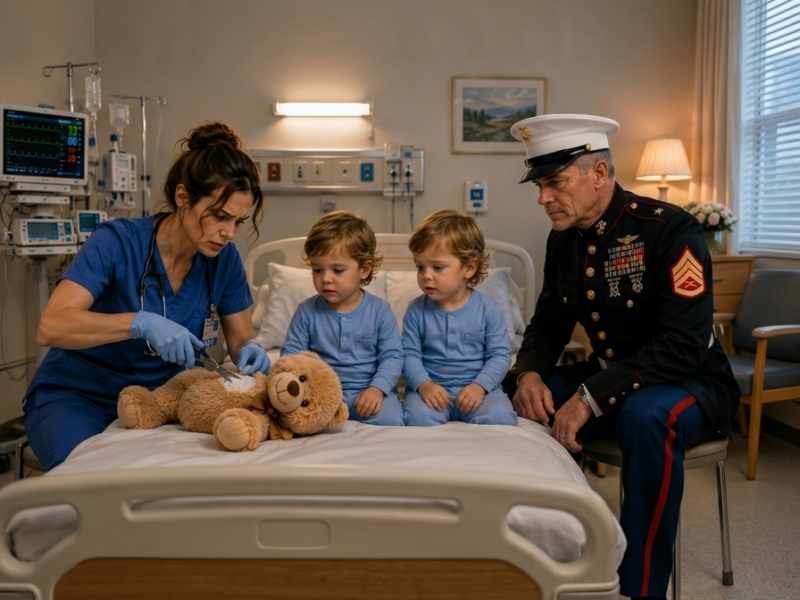
The admiral’s six-month-old twins screamed so violently in the VIP hospital suite that three specialists failed to calm them
The seventh floor of St. Mary’s Medical Center in Norfolk, Virginia, was designed to look less like a hospital and more like a luxury hotel. The floors were covered in plush burgundy carpets that muffled the sound of footsteps, the walls were paneled in polished mahogany, and the air smelled faintly of lavender rather than bleach and rubbing alcohol. But that afternoon, the calm of the VIP wing was completely shattered by a sound that echoed through the heavy oak doors of Suite 702.
It was a raw, guttural screaming—two six-month-old infants crying with such desperate, unyielding terror that the sound seemed to vibrate through the brass light fixtures in the hallway.
Inside Suite 702, three senior pediatric specialists stood around a pair of white wooden cribs, their foreheads slick with cold sweat. Dr. Harrison, the chief of pediatrics, was desperately adjusting his wire-rimmed glasses with trembling fingers, while two attending nurses hovered beside him holding silver trays filled with unused sedatives, diagnostic equipment, and untouched bottles of specialized infant formula.
“We have run every panel imaginable, Admiral,” Dr. Harrison stammered, his voice straining to be heard over the deafening wails of the twins. “Blood work, cranial ultrasounds, abdominal scans… their vitals are medically stable. There is no fever, no inflammation, no physical trauma. We cannot identify an underlying medical cause for this level of distress.”
“Then find another doctor,” a cold, iron-hard voice sliced through the noise.
Admiral Richard Whitmore stood by the floor-to-ceiling window overlooking the rainy skyline of the naval base across the river. He was fifty-two years old, built like a fortress, and wore his official Navy dress uniform with an absolute, unyielding precision. His photograph hung downstairs in the main hospital lobby—a war hero, a naval strategist, a man who had commanded carrier strike groups across two oceans. But in the dim light of the suite, his shadow stretched long and dark across the carpet.
“I am paying this hospital ten thousand dollars a night to care for my children,” the Admiral turned around slowly, his icy gray eyes locking onto Dr. Harrison with a look that made the seasoned pediatrician step back. “I did not bring them here to listen to medical excuses. Fix it. Or I will have the entire chief medical board replaced by sunrise.”
I stood near the door, keeping my back close to the wall. I was holding a warm bottle of liquid formula that nobody had managed to get the babies to touch for over twelve hours. I was twenty-six years old, the newest nurse hired on the pediatric trauma floor, and known to everyone as Nurse Elena Carter. To the executive staff, I was just a quiet, low-ranking nurse who kept her head down, volunteered for night shifts, and never questioned authority.
They didn’t know that three years ago, before I wore hospital scrubs, I had spent five years working in child trauma units on military bases in Germany, learning how to read the body language of young victims who lacked the words to explain their fear.
I looked past the frantic doctors toward the twin cribs.
The infants—a boy named Leo and a girl named Maya—were thrashing violently against their white cotton sheets. Their faces were flushed dark red, their tiny fists balled tight. But as I watched them, I realized something that Dr. Harrison had completely missed.
They weren’t screaming in pain. Pain makes a child pull their limbs inward, seeking a fetal position. These babies were throwing their small hands outward toward the center gap between their cribs, their wide, tear-filled eyes locked on a single object resting on a glass nightstand between them.
It was a worn, tattered teddy bear. The brown faux fur was faded and matted from years of handling, one of its black button eyes was missing, and a crude line of thick black thread was stitched clumsily across its soft stomach.
“That toy is filthy,” Admiral Whitmore snapped suddenly, his sharp gaze following my eyes to the nightstand. “It’s an infection hazard. Throw it in the incinerator.”
“Sir, wait—” Dr. Harrison began.
Before the doctor could finish, the Admiral picked up the bear by its torn ear and tossed it toward a plastic biohazard waste bin near the doorway.
The moment the bear left the nightstand, both infants erupted into a sound so sharp and violent that Maya began to choke, her face turning a terrifying shade of blue as she gasped for air. Leo slammed his head back against his mattress, his tiny arms reaching wildly into the empty space where the bear had rested.
They weren’t throwing a tantrum. They were terrified. They were terrified that the only thing protecting them was being destroyed.
“Stop!” I called out, breaking hospital protocol and stepping directly into the center of the room.
The Admiral froze, holding the bear an inch above the trash bin. He turned his head slowly toward me, his brow furrowing into a dangerous, dark scowl. “What did you say to me, Nurse?”
“Put the bear back, Admiral,” I said, keeping my voice steady despite the rapid pounding in my chest. “Look at their oxygen monitors. They aren’t sick. They are experiencing a severe psychological panic response.”
Dr. Harrison gasped. “Nurse Carter, lower your tone immediately! You are speaking to—”
“I know who he is,” I interrupted quietly, taking two steps toward the cribs. I didn’t look at the Admiral; I looked at the babies. I lowered myself to my knees between the cribs, keeping my hands resting plainly on the wooden rails, and began to softly hum an old Scandinavian lullaby—a quiet, rolling melody my mother used to sing to me when storm winds rattled our windows in Maine.
Slowly, incredibly, the violent screaming began to abate. Maya stopped choking, taking long, shuddering gasps of air. Leo’s fists uncurled slightly, his tear-filled eyes shifting away from the door to focus on my face. Their sharp cries softened into helpless, frightened whimpers.
Both babies stretched their tiny fingers outward, pointing directly at the brown bear still hanging from the Admiral’s large hand.
“Sir,” I said, looking up into Whitmore’s unreadable gray eyes. “May I examine that toy first? Before you throw it away?”
The Admiral’s expression hardened into granite. “It is a piece of cheap cloth, Nurse Carter. It has no medical relevance.”
“Then it won’t take long,” I replied softly. “Two minutes. If their vitals spike again after I check it, you can destroy it.”
For several long, agonizing seconds, the room fell completely silent save for the hum of the heart monitors. The Admiral stared down at me as if weighing whether to have me escorted out by hospital security or to humor a low-ranking nurse.
“Two minutes,” Whitmore said coldly, tossing the bear onto the stainless-steel examination counter beside me. “Then you will pack your locker and hand in your badge.”
I didn’t argue. I turned to the examination counter and pulled on a fresh pair of nitrile gloves.
The bear was surprisingly heavy for its size. The coarse fur felt dry, and as I turned it over, I noticed that the clumsy black stitching across its stomach wasn’t old—it was recent. The thread was surgical-grade nylon, the exact type used in military field trauma kits.
I gently ran my fingers along the seam. Deep beneath the cotton stuffing, my fingertips hit something hard, rectangular, and cold.
My heart did a sharp drop against my ribs. I reached into my pocket, pulled out a small pair of medical bandage scissors, and snip-snip-snipped the heavy black threads.
I reached inside the torn lining.
My gloved hand pulled out three items wrapped tightly in a thick piece of clear, waterproof plastic: a small silver key with a numbered brass tag, a folded glossy photograph, and a miniature digital voice recorder no larger than a thumb drive.
The floor beneath my feet felt as though it had suddenly tipped sideways.
I unfolded the photograph first. It showed Admiral Richard Whitmore standing in a brightly lit recovery room, holding his newborn twins. Standing right beside him, leaning weakly against his arm, was a striking woman with deep green eyes and soft brown hair. I recognized her instantly from the massive framed portrait hanging downstairs in the hospital’s memorial wing.
Elizabeth Whitmore. The Admiral’s wife.
The official news reports from three months ago had called it a tragic accident—a midnight car crash along the winding, rain-slicked cliffs of Highway 17. Her body had never been recovered from the surging waters of the bay.
I turned the photograph over. Written across the back in jagged, frantic blue ink were ten words that made my skin turn to ice:
If anything happens to me, protect my children from their father.
I took a sharp breath, my thumb brushing against the plastic wrapping of the digital voice recorder.
“Give me the bear, Nurse Carter,” a quiet, lethal voice spoke right behind my shoulder.
I didn’t turn around right away. I instinctively closed my fingers around the tiny recorder and the photograph, slipping them under the sleeve of my scrub top. “Why would your wife hide a key inside her children’s toy, Admiral?”
When I turned around, Richard Whitmore’s face had changed completely. The polished, dignified military officer was gone. In his place was a man whose eyes were empty, dark, and utterly devoid of human warmth.
“Because my wife was mentally unstable,” Whitmore answered, his voice dropping into a raspy, dangerous register that didn’t carry across the room to Dr. Harrison. “She suffered from severe postpartum psychosis. She imagined things that did not exist.”
My thumb hit the small play button on the digital recorder through my sleeve.
A static crackle hissed out from the tiny speaker, cutting through the heavy air of the suite. Then, a woman’s voice filled the space between us—trembling, choked with tears, but terrifyingly clear:
“If you are hearing this… Richard has discovered that I know what happened aboard the USS Mercer.”
Admiral Whitmore lunged toward the counter, his massive hand snapping forward like a steel trap.
I scrambled backward, knocking over a tray of sterile metal instruments that crashed loudly onto the floor. Dr. Harrison gasped in horror, while the two nurses pressed themselves against the far wall.
The recording kept playing, the woman’s voice rising over the clatter of dropped metal:
“He told the navy I died in a car accident… but I survived that night on the docks. I know who ordered the missile strike on the supply vessel. I know who signed the cover-up orders.”
The twin babies in their cribs suddenly stopped whimpering. Both infants turned their small heads toward the counter, their eyes wide, listening to the sound of the mother they hadn’t heard in three long months.
Then, the recorded voice delivered its final, devastating sentence:
“And whatever you do… do not let him take the twins. Richard isn’t their biological father.”
The room went completely, suffocatingly silent.
The Admiral froze mid-step. Every drop of color drained from his face, leaving his skin a sickly, gray ash. The powerful naval hero stood motionless in the center of the VIP suite, his broad shoulders stiffening as if he had just been struck by a sniper’s bullet.
I stared at the two innocent babies, then at the photograph hidden in my palm.
Before I could process the horror unfolding around me, a series of heavy, frantic boots thundered down the mahogany-paneled hallway outside.
BOOM! BOOM! BOOM!
Someone pounded violently on the locked mahogany suite door. A harsh, authoritative male voice shouted over the commotion:
“Federal Law Enforcement! Admiral Richard Whitmore, unlock this door and step away from the children immediately!”
The Admiral didn’t run. He didn’t turn toward the door. Slowly, deliberate as a machine, he raised both of his large hands into the air.
But his cold gray eyes stayed locked onto mine, drilling into my soul with an intensity that made my knees shake.
As the heavy oak door was kicked inward with a deafening crash, and armed federal agents spilled into the room with weapons raised, Admiral Whitmore leaned toward me and whispered six words that sent a wave of sheer terror down my spine:
“Ask Elizabeth who the real father is.”
My eyes darted down to the photograph in my hand. I looked closely at the background of the image—at the dark reflection in the glass window behind Elizabeth Whitmore.
Standing just outside the frame, captured in the reflection, was a man wearing a crisp naval uniform. And on his left ring finger was a heavy gold Annapolis ring bearing a custom eagle crest—the exact same unique crest etched into the silver pocket watch my father had worn the day he disappeared ten years ago.
The chaos that swept through Suite 702 in the minutes following the door breaking open was swift, loud, and absolute.
Federal agents clad in dark tactical vests bearing the yellow letters NCIS filled the room, their boots stomping across the plush burgundy carpet. Dr. Harrison and his nursing staff were ushered out into the corridor under armed escort, their hands held high, their faces pale with shock.
“Secure the perimeter! Escort the suspect out through the private service elevator!” Lead Agent Marcus Vance bellowed, his voice echoing off the mahogany walls as two agents snapped heavy steel handcuffs around Admiral Whitmore’s wrists.
Whitmore didn’t fight them. He didn’t utter a word of protest as his arms were pinned behind his back. As he was marched past me toward the private exit, his eyes remained fixed on my face, a faint, terrifying smirk lingering at the edge of his thin lips.
“Nurse Carter,” Agent Vance stepped up to the examination counter, flashing an official silver badge. “I am Special Agent Vance with the Naval Criminal Investigative Service. We need you to hand over all physical evidence pulled from that stuffed animal immediately.”
My fingers tightened around the worn brown bear, the silver key, and the small digital recorder hidden inside my scrub sleeve.
Three years of working trauma units had taught me one fundamental rule about institutions: when power violently collides with truth, the truth is usually the first thing to be buried.
“The evidence belongs to the federal investigation, Nurse,” Vance repeated, his voice lowering into a firm, unyielding tone as he reached out a gloved hand. “You are a civilian employee here. Do not complicate this.”
I looked past Vance toward the cribs. The two babies had begun to whimper again, their tiny hands clutching at the air as the strange men in tactical gear crowded their room.
“These children are my primary patients, Agent Vance,” I said, keeping my voice cold and professional as I tucked the bear securely under my left arm. “They are suffering from acute trauma. I will hand over the audio file to the lead federal prosecutor, but I am not releasing these infants or their personal items into your custody without an explicit court order from a family judge.”
Vance’s eyes narrowed into dangerous slits. “Nurse Carter, you are walking on thin ice. The Admiral is facing charges of high treason, classified military corruption, and potential homicide. This entire suite is a crime scene.”
“Then secure the room,” I replied, standing my ground. “But if you move these children right now without proper medical oversight, their vitals will collapse. Look at the monitors.”
Vance glanced toward the heart rate screen mounted on the wall. The red numbers were spiking dangerously high as the agents moved closer to the cribs. He swore under his breath, stepping back and pulling a secure satellite phone from his tactical belt.
“Fine,” Vance growled, walking toward the balcony doors. “You have two hours to keep them calm while child protective services clears the federal custody order. But you don’t leave this room, Carter. Not for anything.”
As Vance stepped out onto the rainy balcony to make his call, I moved quickly.
I walked over to the twin cribs, sliding the worn teddy bear back into the narrow gap between Leo and Maya’s mattresses. The moment the soft fur touched their tiny fingers, the sharp blare of the heart monitors began to plummet back toward a safe, rhythmic blue baseline. The babies’ gasps slowed. Maya reached out, her small fingers curling tightly around the bear’s torn ear, while Leo rested his cheek directly against its stitched stomach.
They didn’t just love the toy. They recognized it as a vault.
I pulled out my personal phone from my scrub pocket, connected a short high-speed data transfer cable to the thumb-drive recorder I had tucked into my sleeve, and backed up the entire audio file directly to an encrypted cloud drive my brother had built for me years ago.
I pulled up the photograph I had taken from the bear’s lining.
I zoomed in on the dark glass reflection behind Elizabeth Whitmore.
The rain outside the hospital window reflected off the glossy paper, but the image was unmistakable. The man standing just outside the frame was tall, with broad shoulders and a silver-and-black hair pattern. On his left hand was a heavy gold military ring—a custom-designed Annapolis ring featuring a striking split-winged eagle clutching a trident.
My breath hitched violently in my chest.
I knew that ring. I had held it in my small hands when I was ten years old. It belonged to my father, Captain Daniel Carter—a senior naval engineer who had reportedly been killed in an engine room explosion aboard a repair vessel in the Persian Gulf twelve years ago.
My father hadn’t died in an engine fire. He had been alive six months ago, standing in a naval hospital room, looking down at Elizabeth Whitmore and her newborn twins.
My hands shook violently as I pulled out the small silver key I had retrieved from the bear. Attached to the key was a tiny brass tag stamped with a single set of coordinates and a room number:
NAVY YARD – STORAGE BAY 14B – LOCKER 09
“Nurse Carter.”
I jumped, quickly sliding the key and photo back into my pocket as a female doctor in a white lab coat stepped into the suite. She was a woman in her late forty’s, with dark hair tied back in a tight bun, carrying an official medical chart.
“I am Dr. Sarah Miller,” she said, her tone warm but efficient. “NCIS asked me to take over primary pediatric oversight for the Whitmore infants while the federal hold is processed. You can head down to the staff break room and take your break now. You’ve had a traumatic afternoon.”
I looked at Dr. Miller’s badge. It was a standard hospital ID, but as she reached out to check Maya’s pulse, her scrub sleeve pulled back slightly.
On her inner left wrist was a small, faded tattoo—a distinct three-digit unit number: 302.
My stomach did a violent flip. Unit 302 was the specialized naval medical team attached to Admiral Whitmore’s personal carrier strike group—the same unit mentioned in the classified reports about the USS Mercer.
She wasn’t a civilian hospital doctor. She was Whitmore’s personal medical officer.
“Thank you, Doctor,” I said smoothly, forcing my voice to remain completely calm. “I just need to grab my jacket from the nurse’s station.”
I didn’t head down to the staff break room.
The moment I stepped out of Suite 702 into the dimly lit corridor, I bypassed the main elevators, slipped into the service stairwell, and sprinted down seven flights of concrete stairs toward the basement parking garage.
My mind was racing with terrifying clarity. Admiral Whitmore wasn’t just a corrupt officer covering up a military disaster aboard the USS Mercer; he was part of a deep, systemic network that reached directly into the medical staff of this hospital. And if Dr. Miller had been sent to take charge of the twins, those children weren’t being protected—they were being silenced.
I reached my old Volvo in the dark basement garage, unlocked the driver’s door, and jammed the key into the ignition.
Before I could throw the car into drive, my phone chimed sharply on the passenger seat.
It was an incoming text from an unknown, heavily encrypted military number. A single image loaded onto the screen.
It was a live, high-definition security camera feed showing the interior of Suite 702. Dr. Miller was standing over the cribs, holding a small glass syringe filled with a clear liquid, preparing to plunge it into the IV line connected to little Leo’s arm.
Directly beneath the image, a text message appeared:
If you want to save your father’s children, bring the key to Storage Bay 14B in thirty minutes. Come alone, Elena.
The rain was coming down in thick, blinding sheets as I drove my Volvo through the rusted iron gates of the old Norfolk Navy Yard. The industrial district along the waterfront was vast, dark, and mostly abandoned—a graveyard of crumbling brick warehouses, towering gantry cranes, and silent, decommissioned naval vessels tethered to the rotting wooden piers.
My heart hammered against my ribs like a trapped beast. The image of Dr. Miller holding that syringe over baby Leo was burned into the back of my eyelids.
Your father’s children.
The words of the text message echoed in my head, loud and terrifying. The twins weren’t Admiral Whitmore’s. They were my half-brother and half-sister. The blood running through their tiny veins was the same blood running through mine.
I slammed my foot onto the accelerator, sending the Volvo splashing through deep puddles of standing water until I pulled up outside Storage Building 14—a massive, corrugated steel warehouse near the edge of Pier 9.
The building was dark, its windows long broken and boarded up with thick plywood. The heavy steel door of Bay 14B hung slightly open, swaying back and forth in the howling coastal wind with a sharp, metallic screech.
I pulled my flashlight and my heavy surgical shears from my trauma kit, slipped out of the car, and stepped through the dark doorway into the echoing silence of the warehouse.
“Hello?” my voice echoed off the steel rafters above.
The only answer was the steady tap-tap-tap of rain dripping through holes in the corrugated roof onto the concrete floor below.
I flicked on the flashlight, sweeping the narrow beam through the dark aisle of metal storage lockers that stretched into the gloom. Rows of gray steel lockers stood like silent soldiers, covered in thick layers of dust and rust.
I walked quickly down the central aisle, scanning the faded white numbers painted on the locker doors.
14B-07… 14B-08… 14B-09.
I stopped in front of Locker 09.
Unlike the other rusty lockers around it, the heavy iron padlock securing Locker 09 was clean, silver, and brand new. I pulled the small silver key from my scrub pocket, my hands trembling so violently that it took me three tries to slide it into the keyhole.
CLICK.
The padlock snapped open with a heavy, satisfying pop.
I pulled off the lock and pulled the heavy steel locker door open.
Inside, resting on the middle metal shelf, was a heavy olive-drab military flight case sealed with two heavy brass latches. Attached to the handle of the case was a small handwritten tag that bore a single name:
CAPTAIN DANIEL CARTER – PERSONAL LOGS – CLASSIFIED.
My breath caught in my throat. I reached out, my fingers trembling as I flipped the brass latches open and lifted the thick plastic lid.
Inside the case lay four neatly organized items: a thick, leather-bound military logbook, a stack of technical blueprints labeled USS MERCER – PROPULSION MODIFICATIONS, a small glass vial filled with an amber liquid, and a weathered leather wallet.
I reached for the wallet first. I opened it with shaking hands.
Inside was a faded photograph of my mother holding me when I was a seven-year-old girl on a beach in Maine. Right behind it was a second photograph—taken much more recently. It showed my father, his hair gray at the temples but his eyes as warm as I remembered them, standing beside Elizabeth Whitmore outside a small, remote cabin in the Virginia mountains. She was visibly pregnant, smiling radiance into his shoulder.
Tears blurred my vision, hot and fast, dripping down my cold cheeks. He hadn’t abandoned us. He hadn’t died in that engine room explosion.
I opened the leather-bound logbook to the final entry, dated four months ago:
“If my daughter Elena ever finds this log… I am sorry for the silence. I am sorry for the years in the dark. After the USS Mercer scandal in 2018, when Whitmore ordered the intentional sabotage of the experimental reactor to cover up his illegal weapon sales to foreign contractors, I refused to sign the false maintenance report. Whitmore tried to have me eliminated in the explosion. I survived, but I was forced into hiding to keep Elena and my family alive.”
I swallowed hard, reading the next line as the rain lashed against the metal roof above:
“Elizabeth found me two years ago. She had discovered Whitmore’s hidden offshore accounts detailing the Mercer cover-up. We fell in love while trying to build a case to expose him to the Senate Armed Services Committee. When she became pregnant with the twins, Whitmore found out. He threatened to destroy the babies if she ever left him. She hid the evidence inside the children’s toy before Whitmore staged her ‘accidental’ crash.”
I turned the page. The last sentence was written in heavy, dark ink:
“Whitmore does not know I am still inside the base network. He thinks he has won. But the amber vial in this case contains the biological evidence of the nerve toxin Whitmore used to incapacitate Elizabeth before throwing her car into the bay. If this vial reaches the federal court, Richard Whitmore will spend the rest of his life in a maximum-security military prison.”
“It’s a compelling story, isn’t it, Nurse Carter?”
A smooth, chilling voice sounded from the dark entrance of the aisle behind me.
I spun around, slamming my flashlight beam down the narrow corridor of steel lockers.
Standing thirty feet away, bathed in the shadows of the warehouse, was Dr. Sarah Miller. She was no longer wearing her white medical coat. She wore a dark, form-fitting tactical jacket, and in her right hand was a sleek silver pistol fitted with a long black suppressor.
Standing right beside her was Agent Marcus Vance.
My heart plummeted into my stomach. NCIS wasn’t investigating Admiral Whitmore.
They were protecting him.
“You should have taken your break when I offered it to you, Elena,” Dr. Miller said quietly, taking three slow, deliberate steps toward me, the cold barrel of the suppressed gun pointed directly at my chest. “You’re a very good nurse. But you are a terrible politician.”
The air inside the warehouse became instantly suffocating. The rain outside seemed to dull into a distant background roar as I backed up against the cold steel of Locker 09, my hand clutching the flight case containing my father’s logs.
“Agent Vance,” I said, my voice shaking despite my desperate attempt to appear calm. “You’re a federal officer. You took an oath to uphold the law.”
Vance let out a dry, humorless laugh, taking a step forward while resting his hand on his holster belt. “An oath to the law doesn’t pay for three kids in private college, Nurse Carter. Admiral Whitmore’s offshore network has funded half the senior division of the Norfolk NCIS field office for a decade. Do you really think a few dead crewmen on the USS Mercer are going to break a billion-dollar defense apparatus?”
“What about the twins?” I demanded, my blood boiling with sudden, uncontrollable rage. “Dr. Miller was going to poison them in their cribs!”
“Not poison,” Dr. Miller corrected smoothly, stopping fifteen feet away with her weapon locked onto my heart. “Simply a mild paralytic agent to induce severe respiratory arrest. The official cause of death would have been classified as sudden infant death syndrome brought on by genetic distress. With the twins dead, Whitmore’s legal team could claim total emotional devastation and suppress Elizabeth’s hidden recordings as the ramblings of a unstable mother.”
“They are six months old!” I screamed, the sound echoing wildly off the steel rafters. “They are innocent!”
“Innocent people die in war every day, Elena,” Miller said coldly, her finger tightening slightly against the trigger. “Your father should have learned that twelve years ago on the Mercer. Now, hand over the flight case and the amber vial. If you cooperate, we can make your passing painless.”
I looked down at the flight case in my hand.
I knew I couldn’t outrun a bullet in a narrow warehouse aisle. I knew Vance and Miller were trained operatives who wouldn’t hesitate to erase me just like they had tried to erase my father and Elizabeth Whitmore.
But they had made one fatal mistake. They thought I was just an ordinary civilian nurse trapped in a corner.
They didn’t know that for five years in Germany, I had been trained in combat casualty care alongside Navy EOD teams—learning not just how to patch up broken bodies, but how to read the industrial layout of naval storage facilities.
Directly above Dr. Miller’s head hung a heavy iron cargo hook suspended by a rusted steel cable connected to an ancient manual winching system mounted on the wall right beside Locker 09.
“You want the vial?” I said softly, my voice dropping into a flat, steady register.
I reached into the flight case, pulling out the small glass vial filled with the amber liquid, holding it high between my thumb and forefinger.
Dr. Miller’s eyes flicked to the amber glass, her focus shifting for a fraction of a second. “Set it on the floor, Elena. Slowly.”
“Here it is,” I whispered.
Instead of setting it down, I smashed the glass vial violently against the heavy iron emergency release lever on the wall behind me.
CLANG!
The glass shattered, splashing the amber liquid across the concrete floor. But more importantly, the heavy iron lever snapped downward with a sharp, mechanical crack.
The rusty winching system above exploded into a violent flurry of sparks and screeching metal.
The heavy three-hundred-pound iron cargo hook plummeted from the rafters like a falling meteor, smashing straight through the upper metal catwalk directly above Dr. Miller and Agent Vance.
BOOM! CRASH!
Tons of rusted iron grating, heavy steel pipes, and wooden storage crates collapsed down onto the aisle in a deafening cascade of debris and dust.
“AGHH!” Vance screamed as a heavy steel beam crashed across his legs, slamming him onto the concrete floor and sending his sidearm skidding across the dark warehouse.
Dr. Miller dove sideways to avoid the falling catwalk, her suppressed pistol flying from her grip as she tumbled hard against a row of steel lockers.
I didn’t wait to see if they were getting up.
I grabbed the leather-bound logbook and the silver key, shoved them inside my scrub top, grabbed my heavy surgical shears from my trauma kit, and sprinted down the adjoining storage aisle toward the rear exit of Bay 14B.
“STOP HER!” Miller’s voice shrieked behind me through the cloud of rising rust and dust.
I burst through the rear wooden service door of the warehouse, falling out into the howling, rain-drenched night air of Pier 9.
The wind whipped my hair across my face as I ran across the slippery wooden planks of the dock, the dark, surging waters of the river churning forty feet below.
Behind me, the service door slammed open. Dr. Miller stepped out onto the pier, holding Vance’s backup revolver, her face smeared with soot and blood from the falling catwalk.
“It’s over, Elena!” Miller shouted over the roar of the wind and rain, leveling the gun at my back. “There is nowhere left for you to run!”
I stopped at the edge of the pier. Behind me was a forty-foot drop into icy, treacherous black water. In front of me was a killer with a loaded gun.
“You’re right,” I said, turning around slowly to face her, the cold rain soaking my scrubs through to the skin. “I can’t outrun your gun.”
Miller smiled cruelly, raising the revolver to eye level. “Smart girl.”
“But I don’t need to outrun you,” I said, pulling out my phone with my left hand and holding it up toward the sky. “I just needed to buy thirty minutes.”
Miller’s smile faded. “What are you talking about?”
“Before I left the hospital, I set up an automated broadcast script using the encrypted audio file from Elizabeth’s recorder,” I said, my voice echoing clear over the sound of the storm. “If my phone doesn’t receive a secure biometric check-in code from my thumbprint every thirty minutes, the entire Mercer file—along with the live audio recording of Vance admitting to the cover-up in Suite 702—is transmitted directly to the Inspector General of the Navy and the Washington Post.”
Miller’s face turned ghastly white. “You’re bluffing.”
“Look at the timer, Doctor,” I pointed to the glowing screen on my phone.
The red countdown timer displayed three digits: 00:05… 00:04… 00:03…
“NO!” Miller screamed, taking a desperate step forward.
Before she could pull the trigger, a blinding white spotlight cut through the heavy rain from above, illuminating Pier 9 with the force of a thousand suns.
The deafening, thunderous roar of helicopter blades shattered the night sky as a massive black Sikorsky MH-60 Jayhawk chopper descended from the storm clouds, hovering thirty feet above the pier.
A powerful voice boomed through an external loudspeaker:
“FEDERAL TACTICAL COMMAND! DROP YOUR WEAPONS IMMEDIATELY! THIS FACILITY IS UNDER MILITARY SEIZURE!”
The glare of the helicopter spotlight was so intense it turned the dark night into blinding daylight.
Dr. Miller panicked. She raised the revolver toward the hovering chopper, firing two frantic shots into the storm.
BANG! BANG!
In less than a second, two sharp, suppressed sniper rounds echoed from the open side door of the aircraft.
THWACK. THWACK.
Dr. Miller dropped to her knees with a sharp cry, both of her shoulders pierced with non-lethal precision. The revolver clattered off the wet wooden planks of the pier and tumbled over the edge into the churning black water below.
Four heavily armed tactical operators slid down fast-ropes from the helicopter, landing seamlessly on the wet dock with their weapons trained on the warehouse exit where Agent Vance was dragging himself out through the broken service door.
“Target secured! Clear the pier!” a tactical commander shouted.
From the dark shadow of the warehouse overhang, a man stepped forward into the edge of the spotlight beam. He wore a dark, heavy naval rain-parka, his posture stiff, his face marked by years of hardship and sun-weathered lines. His hair was silver at the temples, and his dark eyes were shining with tears as he looked across the pier at me.
It was my father.
“Elena,” he said, his voice trembling over the sound of the idling helicopter blades above.
I stood frozen on the edge of the dock, the rain pouring down my face, unable to speak as twelve years of grief, anger, and longing crashed over me like a tidal wave.
“Dad?” I gasped, my voice breaking.
Captain Daniel Carter took three slow, heavy steps forward, stopping five feet away. He pulled off his wet leather glove, revealing the broad gold Annapolis ring on his left hand—the custom split-winged eagle crest catching the bright glare of the spotlight.
“I am so sorry, sweetheart,” my father whispered, tears streaming down his face to mix with the rain. “I am so sorry I left you in the dark for so long. I had to make Whitmore believe I was dead so I could stay alive long enough to finish what Elizabeth started.”
I didn’t care about the rain. I didn’t care about the tactical team securing Vance and Miller in plastic flex-cuffs behind us. I dropped my trauma shears, took two fast steps forward, and threw my arms around my father’s neck, burying my face into the wet wool of his parka.
He wrapped his strong arms tightly around me, lifting me slightly off the wet planks, holding me as if he were terrified that if he let go, I would vanish back into the storm.
“I thought I lost you,” I sobbed into his shoulder. “They said you died in the Persian Gulf…”
“I never left you, Elena,” he choked back a sob, his hand resting gently against the back of my head. “Every day… every single day I stayed in the dark, I watched you from afar. I saw you graduate nursing school. I saw you take the trauma job in Germany. You were so brave… so much braver than I ever was.”
He pulled back slightly, holding my shoulders, his eyes searching my face with intense warmth. “Where are the twins?”
“They’re safe,” I said, wiping the rain from my eyes and pulling the leather logbook from my scrub top. “They’re still at St. Mary’s. I kept them safe, Dad.”
My father took a deep, shuddering breath, looking down at the logbook in my hands, then up at the clear sky as the storm clouds above began to part, revealing the pale glow of the morning moon over the Chesapeake Bay.
Six hours later, as the first golden rays of dawn broke over the Norfolk skyline, the high-security federal court building in downtown Richmond was surrounded by dozens of news vans, satellite trucks, and federal security details.
The national headlines broke across every television network in the country at 0700 hours:
DECORATED NAVAL ADMIRAL ARRESTED FOR TREASON, MURDER, AND DECADE-LONG COVER-UP OF USS MERCER DISASTER.
Admiral Richard Whitmore was escorted up the marble steps of the courthouse in full military dress uniform, but stripped of his medals and insignia. His hands were bound in heavy iron waist-chains, his face cold, gray, and completely defeated as reporters shouted questions from behind the security barricades.
The unsealed indictment detailed everything: the false maintenance reports, the illegal foreign weapon sales, the murder of Elizabeth Whitmore, and the attempted assassination of Captain Daniel Carter and his daughter.
Inside the quiet, sunlit private recovery room on the top floor of St. Mary’s Medical Center, the atmosphere was entirely different.
The heavy oak doors were open to the soft morning breeze coming off the river. The harsh fluorescent lights had been turned off, replaced by the warm, golden glow of the morning sun shining through the tall glass windows.
In the center of the room, standing beside the white wooden cribs, was Captain Daniel Carter.
He was holding baby Maya gently in his broad arms, rocking her back and forth as she let out soft, contented coos, her tiny fingers playing with the silver button on his shirt collar. Beside him, resting in a comfortable rocking chair, I held little Leo against my chest, feeding him a bottle of warm formula that he drank eagerly without a single whimpering cry.
Lying neatly between the two cribs on the nightstand was the worn brown teddy bear—its black nylon stitching carefully repaired, its faded brown fur cleaned and soft once again.
The infants weren’t screaming anymore. The terror that had gripped their tiny lives for three long months had finally been washed away by the truth.
My father turned his head toward me, a quiet, peaceful smile gracing his face as he looked from Maya down to Leo.
“They have Elizabeth’s eyes,” he said softly, his thumb gently caressing Maya’s soft cheek.
“And they have your strength,” I replied, setting the empty bottle on the tray and adjusting the warm blanket around Leo’s shoulders.
My father looked at me, his deep green eyes filled with an overwhelming sense of pride and peace that I had missed for twelve long years.
“What happens now, Elena?” he asked quietly. “The Navy is going to reinstate my commission long enough for me to officially retire. But the press… the courts… it’s going to be a long road ahead.”
I stood up from the rocking chair, walking over to stand beside my father, leaning my head gently against his broad shoulder as we looked down at the twin children who had brought us back together from the shadows of the past.
“Now,” I whispered, holding my little brother’s tiny hand as he drifted off into a peaceful sleep, “we raise them together. No more secrets. No more hiding in the dark.”
My father wrapped his free arm around my shoulder, pulling me close as the morning sun filled the room with bright, beautiful light. The battle was over. The truth had finally spoken. And for the first time in my life, our family was finally home.
The end.









