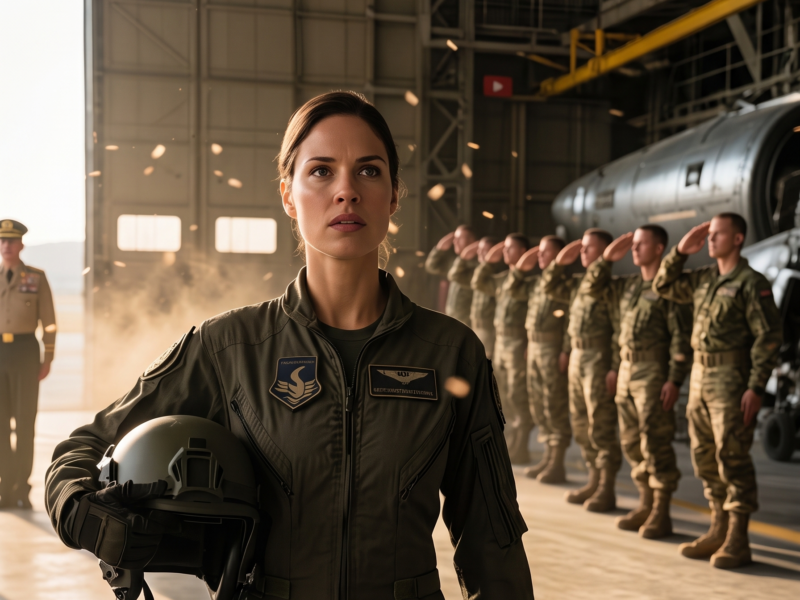
The admiral slammed my old flight helmet onto the briefing-room table at Naval Base Coronado and said, “You expect these SEALs to respect you?”
The fluorescent lights of Briefing Room B inside Naval Base Coronado hummed with a low, electrical buzz. The room smelled of salt air, industrial floor wax, and stale coffee. Outside the reinforced windows, the damp Pacific fog rolled over the tarmac, muffling the distant roar of dual-engine jets executing night-landing patterns.
For the past eight years, I had inhabited a twilight existence. To the young sailors, maintenance crews, and junior officers across three naval air stations, I was merely Claire Bennett: a low-ranking logistics and maintenance officer who wore faded coveralls, carried a clipboard, and spent her shifts verifying engine part serial numbers. I was the quiet woman who checked hydraulic lines and signed off on pre-flight inspection reports without raising her eyes. I had erased my own voice. I had smoothed down my edges. I had made myself invisible.
I was summoned to Coronado under the pretense of delivering a routine inventory briefing regarding aviation parts for the upcoming deployment of a specialized Joint Special Operations Task Force. I walked into the secure tactical briefing room carrying a blue cardboard folder, expecting a short presentation before five or six supply officers.
Instead, the room was packed.
To the left sat twelve men in desert-camo uniforms. They were members of SEAL Team Six—hard-eyed, broad-shouldered, carrying the distinct, watchful stillness of men who lived in the dark corners of the world. They sat in strict silence, arms crossed, watching the front stage.
Standing behind the podium was Admiral Thomas Hayes. He was a man built like a concrete pillar, his chest covered in rows of ribbons, his face carved with deep, unforgiving lines. He did not look at the presentation slides projected on the screen behind him. He was looking at a worn, olive-drab flight helmet sitting squarely in the middle of the polished oak table.
My flight helmet.
The dark visor was scratched; the oxygen mask connector was stained with the faint, reddish residue of oxidized copper; and the callsign stencil across the back—ALERT ONE—was half-peeled away by time and neglect.
I froze at the doorway. My hand tightened around the cardboard folder.
“Officer Bennett,” Admiral Hayes said. His voice was heavy, scraping against the walls of the room like iron on stone. “Step inside. Close the door.”
I obeyed, letting the heavy steel door click shut behind me. “Sir. I have the inventory manifests for the quartermaster—”
“Forget the manifests,” Hayes interrupted. He stepped out from behind the podium, walking slowly toward the table. He reached out, grabbed my old helmet by the night-vision mount, and slammed it down onto the hard surface with a sharp, explosive crack that echoed through the small room.
“You expect these SEALs to respect you?” Hayes demanded, his eyes narrowing into cold slits. “You walk in here in grease-stained utilities, acting like a supply clerk, holding a file on airframe logistics. Do you think they know who you are?”
Before I could answer, Hayes pointed a thick finger at the helmet. “This belonged to you?”
“Yes, sir,” I replied quietly. My voice did not shake, but my chest felt instantly tight, as if the air in the room had been replaced by pressurized water.
Hayes smiled, a flat, bitter line without an ounce of warmth. “Then tell me why your official service record states that you haven’t flown a combat sortie in eight years. Tell these men why an Air Force pilot with four thousand jet hours was stripped of her flight status and handed a socket wrench.”
The room remained motionless. Not a single SEAL shifted in his chair, but I could feel their collective focus shift from the admiral to me. They were evaluating us both with terrifying speed.
“Because the truth was classified, sir,” I said simply.
Hayes let out a short, harsh laugh that sounded like dry leaves scraping across pavement. “That’s convenient, isn’t it? ‘Classified.’ The ultimate shield for a coward who couldn’t handle operational stress.”
He reached into his leather briefcase on the side chair and pulled out a thick, red-bound dossier. He flipped it open, tearing through the plastic sleeves, and pulled out three glossy eight-by-ten reconnaissance photographs. He threw them across the table, sliding them until they stopped right in front of my hands.
“Eight years ago. Operation Black Dawn,” Hayes spat. “Northern border sector. Unsanctioned airspace.”
I looked down at the photographs. The black-and-white thermal prints burned into my retinas instantly, pulling me back through time.
The first photograph showed an F-22 Raptor resting sideways in a snow-covered ravine, its port wing ripped away, smoke billowing from the engine bays. The second showed a scarred, cratered emergency landing strip carved into a dark forest ridge. The third photograph showed three body-heat signatures outlined in white against the dark ground, surrounded by seven hostile combat vehicles.
“Your wingman was down. The ground team was surrounded,” Hayes said, his voice rising, filling the room with structured venom. “Your flight lead ordered a high-altitude withdrawal to preserve airframe secrecy. Instead, you broke formation. You engaged three surface-to-air missile batteries without SEAD support, ruined a forty-million-dollar airframe, and left three operators from Team Six stranded in a blind kill zone.”
He leaned over the table, placing his palms flat on either side of my helmet, bringing his face inches from mine.
“Your decision got them killed, Captain Bennett. You failed your mission. You failed your wingman. And you failed the Navy.”
The words hit with physical force, but they were not new. For eight long, silent years, I had replayed those exact sentences in my head every night before falling asleep in empty military barracks. I had carried that weight alone, locked behind non-disclosure agreements, threatened with federal imprisonment if I ever spoke the name of the valley where my career died.
My mind raced back to the cockpit of my Raptor on that freezing October night. The sound of alarms blaring in my headset. The red warning lights painting the canopy in crimson. The voice of the SEAL team leader breaking through the static over the emergency survival frequency: Captain, we’re trapped. They’ve got the ridge zeroed. We can’t reach the LZ.
I remembered the storm that night—a wall of freezing rain and low clouds that pinned us against the mountain face. I remembered the three enemy interceptors closing in from the north. And I remembered the radio transmission that came directly from Central Command, clear and unyielding: Alert One, abort mission immediately. Leave them. Preserve the asset.
I had refused. I had slammed the throttle into full afterburner, turned my jet back into the black canyon, and dropped through two thousand feet of zero-visibility clouds to lay down a wall of cannon fire between the team and the advancing hostile force.
I looked up from the photographs and met Admiral Hayes’s glare. “I went back for them, Admiral.”
“And you lost your jet, destroyed the diplomatic leverage of this department, and left three bodies in the snow!” Hayes roared. “You were court-martialed in secret and thrown into maintenance because the Pentagon didn’t want the public to know how incompetent you were!”
Silence descended on the room once again. It was heavy, suffocating, and absolute.
Then, in the second row of chairs, a young SEAL slowly stood up. He didn’t speak. He simply stood at attention, his eyes fixed straight ahead.
A second later, the operator beside him stood up. Then another. Then the entire front row. Within five seconds, every single SEAL in the briefing room was standing upright, their shoulders square, their expressions unreadable.
Hayes snapped his head around, his face turning a dark, mottled red. “What the hell are you men doing? Sit down!”
The Senior Chief commanding the unit—a grizzled operator with a thick beard and a deep scar running along his jawline—stepped out of the formation. He ignored Hayes entirely, turned toward me, and raised his right hand to his brow in a crisp, razor-sharp salute.
“What is the meaning of this, Senior Chief?” Hayes yelled, his voice cracking with fury. “I gave you an order!”
“Saluting, sir,” the Senior Chief said softly, his eyes locked onto mine.
“Saluting her?” Hayes sneered. “She’s a disgraced officer who cost this branch three operators!”
The Senior Chief turned his head slightly, giving Hayes a look of cold, dangerous disgust. “No, sir. She’s the pilot who flew under a radar ceiling in a two-hundred-knot crosswind to blow an armor column off our flank when command told us we were acceptable collateral damage. She saved our men.”
My throat tightened into a painful knot. The floor seemed to sway beneath my feet. Eight years of shame, isolation, and silence cracked open in a single second.
The Senior Chief reached into his chest pocket and pulled out a small, heavy object. He stepped forward and placed it gently on the table right next to my scratched helmet.
It was a Special Warfare insignia—the Navy Trident. But it wasn’t the polished gold emblem worn on dress uniforms. It was made of blackened steel, warped by intense heat, its edges scored by shrapnel and scratched down to the bare metal.
I stared at it. I knew that Trident. I had seen it once before, pinned to the tactical vest of Master Chief Jack “Guns” Miller—the ground team commander I had watched disappear into the darkness of that mountain valley six years ago.
“Where did you get this?” my voice came out barely above a whisper.
“Master Chief Miller gave it to us before he disappeared into the black site network,” the Senior Chief whispered. “He told us that if we ever ran into Alert One, we were to give it back to her. He said it belonged to the only pilot who ever had the guts to disobey a coward.”
I looked from the Trident to the Senior Chief’s face. “Jack… Jack is alive?”
No one in the room answered.
Then, the heavy steel doors at the back of the briefing room groaned open.
The sound of heavy, uneven footsteps echoed against the tile floor. A man stepped into the light of the room. He was wearing non-descript civilian clothes—a faded green jacket and dark jeans. His hair was streaked with grey, his left eye was clouded over with white scar tissue, and he walked with a slight, permanent limp in his right leg.
But the posture, the broad shoulders, and the sharp, piercing blue eye were unmistakable.
Jack Miller.
My heart stopped. The breath vanished from my lungs.
Jack walked past the rows of standing SEALs, his eyes fixed entirely on me. He stopped three feet away from the table, looking at the scratched helmet, looking at the black Trident, and finally looking into my eyes.
“I’m sorry it took so long, Claire,” Jack said. His voice was low, gravelly, and worn thin by years of survival in the dark. “They kept me in a dark room for a very long time.”
Admiral Hayes went rigid. The color completely drained from his face, leaving him pale and gray under the fluorescent lights. He stepped back toward the podium, his hand instinctively reaching for the secure phone mounted on the wall. “Miller… you’re not cleared to be on this installation. You are listed as inactive—”
Jack didn’t even look at Hayes. He reached into his jacket, pulled out a encrypted silver flash drive, and tossed it onto the table beside the Trident.
Then, Jack turned his one good eye onto Admiral Hayes, his voice cutting through the quiet room like a bayonet.
“Admiral,” Jack said softly, every word weighted with pure, dangerous truth, “you should probably tell Captain Bennett why you ordered us to leave her behind that night. Or should I let this drive explain how much money you made selling our extraction coordinates to the contractors?”
The briefing room felt as though all atmospheric pressure had been sucked out of it. The silence was absolute, heavy enough to crush a weaker man.
Admiral Hayes stayed frozen against the podium wall, his hand hovering two inches from the emergency communications terminal. His chest rose and fell in rapid, shallow breaths. The cold, aristocratic arrogance that had defined him ten minutes ago had vanished, replaced by the raw, panicked calculation of a man whose executioner had just walked through the front door.
“Master Chief Miller,” Hayes stammered, his tone shifting wildly from command authority to defensive bargaining. “You are severely confused. You’ve been out of the loop for eight years. You suffered a traumatic brain injury during the crash—”
“I didn’t crash because of a pilot error, Hayes,” Jack interrupted. He didn’t raise his voice, but the flat, absolute certainty in his tone made the twelve SEALs in the room shift their weight, their hands dropping naturally toward their sidearms. “I went down because my team was ambushed by a private military contractor firm operating on a black-budget maritime contract. A firm whose parent board you sat on until three months after the mission was scrubbed.”
The Senior Chief stepped closer to Jack, his eyes darting between the silver flash drive on the table and the pale face of the Admiral. “Master Chief… what is on that drive?”
Jack pointed a scarred finger at the drive. “The complete flight telemetry from Claire’s Raptor. The ground-to-air communications log that Hayes tried to delete from the Coronado mainframes eight years ago. And the bank records showing six million dollars transferred into a shell corporation in Panama twenty-four hours after my team was declared missing in action.”
I stared at Jack, then at Hayes. The pieces of the puzzle that had been shattered for eight years suddenly locked into place with a sickening click.
“You didn’t order me to pull back because of airframe safety,” I said, my voice dangerously calm as I stepped around the table toward Hayes. “You ordered me to pull back because if I stayed over that valley, my radar would record the contractor vehicles moving into the extraction zone before the rescue team arrived. You wanted Jack’s team captured. You wanted them buried so no one could report that the ‘enemy’ we were hunting was wearing American-made armor.”
Hayes swallowed hard, his eyes darting toward the heavy steel doors behind Jack. “Claire… you don’t understand the strategic scope of what was happening in that sector—”
“Captain Bennett,” I corrected him, my voice ringing out like a strike on an anvil. “You stripped my rank, Admiral. But you never had the authority to strip my commission.”
“This drive isn’t going anywhere,” Hayes growled, attempting to regain his footing. He took a step toward the table, reaching out his hand to seize the flash drive. “This is classified military intelligence! Possessing it is an act of high treason!”
Before Hayes’s fingers could touch the metal casing, the Senior Chief’s hand slammed down onto the table, covering the drive.
The Senior Chief looked Hayes dead in the eye. “With all due respect, Admiral… the only thing in this room that looks like treason is you.”
Hayes pulled his hand back as if he had touched a red-hot iron. “Senior Chief, you are walking a very thin line! I am your commanding officer!”
“Not anymore,” Jack said softly.
Jack reached into his jacket pocket and pulled out a folded piece of cream-colored paper bearing the gold embossed seal of the Department of the Navy. He unfolded it slowly and slapped it flat against the glass of the podium.
“Direct authorization from the Naval Criminal Investigative Service and the Armed Services Oversight Committee,” Jack stated. “As of 0600 hours this morning, Admiral Hayes, your command authority over Naval Base Coronado is suspended pending immediate federal inquiry.”
Hayes stared at the document. The air left his lungs in a long, ragged exhale.
At that exact moment, the heavy steel doors opened again. Four armed Military Police officers, flanked by two federal agents wearing dark suits and gold badges, walked into the room. They didn’t look at me, and they didn’t look at the SEALs. They walked directly to Hayes.
“Admiral Thomas Hayes,” the lead federal agent announced, pulling a pair of steel handcuffs from his belt. “You are being placed under arrest for operational sabotage, grand theft of military assets, and conspiracy to commit treason. You have the right to remain silent…”
As the agents stepped forward and pulled Hayes’s arms behind his back, the admiral didn’t utter another word. He kept his eyes fixed on the floor, avoiding the glares of the twelve SEALs who stood in rigid, silent judgment as he was led out of the briefing room.
When the heavy steel doors clicked shut behind the arresting officers, the room felt different. The air was cleaner.
I stood beside the oak table, staring down at my scratched helmet, the blackened Trident, and the silver drive. My hands were shaking—not from fear, but from the sudden, overwhelming release of eight years of repressed truth.
Jack walked over to me. Up close, I could see the heavy toll the years had taken on him. The dark circles under his good eye, the thin white scars crisscrossing his neck, the way he rested his weight on his good leg. But when he looked at me, his expression was filled with the same steady, unbreakable warmth I remembered from our joint operations briefing eight years ago.
“You kept the helmet,” Jack said softly, pointing a finger at the worn green shell.
“I kept it in my locker,” I replied, a faint, sad smile touching my lips. “To remind me that I used to be someone who could fly.”
“You never stopped being that person, Claire,” Jack said. He reached out, picked up the blackened Trident from the table, and pressed it into the palm of my hand. “We knew you came back for us that night. We heard your engines through the storm. We saw the artillery shells hitting the ridge right when they were about to overrun our position. You gave us the three minutes we needed to break out and reach the secondary hide site.”
“I thought I lost you, Jack,” I said, my voice cracking slightly. “They told me all three of you were gone.”
“Miller and Vance survived,” Jack said.
I went rigid. My breath caught in my throat. “Vance? Marcus Vance?”
Jack nodded. “Marcus was captured by the contractor group. They held him in an off-grid facility in Western Europe for six years to keep him from talking. I spent four years tracking him down, pulling him out of that hole, and collecting the paper trail that led straight back to Hayes.”
“Where is Marcus now?” I asked, my heart pounding against my ribs.
Jack looked toward the window that overlooked the fog-covered runway. “He’s at a secure safehouse three miles from here. But we don’t have much time, Claire. Hayes wasn’t working alone. The contractor network he was selling assets to… they know Hayes was just picked up. Their primary data vault is located at an unlisted facility twenty miles off the coast, on a decommissioned oil platform in international waters.”
“And they’re scrubbing the servers,” I said, catching his thought instantly.
“They’re scrubbing everything,” Jack agreed. “If those servers go dark before we secure the hard data, the men who ordered the strike eight years ago walk away completely clean. And Marcus remains a ghost forever.”
The Senior Chief stepped up beside us, racking the slide on his sidearm before re-holstering it. “We have a stealth Insertion Craft sitting at Dock 4, Captain. But if we go into international waters against a heavily armed private security team, we need air coverage. Real air coverage.”
I turned my head and looked out the window. Through the rolling Pacific fog, sitting under the high-intensity floodlights of Hangar 3, was an F-22 Raptor—a visiting airframe brought in for the joint task force evaluation.
I looked down at the scratched helmet in my hands. I looked at the blackened Trident resting in my palm.
“Senior Chief,” I said, my voice flat, clear, and filled with the fire that had been buried for eight years. “Get your men to the boat.”
“And you, Captain?” the Senior Chief asked, a slow, grim smile spreading across his face.
I pulled my old flight suit out of my sea-bag and looked up at the ceiling. “I’m going to take my jet back.”
The sound of an F-22 Raptor starting up inside a closed hangar is not a noise; it is a physical force. The twin Pratt & Whitney turbofan engines don’t merely hum—they vibrate through the soles of your boots, rattling your teeth, vibrating the air inside your lungs until the entire world feels composed of pure energy.
I sat in the ejection seat of Alert One, the glass canopy slowly descending and locking into place with a heavy, pneumatic hiss.
The maintenance crew outside the aircraft stood back in a wide circle. These were the same men and women who had spent three years watching me sweep floors, check oil levels, and organize spare parts. Now, they watched through the clear glass as I executed the complex pre-flight startup sequence with rapid, terrifying precision.
My left hand swept across the lower panels, flipping power breakers, activating the auxiliary power unit, and booting the integrated flight computers in a single, fluid motion that took less than six seconds. My right hand gripped the side-stick controller, feeling the familiar, hydraulic resistance of the flight surfaces coming to life.
The green digital light of the Head-Up Display reflected off my visor.
SYSTEMS: NOMINAL.
WEAPONS: ARMED.
FUEL: 100%.
“Coronado Tower, Alert One,” I spoke into my oxygen mask, my voice dropping back into the rhythmic, disciplined calm of an active combat aviator. “Requesting immediate priority departure, direct vector vector-two-seven-zero.”
The radio crackled. The voice on the other end was not the standard tower controller; it was the base operations director himself, his voice laced with awe and urgency. “Alert One, Coronado Tower. You are cleared for immediate takeoff on Runway 29. Clear air space all the way to the territorial limit. Captain Bennett… give ’em hell.”
“Copy, Tower,” I replied.
I released the wheel brakes and pushed the twin throttles forward past the detent, slamming them directly into full afterburner.
Two massive columns of violet-blue flame erupted from the vectoring nozzles at the rear of the aircraft. The acceleration hit me like a solid wall, slamming my spine back into the composite armor of the seat. The runway markers blurred into a single streak of white light. At one hundred and forty knots, I pulled back on the stick.
The Raptor’s nose pitched up vertically. The aircraft tore into the night sky, punching straight through the heavy layer of Pacific fog and breaking out into the clear, star-filled upper atmosphere at twelve thousand feet in less than fifteen seconds.
“Alert One, this is Bravo Lead,” Jack’s voice cut through the encrypted tactical channel in my helmet. He was aboard the high-speed Navy insertion craft, cutting through the heavy ocean swells fifteen miles ahead of me. “We have eyes on the platform. It’s lit up like a Christmas tree. They’ve got heavy heavy-caliber automated defense turrets mounted on the upper decks.”
“Copy, Bravo Lead,” I answered, sweeping my long-range radar over the dark ocean floor. “I am twelve miles out, dropping to low-altitude suppression sweep. Keep your boat outside their five-hundred-yard perimeter until I clear the roof.”
“Solid copy, Alert One. Watch your tail—our intelligence indicates they have at least one mobile radar-guided missile system mounted on the primary derrick.”
I rolled the F-22 inverted, pulling the stick back to dive the aircraft toward the black water below. I dropped through five thousand feet, three thousand feet, one thousand feet, leveling off at just two hundred feet above the crashing waves. Flying a stealth fighter at Mach 0.9 at night, two hundred feet above the ocean, requires complete reliance on instrument displays and absolute trust in your own muscle memory. One second of hesitation, one flinch of the hand, and the aircraft buries itself into the sea.
Ahead, cutting through the ocean haze, the silhouette of the abandoned oil platform appeared on my tactical screen. It was a massive, rusty steel structure standing on four massive concrete pillars, towering a hundred feet above the water. But it was no longer an industrial facility. High-frequency satellite dishes, radar domes, and heavily fortified container units were stacked across its main deck.
As I closed the distance, a high-pitched warble sounded inside my helmet.
WARNING: RADAR LOCK.
“Alert One, they’ve painted you!” Jack shouted over the comms. “Two surface-to-air missiles launching from the main derrick!”
Two brilliant streaks of orange fire erupted from the top deck of the oil platform, accelerating directly toward my nose.
“Flares, flares, flares,” I muttered calmly.
I pulled the Raptor into a sharp sixty-degree bank to the left, slapping the countermeasure release button on the throttle. A cascade of burning magnesium flares ejected from the lower fuselage, creating a blinding wall of heat behind my jet. The two incoming missiles swallowed the flares, detonating in massive fireballs that lit up the dark surface of the ocean.
Before the smoke could clear, I rolled the jet back to the right, lining up my optical sight directly on the platform’s primary radar tower.
“Suppressing fire,” I declared.
I pressed the cannon trigger. The six-barrel 20mm Vulcan cannon in the right wing root burst to life with a deafening, metallic scream—BRRRRRRRRRRT. A stream of high-explosive armor-piercing rounds tore through the air at four thousand feet per second, shredding the radar array and exploding the platform’s central control terminal in a massive shower of sparks and black smoke.
“Radar system destroyed!” I reported, zooming past the platform at five hundred miles an hour, the shockwave of my jet shattering the remaining windows on the upper deck. “Bravo Lead, the roof is clear. You are cleared for insertion!”
“Copy that, Alert One!” Jack replied. “Moving in now!”
Below me, the sleek black hull of the SEAL insertion craft cut through the surf, crashing against the base of the platform’s eastern pillar. Twelve operators, led by Jack and the Senior Chief, swarmed up the emergency ladder networks like shadows, carrying tactical carbines and breaching charges.
I banked the Raptor into a wide, sweeping orbit three thousand feet above the platform, keeping my radar locked onto the surrounding ocean. “Bravo Lead, I have eyes on your position. No air contacts in the immediate sector. You have ten minutes before foreign naval elements pick up the distress call.”
“Ten minutes is all we need,” Jack’s voice came back, accompanied by the muffled sound of suppressed gunfire and breaching explosions echoing through the internal corridors of the platform.
For five minutes, I circled in the darkness, watching the infrared signatures of the SEAL team clear room after room on the lower decks. They moved with terrifying efficiency, systematically neutralizing the private security forces and securing the central server room.
Then, my radar screen flashed amber. A new, unexpected contact appeared on the long-range sweep—coming in fast from the west, low over the water, flying at Mach 1.5.
“Bravo Lead, Alert One,” I barked into the radio, my eyes narrowing as I analyzed the incoming contact’s flight profile. “We have an unidentified fast-mover entering the sector. Range fifteen miles, closing fast.”
“Is it military?” Jack asked, his voice strained over the sound of drilling metal.
“Negative,” I said, watching the transponder data stream. “No NATO code. No commercial signal. It’s a high-performance civilian jet… an old Su-27 Flanker, heavily modified.”
“It’s their extraction team,” Jack realization was immediate. “They’re coming to scrub the server bank from the air if we take it!”
“Not while I’m in this sky,” I said.
I rolled the Raptor into a steep dive, pointing my nose straight at the incoming hostile fighter. The hunter had arrived. But this time, I wasn’t the prey.
The dark, sleek silhouette of the modified Su-27 Flanker emerged from the low-lying sea haze like a phantom. It was painted in matte black, with no national insignias, no identification numbers, and no running lights. It was an expensive, highly deadly piece of hardware—the kind of jet owned only by ultra-wealthy private defense firms or rogue intelligence networks.
The Flanker didn’t hesitate. As soon as its sensors picked up my approach, it pitched its nose up and fired a radar-guided air-to-air missile from its starboard wing pylon.
“Missile launch, twelve o’clock!” the automated voice in my cockpit chimed.
“Not today,” I growled.
Instead of dropping flares or breaking away, I pushed the throttle to maximum, flying straight at the incoming missile. At eight hundred yards—a distance that would make any textbook pilot sweat blood—I pulled the control stick hard to the left and kicked the right rudder pedal simultaneously.
The F-22 executed a violent, side-slipping maneuver, sliding sideways through the air like a drift car on ice. The hostile missile passed so close to my canopy glass that I could feel the heat vibration ripple through the airframe before it plunged harmlessly into the ocean below.
“Bravo Lead, I am engaging the hostile air asset!” I called out, pulling back on the stick to reverse my heading and fall in behind the Flanker. “Secure those drives fast!”
“Working on it, Claire!” Jack replied through heavy static. “Server room is locked down! We’re transferring the core data now!”
The black Flanker was fast, and its pilot was clearly a seasoned mercenary. Realizing he couldn’t out-maneuver an F-22 in a standard turning dogfight, the pilot pulled his stick back into an aggressive vertical climb, using the Flanker’s powerful twin engines to zoom toward the cloud deck at twenty thousand feet.
“Trying to run into the weather?” I muttered. “Bad move.”
I followed him up into the vertical, the two jets screaming into the sky like twin rockets. The g-forces mounted rapidly, pressing down on my helmet, heavy and oppressive. My vision narrowed down to a sharp, high-definition tunnel, but I kept my thumb locked over the weapon select switch on the stick.
At fifteen thousand feet, inside the thick grey soup of the cloud deck, the Flanker pulled a Cobra maneuver—pitching its nose up past ninety degrees to slow down instantly, attempting to force me to overshoot its position and fly right in front of its cannons.
It was an elite maneuver. Against a standard pilot, it would have worked.
But I had spent three years staring at the structural blueprints of every advanced jet on Earth while sitting on a crate in a maintenance bay. I knew the exact aerodynamic drag footprint of a Flanker executing a pitch-override maneuver.
The moment I saw his nose pitch up through the cloud fog, I pulled my throttles back to idle and opened the airbrakes.
The Raptor decelerated instantly, hovering in space right behind the Flanker as it hung suspended at the apex of its climb, its wings struggling for lift in the thin air.
“Gotcha,” I whispered.
I flipped the safety cover off the short-range sidewinder missile switch.
TONE… TONE… TONE-TONE-TONE-TONE!
The sharp, continuous high-pitched scream of a solid infrared lock filled my headphones.
“Fire,” I said, pressing the red button.
A AIM-9X Sidewinder missile detached from the Raptor’s internal side-bay. The missile’s solid-rocket motor ignited with a blinding flash, streaking across the short two-hundred-yard gap between the two jets.
The missile struck the Flanker’s starboard engine casing. A bright orange explosion ripped through the rear of the dark airframe, tearing away the vertical stabilizer and sending the mercenary jet into an uncontrollable, flat spin down toward the sea.
Through the fog, I watched a single parachute deploy from the burning airframe as the pilot ejected into the night sky. Three seconds later, the ruined jet slammed into the Pacific Ocean, disappearing beneath the dark waves in a towering plume of white foam and fire.
“Target neutralized,” I reported, my breathing heavy against the rubber mask as I leveled the Raptor out at ten thousand feet. “Sector is clear. Bravo Lead, what’s your status?”
“Data transfer complete!” Jack’s voice came back, loud, clear, and filled with victory. “We have every transaction, every flight log, every name, and every offshore account stored on the central drive! The entire network is burned!”
A long, slow exhale escaped my lips. I pulled my helmet visor up for a brief second, wiping a drop of sweat from my eye, before snapping it back down into position.
“Good copy, Bravo Lead,” I said, a soft, genuine smile finally spreading across my face under the mask. “Let’s go home.”
“Alert One, this is Coronado Tower,” a crisp, formal voice cut into the radio frequency. “Be advised, we have four F-18 Super Hornets entering your sector, flying escort formation. They are under direct orders from the Chief of Naval Operations to guide you back to base.”
I looked out my side canopy glass.
Through the breaking clouds, four sleek Navy fighters dropped into formation around my F-22—two on my left wing, two on my right. The flight lead of the Navy formation rolled his aircraft slightly, giving me a crisp, slow wing-dip—the universal pilot salute of deep respect between aviators.
I dipped my wings in return.
Together, five fighters turned east, flying through the twilight sky back toward the glowing lights of Naval Base Coronado.
The morning sun broke over the San Diego skyline, casting a warm, golden light across the tarmac of Naval Base Coronado. The Pacific fog had completely cleared, leaving behind a sky so clear and blue that it felt endless.
The main apron outside Hangar 3 was packed with personnel. Word had traveled through the base like wildfire. Over two hundred sailors, maintenance technicians, pilots, and officers stood along the boundary lines, watching in quiet, respectful discipline.
At the center of the tarmac sat Alert One. The F-22’s dark, radar-absorbent skin was streaked with salt-spray residue and cannon smoke, its engine nozzles still radiating a soft, gentle wave of heat into the cool morning air.
The twin engines spooled down into silence. The canopy opened slowly, rising with a soft hydraulic hiss.
I took off my helmet, placed it carefully on the side rail of the cockpit, and unclipped my shoulder harness. As I climbed down the metal rungs of the maintenance ladder, my boots touched the concrete with a solid, firm thud.
Standing at the base of the ladder were two people.
Jack Miller stood on the left, wearing a clean Navy service uniform, his chest decorated with the ribbons of his long, decorated service. Beside him stood Marcus Vance—tall, thin, carrying the quiet, intense gaze of a man who had finally stepped out of a long nightmare, but holding himself proud and straight.
Behind them stood the twelve operators of SEAL Team Six, flanked by the Senior Chief.
As I stepped off the final rung of the ladder, the Senior Chief stepped forward, brought his heels together, and snapped his hand up into a rigid, immaculate salute.
Behind him, every single sailor, pilot, and officer along the flight line followed suit. Two hundred hands raised in unison, honoring the woman they had ignored for eight years.
I stood straight, squared my shoulders, and returned the salute—not as Claire Bennett the maintenance clerk, but as Captain Claire Bennett, flight lead of the United States Air Force.
“It’s good to have you back in the light, Claire,” Marcus said softly, stepping forward and reaching out his hand.
I shook his hand firmly, looking into his eyes. “It’s good to be back, Marcus.”
Jack walked up beside us, holding a manila folder in his hands. He handed it to me with a broad, genuine smile.
“What’s this?” I asked, opening the cover.
Inside was an official document signed by the Secretary of Defense and the Chief of Staff of the Air Force.
SUBJECT: RESTORATION OF FLIGHT STATUS AND RECORD CORRECTION.
OFFICER: BENNETT, CLAIRE E.
RANK: MAJOR (PROMOTED).
ASSIGNMENT: COMMANDING OFFICER, 94TH FIGHTER SQUADRON.
I read the lines twice, my eyes lingering over the word MAJOR.
“The oversight committee cleared the file two hours ago,” Jack explained, his voice thick with pride. “Your service record has been completely restored. The false charges have been expunged from the federal register. And Admiral Hayes… well, he’s going to spend the rest of his natural life inside a military prison at Fort Leavenworth.”
I closed the folder, holding it tightly against my chest.
“They’re offering you the 94th Squadron at Langley,” Jack added, pointing toward the clear blue sky above us. “They want you back in the seat full-time. Flight Lead.”
I looked back at the F-22 sitting behind me, its dark silhouette gleaming in the morning sun. I looked at the worn, scratched helmet sitting on the edge of the cockpit sill, and then at the blackened steel Trident resting safely inside my flight suit pocket.
I had spent eight long years in the shadows, carrying a lie that wasn’t mine, fixing machines that belonged to other people, waiting for a justice that felt like it would never come. But as I looked at the sky, I realized that the time for waiting was over.
“Tell them I accept,” I said softly, a clear, confident smile spreading across my face. “But tell them I’m taking my helmet with me.”
Jack laughed—a rich, deep sound that carried across the open tarmac. “They wouldn’t dare stop you, Major.”
I turned, walked back toward the edge of the flight line, and picked up my flight bag. As I walked past the rows of saluting sailors and operators, I didn’t look at the ground anymore. I kept my head up, my eyes fixed on the open horizon where the sky met the sea.
The shadows were gone. The silence was broken. And I was finally flying home.
The end









