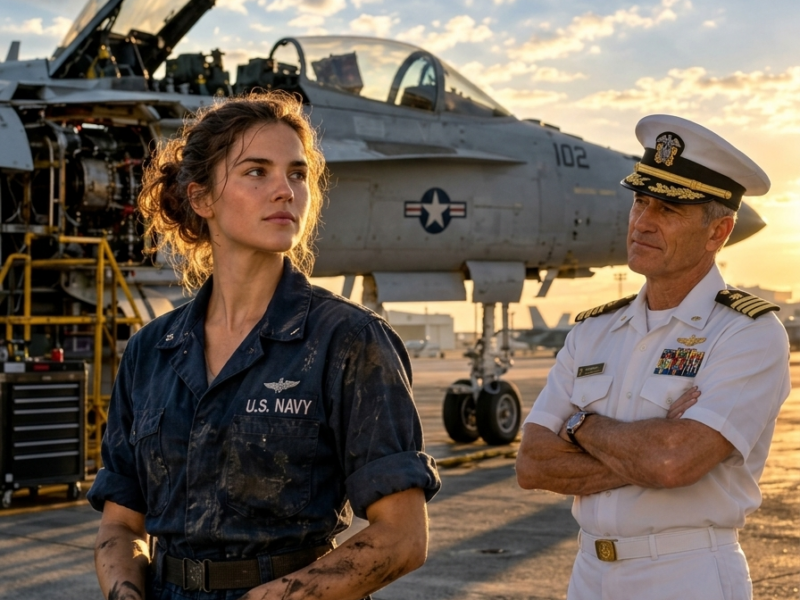
The admiral laughed in front of the entire hangar when he pointed at the dead F-18 and told me, “Fix this jet and I’ll make you a Navy SEAL,”
The concrete apron of Hangar 4 at Naval Air Station Oceana stayed freezing well into April. The salt mist blew off the Atlantic, creeping through the cracked seals of the four-story hangar doors, mixing with the sharp odors of hydraulic fluid, dry sulfur, and burned turbine wash. I liked the cold because it kept the shop quiet. At twenty-six, my rank didn’t exist on any naval roster; I was a GS-9 civilian contractor with an airframe and powerplant rating, grease worked so deep into the cuticles of my thumbs that no orange pumice soap could touch it. To the flight crews and the deck officers, I was just Miller—a thin silhouette in washed-out coveralls with a magnetic parts tray balanced on her knees and an oil-blackened rag tucked into her hip pocket.
Nobody asked why I worked the night shift. Nobody asked why I stayed three hours after punch-out to organize copper crush washers or micrometer the landing gear shims on jets that weren’t assigned to my line. If they had asked, I would have told them that machinery is honest. A sheared bolt doesn’t lie to you about why it failed. A high-pressure fuel pump doesn’t have an agenda. It works until the metal fatigues or the tolerances drift, and then it stops. Men were the ones who made things messy.
The F/A-18C Hornet sitting in Bay 6 was the messiest thing on base. Its tail code was faded, its canopy yellowed by ultraviolet glare, and its dull gray skin wore chalk marks from three separate depot-level inspection teams dating back nearly eight months. The red tags hanging from its pitot tubes read SCRAP / DISPOSITION PENDING. The starboard engine bay had been gutted for spare turbine stages; the avionics bays had been stripped of their primary mission computers; and the braided hydraulic trunk lines in the belly had been sawed through with a coarse blade during an undocumented de-servicing sweep. It was a carcass. A hangar queen meant to be picked clean until the skeleton was sold off for aluminum scrap.
Then the side access hatch rattled open, and the temperature in the bay dropped another ten degrees.
Admiral Thomas Walker didn’t travel without a cortege. He wore the working khakis of a flag officer who wanted people to know he had once lived in a cockpit, three gold stars glinting on his collar points, his chest ribbon stack neat and narrow. Behind him walked four junior strike-fighter pilots from VFA-106—boys with freshly pressed flight suits, high skin-fades, and the sharp, restless posture of wolves who hadn’t smelled combat yet.
Walker’s eyes didn’t linger on the active birds being prepped for dawn sorties in Bays 1 and 2. He came straight down the yellow safety line toward Bay 6, his boots striking the sealant-coated floor with deliberate weight.
“Miller,” he said. He didn’t raise his voice, but the acoustic curve of the hangar roof caught it and threw it back down.
I set my half-inch torque wrench on the rolling cart, wiped my palms down the thighs of my coveralls, and turned around. “Admiral.”
“The master chief tells me you’ve been putting hours against this airframe on your own time,” he said. His gaze flickered over the stripped port intake, taking in the dangling harnesses and the gray dust coating the wing root. “He says you think she can be turned back over to the line. He says you think you can fix anything that has a serial number.”
A soft, collective snicker came from the pilots behind him. One of them, a lieutenant with a sharp chin and callsign patches fresh off the embroiderer, folded his arms and smirked at the dead landing gear.
“I didn’t say that, sir,” I answered evenly. “I told the chief that the spar isn’t twisted. The logbook shows zero over-G incidents on its last ten hops before it was pulled from the flight schedule.”
“She’s dead iron, Miller,” Walker said. His smile was thin, practiced, the kind of smile officers used right before they signed administrative reprimands. “Her harness is charred from the cockpit back to the tail-hook actuator. The depot in Jacksonville washed their hands of her. But you think you know something three master chiefs and a NAVAIR engineering team missed?”
“I think metal doesn’t die of old age unless you let water sit on it,” I said.
The lieutenant with the chin chuckled out loud this time. “Hear that, sir? A wrench thinks she’s a flight surgeon.”
Walker raised one finger, silencing the pilot without looking at him. His eyes remained locked on my face, searching for something in my jawline or the set of my shoulders that had nothing to do with naval aviation. “Tell you what, Miller. We’ll make a deal. The Navy spends eight million dollars training a pilot, but we spend ten times that trying to find people who don’t crack when the metal starts screaming. You get that bird’s auxiliary power turned over before breakfast—you get an engine spinning in that empty hole—and I’ll sign the paperwork to send you to Coronado myself. I’ll make you the first civilian mechanic to test into the Teams.”
The pilots behind him broke into open laughter now. It was the safe, cruel laughter of men who knew the odds were impossible. A jet with no engines, no computers, and a sliced hydraulic harness could no more start than a tombstone could sing.
“I don’t need to go to Coronado, Admiral,” I said. “I like it here.”
“Then do it for the pride,” Walker said, his voice dropping into a mocking challenge. “Or don’t. And I have the tractor out here at noon to haul this junk to the salt marsh for target practice.”
He stood there, waiting for me to lower my eyes.
I didn’t look down. Instead, I walked past him, grabbed my pneumatic cutter, an inspection mirror, and an LED snake-light from the tool rack, and slid under the Hornet’s belly on a canvas creeper.
The belly of an F-18 is a maze of titanium ribs, fuel transfer tubing, and miles of Teflon-coated wiring. When a jet is stripped for parts, mechanics work fast; they cut zip-ties, leave tags, and pull harnesses out through the maintenance doors like gutting a deer. But as I rolled my creeper directly under the center line station, shining the beam up into the dark cavity where the auxiliary power unit fuel pump should have been, my fingers hit something cold and smooth.
It wasn’t military-spec wiring.
A mil-spec harness is braided in dark Nomex or heavy green nylon, banded with stamped aluminum sleeves every twelve inches showing circuit IDs. This was a single run of flat, four-conductor ribbon cable, wrapped in black self-vulcanizing tape that looked no more than a few years old. It didn’t route to the distribution bus behind the nose gear. It ran aft, tucked deep into the hollow cavity of the titanium keel beam—an area no routine pre-flight or phase inspection would ever touch unless the airframe had suffered a cataclysmic structural break.
I followed it with my fingertips. The ribbon terminated at an avionics inspection plate just forward of the arrestor hook well.
The plate was steel, not aluminum. And its four mounting screws hadn’t been torqued down. They had been tack-welded with an oxygen-acetylene bead, then ground flat and sprayed with zinc-chromate primer to match the surrounding bay.
“What are you doing under there, Miller?” Walker’s voice drifted in from the nose gear. His tone had lost its playful edge; it was tight, clipped at the margins.
“Looking at the ground connections,” I shouted back, my voice vibrating against the aircraft’s skin.
“Come out from under that deck,” an older master chief from the maintenance pool called from near the tool cart. “Miller, leave the scrap alone. Let the Admiral have his joke.”
I didn’t move. I set the pneumatic cutter against the corner of the welded plate. The high-pitched scream of the air-motor filled the bay, spitting yellow sparks onto my leather sleeve as the carbide bit chewed through the soft steel weld.
“Miller!” Walker’s boots moved sharply around the port tire. “I ordered you out from under that jet.”
The weld popped with a sound like a pistol shot.
I dropped the tool, jammed a flathead screwdriver into the seam, and pried the plate back.
Inside the beam wasn’t empty space. Tucked into the keel, secured with heavy-duty vibration dampers, was an aftermarket solid-state drive housing—unmarked, anodized black, roughly the size of a paperback book. From its forward interface sprouted a bypass bridge that tapped directly into the F-18’s primary emergency flight bus, splicing cleanly into the digital flight data recorder circuit.
The entire bay above me suddenly dropped into dead silence. The boots stopped moving.
I didn’t touch it. I stayed on the creeper, staring at the little black block. On its face was a single red light-emitting diode.
Then the diode flashed green.
A relay clicked deep within the forward fuselage—a sharp, mechanical clack-whir that vibrated straight through the fuselage into the creeper frame.
“What did you touch?” the lieutenant’s voice asked, no longer laughing. “Why is there power on the line? That jet has no battery installed.”
I slid the creeper out from under the belly, stood up, and wiped my grease-covered hands on my hips. Walker was standing less than two feet away. His face wasn’t amused. The color had pulled away from his lips, leaving a yellowish tint around his nostrils.
Above us, the Hornet’s cockpit displays didn’t just flicker. The twin DDI screens on the instrument panel glowed green in the dim hangar light. Then came a deep, hydraulic groan from the rear fuselage as the horizontal stabilators twitched, searching for neutral trim.
“Miller,” Walker whispered, and this time his hand drifted toward the leather holster strapped to his belt—an abnormal carry for a flag officer inside a domestic maintenance hangar. “Get away from the ladder.”
I didn’t listen. My boots hit the kick-steps on the port side before he could move. I hauled myself up the sill, my hands landing on the worn canopy frame, and dropped into the ejection seat.
The master arm switch was safed. But the mission computer display was scrolling lines of hex code that didn’t match any tactical software I had ever loaded into an active Hornet. At the bottom of the screen, beneath the synthetic attitude indicator, two green words were burned into the phosphor:
RECOVERY PROTOCOL: ACTIVE.
From behind the cockpit bulkhead, in the empty starboard bay where no engine was supposed to exist, a turbine started to whine.
It wasn’t an F404 engine. It was an internal auxiliary turbine—a high-output starter unit buried deep in the center fuselage that had been plumbed into the fuel lines using the emergency cross-feed valve. The sound was high, piercing, like an electric drill spinning up to fifty thousand revolutions per minute.
“Shut it down!” Walker roared from the hangar floor. He was halfway up the boarding ladder now, his fingers clawing at the rim of the cockpit. “Shut the breaker! Miller, that’s an order!”
I didn’t reach for the breaker. I reached for the communication headset hanging from the canopy bow, sliding the heavy rubber cups over my ears and flipping the toggle to the internal intercom circuit.
The noise of the screaming turbine cut out, replaced by heavy, rhythmic static.
Then the static parted.
“If you’re hearing this,” a voice said through the headset, “trust nobody.”
The voice wasn’t synthetic. It wasn’t recorded off a modern digital bus. It was grainy, compressed through an old ceramic microphone, carrying the background whine of an older twin-seat Tomcat.
It was my father’s voice.
Commander David Miller. The man whose flag-draped box of personal effects had been delivered to our house in Virginia Beach when I was fourteen years old. The man who had allegedly flown an experimental test platform into the sea seventy miles off Cape Hatteras during a routine night-navigation exercise.
“The logbooks were scrubbed at Pax River,” the voice continued, slow, measured, the voice of an aviator who knew he was running out of sky. “The flight you’re looking for didn’t crash. It was recovered under hull number 04-Alpha. If the plane is alive, Walker is already there. Run.”
The transmission cut with a loud pop of electrical discharge.
I sat frozen in the seat, my heart slamming against my ribs like a trapped bird. Outside the canopy, Admiral Walker reached the top step. His cap had fallen off, his gray hair wild around his temples. He wasn’t smiling. His face was gray, his eyes wide and fixed on the glowing screens in front of me.
He reached over the rail and hit the emergency canopy release handle, the canopy glass hissing as the pneumatic pressure dropped.
“Where did you find that?” he demanded, his voice cracking on the final syllable.
I looked at him through the narrow gap. The smell of his expensive aftershave was swallowed by the stink of hot oil from the starter turbine. “Why do you know what it is, Admiral?”
Walker didn’t reach for the master switch. He looked past my shoulder, down into the footwell where the auxiliary data lines disappeared behind the rudder pedals, and then he leaned in close enough that I could see the broken red veins in his eyes.
“Your father wasn’t killed in an accident,” he whispered.
The turbine behind us surged, its pitch rising to a deafening shriek that shook the hangar windows, and the joke about making me a SEAL suddenly felt like the execution sentence it had always been.
The auxiliary turbine was spinning so fast the cockpit floorboards vibrated through the soles of my boots. In the hangar below, the four young pilots weren’t laughing anymore. They had backed up thirty paces, their hands up against the deafening wash of hot exhaust rolling out from the starboard cavity, their postures broken by the sheer impossibility of what they were witnessing.
“Get down from the platform, Miller,” Walker said. His voice was barely audible over the mechanical whine, but the urgency in his face needed no translation. “Now. Before I have the security detachment drag you down.”
“You said he went into the drink,” I shouted, keeping my hands resting flat on the cockpit combing, inches from the emergency throttle controls. “You sat in our living room with the chaplain. You told my mother that the wreckage was in five thousand feet of water and the current took him.”
“And if I had told her the truth, she would have been dead by morning, and you would have grown up in a state home,” Walker hissed. He reached into his khaki pocket, not for a gun, but for a small electronic keycard on a lanyard. He held it out toward me. “The people who wanted this airframe crushed aren’t on this base, Miller. They’re sitting three miles from the Pentagon in Arlington, and they’ve had an automated satellite alert linked to that keel bus since 2014. The moment you powered that solid-state unit, an alert ping went out through the defense data network. We have less than ten minutes before the Base Commander’s office gets a phone call that overrides my stars.”
“Why this plane?” I asked, refusing to move. “This is an early-lot C-model. It’s thirty years old.”
“It’s not a C-model,” Walker said, his knuckles turning white where he gripped the canopy sill. “It’s the prototype for the Link-16 secure tactical reconnaissance bridge. Your father flew it out of Naval Air Station Patuxent River the night he vanished. He didn’t crash off Hatteras. He landed it at a decommissioned marine airstrip in North Carolina, pulled the optical storage drives from the nose, and buried this machine inside a dead-line logistics manifest under a false tail number.”
“To hide what?”
“A recording of an intercept over the Barents Sea,” Walker said. His eyes flickered toward the hangar doors. “An intercept that showed an American carrier group commander letting an unflagged cargo ship pass through the blockade with four hundred crates of advanced radar components destined for a shipyard in Murmansk. The man who gave that order is currently the vice chief of naval operations. And he believes this plane was scrapped in Georgia six years ago.”
The realization hit me like a blow to the gut. The F-18 hadn’t been abandoned because it was worthless. It had been kept in plain sight, listed as dead inventory, moved from hangar to hangar by clerks who didn’t know what they were stamping, while my father hid the evidence inside the only safe place he knew: an aircraft whose flight systems only he had mapped.
“If the Vice Chief knows,” I said, “then you’re here to finish what he started.”
“I was David’s wingman for six years, you stupid girl,” Walker snarled, his mask of command slipping completely, revealing the bitter, exhausted old man beneath it. “I’ve spent twelve years keeping this bird from being towed to the shredder without drawing attention to myself. I came down here tonight because I heard an airframe mechanic was digging around Bay 6. I thought you were one of their inspectors. When I saw your name on the duty sheet—Miller—I thought… I thought God had a sick sense of humor.”
A sharp whistle cut through the bay.
At the main security gate two hundred yards down the taxiway, a pair of blue-and-white Navy Security Force patrol trucks screeched to a halt, their light bars throwing flashes of crimson and sapphire against the high corrugated metal walls. Four armed sailors in tactical vests jumped out, carrying M4 carbines across their chests. They weren’t moving like a routine patrol. They moved in a wedge, heading straight for Hangar 4.
“They didn’t waste any time,” Walker muttered, glancing over his shoulder. He looked back at me, his eyes hard and cold. “You want to know who your father was? You want to know why you’ve spent your life turning wrenches on other people’s airplanes instead of flying your own? Then climb out of that seat and help me get that drive out of the keel.”
“We can’t,” I said.
Walker paused, his hand halfway to the ladder rung. “What do you mean, we can’t?”
“The bypass harness,” I said, pointing down between my knees. “The drive isn’t just storing data. It’s running the system. The moment the solid-state unit detected external battery power, it loaded a secondary operating system into the flight management computers. It’s writing over the naval firmware. If you pull that drive now, the whole system initiates an emergency purge. It wipes the flash memory in three seconds.”
“Then what does it want?”
“It doesn’t want anything,” I said, looking at the glowing HUD repeater. “It’s an automated recovery route. My father programmed it before he died. Look at the navigation coordinates.”
Walker leaned his torso into the cockpit, squinting at the small alphanumeric display on the up-front control panel.
The target waypoint wasn’t Oceana. It wasn’t Norfolk. It was a set of geographic coordinates sixty miles south-southwest—an old logging strip in the Great Dismal Swamp that had been abandoned by the Forestry Service since the late eighties.
“It’s not just a storage drive,” I said, my heart pounding so hard I could hear it in my teeth. “It’s a flight plan. If this jet had two working F404s, it would be trying to take off right now.”
“Well, it doesn’t have two working engines,” Walker snapped. “It has one auxiliary turbine that wouldn’t push a lawnmower down the ramp. Miller, look at the door. We have sixty seconds before those security cops put zip-ties on our wrists and throw us into a black van.”
The security detail was thirty yards from the hangar entrance now. The junior pilots from VFA-106 were backing away toward the lockers, wanting nothing to do with the armed sailors marching into the bay. The lead master-at-arms had his hand on his sidearm holster, his eyes fixed on the Admiral.
“Admiral Walker!” the security petty officer shouted, his voice echoing off the corrugated iron. “Sir, I have orders from Base Command to secure this bay and detain all civilian personnel pending the arrival of NCIS.”
Walker didn’t turn around. He stayed on the ladder, his face inches from mine.
“You said the spar wasn’t twisted,” he whispered.
“It’s not,” I replied.
“You said the hydraulic trunk was only cut at the center line.”
“I can bypass the actuators with manual isolation valves in ninety seconds,” I said, the mechanic in me answering before my brain could process the madness of what was happening. “The emergency gear-blow bottle is still charged. But there’s no thrust, Admiral. You can’t taxi a jet on an APU.”
“We don’t need to taxi,” Walker said. He reached down to his belt, unclipped a set of heavy brass keys, and threw them into my lap. “The heavy tow-tractor outside Bay 4. It’s hooked up to the engine-transport trailer from the depot. There’s a crated, hot-tested GE engine sitting on that deck that was meant for Bird 201’s morning swap. If you can get that engine into this bay before those sailors clear the threshold, we have a chance.”
“A chance at what?”
Walker dropped down to the floor, turning to face the four armed sailors with his chest out and his stars shining. “A chance to show them why David Miller never left a wingman behind.”
The heavy steel doors of the engine-transport bay slammed back against their rollers with a sound like thunder.
“Admiral, with all due respect, you need to step away from the civilian!” The security petty officer had his hand flat against his chest-rig, his M4 still slung, but his voice was trembling. You don’t pull steel on a three-star admiral unless the man on the other end of the radio has four stars and a presidential commission, and the petty officer knew it.
Walker didn’t shout. He used the flat, terrifying voice that admirals use when they are prepared to end careers with a stroke of a pen. “Petty Officer, this bay is under a classified operational readiness evaluation by order of the Chief of Naval Operations. If you take one more step across that yellow safety boundary without a written directive bearing my personal clearance stamp, I will have you broke to seaman recruit and chipping paint on an oiler out of Diego Garcia before the sun comes up.”
The sailor hesitated, his boots skidding half an inch on the slick sealant.
That was all the time I needed.
I hit the starter button on the diesel tug parked between Bays 4 and 5. The six-cylinder Cummins engine roared to life with a cloud of black exhaust, rattling the grease trays on my workbench. I didn’t bother checking the mirrors. I slammed the transmission into reverse, dropped the heavy pintle hitch onto the towing bar of the hydraulic lift trailer, and dragged the crated F404-GE-402 engine backward toward Bay 6.
To an outsider, an aircraft engine replacement—an “engine swap”—is an eighteen-hour job for an entire six-man line crew. It requires overhead cranes, three different torque wrenches, hydraulic bleed kits, and thick manuals full of safety wire procedures.
They didn’t know how I worked.
For five years, I had rebuilt these engines in my sleep. I knew every three-quarter-inch mounting bolt, every quick-disconnect fuel coupling, and every single-pin cannon plug by the texture of the metal alone. The crated engine on the trailer was a “plug-and-play” replacement unit—fully serviced, oiled, and pre-rigged for rapid installation on carrier decks under combat conditions.
“Miller!” the master chief shouted, rushing out from the tool room with a massive two-inch socket wrench in his hand. He wasn’t looking at the security guards. He was looking at me, his weathered old face pale with sudden, terrifying understanding. “The aft trunnion pins aren’t aligned! You’ll snap the rail!”
“Jack the starboard strut two inches!” I screamed back, throwing the tug into neutral and jumping from the seat before the tires had even stopped spinning. “Master Chief, get that hoist chain onto the forward sling! Move!”
The chief didn’t ask questions. Decades of salt and grease take over when an engine starts swinging. He grabbed the pneumatic lift control, and the massive three-ton crane arm on the mobile trailer rose with a pneumatic hiss, hoisting the sleek, bare titanium cylinder of the turbine engine level with the open starboard bay of the Hornet.
The armed security sailors tried to push past the Admiral.
“Hold your ground!” Walker bellowed, stepping directly into the petty officer’s path, his chest almost touching the muzzle of the slung rifle. “You want to arrest me, son? Go ahead. Unholster that sidearm. Do it in front of six witnesses and four active flight cameras, and see how long your career lasts.”
Behind Walker’s back, I shoved the heavy engine carriage forward along the alignment tracks. The metal shrieked as dry steel met aluminum guide rails.
“The fuel coupling!” I yelled at the chief. “Main line twelve-B! Don’t torque it, just lock the quick-disconnect!”
My hands were bleeding. The sharp edges of the stainless-steel firewalls chewed through my palms as I jammed the thick bundles of electrical cables back into their sockets. One click. Two clicks. The three-pin thermocouple sensor snapped into place with a dry crack.
“Hydraulics are still severed at the rudder!” the chief shouted, his face purple from hauling on the alignment bar. “You won’t have control surfaces, girl! You’ll be flying a brick!”
“The trim tabs are electric!” I reached into the bay, grabbed a pair of manual isolation levers on the primary manifold, and yanked them ninety degrees downward until the seals locked with a metallic thunk. “I don’t need the rudders. I just need horizontal stabs and fuel.”
From the cockpit above, the auxiliary turbine had reached its peak frequency. The screens were flashing amber now: SYSTEM ENGINE SPLIT: STARBOARD STATUS PENDING.
I grabbed the heavy three-quarter-inch drift pin, jammed it through the forward mounting lug, and hit it with a five-pound brass mallet until the shoulder seated flush against the airframe keel.
One bolt.
In a normal maintenance cycle, there were four primary mount bolts and sixteen secondary stabilizer brackets. We were holding a thirty-thousand-pound-thrust engine to an aging airframe with one primary pin and the friction of the maintenance rails. If the turbine hit full afterburner, the entire assembly might rip out through the tail and tear the empennage off the fuselage.
“It’s seated!” I screamed, dropping the hammer onto the concrete.
“Clear the bay!” Walker yelled. He didn’t wait for the security guards to recover from their shock. He turned, grabbed the boarding ladder with both hands, and hauled himself up toward the cockpit steps like an aging sailor boarding a ship under fire.
“Walker!” a new voice boomed across the hangar.
At the main entrance, standing in front of three black government sedans that had just roared into the bay, was a man in civilian clothes—a heavy woolen overcoat, leather gloves, and a face as flat and featureless as an anvil. Behind him were two men in dark windbreakers with yellow letters across the back: NCIS SPECIAL AGENT.
“Admiral Walker,” the man in the overcoat called out, holding up a laminated badge. “By direction of the Vice Chief of Naval Operations, your command authority is suspended. Clear the aircraft immediately.”
Walker didn’t even look back. He scrambled over the rail, hit the canopy toggle, and the heavy acrylic bubble began to slide forward on its tracks, hissing as the pneumatic seals inflated around the rim.
“Miller!” he yelled into the slipstream. “Get in or get out!”
I looked at the men in the windbreakers. I looked at the master chief, who had already stepped back into the shadows of the tool room, his hands raised in surrender. Then I thought of my father—twelve years in a cold grave that didn’t have his bones in it, while men in wool overcoats moved papers across mahogany desks in Washington.
I grabbed the forward handhold, vaulted onto the trailing edge of the wing root, and squeezed my body into the narrow space behind the ejection seat just as the canopy locked down with a sickeningly final mechanical chunk.
There were no spare seats. The C-model was a single-place fighter. I was wedged between the back of the Martin-Baker seat and the electronic warfare equipment rack, my knees tucked against my chin, smelling the copper dust and the sharp ozone of the live circuit breakers.
“Start the starboard engine!” Walker shouted through his mask, flipping the red-guarded engine crank switch on the lower left console.
The crated engine we had just jammed into the belly groaned. The starters caught. A low, subterranean rumble rolled through the floorboards as fifty gallons of JP-5 fuel per minute flooded into the combustion chambers.
Outside, the man in the overcoat drew a semi-automatic pistol from his pocket and leveled it directly at the nose wheel.
“Hold on to something metal,” Walker muttered.
He reached down, grabbed the emergency throttle quadrant, and shoved the lever forward to eighty percent military thrust.
The acceleration didn’t feel like a car or a train; it felt like a freight elevator that had snapped its cables and was falling sideways.
Because the port engine bay was empty, the asymmetrical thrust hit the airframe like a giant sledgehammer. The Hornet lurched violently to the left, the tires screaming against the hangar sealant as Walker stomped the right toe-brake with all his strength to keep the nose from smashing through the concrete support pillars.
The blast of the single F404 engine erupted inside Hangar 4 with apocalyptic violence. Tool cabinets weighing four hundred pounds were lifted off their wheels and flung against the back wall. The black government sedans parked at the entrance had their windshields blown inward by the sheer concussive pressure of the exhaust, their hoods buckling as the eight-hundred-degree heat ignited the paint on their panels.
The men in the windbreakers scattered, diving behind the thick concrete pillars as the jet blasted through the hangar threshold out onto the freezing, rain-slicked taxiway.
“Gear’s pinned!” I screamed into the cockpit, my lips inches from Walker’s flight helmet. “The ground-safety locks are still in the struts! You can’t retract the landing gear!”
“Good!” Walker yelled back, his shoulders hunched over the stick, his hands fighting the wild, shuddering vibration coming up through the control column. “The drag will keep the speed down! If we hit two hundred knots, that single mount pin you hammered in is going to shear like a wooden match!”
We weren’t on a runway. We were on Taxiway Bravo, a narrow stretch of concrete lined with yellow taxi lights and drainage culverts. Ahead of us, half a mile out, was the southern perimeter fence of NAS Oceana—ten-foot chain link topped with six strands of razor wire, beyond which lay the dark, sodden expanse of the Virginia timberland.
“Tower’s killing the field lights!” I shouted.
The blue taxiway markers winked out in unison. The world went black, save for the sickly green wash of the instrument displays and the dull orange glow of the engine instruments showing the starboard turbine temperature climbing through seven hundred degrees Celsius.
EGT WARNING. OIL PRESSURE SPLIT.
“Walker, pull!” I cried. “The ditch!”
Walker didn’t pull the stick back with his fingers; he hauled it into his gut with both arms, bracing his boots against the rudder pedals.
The Hornet’s nose rotated. The nose gear left the blacktop with a sickening clatter as the tires struck the lip of the storm drain, and then the single engine found clean air. The jet climbed into the rainy night like an injured hawk, dragging its heavy landing gear through the tops of the sweetgum trees along the perimeter road, branches snapping against the titanium belly with the sound of machine-gun fire.
Behind us, the blue lights of five different emergency vehicles swarmed onto the runway, their sirens lost in the roar of our turbine.
“We’re airborne,” Walker panted. His visor was fogged with sweat, his breath ragged inside his oxygen mask. “Talk to me, Miller! What’s the heading?”
I pulled myself up higher against the back of his seat, my fingers finding the edge of the up-front control panel. The little solid-state drive had taken full possession of the navigation system now. The waypoint needle on the horizontal situation indicator wasn’t drifting. It was pointing dead steady at two-one-five degrees.
“Heading two-one-five,” I said. “Keep it below a thousand feet. If you climb, the radar at Dam Neck will paint us, and they’ll have two ready-alert birds off the deck at Langley before we cross the state line.”
“They won’t scramble from Langley,” Walker said grimly, banking the shuddering aircraft south over the dark woods of Chesapeake. “The Vice Chief won’t use Air Force birds. He can’t explain why an F-22 shot down a Navy jet over Virginia. He’ll use the security team from Little Creek. He’ll wait until we’re on the ground.”
The Hornet flew like a wounded animal. Without hydraulic pressure to the port side, the right aileron had to carry the entire rolling load, forcing Walker to hold twenty pounds of left pressure on the stick just to keep the wings level. Every time the engine surged, the single mounting bolt groaned in its housing, sending a sharp, metallic shiver straight through the bulkhead into my spine.
“The recording,” I said, leaning close to his ear. “In the hangar. You said my father wasn’t killed in an accident. You said he was murdered.”
Walker’s hands stayed rock-steady on the stick. Below us, the scattered lights of suburban Virginia fell away, replaced by the endless, black void of the Great Dismal Swamp—hundreds of square miles of peat bogs, blackwater canals, and dense cypress stands.
“Twelve years ago,” Walker said, his voice flat through the cockpit intercom, “your father called me from a payphone in Elizabeth City. He told me he had the optical disks from the Barents Sea incident. He told me the Vice Chief—he was a two-star then, running the carrier strike group—had doctored the logs to show our planes were fifty miles away from that Russian freighter. David knew they were going to erase the records at Pax River. So he stole the test bird.”
“Why didn’t he go to the press?”
“Because the press doesn’t understand naval radar telemetry, Miller,” Walker said bitterly. “They would have called him a paranoid crackpot, and he would have spent the rest of his life in Leavenworth. He wanted to deliver the drives directly to the chairman of the Senate Select Committee on Intelligence. But his contact was dirty. The night he was supposed to meet them at the logging strip, his truck was run off Highway 17 into three feet of swamp water. When they pulled him out, his lungs were full of water, but there wasn’t a scratch on the car. They ruled it a DUI drowning.”
My throat felt like dry paper. “They killed him for eight gigabytes of radar logs.”
“They killed him for thirty pieces of silver,” Walker corrected. “And they spent the last twelve years trying to locate the plane. They thought he hid the disks somewhere on base. They never realized he had coded the decryption key into the aircraft’s own keystone flight bus.”
The master caution tone chimed three times.
HYD PRESS STARBOARD: 800 PSI.
The pressure in our only working hydraulic system was dropping fast. The bypass valves I had jerry-rigged in the hangar were failing under the vibration; the fluid was blowing out into the exhaust path in a fine, atomized mist.
“We’re losing the controls,” Walker said, his voice dropping into the quiet cadence of a combat pilot facing the inevitable. “Miller, look for the runway. We have about two miles of glide left before this stick goes limp.”
I pressed my face against the cold side glass of the canopy, staring down into the darkness.
There were no lights. Nothing but the vast, black velvet of the marsh stretching toward North Carolina.
Then, three miles ahead, cutting through the dense cypress canopy like a silver needle, I saw it: a long, perfectly straight line of black asphalt, overgrown with weeds, flanking the western bank of the Dismal Swamp Canal.
“There!” I pointed over his left shoulder. “The old forestry strip! At ten o’clock!”
“Gear is already down,” Walker muttered. “No flaps. No anti-skid. And the brakes are going to be dry the second I tap them.”
“Just put the nose on the black, Admiral,” I said, reaching down and bracing both my feet against the heavy titanium frames of the lower bulkhead. “I didn’t rebuild that engine for you to leave it in the mud.”
Walker pulled the throttle to idle.
The engine died with a long, wheezing groan. The silence inside the cockpit was instantaneous, terrifying, broken only by the violent rush of sixty-mile-an-hour wind whistling through the unsealed canopy edges. The Hornet sank like a stone through the freezing mist, heading straight for the black trees.
The landing wasn’t a flare; it was a controlled crash.
The main gear struck the broken asphalt of the abandoned strip with a violence that made the instrument panel jump six inches on its rubber shock mounts. The port tire blew out instantly, shredded by thirty years of blackberry briars and buckled concrete, sending the Hornet spinning into a violent ground-loop.
The starboard wing dipped, the composite tip digging into the soft peat of the ditch line, ripping the missile rail off with a screech of tearing metal. We slid sideways for two hundred yards, throwing up a rooster-tail of black mud, dead wood, and swamp grass, before the nose wheel collapsed into an old drainage trench and the aircraft came to a shuddering, dead stop.
Inside, the silence returned, heavier this time.
The only sound was the clicking of the cooling turbine blades and the steady, rhythmic drip-drip-drip of fuel leaking onto the wet earth.
Walker didn’t move for five seconds. Then he hit the manual canopy release.
The acrylic shell swung back with a wet pop. The air that rushed into the cockpit was cold, sweet with the smell of decaying pine needles and wet moss, completely free of the kerosene stench of Oceana.
“Miller,” Walker grunted, his fingers fumbling with his lap belt. “You still in one piece back there?”
“My ribs are bruised,” I said, crawling over the back of the seat and dropping down onto the muddy wing. “The airframe’s dead, Admiral. The spar cracked on impact.”
“She did her job,” Walker said. He climbed down after me, his khaki trousers soaked to the knees in swamp water as he hit the ground. He didn’t look like a three-star admiral anymore; he looked like a survivor from an open-water raft, his hair caked with mud, his face lined with deep exhaustion.
He didn’t waste time. He pulled a heavy flathead pry-bar from the emergency kit behind his seat, walked straight to the Hornet’s belly, and reached into the shattered keel beam.
The black solid-state drive had survived the crash. The little green light was still blinking, powered by an internal lithium cell that had twenty minutes of operational life left.
Walker wedged the pry-bar into the retaining clip, popped the unit free, and held it in his palm. It looked small, pathetic against the massive carcass of the thirty-million-dollar fighter rotting in the ditch behind us.
“Now what?” I asked, shivering in my thin coveralls as the swamp wind cut through the grease. “There’s no phone out here. There’s no tower.”
“We don’t need a tower,” Walker said.
He turned toward the tree line on the western side of the overgrown strip.
From the shadows of the cypress trees, two sets of headlights flickered on. They weren’t military vehicles. They were old, battered four-wheel-drive pickup trucks with Virginia agricultural plates. A man in an oilskin jacket stepped out from the lead truck, carrying an ancient steel lantern and a thermos bottle.
He was seventy years old, with white hair cut to the scalp and the unmistakable bearing of an old carrier boatswain.
“You’re late, Thomas,” the old man said, his voice gravelly, cutting through the marsh mist.
Walker let out a long, ragged breath that looked like smoke in the headlights. “We had to pick up an extra passenger, Jack.”
The old man walked closer, holding the lantern up to my face. His eyes were pale blue, watery from the wind, but they widened as he looked at my cheekbones, my grease-stained hands, and the name tape on my coveralls that read MILLER.
“David’s girl?” the old man asked softly.
“This is Jack Vance,” Walker said to me. “He was the command master chief on the Roosevelt the night your father flew his last mission. He’s the one who hid the physical paperwork before the NCIS teams boarded the ship.”
Vance reached out with a rough, calloused hand and touched my shoulder. “Your father was the finest stick in the fleet, young lady. He didn’t break. Not once. When they told him what they were going to do to his flight records, he told the admiral to his face that he’d see him hanged in front of the Navy Memorial.”
“We have the drive, Jack,” Walker said, holding up the black box. “The whole mission telemetry is intact. The radar tracks, the encrypted voice loops, the satellite transponder handshakes—all of it.”
“The Senator’s plane is waiting at the regional field in Edenton,” Vance nodded toward the south. “We have twenty minutes before the state police start closing the bridges on Highway 17. The radio says Oceana has declared this a stolen aircraft incident. They’re telling the news it was an unauthorized civilian joyride.”
“Let them say what they want,” Walker said. He turned back to me, holding the drive out between us. “This belongs to you, Miller. You’re the one who turned the key. You’re the one who brought the dead bird home.”
I looked at the black box. It was cold, wet with hydraulic fluid and swamp rain, but inside it were the only words my father had left behind for me—the proof that he hadn’t died in a drunken spin into the Atlantic, that he hadn’t abandoned his family for a mistake in the clouds.
“No,” I said, pushing his hand back. “You take it to Washington, Admiral. You finish the fight with the Vice Chief.”
Walker frowned. “And what are you going to do?”
I looked past him at the F-18 sitting broken in the ditch. The port engine bay was an empty black hole; the starboard turbine was ruined, half-buried in the mud; the landing gear was bent like paperclips. But its spine was still straight. It was still a machine that had done exactly what it was designed to do when a mechanic who cared enough gave it the chance.
“The master chief at Oceana has three birds down for phase maintenance in Hangar 2,” I said, wiping a streak of black grease from my nose with the back of my hand. “And nobody on that base knows how to tune an emergency fuel-metering valve except me.”
Walker stared at me for a long beat. Then, slowly, the old three-star admiral clicked his heels together in the mud, brought his right hand up to the brim of an imaginary cap, and gave me the crispest, sharpest salute I had ever seen.
“Carry on, Miller,” he said.
“Understood, sir,” I answered, not saluting back, but reaching into my pocket for my rag to wipe the cold rain from my tools.
The trucks pulled away into the cypress dark, their red taillights disappearing down the logging trail toward the highway, carrying twelve years of lies to the light.
I stayed on the wing of the broken Hornet for five more minutes, listening to the wind in the reeds, waiting for the sirens that I knew were coming, perfectly content to wait in the cold with the only machine that had never told me a lie.
The end.









