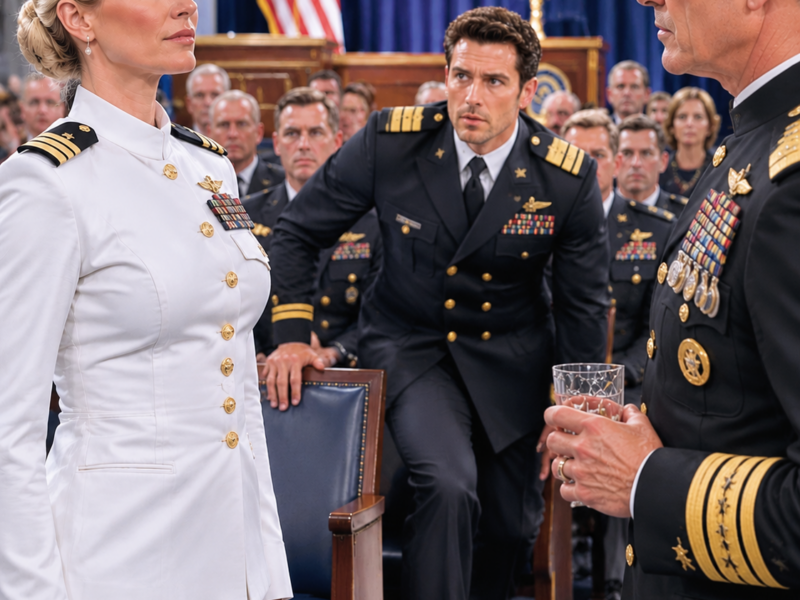
“The admiral asked me for my call sign in front of hundreds of elite military officers, expecting the room to laugh when I admitted I didn’t have one
The room stayed silent after Daniel finished speaking.
Not the polite silence of a military ceremony.
This was the kind of silence that comes when everyone knows a name is about to be spoken, and nobody is certain they want to hear it.
Admiral Mason Crowe lowered his program.
“Senior Chief Mercer,” he said, “you have made your point. Return to your seat.”
Daniel didn’t move.
“With respect, Admiral, I haven’t made it yet.”
A few people shifted in their chairs.
I stood beside the stage, my hands locked together so tightly that my fingers had begun to ache.
The metal identification plate in the operator’s hand caught the overhead light.
I recognized the shape before I could read the name.
It was old military issue, scratched along one edge, with a dark stain that had settled into the grooves.
The man holding it was Petty Officer First Class Caleb Rourke.
I remembered Caleb from the operation.
He had been twenty-nine, quick with a dry joke, and incapable of walking past a broken piece of equipment without trying to fix it.
He had been the last man I heard clearly before the radio went quiet.
Daniel turned toward the audience.
“Three years ago, during Operation Silent Harbor, our team was sent to extract a source from a compromised location. We were told the northern route was clear. It wasn’t.”
Crowe’s expression tightened.
“That operation remains classified.”
“Yes, sir. The operational details do. The men who served on it do not.”
Daniel looked at me.
“And neither does the truth about the person who kept us alive.”
My stomach tightened.
I had spent three years trying not to remember that night in sequence.
The first call.
The second call.
The static.
The voice that stopped answering.
I had learned how to live around those memories, the way people learn to walk around a damaged floorboard.
But Daniel was pulling the board up in front of everyone.
“Lieutenant Commander Whitaker was assigned to the joint operations center,” he continued. “She wasn’t on the ground with us. She was our communications and intelligence liaison. Her job was to track the situation, relay updates, and keep the command channel clear.”
Crowe interrupted.
“Her job was not to make tactical decisions.”
“No, sir,” Daniel answered. “It wasn’t.”
He paused.
“Until the people who were supposed to make them stopped listening.”
A murmur moved through the room.
I looked at Crowe.
His jaw had gone rigid.
Daniel continued.
“At 0217, we received a route update. We were told to move north through a narrow service corridor. The briefing said the area had been cleared. Lieutenant Commander Whitaker noticed the surveillance pattern didn’t match the briefing.”
“She was working from incomplete intelligence,” Crowe said.
“She told us that, sir. She asked for confirmation before we moved.”
“And the confirmation was given.”
“Yes, sir. It was.”
Daniel’s voice never rose.
That made every word land harder.
“We followed the route. Within minutes, we were pinned down. Our primary communications relay went down, and our extraction window began closing.”
I remembered the exact sound of that first burst of interference.
It had started as a faint crackle beneath Daniel’s voice.
Then the signal had fractured.
Then someone shouted.
Then the operations center filled with overlapping voices, all demanding information nobody had.
I had been twenty feet from the main command console when the first casualty report came through.
Daniel looked toward Caleb.
“Rourke was carrying our spare relay. He got it working long enough for us to reach Whitaker on a backup channel.”
Caleb held the identification plate in both hands.
“And that was when she heard us,” Daniel said. “Not through the command channel. Not through the approved relay. Through a narrow emergency frequency that wasn’t supposed to be used for operational direction.”
Crowe stepped forward.
“Mercer, you are approaching the limits of what you are authorized to disclose.”
Daniel met his eyes.
“Then you should have told the truth when you had the chance, sir.”
The room seemed to shrink around us.
I felt the blood drain from my face.
Because I knew what was coming.
Three years earlier, I had been told the official report was final.
I had been told that the loss of one operator was tragic but unavoidable.
I had been told that the communication failure had delayed the extraction.
And I had been told, in a private meeting, that I should be grateful my name had not been included in the findings.
Daniel reached into his uniform pocket.
He removed a folded sheet of paper.
“I brought the original radio transcript.”
Crowe’s eyes moved to it.
“That’s not admissible.”
“It’s not a court proceeding, sir. It’s a graduation.”
A few people in the audience looked down.
Daniel unfolded the paper.
“Here is what happened at 0223.”
He read from it.
“Whitaker: ‘Your northern route is compromised. Do not advance.’”
His voice shifted slightly as he continued.
“Command: ‘Maintain assigned route. No change without authorization.’”
Then he looked directly at Crowe.
“That authorization came from your office, Admiral.”
Crowe didn’t answer.
My pulse hammered in my ears.
I could see the operations room again.
The map on the wall.
The red markers.
The northern corridor.
The warning I had sent twice.
I remembered the officer who had told me the intelligence had been verified.
I remembered the second officer who had repeated the order.
And I remembered the voice that came through the backup channel afterward.
Daniel’s voice.
“Whitaker, we’re taking fire. Confirm the route.”
I had stared at the map.
The surveillance feed had been delayed, but the pattern was unmistakable.
The northern corridor wasn’t clear.
It was a funnel.
I had called for confirmation again.
No answer.
I had requested permission to redirect the team south.
No answer.
Then I heard Caleb.
“Whitaker, we need a route. Now.”
I had made the decision.
Not because I had authority.
Because they were running out of time.
Daniel folded the transcript halfway.
“At 0226, she gave us a new route. It wasn’t the route in the plan. It wasn’t the route approved by command. It was a path through an abandoned drainage channel that had been marked unusable.”
He paused.
“She had noticed an old maintenance access point on an outdated survey. She cross-checked it against the latest thermal imagery and found a gap in the surveillance pattern.”
I remembered the image.
A thin line between two blocks of concrete.
A passage barely wide enough for a man carrying equipment.
I had traced it with my finger.
Then I had given Daniel the coordinates.
“We moved,” he said. “Nineteen of us made it to the secondary extraction point.”
He looked down at the identification plate.
“Caleb stayed with our team leader, Chief Warrant Officer Jonah Reyes. Reyes had been hit during the retreat. He couldn’t move fast enough, and the rest of us were exposed.”
I swallowed.
I remembered Reyes’s voice, too.
He had been calm, even when the radio was failing.
“Don’t send them back for me,” he had said.
I had refused to accept that.
I had asked for another extraction unit.
I had demanded a second route.
I had tried every channel available.
And then I heard the command order.
“Terminate the emergency transmission. Return to the assigned protocol.”
It had come from Crowe’s office.
Daniel looked at me.
“You remember what Reyes said?”
I nodded, though my throat had tightened.
“He told us to keep moving.”
“No,” Daniel said gently. “He told you something else.”
He turned toward the audience.
“He told her to stop trying to bring him out.”
The room was so quiet I could hear the ventilation system above the stage.
Daniel continued.
“Reyes knew the northern route had been compromised before we ever reached it. He had reported it during the final briefing. His warning never reached the team.”
Crowe’s face had changed.
For the first time, I saw something beneath the anger.
Fear.
“That’s enough,” he said.
But Daniel wasn’t finished.
“Reyes had also requested that the warning be preserved in the mission record. He knew someone would eventually ask why we had been sent through that corridor.”
I stared at the identification plate.
The name was visible now.
JONAH REYES.
I had seen that name on casualty paperwork.
I had seen it on a folded flag.
I had seen it in the dreams I refused to describe.
But I had never seen his identification plate in Caleb’s hands.
Daniel lowered the transcript.
“The official report said the team lost contact because of a communications failure. It said Lieutenant Commander Whitaker made an unauthorized route change that complicated the extraction.”
A cold feeling spread through my chest.
“They said the team was already beyond recovery when I gave the coordinates,” I whispered.
Daniel shook his head.
“No. We were still moving. We were still alive. And your route got us out.”
Crowe stepped toward the microphone.
“The report reflected the information available at the time.”
“Then why was the original transcript excluded?” Daniel asked.
Crowe’s mouth tightened.
“Because the channel was unauthorized.”
“It was the only channel that worked.”
“Because the information was unverified.”
“Then why did Reyes’s warning disappear from the briefing?”
The question struck the room like a dropped weight.
Crowe didn’t answer.
I felt every pair of eyes turn toward him.
I had spent three years believing I had failed Jonah Reyes.
I had believed my decision to redirect the team had come too late.
I had believed that if I had pushed harder, found another frequency, or argued one more time, he might have come home.
But the truth was worse in one way.
And better in another.
I hadn’t been too late.
I had been right.
And someone had made sure the record said otherwise.
Caleb stepped forward.
“Admiral, this belongs to you.”
He held out the identification plate.
Crowe stared at it.
“Why would I take that?”
“Because Chief Reyes asked us to return it to the person who would finally tell the truth.”
Crowe looked toward Daniel.
Daniel shook his head.
“He didn’t ask us to give it to you. He asked us to make sure you saw it.”
Caleb turned to me.
Then he placed the plate in my hands.
It was heavier than I expected.
The metal was cold against my palm.
I read the name again.
Jonah Reyes.
On the back, beneath the scratches, someone had etched three small words.
KEEP THEM MOVING.
My vision blurred.
I pressed my thumb against the letters.
“Where did you get this?” I asked.
Caleb’s voice was rough.
“I recovered it at the extraction site. It was tangled in the strap of his medical kit. I carried it out because I couldn’t leave him with nothing.”
I closed my fingers around the plate.
For three years, I had imagined the last moments of that operation in a hundred different ways.
I had pictured Jonah alone.
I had pictured him angry.
I had pictured him calling my name.
But the words on the back were his.
And they were not an accusation.
They were an instruction.
Daniel turned toward Crowe.
“There’s one more thing, sir.”
Crowe’s voice was low.
“I suggest you stop.”
“Jonah’s warning was logged at 1940 the night before the operation. It was signed, acknowledged, and routed to the command review desk.”
He held up another document.
“The review desk was under your authority.”
A murmur spread through the audience.
Crowe looked at the paper but didn’t reach for it.
Daniel continued.
“Jonah wasn’t asking for the mission to be canceled. He was asking for the northern approach to be checked. He believed the surveillance feed was outdated.”
Crowe stared straight ahead.
“The intelligence was assessed by multiple officers.”
“Yes, sir. And the assessment was wrong.”
“That does not establish misconduct.”
“No. But the missing warning does establish that someone chose not to include information that could have changed the plan.”
The admiral’s face had become unreadable.
I stepped toward the microphone.
“Senior Chief.”
Daniel turned.
“May I?”
He moved aside.
I stood beneath the graduation lights, still holding Jonah’s plate.
My hands were shaking.
I hated that they were shaking.
For three years, I had imagined what I would say if I ever stood in the same room as the people who had written that report.
I had prepared speeches.
I had rehearsed questions.
I had imagined anger would make me stronger.
Instead, I looked at the men in front of me and felt the weight of everything they had carried without me.
“I was told that the team lost contact because I used an unauthorized channel,” I said.
Nobody moved.
“I was told that my route change was the reason the extraction failed. I was told the official report had been reviewed and that there was nothing left to discuss.”
I looked at Daniel.
“I believed it.”
He nodded once.
“I believed it because I trusted the people who gave me the report. And because I thought if I accepted the blame, at least I wouldn’t have to keep asking whether Jonah might have survived if I’d done something differently.”
My voice cracked.
I paused.
“But I never stopped hearing him.”
I looked down at the plate.
“KEEP THEM MOVING.”
The words blurred again.
“I didn’t know that was what he wanted me to remember.”
Daniel’s expression softened.
“He wanted you to know you did your job.”
I looked back at Crowe.
“Admiral, did you know about Jonah’s warning before we deployed?”
Crowe stood completely still.
For several seconds, the only sound in the room was the faint hum of the lights.
Then he answered.
“I knew a concern had been raised.”
“Was it included in the final briefing?”
“No.”
“Why?”
His jaw flexed.
“The assessment team considered it inconclusive.”
“Did you know I had challenged the route?”
“Yes.”
“Did you know I requested authorization to redirect the team?”
“Yes.”
“Did you know the backup channel was the only one still functioning?”
Crowe looked at Daniel.
Then back at me.
“I did.”
I waited.
He said nothing more.
“Then why did the report say I acted without warning?”
His eyes hardened.
“Because the mission had failed, Lieutenant Commander. There were casualties. We needed a clear account of what happened.”
“An accurate account?”
His expression flickered.
“A defensible account.”
That was the moment the room changed.
Not because he had confessed to every detail.
Not because the truth had suddenly become simple.
But because the distinction between those two words had finally been spoken aloud.
Defensible.
Not accurate.
Daniel lowered his head.
One of the operators in the second row closed his eyes.
Crowe looked toward the audience.
“This is not the appropriate setting for an operational review.”
“No, sir,” I said. “It isn’t.”
I placed Jonah’s plate against my chest.
“But it was the setting you chose when you decided to make my missing call sign a joke.”
Crowe stared at me.
I continued.
“You asked me to stand in front of this room and explain why I had no name. You made it sound like I had failed to earn one.”
My voice steadied.
“I didn’t come here asking for a title. I didn’t come here asking for recognition. I came here because I was invited to complete a course, and I intended to do that work without asking anyone to lower the standard.”
I looked at the nineteen operators.
“But these men know why I never received a call sign.”
Daniel stepped forward.
“We didn’t give her one because it wasn’t ours to give.”
I frowned.
He looked at the men beside him.
“After Silent Harbor, we wanted to call her something. We talked about it. We had a name picked out before we even got back to the ship.”
Caleb gave a faint, sad smile.
“Jonah had one for her, too.”
I looked at him.
“What was it?”
Daniel answered.
“Lifeline.”
The word moved through the room quietly.
Not like applause.
Like recognition.
“Jonah called you that during the final transmission,” Daniel said. “He said you were the only reason the rest of us still had a way home.”
I couldn’t breathe.
“Then why didn’t you use it?”
“Because the inquiry was still open. Because the mission was sealed. And because we didn’t want to turn the last thing Jonah said about you into a name you had to carry before you knew what happened.”
Daniel glanced at the identification plate.
“We weren’t going to hand you a call sign built on a lie.”
I looked at him.
“You could have told me.”
“We tried.”
The words were quiet.
I searched his face.
“Your letters?”
He nodded.
“Some came back. Some never got through. We were warned not to discuss the operation outside the authorized review. And we thought the truth would come out when the inquiry reopened.”
“But it never did.”
“No, ma’am.”
He swallowed.
“We should have kept pushing.”
The admission hurt more than I expected.
Because I had thought I was the only one who had been alone with that night.
I hadn’t realized they had been carrying it, too.
I looked at the nineteen operators.
“Did all of you know?”
Every one of them nodded.
“Did all of you agree to keep quiet?”
Daniel answered for them.
“We agreed not to let anyone turn your part in that mission into a story that left Jonah behind.”
I looked down at the plate.
For the first time, I understood why the name had stayed blank.
It wasn’t an empty space.
It was a promise.
A promise that no one would write a convenient ending over a dead man’s warning.
A promise that the woman on the radio would not be celebrated until the truth could stand beside her.
Crowe took a breath.
“This ceremony will conclude. The matter will be referred to the appropriate review authority.”
His words sounded official.
But they no longer sounded final.
Daniel gave a short nod.
“Yes, sir.”
Then he turned to me.
“There’s something else.”
I almost laughed.
“Of course there is.”
A few people in the audience smiled, but Daniel remained serious.
He reached into his jacket and removed a small black box.
He opened it.
Inside was a simple metal tag, newly engraved.
No rank.
No unit.
Just one word.
LIFELINE.
“I know it’s not an official call sign,” he said. “And I know you never asked for one.”
He held it out.
“But if you’ll accept it, we’d like you to have the name Jonah gave you.”
I stared at it.
The tag was clean and bright.
It looked nothing like the battered plate in my other hand.
I didn’t take it immediately.
“Does everyone agree?”
Daniel glanced over his shoulder.
Nineteen men stood straight.
Then Caleb spoke.
“Every one of us.”
A second operator nodded.
“Jonah said it first.”
Another added, “We just took too long to say it out loud.”
I reached for the tag.
My fingers closed around the metal.
It was light.
Almost weightless.
But I felt the full weight of the three years behind it.
“Thank you,” I whispered.
Daniel saluted.
The nineteen operators followed.
Then, from somewhere near the back of the room, another person stood.
It was one of the instructors from the course.
Then another.
And another.
Not everyone knew the details of Silent Harbor.
They didn’t need to.
They had seen what had happened in front of them.
They had seen a senior chief stand when an admiral ordered him to sit.
They had seen nineteen operators refuse to let a fallen teammate’s name disappear.
And they had seen a woman accept a name without pretending it could replace the truth.
The applause began slowly.
It spread across the room, but I barely heard it.
I was looking at Jonah’s plate.
For three years, I had thought the last thing I owed him was an apology.
Now I understood that what he had asked for was harder.
He had asked me to keep moving.
After the ceremony, the review began.
It wasn’t quick.
There were interviews, records requests, and a formal examination of the original radio traffic. The mission warning was authenticated, and the missing briefing entry became the focus of a separate command inquiry.
Crowe was relieved of his operational responsibilities pending review.
I didn’t celebrate.
A career ending could not bring Jonah back.
Nor could a corrected report undo the years the nineteen men had spent carrying a version of the operation that made them look careless and made me look reckless.
But the official record was amended.
It stated that I had identified a discrepancy in the assigned route, requested authorization to divert the team, and established an emergency communications link when the primary network failed.
It stated that the alternate route enabled nineteen operators to reach the extraction point.
And it stated that Chief Warrant Officer Jonah Reyes had remained behind while assisting the withdrawal.
There was no sentence that could make that ending fair.
There was only the truth.
Months later, I returned to Coronado.
The course had ended, but the instructors had invited me back to speak with the next class.
I stood at the front of the training room.
The students watched me with the same guarded attention I had seen on their faces during the first week.
One young officer raised her hand.
“Ma’am, can I ask you something?”
“Of course.”
“Is it true you went through the course without a call sign?”
I smiled.
“It is.”
“Why?”
I touched the small tag beneath my uniform collar.
“Because sometimes a name belongs to more than one person. And sometimes you have to understand the truth before you decide what to do with it.”
She considered that.
“Do you use it now?”
I took the tag out and let it rest in my palm.
“Only when the people who gave it to me are the ones calling.”
The students looked at one another.
Then I told them about the night a radio channel went dark.
I told them about a team that kept moving when the plan collapsed.
I told them about a man who stayed behind so others could get home.
I didn’t describe every classified detail.
I didn’t need to.
I told them that courage wasn’t always the person who crossed the doorway first.
Sometimes it was the person who questioned the map.
Sometimes it was the person who refused to let a warning disappear.
And sometimes it was the person who kept speaking into a dead channel because someone, somewhere, might still be listening.
When the session ended, I walked outside.
The Pacific wind moved across the training grounds.
Daniel was waiting near the steps.
He had retired from active duty, though he still carried himself like a man who expected someone to call him back to formation.
He looked at the tag around my neck.
“Still wearing it?”
“Only on days that matter.”
He smiled.
“Jonah would’ve liked that.”
I looked toward the water.
For the first time in three years, I could think about that night without hearing only the final silence.
I could hear the nineteen voices that came after it.
I could hear Daniel calling out the coordinates.
I could hear Caleb confirming the route.
And beneath all of it, I could hear Jonah’s last clear words.
“Keep them moving.”
I had spent years believing my name was missing because I had failed.
Now I knew the space had been left blank because the truth had not yet caught up with it.
I slipped the tag beneath my uniform.
Then I walked back toward the training grounds.
My name was Aurora Whitaker.
My rank was Lieutenant Commander.
And the men who had come home from Silent Harbor had given me one more name.
Lifeline.
I finally understood that it wasn’t a reward for saving nineteen lives.
It was a reminder that even when one person couldn’t be brought home, the truth still could.
ThE end.









