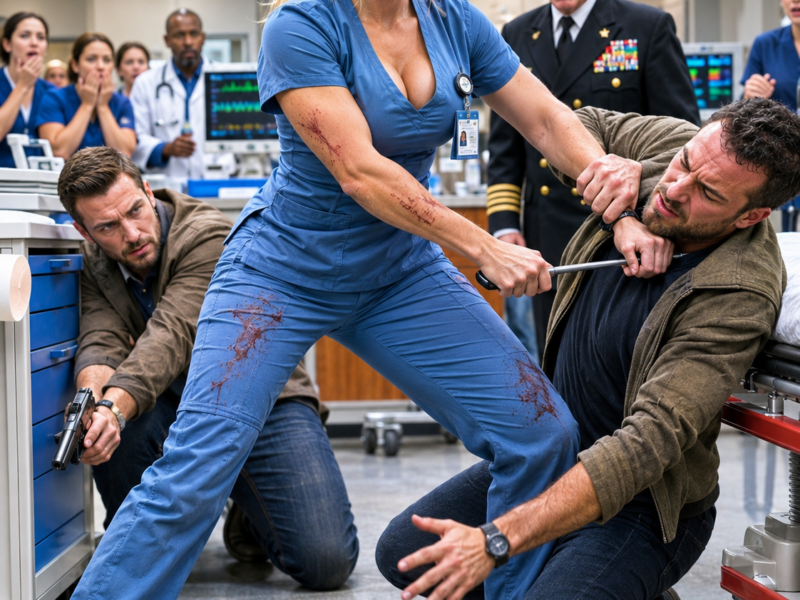
“The admiral actually LAUGHED when I told him I had four years of combat medicine experience, then pointed at my nurse’s badge in front of the entire trauma team
The man’s hand moved toward the surgical suite door.
I didn’t wait for him to reach it.
I stepped forward, putting myself directly between him and the wounded prisoner.
“Don’t,” I said.
He looked at me as though he hadn’t expected resistance.
“Move, Nurse.”
“No.”
His gun came up.
I caught his wrist with both hands, but he was faster and stronger than I had hoped. His forearm struck mine, sending a sharp pain through my injured shoulder.
The weapon slipped from his grip and hit the floor.
He drove me backward into the wall.
My cheek struck the hard surface, and for a second the room blurred around the edges.
I heard the surgical nurse, whose name tag read Okafor, shout my name.
Then the corridor door exploded inward.
Three tactical officers entered with rifles raised.
“Police! Drop your weapon!”
The man reached for the gun.
One officer kicked it away while another forced him face down against the floor.
“Suspect secured!”
I pushed myself away from the wall.
My cheek was bleeding, my shoulder was beginning to throb, and my hands were shaking now that the immediate danger had passed.
The lead officer turned toward me.
“Emily Carter?”
“Yes.”
“We’ve been briefed. Is the patient stable?”
I looked through the surgical suite window.
Aldrich Soto was still breathing.
“Stable enough to transport. He needs a proper surgical facility immediately.”
The officer spoke into his radio.
“Medical transport to the rooftop. Eight-minute ETA.”
I leaned against the wall for a moment.
Eight minutes.
I could manage eight minutes.
But the morning wasn’t over.
The officer asked me to account for everyone in the building, so I gave him everything I knew.
The two attackers on the fourth floor.
The men in the emergency department.
The facilities crew trapped near the east stairwell.
Dr. Vain restrained in the security room.
And Admiral Nathan Briggs, who was still downstairs with Captain Drell and Lieutenant Marsh.
The officer listened carefully.
When I finished, he said, “Your information matches what we’re seeing. The remaining suspects are being contained.”
I nodded toward the surgical suite.
“Then please let us finish our work.”
He stepped aside.
I returned to Soto’s bedside.
Okafor was checking his blood pressure.
“Eighty-six over fifty-two,” she said.
“Better than before.”
“Not good, though.”
“No,” I said. “Not good enough.”
We worked quietly.
She checked his oxygen saturation while I reassessed the dressing and watched his breathing.
Soto opened his eyes.
“Did they get it?”
“Get what?”
“The access key.”
“No.”
He closed his eyes briefly.
“Good.”
I leaned closer.
“Mr. Soto, I need you to stay with us. You’re going to be transported for surgery.”
He looked at me.
“Do you know what that network controls?”
“I know enough to understand why these people came here.”
He shook his head slightly.
“Probably not.”
His voice was weak, but there was urgency behind it.
“The coordination network links military medical facilities, emergency transport assets, and casualty-routing information across the district. If someone controls it, they can redirect resources, identify vulnerable facilities, and interfere with emergency response.”
I looked at Okafor.
She had stopped adjusting the monitor.
“Could they actually do that?”
“With the right credentials, yes.”
Soto swallowed.
“They didn’t come for a password. They came for the biometric authorization and a secondary authentication sequence. I refused to provide the second part.”
“Why?”
He looked toward the ceiling.
“Because the system has safeguards. If someone tries to force an unauthorized transfer, the network can be compromised. I wasn’t going to give them the chance.”
I understood then why they had kept him alive.
They didn’t simply need information.
They needed him to cooperate.
And they had been willing to turn an entire hospital into a hostage situation to get it.
The tactical officer returned.
“We’re ready to move him.”
I checked the monitor one last time.
“Let’s go.”
As the transport team prepared the stretcher, Soto caught my hand.
“Emily.”
I looked down.
“Thank you.”
I squeezed his fingers.
“Save your strength.”
He was taken toward the elevator under armed escort.
I followed as far as the stairwell before a paramedic stopped me.
“You’re not going any farther. You’ve done enough.”
I almost argued.
Then I noticed how badly my left hand was trembling.
For the first time that morning, I allowed myself to sit down.
And that was when I heard Admiral Briggs calling my name.
“Carter!”
He was coming down the corridor with Captain Drell behind him.
His uniform was rumpled.
There was a small cut near his eyebrow, and his silver hair was no longer perfectly arranged.
But he was walking.
That was enough for me.
“Admiral.”
He stopped a few feet away.
For several seconds, he said nothing.
Then he looked at the torn sleeve of my scrubs and the blood on my cheek.
“Are you injured?”
“Nothing serious.”
“That’s not what I asked.”
I gave him a tired look.
“My shoulder’s strained. I probably need stitches on my cheek.”
He nodded.
Then he looked at my left forearm.
The scars were still exposed.
“I owe you an apology.”
Captain Drell suddenly became very interested in the floor.
I leaned back against the wall.
“For what?”
Briggs looked directly at me.
“For the way I treated you this morning. For dismissing your experience. For assuming that your position in this hospital told me everything I needed to know about your abilities.”
I didn’t answer immediately.
He continued.
“I’ve spent thirty-eight years in uniform. I’ve worked with extraordinary people. I’ve also spent too much time believing that authority and competence always arrive together.”
His voice lowered.
“They don’t.”
I studied him.
“You were wrong about me, Admiral.”
“Yes.”
“But I wasn’t doing this to prove you wrong.”
“I know.”
I looked down the corridor where Soto had disappeared.
“There were patients in this building. People who had no idea what was happening. That was enough.”
Briggs nodded slowly.
Then he said something I hadn’t expected.
“I remember your hands.”
I looked up.
“What?”
He glanced at the scars on my arm.
“Years ago. An operation overseas. I was wounded during an evacuation. I was told later that a medic had kept me alive long enough to get me out.”
My breathing changed.
I hadn’t thought about that operation in years.
He continued.
“I was barely conscious. I remember the sound of aircraft overhead, someone shouting for a medic, and a woman telling me not to close my eyes.”
I stared at him.
“Where was this?”
“Near a forward operating position outside Kandahar. Late summer. Eight years ago.”
I looked away.
I remembered.
Not his face.
Not his rank.
But the man.
The damaged vehicle.
The blood.
The frantic radio traffic.
The young officer who kept trying to sit up despite a head wound.
“You were the officer in the transport vehicle,” I said.
His expression changed.
“You remember?”
“I remember telling you that if you sat up again, I’d personally tie you to the stretcher.”
For the first time since the attack began, Briggs smiled.
A real smile.
“I remember that, too.”
I shook my head.
“You were a terrible patient.”
“I’ve been told.”
For a moment, we stood in silence.
Then his expression became serious again.
“I didn’t know who you were this morning.”
“I noticed.”
He accepted the remark without defending himself.
“That doesn’t excuse it.”
Before I could respond, Captain Drell approached.
“Admiral, the federal team wants to speak with both of you.”
Briggs nodded.
Then he turned toward me.
“Will you come?”
I looked at my injured shoulder.
“After someone stitches my face.”
“Of course.”
He paused.
“And Carter?”
“Yes?”
“Thank you for saving my life.”
I looked at him for a long moment.
“You’re welcome, Admiral.”
Then I added, “Next time, try listening to the nurse.”
He gave a short, almost embarrassed laugh.
“Fair enough.”
By noon, Redstone Regional was surrounded by federal vehicles.
The hospital had been placed under temporary security control while investigators searched the building.
The attackers had been identified as members of a private intelligence network operating through shell companies and former military contractors.
Their leader was a man named Victor Hale.
He had worked with the firm that Dr. Vain hired to oversee the hospital’s security upgrade.
Vain had provided him with the building’s internal layout, camera locations, access codes, and information about the scheduled inspection.
The inspection wasn’t a coincidence.
They had chosen that morning because they knew Admiral Briggs would be inside the building.
His presence would complicate any response and give them another valuable hostage.
The helicopter had been used to bring Soto into the hospital without triggering the normal transport protocols.
The power disruption and communications interference had been planned to isolate the facility long enough for the attackers to reach the underground data center.
They had expected a frightened hospital staff.
They had expected confusion.
They had expected the senior officers to take command.
They hadn’t expected the quiet nurse who had memorized every hallway in the building.
But there was one part of the investigation that bothered me.
Dr. Vain.
I had worked with him for three years.
He had never been especially warm, but he had always seemed professional.
He knew the names of the cleaning staff.
He occasionally brought coffee for the night nurses.
Once, he’d stayed late to help a frightened patient’s family understand an insurance problem.
It was difficult to reconcile that man with someone who had knowingly helped armed criminals enter a hospital.
I asked to speak with him.
The federal investigators initially refused.
Then Briggs intervened.
He didn’t demand anything.
He simply explained that I had recognized Vain’s behavior before anyone else had and that my observations might be relevant.
They agreed to give me ten minutes.
I found Vain in a conference room on the second floor.
His wrists were no longer bound, but two federal agents stood outside the door.
He looked older than he had that morning.
His silver hair was disheveled, and his jacket had a torn seam near the shoulder.
When I entered, he looked up.
“Emily.”
I pulled out the chair opposite him.
“Dr. Vain.”
He glanced at my bandaged cheek.
“I heard you were injured.”
“I’m fine.”
He looked down at his hands.
For a while, neither of us spoke.
Then he said, “I didn’t intend for anyone to get hurt.”
I let the silence sit between us.
He looked up.
“I know how that sounds.”
“Do you?”
His jaw tightened.
“I thought I could control the situation.”
“By giving armed men access to a hospital?”
“I was told they only wanted the network credentials. They said nobody would be harmed.”
“Did you believe them?”
He hesitated.
“I wanted to.”
That answer was more honest than anything else he had said.
He rubbed his forehead.
“The hospital was in financial trouble. We were facing budget reductions. I was trying to secure additional funding. The firm approached me with a proposal. They offered to pay for the security upgrade and provide access to a federal medical coordination project.”
“And you didn’t ask why a private company wanted that information?”
“I did. They gave me documentation.”
“Which you accepted.”
He nodded.
“They offered me a consulting position. A significant amount of money. Enough to clear my debts and retire comfortably.”
I watched him.
“How much?”
He told me.
The number was large enough to make me understand why someone might hesitate.
It wasn’t large enough to make me understand how he could accept it.
“Did you know they were bringing a wounded prisoner here?”
“No.”
“Did you know they were going to take the hospital?”
He looked away.
“I knew there would be an operation.”
“That’s not an answer.”
He closed his eyes.
“I knew.”
The room seemed colder.
“Then why?”
He looked at me with tired, bloodshot eyes.
“Because I convinced myself the consequences would be manageable.”
I stood.
“People trusted you with their lives.”
“I know.”
“No, Dr. Vain. I don’t think you do.”
He said nothing.
At the door, I turned back.
“Roy was in trauma bay two that morning. He had a cut on his arm. Agnes was in the medication room with breathing problems. Priya was trying to keep two patients calm while armed men walked through the building.”
I paused.
“They weren’t numbers on a report. They were people who came here because they believed this was the safest place they could be.”
Vain lowered his head.
I left before he could answer.
The federal investigation lasted several months.
Soto survived surgery.
The bullet had damaged tissue near his left lung, but the medical team repaired the injury and prevented the infection that could have complicated his recovery.
The network credentials were secured.
The attempted data transfer was traced to several overseas servers, and investigators discovered that the attackers had already obtained fragments of sensitive information through other compromised facilities.
It was bigger than Redstone.
Much bigger.
Vain eventually pleaded guilty to conspiracy and unauthorized disclosure of protected information.
He lost his medical license and faced federal prison time.
He also cooperated with investigators, providing names and records that helped identify other people involved in the operation.
I didn’t celebrate his arrest.
I didn’t feel sorry for him, either.
Some decisions don’t become less damaging simply because the person who made them regrets them.
As for me, I spent two weeks on restricted duty.
My shoulder needed physical therapy, and the cut on my cheek left a thin scar.
Priya visited me during my first week back.
She brought coffee and a bag of pastries from the little bakery near the harbor.
“You know,” she said, setting everything on the table, “I still can’t believe you went back into that building.”
I looked at her.
“I work there.”
“That’s not what I mean.”
She sat down.
“Everyone else was terrified. I was terrified. You just kept giving instructions like you were telling us where to find the extra blankets.”
I smiled faintly.
“I was terrified, too.”
She stared at me.
“You were?”
“Of course.”
“Then how did you do it?”
I considered the question.
“I stopped thinking about how frightened I was and started thinking about the person who needed help next.”
Priya nodded slowly.
Then she reached into her bag and pulled out a folded piece of paper.
“Someone left this at the nurses’ station for you.”
I recognized the handwriting before I opened it.
It was from Roy, the patient whose dressing I had been changing when Briggs first insulted me.
The note read:
Emily, I never got to thank you properly. I came in that morning worried about a cut on my arm, and I left knowing there are people who show up for others even when nobody is watching. I hope you know how much that matters.
I read it twice.
Then I folded it carefully and put it in my locker.
It was the first thing I had kept from that day.
Three weeks after the incident, Admiral Briggs returned to Redstone Regional.
This time, he arrived without a convoy.
He wore a plain navy jacket and carried a small paper bag.
I was at the nurses’ station when I saw him.
“Morning, Carter.”
I looked up.
“Admiral.”
He placed the bag on the counter.
“Coffee.”
I glanced inside.
Two cups.
One black.
One with cream and two sugars.
I raised an eyebrow.
“How did you know?”
“Captain Drell told me.”
I smiled despite myself.
“That was thoughtful.”
He shifted his weight.
“I also came to ask you something.”
“What’s that?”
“The Department of Defense is reviewing the trauma readiness program for this district. We want someone with actual field experience to help improve the civilian hospital training.”
I looked at him.
“Someone from the military?”
“Someone who understands both sides.”
He paused.
“I’d like to recommend you.”
I stared at the coffee.
“Admiral, I’m an ER nurse. I have patients to take care of.”
“I know.”
“I’m not looking to return to military service.”
“I’m not asking you to.”
He leaned against the counter.
“The position would be advisory. You’d help design emergency procedures, train civilian trauma teams, and make sure hospitals like this aren’t left unprepared when something happens.”
I thought about the locked medication room.
Priya holding the door shut.
Darnell standing at the security desk, trying to understand why a helicopter had arrived without authorization.
The patients who had trusted us to keep them safe.
“What would it change?” I asked.
Briggs answered without hesitation.
“Hopefully, the next time something like this happens, no nurse will have to improvise alone.”
That stayed with me.
I looked toward trauma bay two.
A young nurse was helping an elderly man adjust his blanket.
Another was checking an IV line.
A doctor was explaining test results to a worried family.
Ordinary moments.
The kind I had chosen this job for.
“I’ll think about it,” I said.
Briggs nodded.
“That’s all I can ask.”
Then he started toward the exit.
“Admiral?”
He turned.
“Yes?”
“Next time you inspect a hospital, don’t start by asking who has the highest rank.”
He smiled.
“I won’t.”
“And maybe don’t tell the nurses to stay in their lanes.”
He laughed.
This time, I laughed, too.
Six months later, I accepted the advisory position.
I kept my job at Redstone Regional and continued working several ER shifts each month.
The training program became one of the most demanding projects I had ever taken on.
We revised evacuation procedures, improved communication systems, and created emergency response plans that didn’t depend on a single person making every decision.
We trained nurses to recognize security threats.
We trained security officers to work alongside medical staff.
We made sure every employee knew where to go, whom to contact, and how to protect patients when normal systems failed.
Captain Drell became one of our strongest supporters.
He was still young, still ambitious, but he had changed.
One afternoon, during a training exercise, he approached me with a clipboard.
“Your scenario is brutal,” he said.
“It’s realistic.”
“You’ve got a simulated power outage, two compromised access points, and a missing patient.”
“That’s what happens when people plan for the best instead of preparing for the worst.”
He looked at the exercise schedule.
“Admiral Briggs says you’re the toughest instructor he’s ever worked with.”
I laughed.
“That’s because he hasn’t seen me teach someone to operate a blood pressure cuff.”
Drell grinned.
Then his expression became serious.
“I owe you something, too.”
I looked at him.
“What?”
“An apology.”
“For what?”
“For the first morning. When Briggs dismissed you, I didn’t say anything. I knew you had experience, but I still waited for someone senior to decide whether you were worth listening to.”
He looked uncomfortable admitting it.
“I should have trusted what I saw.”
I thought about that.
“You were in a difficult position.”
“That’s not an excuse.”
“No,” I said. “It isn’t.”
He nodded.
I handed him the clipboard.
“Then do better next time.”
“I will.”
And I believed him.
A year after the attack, I visited the rooftop landing pad.
It was a clear November morning.
The harbor was visible beyond the hospital buildings, and the cold wind carried the smell of saltwater through the open access door.
The landing pad had been repaired and fitted with new security equipment.
There was also a small plaque near the entrance.
It had been installed at the hospital’s request.
It read:
In recognition of the courage and service of the Redstone Regional Medical Center staff, whose actions protected patients and colleagues during the November incident.
There were no individual names.
I preferred it that way.
I stood there for a while, thinking about the people who had been in the building that morning.
Roy, who had come in for stitches.
Agnes, who had needed oxygen.
Priya, who had been frightened but had followed her instructions.
Darnell, who had stood his ground at the security desk.
Okafor, who had kept a wounded man alive with improvised equipment.
And Aldrich Soto, who had refused to surrender credentials that could have endangered thousands of people.
They had all played their part.
The admiral’s voice came from behind me.
“Beautiful morning.”
I turned.
Briggs stood in the doorway, holding two coffees.
“You’re getting predictable, Admiral.”
“One black, one with cream and two sugars.”
I accepted mine.
He looked out over the harbor.
“I’ve been thinking about something you said.”
“That happens occasionally?”
He smiled.
“About staying in your lane.”
I waited.
“I spent most of my career believing that leadership meant being the person everyone looked to for answers. That morning, I learned something different.”
He turned toward me.
“Sometimes leadership means recognizing the person who already has the answer, even if they don’t have the rank.”
I took a sip of coffee.
“That’s a good lesson.”
“It was an expensive one.”
“Could have been more expensive.”
He nodded.
We stood together, watching the fog lift from the water.
After a while, he said, “I never properly thanked you for Kandahar.”
“You already did.”
“No. I thanked you for saving my life. I never thanked you for what you did afterward.”
I looked at him.
“What do you mean?”
“You chose to leave that world and build a life helping people who would never know what you had done before. You didn’t need another uniform or another medal. You just kept showing up.”
I looked down at the coffee cup.
For years, I had thought leaving the Army meant putting that part of my life behind me.
I had thought the quiet work of an emergency department was a completely different kind of service.
I understood now that I had been wrong.
The uniform had changed.
The people who needed help hadn’t.
Briggs offered his hand.
I shook it.
Then I headed back downstairs.
The emergency department was already busy.
A new patient had arrived.
A little girl with a scraped knee was crying in her father’s arms.
One of the nurses looked up as I entered.
“Emily, can you take this one?”
I smiled.
“Of course.”
I pulled on a fresh pair of gloves and walked toward the bed.
Nobody in that room needed to know about my scars.
Nobody needed to know about the helicopter, the admiral, or the men who had taken control of the hospital.
The little girl just needed someone to tell her that the stitches wouldn’t hurt as much as she imagined.
So I knelt beside her.
“Hey, sweetheart. I’m Emily. Let’s take a look at that knee.”
She sniffled and held out her hand.
I took it gently.
And as the monitor beeped behind us and the ordinary noise of the emergency department filled the room, I realized something I hadn’t understood when I first walked into Redstone three years earlier.
I hadn’t left my old life behind.
I had simply found another place where my hands could make a difference.
The End.









