“That’s tomorrow’s payment. What is it, Bran? Stay where I can see you!”
The first thing Marabelle Weather noticed after Cline finally left was the silence.
Not the peaceful kind that settled over her cabin on a quiet winter morning, when the only sounds were the wind brushing the eaves and the soft pop of wood in the stove. This silence felt different. It came after fear. After raised voices. After the scrape of boots across her floor and the sight of a stranger standing beside her belongings, waiting for permission to carry them out.
Her spare quilt was still folded at the foot of the bed. The kettle remained on the stove. The old wooden chest sat against the wall where it had always been.
Nothing had been taken.
For the first time in weeks, Marabelle could look around her home without wondering which piece of it someone might claim next.
She sat down slowly, resting both hands on the table.
Across from her, Esther was still standing. The shopkeeper had removed her gloves, but her fingers were red from the cold. She looked as though she had only just realized how close the afternoon had come to ending badly.
“Are you all right?” Esther asked.
Marabelle nodded, though her eyes had begun to sting.
“I think I am.”
Esther pulled out a chair and sat beside her. Neither woman spoke for a moment.
Outside, the last of the daylight was slipping behind the trees. Snow had gathered along the cabin windowsills, and the road beyond the yard was turning gray with dusk.
Taevan Readwell had already returned to his office with the report. He had made it clear that the matter would be handled through the proper channels. Cline had been told to leave Marabelle’s belongings where they were, and the worker he had brought along had refused to carry anything out once he understood that the permission he had been promised did not exist.
It was not a grand victory. No one had marched Cline away in handcuffs. No dramatic judgment had been delivered in the middle of the yard.
But Marabelle still had her home.
And that was enough for one evening.
Esther finally reached across the table and covered Marabelle’s hand.
“You shouldn’t have had to go through that alone.”
Marabelle looked down at their hands.
“I thought I did.”
“Well, you don’t now.”
Those words stayed with her long after Esther had gone.
That night, Marabelle slept more soundly than she had in days. The wind still rattled the shutters, and the cold still pressed against the walls, but she no longer lay awake listening for a wagon outside.
The next morning, she found the three dollars she had set aside for Cline still sitting in the small dish beside the stove.
Three dollars.
It was not much. It would not buy a new roof or fill the pantry for a month. But it had been the last money she could spare, and she had nearly handed it over simply because a man with a confident voice had told her she owed more than she did.
She picked up the coins and turned them over in her palm.
Then she put them away.
The debt was not gone. She knew that. Her late husband had borrowed forty dollars, and she had made no attempt to deny it. She had paid twenty-two dollars already. The remaining eighteen dollars were real, and she intended to repay them.
What she would not do was pretend that another twenty-nine dollars had appeared out of thin air simply because Cline had written a larger number beside her name.
That distinction had seemed small when she was frightened.
Now it felt like the one thing she needed to hold on to.
By midday, the relief wagon returned to Alder Basin.
Marabelle heard it before she saw it: the creak of wheels on packed snow, the low voices of men calling to one another, and the steady clop of horses approaching along the road.
Edlin Ruk was riding beside the wagon.
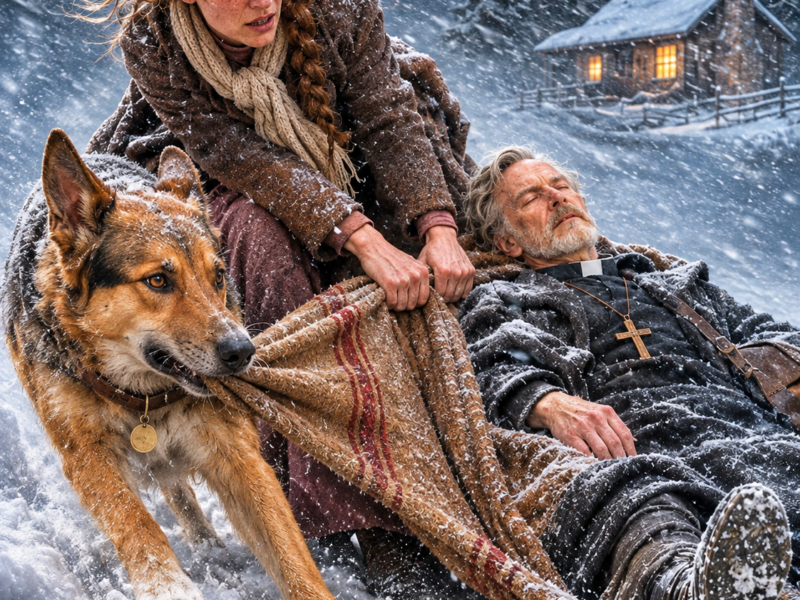
He had recovered enough from the cold to travel again, though he still moved carefully when he climbed down. His face had more color than it had when Marabelle found him in the snow, and his coat was buttoned properly this time.
He looked toward the cabin and raised a hand.
Marabelle stepped outside.
“I thought you were supposed to be resting,” she called.
Edlin smiled.
“I was. Then the wagon came back.”
“That isn’t the same thing.”
“No,” he admitted. “It isn’t.”
The men accompanying him began unloading supplies for the families on their route. There were sacks of flour, blankets, a few crates of canned food, and other necessities gathered for people who had little chance of reaching town in the winter weather.
Edlin explained that the wagon would continue its rounds, and that others had agreed to help with the deliveries so he would not have to manage every stop himself.
“Esther helped arrange it,” he added. “She spoke to a few people in town.”
Marabelle looked toward the wagon.
“She didn’t tell me.”
“She probably thought you’d try to talk her out of it.”
Marabelle gave a small laugh.
“She knows me too well.”
Edlin glanced at the cabin, then back at her.
“How did you sleep?”
“Better.”
“Good.”
He did not ask about Cline immediately. He did not need to. Marabelle could tell that he wanted to know, but he gave her room to speak when she was ready.
“Taevan has the report,” she said at last. “He said the account would be handled through the office. Cline hasn’t come back.”
“And the belongings?”
“Still here.”
Edlin nodded.
“Then we’re making progress.”
Marabelle looked at him for a moment. She remembered finding him half-buried in snow, his body too cold to move properly, his words barely reaching her through the wind. She had not known who he was then. She had not known that he had once served as sheriff in Alder Basin, or that he had spent years learning how to listen when people were frightened and did not know how to explain what had happened to them.
She had only seen a man who needed help.
Now she wondered whether he understood how much his help had meant to her.
“You came back,” she said.
“I told you I would.”
“I know. I just didn’t think anyone would.”
Edlin’s expression softened.
“People should be able to keep their word.”
He turned toward the wagon when one of the men called his name. Before leaving, he looked back at her.
“Don’t let this trouble convince you that asking for help was a mistake.”
Marabelle shook her head.
“I won’t.”
He gave her a final nod and went to help with the supplies.
For the rest of the afternoon, the wagon moved from one home to another. Marabelle watched from her doorway as the men carried food and blankets to neighbors who had been struggling through the same bitter weather. Some came out to thank them. Others simply stood in their doorways, surprised that anyone had remembered them.
It reminded Marabelle of something she had almost forgotten.
Hard times did not make people disappear from one another’s lives. Sometimes they made it harder to see one another. But there were still people willing to knock on a door, carry a sack of flour, or stand beside someone who had been pushed too far.
And sometimes, that was where the difference began.
A few days later, Marabelle went into town.
She had waited until the road was clear enough to travel safely. She wore her thickest coat and carried a small envelope inside her pocket. The three dollars were gone from the dish beside the stove, but she had not spent them. She had put them in the envelope with a note recording the amount she intended to pay once the revised balance was confirmed.
She wanted everything written down.
She had learned that lesson the hard way.
At the office, Taevan Readwell greeted her and brought out the record of her complaint. He went over the facts carefully: the original forty-dollar loan, the twenty-two dollars already paid, the eighteen-dollar balance, and the additional charges Cline had attempted to impose.
He did not rush her. When she corrected a date, he made the change. When she asked whether the three dollars could be credited toward the balance, he explained that the repayment arrangement would need to reflect it clearly.
“The amount we recognize as remaining is eighteen dollars,” he said. “With your three-dollar payment, that leaves fifteen.”
Marabelle listened closely.
“Fifteen,” she repeated.
“That’s right.”
“And no extra waiting fees?”
“Not without a valid basis for them.”
She looked at the paper.
The number was so ordinary. Fifteen dollars. A figure that could fit on a scrap of paper, written in a few seconds.
Yet that small number represented weeks of worry, the threat of losing her belongings, and the fear that she might be forced out of the only home she had left.
Taevan placed the document in front of her.
“We can record the arrangement as five dollars a month for three months. Each payment will be documented. You’ll receive a receipt.”
Marabelle read it twice.
“Then that’s what I’ll do.”
“Good.”
She signed where he indicated.
Taevan made a copy for her and kept the original with the report.
“Keep your copy somewhere safe,” he said. “And don’t hand over money without getting a receipt.”
“I won’t.”
“If Cline contacts you about anything beyond this arrangement, bring it back to the office. Don’t try to settle a new demand at your doorstep.”
Marabelle folded the paper carefully and slipped it into her envelope.
“Thank you, Taevan.”
He gave her a steady look.
“You did the important part. You came forward and told the truth.”
She left the office with the document tucked safely inside her coat.
The trip home seemed shorter than the trip into town. Perhaps the road was easier now that the sky had cleared. Perhaps the weight she carried was lighter.
Either way, she walked with her shoulders a little straighter.
The following week, Cline appeared again.
Marabelle saw him coming from the kitchen window. His wagon moved slowly along the road before stopping near the gate. For one brief moment, her body reacted before her mind could catch up. Her fingers tightened around the dish towel. Her stomach knotted.
Then she looked toward the table.
The paper from Taevan’s office was there, folded beside her small ledger.
She took a breath.
Cline climbed down and approached the door. He knocked twice.
Marabelle did not hurry to answer.
When she opened it, she kept one hand on the door and stood firmly in the doorway.
“Mrs. Weather,” he said.
“Mr. Cline.”
He glanced past her into the cabin.
“I understand you’ve been to the office.”
“I have.”
“And they’ve made a record of your complaint.”
“They have.”
He shifted his weight. His expression was harder to read than it had been during their earlier encounters. He had come expecting an argument, perhaps, or a frightened woman willing to pay whatever he demanded just to make him leave.
Instead, Marabelle reached for the paper on the table.
“The remaining balance is fifteen dollars after my three-dollar payment,” she said. “I’ll pay five dollars a month for three months. Each payment will have a receipt.”
Cline looked at the document.
“That isn’t how I calculated it.”
“It’s how the office recorded it.”
He did not answer immediately.
Marabelle kept her voice even.
“I am not refusing the money my husband borrowed. I have never refused it. But I won’t pay charges that were never part of the agreement.”
Cline’s eyes moved from the paper to her face.
For once, he did not have an immediate answer.
Marabelle could feel her heart beating quickly, but she did not step back. She had spent too many nights imagining this moment, and in every version she had been alone, frightened, and unsure of what to say.
This time, she knew.
Cline finally handed the document back.
“I’ll have to review the account.”
“Then review it with the office.”
He looked at her for another moment before turning away.
Marabelle watched him walk to his wagon and climb aboard. She remained in the doorway until the wagon disappeared down the road.
Then she closed the door.
Her hands were shaking.
But she was still standing in her own home.
The first five-dollar payment was made at the end of the month.
Marabelle had put the money aside a little at a time. She had counted it twice before leaving the cabin, then placed it in a small envelope with the date written across the front.
At the office, Taevan accepted the payment and wrote out a receipt.
He checked the amount, marked the remaining balance, and handed her the paper.
“Ten dollars left,” he said.
Marabelle slipped the receipt into her envelope.
“Ten dollars.”
“Two more payments.”
She smiled faintly.
“That sounds manageable.”
It was not that five dollars came easily. She still watched every coin. She still planned meals around what she had in the pantry and repaired things instead of replacing them. But there was comfort in knowing exactly what she owed and when it would be finished.
No surprise numbers.
No invented fees.
No threats at the door.
Just five dollars, recorded properly, and a receipt she could keep.
As winter continued, the cabin became a place of ordinary routines again.
Marabelle rose early, fed the stove, and made coffee before the light reached the eastern window. She mended a tear in her old coat and patched a draft beneath the kitchen door. She carried water in from the well when the weather allowed and made sure the firewood was stacked where she could reach it.
There were still difficult days. The cold did not care that she had stood up to Cline. Neither did the cost of food or the long distance between her cabin and town.
But she no longer felt that every knock on the door might take something from her.
Esther visited often.
Sometimes she brought a loaf of bread. Sometimes she stayed long enough to drink coffee and talk about the people coming through the store. She never made a show of having helped Marabelle. She did not ask for thanks each time she arrived.
That made Marabelle appreciate her even more.
One afternoon, Esther came in carrying a small parcel wrapped in brown paper.
“I brought you something.”
Marabelle looked suspiciously at the parcel.
“What is it?”
“Open it.”
Inside was a new notebook.
The cover was plain, and the pages were lined. Nothing fancy. But it was sturdy and large enough to keep records of payments, dates, and anything else Marabelle might need to remember.
Esther tapped the cover.
“Every payment. Every receipt. Every agreement. Write it down.”
Marabelle ran a finger along the edge of the paper.
“I have a little ledger already.”
“I know. But that one has seen better days.”
Marabelle laughed.
“You’re not wrong.”
Esther sat down and poured herself a cup of coffee.
“I also wanted you to know something. People heard what happened.”
Marabelle looked up.
“Who?”
“People in town. Not every detail, and not because I went around telling your business. But they know you spoke up. They know you brought the account to the office.”
Marabelle lowered her eyes.
“I didn’t want everyone talking about me.”
“They aren’t talking about you the way you think.”
Esther leaned back.
“Some people have had the same trouble with collectors. They just didn’t know what they could do about it. A few have started keeping better records.”
Marabelle looked at the notebook again.
“Then perhaps something good came of it.”
“Perhaps.”
Esther did not say more. She did not need to.
The second payment came and went.
Ten dollars became five.
Taevan wrote the receipt, marked the account, and reminded Marabelle that the final payment would close the balance.
She kept every paper in the new notebook.
By then, the fear that had once followed her from room to room had begun to fade. She still remembered Cline standing beside her chest, and the worker waiting to carry out her belongings. She still remembered the awful feeling of hearing someone say she had agreed to something she had never agreed to.
But the memory no longer controlled the way she moved through her day.
She had learned that being frightened did not mean she was powerless. She had learned that she could ask for a record, demand a receipt, and seek help before a threat became an action.
Most of all, she had learned that she did not need to face every problem alone.
Edlin returned to the cabin once more before the winter began to loosen its hold.
This time he arrived on foot, carrying a small package beneath one arm. The relief wagon had continued its rounds, and he had been traveling with the group as they checked on families who still needed supplies.
Marabelle opened the door before he knocked a second time.
“You’re getting better at arriving on your feet,” she said.
Edlin smiled.
“I’m trying to make a habit of it.”
She invited him inside.
He set the package on the table. It contained a few necessities gathered for the families along the route. Marabelle thanked him, then put on a fresh pot of coffee.
They talked about the weather, the road conditions, and the people the wagon had visited. Edlin told her that one family had finally received enough firewood to make it through the coldest weeks. Another had been helped by neighbors who had begun taking turns checking on them.
Marabelle listened, grateful for the news.
After a while, Edlin asked how the debt had been settled.
“Almost finished,” she said. “I’ve made two payments. There’s only five dollars left.”
“That’s good.”
“Taevan has kept the record. Every payment has a receipt.”
Edlin nodded.
“And Cline?”
“He hasn’t tried to take anything. He came once to review the account, but I told him to speak with the office.”
“Good.”
Marabelle watched him over the rim of her cup.
“You knew what to say when I didn’t.”
Edlin looked down at his coffee.
“I knew what it was like to hear people come to you frightened and not know where to begin.”
“You were a sheriff then.”
“I was.”
“And now?”
“Now I’m a priest. I go where I’m needed, and I try to help where I can.”
Marabelle considered that.
“Does it ever feel strange? Leaving one kind of work behind for another?”
Edlin thought for a moment.
“Not as strange as you might imagine. The work changes. The need for people to be heard doesn’t.”
She sat quietly with that answer.
When Edlin stood to leave, Marabelle walked him to the door.
The sky was pale, and the snow along the road had begun to soften beneath the afternoon sun.
“I’ll be passing through again,” he said. “If the route brings me this way, I’ll stop.”
“You’re welcome to.”
He paused at the edge of the porch.
“And Marabelle?”
“Yes?”
“Remember what you did when you found me in the snow.”
She frowned slightly.
“What about it?”
“You didn’t ask whether I could repay you. You didn’t ask what I could do for you. You saw someone who needed help, and you helped.”
Marabelle looked away toward the road.
“I couldn’t have left you there.”
“Exactly. You understood that someone else’s need mattered. Don’t forget that your own needs matter, too.”
She nodded slowly.
Edlin gave her a warm smile and continued down the road.
Marabelle watched until he disappeared beyond the bend.
The final five-dollar payment was made a few weeks later.
She carried it into town in the same envelope she had used for the first payment. The money had been set aside carefully, one small amount at a time.
Taevan accepted it, entered the payment in the record, and wrote the final receipt.
He checked the account before handing it to her.
“That closes it,” he said.
Marabelle stared at the paper.
“All of it?”
“All of it. The fifteen dollars has been paid.”
She took the receipt with both hands.
For a moment, she could not find anything to say.
It was only a small piece of paper. A few lines of writing. A date, an amount, and a record that the debt was paid.
But it marked the end of something that had consumed her attention for far too long.
Her husband had borrowed forty dollars. She had repaid what was owed. She had not run from it, and she had not pretended the obligation did not exist.
She had simply refused to let someone turn an eighteen-dollar balance into a threat against her home.
“Thank you,” she said.
Taevan nodded.
“You did what you set out to do.”
Marabelle folded the receipt and placed it in her notebook.
On the way home, she stopped at Esther’s store.
Esther was arranging goods behind the counter when Marabelle came through the door.
“Well?” Esther asked.
Marabelle lifted the notebook.
“It’s paid.”
Esther’s face brightened.
“Every dollar?”
“Every dollar.”
Esther came around the counter and hugged her.
“Then we’re celebrating.”
Marabelle laughed.
“With what? A feast?”
“With coffee and whatever I can find that hasn’t been claimed by someone else.”
They shared a small treat at the counter, and Esther insisted that Marabelle take a little extra home.
It was not a grand celebration. No one made a speech. No one gathered the whole town to announce the end of the debt.
But Marabelle walked out of the store with a lighter heart than she had carried in.
Spring arrived slowly.
The snow retreated from the road, leaving patches of dark earth and muddy tracks. Water ran through the ditches, and the trees began to show the first signs of new growth.
Marabelle opened the cabin windows on warmer afternoons. She aired the blankets, swept the porch, and began clearing the small patch of ground she used for planting.
Her life did not transform overnight. There were still repairs to make and bills to consider. She still had to be careful with money. The loss of her husband was still part of every quiet evening.
But she began to look forward to the next day instead of merely worrying about what it might bring.
She also began helping where she could.
When a neighbor needed someone to watch a child for an hour, Marabelle offered. When an older woman down the road struggled to bring in her firewood, Marabelle helped carry a few pieces. When the relief wagon came through, she brought out what she could spare for another family.
She never had much extra.
But she remembered how it felt to need help and wonder whether anyone would notice.
One afternoon, Edlin arrived with the wagon again.
The weather was clear, and the road was finally dry enough for easy travel. He stepped down from the seat and greeted her with the same warm expression she remembered from the first morning after she had found him in the snow.
“Looks like spring has found you,” he said.
“About time.”
He looked toward the small garden patch.
“Getting ready to plant?”
“Trying to. The ground isn’t cooperating yet.”
“It rarely does when you’re in a hurry.”
Marabelle smiled.
The wagon crew unloaded a few supplies for a family farther down the road. While they worked, Edlin stayed near the porch and asked how she was doing.
She told him about the final payment. About the receipt. About Esther’s celebration at the store.
He listened, pleased.
“Then it’s settled.”
“It is.”
Marabelle glanced toward the cabin.
“I kept every receipt. Even the first one.”
“Good.”
“And I kept the original agreement, too.”
“Better still.”
She looked at him.
“I used to think keeping records meant I didn’t trust people. Now I think it means I don’t have to rely on someone else’s memory.”
Edlin smiled.
“That’s a useful thing to learn.”
They stood quietly for a moment, watching the wagon crew finish their work.
Marabelle thought about the winter day when she had found him lying in the snow. She had been worried about keeping herself alive, keeping the cabin warm, and making the money stretch until the next week. Yet she had stopped because someone else needed her.
She had never imagined that the simple decision would bring her into a chain of events that would change the way she saw her own strength.
She had not become wealthy. She had not suddenly gained influence or power. She was still a widow living in a modest cabin, still careful with every dollar, still facing the ordinary difficulties of life.
But she had learned that her voice mattered.
She had learned that kindness did not require surrendering her rights. That paying a debt did not mean accepting every demand made by the person collecting it. That a person could be generous and still draw a line.
And she had learned that courage did not always look like standing without fear.
Sometimes it looked like opening a door, telling the truth, and asking someone to write down what had happened.
The wagon was ready to leave.
Edlin climbed onto the seat, then paused and looked back at her.
“I’ll try to stop by again.”
“You know where to find me.”
“I do now.”
Marabelle smiled.
This time, when the wagon rolled away, she did not feel as though she were watching help disappear into the distance. She knew there were people on the road who would keep looking for those who needed them.
She returned to the cabin and set the kettle on the stove.
On the table, her notebook lay open. Inside were the dates and receipts from the payments she had made. The final page held the last receipt, neatly folded and tucked between the lines.
She closed the notebook and placed it in the drawer.
Then she went outside to look at the garden.
The soil was still cold in places, but the sun was warm against her face. She could hear birds in the trees, and somewhere beyond the road, a wagon wheel creaked as the relief crew continued on.
Marabelle stood on the porch for a long moment.
She thought about the quilt that had nearly been carried away, the kettle that had stayed on the stove, and the wooden chest that still rested against the wall. They were ordinary things, but they were hers. They had belonged to her before Cline arrived, and they remained hers after he left.
Her home had survived the winter.
So had she.
And when someone knocked on her door again, she would no longer answer with the helpless fear that had once tightened her chest.
She would listen. She would ask questions. She would keep a record. And if someone needed help, she would offer what she could without forgetting that she, too, deserved kindness.
The debt was paid. The receipts were safe. The cabin was still standing.
But the greatest thing Marabelle had carried out of that winter was not the final piece of paper in her notebook.
It was the knowledge that she did not have to choose between being a good person and standing up for herself.
She could do both.
And from then on, she intended to.
The End.









