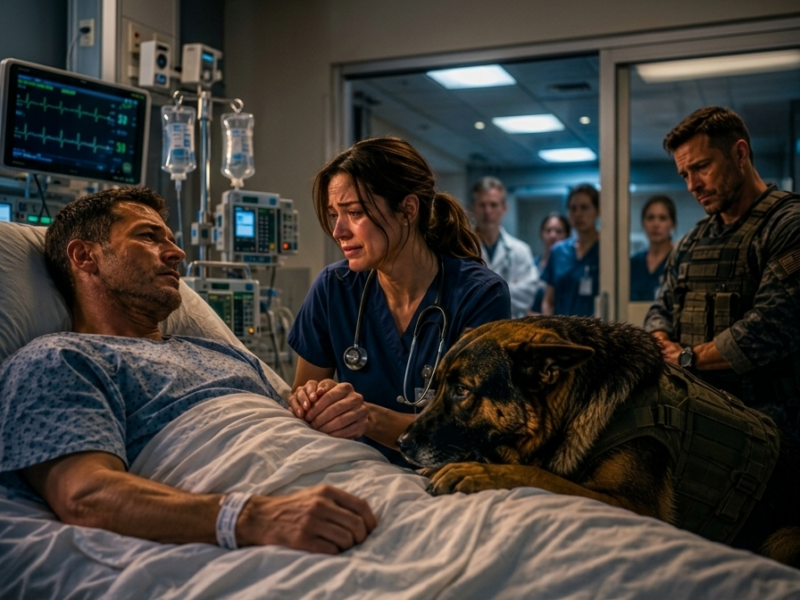
“Take care of my dog,” the dying Navy SEAL whispered in front of the entire emergency room, and when the arrogant surgeon ordered me to hand the blood-covered German Shepherd to animal control
The emergency room at St. Mary’s Hospital in coastal Virginia was drowning in absolute chaos when they wheeled in the wounded soldier just after midnight. Rain pounded ruthlessly against the reinforced glass windows of the triage bay, while sirens wailed across the flooded parking lot. The floor was slick with seawater and crimson tracks. Frightened patients squeezed into the corners of the waiting room, staring in wide-eyed terror as an intensive trauma team cleared a direct path to Bay 4.
The soldier on the gurney was barely conscious. His tactical uniform was shredded and soaked in deep blood, his chest rising and falling in erratic, shallow hitches. Yet despite his devastating wounds, his right hand was locked in a vice-like grip around the leather collar of a massive, blood-covered German Shepherd named Rex. The dog ran alongside the moving stretcher, his claws digging into the slippery linoleum, his dark eyes never leaving his handler’s face for a single second.
I was the head trauma nurse on duty that night. I rushed to the side of the gurney, grabbing a roll of pressure dressing to apply to the massive arterial bleed in his abdomen.
“Please,” the soldier whispered, his voice raspy, fighting through the dark haze of heavy shock to lock his dying eyes onto mine. “Don’t… don’t let them take him.”
I squeezed his cold, trembling left hand firmly. “I won’t. I promise you, soldier, he stays right here.”
His gaze moved toward Rex, who stood perfectly still beside the stretcher as the gurney slammed into place inside the bay. The animal was trembling violently, exhausted and wounded himself, but refusing to retreat even an inch from his handler.
Then the soldier leaned his head slightly closer to mine, using the very last reserve of his fading strength. “His name… isn’t Rex.”
Before I could ask what he meant by that cryptic warning, the overhead heart monitor burst into a terrifying, continuous scream. A straight red line flatlined across the digital screen.
“He’s going into V-fib! Get me 1mg of Epinephrine now!” Dr. Harrison Cole shouted as he barged into the room.
Dr. Cole was St. Mary’s chief of trauma surgery—a wealthy, arrogant man whose custom surgical coat always looked pristine, and whose reputation within the medical board was legendary. He brutally shoved me aside, throwing his full weight onto the patient’s chest to begin mechanical compressions while ordering the rest of the team to clear the bay.
We fought relentlessly for twelve agonizing minutes. We charged the defibrillator paddles three times. We pushed full vials of drugs directly into his IV line. We poured everything we had into keeping the young soldier’s heart pumping.
Then, Dr. Cole stopped. He wiped his forehead with the back of his arm and slowly let out a cold, detached sigh.
The monitor remained completely flat. The soldier was gone.
I stood frozen beside the stainless-steel bed, listening to the suffocating silence that followed the pronouncement of death. Rex slowly stepped forward, resting his heavy, scarred snout gently against the dead soldier’s motionless hand, letting out a low, heartbreaking whine that chilled everyone in the room to the bone.
Dr. Harrison Cole peeled off his bloody latex gloves and tossed them carelessly into the biohazard bin. “Get that animal out of my emergency room immediately. He’s a biological hazard and a distraction.”
“He belongs to the patient, Dr. Cole,” I said, my voice shaking with raw grief and rising anger. “He’s a service animal. He stays until military police arrive.”
“The patient is dead,” Dr. Cole snapped back coldly, adjusting the platinum watch on his wrist. “Security will handle the dog. Call animal control to pick up the carcass if it refuses to move.”
Rex suddenly growled.
It wasn’t a standard bark or an anxious whine. It was a terrifying, guttural rumble that vibrated through the floorboards—a lethal warning from a trained military asset.
He wasn’t growling at the two heavy-set hospital security guards who were cautiously approaching with catch-poles.
Rex was looking directly at Dr. Harrison Cole.
The surgeon’s calm, aristocratic expression hardened instantly. A strange, shadowy flicker of pure panic crossed his face before he quickly covered it with anger. “Control your animal, Nurse Emily, or I will personally have security shoot him and throw him in the dumpster.”
Something about his extreme reaction felt deeply wrong, but grief and exhaustion had already clouded my judgment. I dropped to my knees beside the wounded dog, wrapping one arm around his neck to comfort him. “It’s okay, boy. Easy… easy.”
Rex turned his head and looked directly into my eyes. His intelligence was staggering. He didn’t act like a hysterical animal; he acted like an operator executing a command. He raised his front paw and deliberately nudged my hand toward a small, waterproof black pouch concealed beneath the inner lining of his leather collar.
I unzipped the hidden pouch. Inside was a heavy metal identification tag, a faded, weather-worn photograph, and a folded piece of official waterproof paper bearing a rank and name I hadn’t seen or heard in seven agonizing years:
COMMANDER EMILY CARTER.
My own name. My former military rank.
My fingers went numb. My heart stopped in my chest.
Seven years earlier, I had served as an elite combat medic attached to a joint Navy SEAL task force overseas. Our final clandestine mission had ended in a bloody, tragic ambush that left three of my closest teammates dead, destroyed my career, and resulted in my honorable discharge under non-disclosure circumstances I had never been legally allowed to discuss. The official Pentagon report had blamed faulty satellite intelligence for the tragedy.
But the photograph in my hand showed my old strike team standing shoulder-to-shoulder in the desert, posing beside this very same German Shepherd when he was just a young pup.
And standing right behind our tactical unit in that photograph—wearing a clean desert uniform without name tapes—was Dr. Harrison Cole.
Younger, thinner, but unmistakably the exact same man now standing three feet away from me.
On the back of the photograph, handwritten in thick, dark marker, was a single sentence:
IF EMILY IS ALIVE, TELL HER WHO GAVE THE ORDER.
I slowly lifted my eyes from the photograph toward the surgeon. He was watching me intently from across the bed. For the first time since I had met him two years ago, the powerful, arrogant Dr. Harrison Cole looked utterly terrified.
“Give me that pouch, Emily,” he said, his voice dropping into a dangerously quiet, venomous pitch.
I slowly closed my hand around the contents, feeling the metal tag dig into my palm. “No.”
His artificial smile vanished completely. “You have no idea what you’re holding.”
Rex immediately took two steps forward, positioning his heavy body directly between me and the surgeon, baring his sharp white teeth in an unmistakable threat display. In that split second, I finally understood why the dying soldier had begged me with his last breath to protect his dog.
The dog wasn’t just a loyal companion carrying a message.
He was the physical evidence.
Suddenly, a loud metallic thud reverberated through the hallway as the hospital’s main magnetic security doors slammed shut and locked automatically. Every landline phone in the emergency room went dead, and the cellular signal on my personal phone vanished to zero.
The overhead public address speakers crackled with high-voltage static, and a digitized voice echoed through the dark corridors of the building:
“Commander Carter, please report to the basement isolation wing immediately.”
I had never told a single soul at St. Mary’s Hospital about my military rank or my past life in Special Operations.
Rex suddenly whimpered, pressing his warm, blood-stained head against my chest. Beneath the leather strap of his collar, I felt a high-frequency vibration. A concealed micro-speaker sat embedded in the brass buckle.
A soft, synthesized click sounded, and the dying soldier’s recorded voice emerged clearly from the collar. He hadn’t trusted me merely to save his dog. He had trusted me to finish the dark, unfinished mission that had ultimately taken his life.
“Emily,” the recording whispered into the silent room, “if you’re hearing this, the man who betrayed our team seven years ago is standing right beside you.”
I raised my eyes to Dr. Cole. He was already reaching beneath his surgical coat, pulling a sleek, silenced semi-automatic pistol from his shoulder holster.
“Get down!” I screamed, lunging sideways behind the stainless-steel trauma cart just as Dr. Cole raised his weapon.
Pfft! Pfft!
The silenced gunshots sounded like heavy pneumatic whispers, but the impact was devastating. The rounds tore through the IV bags above the bed, sending thick torrents of saline and blood showering down over the dead soldier’s body. The surgical glass behind me shattered into thousands of tiny, glittering sharp fragments.
Rex didn’t flinch. Despite his injuries, the Shepherd executed a perfect tactical defense maneuver, driving his shoulder into the base of the heavy trauma cart and shoving it directly into Dr. Cole’s legs. The surgeon lost his balance, his second shot going wide into the ceiling tile, sending plaster dust raining down upon us.
“Security! Kill that dog!” Cole shrieked, his pristine mask completely shattered as he scrambled back to his feet.
The two hospital security guards, who were clearly not standard civilian guards but private military contractors embedded within the hospital staff, pulled high-caliber handguns from their blazers. They moved with trained tactical precision, taking up flanking positions near the bay exit.
I didn’t hesitate. Seven years of buried combat instinct surged back into my veins like raw electricity. I grabbed a heavy stainless-steel defibrillator paddle from the wall, slammed the power toggle to maximum charge, and shoved the copper plate directly into the chest of the closest guard as he rounded the corner.
The electrical arc cracked through the air with a blinding flash. The guard gasped violently, his muscles seizing as he crashed hard onto the tile floor, dropping his weapon. I kicked his firearm across the room, grabbed Rex by his tactical harness, and sprinted through the side emergency exit toward the rear supply corridors.
“Emily! You can’t leave this building alive!” Cole’s voice echoed through the intercom system behind us, cold and hollow. “The entire facility is locked down! You’re carrying classified defense material that belongs to Sector 4!”
I ignored the loudspeaker, dragging Rex down a dimly lit, narrow hallway lined with heavy linen carts and medical waste containers. The dog was limping heavily now, his breath ragged, leaving a thin trail of dark blood on the pristine floor.
“Hold on, boy,” I whispered, ducking into a disused pharmacy storage closet and slamming the heavy steel door shut behind us. I shoved a heavy wooden supply cabinet against the knob to barricade the door.
I dropped to my knees, flipping on my small penlight to assess Rex’s condition. He had a deep grazing gunshot wound along his left hind flank, bleeding profusely but fortunately missing the bone. I quickly pulled a roll of sterile pressure wrap and a tube of medical adhesive from the storage shelves, binding his leg with rapid, professional precision.
“Good boy, Rex… or whatever your real name is,” I murmured softly, patting his ribs.
Rex nudged his snout against my tactical pocket, where I had stuffed the waterproof pouch. I pulled out the metal tag, the folded paper, and the photograph.
I held the small flashlight over the photograph. Standing in the sun-drenched desert of Afghanistan seven years ago were five members of my elite medical-tactical unit. To the far left was my fiancé, Lieutenant Mark Vance—the man whose body was never recovered after the ambush. Right beside him was the dying soldier who had just passed away in my ER tonight: Petty Officer David Miller.
And standing in the background, holding a clipboard beside a unmarked military transport helicopter, was Dr. Harrison Cole.
Back then, Cole was a civilian research scientist working for a rogue military contracting conglomerate known as Apex Bio-Tech. Our unit had been sent into a remote village in Helmand Province under the pretense of retrieving a fallen drone. But the moment we arrived at the site, we discovered something horrifying: an illegal human testing lab designed to test advanced neurological weapons on combat casualties.
When Mark realized what was happening, he refused to allow Apex to burn the site. He attempted to gather the research drives to expose the operation to the Joint Chiefs of Staff.
That was the night our position was hit by a precise, devastating mortar strike. Mark was killed instantly. Our unit was wiped out. I was knocked unconscious, waking up three days later in a military hospital in Germany with severe concussion amnesia, only to be told that our team had blundered into an enemy minefield due to my own navigation error. I was honorably discharged, my reputation tarnished, my memory shattered, and my life broken.
I had spent seven years believing I was responsible for the deaths of the men I loved.
I unfolded the piece of paper found inside Rex’s collar. It was a encrypted blueprint of St. Mary’s Hospital, overlaid with hand-drawn red ink paths leading down into the subterranean levels beneath the old boiler room.
Written across the bottom in Mark’s unmistakable handwriting was a final message:
Emily—If you are reading this, David found you. Cole didn’t kill me in the blast. He brought me back here to finish the project. I am locked in Level B3. The dog knows the way. Don’t trust the air.
My hand trembled violently against the paper. Tears blurred my vision as the sheer magnitude of the truth crashed over me.
Mark wasn’t dead. He had been kept alive in the dark underbelly of the very hospital where I had been working as a civilian nurse for two years. Harrison Cole hadn’t just stolen my life; he had brought me here to keep me under constant surveillance, ensuring I never remembered the truth about that fatal night in Afghanistan.
A heavy metallic boom echoed against the pharmacy closet door. The wooden cabinet shoved against the knob groaned under intense force.
“Commander Carter,” a cold, computerized voice barked through the door. “Open the hatch. You have thirty seconds to hand over the canine and the encryption tag, or we vent neuro-paralytic agent into the ventilation system.”
I looked down at the German Shepherd. He stood tall, ignoring his bleeding leg, his ears pinned back, his dark eyes fixed on me with absolute, unwavering loyalty.
“Alright, partner,” I whispered, pulling a tactical scalpel from my medical kit and thumbing the safety off the heavy service pistol I had taken from the downed guard. “Let’s go find my fiancé.”
I didn’t wait for them to blow the storage closet door off its hinges. Using the surgical scalpel, I jimmied the latch on the floor-level air duct access panel in the back corner of the room. The narrow metal chute dropped down into complete darkness, smelling heavily of damp concrete and ancient rust.
“Go, Rex!” I whispered, guiding the Shepherd into the opening.
Rex slid smoothly into the duct, his body low to the metal frame. I crawled in right behind him, pulling the heavy steel cover back into place just as a sharp explosive charge detonated against the closet door outside. Flames and smoke billowed through the seams, but we were already sliding down the steep, forty-foot vertical ventilation shaft.
We hit the bottom of the chute with a dull thud, landing on a pile of discarded fiberglass insulation inside the maintenance basement.
The air down here was thick, cold, and smelled sharply of industrial chemical preservatives and ozone. Heavy steam pipes hissed along the low concrete ceiling, dripping condensation into murky puddles on the unpainted floor. This wasn’t a standard hospital facility; this was an old Cold War fallout bunker that had been secretly retrofitted with state-of-the-art security systems.
Rex immediately moved to the head of the dark corridor. His nose was low to the floor, sniffing intently despite the harsh chemical odors. He let out a soft, short bark, looking back over his shoulder to ensure I was following.
“Lead the way, boy,” I whispered, flipping the tactical flashlight attached to the guard’s pistol.
We navigated through a maze of narrow concrete passageways, ducking beneath thick high-voltage cables and heavy security doors marked with biohazard symbols. With every step deeper into Level B3, the modern hospital above us felt further away. The quiet hum of the building was replaced by the low, haunting vibration of heavy industrial air scrubbers working somewhere in the dark.
Rex stopped abruptly at a intersection of two tunnels. He raised his snout, sniffing the air, then let out a deep, venomous growl aimed toward a heavy steel blast door at the far end of the corridor.
The door was framed by a thick glass observation panel and secured with an advanced biometric lock system.
I approached the glass window slowly, shining my beam through the heavy double pane. Inside, lit by a solitary, pale blue fluorescent light hanging from the concrete ceiling, was a fully equipped surgical containment unit.
On an iron gurney in the center of the room lay a man. His body was hooked up to an array of complex monitoring equipment and automated IV drip systems. His face was pale, lined with severe operational scars, and his hair was long and streaked with gray. But the jawline, the broad shoulders, and the faint tactical tattoo on his right forearm were completely unmistakable.
It was Lieutenant Mark Vance.
My breath caught in my throat. I pressed my trembling hand flat against the cold glass. “Mark…” I sobbed silently, tears hot against my cheeks.
He was alive. For seven years, while I had grieved his death and suffered under the weight of false guilt, Mark had been kept in a drug-induced coma beneath my very feet, his neurological responses monitored and harvested by Harrison Cole’s black-budget research project.
“He can’t hear you, Commander,” a voice echoed down the tunnel.
I spun around instantly, bringing my weapon up in a two-handed combat grip.
Standing thirty feet away at the end of the corridor was Dr. Harrison Cole. He was flanked by four heavily armed Apex contractors carrying suppressed automatic rifles. He had discarded his white surgical coat, revealing a dark tactical vest underneath. In his right hand, he held a remote detonator unit with a flashing red LED light.
“You were always too sharp for your own good, Emily,” Cole said, stepping slowly forward, his shoes clicking sharply against the concrete. “If you had just stayed upstairs, taking your blood pressure readings and handing out pain meds, you could have lived a long, peaceful life. But you had to dig into things that don’t concern you.”
“He’s my fiancé, Cole!” I shouted, my voice bouncing off the concrete walls. “You betrayed your country! You murdered your own team! You kept him locked in a cage like an animal for seven years!”
“I preserved a vital defense asset!” Cole screamed back, his eyes widening with unhinged fanaticism. “Mark’s brain survived the neural enhancement compound we tested in Helmand! His brain chemistry holds the key to developing combat soldiers who feel no pain, no fear, and no fatigue! The Pentagon funded it, Apex built it, and I perfected it!”
He pointed his hand toward the glass window. “Do you know why I brought you to St. Mary’s, Emily? Because Mark’s neural activity only spikes when your voice is played through his audio monitors. Your presence was the catalyst that kept his brain alive. You were never a nurse here. You were part of the life-support system.”
A wave of pure disgust washed over me. The entire tragedy of my life had been orchestrated down to the smallest detail by the monster standing in front of me.
“It ends tonight, Cole,” I said, my finger tightening on the trigger.
“I agree,” Cole sneered, raising the remote detonator. “In exactly sixty seconds, I activate the thermal purge charges planted along the structural columns of Level B3. This entire basement will be reduced to a thousand degrees of liquid slag. You, your precious Mark, and that damn dog will be vaporized. And I will walk upstairs, report a tragic structural gas leak, and claim my millions from Apex.”
Rex let out a deep, fierce growl, his front paws planting firmly into the floor as he prepared to spring.
“You’re forgetting one thing, Doctor,” I said softly, lowering my weapon slightly to catch his eye.
Cole frowned. “And what is that?”
“The dog wasn’t just trained for combat,” I said, slamming my left thumb into the metal tag I had pulled from Rex’s collar. “He was trained for sabotage.”
The moment my thumb compressed the hidden micro-switch on the military tag, a piercing, ultra-high-frequency acoustic frequency blasted out of Rex’s brass collar speaker.
The sound was completely imperceptible to human ears, but to the electronic sensors embedded within Cole’s remote detonator unit, it acted as a targeted signal-jamming pulse.
The red LED light on Cole’s detonator flickered violently, turned solid yellow, and then let out a sharp spark of blue electricity as the short-range circuitry fried completely.
“What?!” Cole shrieked, frantically mashing the activation button on the dead remote. “Shoot them! Kill them both now!”
“Rex, execute!” I roared.
The wounded German Shepherd exploded forward with impossible speed, a blur of tan and black fur tearing through the dark tunnel. He ignored the tactical gear of the lead Apex contractor, lunging straight for the man’s throat and bringing him down with devastating force. The guard’s rifle discharged wildly into the ceiling, taking out the primary fluorescent light fixtures and plunging the entire corridor into sudden, chaotic darkness punctuated only by the flash of muzzle fires.
I dropped low to the floor, drawing my weapon and firing three rapid, precise shots into the muzzle flashes of the remaining guards.
Years of elite Special Operations tactical training took complete control of my mind and body. I moved through the shadows with silent lethality. My first shot struck the second contractor in the shoulder plate, knocking him backward into the steam pipe. My second and third rounds incapacitated the third guard before he could bring his weapon to bear.
Cole let out a terrified shriek, dropping the useless detonator and sprinting back toward the main security stairwell.
“Rex, hold!” I commanded, rushing past the fallen guards to the glass containment room.
I took the heavy tactical rifle from the downed contractor, turned toward the reinforced glass door of Mark’s cell, and fired an entire magazine directly into the electronic locking mechanism. Heavy sparks flew in every direction, the door’s pneumatic seal hissed open, and the massive steel frame swung wide.
I sprinted into the cell, dropping the rifle and leaning over the gurney. “Mark! Mark, wake up!”
I grabbed a syringe of pure reversal agent from the emergency medical tray beside his bed and injected it directly into his central IV line.
For three terrifying seconds, nothing happened. The heart monitor beeped slowly, faintly.
Then, Mark’s chest heaved violently. His eyes snapped wide open, flashing with a brilliant, intense blue light. He gasped for air, his hand instinctively shooting out to grab my wrist with immense strength.
He looked at me through the haze of seven years of chemical restraint. His mouth worked to form words, his voice a cracked, hollow whisper. “Emily…?”
“I’m here, Mark. I’m right here,” I sobbed, wrapping my arms around his shoulders and pulling his chest against mine. “I’ve got you. You’re safe.”
He looked past my shoulder, his eyes locking onto the scarred German Shepherd standing guard in the doorway, bleeding but victorious.
“Rex…” Mark breathed, a small, painful smile breaking across his cracked lips. “Good boy… you found her.”
Suddenly, the red emergency lights across the subterranean level began flashing in a rapid, alarming sequence. A deep, mechanical horn began to wail through the concrete tunnels.
WARNING: STRUCTURAL INTEGRITY COMPROMISED. AUTOMATIC CONTAINMENT PURGE INITIATED. THREE MINUTES TO COMPLETE SYSTEM ISOLATION.
“Cole didn’t need the remote,” Mark rasped, struggling to sit up on the gurney despite his severe physical weakness. “The facility… it has an automated fail-safe wired to the hospital’s main mainframe upstairs. If he reaches the primary server room in the executive office, he can initiate the burn manually.”
I helped Mark swing his legs over the side of the bed, supporting his weight as he stood up on unsteady feet. “Can you walk?”
“I can fight,” Mark replied, his blue eyes burning with an intense, unbreakable fire as he picked up a fallen tactical sidearm from the floor. “Seven years of waiting for this moment, Em. I’m not dying in this basement.”
“We finish this together,” I said, handing him a fresh magazine.
With Rex leading the way, his tail held high despite his wounds, the three of us moved out of the subterranean darkness and began our ascent into the light to face Harrison Cole one final time.
The storm outside had reached its peak as we breached the heavy mahogany doors of Dr. Harrison Cole’s penthouse executive suite on the top floor of St. Mary’s Hospital. Lightning illuminated the floor-to-ceiling glass walls, casting dramatic shadows across the luxurious room.
Cole stood behind his massive oak desk, frantically shoving encrypted hard drives and stacks of bearer bonds into a leather duffel bag. On his computer terminal, a red progress bar was rapidly filling: MANUAL THERMAL PURGE: 89% COMPLETE.
“It’s over, Harrison,” I said, my voice cold and steady as I stepped into the room, my weapon locked firmly onto his chest. Mark stood right beside me, holding his firearm in a military posture, with Rex positioned between us like an ancient guardian.
Cole froze, slowly turning around. When his eyes landed on Mark—standing upright, alive, and free—the duffel bag slipped from his hands and hit the carpet with a dull thud.
“Impossible…” Cole whispered, his voice trembling violently. “You… you were chemically paralyzed… your mind was broken…”
“My mind was built by the United States Navy, Cole,” Mark said, his voice deep and echoing with absolute authority. “And unlike you, I never forgot my oath.”
“You think you’ve won?” Cole suddenly laughed, a maniacal, desperate sound that cracked through the thunder outside. He slowly backed toward the heavy glass window overlooking the flooded city below. “Apex operates across thirty countries! I have federal judges, generals, and hospital directors on my payroll! You are two broken operators and a dying dog! Even if you shoot me right now, the purge code completes in twenty seconds, and every piece of evidence in this building burns to ash!”
“He’s right,” Mark whispered, looking at the computer screen. “The overwrite command is locked behind a two-factor encryption key. We can’t stop the timer from here.”
Cole sneered, reaching into his pocket. “Goodbye, Commander Carter.”
Before he could pull whatever weapon or trigger he had concealed, Rex moved.
The German Shepherd didn’t bark. He didn’t hesitate. Propelled by the unbroken thread of loyalty that had carried him through Afghanistan, through seven years of secret captivity, and through a night of unimaginable horror, Rex launched himself across the mahogany desk.
His heavy body slammed directly into Cole’s chest, carrying both of them through the floor-to-ceiling glass window behind the desk.
“NO!” I screamed.
The heavy plate glass shattered into a million sparkling diamonds. The howling coastal wind and freezing rain blasted into the penthouse suite as Harrison Cole fell eight stories into the raging, flooded courtyard below, taking his secrets and his madness with him into the dark.
“REX!” I shouted, rushing to the shattered window ledge.
Hanging by his front paws from the jagged lower frame of the broken window, his jaw locked firmly onto the heavy leather duffel bag containing the master encryption drives, was Rex.
Mark sprinted to my side. Together, we reached out over the rain-slicked ledge, grabbing the German Shepherd by his tactical harness and hauling his heavy body back inside onto the plush carpet of the executive office.
Rex collapsed onto his side, breathing heavily, but his dark eyes were bright, clear, and victorious. The master duffel bag clattered onto the floor beside him.
Mark immediately dropped to his knees, pulling the master encryption flash drive from the bag and shoving it into the computer terminal. He slammed his hand onto the keyboard, executing the master override command.
The flashing red screens instantly turned a calm, brilliant green:
SYSTEM OVERRIDE ACCEPTED. PURGE CANCELED. ALL DATA SECURED AND TRANSMITTED TO FEDERAL AUTHORITIES.
Outside the shattered windows, the wail of dozens of sirens echoed through the rain. A fleet of state police cruisers, Federal Bureau of Investigation vehicles, and military police transports pulled into the hospital driveway, flooding the complex with bright red and blue emergency lights.
The lockdown doors across St. Mary’s Hospital disengaged with a massive, collective hiss.
Twenty minutes later, the main lobby was filled with armed federal agents securing the facility and arresting every embedded Apex contractor in the building. Media helicopters hovered in the stormy sky above, their searchlights cutting through the darkness.
Mark and I sat together on the back bumper of a military ambulance parked under the covered bay. A thick warm blanket was wrapped around both of our shoulders, our hands tightly interwoven for the first time in seven long years.
A military veterinarian team was tenderly tending to Rex in an adjacent transport. The Shepherd was resting comfortably on a warm orthopedic bed, his leg bandaged, enjoying a bowl of fresh water while three young military handlers petted his head with profound respect.
A senior Navy Captain stepped up to our ambulance, carrying a heavy steel briefcase and wearing a look of deep, somber solemnity. He looked at Mark, then looked at me, before executing a crisp, perfect military salute.
“Commander Carter, Lieutenant Vance,” the Captain said firmly. “The Department of Defense has just received the full data transmission from this facility. The President has been briefed. Apex Bio-Tech is being dismantled as we speak, and all charges against your record have been expunged with full military honors.”
He turned to look at the German Shepherd sitting proudly in the back of the transport.
“And as for Petty Officer Rex,” the Captain added with a slight, emotional smile, “he has been awarded the Navy Cross for extraordinary heroism in the line of duty. He is officially retired from active service, effective immediately.”
Mark looked at me, a tear slipping down his cheek as he pulled me close against his side. “He’s coming home with us, Em.”
“He sure is,” I whispered, resting my head against Mark’s shoulder as I watched the sunrise break through the stormy clouds over the Atlantic Ocean.
The long, dark nightmare that had haunted our lives for seven years was finally over. The truth had won, the fallen were honored, and our hero was finally resting peacefully at our feet.
The end.









