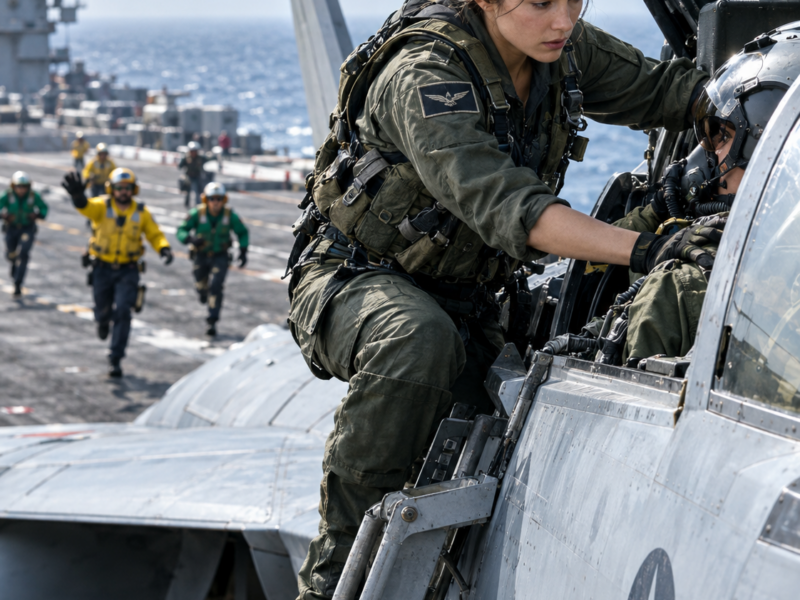
“Stay on the Bench.” Seconds Later, Her Hidden Past Saved a Super Hornet Pilot
Commander Blake Harrison had ordered the woman on the bench to stay out of his way, mocking her faded jacket in front of dozens of sailors—until an F/A-18 Super Hornet skidded across the runway, its pilot trapped inside, and a terrified voice shouted, “Don’t let them take her! She’s the only one who knows what really happened to Raven!”
The afternoon sun burned over Naval Air Station Oceana, turning the concrete flight line into a shimmering expanse of heat. The air smelled of jet fuel, hot rubber, and salt carried inland from the Atlantic. Beyond the hangars, the deep rumble of turbofan engines rolled across the base as ground crews prepared another wave of training flights.
I sat alone on a metal bench, wearing faded jeans, scuffed boots, and a navy-blue jacket that had seen better days. My hands rested around a paper cup of coffee that had gone cold twenty minutes earlier.
I had come to watch the aircraft.
That was the explanation I gave myself, anyway.
The truth was harder to admit. I missed the sound of engines spooling up, the vibration of a jet passing overhead, and the strange, weightless instant when an aircraft left the ground. I missed flying so much that sometimes I woke before dawn convinced I was still strapped into a cockpit.
Then I remembered the crash.
And I stopped dreaming.
“Ma’am.”
I looked up.
Commander Blake Harrison stood in front of me, his spotless uniform sharply pressed beneath the Virginia sun. Two younger officers flanked him. His expression suggested that discovering me on the bench had personally offended him.
“Can I help you?” I asked.
“Civilian access doesn’t mean you can sit wherever you please. This area is restricted to authorized personnel.”
“I was directed to wait here.”
“By whom?”
I gave him the name of the base contact who had arranged my visit.
He checked his tablet, apparently found the information, and looked irritated that I hadn’t been trespassing after all.
“Fine. But stay on the bench, ma’am. The flight line isn’t a tourist attraction.”
One of the younger officers smirked.
I glanced beyond them toward a Super Hornet parked beside a hangar. Its maintenance panels were closed, but a ground technician was examining the landing gear.
“Your starboard nose-gear door looks slightly out of alignment,” I said.
Harrison followed my gaze.
“What?”
“The panel. The forward edge isn’t sitting flush.”
He gave a short laugh.
“You can identify a mechanical fault from a bench?”
“I can identify something worth checking.”
The younger officer leaned toward his colleague and whispered something I didn’t catch.
Harrison heard enough to smile.
“Here’s some advice. Leave the technical assessments to people qualified to make them.”
I took another sip of cold coffee.
“Of course, Commander.”
He waited, perhaps expecting an argument.
When none came, he turned and walked away.
I watched him go without resentment. Arrogance was common on flight lines. So was the belief that knowledge could be measured by the shine on someone’s boots.
Twelve years earlier, I’d worn a uniform almost identical to his.
I had flown combat missions over hostile territory, qualified on carrier-based aircraft, and spent years training to recognize danger before it became visible to anyone else. My callsign had been Raven, a name earned after I brought a damaged aircraft back through a night storm when the recovery crew had already begun preparing for a possible ejection.
Then came the mission over the Arabian Sea.
My wingman, Lieutenant Daniel Cross, disappeared from radar after reporting an unidentified contact. I had requested permission to divert toward his last known position. Command refused, ordering me to return to the carrier.
I obeyed.
The official report concluded that Cross had been lost following an engagement with hostile aircraft. My decisions were scrutinized, my testimony questioned, and my flying privileges suspended pending investigation.
Before the inquiry ended, my career was over.
I left the Navy carrying one thing nobody wanted to discuss: a recording of Cross’s final transmission that contradicted the official timeline.
I had never released it.
Not because I believed the report, but because the people controlling the investigation had made it clear that challenging them would destroy what remained of my life.
So I disappeared into civilian work, repairing aircraft engines at a small airfield outside Norfolk.
I learned to keep my head down.
I learned to ignore the sky.
And I learned that silence could become a habit long after the danger had passed.
Then the warning sirens erupted.
Every conversation on the flight line stopped.
An F/A-18 Super Hornet came screaming toward the runway, far lower than I expected. Its engines roared, but the aircraft’s approach looked wrong. The nose oscillated, the jet drifted off the centerline, and its landing gear struck the runway with a violent bounce.
Sparks erupted beneath the fuselage.
A ground controller shouted into his radio.
“Aircraft down! Aircraft down! Clear the runway!”
The Super Hornet lurched sideways.
Its nose swung toward a row of support vehicles while the pilot fought to regain control. The aircraft’s movement was abrupt and uneven, suggesting a serious problem, though I couldn’t diagnose the precise failure from the bench.
I was standing before I realized I had moved.
“Get those vehicles clear!” I shouted. “Keep the emergency crews out of its forward path!”
Harrison spun toward me.
“Get back on the bench!”
I ignored him.
The aircraft veered again, showering the runway with debris.
“His nose gear isn’t tracking properly!” I yelled. “Don’t send anyone directly in front of that aircraft until the crew confirms it’s secure!”
Harrison grabbed my arm.
“I gave you an order!”
I pulled free.
“And your pilot has seconds!”
The Super Hornet finally ground to a halt near the edge of the runway. Smoke curled from beneath its fuselage, and the engine noise dropped into a harsh, uneven whine.
For one terrible moment, nobody moved.
Then the rescue crews surged forward.
“Pilot’s trapped!” a firefighter shouted. “Canopy release isn’t responding!”
I ran toward the aircraft, stopping when the rescue chief raised an arm to keep the approaching personnel clear.
“What’s the problem?” I asked.
“Electrical failure, possible damage to the canopy system. We’re assessing our options.”
“Is the aircraft secured?”
“Not yet.”
“Then don’t force the canopy. Follow your emergency procedures and confirm the aircraft is safe before anyone reaches into the cockpit.”
The rescue chief studied me.
“How do you know that?”
“Because rushing into a damaged aircraft can turn one casualty into five.”
A sharp crack sounded from beneath the jet.
Everyone flinched.
I looked at the forward fuselage, then at the position of the nose gear. Something about the way the aircraft had settled troubled me. I couldn’t see enough to determine the full extent of the damage, but I could tell the crew needed space and a careful assessment, not a crowd of people improvising around a potentially unstable machine.
“Get the pilot on the radio,” I said. “Ask whether he’s conscious and whether he can communicate.”
The rescue chief relayed the request.
A moment later, a faint voice came through the emergency headset.
“I’m conscious. Can’t release the canopy. My controls went strange on final.”
My stomach tightened.
The words were different, but the memory was unmistakable.
My controls went strange.
Daniel Cross had said almost the same thing twelve years earlier.
I stared at the cockpit.
“Ask him whether he received any unusual flight-control warnings before the approach,” I said. “And preserve the aircraft’s recorded data. Don’t let anyone overwrite it during the recovery.”
The rescue chief nodded and relayed the questions.
Behind us, Harrison had stopped shouting. He was watching me with an expression that had shifted from irritation to suspicion.
The pilot answered, his voice strained.
“Multiple warnings. I need to get out of here.”
The rescue team continued its assessment, coordinating with the appropriate maintenance and emergency personnel. I stayed outside their working area, offering observations when asked.
Then the canopy released.
The rescue chief and his team carefully extracted the pilot and moved him toward the waiting medical crew.
He was pale, shaken, and struggling to catch his breath, but he was conscious.
As they passed me, his eyes suddenly widened.
He reached for the rescue chief’s sleeve.
“Wait.”
The team stopped.
The pilot stared at my face as if he had seen someone return from the dead.
“It’s her.”
I felt the blood drain from my cheeks.
The rescue chief leaned closer.
“Who?”
The pilot swallowed painfully.
“Raven.”
Commander Harrison stepped forward.
“What did you say?”
The young pilot gripped the rescue chief’s sleeve harder.
“She was the pilot from the incident. The one they said had abandoned Cross.”
Harrison turned toward me.
“You told me you were a civilian visitor.”
“I am.”
“Then why does a Navy pilot recognize you by a classified callsign?”
Before I could answer, his radio crackled.
A voice from command spoke with chilling precision.
“Commander Harrison, detain the civilian immediately. Her presence at this incident is not to be disclosed.”
Harrison stared at his radio.
Then he looked at me.
I saw the calculation in his eyes. He was deciding whether to obey an order that made no sense or question the people issuing it.
The rescued pilot suddenly struggled against the medic’s attempt to settle him onto the stretcher.
“Don’t let them take her!”
His voice broke across the flight line.
“She knows who really shot us down twelve years ago!”
Every sailor within earshot went silent.
Harrison slowly lowered his radio.
I looked at the young pilot, then at the hangars beyond him, where the shadows were beginning to lengthen across the concrete.
For twelve years, I had believed Daniel Cross was dead.
Now a living pilot was telling me that the mystery surrounding his disappearance had never ended.
And someone in command was already trying to silence me again.
The order came through the control tower before anyone could ask another question.
“Security team, proceed to the south maintenance apron. Detain the civilian female known as Claire Bennett. Do not permit her to leave the installation. Her presence is to remain undisclosed.”
The radio fell silent.
Commander Blake Harrison stared at the receiver as if it had just accused him of a crime.
Then he looked at me.
“Claire Bennett,” he said slowly. “What exactly have you gotten yourself involved in?”
I stood beside the grounded Super Hornet, my hands still stained with grease from the emergency inspection.
“Nothing I chose, Commander.”
“Funny. Headquarters seems to disagree.”
The pilot, Lieutenant Ethan Cole, struggled to sit upright on the stretcher. A corpsman tried to hold him down, but Cole grabbed Harrison’s sleeve.
“Sir, you need to listen to her.”
Harrison pulled free.
“You’re injured, Lieutenant. Let the medical team do its job.”
“I’m not confused.” Cole’s voice cracked with frustration. “I saw the file. I heard the recording. Raven was there twelve years ago.”
The name hung between us.
Raven.
For years, I had trained myself not to react when someone said it. The callsign belonged to another life, one I had buried beneath civilian work shirts and long shifts in aircraft hangars.
But Cole knew.
And somehow, he knew about Daniel.
Harrison stepped closer to the stretcher.
“What recording?”
Cole glanced at me.
“The last transmission from Flight Viper Two. The one the investigation claimed never existed.”
My heart seemed to stop.
I had heard that transmission only once, twelve years earlier, through a damaged communications channel during a classified mission over the North Arabian Sea.
Daniel Cross had been my wingman.
We had been tracking an unidentified aircraft when our formation suddenly came under fire. The official report claimed Daniel’s aircraft suffered catastrophic mechanical failure before disappearing from radar.
But I remembered his voice.
I remembered the panic he tried to conceal.
And I remembered the words he spoke just before the signal vanished.
Raven, it’s not the aircraft. They’re locking us from the other side.
The Navy declared him lost at sea.
The investigation closed.
My questions cost me my career.
Now a pilot who had barely survived an emergency landing was telling me that the recording existed.
“Where did you hear it?” I asked.
Cole swallowed.
“Three nights ago. Someone sent it to me anonymously. There was no name, no explanation. Just the audio file and a scanned copy of your old flight record.”
Harrison’s expression hardened.
“You received classified material and decided to bring it onto a naval air station?”
“I came here because I thought the aircraft involved in that recording was still flying.”
His eyes shifted toward the Super Hornet.
“What are you saying?”
Cole looked directly at me.
“The system that nearly killed me today wasn’t malfunctioning. Someone interfered with the flight-control data.”
I felt the old instincts return—the sharp focus, the mental calculations, the instinctive search for patterns.
“What did the aircraft do?” I asked.
“During the approach, the controls began responding in the opposite direction. I corrected left, and the jet rolled right. The flight-control computer showed normal status, but the aircraft wasn’t obeying the commands.”
“Did you switch to the backup channel?”
“Yes. For about four seconds, everything worked.”
“And then?”
“The same problem returned.”
I looked toward the aircraft’s open maintenance panel.
That was not ordinary equipment failure.
Someone—or something—had made the aircraft lie to its pilot.
“Did you save the diagnostic data?” I asked.
Cole nodded weakly.
“On my mission recorder. I didn’t trust the onboard display.”
For the first time, Harrison stopped looking at me as though I were an inconvenience.
“You think this has something to do with Cross?”
“I think someone is using the same method that brought his aircraft down.”
Harrison’s jaw tightened.
“You have no evidence that Cross was shot down.”
“No,” I replied. “I have evidence that the official story was wrong.”
Before he could answer, two armed security personnel appeared at the edge of the apron.
A senior officer followed them, carrying a tablet.
“Commander Harrison?”
Harrison straightened.
“That’s me.”
“Orders from Naval Air Forces command. Claire Bennett is to be escorted to a secure holding facility immediately. No interviews, no outside communications, and no record of this incident is to be released without authorization.”
I watched the officer carefully.
“Who signed the order?”
“That’s above your clearance, ma’am.”
“I used to have clearance.”
“And you no longer do.”
The words were delivered with practiced indifference.
For twelve years, that sentence had followed me everywhere.
I took a breath.
“Then you should have no reason to be afraid of what I know.”
The officer’s expression flickered.
Only for a second.
But I saw it.
Harrison saw it, too.
“Stand down,” he ordered the security team.
The officer turned sharply.
“Commander, that is a direct order.”
“And I’m asking for clarification before I surrender a civilian witness to an unidentified command authority.”
“You’re making a mistake.”
“Possibly,” Harrison said. “But it will be my mistake.”
The officer stepped aside and spoke quietly into his radio.
I couldn’t hear the response.
I didn’t need to.
His face changed.
When he looked back at me, the hostility had vanished, replaced by something far more unsettling.
Recognition.
“Bennett,” he said, almost whispering. “Is the original recording still in your possession?”
My blood ran cold.
I had never told anyone on this base that I had kept a copy.
Not even Harrison.
“How do you know about that?” I asked.
The officer didn’t answer.
Instead, he turned toward Harrison.
“Commander, you have five minutes to reconsider. If she leaves this apron with that recording, every person involved in the Viper investigation could be exposed.”
Harrison stared at him.
“Every person?”
The officer looked away.
And that was when Cole spoke again.
“There’s something else you need to know.”
His trembling hand reached into the pocket of his flight suit and produced a small, folded sheet of paper.
“I didn’t come here just because of the recording.”
He held it out to me.
Across the top was a classified mission identifier I hadn’t seen in twelve years.
Beneath it was a single handwritten sentence.
DANIEL CROSS IS ALIVE. DO NOT TRUST COMMAND.
I looked up.
The security team had raised their weapons—not at me, but toward the hangar doors behind us.
Someone was coming.
And when I heard the approaching footsteps, I recognized the voice that called my old callsign.
“Raven.”
It was a voice I had spent twelve years hoping never to hear again.
“Raven.”
The voice came from the hangar entrance.
I knew that voice.
Twelve years earlier, it had guided me through violent turbulence, warned me about incoming fire, and promised me that we would make it home.
Daniel Cross.
I turned so quickly that the folded paper slipped from my fingers.
A man in a dark flight suit stood beneath the hangar lights. His hair was shorter than I remembered, his face leaner, and a pale scar ran from his left temple to his jaw.
But his eyes were unmistakable.
“Daniel?”
He took one step toward me.
“Hello, Claire.”
For a moment, I couldn’t breathe.
I had attended a memorial service for him. I had watched officers present a folded flag to a family that never received his body. I had spent twelve years wondering whether his final transmission had been a plea for help or a warning I had failed to understand.
Now he was standing ten feet away.
Alive.
I moved toward him, then stopped.
Something was wrong.
Daniel had been my wingman, my closest friend, and the only person who knew the full truth about the mission that ended my career.
Yet he wasn’t smiling.
He looked frightened.
“Where have you been?” I whispered.
“Somewhere I wasn’t supposed to survive.”
I reached for his arm.
He stepped back.
“Don’t touch me.”
The words struck harder than I expected.
Behind me, Commander Harrison ordered the security personnel to lower their weapons. The senior officer who had delivered the detention order was already backing toward the exit.
“Captain Cross,” Harrison said, his voice suddenly formal. “Your status has been listed as deceased for twelve years. You will explain yourself.”
Daniel ignored him.
His attention remained fixed on me.
“Did you keep the recording?”
I hesitated.
“Yes.”
“Does anyone else have a copy?”
“No.”
He closed his eyes briefly.
“Then we may still have a chance.”
“A chance at what?” I demanded. “You disappeared. They blamed me. I lost my wings, my clearance, my entire career. And you expect me to stand here while you speak in riddles?”
For the first time, something resembling shame crossed his face.
“I know what they did to you.”
“Then tell me why.”
Daniel glanced at the security cameras mounted above the hangar doors.
“Not here.”
Harrison stepped between us.
“No. Absolutely not. You don’t walk onto my installation after twelve years, refuse to explain your status, and expect everyone to follow your instructions.”
Daniel finally looked at him.
“Commander, the aircraft Lieutenant Cole flew today was deliberately compromised. The same system was used against us twelve years ago.”
Harrison’s expression tightened.
“That’s a serious accusation.”
“It’s worse than you think.”
Daniel reached inside his flight suit and withdrew a small metal data drive.
“Someone has been testing a control-system exploit on operational aircraft. Cole’s emergency was supposed to look like a pilot error. If he’d died, the investigation would have blamed him.”
“And you know this how?” Harrison asked.
“Because I was ordered to help build the system.”
Silence fell over the apron.
I stared at Daniel.
“You were a pilot.”
“I was.”
“What happened to you?”
He looked down at the drive.
“After our mission, I survived the ejection. A recovery team found me before the search aircraft did. They told me you were dead, that the entire flight had been lost, and that the operation never officially existed.”
My hands began to shake.
“That makes no sense. I returned to base.”
“They showed me photographs of a burned aircraft and a report with your name on it. They said you had died during recovery.”
“But I was standing right there.”
“I know that now.”
Daniel’s voice broke on the final word.
“For years, I believed the people holding me were the only ones who knew what happened. Then I discovered they had been monitoring your career. Every inquiry you made. Every request for the mission files. Every attempt to contact my family.”
I remembered the anonymous warnings. The sudden suspension of my flight status. The security officers who searched my quarters and confiscated my notebooks.
“You knew I was alive,” I said.
“Not until six months ago.”
“And you didn’t come to me?”
“I couldn’t. They had a way to track everyone I contacted.”
“Who are they, Daniel?”
He looked toward the senior officer.
The man had disappeared.
Daniel lowered his voice.
“A group operating inside the procurement and testing chain. They developed an experimental flight-control override. It was supposed to be used in simulations, but someone began using it on real aircraft. Our mission twelve years ago was meant to expose the program.”
I remembered the unidentified aircraft, the sudden loss of control, and Daniel’s final warning.
“They shot us down to protect it.”
“Yes.”
“And you survived.”
“Yes.”
“Then why did they let me live?”
Daniel looked at me with an expression I had never seen before.
“Because they needed someone to blame. And because you were the only pilot who might eventually discover how the system worked.”
Before I could answer, every light on the maintenance apron went dark.
A warning siren sounded from the hangar.
Then came the sharp crack of a gunshot.
Harrison shoved me behind a maintenance vehicle as security personnel scattered.
“Everyone down!”
Another shot struck the concrete beside Daniel.
He dropped behind the Super Hornet, clutching his shoulder.
I crawled toward him.
“Daniel!”
“Stay back!” he shouted.
But I was already beside him.
Blood spread across his flight suit.
I pressed my hand against the wound.
“Who fired?”
He forced the data drive into my palm.
“Get this somewhere safe.”
“I am not leaving you again.”
His fingers closed around my wrist.
“Claire, listen to me. The person who authorized the original operation is here.”
“Who?”
Daniel’s eyes shifted toward the control tower.
A figure stood behind the glass, watching the chaos below.
Even at that distance, I recognized the silver hair and rigid posture.
Admiral Richard Voss.
The man who had led the investigation into our disappearance.
The man who had personally signed the document ending my flying career.
And the man who had once looked me in the eye and told me that Daniel Cross was dead.
My radio crackled.
A calm voice emerged through the static.
“Commander Harrison, secure the woman and recover the data drive. Captain Cross is not to leave the installation alive.”
Harrison slowly raised his head.
Then he looked at me.
For the first time since I had met him, the arrogance was gone.
“Bennett,” he whispered, “tell me you have a plan.”
I looked at Daniel’s bleeding shoulder, the darkened hangar, and the control tower where Admiral Voss was watching us.
I had spent twelve years trying to prove that I hadn’t failed my wingman.
Now my wingman was dying in front of me.
And the only way to save him might be to do the one thing the Navy had forbidden me to do.
Fly again.
I turned toward the grounded Super Hornet.
“Commander,” I said, “I need access to that aircraft’s flight-control diagnostics.”
Harrison stared at me.
“You can’t possibly mean—”
A new transmission interrupted him.
“Attention all personnel. Initiate lockdown. No aircraft are authorized to launch.”
I tightened my grip on the data drive.
Someone knew exactly what I was planning.
And they were already trying to stop me.
The lockdown alarm continued to howl across NAS Oceana.
Red warning lights flashed over the maintenance apron. Security personnel rushed toward the hangars, while ground crews were ordered to clear the flight line.
Daniel lay against the landing gear of the Super Hornet, his face pale.
I kept pressure on his wound.
“Stay with me,” I whispered.
He managed a weak smile.
“You always did give orders like a squadron commander.”
“Then consider this a direct order. You’re not dying today.”
A corpsman finally reached us and took over the bandage. Daniel grabbed my sleeve before I could stand.
“Claire, the drive isn’t the only copy.”
“What do you mean?”
“There’s a backup in the aircraft’s mission computer. The exploit leaves a trace in the flight-control logs. If you can recover it, you’ll have proof.”
“Proof that can survive an investigation?”
“Proof that can survive anything.”
His expression changed.
“But you need to understand something. Voss won’t let that data leave this base.”
I looked toward the control tower.
Admiral Richard Voss had disappeared from the window.
That frightened me more than if he had stayed.
I rose and faced Commander Harrison.
“Get me the diagnostic station.”
He shook his head.
“Absolutely not. You’re a civilian. You’re not cleared to access that aircraft’s classified systems, and you certainly aren’t cleared to fly it.”
“I’m not asking to fly it.”
“You’re asking me to violate a direct lockdown order.”
“I’m asking you to investigate an aircraft that nearly killed one of your pilots.”
He glanced toward the medical team working on Daniel.
Then he looked back at the Super Hornet.
“Suppose I give you access. What exactly are you looking for?”
“An inconsistency between the aircraft’s recorded control inputs and its actual flight response. If someone injected false commands into the system, the diagnostic logs may show where they entered.”
“And if they don’t?”
“Then you can have security escort me wherever you want.”
Harrison studied me for several seconds.
Finally, he turned to his chief maintenance technician.
“Open the diagnostic station. Nobody touches the flight controls. Nobody powers up the aircraft without my authorization.”
The technician hesitated.
“Sir, headquarters ordered—”
“I heard the order.”
Harrison’s voice hardened.
“I’m responsible for the aircraft and the pilot who almost died in it. Open the station.”
The technician obeyed.
Inside the maintenance shelter, a diagnostic monitor flickered to life. I connected the approved service equipment to the aircraft’s recorded data interface.
My hands remembered the procedure before my mind did.
Twelve years had passed, but the patterns were familiar: control-surface commands, sensor feedback, flight-control computer status, and recorded pilot inputs.
I scanned the final minutes of Cole’s flight.
At first, everything looked normal.
Then I found it.
A series of control corrections had been recorded as if they originated from the pilot. But the timestamps didn’t match Cole’s movements, and the corresponding sensor data contradicted the commands.
Someone had inserted a false control signal.
“There,” I said.
Harrison leaned over my shoulder.
“What am I looking at?”
“Someone made the system record commands that Lieutenant Cole never issued.”
“Can you prove it?”
I pointed to the next sequence.
“The backup channel briefly restored normal control. Then the same false commands appeared again. That’s why he lost control a second time.”
Harrison’s face went rigid.
“Can you identify who did it?”
“Not from this log alone.”
I opened the deeper diagnostic records.
A hidden process appeared beneath the normal system entries.
It wasn’t part of the standard flight-control software.
And beside it was an authorization identifier.
I recognized the first four characters immediately.
VX-17.
My stomach tightened.
That was the designation attached to the experimental system from our mission twelve years ago.
The same identifier I had seen in Daniel’s classified briefing.
“Commander,” I whispered, “this isn’t just a copy of the old exploit.”
“What is it?”
“It’s the original system. Someone has been maintaining it.”
I copied the relevant diagnostic records to an authorized evidence drive.
Then another file appeared.
A protected directory had been accessed less than twenty minutes before Cole’s emergency.
The user credentials belonged to the installation’s senior command network.
Harrison read the identifier.
“That’s impossible.”
“Why?”
“Because that access code belongs to Admiral Voss.”
Before either of us could speak again, the shelter door slammed open.
Three armed security officers entered.
Their leader held a tablet displaying an official order.
“Commander Harrison, step away from the terminal.”
Harrison straightened.
“On whose authority?”
“Admiral Voss. The aircraft investigation is being transferred to a special command team.”
“That’s convenient,” I said.
The officer turned toward me.
“Claire Bennett, hand over the drive.”
“No.”
His hand moved toward his weapon.
Harrison stepped between us.
“Careful. She’s a civilian witness, and this is an active aircraft-safety investigation.”
“You’ve exceeded your authority, Commander.”
“Then file a complaint.”
For a moment, nobody moved.
Then the officer’s radio crackled.
“Team leader, report.”
He touched the receiver.
“Target secured. Awaiting transfer instructions.”
A second voice answered.
“Negative. Do not transfer the witness. Eliminate all unauthorized evidence and prepare the aircraft for immediate removal.”
The officer went pale.
Harrison heard it, too.
“Repeat that order,” he demanded.
The radio went silent.
I looked at the monitor.
The protected directory had opened a final document automatically.
It contained a list of aircraft registration numbers, mission dates, and pilot names.
There were seventeen entries.
Daniel Cross’s name was number one.
Lieutenant Ethan Cole’s was number seventeen.
Between them were fifteen other pilots.
Some had been officially listed as killed in accidents.
Others had been dismissed for alleged misconduct.
One name belonged to a pilot who had disappeared only three months earlier.
At the bottom of the document was a final line:
OPERATION RAVEN: PHASE TWO AUTHORIZED.
I felt the room tilt around me.
“Phase Two?” Harrison asked.
I scrolled to the attached operational note.
The plan was brief.
A live demonstration of the control-system override was scheduled for the following morning. The target was a flight of Super Hornets participating in a high-profile evaluation exercise.
The pilots would believe they were testing a routine software update.
Instead, someone would seize control of their aircraft.
The resulting failures would be blamed on a technical defect, and the VX-17 program would be permanently buried beneath another official investigation.
Harrison stared at the screen.
“How many aircraft?”
“Six,” I answered.
“Six pilots?”
I nodded.
“And we have until morning?”
A new transmission sounded over the base loudspeakers.
“Attention all personnel. Due to an urgent operational requirement, tomorrow’s flight evaluation has been moved forward. All participating aircraft will launch in twenty minutes.”
Harrison looked at the clock.
Twenty minutes.
I pulled the evidence drive from the diagnostic station.
“We have to stop them.”
The security officer raised his weapon.
“Put the drive down.”
Harrison didn’t move.
Then, slowly, he removed his command insignia and placed it on the workbench.
“If you’re going to arrest someone,” he said, “start with me.”
The officer hesitated.
That was all I needed.
I slipped through the rear service door and ran toward the hangar.
Behind me, Harrison shouted for the security team to stand down.
Ahead, the Super Hornets were already being prepared for launch.
I had no authorization, no squadron, and no guarantee that my skills were still good enough.
But six pilots were about to enter the sky with a system designed to betray them.
I reached the nearest aircraft and stopped beside its ladder.
A familiar voice came through the maintenance radio.
“Raven, if you can hear me, don’t launch.”
Daniel.
His voice was weak but urgent.
“Voss knows about the backup plan. The aircraft aren’t the real target.”
I grabbed the radio.
“Then what is?”
There was a pause.
Then he spoke four words that turned my blood to ice.
“They’re targeting the control tower.”
I looked up.
Every launch authorization for the six aircraft was being routed through that tower.
And on its roof, a red warning light had just begun to flash.
Someone had already started the countdown.
“They’re targeting the control tower.”
Daniel’s warning repeated in my headset.
I stared at the red light flashing above the tower. Six Super Hornets were being prepared for launch, their engines beginning to roar across the flight line.
If the tower lost control of the aircraft authorization system, the pilots could be airborne before anyone realized their flight-control computers had been compromised.
And if VX-17 activated in the air, the results could be catastrophic.
“Daniel, what exactly is the target?”
“The tower’s primary authorization server. Voss wants the system to fail during the launch window. Once the aircraft lose control, he’ll blame a software malfunction and destroy the evidence.”
“Can we shut it down remotely?”
“No. The override is embedded in the flight-control update. You have to stop the update before the aircraft launch.”
I looked at the nearest Super Hornet.
Its canopy was open. A young pilot was climbing into the cockpit, unaware that someone had turned his routine mission into a death sentence.
“How much time do we have?”
“Less than fifteen minutes.”
I ran toward the aircraft.
Commander Harrison appeared at the edge of the hangar, followed by two maintenance technicians.
“Bennett!”
He caught up with me, breathing hard.
“Security is looking for you. Voss has ordered the entire apron sealed.”
“Then we have to work quickly.”
I showed him the evidence drive.
“VX-17 is scheduled to activate during the flight evaluation. The authorization server is the key. If we interrupt the update before launch, we may prevent the aircraft from accepting the compromised commands.”
Harrison looked toward the tower.
“And if you’re wrong?”
“Six pilots could die.”
He held my gaze for a moment.
Then he turned to the technicians.
“Get every participating aircraft’s update status. Now. No one launches until I personally clear it.”
One technician hurried away.
The other shook his head.
“Sir, we can’t stop the launch without authorization from the tower.”
Harrison pulled out his radio.
“Tower, this is Commander Harrison. Suspend all launches immediately. Possible flight-control system compromise.”
Static answered.
He tried again.
Nothing.
Then a voice came through.
“Commander Harrison, all launch authorizations remain in effect. Any interference will be treated as a security violation.”
Admiral Voss.
Harrison’s expression hardened.
“Admiral, I have evidence that the flight-control update is compromised.”
“Your evidence is fabricated.”
“Then you won’t object to an independent technical inspection.”
“I will not repeat myself. Stand down.”
The transmission ended.
Harrison lowered the radio.
“He’s not going to stop.”
“No,” I said. “He isn’t.”
I climbed into the maintenance access area beside the nearest aircraft’s service panel.
The system was already preparing to install the update.
A progress indicator showed that the process was nearly complete.
I connected the diagnostic equipment and began checking the update signature against the aircraft’s authorized software record.
The signatures didn’t match.
Someone had replaced a trusted component with a modified version.
I isolated the discrepancy and sent the evidence to Harrison’s secure command terminal.
“Can you stop it?” he called.
“Not from here. The aircraft’s update is being authorized through the tower.”
“Then we need the tower.”
A loudspeaker crackled overhead.
“Final launch sequence begins in five minutes.”
I climbed down.
“We’re going inside.”
Harrison nodded.
We ran toward the tower entrance, taking the service corridor that connected the maintenance hangar to the operations building.
At the security checkpoint, two armed guards blocked our path.
“Commander, no one is authorized to enter the tower.”
Harrison held up his identification.
“I’m ordering an emergency safety inspection.”
“Your access has been revoked.”
He looked at me.
“Any suggestions?”
I glanced at the guards, then at the emergency operations panel beside the door.
“Tell them the truth.”
Harrison faced the guards.
“If those aircraft launch, there is a credible risk that their flight controls will be compromised. If you prevent us from reaching the authorization system, you will be preventing an aircraft-safety intervention.”
The older guard hesitated.
Then his radio sounded.
“Security team, detain Commander Harrison and Claire Bennett. Admiral’s orders.”
The younger guard raised his weapon.
The older one lowered his.
“I joined this service to protect pilots,” he said quietly. “Not to help someone kill them.”
He stepped aside.
We entered the tower.
Inside, personnel were scrambling around the operations consoles. A warning flashed on the main display, indicating that the update had been authorized for all six aircraft.
At the central workstation stood Admiral Voss.
He turned as we approached.
“You have no idea what you’re interfering with.”
I held up the evidence drive.
“I know exactly what VX-17 is.”
His eyes narrowed.
“Give me that drive.”
“No.”
“You think this will restore your career? Your clearance? Your reputation?”
I stepped closer.
“I don’t want any of those things.”
For the first time, my voice didn’t shake.
“I want the truth about Daniel Cross. I want the truth about every pilot on that list. And I want those six aircraft to land safely.”
Voss’s expression turned cold.
“Cross was a liability. You were supposed to have been one, too.”
Harrison moved toward the central console.
Voss immediately pressed a button beneath the workstation.
A security shutter dropped across the room’s main exit.
The lights changed from white to red.
“Lockdown initiated,” an automated voice announced.
Voss looked at me.
“You should have stayed on that bench.”
I stared at him.
“You made that mistake twelve years ago.”
I turned toward the console.
The launch countdown showed ninety seconds.
The system was still processing the update.
I didn’t need to fly the aircraft. I didn’t need to prove I was still Raven.
I needed to stop the compromised software from reaching the pilots.
The diagnostic screen displayed an emergency option for suspending the update authorization. It required confirmation from the installation’s safety officer and the commanding officer on duty.
Harrison reached for his credentials.
Voss lunged toward him.
They collided against the workstation.
The screen flashed.
FINAL AUTHORIZATION REQUIRED.
Harrison struggled to hold Voss back.
“Claire! Now!”
I entered the safety suspension request and attached the verified software discrepancy.
The system rejected it.
COMMAND AUTHORITY OVERRIDE ACTIVE.
Voss laughed.
“You can’t overrule me.”
I looked at the diagnostic record one final time.
The VX-17 process was operating under an administrator credential.
But the underlying audit log had recorded the original authorization chain, including the identity of the person who had installed the altered software.
I selected the audit record and transmitted it to the base’s independent flight-safety network.
Then I triggered the system’s mandatory safety review.
The console went black.
For one terrifying second, nothing happened.
Then the tower’s loudspeakers crackled.
“Flight evaluation suspended. All aircraft remain grounded pending a flight-control safety investigation.”
Outside, the engine noise began to subside.
The six Super Hornets remained on the ground.
The pilots were safe.
Voss stopped struggling.
He looked at the console, then at me.
“You have no idea what you’ve done.”
“I saved six lives.”
“You’ve destroyed years of work.”
“No,” I said. “I exposed years of lies.”
Security officers entered through the service corridor. This time, they didn’t come for me.
They came for Admiral Voss.
As they escorted him away, he turned back one last time.
“This isn’t over, Bennett.”
I watched him disappear through the doorway.
“For you,” I replied, “it is.”
Three months later, an independent investigation confirmed that VX-17 had been used to compromise multiple military aircraft.
The original inquiry into Daniel Cross’s disappearance was reopened. Several officers were removed from command, and the program was suspended pending a full review.
Daniel survived his injuries.
He still had a long recovery ahead, and there were questions he couldn’t yet answer. But he was no longer a ghost buried in a classified report.
As for Commander Harrison, he submitted a formal statement acknowledging that he had misjudged me.
He never apologized in public.
He didn’t need to.
One morning, I returned to NAS Oceana and sat on the same bench where he had told me to stay out of the way.
The air smelled of salt, jet fuel, and the beginning of another day.
A young female aviator approached, carrying her helmet beneath one arm.
“Excuse me, ma’am. Are you Claire Bennett?”
I nodded.
She hesitated.
“My instructor told me about you. He said you were one of the best pilots the Navy ever had.”
I looked toward the flight line.
“I was a pilot.”
She smiled.
“Once a pilot, always a pilot?”
I considered the question.
Then I stood.
“Not always,” I said. “But you never stop being responsible for the people flying beside you.”
A Super Hornet roared overhead, climbing into the morning sky.
For twelve years, I had believed my story ended when the Navy took away my wings.
I had been wrong.
My story hadn’t ended on that bench.
It had been waiting there for me to stand up.
And somewhere beyond the clouds, the truth about Daniel Cross was finally free to fly.
THE END
Thank you for reading!









