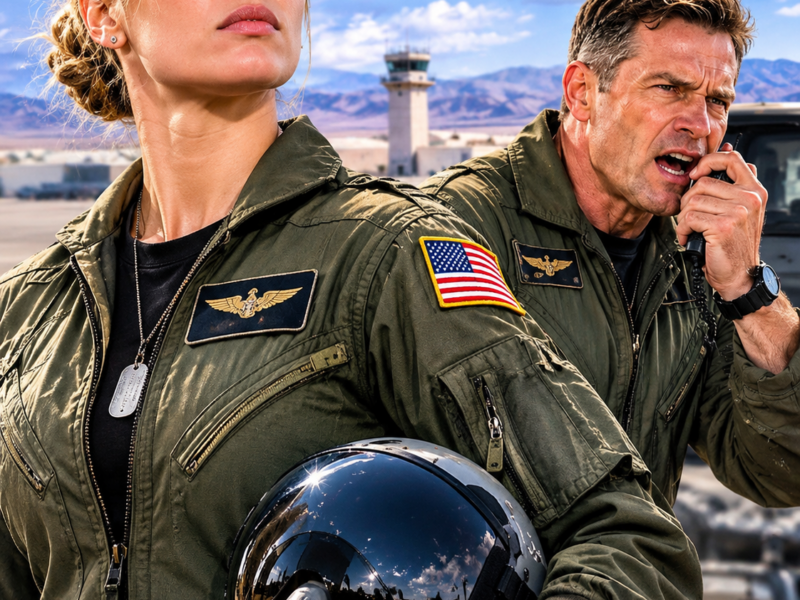
“Stay in your lane, Lieutenant Brooks.” Colonel Cole said it in front of the entire squadron
The first time Lieutenant Maya Brooks warned Colonel Cole about Aircraft 204, he barely looked up from the papers on his desk.
“The winds in the Northern Corridor are unstable,” she said, keeping her voice steady. “And Aircraft 204 still has a maintenance warning that hasn’t been properly cleared.”
Colonel Cole continued reading.
“Is that your assessment, Lieutenant?”
“Yes, sir.”
“Or are you questioning the maintenance team’s work?”
“I’m reporting what I found, sir.”
He finally raised his eyes.
Maya stood straight in front of his desk, her hands at her sides. She had learned long ago that confidence did not require raising your voice. In the military, she had also learned that being right did not always mean being heard.
Cole leaned back in his chair.
“You’re a pilot, Brooks. Your job is to fly the aircraft assigned to you, not second-guess every decision made by the people responsible for keeping them operational.”
“With respect, sir, if the warning hasn’t been cleared—”
“Stay in your lane, Lieutenant.”
The words landed harder than they should have.
Maya held his gaze.
“Understood, sir.”
She turned and left.
But she did not withdraw the report. She did not pretend the warning had disappeared. And she certainly did not forget what she had seen.
Three days earlier, she had submitted the maintenance concern through the proper channels. She had documented the issue, reported the incomplete clearance, and made sure her concerns were recorded.
She had done everything expected of her.
Now, standing outside the colonel’s office, she wondered whether any of it would matter.
She looked toward the hangar, where Aircraft 204 sat among the others.
It looked perfectly ordinary from a distance.
That was the frightening part.
A dangerous problem did not always announce itself with smoke or sparks. Sometimes it sat quietly behind polished metal, waiting for the moment someone needed to trust it with their life.
Maya knew that.
She had been raised to know that.
Her father, James Brooks, had been a military pilot. He had taught her that the most important part of flying was not confidence. It was judgment.
“An aircraft doesn’t care about your rank,” he used to tell her. “It doesn’t care how many people are watching or how important the mission looks on paper. If something isn’t right, you speak up.”
James had also taught her that courage was not the absence of fear.
It was doing what needed to be done even when the people around you would rather you stayed quiet.
Maya had carried those lessons into every assignment.
She had never expected that the hardest part of following them would be convincing another officer to listen.
***
The next morning, the squadron gathered for Falcon formation training.
The operation was routine on paper. Pilots would practice coordinated movement, formation discipline, and response procedures under changing weather conditions.
Colonel Cole would lead the exercise.
Aircraft 204 was assigned to him.
Maya checked the flight information and felt her stomach tighten.
She knew the aircraft’s maintenance clearance remained a concern. She also knew she had already reported it. The decision to proceed was no longer hers.
Still, she approached the colonel before the briefing ended.
“Sir, I need to raise the Aircraft 204 issue again.”
Cole looked at her.
“Brooks, we discussed this.”
“Yes, sir. The maintenance warning was reported three days ago. The clearance is still incomplete in the records I reviewed.”
“The aircraft has been cleared for today’s exercise.”
“Sir, I haven’t seen documentation that resolves the original warning.”
His expression hardened.
“Do you have new information?”
“No, sir. I have the same concern, and I don’t believe it has been addressed.”
A few people nearby stopped talking.
Cole lowered his voice.
“Lieutenant, I understand that you want to be thorough. But you need to understand the difference between raising a concern and challenging the chain of command.”
Maya took a breath.
“I’m not challenging your authority, sir. I’m trying to prevent a problem.”
For a moment, neither spoke.
Then Cole turned toward the rest of the group.
“We’re proceeding with the exercise.”
Maya stepped back.
She had made her position clear. She had documented it. She had warned him twice.
But she still felt the weight of the decision.
***
The aircraft engines began to roar across the runway.
One by one, the Falcons took off and climbed into formation.
Maya settled into her aircraft and completed her checks. Her hands moved through the familiar sequence with practiced precision. Instruments. Communications. Flight controls. Position.
She could see the other aircraft holding formation.
For a while, everything appeared normal.
The weather was changing, but not beyond what the pilots had trained to handle. The Northern Corridor was known for unstable winds, and the formation adjusted as conditions shifted.
Then a transmission came through.
“Falcon Lead, this is 204. Experiencing abnormal vibration.”
Maya recognized Cole’s voice immediately.
She straightened in her seat.
“Falcon Lead, confirm your status.”
“Aircraft 204 reporting engine trouble.”
The next transmission was more urgent.
“Mayday, mayday, mayday. Falcon Lead declaring an emergency. Losing altitude.”
The calm rhythm of the exercise vanished.
Maya’s eyes moved rapidly between her instruments and the other aircraft.
Aircraft 204 was no longer maintaining its expected position.
“Falcon Lead to 204. Colonel, do you read?”
“Reading you. Engine performance is deteriorating. I’m losing altitude.”
Maya’s mind went back to the maintenance report.
Three days earlier.
The warning.
The incomplete clearance.
She felt anger rise, but she pushed it aside.
There would be time for questions later.
Right now, someone needed help.
“Colonel, maintain communication with me. We’re going to work through this.”
“I’m trying. The aircraft isn’t responding the way it should.”
“Understood. Keep your focus on the aircraft. I’ll coordinate the recovery.”
Maya began assessing the situation.
The formation was breaking apart. Weather conditions were shifting. Aircraft 204 was losing altitude, and the available options were narrowing.
She identified an auxiliary strip southwest of their position.
It was not the easiest place to land under the circumstances, but it offered a possible recovery point.
“Falcon Lead to ground control. We have an emergency aircraft. Prepare the auxiliary strip southwest of our position. Clear the area and stand by for emergency recovery.”
The response came back.
“Understood. Ground crew moving.”
Maya switched back to Cole.
“Colonel, I need you to stay with me. We’re working toward the auxiliary strip.”
“Copy.”
“Keep your attention on controlling the aircraft. Don’t let the situation pull your focus away.”
Another burst of static interrupted the channel.
Then Cole’s voice returned.
“I’m losing more altitude.”
“I hear you, sir. Keep talking to me.”
Maya could hear the strain in his breathing.
The man who had dismissed her warnings was now depending on her to help bring him home.
She did not let that thought interfere with the work.
She checked the position of the other aircraft.
“Wingman, maintain visual contact with 204. Report any change in position.”
“Copy. Keeping him in sight.”
Maya continued coordinating with the ground crew while tracking the developing emergency.
Every second mattered.
The aircraft was unstable. The weather was shifting. The landing strip was being prepared, but no one could guarantee that the recovery would be easy.
She kept her voice measured.
“Colonel, stay with me. We have a recovery point. The ground team is clearing it now.”
“Understood.”
“Keep your eyes on your instruments. Make every correction deliberately.”
The radio crackled.
For a moment, there was only static.
Then Cole spoke again.
“Brooks…”
“I’m here, sir.”
“I should have listened.”
Maya tightened her grip.
There were a hundred things she could have said.
She could have reminded him that she had warned him three days earlier. She could have repeated the words he had used in his office. She could have asked whether he still thought she was staying outside her lane.
But none of that would help him land.
“You can apologize once we’re safely on the ground, sir.”
A pause.
Then Cole answered.
“Copy that.”
***
The auxiliary strip came into view.
Maya continued guiding Cole toward it, keeping communication open as the aircraft approached the recovery area.
The ground crew had cleared the strip and was standing by.
The situation remained difficult.
Aircraft 204 was damaged, and the shifting conditions left little room for error. Maya watched its position closely, relaying information and helping Cole maintain focus.
“Falcon Lead to 204. You’re approaching the recovery area.”
“Copy.”
“Keep it steady. Stay focused.”
The aircraft moved closer.
For a brief moment, it looked as if the situation might slip beyond control.
Maya’s heart pounded.
She forced herself to concentrate.
She had trained for emergencies. She had studied procedures, practiced responses, and learned how to make decisions under pressure.
Now all of that training had to become action.
“Colonel, you’re almost there. Stay with me.”
Cole’s response was faint.
“Still here.”
“Good. Keep going.”
The aircraft descended toward the strip.
Maya watched every movement, listening for every change in Cole’s voice and every update from the ground.
Then Aircraft 204 touched down.
It was not a graceful landing.
But it was a landing.
The aircraft slowed, and the ground crew moved into position.
For a moment, the radio remained quiet.
Maya stared at the aircraft.
Then the transmission came.
“Falcon Lead… Aircraft 204 is down.”
She exhaled.
“Confirm your status, Colonel.”
“I’m safe.”
Maya closed her eyes for half a second.
“Understood, sir. Stand by for ground assistance.”
The emergency had ended.
The questions had only begun.
***
When Maya reached the ground, the atmosphere around the auxiliary strip was tense.
Ground personnel were checking the aircraft and attending to the situation. Cole was safe, but the condition of Aircraft 204 made one thing unmistakable: the problem had been serious.
He approached her after the immediate response was underway.
For the first time since she had joined the squadron, he seemed unsure of what to say.
“Lieutenant Brooks.”
“Sir.”
He looked toward the aircraft, then back at her.
“You kept me focused. You coordinated the recovery. You got me down safely.”
Maya did not answer immediately.
Cole nodded.
“You were right about the warning.”
“Yes, sir.”
“I should have listened.”
“Yes, sir.”
He looked as though he expected her to say more.
Maya finally spoke.
“I reported the problem because I believed the aircraft wasn’t safe to fly without a proper clearance. I wasn’t trying to make your job harder.”
“I know that now.”
“Sir, I need you to understand something. I don’t want to be right about an emergency. I want the emergency prevented.”
Cole’s expression changed.
The words seemed to reach him more deeply than any accusation could have.
He glanced at the aircraft again.
“We’ll find out exactly what happened.”
“I hope so, sir.”
He turned toward the personnel nearby.
“Preserve every maintenance record, every message, and every report connected to Aircraft 204. Nothing gets discarded or altered. I want a full investigation into the clearance.”
A member of the team acknowledged the order.
Cole looked back at Maya.
“Your original report needs to be part of that investigation.”
“It should have been part of the decision before we took off.”
He accepted the criticism without arguing.
“Yes,” he said quietly. “It should have.”
***
The first review of the records revealed a troubling detail.
The original maintenance warning had never been properly cleared.
The documentation showed that the concern had been received three days earlier. Yet Aircraft 204 had still been marked as cleared.
There was also a forged signature on the clearance.
The discovery changed the nature of the investigation.
This was no longer simply a disagreement between a colonel and a lieutenant about whether an aircraft was ready for a training exercise.
A safety warning had been submitted. The records did not show a legitimate resolution. And someone had made the aircraft appear cleared when the documentation did not support that conclusion.
The investigation would need to establish how that happened and who was responsible.
Cole ordered that all related messages and reports be preserved.
Maya’s warning became a central part of the review.
For the first time, the report that had been dismissed as an inconvenience was being treated as what it had always been: a serious safety concern.
But the paperwork was only one part of what needed to change.
There was something else Cole had to address.
Something personal.
***
Later, he asked Maya to meet with him.
She entered his office and stood at attention.
“At ease, Lieutenant.”
She relaxed slightly.
Cole gestured toward a chair.
“Have a seat.”
Maya sat.
For a moment, he studied the documents on his desk without speaking.
Then he looked up.
“I owe you an explanation.”
Maya waited.
“Why did you think I didn’t belong, sir?”
The question was direct.
Cole did not pretend to misunderstand.
He leaned back.
“When you first reported the warning, I should have treated it as a professional concern. Instead, I treated it as a challenge to my authority.”
Maya remained quiet.
“I told myself I was protecting the chain of command. I told myself you were questioning decisions you weren’t responsible for making.”
“You told me to stay in my lane.”
“Yes,” he said. “I did.”
“Why?”
Cole looked toward a photograph on his desk.
It showed an older military pilot.
“Do you recognize this man?”
Maya turned toward it.
Her expression changed.
“My father.”
“James Brooks.”
She looked back at the colonel.
“You knew him?”
“I did.”
Cole took a breath.
“Your father saved my life.”
Maya went still.
She had known her father served as a pilot. She knew he had flown difficult missions and earned the respect of people who had worked with him.
But she had never heard this story from Cole.
He continued.
“There was a time when I was in a situation I couldn’t get myself out of. Your father was there. He made a decision that brought me home.”
Maya listened without interrupting.
“He never treated it as though I owed him something. He didn’t make it about himself. But he taught me something I’ll never forget.”
Cole paused.
“He told me that pride must never outrank safety.”
Maya lowered her eyes for a moment.
That sounded exactly like her father.
“He believed that every pilot had a responsibility to speak up when something was wrong,” she said.
“He did.”
“He used to tell me an aircraft doesn’t care about your rank.”
Cole gave a small, sad smile.
“That sounds like James.”
Maya looked at the photograph again.
“Then why didn’t you listen to me?”
The question hung in the room.
Cole had no easy answer.
“Because I forgot what he taught me,” he said. “I let my position become more important than the warning. I treated your concern as disrespect when it was exactly the kind of responsibility he expected from every pilot.”
Maya looked at him.
“My father never taught me to be quiet just because someone outranked me.”
“I know.”
“He taught me to speak up when people’s lives could be at risk.”
“You did the right thing.”
“I did what I was supposed to do, sir.”
Cole nodded.
“And I failed to do what I was supposed to do.”
The silence that followed was different from the silence in his office three days earlier.
This time, he was not waiting for her to back down.
He was listening.
“I can’t undo what happened,” he said. “But your report will be central to the investigation. And I will make sure the next pilot who raises a safety concern gets heard.”
Maya studied him.
“Not just the next pilot who happens to be right?”
Cole understood.
“No. Every pilot. Every warning.”
She nodded.
“That matters, sir.”
“It should have mattered before.”
***
The investigation continued.
The forged signature and incomplete maintenance clearance were examined alongside the original warning and the events leading up to the emergency.
Cole made sure the records were preserved and that Maya’s report was not treated as an afterthought.
The investigation had to establish how the aircraft was cleared and how a warning could be ignored despite being properly reported.
For Maya, the days that followed were complicated.
She was relieved that Cole had survived.
She was relieved that the emergency landing had succeeded.
But she could not forget how close the situation had come to ending differently.
There had been a moment in the air when the radio went quiet.
A moment when she did not know whether the next transmission would be Cole confirming he was still in control or something far worse.
She had spent those seconds doing her job.
Now, when she walked past Aircraft 204, she found herself looking at it differently.
It was no longer just another aircraft in the hangar.
It was a reminder.
A reminder that warnings were not paperwork to be moved from one desk to another. They represented people who would climb into an aircraft believing the people responsible for its safety had done their work.
They represented families waiting for someone to come home.
And sometimes, they represented the difference between a routine training day and a Mayday call.
***
A few days later, the squadron gathered for a briefing.
Maya expected the usual schedule updates and operational notes.
Instead, Colonel Cole stood before the group and asked her to join him.
She walked forward.
He waited until everyone was paying attention.
“Before we begin, I need to address what happened with Aircraft 204.”
The room became quiet.
Cole looked directly at Maya.
“Lieutenant Maya Brooks raised a maintenance concern three days before the emergency. She reported that the warning had not been properly cleared. She raised it again before the exercise.”
He paused.
“I dismissed her concerns.”
No one moved.
“I told her to stay in her lane. I treated a safety report as a challenge to my authority. That was wrong.”
Maya stood still.
Cole continued.
“Aircraft 204 experienced an engine emergency during the Falcon formation exercise. Lieutenant Brooks coordinated the recovery, helped direct us to the auxiliary strip, and kept communication open until we were safely on the ground.”
He looked around the room.
“She did what a pilot is supposed to do. She recognized a danger, reported it, and acted when the situation became critical.”
Then he said the words Maya would remember.
“I called Lieutenant Brooks nobody. But that nobody brought me home.”
A few people lowered their eyes.
Cole did not look away from her.
“She deserved my respect before she ever saved my life. She deserved to be heard when she first reported the warning. She deserved to be treated as a professional because she was one.”
He turned back toward the squadron.
“I failed her. I failed the standards I was supposed to uphold. And I will not pretend otherwise.”
Maya felt the room’s attention shift toward her.
She had not expected a public apology.
She had not asked for one.
But she understood why it mattered.
A private apology could repair a personal relationship. A public acknowledgment could correct a public failure.
Cole stepped slightly aside.
“Lieutenant, is there anything you’d like to say?”
Maya looked at the people around her.
She could have used the moment to make a point about rank, pride, or the way she had been treated.
Instead, she focused on the lesson.
“Sir, I appreciate you saying that.”
She paused.
“But I want you to remember this the next time another pilot speaks up.”
Cole nodded.
Maya continued.
“The next person raising a concern might not have an emergency to prove it. They might not be able to point to an aircraft that nearly went down. They might simply have noticed something that doesn’t look right.”
She looked across the room.
“They need to be heard before something happens. Not after.”
No one interrupted.
“That’s the difference between investigating a mistake and preventing one.”
Cole answered immediately.
“Agreed.”
Maya returned to her place.
The briefing continued, but something in the room had changed.
The apology was not the end of the story.
It was the beginning of a standard that needed to be lived.
***
Over the following weeks, the squadron began putting that standard into practice.
Safety concerns were reviewed with greater care. Reports were preserved. Questions were not automatically treated as challenges to authority.
The investigation into Aircraft 204 continued, including the incomplete clearance and forged signature.
Cole made clear that the original warning had to remain part of the record.
He also made clear that no one should feel pressured to stay silent because of rank.
Maya did not suddenly become someone who enjoyed speaking in front of a room.
She remained the same pilot who preferred to focus on her responsibilities and let her work speak for itself.
But she noticed the difference.
When another pilot raised a concern during a briefing, the discussion did not end with a dismissal.
Someone asked for details.
Someone checked the record.
Someone followed up.
It was not dramatic.
It did not make headlines.
But that was the point.
The best safety decision was often the one that prevented an emergency from happening at all.
One afternoon, Maya passed Cole near the hangar.
He stopped her.
“Lieutenant Brooks.”
“Sir?”
“I’ve been thinking about what you said.”
“Which part, sir?”
“The next pilot who speaks up.”
Maya waited.
“I don’t want this to become something we say at one briefing and forget a month later.”
“Then we have to keep doing it, sir.”
Cole nodded.
“Every warning gets heard.”
“Every warning gets taken seriously,” Maya corrected.
He accepted the distinction.
“Every warning gets taken seriously.”
For the first time, Maya believed he understood the difference.
***
The squadron’s next emergency call came during another training period.
A pilot reported a problem and requested assistance.
The radio came alive with the urgency everyone recognized.
Maya was listening.
Cole was listening, too.
No one dismissed the call.
No one questioned whether the pilot was overreacting.
The response began immediately.
The details were different. The circumstances were different. But the responsibility was the same.
Cole took the radio.
“Falcon Lead responding. Nobody gets left behind.”
Maya heard the words and thought of her father.
She remembered his voice telling her that an aircraft did not care about rank.
She remembered the warning she had submitted three days before Aircraft 204 went down.
She remembered the silence in Cole’s office, the emergency call, the difficult landing, and the apology that followed.
Most of all, she remembered the lesson that had survived all of it.
A uniform did not make someone infallible.
A rank did not make someone incapable of being wrong.
And a junior officer’s warning did not become less important simply because it came from someone with fewer stripes.
Maya had not needed to save a colonel to prove she deserved respect.
She had deserved it from the beginning.
That was the lesson Cole had finally learned.
And it was the lesson the squadron now had a responsibility to carry forward.
When the next pilot spoke, they would listen.
When the next warning arrived, they would take it seriously.
And when someone needed help, they would answer.
Because in the air, there was no room for pride to outrank safety.
There was no room for rank to silence responsibility.
And there was no place in Falcon Squadron for the belief that some people mattered less than others.
Nobody gets left behind.
The end.









