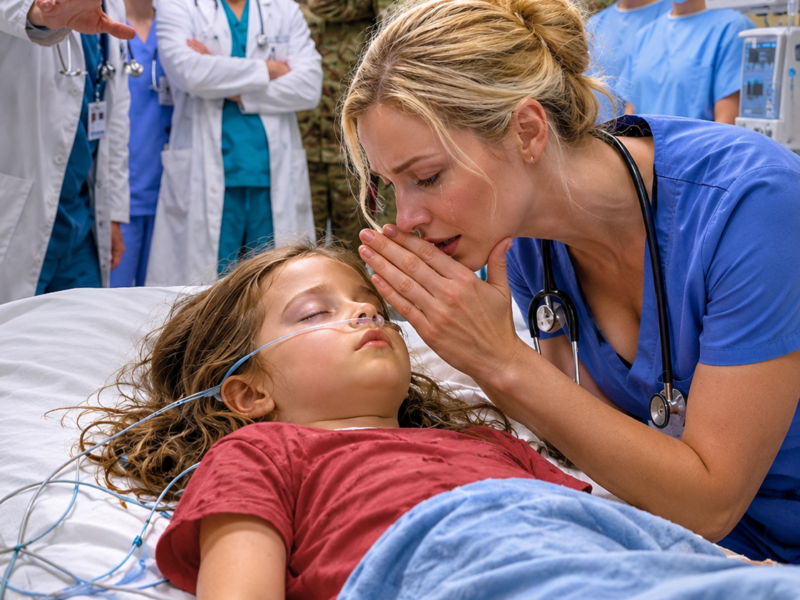
“Stand back. She just signs the schedules.” Dr. Whitfield said it without even looking at Sarah Kessler.
Sarah Kessler had spent years learning how to save lives without needing anyone to notice.
At Naval Medical Center, she was known as the quiet pediatric ICU nurse who kept the schedules organized, checked medication charts twice, and made sure frightened parents never felt alone. She rarely raised her voice. She never fought for attention. And she certainly never reminded anyone of the things she had done before becoming a nurse.
To most of the doctors, Sarah was dependable but unremarkable.
Dr. Whitfield, the senior physician in the pediatric intensive care unit, was particularly dismissive.
“Your job is to sign schedules and keep the nurses organized,” he once told her in front of the staff. “Leave the medical decisions to the doctors.”
Sarah said nothing.
She had learned a long time ago that some people would never understand the difference between being quiet and being incapable.
But one afternoon, everything changed.
A seven-year-old girl named Lily Reyes was rushed into the emergency department after being pulled from Fenwick Lake. She had been underwater for approximately forty minutes. The water was dangerously cold, and by the time emergency responders reached the hospital, Lily was severely hypothermic.
Her skin was pale. Her body was nearly motionless. The monitor showed no detectable heartbeat.
The emergency team moved quickly, but the situation was grim.
Dr. Whitfield examined the child and looked at the monitor.
“We’ve been working for a long time,” he said. “There is no response.”
One of the nurses glanced toward Sarah.
Sarah was standing near the foot of the bed, studying Lily’s condition. Something about the situation felt familiar. Not because she had seen it in a hospital, but because she had encountered it in a completely different life.
A life she had spent years trying not to revisit.
“Don’t stop yet,” Sarah said.
Whitfield turned toward her.
“Excuse me?”
“We need to consider the hypothermia. Her body temperature is extremely low. We can’t evaluate this situation the same way we would an ordinary cardiac arrest.”
Whitfield frowned.
“Sarah, this is not the time for you to give opinions.”
“I’m asking you to continue the resuscitation and follow the appropriate cold-water hypothermia protocol.”
“There is no reason to drag this out.”
Sarah looked at Lily again.
“Cold water changes the equation.”
Whitfield’s expression hardened.
“You are not leading this case.”
Sarah didn’t argue. Instead, she stepped closer to the bed and explained what she was seeing. The child’s extreme hypothermia could have significantly reduced her body’s oxygen demands. In certain cold-water drowning cases, prolonged submersion did not automatically mean that resuscitation was hopeless.
She knew this because, years earlier, she had served as a Coast Guard rescue swimmer in Kodiak, Alaska.
She had entered freezing waters when other people were running toward safety. She had pulled victims from dangerous currents, watched rescue crews fight against impossible conditions, and learned how cold water could alter the body’s response to oxygen deprivation.
She had also learned that declaring someone beyond help too soon could be a fatal mistake.
“Keep working,” she said firmly. “Rewarm her carefully. Follow the resuscitation team’s clinical judgment, and don’t assume there’s no chance simply because the monitor is silent.”
For a moment, nobody moved.
Then Dr. Voss, another physician on the team, looked at the monitor and ordered the team to continue.
The room became a coordinated effort. Nurses prepared warming equipment. Physicians reassessed the child’s condition. Every intervention was performed carefully, with the team monitoring her temperature and circulation.
Sarah remained beside Lily, watching every detail.
She wasn’t thinking about the doctors who had dismissed her. She wasn’t thinking about her reputation.
She was thinking about a little girl who had not yet had the chance to grow up.
Minutes passed.
Then the monitor changed.
A faint electrical signal appeared.
Someone leaned closer.
“Wait,” a nurse whispered.
The team continued working, and the signal became more meaningful.
“There’s activity.”
Dr. Voss checked again.
“I’m getting a rhythm.”
The room suddenly felt different.
Lily’s heart had begun beating again.
No one cheered immediately. There was still a long road ahead, and the child remained critically ill. But the team now had something they had nearly lost hope of finding.
A chance.
Sarah let out a breath she hadn’t realized she was holding.
Whitfield stood silently at the other side of the bed.
For the first time that afternoon, he had nothing to say.
Lily was transferred to intensive care, where the team continued treating her hypothermia and monitoring her neurological condition.
Her father arrived shortly afterward.
Admiral Marcus Reyes had been notified while attending a military meeting. He entered the hospital with an aide, his expression tight with fear.
“Where is my daughter?” he asked.
A physician explained that Lily was alive but remained in critical condition.
The admiral closed his eyes briefly.
Then his aide noticed Sarah standing near the nursing station.
He looked at her again.
And again.
“Ma’am,” he said cautiously. “Have we met before?”
Sarah turned.
“I don’t think so.”
The aide studied her face.
“Were you stationed in Kodiak with the Coast Guard?”
Sarah’s expression changed slightly.
“Yes. A long time ago.”
The aide looked genuinely surprised.
“Were you the rescue swimmer involved in the Ferris incident?”
Sarah didn’t answer immediately.
The name brought back a memory she had spent years trying to keep buried.
Danny Ferris.
He had been a teenager when he disappeared beneath freezing water. Sarah had been part of the rescue operation that pulled him out after approximately forty-one minutes in the water.
The circumstances had been terrifying. The odds had been terrible. But Danny had survived.
The rescue had become one of the most remarkable moments of her Coast Guard career.
The aide nodded slowly.
“I remember reading about that operation. You were the swimmer who refused to give up.”
Sarah lowered her eyes.
“I was part of a team.”
“But you were the one who went into the water.”
Before she could respond, Admiral Reyes approached.
“What’s going on?”
His aide explained who Sarah was and why he recognized her.
The admiral looked at her with a new expression.
“You were involved in the rescue of Danny Ferris?”
Sarah nodded.
“Yes, sir.”
“And today you helped save my daughter?”
Sarah shook her head gently.
“The whole team helped Lily. I just recognized something that needed attention.”
The admiral looked through the glass toward the intensive care unit.
“Whatever you did, thank you.”
Sarah didn’t know what to say.
She had never been comfortable receiving praise. In the Coast Guard, she had learned that rescue operations were never the work of one person. And in the hospital, she believed the same thing.
But the admiral’s gratitude was not the only thing that changed that afternoon.
Dr. Whitfield approached her after the immediate crisis had settled.
He looked uncomfortable.
“Sarah, can I speak with you?”
She followed him into a quiet corridor.
“I owe you an apology,” he said.
Sarah waited.
“I dismissed your concerns. I assumed you were speaking outside your experience, and I was wrong.”
“You were making a difficult decision under pressure,” she replied.
“That doesn’t excuse the way I spoke to you.”
He paused.
“Where did you learn so much about cold-water rescue?”
Sarah looked toward the windows.
“Coast Guard. Kodiak. Rescue swimmer.”
Whitfield seemed to be processing the information.
“You never mentioned that.”
“You never asked.”
It was a simple answer, but it stayed with him.
Over the next several days, Lily’s condition gradually improved.
The first hours had been uncertain. The medical team watched closely for complications, carefully managed her rewarming, and continued evaluating her neurological recovery.
Her parents remained near her bed.
Her father, despite his military responsibilities, returned whenever he could. He often stood quietly beside her, holding her small hand and speaking to her even when she could not respond.
Sarah checked on Lily during every shift.
She never promised the family that everything would be fine. She had seen too many difficult outcomes to offer guarantees she couldn’t keep.
Instead, she gave them something more reliable.
Honest updates. Gentle reassurance. And the knowledge that their daughter was being watched over by people who cared.
Then, one morning, Lily moved her fingers.
Her mother noticed first.
“Lily?”
The girl’s eyelids fluttered.
A nurse called the physician, and the team gathered around the bed.
Lily slowly opened her eyes.
Her first words were faint and confused.
“Mom?”
Her mother began crying.
“Oh, sweetheart. I’m right here.”
Lily looked around the room, trying to understand where she was.
Sarah stood near the doorway.
When Lily’s eyes met hers, Sarah offered a small smile.
“Hi, Lily. You’ve had a very long few days.”
The girl looked at her mother again.
“Am I okay?”
Her mother kissed her forehead.
“You’re here with us. That’s what matters right now.”
Lily’s recovery continued, and she eventually began responding more consistently. The medical team remained cautious, but the improvement was deeply encouraging.
For Sarah, seeing Lily awake was a relief unlike anything she could easily describe.
It also brought back memories of Danny Ferris.
She remembered the freezing water, the frantic rescue, and the moment when a seemingly impossible mission had turned into a second chance.
But there was another memory, too.
One she never discussed.
Three years earlier, Sarah had left the Coast Guard after a later rescue operation ended in a loss she could not bring herself to explain. She had carried that experience quietly, convincing herself that leaving the water behind was the only way to keep moving forward.
She had become a nurse because she still wanted to help people.
But some part of her had wondered whether she had left too much of herself behind.
A week after Lily was admitted, Dr. Voss invited Sarah to a meeting with the hospital leadership.
Sarah assumed it would be a routine discussion about staffing and patient care.
Instead, she found Dr. Voss, Dr. Whitfield, several department leaders, and Admiral Reyes waiting in the conference room.
Dr. Voss began.
“What happened with Lily made us realize that our hospital needs a more comprehensive approach to severe hypothermia and cold-water emergencies.”
Sarah listened quietly.
“We have experienced physicians and excellent emergency teams,” he continued. “But experience alone isn’t enough. We need clear procedures, coordinated training, and a better understanding of situations where prolonged cold exposure changes the clinical picture.”
He placed a document on the table.
“We would like you to help us build that program.”
Sarah looked down at the document.
It proposed a hospital-wide cold-water and hypothermia emergency training initiative. The plan included clinical education, team coordination, simulation exercises, and protocols developed in collaboration with the appropriate medical specialists.
“You want me to lead this?” she asked.
“We want you to help design it,” Dr. Voss replied. “Your rescue experience gives you a perspective we need. Your nursing experience gives you another.”
Whitfield nodded.
“I’d also like to be part of the training. I don’t want another physician making assumptions without understanding the full situation.”
Sarah looked at him.
There was no defensiveness in his expression now.
Only sincerity.
Admiral Reyes spoke next.
“My daughter is alive because someone recognized that there was still a reason to keep trying. I can’t repay that. But I can make sure your work receives the support it deserves.”
Sarah glanced back at the document.
For years, she had believed her Coast Guard career belonged to another version of herself. She had treated those memories as something painful, something best left untouched.
Now, for the first time, she saw a way to use what she had learned without returning to the life she had left.
“I have one condition,” she said.
Dr. Voss leaned forward.
“What is it?”
“I want the program to be about the entire team. Nurses, physicians, emergency responders, everyone involved. No one should feel that their observations don’t matter because of their job title.”
The room fell quiet.
Then Dr. Voss smiled.
“Agreed.”
Over the following months, Sarah helped develop the new training program.
She worked with physicians to establish clear clinical guidance, helped create realistic emergency simulations, and shared lessons from her years in Coast Guard rescue operations.
She taught staff how to recognize the special challenges of severe hypothermia, why cold-water emergencies require careful assessment, and why communication between team members matters so much when every second feels critical.
She never presented herself as the person with all the answers.
Instead, she encouraged the team to ask questions, challenge assumptions, and listen when someone noticed something important.
The first training session was held in a hospital conference room.
More than thirty medical professionals attended.
Some had worked with Sarah for years. Others had barely spoken to her before Lily’s emergency.
Whitfield sat in the front row.
Sarah stood beside the presentation screen, looking at the faces in front of her.
For a moment, she felt the familiar nervousness that had accompanied her first days as a rescue swimmer.
Then she began.
“Before we talk about equipment, procedures, or medical decisions, I want to talk about one thing,” she said.
She paused.
“Never confuse a quiet person with someone who has nothing to contribute.”
The room remained silent.
Sarah continued.
“In an emergency, the person who notices something important may not be the most senior person in the room. It may be the nurse checking the monitor, the responder arriving from the scene, or the person who has seen a situation that others haven’t encountered before.”
She looked around.
“Listen to each other. Ask questions. And when the circumstances are unusual, don’t let assumptions make the decision for you.”
Whitfield lowered his eyes briefly, then nodded.
Sarah smiled and moved to the next slide.
Several weeks later, Lily returned to the hospital for a follow-up visit.
She was walking on her own, holding her mother’s hand. Her father followed behind them, carrying a small gift bag.
When Sarah saw them in the corridor, she stopped.
“Lily!”
The girl smiled.
“Sarah!”
She hurried toward her, then wrapped her arms around Sarah’s waist.
Sarah laughed softly and hugged her back.
“I heard you’ve been getting stronger.”
“I can run again,” Lily said proudly. “And I don’t like cold water anymore.”
Her mother smiled.
“That’s understandable.”
The admiral handed Sarah the gift bag.
“We wanted to bring you something.”
Inside was a framed photograph of Lily standing between her parents, smiling brightly. On the back, they had written a short message:
Thank you for seeing a chance when everyone else saw an ending.
Sarah held the photograph for a long moment.
“I’m glad she’s doing well,” she said.
Lily looked up at her.
“Are you going to save more kids?”
Sarah knelt slightly so they were at eye level.
“I’ll do my best. And I’ll teach other people how to help, too.”
“Good,” Lily replied. “Because some kids might need you.”
Sarah smiled.
“That’s why we’re training the whole team.”
As the family walked away, Sarah remained in the corridor for a few seconds.
She thought about Danny Ferris. She thought about the rescue she had never fully discussed. She thought about the cold water of Kodiak and the hospital room where Lily had finally opened her eyes.
For a long time, she had believed that the best way to survive her past was to leave it behind.
But perhaps healing did not always mean forgetting.
Sometimes it meant finding a new way to use what you had learned.
Sarah returned to the pediatric ICU.
The schedules still needed organizing. The medication charts still needed checking. Frightened parents still needed someone who would sit beside them and explain what was happening.
She was still a nurse.
She still preferred quiet conversations to recognition.
But now, when she spoke during an emergency, people listened.
And that was enough.
Because the most important lesson from Lily’s rescue was never that one person had saved a life.
It was that a team had nearly missed an opportunity because it had failed to listen to someone standing right in front of them.
Sarah Kessler had spent years believing she needed to leave one life behind to begin another.
Instead, she discovered that both lives had been preparing her for the same purpose all along:
To give people another chance.
The end.









