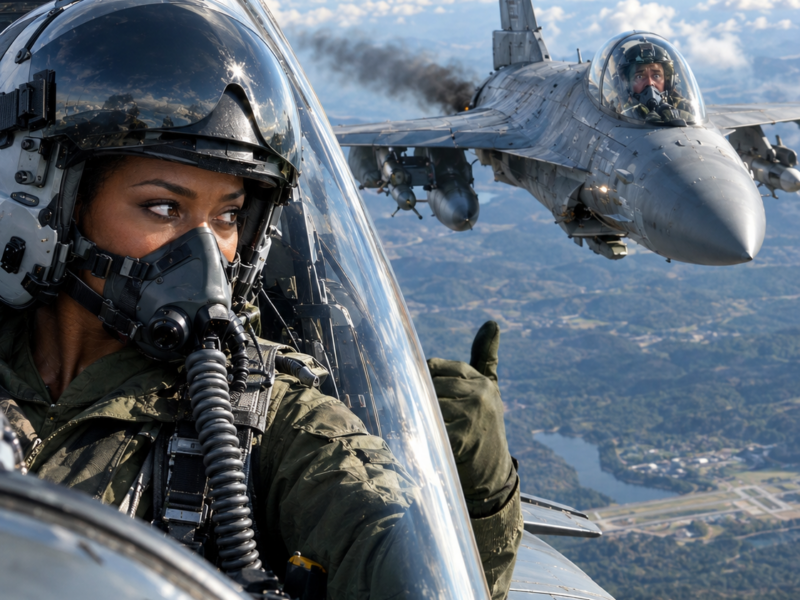
Squadron Leader Named the Black Female Pilot ‘Nobody’ — His Engine Died, and Nobody Brought Him Home
Colonel Richard Hayes humiliated the only Black woman in his squadron in front of forty pilots, calling her “Nobody” when she asked to fly his wing. Minutes later, when his fighter began falling out of the sky over the Atlantic, the voice that answered his desperate Mayday call belonged to the one pilot he had spent months trying to erase.
My name is Captain Simone Brooks, and I learned something about respect long before I ever earned my wings: some people would rather die believing they are right than survive by admitting they were wrong.
At Langley Air Force Base in Virginia, Colonel Richard Hayes seemed determined to prove it.
The morning it began, rain swept across the flight line in silver sheets, rattling against the hangar doors and turning the concrete beneath the parked F-15s into a mirror. The smell of JP-8 fuel hung heavy in the cold air, mixing with the metallic tang of wet steel and the faint exhaust drifting from a maintenance crew testing an auxiliary power unit.
I walked toward the operations building carrying a battered flight bag in one hand and a stack of weather charts in the other. My flight suit was faded at the knees, my boots scuffed from years of climbing into cockpits, and my dark hair was pulled tightly beneath a plain black cap.
I had no interest in looking impressive.
I wanted to fly.
That morning, apparently, was going to be a problem.
As I entered the briefing room, forty pilots were already gathered around a long table beneath a wall of digital tactical displays. Their voices overlapped with the low hum of projectors and the occasional electronic chirp from a secure communications terminal.
Colonel Hayes stood at the head of the room.
He was tall, broad-shouldered, and silver-haired, with a chest full of ribbons and the permanent expression of a man accustomed to having the final word. His immaculate flight suit looked as though it had never been near an aircraft maintenance bay.
His eyes settled on me.
“Well, look who finally decided to join the professionals.”
A few pilots chuckled.
I checked the wall clock.
I was three minutes early.
“Good morning, Colonel.”
Hayes glanced at my flight bag.
“Are you delivering paperwork, Captain, or did somebody forget to tell you this was a pilots’ briefing?”
More laughter followed, louder this time.
I took an empty chair near the end of the table and laid my weather charts flat.
“I’m assigned to today’s Atlantic training mission, sir.”
“Assigned?”
He repeated the word as if it were a joke.
“Interesting. I don’t remember requesting you.”
“You approved the flight roster yesterday.”
One of the younger pilots suddenly became fascinated with his coffee.
Hayes stared at me for a long second.
Then he smiled.
“Right. Brooks. Our very own Nobody.”
The nickname landed exactly as he intended.
A few men laughed outright. Others looked away, uncomfortable but unwilling to challenge a colonel who could influence their careers with a single performance report.
I felt the familiar heat rise behind my ribs. I let it pass without reaching my face.
Hayes leaned against the table.
“Tell me, Captain. What exactly do you think you bring to this squadron?”
“An assigned aircraft, current qualifications, and a clean flight record, sir.”
“And humility?”
“I try to bring enough for the entire room.”
The laughter stopped.
For a moment, Hayes looked genuinely surprised.
Then his expression hardened.
“Careful, Brooks. Confidence is useful in a cockpit. Arrogance gets people killed.”
I met his eyes.
“Agreed, sir.”
He turned back to the tactical display as though I had ceased to exist.
I opened my charts.
The mission was a long-range formation exercise over the Atlantic, designed to test navigation, fuel management, and coordination under rapidly changing weather conditions. Hayes would lead the formation in an F-15, with the remaining aircraft maintaining assigned positions along a planned route east of Virginia’s coastline.
The flight plan looked ordinary.
Too ordinary.
I studied the upper-level wind projections, then the satellite imagery, then the pressure contours laid over the projected route.
Something was wrong.
A low-pressure system was accelerating northeastward faster than the briefing’s weather package suggested. Its outer cloud bands were already expanding across the proposed flight corridor, and the temperature profile at altitude indicated conditions that could produce severe turbulence and rapidly deteriorating visibility.
But that wasn’t the most dangerous part.
I leaned closer to the display.
The planned route crossed the developing system at an angle that would leave the formation with fewer comfortable options if the weather closed in behind them. Worse, the return calculations appeared to assume the winds would remain close to forecast values.
They wouldn’t.
A sustained change in headwind could eat into their fuel reserves. Add an extended diversion around the storm, and an aircraft already experiencing a mechanical problem could find itself with very little margin.
I checked the data timestamp.
Then I checked the source feed.
The briefing software had updated the satellite picture, but the route overlay was still using an earlier forecast cycle.
Someone had refreshed the image without refreshing the numbers beneath it.
I raised my hand.
“Colonel, the weather package is inconsistent with the latest upper-level data.”
Hayes didn’t turn around.
“Is it?”
“Yes, sir. The system is moving faster than the plotted forecast. The current route could put us inside the storm’s western edge before the scheduled turn.”
He sighed loudly.
“Captain, this is a training sortie, not a disaster movie.”
“The projected winds have shifted significantly since the route was calculated.”
A pilot two seats down leaned forward to inspect my chart.
She was a major with twelve years of service, and I noticed her eyebrows draw together as she compared my figures with the display.
I pointed to the pressure gradient.
“If we encounter stronger headwinds here, the fuel calculations won’t hold. We should revise the route or establish an earlier diversion decision point.”
Hayes finally faced me.
His expression was no longer amused.
“You’re suggesting my mission planners failed to check the weather?”
“I’m saying the displayed forecast and the current data don’t match.”
“Did you run the official model?”
“I cross-checked the latest available data against the route package.”
“That wasn’t my question.”
“No, sir. I used the published forecast and the updated satellite information.”
He gave a dismissive wave.
“Then you have an opinion, not an operational assessment.”
“Sir, the discrepancy is measurable.”
Hayes stepped away from the table.
“Nobody asked for your opinion, Lieutenant.”
The room went still.
He had deliberately demoted me, stripping my rank with a single word in front of the entire squadron.
I looked at the display rather than at him.
“Captain Brooks, Colonel.”
“What was that?”
“My rank is captain, sir.”
A nervous murmur passed through the room.
Hayes approached my chair, stopping close enough that I could smell the mint on his breath.
“You seem to have mistaken technical competence for authority. Around here, Captain, we follow the chain of command.”
“Yes, sir.”
“Good. Then follow this order. Put your charts away and let the people responsible for this mission do their jobs.”
I gathered the charts carefully.
There was no point arguing with someone who had already decided that acknowledging a fact would cost him more than ignoring it.
But as I slid the final sheet into my folder, I noticed something else.
The planned recovery route passed south of the area where the pressure gradient was tightening. If the system continued to accelerate, aircraft returning with reduced power might encounter strong crosswinds and rapidly changing cloud ceilings near their intended recovery corridor.
I memorized the coordinates.
Hayes watched me.
“Something else you want to teach us?”
“No, sir.”
“Excellent. Then security can help you find somewhere more appropriate to spend your morning.”
He nodded toward the door.
Two armed security personnel standing outside the briefing room appeared in the doorway.
I rose, slung my flight bag over my shoulder, and tucked the charts under my arm.
I didn’t argue.
I didn’t slam a door.
I simply walked out.
Behind me, Hayes resumed the briefing, his voice growing louder as if volume could make the weather obey him.
Outside, the rain had eased to a fine mist. The flight line stretched beneath a low gray sky, and ground crews moved between aircraft with their heads bowed against the wind. A maintenance technician was checking a panel on one of the F-15s, his gloved hand pausing briefly near a row of fasteners before he leaned in for a closer look.
I continued toward the operations corridor.
My phone vibrated once inside my pocket.
A notification from the squadron’s flight-planning system confirmed that the mission package had been locked.
The weather overlay still hadn’t been corrected.
I stopped beneath the metal awning and watched a crew chief guide a tow vehicle around a parked fighter.
The wind had shifted.
I could tell from the way the rain was traveling sideways across the concrete and from the low clouds building beyond the far end of the runway.
I had seen that combination before.
Not in a classroom.
Not on a simulator.
Three years earlier, I had flown rescue missions in conditions that turned familiar mountains into walls of white. On one mission, a former wingman disappeared into freezing cloud while two injured crew members waited for help. I had spent the next forty minutes navigating by instruments, terrain data, and the thin thread of a radio signal that repeatedly threatened to vanish.
I brought the survivors home.
My wingman didn’t come back.
Afterward, I stopped talking about that mission. I didn’t mention the commendation, the debriefings, or the questions from officers who wanted to know how I had managed to keep flying when every warning light seemed to be telling me to stop.
I had learned that some achievements made people curious.
Others made them uncomfortable.
Hayes had never asked about my previous assignments.
He had read my personnel file, I assumed, but whatever it contained hadn’t changed his mind about me.
I watched the clouds gather over the Atlantic horizon.
Then I made a decision.
If the mission launched, I would be ready.
I returned to the flight line and began checking the equipment assigned to my aircraft, confirming the mission data and reviewing the updated wind information. I checked the route coordinates twice, then compared the fuel planning figures with the latest forecast.
I made no changes to the approved mission package.
Instead, I prepared the information I would need if the conditions deteriorated.
At 0915, the squadron began moving toward the aircraft.
The F-15s sat in their revetments with their canopies raised, ground crews disconnecting service lines and making final checks. The smell of fuel grew stronger as engines were prepared for startup. Somewhere down the line, a turbine whined into life, its pitch climbing until it settled into a steady mechanical roar.
Pilots climbed ladders, secured harnesses, and began their cockpit checks.
I reached my aircraft and placed one hand against the fuselage.
The metal was cold beneath my glove.
For a moment, I closed my eyes and listened to the wind.
Then I climbed aboard.
The cockpit smelled of oxygen equipment, electronics, and the faint, familiar trace of hydraulic fluid. I settled into the seat and began my checks, moving through each control and display with deliberate precision.
Battery.
Displays.
Flight controls.
Navigation.
Communications.
The instruments illuminated one by one.
My hands found their places without hesitation.
On the squadron frequency, Hayes’s voice came through crisp and confident.
“Razor Flight, prepare for departure. Maintain assigned positions and observe the published route. We are not changing the mission because someone got nervous about a cloud.”
A few pilots acknowledged.
I kept my eyes on the weather display.
The latest returns showed the storm’s leading edge advancing faster than the original briefing had predicted.
I keyed the microphone.
“Razor Lead, Brooks. Updated weather indicates the western boundary is closing. Recommend reassessing the route before departure.”
The response came immediately.
“Brooks, we’ve discussed this. Fly your assignment.”
“Understood, sir.”
I released the transmit switch.
The engine behind me rose in pitch as the ground crew completed the final checks. The aircraft vibrated around me, the low-frequency rumble traveling through the seat and into my chest.
One by one, the fighters began taxiing toward the runway.
I followed.
The formation rolled into position beneath the gray sky. Beyond the runway, the horizon had almost disappeared behind a dense wall of cloud.
Hayes’s aircraft accelerated first.
His F-15 surged forward, lifted cleanly from the runway, and climbed into the overcast.
The others followed.
I advanced the throttles and felt my aircraft gather speed beneath me. The runway markings blurred past the canopy, and then the ground fell away.
For several minutes, the formation climbed through broken cloud into a layer of cold, bright air.
The radio filled with routine position reports.
Altitude checks.
Navigation confirmations.
Fuel status.
Hayes sounded relaxed enough to be bored.
“Razor Flight, maintain spacing. We’re proceeding east as briefed.”
I watched the wind figures change.
The discrepancy was growing.
At the next scheduled checkpoint, I compared my position with the storm’s latest estimated movement. The system had advanced beyond the boundary shown in the original mission package.
I reached for the radio.
“Razor Lead, Brooks. Recommend a heading adjustment to remain clear of the developing weather.”
Hayes answered with an audible sigh.
“Captain, are you going to question every decision I make today?”
“Only the ones that affect the aircraft, sir.”
Silence followed.
Then a pilot somewhere in the formation coughed, possibly to cover a laugh.
Hayes’s voice returned, cold and controlled.
“That’s enough. Maintain formation. No independent deviations.”
I acknowledged.
But I kept watching the storm.
Ahead, the cloud bank had risen into a towering gray wall. Its upper surface spread across the sky, and faint flashes of lightning flickered inside it like distant camera strobes.
The first turbulence hit without warning.
My harness tightened against my shoulders as the aircraft jolted sideways. Loose reflections jumped across the canopy. The radio erupted with overlapping calls as pilots reported sudden changes in visibility and unexpected wind shifts.
Then a warning tone sounded in my headset.
I checked my instruments.
Another aircraft called out a rapid altitude deviation.
Hayes ordered the formation to tighten its spacing, then immediately reversed the instruction as the turbulence intensified.
I looked at the navigation display.
The storm was forcing the formation toward the very corridor I had warned about.
And Razor Lead was moving deeper into it.
“Razor Lead, recommend turning east now,” I transmitted. “The return corridor is deteriorating.”
“Negative. We are continuing.”
A flash of lightning illuminated the cloud ahead.
Then Hayes’s voice broke across the frequency.
“Razor Flight, I’m getting an engine warning.”
The next transmission came seconds later.
“Engine indications are falling. I’ve got a power problem.”
I sat forward, my eyes moving between his last reported position, the weather returns, and my own flight instruments.
“Razor Lead, confirm your aircraft status.”
Static crackled.
Then came Hayes’s voice, no longer smooth, no longer amused.
“Mayday, mayday, mayday! Razor Lead declaring an emergency. Engine failure. I’m losing power!”
The formation fractured as the pilots fought to maintain safe separation in the violent air. One aircraft disappeared into cloud to my left. Another reported unreliable navigation indications. The tactical display flickered as the storm interfered with the picture.
Hayes’s aircraft began losing altitude.
I could see nothing through the gray wall ahead, but his position marker told the story. He was drifting away from the safest recovery corridor, and every second carried him farther toward a stretch of ocean where the weather was worsening.
Then his voice returned.
“Brooks, return to base.”
I watched his marker drop.
“That’s an order. Get out of this weather.”
I could have obeyed.
I could have turned west, followed the approved recovery route, and landed safely while another crew tried to locate him.
Instead, I checked the wind, calculated the relative positions, and turned toward his last reported location.
“Colonel, your current heading is taking you away from the safer recovery corridor. Turn twenty degrees east.”
“Brooks, I said return to base!”
His transmission broke apart beneath a burst of static.
I adjusted my heading and pushed into the cloud.
Visibility vanished.
The cockpit became a small, illuminated island surrounded by gray. Rain struck the canopy in irregular bursts. Turbulence shook the aircraft, but I held the instruments steady and tracked Hayes’s last known position.
Then I heard a sound on the radio that changed everything.
A breath.
A pause.
Another breath, shallow and ragged.
“Brooks,” Hayes whispered. “I can’t keep her up.”
I stared at the instruments.
All the months of insults, the briefing-room laughter, the deliberately dismissive reports, and the nickname he had used to make me feel invisible seemed to collapse into a single moment.
He was no longer the colonel who had ordered me out.
He was a pilot in trouble.
And he was running out of sky.
I keyed the microphone.
“Colonel Hayes, listen carefully. Stop fighting the aircraft. Look at your instruments and give me your altitude.”
“I’m losing power.”
“I know. Give me your altitude.”
A pause.
“Twenty-two thousand feet. Descending.”
I checked the distance between us.
“I’m coming to you. Keep transmitting as long as you can.”
“Brooks, you need to return to base.”
“No, sir.”
I adjusted the controls, made another careful heading correction, and watched the distance between our aircraft begin to close.
“I’m bringing you home.”
The radio fell silent for two seconds.
Then another voice broke through the emergency frequency, sharp with disbelief.
“Control, we have an unidentified aircraft entering Razor Lead’s position. Confirm the pilot’s identity immediately.”
A controller answered, his voice suddenly stripped of its routine calm.
“Stand by. Cross-checking flight records.”
I held my heading as the storm swallowed the last trace of daylight.
In the operations center, someone was apparently opening a file that had been sealed for years.
Then the controller returned to the frequency.
“Razor Flight, all stations, authenticate the supporting aircraft.”
A pause followed.
And then, across every cockpit, every control-room speaker, and every headset listening to the emergency channel, a voice spoke the words that Colonel Hayes had spent months making sure nobody would say.
“Supporting aircraft identity confirmed. Captain Simone Brooks. Callsign: GHOSTHAWK.”
The reaction came instantly.
In the operations center, chairs scraped backward. Pilots turned toward the main display. Armed guards snapped to rigid attention. The special operations personnel standing near the tactical console straightened and raised their hands in a crisp salute.
Even the controller who had once filed my callsign away as an old record stood motionless, staring at the screen.
And somewhere inside the storm, Colonel Richard Hayes heard the name of the pilot he had called Nobody.
For the first time since I had met him, he had absolutely nothing to say.
For three seconds, nobody in the operations center moved.
Then Colonel Richard Hayes’s voice crackled through the emergency channel, stripped of every ounce of authority he had carried into the briefing room that morning.
“Ghosthawk?”
I heard him through the static.
I was fighting turbulence, monitoring my fuel state, and trying to keep his failing aircraft within a survivable recovery corridor. I didn’t have time to explain the past to a man who was rapidly running out of future.
“That’s Captain Brooks, Colonel. I’m on your left, slightly above your position. Can you maintain control?”
“Ghosthawk, I thought you were—”
“Colonel, I need your altitude and your current engine indications. Now.”
A burst of static swallowed his answer.
I tightened my grip on the controls as another violent gust struck my aircraft. The cockpit shuddered, and rain streamed across the canopy in silver ribbons. My instruments remained readable, but the storm outside had become a featureless wall of gray.
“Hayes, transmit your altitude.”
“Eighteen thousand. Still descending.”
“Understood. Keep your wings as level as you can. Don’t make any sudden corrections.”
I glanced at the navigation display.
He was losing altitude faster than he should have been, and his last reported position placed him uncomfortably close to the storm’s most active region.
I needed a clearer picture.
“Razor Control, Ghosthawk. Request all available position reports, current weather observations, and the last confirmed engine status for Razor Lead.”
The controller responded immediately.
“Ghosthawk, standby. We’re assembling the data now.”
I could practically hear the confusion behind his words. A few minutes earlier, I had been the captain ordered out of a briefing room. Now the entire operations center was scrambling to provide me with information.
“Negative on standby,” I replied. “I need the most recent data you have. Send it in pieces if necessary.”
“Copy, Ghosthawk.”
That callsign had once been printed on a classified mission report that most of the squadron had never seen. It belonged to a chapter of my life I had deliberately kept separate from my current assignment.
But the weather didn’t care about classified files.
Neither did gravity.
And neither did the man falling through the clouds.
Twenty minutes earlier, in the operations center at Langley, Major Elena Ward had been watching the mission unfold on the main tactical display.
Ward was the senior controller on duty, a woman who had spent enough years around fighter squadrons to recognize the difference between a difficult flight and a developing catastrophe.
When Hayes declared an emergency, she immediately began coordinating the response.
But the weather had disrupted the tactical picture, and the formation’s position reports were coming in irregularly.
Then Captain Brooks had turned toward Razor Lead.
Ward stared at the display.
“Who authorized that deviation?”
A young controller checked the mission roster.
“Captain Brooks, ma’am. Her aircraft is moving toward the emergency position.”
“Was that ordered by Razor Lead?”
“No, ma’am.”
Ward’s eyes narrowed.
“Pull up her flight record.”
The controller hesitated.
“Which record, ma’am? Her current qualification file?”
“All available records. Search the restricted personnel index, too.”
A few seconds passed.
Then the controller stopped typing.
“Major, I have a match.”
“Read it.”
“Captain Simone Brooks. Former rescue detachment assignment. Multiple adverse-weather recovery missions. Specialized qualification in degraded-visibility navigation and emergency escort operations.”
Ward leaned closer to the screen.
“There’s more.”
The controller swallowed.
“Her previous callsign is listed as Ghosthawk.”
The room went silent.
Ward looked at the main display again.
“Authenticate it.”
The controller entered the verification request.
A moment later, the system returned a confirmation.
Ward straightened.
“Patch her through on the emergency channel. Give her priority access to the weather feed, and get the rescue coordination team moving.”
“Ma’am, Colonel Hayes is still the mission lead.”
“He is also the pilot declaring an engine emergency.”
Ward’s voice sharpened.
“Get the team moving.”
Across the room, a special operations liaison rose from his chair. Two armed security personnel at the entrance turned toward the display as the restricted identity record appeared.
One of them quietly whispered the callsign.
“Ghosthawk.”
The other guard looked at him.
“You’ve heard of her?”
“I’ve heard the stories.”
Neither man looked away from the screen.
I didn’t know what was happening inside the operations center.
I knew only that Hayes was losing altitude, the storm was intensifying, and the information reaching me was incomplete.
My fuel indicators remained within the planned limits, but I had to account for the additional time required to reach him and guide him toward a viable recovery option.
I studied the wind vectors.
The storm’s movement was pushing the formation south and east. Hayes’s last reported heading had carried him farther into the deteriorating weather, precisely as I had feared during the briefing.
“Colonel, I need you to listen carefully.”
“I’m listening.”
“Your aircraft is moving away from the recovery corridor. I want you to make only the corrections you can safely manage. Tell me if your controls respond normally.”
“My controls are responding. The engine isn’t.”
“Understood. Don’t chase the altitude indication. Fly the aircraft.”
A rough laugh came over the radio, more disbelief than humor.
“You always talk to people like they’re students?”
“Only when they’re busy arguing with their instruments.”
Silence.
For half a second, I wondered whether I had gone too far.
Then Hayes answered quietly.
“Fair enough.”
It was the first time he had acknowledged anything I had said without trying to diminish it.
I returned my attention to the instruments.
“Ghosthawk to Razor Control. I need the latest winds along the eastern edge of the storm and the current status of the nearest recovery facilities.”
“Copy, Ghosthawk. Weather information coming through.”
The display updated.
I checked the reported winds against the movement of the cloud bands and adjusted my assessment. The safer option would depend on Hayes’s remaining control authority, the actual condition of his aircraft, and whether the recovery corridor remained usable.
There was no guarantee.
There never had been.
“Colonel, can you confirm whether you have any additional engine indications?”
“Oil pressure warning. Temperature indication is unstable. Thrust is nearly gone.”
“Copy. Maintain the safest controllable attitude you can. I want you to tell me immediately if anything changes.”
“Understood.”
His voice sounded steadier now, though I could hear the strain beneath it.
Then another transmission interrupted us.
“Ghosthawk, this is Razor Three. I’m experiencing severe turbulence and have lost visual contact with the formation. Request instructions.”
I checked the tactical picture.
Razor Three was separated from the main group, with another aircraft reporting intermittent communications. The entire formation was being scattered by the storm.
I couldn’t afford to let one emergency become three.
“Razor Three, maintain your assigned emergency procedures and report your position and aircraft status to Razor Control. Do not attempt to rejoin the formation until conditions permit.”
“Copy, Ghosthawk.”
I turned back to Hayes.
“Colonel, we’re going to deal with one problem at a time. Your job is to keep the aircraft controllable. My job is to help you reach the safest available recovery option.”
He didn’t answer immediately.
When he finally spoke, his voice was almost unrecognizable.
“Why didn’t you tell us who you were?”
I watched the storm roll across my display.
“Would it have changed anything?”
He said nothing.
I didn’t need him to answer.
Inside the operations center, Colonel Hayes’s emergency declaration had changed the mood of the entire base.
The original mission briefing was still displayed on one of the secondary screens. My weather warning remained visible in the archived comments, complete with the timestamp showing that I had submitted it before the formation departed.
Major Ward noticed it.
“Who closed this report?”
A controller checked the record.
“It was marked reviewed by the mission lead, ma’am.”
“Was the weather discrepancy resolved?”
“No, ma’am. The route was approved without a revision.”
Ward’s jaw tightened.
She looked toward the colonel’s empty chair at the command station.
“Preserve the original file and every subsequent change. I want the timeline intact.”
“Yes, ma’am.”
The special operations liaison stepped closer to the display.
“Major, is Ghosthawk actually in the air?”
“Confirmed.”
“Then Hayes has a chance.”
Ward turned to him.
“You know Brooks?”
“Not personally. But I’ve seen the recovery reports from her previous assignment. One of those reports describes a rescue under conditions where the other aircraft couldn’t maintain a reliable position fix.”
He paused, choosing his words.
“Her crew brought two injured personnel home when the weather had already forced another aircraft to turn back.”
Ward looked at the screen again.
“Why was she assigned to this squadron without that history being discussed?”
“That’s a personnel question, ma’am.”
“No,” Ward replied. “At this point, it’s a command question.”
The room settled into an uneasy silence.
Every person there understood what was happening.
The pilot Hayes had publicly dismissed was now the one person in the air who could help him.
And the weather was getting worse.
“Ghosthawk, this is Razor Control. We have an updated weather picture and your latest position data.”
I listened as the controller relayed the information.
The situation was changing quickly. I studied the available data, compared it with Hayes’s reported condition, and began narrowing the options.
“Razor Control, confirm rescue coordination has been notified.”
“Confirmed. Rescue coordination is active and tracking the emergency beacon.”
“Good. Keep them informed of every position update.”
“Copy.”
Hayes came back over the radio.
“Ghosthawk, I’m getting another warning.”
“What warning?”
“Hydraulic indication. I’m not sure the reading is reliable.”
I felt my stomach tighten.
“Tell me exactly what the instrument shows. Don’t guess.”
He gave me the indication.
I asked him to verify it against the other available information, then waited while he checked.
“It’s fluctuating.”
“Understood. Continue monitoring it and report any change in control response immediately.”
Another gust rocked my aircraft.
The turbulence had become severe enough that I had to concentrate on keeping my own flight path stable. My shoulders pressed against the harness as the aircraft jolted, then settled.
I breathed slowly.
One problem at a time.
Hayes was still airborne. His aircraft remained controllable, at least for the moment. Rescue coordination was underway, and I had enough information to continue assessing the safest way to help him.
That was what mattered.
Not the nickname.
Not the laughter.
Not the fact that forty pilots had watched a colonel try to humiliate me.
I keyed the microphone.
“Colonel, give me your current altitude.”
He answered.
I checked the figures and listened to the faint strain in his voice.
“Copy. Stay with me.”
Then, unexpectedly, he said something I had never imagined hearing from him.
“Captain Brooks, I’m sorry.”
I kept my eyes on the instruments.
“Save your breath, Colonel. We’ll discuss it when you’re safely on the ground.”
A pause followed.
“That’s an order?”
Despite everything, I almost smiled.
“No, sir. It’s a recommendation.”
For the first time that day, Hayes laughed without cruelty.
It was a small, broken sound, swallowed almost immediately by static.
Then his voice returned.
“Understood, Ghosthawk.”
I checked my position and the latest weather information.
The next few minutes would decide whether Hayes made it home.
I could hear him breathing through the radio. I could hear the storm battering my aircraft. Somewhere far below us, the Atlantic waited beneath a blanket of cloud.
I adjusted my course and continued toward him.
Back at Langley, the tactical display showed two aircraft moving through the storm: one fighting to remain airborne, the other closing the distance.
Major Ward stood motionless before the screen.
The special operations liaison had stopped talking.
The armed guards remained at attention.
And on the emergency channel, the colonel who had called me Nobody was following my voice.
But as I checked the latest transmission from Hayes’s aircraft, one detail caught my attention.
His reported engine condition was deteriorating faster than the previous updates suggested.
I keyed the microphone.
“Colonel, I need you to listen very carefully. We’re approaching a critical point. Tell me immediately if your aircraft responds differently to your control inputs.”
“Copy.”
I watched the numbers change.
Then his next transmission came through, barely audible beneath the static.
“Ghosthawk…”
“Go ahead, Colonel.”
“I think I’ve lost—”
The radio cut out.
On my display, his position marker continued to descend.
I called him again.
“Razor Lead, Ghosthawk. Respond.”
Nothing.
I tried once more.
“Colonel Hayes, acknowledge.”
Only static answered.
For the first time since entering the storm, I felt a cold knot tighten in my chest.
I knew the difference between a damaged transmission and a pilot who could no longer answer.
And somewhere inside that wall of cloud, the man who had spent months trying to erase me had just disappeared from my radio.
The radio was silent.
No breathing. No engine noise. No clipped acknowledgment from Colonel Richard Hayes.
Just static.
I stared at the last known position of his F-15, watching the symbol hover on the edge of the tactical display before the information began to flicker.
“Razor Lead, this is Ghosthawk. Radio check.”
Nothing.
“Colonel Hayes, acknowledge.”
Still nothing.
The storm hammered my aircraft, shaking the cockpit hard enough to make the instrument reflections tremble across the canopy. Outside, the Atlantic had disappeared beneath an impenetrable ceiling of cloud. Lightning flashed somewhere below me, illuminating the rain for a fraction of a second before darkness swallowed everything again.
I checked my instruments, verified my own aircraft’s status, and tried the emergency frequency once more.
“Razor Lead, Ghosthawk. If you can hear me, transmit anything. One click, one word. Anything.”
Silence.
I had spent years learning not to let fear make decisions for me. Fear was information. It told you what mattered, what could be lost, and what you needed to protect. But fear was a terrible pilot.
I forced myself to examine the facts.
Hayes had reported worsening engine indications. He had mentioned a fluctuating hydraulic warning. His last known position placed him inside the storm, descending toward the ocean. The loss of radio contact could have several explanations, and I could not afford to assume the worst before checking the available evidence.
I keyed the microphone.
“Razor Control, Ghosthawk. I’ve lost communications with Razor Lead. Request his last confirmed position, emergency beacon status, and all available tracking data.”
Major Elena Ward answered immediately.
“Ghosthawk, we have his last confirmed position. The beacon signal is intermittent. Rescue coordination is tracking the most recent transmission.”
“Can you confirm whether he has ejected?”
“Negative. No confirmed ejection.”
“Understood. Keep monitoring the beacon. I need the rescue team ready to respond the moment his location is established.”
“Already in progress.”
I glanced at the fuel display.
I could not stay in the storm indefinitely. I needed to manage my aircraft’s reserves while maintaining a realistic recovery option for myself. If I allowed the emergency to consume every margin I had, I would create a second crisis without solving the first.
I checked the weather picture again.
The storm had developed a broad area of intense precipitation along the route Hayes had been following. The strongest returns were moving northeast, while the available recovery corridor remained farther west.
I had to find him before his remaining altitude disappeared.
“Razor Control, I’m continuing to the last confirmed position. Keep the channel clear for emergency traffic.”
“Copy, Ghosthawk. You are authorized to continue the emergency response.”
I adjusted my course.
Then I entered the deepest part of the storm.
At Langley, nobody was laughing anymore.
Forty pilots had watched Hayes humiliate me that morning. Several of them had repeated the nickname in the hallways over the previous weeks. Others had simply remained silent, hoping the colonel’s attention would never turn toward them.
Now every one of them was gathered around the operations center’s main display.
Captain Daniel Mercer, one of Hayes’s most trusted pilots, stood near the front of the room with his arms folded tightly across his chest.
“She’s going after him alone?”
Major Ward didn’t look away from the screen.
“She’s maintaining contact with rescue coordination and following the available emergency information.”
“But she can’t search that entire storm by herself.”
“No,” Ward replied. “She can’t.”
The honesty in her answer silenced him.
A controller spoke from the next station.
“Ma’am, we’re receiving a weak emergency beacon return.”
Ward moved immediately.
“Mark the position. Compare it with the last confirmed transmission.”
The controller entered the information. A new marker appeared on the screen, then flickered.
“Beacon is intermittent.”
“Could the signal be moving?”
“Possibly. We don’t have enough consecutive returns to establish a reliable track.”
Ward studied the display.
“Send the information to Ghosthawk. Label it as an uncertain position, not a confirmed aircraft location.”
“Copy.”
Mercer stared at the new marker.
“Colonel Hayes could be anywhere inside that weather.”
Ward turned toward him.
“And Captain Brooks knows that.”
He looked back at the screen.
“Then why is she still going in?”
Ward’s voice dropped.
“Because someone has to find him.”
No one answered.
On the main display, my aircraft continued moving toward the storm’s center.
The controller’s voice trembled slightly as he spoke.
“Ghosthawk has acknowledged the updated position.”
Ward folded her arms.
“Then keep giving her everything we have.”
Inside my cockpit, the storm felt endless.
Rain struck the canopy in irregular bursts. The aircraft shook through pockets of turbulence, and the changing cloud density made the outside world impossible to read. I relied on my instruments, checking my position and aircraft status while listening for the slightest change in the radio.
I thought about the last time I had lost a wingman.
His name had been Lieutenant Marcus Reed.
He was twenty-nine years old, a talented pilot with a terrible habit of humming old songs during long navigation legs. On the night we lost contact, a mountain storm had closed around our rescue formation faster than the forecast predicted.
I remembered his final transmission.
“Ghosthawk, I’ve got the ridge on my display, but I can’t see a thing.”
I had answered him then, too.
“Stay with me, Marcus. Talk to me.”
The next transmission had been a warning tone, a burst of static, and a voice from the ground telling me that his aircraft’s signal had vanished.
I had continued the rescue mission because two injured crew members still needed help.
I brought them home.
Marcus never returned.
For years, I had replayed that night in my mind, searching for the decision that might have changed the outcome. I knew that not every loss could be prevented. I also knew that uncertainty never stopped the mind from asking what if.
Now Hayes was somewhere inside another storm, and I was listening to the same terrible silence.
I tightened my grip on the controls.
“Not today,” I whispered.
The words disappeared beneath the engine noise.
I called him again.
“Colonel Hayes, this is Ghosthawk. If you can hear me, transmit.”
A crackle answered.
Then a faint, distorted voice emerged.
“…hawk…”
I sat forward.
“Colonel, say again.”
“Ghost… can hear…”
His voice was barely audible, but it was his.
“Copy, Colonel. I hear you. Are you able to control the aircraft?”
A pause followed.
“Not sure.”
“Understood. Tell me what you can see on your instruments.”
“Displays… failing. I can’t keep them straight.”
I checked the last known position and tried to reconstruct his situation from the information available.
“Colonel, don’t try to find me visually yet. Keep your attention on the aircraft and your instruments. Tell me immediately if you lose control response.”
“Copy.”
His voice broke into static again.
I continued transmitting, keeping my words short and calm.
“I’m here, Colonel. Keep talking to me.”
At the operations center, Major Ward watched the communications record populate with fragments of the exchange.
“Ghosthawk has re-established contact.”
Several people exhaled at once.
Mercer stepped closer.
“Can we establish their separation?”
The controller shook his head.
“Not accurately. Hayes’s position is still uncertain.”
“Then how does Brooks know where he is?”
“She doesn’t know exactly,” Ward said. “She’s using the last confirmed information and whatever updated data we can provide.”
She pointed to the display.
“That’s why every position report matters. If we give her an uncertain coordinate as though it’s exact, we could send her in the wrong direction.”
The controller nodded and continued updating the data.
Ward turned toward the communications station.
“Tell Ghosthawk that Hayes has answered. Confirm we are still tracking the emergency beacon intermittently.”
“Copy, ma’am.”
A message went out.
My acknowledgment returned seconds later.
Ward lowered her eyes briefly, then looked at the room.
“Everyone understands the situation. We are not going to make it harder for her by turning this into a spectator event. I want the rescue coordination team fully updated, and I want the flight records preserved.”
Mercer looked at her.
“Ma’am, if she gets him back—”
“When she completes this emergency response,” Ward interrupted, “we will address everything that happened before takeoff.”
The distinction mattered.
A successful rescue would not erase the decisions that had created the danger.
It would, however, make it impossible to ignore them.
“Ghosthawk, I’m getting another warning,” Hayes transmitted.
“What warning?”
“Fuel indication. It’s dropping.”
I checked the available information.
His engine problem was only part of the danger. With the aircraft descending and the weather deteriorating, every decision had to account for the possibility that he might no longer be able to maintain the flight path required for a conventional recovery.
I needed reliable information before recommending any further action.
“Colonel, give me your current indicated altitude and tell me whether the reading is stable.”
He answered, then paused.
“It’s changing.”
“Copy. Tell me if you receive any new warnings.”
“Brooks…”
“I’m listening.”
“I can’t see anything.”
“I know.”
“I can’t see the ocean. I can’t see the horizon. I can’t even tell which way the clouds are moving.”
I glanced at my instruments.
“Then don’t try to judge your position from the clouds. Stay focused on your instrument indications and report what the aircraft is doing.”
A pause followed.
Then Hayes asked the question I had expected sooner or later.
“Are you afraid?”
I watched the altitude and heading information settle into a more consistent pattern.
“Yes, sir.”
The answer surprised him.
“You are?”
“Of course.”
“Then how are you doing this?”
I adjusted my course slightly as the turbulence changed.
“Being afraid doesn’t mean you stop thinking.”
He said nothing.
I continued.
“It means you pay attention to what matters.”
The radio crackled.
Then, in a voice barely louder than a whisper, Hayes said, “I should have listened to you.”
I swallowed.
There were a hundred things I could have said. I could have reminded him of the briefing, the weather charts, the insults, and the security guards he had summoned to escort me out.
Instead, I answered with the only thing that mattered in that moment.
“We can discuss that later, Colonel. Right now, I need you with me.”
“Understood.”
I listened carefully as he described his aircraft’s condition. His answers came in fragments, and I asked him to repeat anything that wasn’t clear. Every piece of information mattered.
Then a new transmission arrived from Langley.
“Ghosthawk, Razor Control. Emergency beacon signal has strengthened briefly. We have a possible updated position.”
I checked the transmitted coordinates against the last confirmed location.
The new information suggested Hayes might be farther east than we had believed.
But the signal had been intermittent. It was not enough to establish his exact position with confidence.
“Razor Control, confirm the latest return is unverified.”
“Affirmative. Treat as an estimated location only.”
“Copy. Continue monitoring.”
I studied the display again.
The storm was moving, the beacon was unreliable, and Hayes was still losing altitude.
I had to make a decision with incomplete information.
But I wasn’t going to mistake uncertainty for permission to panic.
“Colonel,” I transmitted, “I have a possible updated position from control. I need you to keep reporting your aircraft status. We are going to work with the information we have.”
“Understood, Ghosthawk.”
The reply came more quickly this time.
I continued into the gray.
Back at Langley, the colonel’s absence had begun to feel almost unreal.
His chair remained empty at the head of the operations table. His mission notes were still displayed on a secondary monitor. His morning briefing was preserved in the recording system, including the moment he had called me Nobody.
Major Ward had listened to that section once.
She had not listened to it again.
There was no need.
The words were clear enough the first time.
Mercer stood beside the display, watching my aircraft’s symbol approach the uncertain beacon position.
“Major, I need to ask something.”
“Go ahead.”
“If Ghosthawk finds him, what happens afterward?”
Ward studied the screen.
“First, we bring everyone home.”
“And after that?”
“After that, we determine why a documented weather discrepancy was dismissed, why a qualified pilot was publicly undermined, and whether the command decisions made before departure complied with the applicable procedures.”
Mercer looked uncomfortable.
“Hayes has been leading this squadron for six years.”
“That doesn’t make him immune to review.”
He lowered his gaze.
Ward continued.
“And Captain Brooks’s actions will be reviewed, too. Saving someone does not mean every decision made in the process is automatically correct. We establish what happened, what information was available, and what actions were justified.”
Mercer nodded slowly.
For the first time, he seemed to understand that the story unfolding on the display was larger than a rivalry between a colonel and a captain.
It was about the decisions that put a pilot in danger.
And the people who had to respond when those decisions went wrong.
“Ghosthawk, I have a visual indication.”
Hayes’s voice came through suddenly, clearer than before.
I sat forward.
“Describe what you’re seeing.”
“Light. Maybe a reflection. I can’t tell.”
“Understood. Don’t change your flight path based on that alone. Stay with your instruments.”
I checked the information from control and compared the possible beacon position with the last known track.
There was still too much uncertainty to rely on a single clue.
Then Hayes spoke again.
“Ghosthawk, I can hear your aircraft.”
I glanced around the cockpit as though I could somehow hear him through the storm.
“Say again?”
“Engine noise. I think you’re closer.”
I listened to the radio and watched the available position information.
He might have been right. Or the sound could have been distorted by the conditions, bouncing through the radio in ways neither of us could reliably interpret.
“Colonel, keep transmitting. Tell me if you see any change in your instruments.”
“Copy.”
A second passed.
Then another.
The radio erupted in a burst of static, followed by Hayes’s voice shouting over the noise.
“Ghosthawk, I’m losing control!”
My heart hammered against my ribs.
“Colonel, tell me exactly what is happening!”
“The aircraft is rolling—I can’t—”
His transmission broke apart.
I checked my instruments and the last available position.
His marker had shifted again.
The descent was continuing.
I keyed the microphone.
“Colonel Hayes, respond immediately.”
Nothing.
I tried once more.
“Razor Lead, this is Ghosthawk. Respond.”
A single burst of static answered.
Then the emergency beacon signal on the tactical feed changed.
At Langley, the controller stared at his screen.
“Major Ward…”
She turned.
“What is it?”
“The beacon has moved sharply. We may have an aircraft attitude change or a tracking error. We can’t confirm which.”
Ward leaned over the console.
“Send the update to Ghosthawk immediately.”
The controller transmitted the information.
I received it seconds later.
I stared at the figures, comparing them with the previous returns.
Something had changed.
Something significant.
And I was running out of time to find out what.
I took a breath, steadied my hands, and keyed the microphone.
“Colonel Hayes, this is Ghosthawk. If you can hear me, keep transmitting. I’m still here.”
The storm roared around me.
I turned toward the last credible position and continued searching.
Because I knew what silence could mean.
And I was not prepared to hear it again.
The emergency beacon disappeared at 10:42 a.m.
One moment, Colonel Richard Hayes’s position flickered across my display. The next, the signal vanished, leaving a blank stretch of ocean beneath a wall of cloud.
“Razor Control, Ghosthawk. Confirm loss of beacon signal.”
Major Elena Ward answered, her voice tight with tension.
“Confirmed, Ghosthawk. We have no reliable position update.”
“Any new transmissions from Razor Lead?”
“Negative.”
I stared at the display.
The silence brought back a memory I had spent years trying to bury: a mountain storm, a lost wingman, and a radio that had gone quiet before anyone was ready to accept what it meant.
I refused to let that memory make this decision for me.
“Razor Control, preserve the last confirmed coordinates and continue monitoring all emergency frequencies. I need every available update immediately.”
“Copy, Ghosthawk.”
I checked my own instruments. My aircraft remained controllable, but the weather was deteriorating, and the fuel remaining had to cover both the ongoing emergency and a safe recovery.
There was no room for recklessness.
I needed information, not heroics.
“Colonel Hayes, this is Ghosthawk. If you can hear me, transmit.”
Static.
I tried again.
“Richard, if you can hear me, give me one word.”
Nothing.
I had used his rank for the entire flight. Now, with his aircraft somewhere inside the storm, I had finally said his first name.
I didn’t know whether he had heard me.
But I kept talking.
“I’m still here. I’m not leaving you without a search.”
A faint electronic chirp sounded in my headset.
Then the radio erupted with a distorted burst of speech.
“…hawk…”
I leaned forward.
“Colonel? Say again.”
“Ghosthawk…”
His voice was weak but unmistakable.
“I’m here, Colonel. Can you hear me clearly?”
“Barely.”
“Tell me what happened.”
A pause.
“Lost the display. Aircraft rolled. I corrected, but I don’t know where I am.”
I checked the last credible position information.
“Understood. Are you still receiving any reliable flight indications?”
“Some. Not all.”
“Tell me which ones you can trust.”
His answer came slowly, interrupted by static.
I listened, asked him to repeat the unclear details, and relayed the relevant information to Razor Control. The emergency beacon was still unavailable, but we had a voice connection, however fragile.
Then Hayes said something that made my chest tighten.
“Brooks, I can’t see anything.”
“I know, Colonel.”
“I think I’m going to lose her.”
I took a slow breath.
“Then we focus on what you can still control.”
Inside Langley’s operations center, Major Ward watched the radio transcript appear on her screen.
“Ghosthawk has re-established voice contact,” the controller announced.
The room exhaled.
Ward moved to the main display.
“Do we have a reliable position?”
“No, ma’am. We have a last confirmed position and an uncertain estimate from the earlier beacon return.”
“Then label it correctly. I won’t have anyone treating an estimate as a fact.”
“Yes, ma’am.”
Captain Daniel Mercer stood behind the controllers, his face pale.
“Can she bring him back?”
Ward didn’t answer immediately.
She watched the storm move across the display, then looked at the scattered aircraft symbols representing the rest of the formation.
“Captain Brooks is working with incomplete information in dangerous weather. She has a radio connection with Hayes, and rescue coordination is active.”
“That wasn’t what I asked.”
“No,” Ward said quietly. “It wasn’t.”
She turned back toward the console.
“Keep the emergency channel clear. Get every available update from the aircraft and rescue team. And do not send anyone else into that weather without a clear operational justification.”
The controller nodded.
Ward’s attention returned to the display.
She had seen skilled pilots make remarkable decisions under pressure. She had also seen confident people confuse courage with the refusal to acknowledge danger.
Whatever happened next, she wanted Simone Brooks to have the information she needed to make the decision herself.
The cockpit seemed smaller with every passing minute.
My breathing sounded loud beneath the oxygen mask. The aircraft vibrated around me, and the gray outside the canopy offered no useful visual reference.
I checked my instruments again.
Then I listened.
Hayes was still transmitting, but his voice had become increasingly strained.
“Ghosthawk, I’m getting another warning.”
“What warning?”
“Control response feels different. I can’t tell whether it’s the turbulence or the aircraft.”
“Understood. Describe the response as precisely as you can.”
He did.
I asked him to verify the indication against the instruments he could still read. I needed to distinguish between a warning caused by a changing condition and a display that could no longer provide reliable information.
He answered as best he could.
The situation remained serious, and I had no guarantee that the aircraft would remain controllable long enough for rescue.
But he was still flying.
That mattered.
“Colonel, I need you to keep your communications short and clear. Give me your status whenever something changes.”
“Copy.”
I checked the wind data again.
The strongest weather returns remained ahead and to one side of my position. The storm was not a single solid wall; its intensity varied across the system. But the gaps between the worst returns were not invitations to make reckless turns. They were uncertain pieces of information that had to be interpreted alongside the aircraft’s condition and the available recovery options.
I began assessing whether I could maintain a safe search while preserving enough fuel and maneuvering room to recover.
Then Hayes transmitted again.
“Brooks?”
“Go ahead.”
“Why are you still here?”
I kept my eyes on the instruments.
“Because you’re still here.”
“You could have gone home.”
“Yes, sir.”
“You could have followed my order.”
“Yes, sir.”
A pause followed.
“Then why didn’t you?”
I watched the navigation display.
“Because I believed there was still a chance to help you.”
The radio crackled.
“I called you Nobody.”
“I remember.”
“I made sure everyone else called you that, too.”
“I remember that as well.”
His breathing came through the headset, uneven and shallow.
“I thought if I made you small enough, nobody would notice you were better prepared than the people I trusted.”
I felt something tighten inside my chest, but I didn’t let it change my concentration.
“Colonel, this is not the time for that conversation.”
“I know.”
“Then help me help you. Give me your current status.”
He answered.
I acknowledged and relayed the relevant information to control.
There would be time for judgment later.
There had to be.
At Langley, a new message arrived from rescue coordination.
The team had refined its search area using the last confirmed transmission and the available beacon information. The location remained uncertain, but the new data narrowed the region that needed attention.
Ward immediately passed it to me.
“Ghosthawk, rescue coordination has updated the search area. Treat the coordinates as an estimate. They are not a confirmed aircraft position.”
“Copy, Razor Control. I understand.”
I compared the update with Hayes’s last reported position and the available weather information.
The data didn’t give me a perfect answer.
It gave me a better one.
I adjusted my assessment and continued communicating with Hayes, trying to establish whether his aircraft’s reported state was consistent with the updated search area.
Then another voice broke into the emergency frequency.
“Ghosthawk, this is Razor Three. I have you on my instruments, but I cannot establish a visual.”
I recognized the voice.
Captain Daniel Mercer.
He had been one of the men laughing in the briefing room.
“Razor Three, maintain your assigned recovery plan and coordinate your position with Razor Control. Do not attempt to join my aircraft in this weather.”
“Copy, Ghosthawk.”
A pause followed.
Then Mercer transmitted again.
“Captain Brooks, I heard the recording of the briefing.”
I didn’t answer immediately.
He continued.
“I should have said something.”
The storm shook my aircraft.
“Captain, acknowledge the instruction and maintain your assigned plan.”
“Copy.”
I returned to the emergency.
There was no room in my cockpit for an apology that could wait until everyone was safe.
The next change came without warning.
Hayes transmitted a short, broken message.
“Ghosthawk, I’ve got a momentary indication—”
The signal dissolved into static.
I called him back.
“Colonel, repeat your last transmission.”
No response.
“Razor Lead, acknowledge.”
Nothing.
I checked the available position data. The last confirmed point was still too old to provide certainty, and the beacon had not returned.
I could continue toward the estimated search area, but I had to weigh the risk of losing my own recovery margin against the possibility of reaching him in time.
There was no perfect choice.
I thought of Marcus Reed.
I remembered the last time I had waited for a voice that never came back.
Then I forced myself to look at the instruments instead of the memory.
I was not going to repeat the past by refusing to recognize the present.
I transmitted to control.
“Razor Control, Ghosthawk. Request the latest rescue coordination status and confirmation of my remaining recovery options.”
Ward answered directly.
“Ghosthawk, rescue coordination is active. Your latest position and fuel information have been received. We cannot confirm Hayes’s location. Continue only while you can maintain a safe recovery option.”
“Copy.”
Her words were not permission to gamble.
They were a reminder that bringing Hayes home could not mean creating another missing aircraft.
I checked my instruments again, reassessed the available data, and continued the search within the limits of what I could safely do.
Then the radio crackled.
“Ghosthawk…”
I froze.
It was Hayes.
“I’m here, Colonel. Transmit your status.”
“Engine… still losing power. I think I’ve got a partial response.”
I checked the information he provided.
“Understood. Do not make any sudden corrections. Tell me if the response changes.”
“Copy.”
For the next several moments, I kept him talking, asking short questions and listening carefully to the answers. I couldn’t see his aircraft, and I wouldn’t pretend that I could. I could, however, help him communicate what was happening and ensure that control received the information needed to coordinate the response.
Then he said, “I think I see something.”
“What do you see?”
“A light. Far away.”
“Don’t assume it’s my aircraft. Describe its movement and tell me what your instruments show.”
He answered.
The description was uncertain, but it was another piece of information we could compare against the available data.
I relayed it to Razor Control.
The controller confirmed that rescue coordination was evaluating the report.
No one promised a miracle.
No one declared the crisis over.
We kept working.
At Langley, Major Ward stood before the main display while the rest of the room waited for the next transmission.
The colonel who had entered the briefing room that morning certain of his authority was now dependent on information he had once dismissed.
And the captain he had called Nobody was doing everything she could to help him.
Mercer stared at the emergency transcript.
“She hasn’t once mentioned what he did to her.”
Ward looked at him.
“Would that help him right now?”
“No, ma’am.”
“Then that’s your answer.”
The controller interrupted.
“Ma’am, we have another update from rescue coordination.”
Ward turned toward the screen.
The new information suggested that the search area might need to be adjusted again.
“Send it to Ghosthawk.”
“Sending now.”
Ward watched the acknowledgment arrive.
Then she spoke quietly, almost to herself.
“Come on, Simone.”
I received the update and compared it with the information Hayes had transmitted.
The search picture was still imperfect. I had no visual confirmation, no continuous beacon track, and no guarantee that the weather would allow either of us to continue indefinitely.
But I had something I hadn’t possessed when the signal first disappeared.
Hayes was answering.
He was still giving me information.
And rescue coordination was narrowing the uncertainty.
I transmitted again.
“Colonel, I need you to keep talking to me. Tell me immediately if you experience another change.”
“Understood.”
I checked my fuel and aircraft status, then looked at the weather display.
The next decision would determine whether I could continue assisting him or needed to transition to my own recovery.
I wasn’t going to make it blindly.
I asked control for the latest available assessment, listened to the answer, and weighed the information carefully.
Then I made my decision.
I would continue as long as I could do so safely.
Not because I was trying to prove anything.
Not because I wanted to punish Hayes for the way he had treated me.
And certainly not because I believed I could control a storm.
I continued because the man on the other end of the radio was still alive, and there was still a chance to bring him home.
I keyed the microphone.
“Colonel Hayes, this is Ghosthawk. Can you hear me?”
His response came faintly through the static.
“Yes.”
“Good. Stay with me.”
I watched the instruments, listened to his next report, and prepared for the next change.
Then, for the first time in several minutes, his voice sounded almost steady.
“Captain Brooks?”
“Go ahead.”
“When we get back…”
He stopped.
I waited.
“I need to tell you something about your father.”
My hands went still for a fraction of a second.
The storm continued to batter the aircraft.
I stared at the instruments, suddenly aware that the emergency had opened a door I had spent most of my life believing was permanently closed.
“My father is dead, Colonel.”
“I know what you were told.”
A burst of static swallowed the next few words.
I leaned toward the microphone.
“Repeat that.”
His answer came through, weak but unmistakable.
“Your father may not be dead.”
For a moment, the storm, the aircraft, and the emergency channel seemed to recede.
My father had died before I ever learned to fly.
That was the story I had been given. That was the explanation repeated whenever I asked questions about the man whose photograph my mother kept in a drawer she rarely opened.
But Hayes sounded certain enough to make my blood run cold.
“Colonel, what are you talking about?”
“I found a document in your personnel file. A recommendation. His signature.”
My throat tightened.
“What document?”
“I’ll explain when we’re on the ground.”
I looked at the uncertain position data, then back at my instruments.
“Then you need to help me get you there.”
“I will.”
I couldn’t tell whether he was promising to survive or promising to tell the truth.
Perhaps he meant both.
I checked my instruments again and continued the emergency response.
The storm was still around us.
The danger was still real.
And somewhere in the middle of it, the man I had spent months trying to ignore had just given me a reason to question the most important story of my life.
“Your father may not be dead.”
Colonel Richard Hayes’s words followed me through the storm long after his voice dissolved into static.
For twenty-three years, I had believed my father was gone.
My mother had told me he died before I was old enough to remember him. There had been no funeral I could recall, no stories about his final days, and no explanation beyond the carefully repeated phrase that he had served his country and never returned home.
I had learned to live with the absence.
I had never learned to stop wondering.
Now, thousands of feet above the Atlantic, with Hayes fighting to keep his damaged fighter under control, the past had suddenly become part of the emergency.
“Colonel, I need you focused on flying.”
“I am focused.”
“Then give me your status.”
He reported what he could, and I passed the relevant information to Razor Control. Rescue coordination continued working from the latest confirmed data, while I maintained my own assessment of the weather, aircraft condition, and recovery options.
I could not afford to chase a family mystery while another pilot was in danger.
Not yet.
“Ghosthawk,” Hayes said, his voice rough with exhaustion.
“Go ahead.”
“I owe you more than an apology.”
“You owe me a conversation, Colonel. We’ll have it when you’re safe.”
A pause.
“Yes, Captain.”
It was the first time that morning he had said my rank without sarcasm.
It would not be the last thing that changed between us.
The next several minutes demanded everything I had.
The weather remained unstable. Hayes’s reports were intermittent, and the available position information still carried uncertainty. Every decision required me to separate what we knew from what we merely hoped was true.
I stayed in contact when the radio allowed it, asked for concise updates, and relayed them to the operations center.
Then Hayes transmitted a sentence I had been waiting to hear.
“Ghosthawk, I have a visual reference.”
“Describe what you’re seeing.”
He did.
I compared his report with the available information and passed it to Razor Control.
The response came back after what felt like an eternity.
“Ghosthawk, rescue coordination has received the report. The search area is being refined. No confirmed visual identification yet.”
“Copy. We will continue to coordinate.”
I kept Hayes talking whenever the signal returned. I reminded him to report changes rather than guess at what his instruments meant. I did not tell him he was safe, because he wasn’t. I did not promise that the next minute would be easier, because I had no way of knowing.
I gave him something more useful.
The truth.
“We have not confirmed your recovery yet, Colonel. Keep communicating. We’re still working the problem.”
“Understood.”
Then, faintly:
“Thank you, Simone.”
I looked at the radio controls.
He had called me by my first name.
Not Nobody.
Not Brooks in that dismissive tone he used in front of the squadron.
Simone.
I answered without ceremony.
“Keep talking, Richard.”
At Langley, Major Elena Ward stood in front of the operations display as the latest update came in.
“Rescue coordination reports a possible visual match,” the controller announced. “They are working to confirm it.”
Ward gripped the edge of the console.
“Keep the channel open. I want confirmation before anyone declares that aircraft found.”
Captain Daniel Mercer stood beside her, watching the information populate the screen.
“Captain Brooks has been out there a long time.”
“She knows her recovery limits,” Ward replied.
“And if she reaches them?”
“Then she will make the decision she has to make. We will support it.”
Mercer looked at the display again.
“She could have left him.”
Ward’s expression hardened.
“Yes. She could have.”
“Why didn’t she?”
The major turned to him.
“Because she understood something the rest of us forgot this morning.”
“What?”
Ward looked toward the emergency communications console.
“That a pilot’s worth is not determined by the person who has the loudest voice in the briefing room.”
No one spoke for several seconds.
Then the controller called out again.
“Ma’am, we have confirmation of the aircraft’s location.”
Ward straightened.
“Pass the confirmed information to Ghosthawk and the recovery team. Continue monitoring the emergency channel.”
“Yes, ma’am.”
Ward exhaled.
For the first time since the beacon disappeared, the room allowed itself to believe that this might end with two pilots coming home.
The return was not glorious.
There was no dramatic formation crossing beneath a clear blue sky, no effortless landing before a cheering crowd. There was only the steady work of bringing an aircraft back, keeping the emergency information flowing, and making the safest choices available as the weather slowly began to ease.
When Hayes finally reported that he was approaching the recovery phase, I felt the tension in my shoulders loosen by a fraction.
“Razor Control, Ghosthawk. Colonel Hayes is reporting progress toward recovery. Please confirm the current landing and emergency-response coordination.”
Ward came over the radio.
“Confirmed, Ghosthawk. Recovery personnel are standing by. Continue to follow your assigned recovery instructions.”
“Copy.”
I stayed available while Hayes worked through his remaining difficulties. The operations team coordinated the response, and the ground crews prepared for his arrival.
Then his voice came through, clearer than it had been in nearly an hour.
“Ghosthawk, I have the runway in sight.”
I closed my eyes for half a heartbeat.
“Copy, Razor Lead. Continue your recovery.”
“I intend to.”
For the first time all morning, there was a trace of his old confidence in his voice.
But it no longer sounded like arrogance.
It sounded like a man who understood how close he had come to losing everything.
I watched the information available to me and listened until control confirmed that his aircraft was down.
“Razor Lead is on the ground,” Ward announced. “Emergency personnel are responding.”
My breath left me in a long, unsteady exhale.
Hayes was alive.
The mission was not over until I had completed my own recovery, so I turned my attention fully to the remaining flight and followed the established procedures.
I did not permit myself to celebrate early.
I had learned that lesson the hard way.
But as the storm receded behind me and the airfield emerged from the gray, I allowed myself one small thought.
We were both coming home.
The runway stretched ahead as I brought my aircraft in.
The landing was firm, controlled, and uneventful.
I taxied to the designated position, shut down according to procedure, and waited for the ground crew’s signal before climbing out.
The air smelled of wet concrete, jet fuel, and rain.
Personnel were moving briskly across the ramp. Emergency vehicles stood near Hayes’s aircraft, their lights reflecting off the damp pavement.
I removed my helmet and climbed down.
A ground crew member approached.
“Captain Brooks, Major Ward requests that you report to the operations building once medical personnel have cleared you.”
“Understood.”
“Colonel Hayes also asked that I give you this.”
He held out a sealed document envelope.
My name was written across the front.
CAPTAIN SIMONE BROOKS.
Beneath it, in a different hand, were four words:
Read this before you judge.
I stared at the envelope.
“Who gave you this?”
“The colonel, ma’am.”
“Is he all right?”
“Being evaluated, but he’s conscious. He insisted that the envelope be kept secure.”
I took it.
The paper felt heavier than it should have.
For a moment, I considered opening it right there on the wet pavement.
Instead, I tucked it beneath my arm and headed for the operations building.
I needed to hear what Hayes had to say.
And I needed to know whether he had told me the truth.
Major Ward was waiting in a small conference room.
She stood when I entered.
“Captain Brooks.”
“Major.”
“How are you feeling?”
“I’m all right, ma’am.”
She studied my face.
“You’ve had a difficult flight. Medical personnel will want to evaluate you before you return to duty.”
“I understand.”
“Good. Sit down.”
I took the chair opposite her.
Ward placed a folder on the table.
“I want you to know that your weather concerns were recorded before the mission. The review did not resolve the discrepancy you identified. That failure is being examined.”
I nodded.
“I want the record to be accurate, ma’am. That’s all.”
“And it will be.”
She paused.
“There will also be a formal review of the mission and the decisions made before launch. Your actions during the emergency will be evaluated alongside the information available to you at the time.”
“Understood.”
Ward’s expression softened.
“You did not have to prove your worth to anyone today, Captain. You had already earned your place in that cockpit.”
I looked down at the envelope.
“Ma’am, the colonel told me something in the air. He said he found a document in my personnel file with my father’s signature.”
Ward’s face changed.
Not dramatically.
Just enough.
“You should ask Colonel Hayes about that document directly,” she said carefully. “I don’t want to speculate about your family based on a statement made during an emergency.”
I understood her caution.
But I also recognized that she knew something.
“Major, did you know my father?”
“No,” she answered. “But I have seen his name.”
My heart began to beat harder.
“Where?”
Ward looked at the envelope.
“In a restricted historical record associated with an earlier military aviation program. I don’t have the authority to tell you more without confirming that you are entitled to see it.”
I had spent years believing there was nothing left to learn about my father.
Now two senior officers had independently indicated that his name remained somewhere in the military’s records.
I stood.
“Then I want to see the record.”
Ward nodded.
“We’ll pursue the appropriate access.”
Colonel Hayes was waiting in a medical examination room when I found him.
He looked exhausted. A medic had checked him over, and his flight suit bore the unmistakable signs of a day that had gone terribly wrong.
When I entered, he tried to stand.
I motioned for him to remain seated.
“You don’t have to get up, Colonel.”
He settled back into the chair.
For several seconds, neither of us spoke.
Then he looked at me.
“I was wrong.”
I waited.
“I was wrong about you. I was wrong about your warning. And I was wrong to use my position to humiliate you in front of the squadron.”
The words were plain.
No excuses.
No attempt to soften what he had done.
“I treated you as if you had to earn the respect I was already supposed to give you,” he continued. “And when you demonstrated that you knew what you were talking about, I had already put myself in a position where admitting it would have meant admitting I was wrong.”
He lowered his eyes.
“That was my failure, not yours.”
I felt no urge to comfort him.
An apology did not erase what had happened. It did not undo the risks created when he ignored a valid concern.
But it was the first honest thing I had heard from him.
“Your decisions put people in danger, Colonel.”
“I know.”
“You don’t get to call that a misunderstanding and move on.”
“I won’t.”
I held his gaze.
“Then make sure the review tells the truth. Every part of it.”
“It will.”
He reached toward the envelope I had brought with me.
“That brings us to your father.”
I sat down.
“Tell me what you know.”
Hayes looked at the sealed document.
“Before I do, I need you to understand something. I didn’t discover his name today. I discovered the significance of it when I reviewed your file several weeks ago.”
“Why was my father’s name in my personnel file?”
“Because someone had requested that an old document be attached to your record. It wasn’t an ordinary recommendation, and I should have investigated the circumstances before making assumptions.”
“Who requested it?”
He hesitated.
“I can’t answer that with certainty.”
“Then what can you tell me?”
He pushed the envelope across the table.
“Open it.”
My fingers trembled slightly as I broke the seal.
Inside was a folded, yellowed document, carefully preserved in a transparent protective sleeve. It carried an official military heading, an old reference number, and a handwritten signature at the bottom.
I knew that signature.
I had seen it only a handful of times, on the back of the photograph my mother kept in her drawer.
DAVID BROOKS.
My father.
Above his name, the document contained a formal recommendation for an aviation training candidate.
The candidate’s name was not mine.
I read the page again.
Then I noticed the date.
It was from a year before my birth.
At the bottom of the document, beside my father’s signature, was a handwritten note:
If my daughter ever chooses to fly, make sure she is given the chance I was denied.
I stopped breathing for a moment.
My eyes moved to the reference number.
The final line was stamped in red:
STATUS: CLASSIFIED — SUBJECT’S FINAL DISPOSITION UNCONFIRMED.
I looked up at Hayes.
“What does ‘final disposition unconfirmed’ mean?”
He swallowed.
“It means the record does not establish what happened to him.”
“My mother said he died.”
“I understand.”
“You’re telling me that the military never confirmed it?”
“I’m telling you that this document does not confirm it.”
I looked back at the signature.
The handwriting was unmistakable.
My father had known he might have a daughter.
He had written about me before I was born.
And somewhere inside the military’s own records was an unresolved account of what had happened to him.
I gripped the edge of the paper.
“Why wasn’t this shown to me before?”
Hayes shook his head.
“I don’t know. I should have found out.”
For the first time since I had entered the room, his expression held no trace of command.
Only regret.
I folded the document carefully.
“I want the complete record.”
“You have my word I’ll help you obtain it.”
I rose from the chair.
“Don’t give me your word, Colonel. Give me the records.”
He nodded slowly.
“You’re right.”
I walked toward the door, then stopped.
“One more thing.”
“Yes, Captain?”
“When you called me Nobody, you thought it meant I didn’t matter.”
He said nothing.
I looked back at him.
“You were wrong about that, too.”
Then I left.
The following morning, the squadron assembled in the briefing room.
The same room where Hayes had mocked me.
The same room where my weather warning had been dismissed.
This time, Major Ward stood at the front beside the colonel.
Hayes stepped forward.
“Yesterday, Captain Simone Brooks identified a serious weather concern before launch. Her warning was not adequately addressed. During the subsequent emergency, she provided critical assistance while maintaining responsibility for her own aircraft and coordinating with operations.”
He paused.
“I also owe her a personal apology. I publicly demeaned her, dismissed her professional judgment, and used my rank in a manner that was unworthy of the uniform I wear.”
No one moved.
“I called her Nobody.”
His voice faltered.
“That name reflected my failure to recognize her. It did not reflect her value.”
He turned toward me.
“Captain Brooks, I apologize. I will cooperate fully with the formal review, and I will take responsibility for my actions.”
I stood at attention.
“Apology acknowledged, Colonel.”
It was not forgiveness.
Not yet.
But it was a beginning.
Major Ward then addressed the room.
“Let this be clear to everyone in this squadron. Rank establishes responsibility. It does not make someone infallible. Expertise must be heard, safety concerns must be examined, and every pilot deserves to be judged by their conduct and capability—not by prejudice or personal assumptions.”
Her gaze traveled across the assembled officers.
“Dismissed.”
Chairs scraped against the floor. Pilots rose, gathered their folders, and began to leave.
A young lieutenant lingered near the door.
“Captain Brooks?”
I turned.
“Ma’am, I wanted to say… I heard you in the briefing yesterday. I thought you were right, but I didn’t say anything.”
I studied him for a moment.
“Next time, speak up.”
“Yes, ma’am.”
“Not because I’m asking you to defend me. Because the next warning you ignore might belong to someone whose life depends on it.”
He nodded.
“I understand.”
I watched him leave, then looked down at the document in my hand.
The mystery of my father was not solved.
Not even close.
But for the first time in my life, I had evidence that the story I had been told was incomplete.
And I intended to discover the truth.
Three days later, an official notification arrived.
The military had approved a review of the historical record connected to David Brooks. The file contained additional documents that required a supervised examination, and I was scheduled to review them with an authorized records officer.
I read the notification twice.
Then I called my mother.
When she answered, I heard the familiar sounds of her kitchen in the background.
“Simone? Is everything all right?”
“I’m safe, Mom.”
“Thank God.”
I hesitated.
“Mom, I need to ask you something about Dad.”
The sounds in the background stopped.
“What about him?”
I looked at the document on my desk.
“Did anyone from the military ever tell you that his final status was unconfirmed?”
Silence.
Not the confused silence of someone hearing an unfamiliar phrase.
The silence of someone recognizing it.
My throat tightened.
“Mom?”
When she finally spoke, her voice had changed.
“Where did you see that?”
I closed my eyes.
“His personnel record.”
She drew a shaky breath.
Then she said the words that changed everything.
“Simone, your father did not die the way I told you he did.”
I gripped the phone.
“What are you saying?”
“I wanted to protect you.”
“From what?”
Another pause.
Then, barely above a whisper:
“Your father disappeared during a military mission. They told me there had been no confirmed recovery. Months later, an officer came to our house and told me that I should stop asking questions.”
My heart hammered against my ribs.
“You said he died.”
“I thought if I told you there was a chance he was alive, you’d spend your entire life waiting for someone who might never come home.”
I stared at the signature on the desk.
“Did you know he had written about me?”
“No.”
“Did you know he wanted me to fly?”
My mother began to cry.
“No, sweetheart. I didn’t know that.”
For several seconds, I could not speak.
Then I asked the only question that mattered.
“Mom, do you know where he went?”
Her answer came slowly.
“No. But I remember the name of the operation. And there was one other thing the officer told me before he left.”
I leaned closer to the phone.
“What?”
She whispered the words.
“Your father wasn’t the only pilot who disappeared.”
The room seemed to tilt around me.
I looked again at the document, at his signature, at the unresolved status stamped beneath it.
I had spent years learning to fly through storms.
Now I was facing one that had begun long before I ever entered a cockpit.
And somewhere inside the military’s sealed records was the truth about my father—and the other pilots who never came home.
THE END… OF THE BEGINNING.
Sometimes the person called “Nobody” is the one who refuses to let anyone else be forgotten.
And sometimes, the bravest flight begins when you finally decide to search for the truth.









