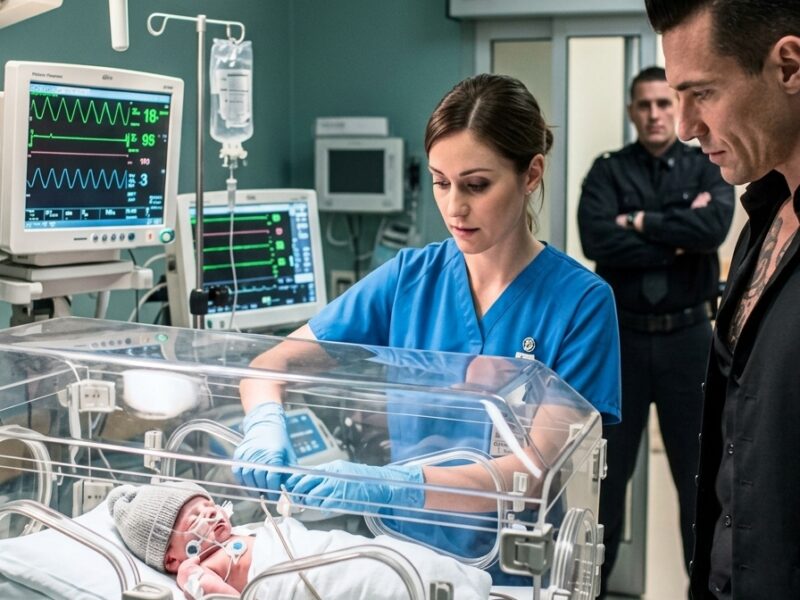
“Something’s wrong with your baby,” the nurse whispered in a packed Chicago hospital room as the feared mafia boss stood beside the crib
The winter wind coming off Lake Michigan always made the third-floor windows of Mercy General rattle like dry bones. I had worked the night shift in the pediatric wing long enough to learn the peculiar language of the hospital after hours: the rhythmic hiss of oxygen monitors, the rubber squeak of orthopedic shoes on polished linoleum, and the silence that falls when a family realizes that money cannot buy a heartbeat.
At two in the morning, the hallway was usually dead. But that night, four men in dark tailored coats stood outside Room 308, their shoulders wide enough to block the light from the fluorescent panels above. They didn’t look at the nurses passing by, and the nurses were careful not to look at them.
Everyone in Chicago knew Victor Romano. To the city council, he was a real estate mogul and a generous benefactor to catholic charities on the South Side. To the men who worked the docks and the back rooms of the meatpacking district, he was the man who decided who operated in the city and who disappeared beneath the ice of the Chicago River.
Inside Room 308, however, the silence was different. It didn’t smell like cigar smoke or heavy cologne; it smelled of rubbed alcohol, warm latex, and the distinct, sour odor of a infant who was fading away.
Six-month-old Sofia Romano lay in the metal crib, looking half her size. Her skin was translucent, showing the faint blue web of veins beneath her temples. Two weeks ago, she had been a round, chubby infant with dark curls. Now, her cheeks were sunken, and her small fingers clutched at the cotton blanket with the weak, desperate movements of a bird fallen from a nest.
Victor Romano stood over the crib. His dark suit was immaculate, but his tie was pulled loose at the collar, and the deep lines etched around his jawline showed he hadn’t slept in days. His hand—a hand that had signed off on fortunes and, if the rumors were true, ordered the destruction of rivals— hovered over his daughter’s head, afraid to touch her as if his rough palm might break her.
“She hasn’t touched the formula since nine,” the floor supervisor, Nurse Sarah, whispered to me near the door. Her voice carried a tremor she couldn’t hide. “He’s been in here for four hours. The doctors tried changing the brand three times today. The lab results for her blood work are completely clear—no infection, no metabolic failure. But she’s losing three or four ounces every single day.”
“Where is the attending physician?” I asked quietly, hanging my stethoscope around my neck.
“Dr. Aris went to check the latest blood panels again,” Sarah said, keeping her eyes fixed on the floor. “Elena, be careful in there. He’s already threatened to fire the entire pediatric staff if she isn’t taking fluids by morning.”
I took a deep breath, adjusted my scrubs, and pushed open the heavy wooden door.
The temperature inside the room was set high to keep the baby warm, but the atmosphere felt icy. Victor Romano didn’t turn around when I entered, but I saw his shoulders tense in the glass reflection of the window.
“Give her another bottle,” Victor ordered. His voice was low, gravelly, and entirely devoid of patience.
“Mr. Romano,” I said softly, stepping toward the stainless-steel cart where three prepared bottles sat in a warm water bath. “If we force her when she’s nauseous, she’ll vomit and lose more fluids. We need to be slow.”
“She’s starving, Nurse,” he said, turning to face me. His dark eyes were bloodshot, rimmed with deep purple shadows. Up close, I could see the sheer panic behind his cold demeanor. “Two weeks ago she was fine. Today she looks like a ghost. Do your job.”
I picked up the bottle of specialized hypoallergenic formula, checked the temperature on the back of my wrist, and sat down in the wooden rocking chair next to the crib. I gently lifted Sofia. She was shockingly light. Her small head rested against my forearm, her dark eyes open, staring up at me with an unfocused, exhausted haze.
I touched the rubber nipple to her lip.
Instantly, Sofia turned her head away with a sharp, frantic twitch. Her little chest heaved, and she let out a thin, miserable whimper, her tiny hands pushing weakly against the bottle.
“See?” Victor’s voice cracked, a sudden, ragged break in his composure that startled the guard standing near the door. “She won’t take it! Why won’t she take it?”
“She’s refusing it,” I said, watching the baby’s face closely.
“I can see she’s refusing it!” he snapped, taking a step toward me. “Is the milk spoiled? Is it too hot? Fix it!”
“It isn’t too hot, Mr. Romano,” I replied, keeping my voice utterly calm. In an ICU, panic is contagious, and I could feel the baby’s pulse racing under my thumb. “And the formula was mixed twenty minutes ago in the main pharmacy.”
I brought the bottle closer to her lips a second time. This time, I didn’t try to feed her; I just held the nipple near her nose. Sofia immediately arched her back, weeping without tears, turning her neck so far to the right her cheek pressed hard into my sleeve.
She wasn’t lethargic from weakness. She was reacting with visceral, instinctual terror.
“She isn’t refusing food because she lacks an appetite,” I murmured, more to myself than to him. “She’s refusing this bottle.”
“What does that mean?” Victor demanded. “It’s the same liquid they’ve been giving her through the tube since Tuesday.”
Before I could answer, the door swung open.
A woman in a tailored gray coat entered, carrying a leather diaper bag. It was Eleanor, the private nanny Victor had hired three months ago following the death of his wife. She was in her late forties, impeccably put together, with neat brown hair gathered in a silk scarf.
“I brought the fresh clothes from the estate, Mr. Romano,” Eleanor said, her tone smooth and measured. “And the custom formula from the pantry, just as you asked.”
The second Eleanor’s foot crossed the threshold, the baby in my arms stiffened. Sofia let out a shrill, piercing scream—a sound far louder and more desperate than any cry she had made all night. Her small body convulsed with terror, her hands clawing wildly at my uniform.
Eleanor froze in mid-step. Her eyes flicked from the baby to me, then to Victor.
“What’s wrong with her?” Eleanor asked, her voice dropping an octave. She reached into her coat pocket, her movements slightly too quick, slightly too deliberate.
I didn’t answer. My eyes dropped to her hands.
Eleanor was wearing fine leather gloves, but around her wrists, where the leather met her coat sleeve, her skin was visible. Her hands were trembling so violently that the metal buckle on her diaper bag rattled against the strap.
I set the baby back down in the crib, keeping one hand gently on her stomach to calm her. Then I turned around and looked directly at Victor Romano.
“Something’s wrong,” I whispered.
Victor’s eyes narrowed into dark slits. The air in the room seemed to drop another ten degrees. “What are you saying, Nurse?”
“I don’t know yet,” I said. “Hold on.”
I walked over to the supply closet in the corner of the room, pulled out a brand-new, vacuum-sealed glass bottle of generic saline-based electrolyte solution from the top shelf—something that had come straight from the hospital central inventory, completely untouched by anyone outside the medical floor.
I poured three ounces into a sterile nipple assembly, sat back down, and lifted Sofia once more.
Eleanor stepped forward. “Nurse Elena, the doctor said she should only have her prescribed diet—”
“Quiet,” Victor barked without taking his eyes off me.
I held the clean glass bottle to Sofia’s lips. The baby sniffed, hesitated for a fraction of a second, and then her tiny mouth clamped onto the nipple. She began to drink greedily, her throat swallowing in steady, desperate gulps.
Within three minutes, she had finished two full ounces. She let out a small sigh, her eyes heavy with sudden exhaustion, and her tiny fingers unclenched against my wrist.
Victor stared at the empty glass bottle, his chest rising and falling heavily. “That bottle was different.”
“Yes,” I said quietly, placing the sleeping baby back onto her mattress. “This was basic hospital stock. The other bottles were prepared downstairs from the batch brought from your home.”
Victor turned slowly toward Eleanor. His face didn’t twist in anger; it went entirely blank—a cold, terrifying slate that made the nanny back up until her shoulder pressed against the wall.
“Call Dr. Aris,” Victor commanded his head guard, a thick-necked man named Mark. “And get the lab director up here right now. Tell him if he isn’t in this room in five minutes, I will burn his laboratory to the ground.”
The hospital’s head toxicologist arrived in four.
The laboratory results didn’t take until morning. Because of who was asking, the screening was rushed through the high-performance liquid chromatography unit on the emergency basement floor. By 11:45 PM, the chief of toxicology walked into Room 308 himself, holding a single sheet of paper. He looked as if he wanted to be anywhere else on earth.
“Well?” Victor asked. He was standing by the window, his hands folded behind his back.
“The formula sample from the home pantry contains traces of a synthetic organophosphate compound,” the doctor said, his hands shaking as he held the paper. “It’s a specialized pesticide derivative. Inodorous, nearly tasteless, and highly lipid-soluble.”
“English,” Victor growled.
“It’s a slow-acting toxin,” I interrupted, looking at the printout over the doctor’s shoulder. “In small doses, it doesn’t cause immediate respiratory arrest. It causes severe gastric ulceration, chronic nausea, and gradual organ failure. To a doctor looking at standard blood panels, it looks exactly like an autoimmune failure or severe infantile metabolic dystrophy.”
“It makes her starve to death,” Victor said, his voice dropping so low it was almost a whisper. “Slowly.”
“Yes,” the doctor confirmed.
The room went completely, suffocatingly silent. Outside, the wind rattled the windowpane.
Victor turned his head toward Eleanor.
The nanny dropped to her knees right there on the cold tile, tears breaking through her makeup, leaving dark streaks down her cheeks. “I didn’t do it! Mr. Romano, I swear on my life, I didn’t put anything in it! I only fed her what I was given!”
Victor walked over to her slowly. He didn’t raise his hand. He didn’t shout. He simply stood over her, looking down with eyes that looked entirely dead. “Then who did, Eleanor? You carry her bag. You prepare her meals at the estate.”
“I was told to use those specific cans!” she sobbed, clutching her hands together in prayer. “I was told they were special vitamins from Europe! I didn’t know!”
“Who told you?” Victor asked.
Eleanor raised a trembling hand. She didn’t point at the guard. She didn’t point at the door leading to the hallway.
She pointed toward the private waiting alcove attached to the back of the suite.
“The person who told me to switch the tins…” Eleanor wept. “…was your mother.”
I felt my stomach plummet into a cold abyss.
Before anyone could speak, the heavy wooden door of the inner suite swung open.
An elderly woman stepped into the light. She was dressed in an elegant, floor-length black wool dress, her silver hair pulled back into a tight, flawless bun. She carried herself with the terrifying poise of old European nobility. In her right hand, she held an old silver-framed photograph.
It was Maria Romano—Victor’s mother, the matriarch who had ruled the family alongside Victor’s father for forty years.
She didn’t look at the nanny crying on the floor. She didn’t look at the guards. She walked straight past Victor, stepped up to the crib, and looked down at the sleeping infant.
“Look at her,” Maria whispered, her voice like dry leaves scraping across stone. “She has her eyes. She has her mother’s weak, fragile eyes.”
Victor took a step toward his mother, his hands clenching into tight fists at his sides. “Mother… tell me she’s lying. Tell me you didn’t touch Sofia’s food.”
Maria slowly turned around. She didn’t show fear. Tears welled in her pale blue eyes, but her face remained rigid, carved from marble.
“Your wife was a snake, Victor,” Maria said quietly. “Clara came from nothing. She was soft. She was weak. And she discovered things about this family that she had no right to know.”
Victor went pale, the color draining from his face until he looked like a corpse. “What are you talking about? Clara died in a car accident six months ago. She was killed by the Moretti family on the highway!”
“Clara died because she was going to ruin everything you built,” Maria said, her voice dropping to a harsh hiss. “And this child… this child is her legacy. A constant reminder of her betrayal.”
“She is a baby!” Victor roared, the sound echoing off the hard surfaces of the room like a gunshot. “She is my daughter!”
“She is a liability!” Maria spat back, her eyes flashing with cold, ancient hatred. “Just like her mother was! You were always blind when it came to Clara. You were never supposed to know what really happened.”
Maria stepped forward and thrust the silver frame into Victor’s chest.
“She left this behind,” Maria whispered with a bitter smile. “She thought she was clever. She thought she could protect a child from beyond the grave.”
Victor took the silver frame with trembling hands. I stepped closer, drawn by an instinct I couldn’t control.
Inside the frame was a photograph of Clara Romano, pregnant, sitting in a garden, smiling gently at the camera. But Victor wasn’t looking at the front. He turned the frame over.
The velvet backing had been ripped away long ago, revealing a piece of yellowed hospital stationery taped securely to the metal backboard.
Written in dark blue ink, in a neat, hurried cursive, was a single sentence:
“Victor, if Sofia ever starts losing weight, do not trust my family. Trust the nurse.”
I stared at the paper, my blood turning to ice in my veins. Victor stared at it, his thumb tracing the faded ink.
“This is Clara’s handwriting,” Victor whispered, his voice shaking so violently he could barely form the words. “She wrote this… before she died.”
He turned the paper over. At the bottom corner was a dated stamp from Mercy General’s prenatal clinic.
The date was August 14th—three days before Sofia was born, and six months before Clara’s tragic car accident.
Victor lifted his eyes from the paper and looked directly at me. The most feared crime boss in Chicago looked entirely shattered, his chest heaving, his eyes wide with a horrifying realization.
“She knew,” Victor whispered, looking at me as if I held the answers to the universe. “Six months ago… before she died… she knew this was going to happen to her baby. And she knew you would be here.”
I backed up a step, my hand touching the edge of the crib. “Mr. Romano… I’ve never met your wife in my life.”
“Then why,” Victor asked, his voice dead and terrified, “is your name written on the back of this paper?”
Victor turned the paper toward the light. Beneath the blue cursive instruction, hidden beneath the yellowing tape, was a second line written in tiny, precise block letters:
Nurse Elena Vance. Night shift, Pediatric ICU.
A cold prickle swept across the back of my neck. My breath caught in my throat. I pulled my hands back from the crib as if the metal had suddenly grown hot.
“I didn’t…” My voice cracked. “I’ve worked on this floor for four years, Mr. Romano. But I swear to you, I never treated Clara Romano. I was on leave in August. I wasn’t even in the state.”
Victor didn’t yell. The wild, explosive rage that had filled him moments ago had vanished, replaced by something far worse—a deadly, razor-sharp focus. He stared at his mother, who stood motionless beside the window, her face set like stone.
“Mark,” Victor said softly to his head guard. “Clear the room. Get the doctors out. Lock the floor down. Nobody leaves this building.”
“Mr. Romano, this is a public hospital—” Dr. Aris began, his hands trembling.
Mark drew a heavy black pistol from beneath his coat, his expression emotionless. “Out. Now.”
The doctors and nurses scurried out like mice, the heavy wooden door clicking shut behind them. Only Victor, his mother, the weeping nanny on the floor, Mark, the sleeping baby, and I remained in the room.
Victor stepped up to his mother until he was inches from her face. “Clara died in a rollover collision on Route 41,” he said, his voice dropping to a dangerous whisper. “The police report said her brakes failed. The mechanics said the brake line corroded. You told me the Morettis tampered with her car.”
“The Morettis are pigs,” Maria said coldly, not flinching from her son’s glare. “They would have killed her eventually anyway. I simply spared them the trouble.”
Victor’s hand twitched toward his coat, but he didn’t draw a weapon. His eyes filled with a horror so profound it looked as though he were physically bleeding from the inside. “You killed my wife.”
“I protected our legacy!” Maria’s voice cracked like a whip through the quiet room. “She was meeting with federal prosecutors, Victor! She had documents from your father’s safe! She was going to give the U.S. Attorney every bank account, every shipping manifest, every name from Milwaukee to St. Louis!”
“She was carrying my child!” Victor roared.
“And she was going to raise that child in a federal witness protection program while you rotted in a cell for the rest of your life!” Maria yelled back, her eyes wide, glittering with a terrifying, unyielding conviction. “I did what had to be done. I arranged the accident. But the fool girl managed to survive long enough to give birth in the trauma unit before she bled out.”
Maria looked over at the crib, her lip curling with bitter disgust. “I let the child live because I thought she was just an innocent piece of you. But then I found Clara’s journal last month in the lake house. Clara knew everything. She knew what I was planning weeks before she died. She set traps for us, Victor. Even from her grave, she is trying to tear this family apart.”
“So you decided to poison a six-month-old baby?” I blurted out, unable to keep quiet any longer. The absolute cruelty of it made my stomach churn. “You poisoned your own granddaughter?”
Maria glanced at me with supreme condescension, as if I were an bug beneath her shoe. “A slow decline looks like nature taking its course. A baby who dies of a rare metabolic illness brings no police, no autopsies, no federal investigations. It ends the line quietly. It closes the book.”
“Mark,” Victor said quietly.
“Yes, Boss?”
“Take my mother to the estate on Lake Geneva,” Victor instructed, his voice completely flat. “Put her in the main house. Take her phone. Take her keys. Lock the gates. If she attempts to leave, or if she speaks to anyone outside the family, put a bullet in her head.”
Maria didn’t scream. She didn’t plead. She simply drew herself up to her full height, smoothed the front of her black dress, and looked at her son with cold pity.
“You are weak, Victor,” she whispered. “Just like your father was before he died. You let your heart rule your head. Clara knew it, and she manipulated you until the day she died. And now you are trusting a strange nurse because of a note written by a dead traitor.”
Mark placed a heavy hand on Maria’s arm. She shook him off with total disdain, turned on her heel, and walked out of the room, two armed guards following closely behind her. The nanny was dragged out next, her pathetic sobs echoing down the empty corridor until the heavy doors swung shut.
The room became terrifyingly quiet.
Victor stood alone in the center of the floor, his head bowed, his heavy shoulders shaking with silent, ragged breaths. The man who ruled the Chicago underworld looked like a shattered statue.
I stood near the crib, my heart hammering against my ribs like a trapped bird. “Mr. Romano… you need to let the doctors look at Sofia now. She needs intravenous fluids and a proper detox protocol to flush the organophosphate from her system.”
Victor slowly turned toward me. The grief on his face was replaced by a hollow, terrifying suspicion. He held up the piece of stationery again.
“How did she know your name, Elena?” he asked.
“I don’t know,” I insisted, shaking my head. “I swear to God, I don’t know! I’ve worked in this hospital for four years, but I’ve spent my entire career in the neonatal unit. I don’t go to the South Side. I don’t know your family. I don’t know anything about crime!”
Victor walked over to me, stopping only inches away. He was tall, his shadow completely engulfing me. He looked into my eyes, searching for a flinch, a hesitation, a sign of deceit.
“Clara didn’t believe in magic,” Victor said softly. “She was a lawyer’s daughter. She was methodical. She kept records of everything. If she wrote your name, your shift, and your department three days before she gave birth, it wasn’t a guess. It was a message.”
He reached into his inner jacket pocket, pulled out an encrypted mobile phone, and dialed a number.
“Frank,” Victor said into the receiver. “Get to the hospital security office downstairs. I want the personnel file for Elena Vance. I want her tax records, her residential address, her phone logs, and every medical chart she’s touched for the last five years. Bring them to Room 308 in ten minutes.”
“Mr. Romano, that’s a violation of hospital privacy laws—” I began.
“My wife was murdered, and my daughter was poisoned in my own home,” Victor interrupted, his eyes burningly intense. “Privacy laws no longer exist in this room.”
He sat down in the wooden chair next to the crib, crossed his legs, and stared at his sleeping daughter. He didn’t speak another word.
Ten minutes later, the door opened, and a lean, sharp-eyed man in a gray suit walked in carrying a thick manila folder. He handed it to Victor without a word and stood by the door.
Victor flipped open the folder. He scanned through my employment history, my background checks, my nursing credentials.
“You grew up in Rockford,” Victor read aloud, his voice devoid of emotion. “Nursing degree from Loyola. No criminal record. No family ties in Cook County. You’ve lived in a small apartment on Lincoln Avenue for three years.”
“I told you,” I said, my voice trembling despite my best efforts. “I’m just a nurse.”
Victor stopped flipping pages. He stared at a printed document near the back of the file. His brows pulled together in deep confusion.
“What is this?” he asked, holding up a sheet of paper.
I looked at it. It was an incident report from the hospital’s emergency department, dated August 17th of the previous year—the exact night Clara Romano was brought in after her fatal car crash.
“I wasn’t working in the ER that night,” I said quickly. “I was on duty on the fourth floor.”
“Look at the signature at the bottom, Elena,” Victor said, his tone turning deadly serious.
I stepped closer and took the paper.
At the bottom of the trauma unit admission form, where the attending triage nurse was required to sign, was my signature: Elena Vance, RN.
Below the signature, in the hand-written notes section describing the dying patient’s personal effects, was a short list: One silver necklace. One diamond wedding ring. One leather-bound notebook, transferred to attending staff.
I stared at the signature. It was my handwriting. The fluid ‘E’, the sharp tail on the ‘V’—it was unmistakably mine.
“That’s impossible,” I whispered, my knees suddenly feeling weak. “I didn’t work the trauma unit that night. I was off… wait.”
Memory returned in a cold, suffocating rush.
“August 17th…” I murmured, touching my forehead. “There was a massive multi-car pileup on the highway that night. The ER was completely overwhelmed with trauma cases. They called a Code Yellow. Every available nurse on duty was drafted down to the basement to help process incoming patients.”
“You processed Clara,” Victor said, standing up.
“I… I don’t remember her face,” I admitted, panic rising in my throat. “It was chaos. Blood everywhere, sirens blaring, doctors screaming orders. I processed eleven patients in three hours! If she came in bleeding out, I would have filled out her personal effects tag and logged her belongings before they rushed her into Operating Room 2!”
Victor grabbed the manila file and flipped to the next page. It was a property log from the hospital vault.
“Where is the leather-bound notebook?” Victor asked, his voice shaking with sudden intensity.
“Standard procedure for high-value personal effects is to send them to the security safe in the basement,” I explained. “If a patient dies and no next-of-kin claims the items within thirty days, they are archived or destroyed.”
Victor grabbed his phone again. “Frank. Get the chief of hospital security up here. Now.”
“Wait,” I said, my mind racing through the hazy memories of that terrible night. “The notebook… it wasn’t put in the safe.”
Victor froze. “What do you mean?”
“I remember now,” I said, the image flashing vividly in my mind. “The patient… the woman from the highway… she was conscious for less than thirty seconds before they put her under anesthesia. She was holding a red leather book against her chest. She wouldn’t let the paramedics take it.”
“What did she do with it?” Victor demanded, grabbing my upper arms. His grip was tight, desperate. “What did she do with the book, Elena?”
“She gave it to me,” I whispered, looking up into his dark, bloodshot eyes. “She pulled my collar down, shoved the book into my coat pocket, and said… she said, ‘Don’t let the old woman find it. Give it to the girl when she comes of age.'”
Victor let out a ragged breath. “Where is it now?”
Before I could answer, the room’s emergency inter-call system buzzed sharply on the wall. A panicked voice came through the small speaker:
“Code Red. Security alert floor three. Armed individuals entering through the South service elevator. All personnel clear the halls immediately.”
A heavy explosion echoed from down the hallway, rattling the metal light fixtures above our heads.
The sound of shattering glass and raised screams flooded the corridor outside Room 308.
Mark pulled two heavy handguns from his coat, flipping the safety switches off with practiced speed. Frank stepped in front of the door, drawing his weapon and aiming it at the frame.
“Boss,” Mark said, his eyes glued to the frosted glass window of the door. “That’s not the police. That’s heavy hardware. Automatic rifles.”
“My mother’s men,” Victor said, his voice dropping into a register of terrifying calm. “She knew I’d lock down the estate. She didn’t go to Lake Geneva. She called in the old guard.”
“Your mother would attack a hospital?” I yelled over the rising commotion. “There are infants on this floor!”
“My mother built an empire alongside my father by burning down three blocks of Little Italy in 1982,” Victor said coldly. “She doesn’t care about the hospital. She cares about that notebook.”
He grabbed a heavy medical blanket from the cabinet, wrapped Sofia securely against his chest, and pulled his long coat over her small body to shield her. He looked at me with eyes like burning charcoal.
“Where is the red book, Elena?”
“It’s not here!” I panicked, ducking as a heavy spray of gunfire erupted down the hall, followed by the heavy thud of security guards falling. “It’s at my apartment! I didn’t know what it was! I thought it was just a dead woman’s personal diary! I put it in a box in my closet a year ago and forgot about it!”
“Then we’re going to your apartment,” Victor said. He turned to Mark. “Cover the hallway. Frank, secure the rear stairwell.”
“Boss, there are at least eight shooters out there,” Frank reported, peeking through the cracked door. “They’ve cut the power to the main elevators.”
“Then we use the service chute,” Victor commanded.
He grabbed my arm with his free hand, pulling me toward the utility room connected to the back of the suite. The utility room contained a heavy metal laundry chute designed to drop soiled linens four stories straight down to the basement laundry facility.
“Are you insane?” I cried out. “We can’t drop down that!”
“There’s a heavy canvas collection cart at the bottom,” Victor said. “It’s either the chute or a bullet through the head. Decide now.”
A volley of bullets chewed through the wooden door of Room 308, sending splinters and white plaster dust flying through the air. Frank fired three shots back into the hallway before a heavy wooden thud signaled he had been hit. He collapsed against the threshold, his coat soaked in blood.
Mark ducked back into the utility room, slammed the reinforced fire door, and threw the heavy iron bolt shut.
“Go, Boss!” Mark yelled, bracing his shoulder against the door as heavy bodies slammed against the other side. “I’ll hold the door!”
Victor didn’t hesitate. He kicked off the metal grate covering the linen chute. He looked down into the dark, vertical shaft.
“Hold onto my waist,” Victor ordered me.
“What?”
“Hold on!” he barked.
I wrapped my arms tightly around his torso. Victor gripped the edges of the smooth metal chute, tucked the baby securely into his inner coat pocket with his left arm, and plummeted into the darkness.
The descent was a violent, friction-burned blur of slick steel and rushing air. We slid down four floors in less than three seconds, crashing hard into a massive mountain of dirty hospital linens at the bottom.
The impact knocked the breath from my lungs, leaving me coughing and disoriented in the dim, damp basement air.
Victor was already on his feet, checking the coat pocket beneath his lapel. Sofia let out a small, offended cry, but she was unharmed, protected by the thick pile of towels.
“Up,” Victor commanded, grabbing my hand and hauling me out of the linen bin.
The basement laundry room was cavernous, filled with giant industrial washing machines humming in the shadows. The emergency red backup lights were pulsing slowly, casting long, bloody shadows across the concrete floor.
“Which way to the alley exit?” Victor asked, his gun drawn, sweeping the room.
“Through the boiler room… to the left,” I gasped, clutching my bruised ribs.
We ran through the dark corridors, the sound of our footsteps echoing off the concrete walls. Behind us, high up in the building, we could hear distant gunshots and shouting, but the basement was eerie and quiet.
We burst through the metal fire door into the freezing alley behind the hospital. The Chicago winter night hit us like a physical blow, the sub-zero wind cutting through my thin nurse’s scrubs.
A black SUV sat idling near the dumpster, its exhaust curling into the freezing air. A man stepped out from the driver’s seat—a young, thin man with a scarred lip.
“Boss!” the driver called out, opening the rear door. “Frank called ahead before the line went dead. I’ve got the engine warm.”
We scrambled into the back seat. Victor immediately slammed the door shut and locked it. “Lincoln Avenue,” he told the driver. “Fast. And don’t use the headlights until we’re off the block.”
The SUV surged forward, its tires screaming against the icy asphalt as we slid out of the alley and melted into the dark, snow-covered streets of the South Side.
Inside the vehicle, the heat blasted from the vents, but I couldn’t stop shaking. My hands were bright red from the cold, and my mind was spinning out of control. An hour ago, I was a pediatric nurse charting temperatures. Now, I was fleeing a crime syndicate with Chicago’s most dangerous man and his motherless infant.
Victor unzipped his coat slightly, checking on Sofia. The baby had fallen back asleep, exhausted by the toxin leaving her system and the warmth of her father’s chest.
He looked over at me. “Tell me about the book.”
I pulled my knees to my chest, trying to stop my shivering. “It’s a red leather notebook. Small, bound with an elastic strap. When Clara gave it to me in the ER, she was coughing up blood. She grabbed my hand so hard she left bruises on my wrist.”
“Did you open it?” Victor asked, his voice low, intense.
“No,” I lied.
Victor’s eyes narrowed. “Don’t lie to me, Elena. You had that book in your house for six months. You opened it.”
I swallowed hard, looking out the window as the streetlights swept over the dark storefronts of Michigan Avenue.
“I opened it once,” I admitted softly. “A week after she died. I didn’t know who she was. The police had logged her as an unidentified victim initially because her purse was missing. I wanted to see if there was a name inside so I could return it to her family.”
“What did you see?”
“Pages and pages of financial numbers,” I said. “Dates, bank routing codes, shipping container numbers for the Port of Chicago. And names. Dozens of names of high-ranking city officials, police commanders, judges… and your mother’s name, written on almost every page.”
Victor closed his eyes, letting out a long, shuddering sigh. “She was building an enterprise corruption case under the RICO statute.”
“Yes,” I whispered. “And on the very last page, there was a personal note. It wasn’t written to the police. It was written to you.”
Victor opened his eyes sharply. “What did it say?”
“She wrote that she loved you,” I said gently. “She wrote that you were a good man trapped inside a terrible legacy. But she said your mother was planning to sell the family’s operations to a cartel in Sinaloa—and that Maria was going to eliminate both you and Clara as soon as the transfer was complete.”
Victor’s hand clenched around the grip of his handgun so hard his knuckles turned white. “My mother told me Clara was the traitor. She told me Clara was feeding information to the federal government to destroy us.”
“Clara wasn’t trying to send you to prison, Mr. Romano,” I said, looking him dead in the eye. “She was trying to buy you a way out. She was gathering leverage against your mother so you, Clara, and Sofia could leave Chicago forever.”
Victor stared at me in absolute silence. A single tear escaped his right eye, tracing a wet path down his scarred cheek before he quickly wiped it away with the back of his hand.
“Boss,” the driver called out from the front seat, his voice laced with sudden panic. “We’ve got two black sedans coming up fast on our tail. They just ran the red light on 22nd Street.”
Victor looked out the rear window. Two heavy vehicles were closing the distance, their high beams flashing through the dark.
“Drive faster, Leo,” Victor ordered, his voice suddenly turning as cold as ice. “We’re almost at her building.”
“They’re cutting us off!” Leo yelled, spinning the steering wheel hard to the left.
The SUV swerved violently across three lanes of slush-covered asphalt. Behind us, the heavy sound of automatic weapon fire erupted once more, glass shattering in the rear cargo area of our vehicle.
The SUV skidded sideways, its heavy rubber tires mounting the curb and knocking over a metal trash can before violently coming to a halt in front of my three-story brick apartment building on Lincoln Avenue.
“Out! Out!” Victor shouted, throwing his door open.
He grabbed my arm and pulled me out into the blinding snowstorm. Leo scrambled out of the driver’s side, drawing a submachine gun from beneath his coat, and positioned himself behind the hood of the SUV to return fire at the approaching sedans.
“Go upstairs!” Leo yelled, firing a steady burst of shots into the darkness. “I’ll buy you two minutes!”
Victor pulled me through the iron front gate of my building. I fumbled frantically with my nurse’s lanyard, my hands shaking so badly I dropped my keys twice into the fresh snow.
“Give them to me!” Victor snapped, snatching the keys from my hands. He inserted the brass key into the lock, turned it, and shoved the heavy glass door open just as a volley of high-caliber rounds shattered the storefront window across the street.
We sprinted up the narrow, carpeted stairs to the third floor. My heart was pounding so hard in my ears I could barely hear the gunshots echoing from the street below.
We reached Apartment 3B. Victor unlocked the door, shoved me inside, and slammed the heavy oak door shut, turning all three deadbolts.
The apartment was cold and quiet, smelling faintly of lavender and old books. It was a simple, one-bedroom home—a couch, a small television, a row of potted plants on the windowsill, and a small dining table covered in nursing journals.
Victor immediately moved to the windows, pulling the heavy velvet drapes shut. “Where is the book?”
“In the bedroom closet,” I panted, rushing down the narrow hallway.
I pulled open the sliding wooden doors of my closet, reaching for a dusty plastic storage bin hidden beneath a stack of extra winter blankets. My hands were trembling violently as I popped the plastic latches off the top.
I dug through old high school yearbooks, photo albums, and tax forms until my fingers touched the cool, smooth surface of the red leather cover.
I pulled it out.
The notebook was exactly as Clara had given it to me—wrapped in a protective plastic bag, bound tightly with its dark elastic strap.
“I have it,” I said, stepping back out into the living room.
Victor stood by the small dining table, holding Sofia against his shoulder. He looked down at the red leather cover in my hands, his breathing heavy and ragged.
“Put it on the table,” he said softly.
I set the notebook down between us.
For a moment, neither of us moved. The gunfire from the street below had suddenly stopped, replaced by a suffocating, heavy silence that felt far more terrifying than the noise of battle.
Victor reached out with a trembling hand, peeled back the elastic strap, and opened the front cover.
On the yellowed flyleaf, in Clara’s elegant handwriting, was a short dedication:
For Victor. My husband, my love, my protector. If you are reading this, I am already gone. Do not look for revenge. Look for our daughter.
Victor closed his eyes, his head dropping toward his chest as a heavy sob racked his body. He pressed his forehead against the wooden table, clutching Sofia to his chest as if she were the only anchor keeping him from drifting into the abyss.
“She tried to save me,” he whispered, his voice broken and raw. “And I let my mother convince me she was a traitor. I didn’t even attend her funeral… I was so angry…”
“Mr. Romano,” I said gently, stepping closer and touching his arm. “Clara knew why you were angry. She wrote it right there—she knew your mother was manipulating you. You didn’t kill her. Your mother did.”
Victor lifted his head. The grief in his eyes was instantly burned away by a cold, terrifying fire. He flipped through the pages, his eyes scanning the lists of offshore bank accounts, shell companies, and safe houses spread across North America and Europe.
“This isn’t just leverage against my mother,” Victor realized, his finger tracing a diagram of corporate holdings in Panama. “This is the entire financial infrastructure of the Romano family. My mother didn’t just plan to kill Clara… she’s been stealing from our syndicate for ten years. She’s been siphoning millions into private accounts in Zurich.”
“She was preparing to liquidate everything,” I realized. “She was going to frame you for the federal crimes, take the money, and leave you to die or rot in prison.”
“Yes,” Victor said, his tone turning dangerously sharp. “And she couldn’t risk Sofia living, because as Clara’s legal heir, Sofia automatically inherits Clara’s estate—including the trust funds holding thirty percent of our legitimate corporate shares.”
He looked down at his sleeping daughter. “My mother wasn’t just killing a child out of spite. She was killing her to consolidate total financial control before fleeing the country.”
Suddenly, the heavy front door of my apartment let out a loud, splintering crack.
The iron lock frame shattered inward.
The door swung open, revealing three men in dark tactical gear carrying silenced pistols. Behind them, stepping over the broken wood of my doorframe, was Maria Romano.
She wore no coat despite the freezing cold. Her face was pale, her silver hair perfectly intact, her cold blue eyes fixing instantly on the red notebook sitting on the wooden table.
“Hand it over, Victor,” Maria said, her voice smooth and devoid of any emotion. “It’s over.”
Behind her, the hallway was silent. Leo was nowhere to be seen.
Victor didn’t reach for his gun. He slowly set Sofia down in a soft cushioned armchair behind him, stepped in front of the baby, and folded his arms over his chest.
“You killed Frank,” Victor said flatly. “You killed Leo.”
“They were employees, Victor,” Maria said dismissively, taking a step into the apartment. “They were paid to take risks. Just as this nurse was.”
Maria’s eyes flicked to me, filled with cold contempt. “You should have kept your head down, Nurse Elena. You should have stayed in your hospital, changing bandages and taking temperatures. Now you are going to die in a cheap apartment on the South Side, and nobody will ever know why.”
“Leave her out of this,” Victor growled. “She knows nothing.”
“She knows enough to put me in a federal maximum-security prison for the rest of my natural life,” Maria replied, gesturing to the armed men behind her. “Kill the nurse. Take the book. Bring my son and the child to the airstrip.”
The guard on the left raised his silenced pistol, aiming it directly at my forehead.
I froze, my breath catching in my throat, staring into the dark hollow of the suppressor.
“Wait,” Victor said sharply.
The guard hesitated, looking at Maria for confirmation.
Victor took a slow step toward his mother, reaching into his inner pocket. The guards instantly raised their weapons at him, but Victor didn’t pull out a gun.
He pulled out a small, metallic black device no larger than a pack of cigarettes, fitted with a single glowing red LED light.
Maria’s eyes narrowed. “What is that?”
“It’s a remote detonator, Mother,” Victor said softly, a dark, terrifying smile spreading across his face. “When Frank called me from the hospital basement, he didn’t just report the attack. He set the fail-safe.”
“You’re lying,” Maria sneered, though a faint flicker of doubt crossed her pale eyes.
“The red book contains every account number you own in Zurich,” Victor said, his thumb hovering over the red button. “It also contains the master passcodes to the private server in your estate on Lake Geneva. Five minutes ago, while we were sitting in this room, I uploaded a digital mirror of Clara’s notebook to the U.S. Attorney’s office in Chicago.”
Maria went completely rigid. “You… what?”
“It’s over, Mother,” Victor whispered. “The federal marshals are already executing search warrants on your accounts. By morning, every dollar you stole, every building you bought, and every bribe you paid will be frozen by the Department of Justice.”
Maria’s composure finally shattered. Her eyes went wild, her face twisting into a mask of hideous, terrifying rage. “You fool! You destroyed our family! You destroyed forty years of work!”
“You destroyed this family the night you murdered my wife,” Victor said, his voice dropping into a register of cold, absolute finality.
He pressed the red button.
A deafening siren began to wail from the street below—not a bomb, but the high-pitched, dual-tone sirens of half a dozen unmarked federal law enforcement vehicles pulling up to the curb.
Flashbang grenades detonated in the hallway outside my apartment, blinding light and concussive sound blowing through the doorway.
The chaos that followed was a dizzying blur of shouting, heavy boots, and blinding white light.
Federal tactical teams burst into the apartment, throwing Maria’s guards to the ground before they could fire a single shot. Maria was forced to her knees, her hands ziptied tightly behind her back, her silver hair finally coming undone as she cursed her son in rapid, bitter Italian.
She didn’t look back as the federal agents dragged her down the narrow stairwell into the freezing snow.
Victor didn’t resist. He stood calmly beside the armchair, holding his daughter close, allowing two armed marshals to secure his wrists in front of his body so he could continue holding Sofia.
I sat on the edge of my sofa, wrapped in a heavy blue police blanket, a paramedic checking my pulse with a plastic pulse oximeter. My living room was completely ruined—the door off its hinges, plaster dust covering my furniture, glass shards littering the carpet.
A tall, sharp-featured man in a dark trench coat walked into the room, carrying a leather briefcase. It was Assistant U.S. Attorney David Miller—the man whose name had appeared on the cover of Clara’s red notebook.
He looked around the room, then looked at Victor.
“We’ve been waiting for this notebook for eighteen months, Victor,” Miller said quietly, taking the red book off the table and placing it carefully into his briefcase. “Clara told us if anything happened to her, it would eventually find its way to us.”
“Is it enough?” Victor asked, his voice low and tired.
“It’s enough to put your mother and her entire network away for the rest of their lives,” Miller said. He looked down at the baby in Victor’s arms. “And what about you?”
“I made a deal with Clara before she died,” Victor said softly, looking at his daughter’s sleeping face. “If she ever got the proof, I promised I wouldn’t fight it. I’ll plead to the corporate tax evasion charges. I’ll give you every name in the city. But my daughter stays safe. And Nurse Elena is given full immunity and federal protection for her role in this.”
Miller nodded slowly. “The U.S. Attorney agreed to those terms twenty minutes ago. Your legal team is already waiting at the federal building downtown.”
Miller turned to me, offering a polite nod. “Nurse Vance… you’re free to go. A federal escort will stay outside your apartment until the building is secured, and the government will reimburse you for all damages.”
“Thank you,” I whispered, my voice barely audible over the hum of the paramedic’s radio.
The agents began leading Victor toward the door. As he reached the broken threshold, he stopped and turned around to face me.
He looked different now. The cold, terrifying crime boss of the South Side was gone. In his place stood a man who looked exhausted, humbled, but finally free of the dark shadow that had governed his life.
“Elena,” Victor said.
I stood up from the couch, stepping over the debris to approach him.
“Why did Clara pick you?” Victor asked, his dark eyes searching mine one last time. “Out of all the nurses in Chicago… why did she write your name?”
I looked at the baby in his arms, then looked up into his eyes.
“Three days before Sofia was born,” I said softly, “a woman came into the pediatric clinic on the fourth floor. She wasn’t a patient. She was just sitting on the bench outside the nursery, watching the newborns through the glass. She was crying.”
Victor’s breath hitched in his throat.
“I sat down next to her,” I continued, memories long forgotten suddenly locking into place. “I brought her a cup of warm tea. She told me she was terrified that she wouldn’t be around to protect her child from her husband’s family. I told her… I told her that mothers always find a way to protect their children, even when they aren’t physically there.”
Tears welled in Victor’s eyes, overflowing and dripping down onto Sofia’s blanket.
“She asked for my name,” I whispered. “I gave her my badge to read. She looked at me and said, ‘If my baby ever needs a guardian angel in the dark, I hope she finds someone like you.'”
Victor bowed his head, letting out a long, ragged breath that sounded like a prayer. “She found you, Elena. She found you.”
He took my hand with his bound wrists, pressing his forehead against my knuckles for a long, silent moment. “Thank you.”
“Take care of her, Victor,” I said gently, touching Sofia’s soft cheek. “She’s going to be fine now.”
The agents led Victor down the stairs, his heavy footsteps fading into the quiet night.
I walked over to the shattered window frame, pulling the heavy velvet curtain aside.
Down on Lincoln Avenue, the emergency lights of the police cruisers were flashing red and blue against the white snow. I watched as they placed Maria Romano into the back of a black federal van, her long silver hair caught in the wind.
Then I watched Victor step into a separate sedan, holding his daughter wrapped securely in his coat, shielding her from the biting wind.
East of the city, over the dark, freezing expanse of Lake Michigan, the dark clouds of the snowstorm were finally starting to part. A pale line of gold and pink light was breaking across the horizon, signaling the arrival of the dawn.
For the first time in six months, the air inside my small apartment felt clean.
I picked up my stethoscope from the dining table, placed it gently in my bag, and sat down by the window to watch the sun rise over Chicago.
The end.









