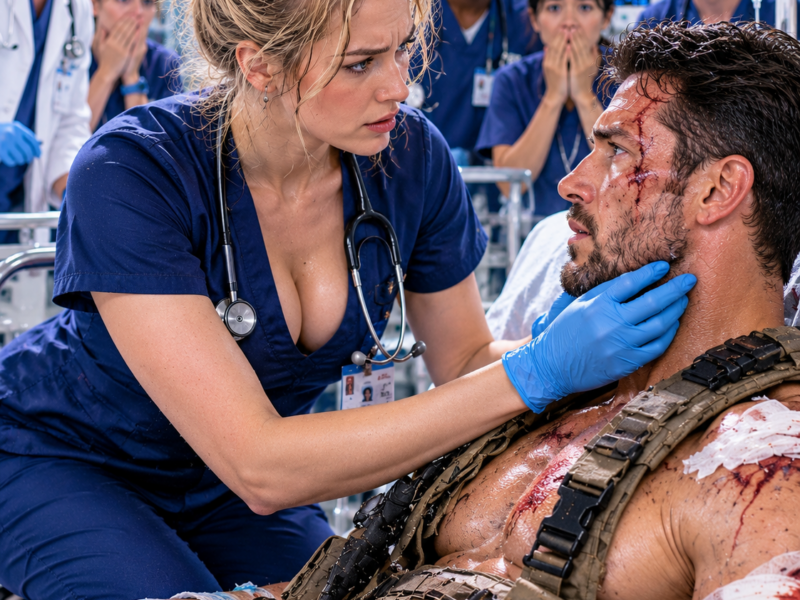
“Six security guards couldn’t hold him. Three doses of sedatives couldn’t calm him. But when I stepped into that blood-soaked room and whispered four words
“Riley is safely home.”
For several seconds, Garrett Hayes didn’t move.
The jagged piece of mirror lay broken on the floor. His right hand remained suspended in the air, fingers curled around nothing. His eyes moved from the dog tag in my palm to my face, then back to the name engraved on the metal.
RILEY J. PRESTON.
“No,” he whispered.
I stayed on my knees.
“Garrett…”
“No. No, that’s not—”
His voice broke.
He looked down at the empty space beside him, the place where he’d been shielding an imaginary body from the people surrounding us.
Then his knees buckled.
I caught him as best I could, but he was a large man, and my own legs nearly gave way beneath his weight. He sank against me, his injured shoulder shaking as a terrible sob tore out of his chest.
“I’m sorry,” he choked. “Abby, I’m so sorry.”
I wrapped my arms around him.
“You don’t have to apologize.”
“I couldn’t get him out.”
“You brought him home.”
“I promised him.”
“I know.”
He buried his face against my shoulder.
For three weeks, this man had fought everyone who came near him. He had broken furniture, ripped out medical lines, and terrified an entire hospital unit.
Now he was crying like someone who had been holding his breath for years.
Outside the room, the security guards slowly lowered their weapons.
Dr. Thomas Aris stepped through the doorway, his expression shifting from alarm to disbelief.
“Get the trauma team in here,” I called. “He has a serious chest injury and significant blood loss. We need to assess the line site immediately.”
That was enough to bring everyone back to their senses.
The room filled with medical staff.
Garrett didn’t resist when they helped him onto the bed. He didn’t swing at the nurses or fight the restraints. He simply kept looking at me.
“Stay,” he whispered.
“I’ll be right here.”
The doctor checked his vital signs while another nurse applied pressure to the bleeding site.
“His blood pressure is low,” Dr. Aris said. “Get fluids running. We need a surgical assessment.”
I stepped aside to give the team room.
Garrett reached for my hand.
I took it.
His grip was weak, but it was there.
“Don’t let them take me away,” he whispered.
“No one is taking you anywhere right now. We’re going to take care of your injuries.”
He closed his eyes.
The doctor glanced at me.
“Abby, what happened?”
I looked at Garrett.
“He recognized the dog tag.”
Dr. Aris followed my gaze.
His eyes settled on the silver chain in my hand.
“Riley Preston?”
I nodded.
He didn’t ask another question.
For the next hour, the medical team stabilized Garrett and repaired the injury caused by the central line removal. His heart rate gradually settled. The glass wound on his hand was cleaned and dressed.
The psychiatric hold remained in place, but the emergency restraints were replaced with softer medical restraints as soon as it was safe.
No one wanted to provoke another episode.
But Garrett didn’t need to be restrained.
He was exhausted.
When the last clinician left the room, I sat beside his bed.
He stared at the ceiling.
“Did he suffer?”
The question came so quietly I almost missed it.
My throat tightened.
“I don’t know everything that happened.”
“You have to know something.”
“I know what the official report says.”
He turned his head.
“What does it say?”
I looked down at Riley’s dog tag.
“It says he died instantly when the explosive device hit your convoy.”
Garrett shut his eyes.
“That’s not true.”
The words landed between us.
I felt my fingers go cold.
“What do you mean?”
He swallowed.
“The explosion flipped our vehicle. It threw us into the rocks. Riley was hurt, but he was alive.”
I couldn’t breathe properly.
“Garrett…”
“He had a serious wound to his leg. I put a tourniquet on him. Then I held pressure while we waited for the extraction team.”
His voice trembled.
“He was awake for a long time, Abby.”
I pressed my hand over my mouth.
“He talked about you,” Garrett continued. “He asked me if I remembered your address in Coronado. He made me repeat it until I got every number right.”
A tear slid down his cheek.
“He said you hated when people forgot the little things.”
I laughed once, a broken sound that immediately turned into a sob.
“That sounds like him.”
Garrett nodded.
“He told me to get you something for your birthday. Said he had already forgotten what you wanted, so I should ask you when I got back.”
I lowered my head.
My birthday had been six days after the notification officers came to my door.
I had spent that day sitting on the bedroom floor, staring at Riley’s shoes.
“What happened at the end?” I asked.
Garrett looked away.
“The extraction helicopter was delayed. We were taking fire. Riley kept telling me to get the radio operator behind cover. He was more worried about the other guys than himself.”
He paused.
“When the helicopter finally came in, we got him aboard. He died just as the aircraft lifted.”
I gripped the edge of the chair.
“Was he alone?”
“No.”
Garrett looked directly at me.
“I was holding his hand.”
The room went blurry.
“He wasn’t alone, Abby. I promised him I wouldn’t leave him. I stayed until there was nothing more I could do.”
I covered my face.
For three weeks, I had imagined my husband dying in a sudden explosion, with no one beside him, no chance to say goodbye.
Now I knew he had lived long enough to think about me.
Long enough to remember our home.
Long enough to trust someone with his final promise.
It hurt more than I could have imagined.
But it was also a gift.
“Thank you,” I whispered.
Garrett shook his head.
“I should have told you sooner.”
“You were injured. You were barely conscious when they brought you here.”
“I should have found a way.”
“You don’t owe me an apology for surviving.”
His jaw tightened.
“I left him there.”
“No,” I said firmly. “You brought him home.”
He turned his face toward the window.
For a long time, neither of us spoke.
Then he asked, “Why were you wearing his tag?”
I looked down at the silver metal.
“Because the military sent me his personal effects. His dog tags were in the envelope. I couldn’t bear to put them away.”
Garrett nodded slowly.
“He gave me his other one before we went out.”
I looked up.
“You have it?”
He hesitated.
“It’s in my property bag. They took it when I was evacuated.”
I reached for the bedside phone.
“We’ll find it.”
“Abby?”
“Yes?”
“He said you’d be strong.”
I smiled through my tears.
“Riley always thought I was stronger than I was.”
“He said you were the person who made him want to come home.”
I couldn’t answer.
For the first time since the casualty notification, I allowed myself to cry without trying to stop.
And Garrett let me.
By sunrise, the storm had moved inland.
The unit smelled of antiseptic and wet clothing. A maintenance worker was examining the cracked window in Room 412, while two nurses quietly replaced the damaged equipment.
I stood at the sink, scrubbing dried blood from my forearms.
The water ran pink, then clear.
My hands were shaking.
“Abby?”
Sarah, one of the younger nurses, stood in the doorway.
She had been working the night shift and had seen most of what happened.
“Are you okay?”
I turned off the faucet.
“I will be.”
She looked toward Garrett’s room.
“He’s calm now.”
“He’s exhausted.”
Sarah hesitated.
“Was that really your husband?”
I nodded.
She looked at the dog tag resting against my palm.
“I didn’t know.”
“Most people didn’t.”
“I’m sorry.”
I gave her a tired smile.
“Thank you.”
Sarah stepped closer.
“I thought he was just… dangerous.”
“He was dangerous last night. That doesn’t mean danger is all he is.”
She looked down.
“Dr. Aris says the board may review what happened.”
“I know.”
“You went in without waiting for the team.”
“I did.”
“He might report you.”
I dried my hands.
“Then I’ll explain why I made that decision.”
Sarah studied me.
“Weren’t you afraid?”
I thought about Garrett holding the glass.
About the blood on the floor.
About the empty space he was protecting.
“Yes,” I said. “I was afraid.”
“Then why did you go?”
“Because I recognized what he was trying to protect.”
Sarah didn’t ask anything else.
She simply nodded.
A few minutes later, Dr. Aris approached me.
“Abby, I need to speak with you.”
His voice was gentle, but his expression was serious.
We stepped into the small consultation room.
He closed the door.
“I want to start by saying that I’m relieved no one was killed.”
“So am I.”
“What you did last night was extremely dangerous.”
“I understand.”
“You entered a room with a severely agitated patient who had a piece of broken glass in his hand.”
“He was guarding a perceived casualty.”
“That doesn’t make the situation safe.”
“No, it doesn’t.”
Dr. Aris rubbed his forehead.
“You also stopped security from deploying the taser.”
“His vital signs were unstable, and he had significant blood loss. I was concerned that using an electrical control device could add another serious risk.”
“I know why you made the decision.”
He sat down.
“But I need you to understand something. We cannot build a treatment plan around one person being the only one who can reach him.”
I nodded.
He was right.
“I don’t want that either.”
“Good. Then we need a plan that involves the whole team.”
He glanced at the notes in front of him.
“I’ve reviewed the medications and the timeline of his episodes. His brain injury, sleep deprivation, pain, and environmental triggers all need to be considered. We need neurology involved, and we need a more careful approach to his agitation.”
“I agree.”
“And, Abby…”
I looked at him.
“You should have told me about your connection to Riley before you volunteered to care for Garrett.”
I lowered my eyes.
“I know.”
“You were grieving. He was grieving. That is a complicated situation.”
“I wasn’t trying to hide a conflict. I just didn’t know he would recognize Riley’s name.”
Dr. Aris sighed.
“I’m not accusing you of anything. But you cannot be his only nurse, and you cannot become his only support.”
“I understand.”
He leaned back.
“I’m glad he trusted you. Now we need to help him trust more than one person.”
That afternoon, I told Garrett the treatment team would be changing his care plan.
He listened without arguing.
“No more locked room?” he asked.
“Your room will remain secure while we assess the risks, but we’ll work on making it less restrictive as your condition improves.”
“Will you still come?”
“I’ll be part of your care team.”
He nodded.
Then he looked at me.
“That’s fair.”
It was the first time I had heard him accept a boundary without fighting it.
The next morning, a man in a dark Navy uniform arrived on Ward 4 East.
Commander Richard Yates, from the Judge Advocate General’s Corps.
He carried a thick folder and wore the kind of expression that made people straighten their backs before he said a word.
He asked to see Garrett’s medical record.
Then he requested a meeting with Dr. Aris and me.
The meeting took place in a small conference room.
Yates placed a photograph on the table.
It showed the damaged window in Room 412.
“Chief Petty Officer Hayes caused extensive property damage,” he said. “He also threatened medical personnel and created a serious security incident.”
“He was experiencing a severe combat-related flashback,” Dr. Aris replied.
“That’s a diagnosis, Doctor. It doesn’t erase the consequences.”
I kept my hands folded.
Yates turned toward me.
“Nurse Preston, you entered the room against the direct instructions of the attending physician.”
“I entered because I believed the patient was about to be seriously injured or killed.”
“You were not authorized to make that decision.”
“I was a licensed nurse responding to an emergency.”
“You are not a military commander.”
“No,” I said. “I’m not.”
His expression hardened.
“Then perhaps you should leave tactical decisions to those who are.”
Dr. Aris shifted in his chair.
“Commander, we’re discussing a medical emergency.”
Yates opened the folder.
“Chief Hayes is under review for assault and destruction of government property. Given his history, the command may recommend permanent psychiatric confinement.”
I felt anger rise, but kept my voice level.
“He is a patient with a traumatic brain injury and severe psychological trauma.”
“He is also a trained combat operator.”
“Those facts are not mutually exclusive.”
Yates closed the folder.
“You seem unusually invested in this case.”
I looked at him.
“My husband was killed in the same operation.”
For the first time, Yates appeared surprised.
“Your husband?”
“Petty Officer First Class Riley Preston.”
He looked down at the folder again.
“I see.”
“No,” I said. “You don’t.”
The room went still.
“Garrett was there when Riley died. He has been carrying the truth about my husband’s final hours while struggling with injuries that none of us can fully understand. He needs treatment, not punishment.”
Yates stood.
“That is a matter for the review board.”
“Then I hope the board reads his medical records before it judges him.”
He gathered his papers.
“We’ll see.”
When he left, Dr. Aris looked at me.
“This is going to become more complicated.”
“I know.”
Over the next several days, Garrett began to improve.
Not dramatically.
Not like a switch had been flipped.
He still woke from nightmares. Some mornings he refused breakfast. Once, a loud crash from a supply cart sent him into a panic, and the nurses had to help him orient himself to the room.
But the episodes became shorter.
He learned to identify the warning signs in his body.
He practiced grounding exercises with the occupational therapist. He attended sessions with Dr. Aris, even when he didn’t feel like talking.
And he began to trust Sarah.
One afternoon, she brought him a cup of coffee.
“Decaf,” she explained. “Doctor’s orders.”
Garrett looked at the cup.
“You trying to punish me?”
“I’m trying to keep your heart rate from climbing through the ceiling.”
He almost smiled.
“Fair enough.”
Sarah returned to the nurses’ station looking pleased.
“He made a joke,” she told me.
“That’s progress.”
“He also asked me where the cafeteria is.”
“That’s even better.”
I watched Garrett through the glass.
He was sitting upright in bed, looking at a photograph someone had placed on his bedside table.
It showed a group of men standing together outside a transport aircraft.
Riley was in the middle.
Garrett was beside him, one arm over his shoulder.
I had never seen that photograph before.
Later, I asked where he got it.
“One of the guys sent it,” he said.
“May I see?”
He handed it to me.
Riley was smiling.
Not the careful smile he used for official photographs. A real one.
His eyes were narrowed against the sunlight, and his hand rested on Garrett’s shoulder.
I traced the edge of the picture.
“I wish I had seen this one sooner.”
Garrett looked at it too.
“He was happy that day.”
“Were you?”
He thought about it.
“Yeah. I think we were.”
I placed the photograph back on the table.
For a moment, the room felt peaceful.
Then Garrett spoke.
“There’s something else I haven’t told you.”
I looked at him.
“What?”
He hesitated.
“Riley asked me to give you a message.”
I sat down.
“What message?”
“He told me that if he didn’t make it back, I should tell you he wasn’t afraid.”
My throat tightened.
“He said that?”
Garrett nodded.
“He said he’d had a good life. That he loved you. That if you ever started thinking you should have made him stay home, you had to remember that he chose his life himself.”
I closed my eyes.
That sounded exactly like Riley.
He had never been a man who wanted me to carry responsibility for his decisions.
“He also said something else,” Garrett added.
I opened my eyes.
“What?”
Garrett looked uncomfortable.
“He said I should stop pretending I was indestructible.”
A faint laugh escaped me.
“That sounds like Riley, too.”
“He told me I’d be the first one to get myself killed if I kept acting like pain was a weakness.”
“Did you listen?”
Garrett looked down at his hands.
“Not until now.”
I reached for the photograph.
“Maybe you can start.”
He nodded.
Two weeks after the incident, Garrett was walking short distances with physical therapy.
His right leg remained stiff, and the doctors warned that recovery would take months. His brain injury still affected his concentration and memory, but his progress was steady.
The military review, however, was moving in the opposite direction.
Commander Yates had recommended a medical evaluation board and supported charges related to the hospital incident.
The hearing was scheduled for the following week.
Garrett received the notice while I was checking his blood pressure.
He read it twice.
Then he placed it on the table.
“They’re going to make an example of me.”
“It’s a review,” I said. “Not a verdict.”
“I know how these things work.”
“Then you know you have a right to present medical evidence.”
He looked at me.
“Do you think they’ll listen?”
“I think we should give them the chance.”
He shook his head.
“I can’t go back to that room and explain what happened.”
“You won’t have to do it alone.”
He studied my face.
“Abby, you don’t owe me anything.”
“I know.”
“Your husband is gone. You shouldn’t have to spend your life dealing with his last mission.”
I sat beside him.
“This isn’t about owing you. It’s about telling the truth.”
He looked away.
“I don’t want you to get hurt because of me.”
“Then don’t ask me to lie.”
For a long moment, he said nothing.
Finally, he nodded.
“Okay.”
The evaluation board met in a windowless briefing room at the medical center.
Three senior officers sat behind a long oak table. Commander Yates stood at one side with his documents arranged neatly in front of him.
Garrett sat at the defense table in his dress uniform.
His medals were polished, but his face was pale. He walked with a noticeable limp, and his right hand occasionally trembled.
I sat behind him.
Dr. Aris was there, too.
Yates began with the photograph of the damaged window.
“Chief Hayes demonstrated extreme and unpredictable aggression while receiving care at this facility,” he said. “He threatened personnel with a broken object, destroyed medical equipment, and placed a nurse at risk.”
He looked toward me.
“Nurse Preston, who was the nurse in question?”
I stood.
“I was.”
“Did he hold a piece of glass near your throat?”
“Yes.”
“Did you believe you might be killed?”
“I believed the situation was dangerous.”
Yates raised an eyebrow.
“Then you admit that Chief Hayes threatened you.”
“I admit that he held a piece of broken glass while experiencing a severe flashback. I do not believe he understood that I was a nurse.”
“That’s convenient.”
“It is also what the medical evidence supports.”
Yates paced slowly.
“You entered the room without authorization.”
“I entered during an emergency.”
“You ignored a direct order.”
“I made a clinical judgment based on the patient’s condition.”
“You put yourself in danger.”
“Yes.”
The room grew quiet.
I continued.
“But the question before this board should not be whether the room was dangerous. It was. The question should be whether Chief Hayes was deliberately assaulting medical personnel or experiencing a severe trauma response that required treatment.”
Yates folded his arms.
“And your conclusion?”
I looked at the panel.
“His injuries, symptoms, and behavior were consistent with a severe trauma-related episode compounded by a brain injury. His actions were dangerous, but they were not evidence that he was beyond treatment.”
Dr. Aris followed with a detailed medical explanation.
He described Garrett’s head injury, sleep deprivation, pain, environmental triggers, and the way his symptoms had been worsened by the conditions surrounding his care.
He did not claim that one conversation had cured him.
He explained that the incident had exposed a need for a more appropriate treatment plan.
Then Garrett was asked to speak.
He stood slowly.
“Sir, I don’t remember every second of that night,” he began. “I remember the blackout. I remember the explosion. I remember seeing my team on the ground.”
He paused.
“I remember thinking the enemy was coming for Riley.”
His voice became rough.
“I know I scared people. I know I broke equipment. I know Nurse Preston could have been hurt.”
He glanced at me.
“But I wasn’t trying to attack her. I thought I was protecting a man who had already died.”
No one moved.
“I’ve spent twelve years learning how to survive in places most people never see,” Garrett continued. “I knew how to fight. I knew how to follow orders. I knew how to get my team out.”
He took a breath.
“But nobody taught me what to do when I came home and the people I lost weren’t there anymore.”
His eyes glistened.
“I don’t know if I’ll ever be the man I was before. I may never carry a rifle again. But I’m willing to do the work. I’m willing to get treatment. I’m willing to learn how to live without hearing explosions every time a door slams.”
He looked directly at the panel.
“I am not asking you to pretend nothing happened. I’m asking you to understand why it happened.”
The room remained silent.
Captain Mitchell, the senior medical officer on the board, leaned forward.
“Chief Hayes, are you willing to continue psychiatric treatment and neurological rehabilitation?”
“Yes, sir.”
“Are you willing to accept restrictions on your duties?”
“Yes, sir.”
“Do you believe you are currently fit for operational service?”
Garrett hesitated.
Then he answered honestly.
“No, sir.”
Captain Mitchell nodded.
“Thank you.”
The board recessed.
Garrett sat down.
His hands were trembling.
I placed a glass of water in front of him.
“You did well.”
“I thought I’d throw up.”
“You didn’t.”
He looked at me.
“That’s progress, I guess.”
I smiled.
“It’s a start.”
Three days later, the board issued its decision.
The alleged assault charges arising from the hospital incident were dismissed after review of the medical evidence and witness statements.
Garrett was found unfit for further operational duty.
He was recommended for an honorable medical retirement, with continued treatment and rehabilitation through the military and Veterans Affairs health systems.
It wasn’t the ending he had once imagined for himself.
But it wasn’t a punishment.
When Dr. Aris delivered the news, Garrett stared at the paperwork for a long time.
“So that’s it?”
“For active operational service, yes,” the doctor said. “Your treatment continues. Your life doesn’t end here.”
Garrett looked down at his hands.
“I don’t know what I’m supposed to do now.”
“That’s something we’ll work on together.”
After the doctor left, Garrett turned to me.
“I thought getting out meant I failed.”
“Does it?”
He didn’t answer.
I pulled the chair closer.
“Riley used to say that coming home was the most important part of any mission.”
Garrett looked at the photograph on his table.
“He said that?”
“Whenever he left. Every single time.”
I smiled sadly.
“He said the mission wasn’t finished until everyone had a chance to come home.”
Garrett swallowed.
“Then I guess I’m not finished yet.”
“No,” I said. “You’re not.”
On the morning of his discharge, Garrett wore jeans, a dark flannel shirt, and a pair of shoes that didn’t belong to the military.
He looked uncomfortable in civilian clothes.
His duffel bag rested beside his wheelchair.
I checked the discharge paperwork one final time.
“Your follow-up appointments are scheduled. Physical therapy starts Monday. Dr. Aris wants you to continue with the outpatient trauma program.”
Garrett nodded.
“I’ll be there.”
“You have the emergency contact information?”
He tapped his pocket.
“Right here.”
I handed him a sealed envelope.
He looked at it.
“What’s this?”
“Your personal copy of Riley’s final casualty record.”
His expression changed.
“I thought you said the report was wrong.”
“It is incomplete. But I requested the original medical and evacuation records through the proper review process. This copy includes the corrected timeline and the statement you provided.”
He held the envelope carefully.
“Why are you giving it to me?”
“Because you deserve to know that what you did mattered. And because I don’t want either of us carrying a false version of that night anymore.”
He nodded.
Then he reached into his duffel bag.
“I have something for you.”
He pulled out a small cloth pouch.
Inside was a second dog tag.
Riley’s other one.
The edges were scratched, and the chain was darkened from years of wear.
I stared at it.
“Garrett…”
“He gave it to me before the operation. Told me to keep it safe if anything happened.”
I lifted it carefully.
For a moment, I could almost hear Riley teasing me for getting emotional over a piece of metal.
“Thank you,” I whispered.
“He wanted you to have both.”
I slipped the second tag onto the chain with the first.
Two pieces of metal rested against my heart.
One had come home with my husband’s belongings.
The other had come home with the man who had held his hand when he died.
Garrett watched me.
“I don’t know how to thank you for that night.”
“You don’t have to.”
“I thought I was protecting Riley.”
“You were.”
“I couldn’t save him.”
I stepped closer.
“You weren’t supposed to control everything that happened that night. You were his friend. You stayed with him. You brought him home.”
Garrett looked down.
“I wish I’d had more time.”
“So do I.”
We stood quietly for a moment.
Then he pulled me into a careful hug.
It wasn’t the desperate embrace of the night in Room 412.
It was the hug of two people who had finally been allowed to grieve without fighting.
“Thank you, Abby,” he whispered.
“Go live your life, Garrett.”
He stepped back.
“I’m going to try.”
“I know.”
He walked toward the sliding doors.
At the entrance, he stopped and looked back.
“Abby?”
“Yes?”
“Riley was right about you.”
I smiled.
“What did he say?”
Garrett’s expression softened.
“He said you were the strongest person he knew.”
I shook my head.
“He always exaggerated.”
“Not about that.”
Then he stepped outside.
The San Diego sunlight fell across his shoulders.
For the first time since he’d arrived, he wasn’t surrounded by security guards or medical staff. He was simply a man walking toward a life he had not yet learned how to live.
I watched until he disappeared into the parking lot.
A month later, I received a letter.
It came in a plain envelope with no military markings.
Inside was a photograph.
Garrett stood beside two former teammates at a small outdoor gathering. His right leg was supported by a brace, and his hair had grown longer. He was smiling—not broadly, but genuinely.
On the back, he had written:
First day helping with the veterans’ peer-support program. I listened more than I talked. Turns out that’s harder than it sounds.
I’m still having bad nights. I’m still working on it. But I’m here.
Riley would have made fun of my flannel shirt.
I laughed through my tears.
Then I placed the photograph beside the one of Riley.
For a long time, I had thought healing meant finding a way to stop remembering.
I was beginning to understand that it meant something different.
It meant remembering without being pulled under.
It meant letting someone speak about the person you lost without feeling that the memory belonged only to you.
It meant accepting that survival could be its own kind of courage.
At work, Room 412 had been repaired.
The cracked window was gone. The damaged equipment had been replaced. The walls had been repainted.
A new patient arrived that afternoon.
A young sailor who hadn’t slept properly in days. He sat on the edge of his bed, watching the doorway as if he expected someone to burst through it.
I approached slowly.
“My name is Abigail,” I said. “I’m one of the nurses here.”
He didn’t answer.
“I’m not going to rush you. We can start with one thing.”
His eyes shifted toward me.
“What thing?”
I pulled a chair beside the bed.
“Just telling me what would make you feel a little safer right now.”
He looked down at his hands.
“I don’t know.”
“That’s okay. We can figure it out together.”
Outside, rain began tapping against the window.
For a moment, I remembered Garrett standing in the corner, clutching a broken piece of glass and defending a ghost.
I remembered Riley’s dog tag in my palm.
I remembered four words that had reached a man when every other voice had failed.
Riley is safely home.
Those words had not erased Garrett’s pain.
They had not brought my husband back.
They had simply opened a door.
And through that door, a wounded man had finally found the courage to step out of the war.
I touched the two dog tags resting beneath my uniform.
Then I turned back to the young sailor.
“Take your time,” I told him.
“I’m listening.”
Because sometimes the bravest thing a person can do is put down the weapon.
Sometimes the strongest person in the room is the one willing to ask for help.
And sometimes, coming home doesn’t happen when the helicopter lands.
Sometimes it begins with a quiet voice reminding you that the battle is over.
The End.









