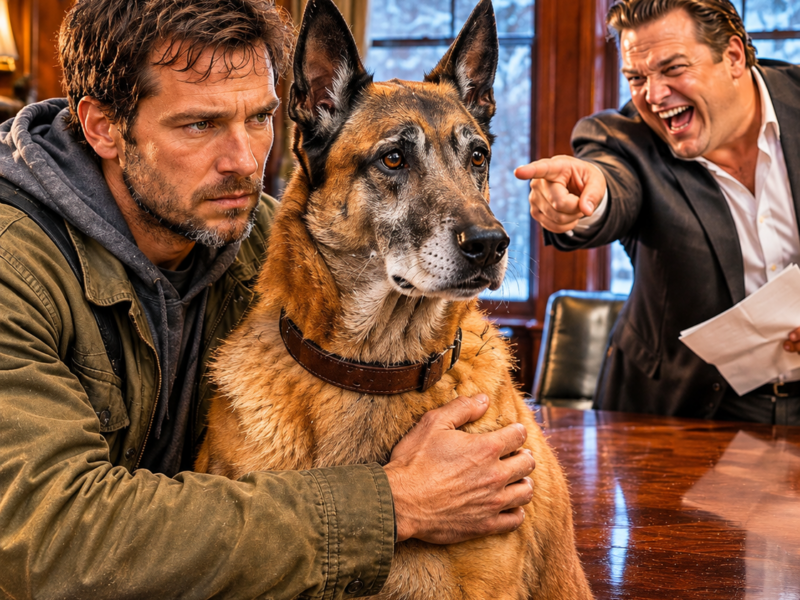
“Sir, that animal can’t come in here. This is a law office.”
“Sir, that animal can’t come in here. This is a law office.”
Cole Mercer stopped just inside the doorway. Beside him stood Ranger, an aging gray German Shepherd with a scarred muzzle, cloudy eyes, and a stiff gait that made every step look painful.
Cole glanced at the woman behind the reception desk.
“He’s a retired Marine, ma’am. Same as me.”
The receptionist looked as though she wasn’t sure whether to argue or call security.
Ranger simply stood beside Cole, his ears relaxed and his tail hanging low. He had spent eight years working in military service, searching for explosives in places where a mistake could cost lives. Now his hips were failing, his hearing wasn’t what it used to be, and his favorite activity was sleeping near Cole’s feet.
He was no longer useful to the military.
But he was still Cole’s partner.
“There’s an animal shelter on Kfax Avenue,” the receptionist said. “I can write down the address.”
Before Cole could answer, a familiar voice came from the conference room.
“Let them both in, Janet. They’re part of the reading, unfortunately.”
Cole recognized the voice immediately.
Grant.
His older brother had always possessed a talent for making an insult sound like a reasonable observation.
Cole walked into the conference room without responding.
Three people sat around the long wooden table. His mother, Lorraine, wore a black dress and a pearl necklace. Grant sat beside her in an expensive suit, looking comfortable enough to be attending a business meeting.
At the far end of the table stood Ruth Callaway, the attorney who had handled his father’s affairs for more than twenty years.
She looked at Cole with a quiet expression of sympathy.
“Thank you all for coming. I’m Ruth Callaway, and I’ll be reading the last will and testament of Walter James Mercer, signed in this office on September 11.”
Grant immediately frowned.
“Ruth, that’s not the will we discussed.”
“It’s the will he signed,” she replied.
The room fell silent.
Ruth opened the document.
“To my wife, Lorraine Mercer, I leave the house on Cherry Creek Drive and everything contained within it.”
Lorraine nodded slightly.
“To my son, Grant Mercer, I leave Mercer Lumber and Supply, including its trucks, equipment, business contracts, and associated assets.”
Grant leaned back, satisfied.
Then Ruth continued.
“To my son, Cole Mercer, I leave the cabin and forty acres of land at Bear Hollow, above Elk Bend, Colorado.”
For a moment, nobody spoke.
Then Grant laughed.
“Bear Hollow?”
Lorraine shook her head.
“That place has been falling apart since the nineties. Walter always did have a strange sense of humor.”
Grant turned toward his younger brother.
“Congratulations, Cole. Finally, a house that matches your wardrobe.”
Cole didn’t look at him.
He had learned long ago that some arguments weren’t worth having.
He stood, thanked Ruth, and prepared to leave.
“Cole, wait.”
Ruth reached into a drawer and removed a sealed envelope.
“Your father left this specifically for you. It’s separate from the will.”
Cole accepted it.
“What’s inside?”
“I don’t know. Walter made me promise you would open it inside the cabin, not before.”
Cole studied the handwriting on the front.
His father’s handwriting.
For twelve years, he had imagined receiving something like this. A letter. An apology. Even a simple explanation.
Now, standing in the same room as the people who had once been his family, he couldn’t decide whether he wanted to open it or throw it away.
He slipped it into his coat.
Outside the office, Grant caught up with him.
“Cole. Hold on.”
Cole stopped on the stairs.
“What?”
Grant pulled a folded document from his briefcase.
“Here’s my offer. Sign this, walk away, and I’ll give you ten thousand dollars.”
Cole looked at the document.
“You just spent five minutes telling everyone the cabin was worthless.”
“Exactly. I’m doing you a favor.”
“Since when do you do me favors?”
Grant sighed.
“Come on. You can’t even afford a bus ticket up there. The property taxes will eat you alive. You’ll be back in Denver within a week.”
Cole looked at the prepared transfer papers.
“You brought this to the will reading?”
“Does it matter? Ten thousand. Final offer.”
Lorraine appeared in the doorway.
“Grant, leave him alone. He’ll come crawling back when the snow starts.”
Cole folded the document and handed it back.
“No, thanks.”
Grant’s expression hardened.
“You’ll last a week up there.”
Cole turned toward the street.
“Come on, Ranger. Looks like we’re going to the mountains.”
He didn’t see the way Grant watched him leave.
He didn’t know that the offer had been prepared weeks earlier.
And he certainly didn’t know that his father’s supposedly worthless cabin was already the subject of a much larger business deal.
The journey to Elk Bend took most of a day.
Cole had no car, no steady employment, and very little money. His possessions fit into one duffel bag, along with Ranger’s food, medication, and an old military blanket.
The bus driver announced the final stop shortly before sunset.
“Last stop, Elk Bend. It’s nineteen degrees outside, folks. Bundle up.”
Cole helped Ranger down the steps.
The dog paused on the icy pavement, testing the ground before putting his weight forward.
“Easy, buddy. Your hips aren’t what they used to be.”
The town was little more than a collection of buildings tucked between mountains. A gas station, a small clinic, a church, and one general store.
Cole followed the smell of coffee toward the store.
An elderly woman stood behind the counter, arranging a box of canned goods.
“You two look like you walked here from Denver.”
“Only from the bus stop.”
She glanced at Ranger.
“That’s a military dog, isn’t it?”
“Was. He’s retired.”
“Yours?”
“Mine now.”
Cole explained that Ranger had served with him overseas. When the military retirement process gave former handlers the opportunity to adopt their dogs, Cole had signed the papers immediately.
The woman nodded.
“Good. They deserve a decent retirement.”
Cole asked for kerosene, matches, and dog food. He counted his remaining money before placing it on the counter.
The woman noticed.
“I can pay for half,” she said.
“Then pay for half.”
Cole looked up.
She smiled.
“Agnes Holcomb. I own this store. And you’re not the first cold person who’s come through that door.”
As she prepared the supplies, Cole mentioned that he had inherited a cabin at Bear Hollow.
Agnes stopped moving.
“Bear Hollow?”
“Yes.”
“Then you’re Walt’s boy.”
Cole looked at her.
“You knew my father?”
“Thirty years. Sold him nails, coffee, and plenty of bad advice.”
For the first time that day, Cole felt something unfamiliar.
Someone in this town knew his father.
Someone might be able to tell him what the man had been like when Cole wasn’t around.
“Did he ever talk about me?”
Agnes gave him a strange look.
“Every single visit.”
Cole stared at her.
“That doesn’t make sense.”
“He talked about his Marine son. The one who never wrote back.”
Cole looked down at the counter.
“I never received anything from him.”
Agnes leaned against the register.
“That’s strange. Walter wrote you a letter every March. Every year.”
Cole slowly raised his head.
“Every March?”
“Every March. He’d sit right over there, write it by hand, seal it, and ask me to make sure it went into the mail.”
Agnes shook her head.
“He told me Lorraine handled the household mail.”
Cole felt the room become strangely quiet.
Twelve years.
Twelve years of silence, and apparently his father had been writing all along.
Agnes continued.
“Something changed this fall, too. Walt came up here four times in six weeks. Bought concrete, cedar boards, and a new padlock.”
“Why?”
“I don’t know. But he was serious about something.”
She looked toward the mountains.
“He never called that cabin worthless. He called it the only honest place he owned.”
Before Cole left, Agnes handed him an old brass lantern.
“It belonged to my husband, Frank. He was a Marine, too. Korea.”
Cole tried to refuse.
“I can’t take your husband’s lantern.”
“Borrow it. Bring it back with a story.”
Cole thanked her.
Then he and Ranger headed toward Bear Hollow.
The cabin looked worse than the stories.
Its roof sagged beneath old snow. Several boards had separated around the windows, and the porch leaned slightly to one side.
The front door resisted until Cole put his shoulder against it.
When it finally opened, the smell of dust, pine, and mice rolled out.
“Well, Ranger. Home sweet home.”
The dog stepped inside, sniffed the corners, and settled near the fireplace.
Cole dropped his duffel bag.
He had slept in worse places.
At least this one had a roof.
He lit the lantern Agnes had lent him, found some dry wood, and started a small fire.
Then he took the envelope from his coat.
His father’s handwriting looked almost exactly as he remembered it.
The message was brief.
Cole, if you’re reading this inside the cabin, Ruth kept her promise.
This key opens the place where your grandfather kept the fire warm.
I can’t write more than that. Too many people in my house read my mail.
Cole stared at the last sentence.
“That’s one strange riddle, Dad.”
He examined the small key.
The obvious place to start was the old wood stove.
He searched behind it, beneath it, and around the chimney stones. Nothing.
He checked the fireplace.
Nothing.
He pulled aside old pieces of furniture and inspected the walls.
Still nothing.
Then Ranger stood up.
The old dog walked toward the fireplace, circled once, and sat down on a faded rug.
Cole watched him.
“What’s wrong, buddy?”
Ranger didn’t move.
Cole crouched beside him.
“You smell something?”
The dog’s ears lifted.
Cole remembered the countless times Ranger had stopped in the middle of a patrol, alerting him to something hidden beneath the sand or inside a vehicle.
He trusted that instinct more than his own eyes.
He moved the rug.
Underneath was an iron hatch.
A heavy padlock secured it.
And the lock looked almost new.
Cole reached into his pocket and pulled out his father’s key.
It fit.
The hatch opened with a long metallic groan.
Cold air drifted upward, carrying a strange smell.
“Ranger, stay here.”
Cole descended the narrow stairs with the lantern.
At the bottom, he found a small underground room.
The concrete walls were fresh. Someone had worked down here recently.
In one corner sat an old wooden crate. Nearby was a tin box and a tape recorder.
Cole approached the crate carefully.
The faded markings suggested it had once contained blasting powder from the old Silverbell mine.
Thankfully, it was empty.
Ranger had smelled the residue.
Cole exhaled.
“Good catch, buddy.”
Then he noticed the tin box.
Inside were twelve sealed envelopes.
Every one had his name.
Some were addressed to Camp Lejeune. Others to Camp Schwab in Okinawa and Camp Pendleton.
The dates stretched across twelve years.
Atop the letters was a handwritten note.
Found in L’s desk, bottom drawer. August.
Cole sat on the floor.
He picked up the oldest envelope.
It was dated March, the year he had joined the Marines.
His hands trembled slightly as he opened it.
Your mother would have been proud of you today.
I watched you board that bus, and I couldn’t say a word.
I said terrible things when you joined. I was scared. I thought I was going to lose my son.
Scared men shout. I know that now.
Write me when you land. Even one line. Even if it’s only to tell me I was wrong.
Cole stopped reading.
He remembered that day.
He had been eighteen when he enlisted. His father had argued with him for weeks. Walter believed his son should stay home and take over the family business.
Cole had wanted something different.
On the morning he left, his father hadn’t hugged him.
He had only stood beside the truck, his jaw tight, and told him he was making a mistake.
Cole had waited for an apology.
Walter had waited for a letter.
Neither had come.
Cole had written several letters during his first deployment. He remembered putting them in envelopes and addressing them to the family home.
But eventually, he stopped.
He had assumed his father didn’t care enough to answer.
Now he understood that something had happened to every one of them.
He wiped his eyes and reached for the next envelope.
Before he could open it, he heard footsteps above.
“Cole? Are you down there?”
It was Agnes.
She stood at the top of the stairs holding a thermos and a thick blanket.
Cole looked up.
“Agnes, you need to hear something.”
He switched on the tape recorder.
The machine crackled.
Then his father’s voice filled the underground room.
“Today is September 11. My name is Walter Mercer. I signed my new will this morning in Ruth’s office.”
There was a pause.
“I know exactly what I’m doing, and I know exactly why.”
Cole leaned forward.
“Cole, I found my letters in August. All twelve. Unopened.”
Walter’s voice broke.
“I never knew, son. I swear I never knew.”
He explained that he had contacted Cole’s old military base. They told him Cole had left the service two years earlier, but they didn’t have a current address.
Walter had hired an investigator.
He had asked Ruth to find his son.
“If you’re hearing this from Ruth, then I didn’t get there in time.”
Cole closed his eyes.
“I’m sorry for that.”
The recording continued.
“I wanted to see you. I wanted to tell you that I was wrong. I wanted to hear about the years I missed.”
There was a long silence.
Then Walter spoke again.
“Most of all, I wanted you to know I never stopped looking for you.”
Agnes covered her mouth.
Cole couldn’t speak.
He had spent twelve years believing his father had abandoned him.
His father had spent twelve years believing the same thing about him.
Then came the part of the recording that changed everything.
“Behind the brick wall is the reason Lorraine and Grant want this land. Don’t open it until you’re sure you’ll never sell.”
Walter explained that he had left Cole his personal savings at Elk Bend Credit Union. The money was enough to repair the roof and survive a difficult winter.
Then his voice became firmer.
“I want this place to belong to men like you. Men who came home tired and found the doors closed.”
He paused.
“Don’t fight them for anger, Cole. Fight for the next man who has nowhere to sleep.”
The recording ended.
For several minutes, nobody moved.
Finally, Cole looked at Agnes.
“He never told me any of that.”
Agnes sat beside him.
“Sometimes people don’t know how to say the things they should have said.”
Cole stared at the empty tape recorder.
“He never got the chance.”
“No,” Agnes replied softly. “But you still have a chance to do something with what he left you.”
The following morning, Cole went to Elk Bend Credit Union.
The branch manager verified his identity and showed him the account Walter had established in his name.
There was enough money to make the cabin habitable.
Not enough to build a luxury resort.
But enough to begin.
Cole withdrew a portion of the funds and returned to Bear Hollow.
For the next three days, Agnes’s nephew Jesse and his two sons helped repair the roof. They brought tools, lumber, insulation, and a ladder.
Cole worked beside them.
Ranger stayed near the fireplace, occasionally getting up to inspect the progress.
By the third evening, the roof no longer leaked.
The cabin was still rough, but it was becoming a home.
Now it was time to open the brick wall.
Cole gathered Jesse and Agnes in the underground room.
“Are you certain?” Jesse asked.
Cole looked at the wall.
“My father wanted me to understand what was here before I made a decision.”
He picked up a hammer.
“I’m certain.”
The first blow cracked the mortar.
The second loosened a brick.
By the fifth, a thin stream of steam escaped through the opening.
Jesse stepped backward.
“That’s warm air.”
Cole removed another brick.
A rush of heat rolled into the room.
Behind the wall was a natural spring, its water flowing steadily through the mountain.
Agnes stared.
“Lord have mercy.”
She knelt near the opening and touched the water.
“It’s hot.”
Cole checked the temperature with a small thermometer they had brought.
One hundred and four degrees.
Agnes shook her head in disbelief.
“The old Silverbell spring. Miners used to bathe in it more than a hundred years ago.”
“Everyone said it dried up,” Jesse said.
“It didn’t dry up,” Agnes replied. “Someone just bricked it over.”
Cole understood now.
The new concrete.
The cedar boards.
The padlock.
His father’s repeated trips to the cabin.
Walter hadn’t been repairing an abandoned shack.
He had been preparing to protect something.
Something valuable.
And apparently, his brother already knew.
Three days later, two black SUVs climbed the mountain road.
Grant stepped out of the first one.
He looked surprised to see the repaired roof.
“Well, you actually fixed it. I’m impressed.”
A second man emerged from the other vehicle.
He wore a dark overcoat and carried a leather briefcase.
“Mr. Mercer,” he said, extending his hand. “Richard Kesler, Summit Peak Resorts.”
Cole shook his hand without smiling.
“I know who you are. Your billboard is on every highway in Colorado.”
Kesler chuckled.
“Then I’ll be direct. We’d like to purchase Bear Hollow, including the land, cabin, and all water rights.”
He opened his briefcase.
“Three hundred and fifty thousand dollars. Certified check today.”
Cole looked at the offer.
Grant stepped closer.
“Three hundred and fifty, Cole. You’ll never have to sleep in a laundromat again.”
Cole folded the paper.
“How did you know there was water worth buying?”
Kesler glanced toward Grant.
“Your brother provided us with laboratory results in October. We confirmed the spring maintains a steady flow at approximately 104 degrees.”
Cole slowly turned.
“Dad was still alive in October.”
Kesler nodded.
“Your brother assured us the family had agreed to sell.”
Grant stepped forward.
“It’s arranged. He’ll sign.”
Cole looked at him.
“How much did you take?”
“That’s none of your business.”
Kesler closed his briefcase.
“Mr. Mercer, if there’s a family dispute, our company cannot proceed without clear title.”
Grant turned toward him.
“Wait. We have an agreement.”
“You have an option agreement with a party who may not have had authority to sell this property. You’ll need to resolve that.”
Kesler looked back at Cole.
“We’ll be in touch through our attorneys.”
The SUVs turned around and disappeared down the mountain.
Grant remained on the porch.
“You just cost me fifty thousand dollars.”
Cole stared at him.
“You inherited a lumber company. You’ll be fine.”
Grant laughed bitterly.
“The company is drowning. It owes the bank two hundred thousand. Dad kept it alive with his own savings. When he died, the bank froze the accounts.”
Cole said nothing.
Grant looked toward the road.
“That fifty thousand is already gone.”
“You spent fifty thousand on something that was never yours.”
Grant’s face tightened.
“You always think you’re better than me.”
“No. I just don’t think everything belongs to you.”
Grant walked toward his vehicle.
Before he left, he turned back.
“This isn’t over.”
Cole knew he was right.
It wasn’t.
The following morning, Lorraine arrived at Bear Hollow.
She stepped out of her car wearing expensive heels that were completely unsuitable for the snowy road.
Agnes watched from the porch.
“Lorraine, you came up the mountain in those shoes?”
“I don’t plan to stay.”
She approached Cole and handed him a legal envelope.
“You’ve been served.”
Inside was a petition challenging Walter’s September will.
Lorraine claimed her husband had not been mentally competent when he signed it.
She had also included a statement from Dr. Fenwick, a physician who had examined Walter earlier that summer.
The petition described Walter as confused, forgetful, and unable to remember basic details.
It also described Cole as unemployed, recently homeless, and emotionally unstable after military service.
Then came another accusation.
Animal control had received a complaint claiming Ranger had threatened Grant during the will reading.
Cole stared at the page.
“He growled at Grant.”
Lorraine shrugged.
“That’s what the complaint says.”
Agnes stepped forward.
“Your husband is trying to take this man’s property, and you’re worried about a dog growling?”
Lorraine ignored her.
“The hearing is in three weeks. Enjoy your roof while it lasts.”
After she left, Cole called Ruth.
The attorney listened carefully.
Then she said something that immediately eased his concern.
“I called the county this morning. The animal control complaint was closed. No bite, no injury, no independent witness. Ranger is fine.”
Cole exhaled.
“Thank you. He’s all I have left.”
Ruth paused.
“Cole, there’s something else you need to know.”
She explained that Walter had hired an investigator in early November. The investigator had located the laundromat where Cole had been sleeping.
Walter had planned to drive down and see him.
But by then, his heart was failing.
He had spent his final weeks in the hospital.
“Why didn’t anyone call me?”
“We were making arrangements to bring you to him. We ran out of time.”
Cole sat quietly.
Twelve years of silence.
And when the silence finally ended, there hadn’t been enough days left.
Ruth continued.
“Keep the letters and the tape safe. Bring the originals to my office. Make copies and leave them at the cabin.”
“Do you think they’ll try something?”
“I think fifty thousand dollars is a lot of money to owe. And desperate people sometimes make foolish decisions.”
She also advised Cole to visit the county veteran service officer.
His disability claim and health care benefits needed attention.
“You earned those benefits,” she reminded him. “Don’t let pride stop you from getting help.”
Cole agreed.
Before ending the call, Ruth gave him one more instruction.
“Keep the Veterans Crisis Line number by your phone. If a night gets too heavy, call 988 and press one.”
Cole already knew the number.
It had helped him through two difficult winters.
“I’ll put it by the phone.”
“Good. Someone else might need it someday.”
Three weeks passed.
The cabin became warmer. The spring continued flowing. Jesse helped install a simple wooden railing around the underground entrance.
Cole began sketching plans for small rooms where veterans could stay.
He didn’t know exactly how he would fund the project.
But he had a purpose.
Then came the blizzard.
It started shortly before midnight.
Wind pushed snow against the windows, and the temperature dropped rapidly.
Cole had gone to bed early.
Ranger slept near the fireplace.
Then the dog lifted his head.
His ears turned toward the floor.
Cole sat up.
“What is it?”
Ranger stood and moved toward the basement stairs.
Cole followed him.
The hatch was open.
He hadn’t left it that way.
Someone was inside.
“Stay quiet, buddy.”
Cole descended carefully.
A sudden cry came from below.
“Ah! My leg!”
He reached the bottom and found Grant lying beside the stairs.
His brother’s ankle was twisted beneath him.
“What are you doing here?”
Grant tried to sit up.
“Don’t come closer.”
Cole stopped.
“I just want the tape,” Grant said. “Give it to me and I’ll leave.”
“The tape is in my lawyer’s safe in Denver.”
Grant looked around the room.
“You’re lying.”
“No. I’m not.”
Grant attempted to stand, then screamed.
“My ankle. I think it’s broken.”
Cole crouched beside him.
The storm outside was getting worse.
“Don’t move.”
“Why are you helping me?”
Cole examined the ankle.
“Because you’re bleeding on Dad’s floor and you’re my brother.”
Grant looked away.
Cole wrapped the injury as best he could.
His truck was parked at the bottom of the road, but the road was blocked by snow. His phone had no signal.
The nearest help was Agnes’s store, about a mile away.
It was five degrees outside.
Grant stared at him.
“You can’t be serious.”
“Can you walk?”
“I can’t feel my foot.”
“Then lean on me.”
Cole lifted his brother’s arm over his shoulder.
Ranger moved ahead, sniffing the ground and finding the safest path through the snow.
They started down the mountain.
Every few steps, Grant stumbled.
Cole kept him upright.
The wind cut through their coats. Snow collected on their shoulders and in Ranger’s fur.
“Cole,” Grant said after several minutes.
“Keep talking.”
“I can’t feel my foot.”
“Tell me something true.”
Grant was silent.
Then he spoke.
“Mom told me to come.”
Cole looked at him.
“She said the tape was the only thing that could hurt her.”
“How did she know about the letters?”
Grant swallowed.
“She always knew.”
Cole stopped for a moment.
“What?”
“She knew Dad was writing them. She said he was too soft to ever find out what happened.”
Cole tightened his grip.
“Keep walking.”
Grant’s voice broke.
“She said the land would be mine by spring.”
They continued through the storm.
Eventually, a faint yellow light appeared ahead.
Agnes’s porch.
Cole called out.
The door opened before they reached it.
“Good Lord! What happened?”
“Get him inside. His ankle’s broken.”
Agnes and Jesse helped carry Grant into the store.
Jesse called the clinic.
Cole removed his wet coat and sat beside the stove.
Grant looked at him.
“You carried me a mile.”
Cole didn’t answer.
“After everything I did.”
Agnes brought him a cup of coffee.
“That’s what Marines do, Grant. Even for people who don’t deserve it.”
Grant stared into the cup.
“Cole, the option money. Mom made me sign it. She said the land would be mine.”
Cole sat across from him.
“Will you tell the truth in court?”
Grant looked toward the window.
“I don’t know. She’s my mother.”
Cole leaned forward.
“He was your father.”
Neither spoke again that night.
The next morning, the doctor confirmed that Grant had two fractures in his ankle.
He would remain in the clinic for several days.
Cole visited him.
Agnes stepped outside to give them privacy.
For a while, the brothers sat without speaking.
Then Cole asked a question.
“Do you remember the summer Dad brought us up here?”
Grant frowned.
“The summer at Bear Hollow?”
“I was eight. You were fourteen.”
Grant nodded slowly.
“You fell in the creek trying to catch a trout.”
“And you jumped in after me.”
“You were freezing.”
“I remember Dad laughing so hard he dropped his coffee.”
For the first time in years, Grant smiled.
“I’d forgotten that.”
“I didn’t.”
Cole looked out the window.
“I just stopped talking about it.”
Grant lowered his head.
“Mom didn’t like it when we talked about you.”
Cole turned back.
“What do you mean?”
“She said you were ungrateful. That you abandoned the family. Every time Dad mentioned you, she’d change the subject.”
“Why didn’t you tell him the letters weren’t being sent?”
Grant didn’t answer immediately.
Then he admitted that he had known about the letters for years.
He had seen their mother putting them away.
He had even helped move some of Walter’s belongings after the first few letters arrived.
But he had never challenged her.
He had been afraid of losing his place in the family business.
Cole absorbed the confession.
“You let Dad believe I didn’t care.”
Grant’s eyes filled.
“Yes.”
“And you let me believe he didn’t care either.”
Grant nodded.
“I know.”
Cole stood.
“The hearing is Monday. I’m not asking you to decide for me. Decide for him.”
He left the clinic.
On Monday morning, the courtroom was crowded.
Lorraine sat beside her attorney, looking confident.
Grant arrived on crutches.
Cole sat beside Ruth.
The judge entered.
“All rise.”
The hearing began with Lorraine’s attorney arguing that Walter had been mentally unfit when he changed his will.
He presented Dr. Fenwick’s medical statement.
According to the report, Walter had experienced confusion earlier that summer. He had sometimes called Lorraine by the name of his first wife and had struggled to remember his own address.
The attorney argued that a man in that condition could not have made a reliable decision about his estate.
Cole listened without moving.
Then Ruth stood.
“Your Honor, the medical report is incomplete.”
She handed the judge a second page.
It explained that Walter’s confusion had been caused by a new heart medication.
His dosage had been adjusted, and Dr. Fenwick had examined him again in late August.
The updated report stated that Walter was fully alert and oriented.
Lorraine’s attorney looked uncomfortable.
The judge examined the documents.
“Mr. Pratt, did you have this second page?”
The attorney hesitated.
“I was provided with one page by my client.”
Ruth continued.
“I drafted the September will. Walter reviewed every page, corrected two spelling errors, and signed it in the presence of witnesses.”
She then introduced the recording made on September 11.
The courtroom listened as Walter identified himself and clearly explained that he understood his decision.
Then came the twelve sealed letters.
Ruth presented the envelopes and the handwritten note explaining where they had been found.
Lorraine shifted in her seat.
“These were private family matters,” she said.
The judge looked at her.
“You’ll have your turn, Mrs. Mercer.”
Ruth then called one final witness.
“Grant Mercer.”
Lorraine turned sharply.
“Grant, what are you doing?”
Grant stood on his crutches.
He approached the witness stand and took the oath.
Ruth asked him whether his father had been mentally confused when he signed the new will.
“No,” Grant answered.
“My father knew exactly what he was doing.”
He explained that Walter had discovered the twelve letters in August.
He had confronted Lorraine about them.
She told Grant that if Walter left Bear Hollow to Cole, they would challenge the will by claiming he was mentally incompetent.
Grant also admitted that Lorraine had arranged the option agreement with Summit Peak Resorts.
She had promised the company that the family would sell the land.
Then came the most difficult part.
Grant described how Lorraine had sent him to the cabin during the blizzard to retrieve the tape.
“She told me to get it before the hearing. She said it was the only thing that could prove what Dad had done.”
His voice shook.
“But I fell. My brother carried me a mile through the snow.”
He looked directly at Cole.
“That’s the man she calls unstable.”
Lorraine stared at her son.
“Grant, stop.”
He continued.
“My father wanted Cole to have that land. He wanted him to build something there. I knew that. I knew about the letters, and I did nothing.”
The courtroom was silent.
When both sides finished presenting their arguments, Judge Helen Marsh reviewed the documents.
Then she delivered her decision.
“The court finds that Walter James Mercer was competent when he executed his September 11 will. The will is valid. Cole Mercer is confirmed as the legal owner of Bear Hollow.”
Cole lowered his head.
Ruth placed a hand on his shoulder.
The judge continued.
“The allegations concerning the concealed correspondence and the attempted entry into the property raise questions beyond the scope of this probate hearing. I am referring the matter to the district attorney for review.”
The hearing ended.
Lorraine approached Cole in the hallway.
“Cole. We’re family.”
He looked at her.
For years, he had imagined what he would say if he ever saw her again.
He had imagined anger.
He had imagined accusations.
But standing there, he felt mostly tired.
“My father was my family, Lorraine.”
She opened her mouth.
“You made sure I never knew it.”
He turned and walked away.
Grant remained behind with his mother.
Outside, Cole sat in his truck with Ranger.
He didn’t celebrate.
He simply placed his hand on the dog’s head and looked toward the mountains.
For the first time in twelve years, something had finally been settled.
But the story of Bear Hollow wasn’t finished.
A week after the hearing, Ruth received a letter from Summit Peak Resorts.
The company had withdrawn its interest in the property because of the dispute and the legal uncertainty surrounding the water rights.
Cole was relieved.
He had no interest in selling.
Grant eventually came to see him.
He arrived in an old pickup truck, his ankle still healing.
He carried an envelope.
“What’s that?” Cole asked.
“The money I owe.”
Cole looked at him.
“You don’t have to bring it all at once.”
“I know. But I want to repay it.”
Grant admitted that he had spent much of the option payment trying to keep Mercer Lumber afloat.
He had inherited the company, but without Walter’s personal money, the business was in serious trouble.
“I made a lot of bad decisions,” he said.
Cole studied his brother.
“Then make better ones.”
Grant looked toward the cabin.
“Would you ever let me come up here again?”
Cole thought about the recording.
Fight for the next man who has nowhere to sleep.
“Come back in the spring,” he said. “I need help building the dog runs.”
Grant looked surprised.
“You’d let me help?”
“I’m not asking you to forget what happened. I’m giving you a chance to do something different.”
Grant nodded.
It wasn’t forgiveness yet.
But it was a beginning.
Spring arrived slowly in the Colorado mountains.
Snow melted from the roof, revealing the dark cedar boards Jesse had helped install.
The underground spring continued flowing at a steady temperature.
Cole used part of his father’s savings to repair the cabin and install basic plumbing.
Agnes helped organize volunteers.
Jesse and his sons built several small rooms along the lower side of the property.
The local church donated blankets and bedding.
The Veterans of Foreign Wars post contributed money for mattresses.
A group of local contractors offered labor.
The town had heard about Walter’s dream.
And they wanted to help make it real.
Cole named the place Second Wind.
The sign was simple.
SECOND WIND
A PLACE TO REST FOR VETERANS AND THEIR RETIRED SERVICE DOGS.
Cole didn’t want it to become a luxury resort.
He wanted it to feel like a home.
There would be warm beds, hot meals, a place to wash clothes, and a safe area for older dogs to move without struggling on steep ground.
The natural spring would provide warmth and a place to rest tired muscles.
Veterans who needed help with benefits could receive assistance from local volunteers.
Nobody would be charged for staying.
Cole had learned what it meant to have nowhere to go.
He didn’t want anyone else to experience that feeling alone.
On the morning the first building opened, Agnes arrived carrying a box of coffee cups.
“Looks good, Marine.”
Cole smiled.
“Wouldn’t have happened without you.”
She looked toward the porch.
“Where’s Frank’s lantern?”
Cole brought it outside.
Agnes had asked him to return it with a story.
He had kept it polished and placed it beside the front door.
She touched its brass handle.
“You brought the story.”
Then she handed it back.
“Keep it. Hang it on the porch. Someone might need its light.”
Cole accepted the lantern.
That afternoon, a vehicle appeared on the road.
An old pickup truck climbed slowly toward the property.
An elderly man stepped out.
He was thin, walked with a cane, and wore an Army jacket that had seen better days.
A large black-and-white dog climbed down from the passenger side.
The dog’s muzzle was almost entirely white, and its hips looked stiff.
The man approached the porch.
“Excuse me,” he said. “The pastor in Elk Bend told me there’s a place up here for old soldiers and old dogs.”
Cole nodded.
“You heard right.”
The man glanced at the sign.
“What’s your name?”
“Martin Doyle. Army. This is Duke. He’s thirteen.”
Cole looked at Ranger, who had slowly risen from his blanket.
The two old dogs approached one another.
They sniffed, circled once, and settled beside the porch.
“Looks like they’ll get along fine,” Cole said.
Martin looked embarrassed.
“I can’t pay much.”
“Nobody pays here.”
The old man looked at him.
“Why would anyone do this for strangers?”
Cole thought about the twelve letters.
He thought about his father sitting at Agnes’s counter every March, carefully writing words he believed would eventually reach his son.
He thought about the years lost because someone had decided those letters didn’t deserve to be delivered.
Then he looked at Ranger.
The dog had given him companionship when he had almost nothing else.
Walter had left him more than land and money.
He had left him a purpose.
“My father wrote me twelve letters I never got to read,” Cole said. “I’m answering them now.”
Martin looked down.
For a moment, he seemed unable to speak.
Then Cole opened the front door.
“Come on in. There’s coffee on the stove.”
Martin followed him inside.
Ranger walked slowly beside Duke.
The two dogs found a warm place near the fireplace and settled down.
Outside, the brass lantern hung beside the sign.
Its light would soon be needed by someone else.
Over the following months, Second Wind grew beyond anything Cole had imagined.
Veterans came from nearby towns and eventually from other states. Some arrived alone. Others brought old military dogs that had nowhere to go after retirement.
A former Navy mechanic helped repair the heating system.
A retired Army medic volunteered at the clinic.
Grant returned in the spring and worked alongside Jesse to build the dog runs. He sold his truck to begin repaying the money he had lost through the resort deal.
He never asked Cole to forget what he had done.
Their relationship remained complicated.
But they began speaking again.
Sometimes they talked about work.
Sometimes they talked about their father.
And occasionally, when the evenings were quiet, they remembered the summer at Bear Hollow when they were boys.
One afternoon, Cole walked down to the creek with Ranger.
The water was clear, moving between the stones.
He sat on a flat rock and removed the twelve letters from his coat pocket.
He had read every one.
Some were only a few paragraphs long. Others filled several pages.
Walter had written about the weather, the lumber business, the changing seasons, and the things he wished he could tell his son.
In one letter, he described watching a young man leave for military service and realizing too late that he had mistaken fear for authority.
In another, he wrote about the first time he visited Bear Hollow after Cole enlisted.
He had stood beside the creek, remembering the summer his sons had played there.
The final letter was dated the previous March.
It was written in a shakier hand.
Cole, I don’t know if you’ll ever read these.
I hope you are safe. I hope you have found good people to stand beside you.
I don’t know how to fix what happened between us. Maybe I waited too long. Maybe I said too much that I can never take back.
But if you ever come home, there will always be a place for you here.
Your mother would have been proud of you.
I am proud of you, too.
Love, Dad.
Cole folded the letter carefully.
For years, he had believed his father had rejected him.
Now he knew the truth.
Walter had never stopped loving him.
He had simply been unable to reach him.
Cole looked toward the cabin.
The windows glowed warmly in the afternoon light.
He could hear laughter from the dining room. Someone was telling a story about an old deployment. Another veteran was helping Martin walk Duke toward the spring.
Ranger rested his head against Cole’s knee.
“You think Dad would like this place?”
The dog lifted his eyes.
Cole smiled.
“Yeah. I think he would.”
He returned to the porch and hung the old lantern beside the entrance.
That evening, another vehicle appeared on the road.
A woman stepped out, carrying a small bag and leading an aging Labrador by a worn leash.
She looked uncertain.
“I’m sorry to bother you,” she said. “Someone told me you might have room for us.”
Cole opened the door wider.
“What’s your name?”
“Sarah. I served in the Air Force. This is Murphy.”
Cole looked at the dog.
The Labrador’s face was gray, and his back legs trembled slightly.
“Come inside, Sarah. It’s warm.”
She hesitated.
“I don’t have much money.”
Cole shook his head.
“You don’t need any.”
The woman looked toward the sign again.
“Why do you do this?”
Cole glanced at the lantern.
For a moment, he could almost hear his father’s voice coming from the old tape recorder.
Fight for the next man who has nowhere to sleep.
Cole stepped aside.
“Because somebody once made sure I had a place to come home to.”
Sarah entered.
Murphy followed.
And as the door closed behind them, Ranger slowly got up from his blanket and walked over to greet the newcomer.
Second Wind was no longer an abandoned cabin.
It was a home.
Not just for veterans who had come back carrying memories they couldn’t explain, but for the old dogs who had stood beside them when the world was dangerous.
And every time someone arrived believing they had nowhere left to go, Cole remembered the twelve letters hidden beneath the floor.
He couldn’t give his father back the twelve years they had lost.
He couldn’t answer the letters in the way Walter had once hoped.
But he could answer them in another way.
By opening the door.
By making coffee.
By giving someone a warm bed.
And by making sure that no veteran, human or canine, would ever have to wonder whether there was still a place for them in the world.
On the porch, the old brass lantern continued to shine.
It had belonged to a Marine who served in Korea.
It had guided a younger Marine through a difficult winter.
Now it welcomed strangers who were no longer strangers for long.
Cole sometimes thought that was the most important thing his father had left him.
Not the forty acres.
Not the spring.
Not the money.
It was the understanding that a home wasn’t something you inherited.
It was something you built, one open door at a time.
And somewhere in the mountains above Elk Bend, an old German Shepherd named Ranger finally had a place where he could sleep without listening for danger.
For the first time in years, neither of them had to keep watch alone.
The end.









