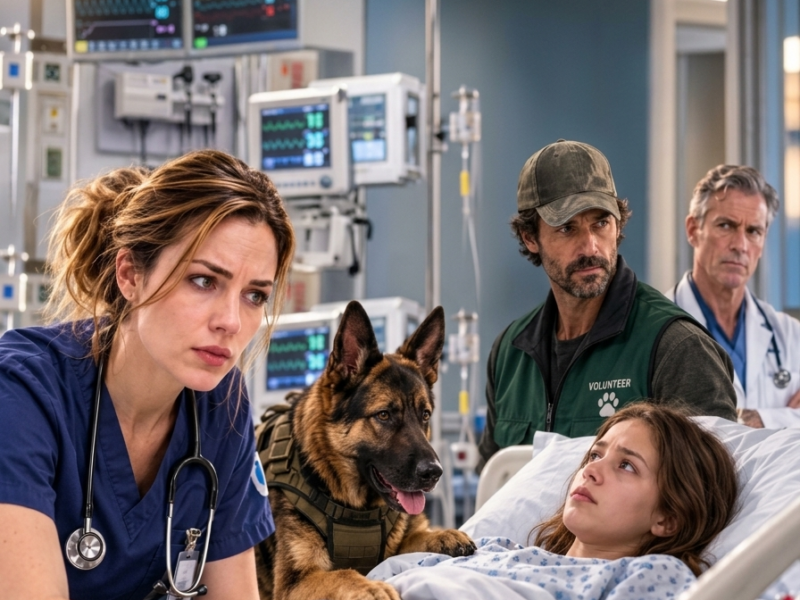
“She’s just tired,” they said as the quiet nurse collapsed beside the ER medication cart
The night shift at St. Jude’s Memorial was governed by a predictable, rhythmic exhaustion. It was measured in the sharp smell of antiseptic, the dim glow of floor-level nightlights, and the low, mechanical hum of oxygen pumps. After six years on the emergency room floor, I had learned that real danger rarely made a grand entrance with blaring sirens or screaming paramedics. Most of the time, catastrophe whispered before it struck.
That night, the whisper took the form of a quiet traveling nurse named Claire.
Claire had been on our unit for less than three weeks, and she had perfected the art of being invisible. She spoke only when spoken to, took the shifts nobody else wanted, and spent her breaks sitting alone near the vending machines with a cold cup of tea. Most of the staff assumed she was simply timid, burnt out from years of contract work.
I noticed the small things that others missed. I saw how her hands trembled whenever she drew blood from a central line, not from incompetence, but from an overwhelming, suffocating tension. I saw the way her eyes darted toward the ceiling cameras every time an administrator walked past the desk.
“She’s just tired,” the head nurse had told me earlier that evening when Claire dropped a box of sterile bandages. “Leave her be. We’re understaffed as it is.”
Around 2:00 AM, the shift hit its peak lull. Claire was moving between trauma bays, checking IV drips with slow, hesitant movements. One of the attending physicians, a young resident named Dr. Marcus, paused beside her at the central medication station.
“Claire, you look like you’re about to fall over,” Marcus said, his tone casual but concerned. “Go take twenty minutes in the breakroom. I’ll cover your beds.”
Claire offered a faint, fleeting smile that didn’t reach her pale eyes. “I’m fine, Doctor. Just a long week.”
“Nobody on this floor is fine,” Marcus muttered, but he didn’t press further. He turned away to review a chest X-ray, leaving Claire alone at the stainless-steel cart.
I walked over to restock my saline flushes, keeping my distance. As Claire reached up to adjust a tray of cardiac medications on the top shelf of the cart, her loose scrub top pulled back, and her right sleeve slipped down past her forearm.
In the harsh fluorescent light, three thin, parallel white lines stood out against her pale skin. They ran horizontally across the undersides of her wrist. They weren’t surgical incisions from a medical procedure, nor were they the jagged marks of an accidental tear. They were precise, clean, and old—the unmistakable signature of surgical steel wielded with deliberate intent.
Claire caught me looking. In a fraction of a second, her faint smile vanished, replaced by a look of sheer, cold panic. She snatched her arm back, pulling her sleeve down to her knuckles.
“Don’t,” she whispered.
It was the first word she had directed at me all night, and it carried a weight that made my chest tighten.
Before I could ask what she meant, the heavy wooden doors at the end of the station opened. Dr. Julian Bennett walked into the bay.
Bennett was one of St. Jude’s most celebrated figures—a senior attending trauma surgeon whose picture hung in the hospital lobby for bringing in millions in research grants. He was tall, immaculate, and possessed a quiet arrogance that demanded immediate compliance from everyone on staff.
He walked straight toward the central desk, his leather dress shoes clicking sharply against the linoleum. He didn’t look at me, but his eyes locked onto the physical paper chart resting on Claire’s cart.
“Give me that,” Bennett said, his voice flat, extending a hand toward the folder.
Claire froze. She didn’t hand it over; instead, she took a slow, calculated step backward, bringing the chart against her chest.
I frowned, stepping between them under the guise of grabbing a roll of medical tape. “Is there a problem with the chart, Dr. Bennett? That patient was just admitted from triage.”
Bennett smiled, but the warmth was entirely missing from his eyes. His jaw was tight. “She’s exhausted and confused, Nurse. She’s logging restricted narcotics incorrectly. I’m taking over the case file to correct her entries before pharmacy flags it.”
As he spoke, his hand reached out and deliberately covered the yellow patient identification tab at the top of the folder. It was a subtle move, but to anyone watching closely, it was an obvious attempt to hide the patient’s name and medical record number.
Claire’s breath hitched. “I can’t do this again,” she whispered, her voice barely audible above the hum of the monitors.
Bennett’s face hardened into a mask of pure, icy authority. “Claire,” he said. The way he pronounced her name wasn’t a professional courtesy; it sounded like an ultimatum. A warning.
Before anyone could say another word, the telemetry monitor in Room 12 erupted into a high-pitched, continuous alarm.
“Code Blue, Room 12! Patient is crashing!” the automated intercom blared.
The hallway exploded into motion. Nurses and tech personnel rushed past us, shoving crash carts into the doorway of Bay 12. Bennett immediately abandoned the chart, pushing past me and taking charge at the foot of the bed.
“V-fib!” Bennett shouted, checking the monitor over the patient’s head. “Prepare for immediate intubation and give me two milligrams of epinephrine! Get me the surgical kit from the tray!”
Claire stood at the threshold of the room, rigid as a statue. Her eyes weren’t on the crash cart or the monitor. They were locked on the small glass vial Bennett had pulled from his own coat pocket and set down beside the surgical tray.
Suddenly, Claire stepped forward into the middle of the chaotic room. “Stop!” she commanded.
The room fell silent except for the frantic beat of the heart monitor. Doctors and nurses turned to glare at her in utter shock.
Claire reached out and picked up the small glass vial Bennett had just placed on the tray. “This isn’t what you ordered, Dr. Bennett. This is a concentrated neuromuscular blocker.”
Bennett’s face turned ghastly white, the blood draining from his features instantly. He reached out to snatch the vial back. “You’re delusional! Drop that!”
Claire snatched her hand away, holding the vial high above her head where the floor nurses could see the red warning cap. “You switched the medication on the cart! Just like you did twelve years ago!”
“You don’t know what you’re talking about!” Bennett snarled, stepping toward her with his fists clenched. “Security! Get this woman off my floor!”
Claire’s voice was no longer shaking. It was steady, loud, and ringing with a terrifying clarity. “I know exactly what I’m talking about.”
With a swift, deliberate motion, she reached down, grabbed her right sleeve, and pulled it all the way up to her elbow.
Beneath the three precise scar lines was a faint, faded blue tattoo—a series of capital letters followed by an eight-digit sequence: USAF-99218401.
My stomach plummeted into a cold abyss.
That wasn’t a civilian tattoo. It was a tactical military identification burn, used exclusively for specialized personnel assigned to covert surgical teams in classified operational zones.
Claire wasn’t an burnt-out traveling nurse. She was a former military surgical specialist who had vanished eight years ago after blowing the whistle on a massive, illegal medical experimentation cover-up within military field hospitals.
And Dr. Julian Bennett had been one of the primary officers overseeing the operation.
Bennett stared at the exposed tattoo, his eyes wide with a mixture of hatred and cold realization. “You should have stayed quiet, Miller,” he hissed, dropping her real name.
Claire met his gaze without flinching, though tears overflowed her eyes and ran down her pale cheeks. “I did,” she whispered. “For eight years, I hid. I let you destroy my life. But I won’t let you kill another patient.”
Two hospital security officers burst into the room, responding to Bennett’s earlier call. But as they looked at the terrified staff, the exposed vial, and the military tattoo on Claire’s arm, they hesitated.
“Take him,” I said loudly, stepping beside Claire and pointing at Bennett. “Check the cameras at the medication cart. He tampered with that vial.”
The security guards looked at Bennett’s trembling hands, then at the physical evidence held high in Claire’s fist. Recognizing that the situation had spun entirely out of control, the lead guard stepped up to Bennett. “Dr. Bennett, step away from the bed, sir. We need to go down to administration.”
Bennett didn’t fight them. He knew the paper trail on that cart was already compromised. But as the guards grabbed his arms to escort him out of the room, he leaned in close to Claire, his lips brushing past her ear, and whispered a single sentence.
Claire went instantly, terrifyingly pale. She looked as if she had been struck by a physical blow, her knees buckling beneath her. I caught her under the arms before she hit the floor, easing her down against the wall as the guards led Bennett out into the hallway.
“Claire, what is it?” I asked frantically, kneeling beside her on the cold tile. “What did he say to you?”
Claire stared blankly at the empty hallway, her chest heaving, her fingers gripping my arm so hard her nails drew blood through my scrubs.
“He told me the surgeon who started all of this… the one who ordered the experiments…” she whispered, her voice hollow and filled with dread. “He said he isn’t dead.”
A violent chill ran straight down my spine.
The lead surgeon from that classified military scandal—the man who had orchestrated the entire operation before reportedly dying in a helicopter crash twelve years ago—was General Arthur Vance.
And as I looked into Claire’s terrified eyes, I realized the nightmare wasn’t over. It was just beginning.
The emergency room descended into an uneasy, breathless silence after Bennett was marched out by security. The patient in Room 12 was stabilized by Dr. Marcus, who used the verified epinephrine from the crash cart rather than the tampered vial Claire had intercepted. But the atmosphere on the floor had fundamentally changed. Every nurse, tech, and resident moved with hushed steps, casting nervous glances toward the central desk where Claire sat in a folding chair, wrapped in a heavy thermal blanket I had pulled from the warmer.
I brought her a paper cup of warm water and sat down across from her, pulling my chair close so no one else could hear us.
“The police are in the administrator’s office right now,” I said softly. “They’re reviewing the security footage from the cart. Bennett didn’t even cover his face when he dropped the blocker into the tray. He was confident nobody would ever question him.”
Claire took the cup with trembling hands, staring down at the clear surface of the water. “He wasn’t trying to cover his tracks because he thought he was untouchable here. St. Jude’s isn’t just a hospital to men like Bennett. It’s an extraction point.”
“What do you mean, an extraction point?” I asked, leaning in closer.
Claire pulled her sleeve up slightly, exposing the faint military burn again. “Twelve years ago, I was part of a mobile surgical unit deployed near the border of Tajikistan. We were supposed to be treating wounded personnel from classified reconnaissance teams. But Major Vance—he wasn’t a military doctor, he was a private contractor funded by a defense conglomerate called Vector Bio-Tech—converted our forward facility into a live testing ground. They were using experimental blood-clotting agents and nerve-blockers on wounded soldiers without their knowledge.”
My throat felt dry. “And Bennett?”
“Bennett was Vance’s second-in-command,” Claire said, her voice filled with a cold, bitter sorrow. “When I discovered the altered logs and tried to upload them to the Judge Advocate General’s database, my entire unit was suddenly wiped out in an alleged mortar attack. I barely survived. I woke up in a civilian hospital in Landstuhl with three surgical scars on my wrist where someone had tried to cut my radial artery to make my death look like a suicide.”
She touched the thin white lines on her wrist, her thumb tracing the old scar tissue.
“I realized then that the military chain of command was compromised,” she continued. “So I ran. I took a dead woman’s identity—Claire Miller—and spent eight years moving from city to city, taking temporary nursing contracts, living like a shadow. I thought if I stayed small enough, they would forget I existed.”
“But Bennett found you,” I said.
“No,” Claire whispered, her eyes meeting mine with a sudden, terrifying intensity. “Bennett didn’t find me by accident. Vector Bio-Tech owns the agency that placed me at St. Jude’s. They’ve known where I was for months. Bennett was sent here to finish the job, but he needed to make it look like a medical mistake on my shift so no one would look into my real file.”
Before I could process the nightmare she was describing, the double doors of the trauma bay swung open.
Two men in dark, tailored suits walked onto the floor. They didn’t look like local police detectives. They carried themselves with a rigid, military posture, their eyes sweeping the room with cold efficiency. The taller man, who had silvering hair and a sharp, angular face, pulled a badge from his coat pocket and held it out toward the charge nurse.
“Federal Bureau of Investigation,” the man announced in a voice that carried easily across the room. “I am Special Agent Thomas. We are taking custody of Dr. Julian Bennett and all physical evidence related to the incident in Room 12.”
I stood up slowly, my instincts screaming that something was wrong. “The local precinct already dispatched officers. They’re upstairs with administration.”
Agent Thomas turned his cold gaze toward me. “The local officers have been dismissed, Nurse. This matter involves classified federal interests under Title 10 regulations. Hand over the patient charts and the physical evidence immediately.”
Claire grabbed my wrist from behind, her fingers digging deep into my skin. “Don’t give it to them,” she hissed under her breath. “They aren’t FBI.”
“What?” I whispered without turning around.
“Look at his shoes,” Claire whispered frantically. “Federal agents wear standard dress soles. Those are reinforced tactical boots with non-slip oil tread. They’re Vector contractors.”
My heart began to hammer against my ribs like a trapped bird. The two men were moving purposefully toward the central desk where the tampered vial and the paper chart were sitting in an clear evidence bag.
“Agent Thomas,” I said loudly, stepping in front of the desk to block their line of sight. “Hospital policy requires the Chief of Surgery to sign off on any transfer of active patient evidence to federal authorities. I’ll need to call Dr. Hayes downstairs.”
Thomas’s expression didn’t change, but his hand moved subtly inside his suit jacket, resting near his left armpit. “That won’t be necessary, Nurse. Stand aside.”
Suddenly, the overhead emergency lights flared bright red, and the loud, pulsing horn of a Code Charcoal—a facility-wide hazardous material lockdown—shrieked through the speakers.
“Facility lockdown activated,” an automated female voice droned over the PA system. “All security doors are engaging. Remain in your stations.”
The heavy, fire-rated steel shutters at the ends of the hallway began to descend with a deafening metallic screech, sealing the trauma bay off from the rest of the hospital.
Agent Thomas didn’t look surprised by the lockdown. In fact, he pulled a suppressed 9mm pistol from his shoulder holster with calm, practiced efficiency.
“Where is the hard copy of the Tajikistan ledger, Claire?” Thomas asked, aiming the gun directly at her chest. “Vance knows you kept a physical duplicate before you fled the field hospital. Give it to us, and we leave the rest of these civilians alive.”
Claire stood up slowly from her chair, her face set in a line of absolute defiance. “If you kill me, Thomas, you’ll never find it. The encryption key is linked to my military ID burn. You shoot me, and the ledger stays locked forever.”
Thomas sneered, taking a step closer. “Then we’ll just take you with us and let General Vance extract it himself.”
I didn’t wait for him to pull the trigger. I grabbed a forty-pound stainless-steel defibrillator unit off the crash cart beside me and hurled it with all my strength straight into Thomas’s chest.
The heavy defibrillator unit struck Agent Thomas square in the chest, the sharp metal edges tearing through his suit jacket and knocking the breath clean out of his lungs. He stumbled backward, his suppressed pistol discharging harmlessly into the rubber floor mat with a soft thud.
“Go!” I screamed, grabbing Claire’s arm and shoving her toward the secondary utility corridor behind the nurses’ station.
The second contractor drew his weapon, but before he could acquire a clear shot through the chaotic maze of overturned medicine carts and scattered IV poles, I slammed the heavy steel fire door shut, throwing the mechanical lock bar down into place.
A volley of silenced rounds slammed into the reinforced door from the other side, punching shallow dents into the thick metal but failing to penetrate the barrier.
“They’ll cut through that lock in less than two minutes!” Claire shouted, her breath coming in rapid, ragged gasps as we sprinted down the narrow, unlit utility hallway.
“The laundry chute at the end of this block leads straight down to the sub-basement maintenance level!” I called back, my lungs burning as we rounded a dark corner. “It bypasses the main security shutters!”
“Where are we going?” Claire asked, her hands clutching her arm where her tattoo was burned into her skin.
“To the old records vault,” I replied, pulling a heavy master key ring from my belt—a privilege earned from six years of working late shifts in every corner of St. Jude’s. “If Bennett and Vance were using this hospital as a front, the original paper manifests from their pharmaceutical shipments won’t be on the main server. They’ll be stored in the physical archive beneath the old building!”
We reached the heavy stainless-steel door of the laundry chute. I threw the latch open, revealing a dark, vertical shaft that dropped thirty feet into the damp concrete belly of the hospital.
“Hold onto the cable!” I instructed, grabbing the thick braided steel winch cable suspended in the center of the chute. “Don’t let go until your feet touch the canvas bin!”
Claire didn’t hesitate. She grabbed the cable with her gloved hands, wrapped her legs around the steel wire, and slid down into the dark abyss. I jumped in right behind her, my rubber soles scraping against the slick metal walls as we descended into the subterranean darkness.
We hit the massive canvas laundry collection cart at the bottom with a heavy thud, tumbling into a pile of damp linens. I scrambled out of the cart immediately, pulling my pocket flashlight from my scrub pants and illuminating the cavernous, concrete space of the sub-basement.
The air down here was cold, smelling of stale water, rust, and old paper. Heavy steam pipes ran along the low ceiling, hissing loudly in the dark.
“Which way?” Claire asked, wiping grease from her cheek.
“East corridor,” I said, shining the narrow beam of light down a long, narrow passageway lined with faded yellow paint. “The old archive vault was built in the 1950s as a fallout shelter. It’s reinforced steel and concrete. Once we’re inside, their tactical radios won’t be able to punch through the shielding.”
We moved quickly through the labyrinth of concrete conduits, our footsteps echoing against the damp floor. The silence down here was deafening compared to the alarm-filled chaos of the ER above.
As we walked, I looked over at Claire. “You said Vance died twelve years ago. How could he still be running Vector?”
Claire lowered her eyes as she walked, her expression shadowed by the faint light of my flashlight. “Vance didn’t die in Tajikistan. He staged the helicopter crash using the remains of a local militia commander. The military covered it up because admitting that a two-star general had gone rogue to build a private bio-weapons syndicate would have ruined the entire command structure.”
“So he’s been operating from the shadows ever since,” I muttered.
“He’s been building a network,” Claire corrected softly. “Using hospitals like St. Jude’s to test experimental compounds on vulnerable patients—people whose deaths can be easily written off as organ failure or sudden cardiac arrest. I tried to stop him eight years ago, but I was just a junior specialist. Nobody wanted to listen to a traumatized soldier over a decorated general.”
We reached the end of the east corridor. Standing before us was a massive, circular steel door with a mechanical wheel lock, looking like the vault of an old bank.
I stepped up to the wheel, grabbing the heavy iron spokes, and muscle-powered the mechanism to the left. The rusted gears inside groaned loudly, grinding against decades of dust before popping open with a heavy metallic clack.
We pushed the thick door open and stepped into the physical archive vault.
The room was vast, lined with rows of towering floor-to-ceiling metal shelves packed with thousands of gray cardboard record boxes. Dust motes danced in the beam of my flashlight as I scanned the labels on the nearest aisle.
“Look for boxes marked 1998 to 2012 – Special Logistics,” Claire said, running her hands along the lower shelves. “That was the internal code Vance used for his procurement manifests.”
We searched frantically through the dusty aisles, the ticking of the wall clock echoing in the stillness. After three agonizing minutes, Claire let out a sharp gasp near the back wall of the vault.
“I found it!” she called out.
I rushed to her aisle. She was kneeling beside a heavy black plastic shipping container that was secured with a digital padlock. Printed on the side of the box in faded yellow stenciling were the words: VECTOR BIO-TECH – ASSET PROCUREMENT.
“Do you know the combination?” I asked, shining the light on the keypad.
Claire reached out, her fingers hovering over the buttons. “The combination isn’t a set of numbers,” she said quietly. “It’s the unit designation from our field surgical team.”
She typed four letters and four numbers into the pad: O-P-E-R-9-9-2-1.
The digital lock beeped green, and the heavy plastic lid popped open with a soft hiss of released vacuum pressure.
Inside lay dozens of leather-bound surgical journals, encrypted flash drives, and a thick stack of unredacted patient files bearing the official seal of the United States Air Force. Sitting on top of the documents was a small, brass-cased digital audio recorder.
Claire reached down and picked up the recorder, her hand shaking violently as her fingers brushed against the rusted casing.
“Is that Vance’s voice?” I asked, my heart pounding in my ears.
“This is the master recording from the Tajikistan bunker,” Claire whispered, tears welling in her eyes once more. “This is the proof that Bennett and Vance personally ordered the lethal trials.”
Before she could press play, the heavy steel vault door behind us slammed shut with a deafening, terrifying boom.
The mechanical wheel on the outside spun rapidly, locking the heavy steel bolts into place from the corridor.
From the external intercom speaker mounted above the door, a low, smooth voice echoed into the dark room—a voice that was cold, refined, and entirely devoid of mercy.
“Thank you for leading us straight to the box, Nurse Miller,” the voice rasped through the static. “We’ve been searching for that container for eight long years.”
Claire froze, the recorder slipping from her fingers as she stared at the closed vault door in utter horror.
“Vance,” she breathed.
The air inside the sealed archive vault instantly felt heavy, cold, and suffocating. The thick concrete walls and reinforced steel door deadened all external sound, leaving only the harsh, rasping voice of General Arthur Vance echoing through the small intercom speaker above our heads.
“I must admit, Nurse Miller, your persistence has been a source of considerable frustration for my investors,” Vance said through the static. His voice possessed the smooth, calm cadence of a man who had spent decades giving orders that were never questioned. “When Bennett reported that you had surfaced in a civilian ER in Pennsylvania, I was skeptical. I assumed a woman of your… fragile disposition would have succumbed to her trauma years ago.”
Claire stepped toward the heavy steel door, her hands clenched into white-knuckled fists at her sides. “It’s over, Vance! The FBI knows Bennett tampered with that cart! The whole hospital is locked down!”
A dry, quiet laugh rattled through the speaker. “The FBI? My dear child, the men standing outside this door are the authorities in this region. St. Jude’s has been a subsidiary of Vector Bio-Tech’s logistics network for over a decade. The local board of directors, the pharmacy procurement officers, even the Chief of Surgery—they all draw salaries from my holding companies. Do you truly believe a local police precinct is going to breach a classified corporate archive?”
I stepped up beside Claire, keeping my flashlight aimed at the speaker. “You can’t keep this vault sealed forever, Vance. The morning shift arrives in three hours. When the ER staff realizes two nurses are missing and the sub-basement is locked out, people will start asking questions.”
“Missing?” Vance replied, his tone dripping with fake sympathy. “Oh, no one is missing, Nurse. The official record will show that Nurse Claire Miller—a deeply disturbed individual with a documented history of severe psychological trauma—suffered a tragic psychotic break during her shift. In her confusion, she lured a fellow staff member down into the abandoned boiler rooms, set fire to the old paper archives, and perished in the resulting blaze along with her victim.”
My blood ran cold. I looked over at the far wall of the vault, where ancient electrical conduit boxes and gas heating pipes ran along the concrete ceiling.
“He’s going to flood the ventilation ducts with carbon monoxide,” I whispered to Claire, the terrifying reality of his plan dawning on me.
“A tragic accident,” Vance continued smoothly through the speaker. “And when the fire department finally clears the rubble, the black box you so foolishly uncovered will be reduced to ash. You survived the mortar strike in Tajikistan, Claire. But you will not survive tonight.”
A loud, mechanical click echoed from the ceiling, followed by the deep, low hiss of a high-pressure valve opening in the dark corner of the room. A faint, invisible draft began to flow down from the upper air vents—smelling faintly of sweet, heavy gas.
“Vance!” Claire screamed, slamming her palms against the cold steel of the vault door. “Vance, open this door!”
The intercom clicked off, leaving only the quiet, terrifying hiss of the gas entering the room.
“We have less than five minutes before the air becomes lethal,” I said, my voice tight as I grabbed Claire by the shoulder and pulled her away from the door. “Is there another way out of this fallout shelter?”
Claire wiped the sweat from her forehead, her eyes darting frantically across the rows of metal record shelves. “These 1950s fallout shelters were built with emergency egress hatches! Look for a vertical ladder behind the rear storage racks!”
We sprinted to the back of the vault, pushing heavy cardboard boxes off the shelves, sending old paper files cascading across the floor like autumn leaves. The gas was already beginning to take effect; my head felt light, a faint, metallic taste coating the back of my tongue.
“Here!” I yelled, shining the flashlight beam onto a circular iron hatch built into the low concrete wall near the floor.
The hatch was secured with a heavy iron latch that had rusted shut over half a century of disuse.
“Give me something heavy!” I shouted, grabbing the rusted iron bar with both hands, pulling with all my strength.
Claire snatched a heavy brass bookend from a nearby shelf and slammed it down onto the rusted latch with a sharp, echoing clang. Once, twice, three times—until the rusted iron gave way with a loud pop, and the circular door swung open.
A draft of cool, damp, unpolluted air rushed into the room, cutting through the sweet smell of the gas.
Behind the hatch was a narrow, vertical brick shaft lined with rusted iron rungs leading straight up into the dark.
“Go! Up!” I ordered, shoving Claire into the narrow shaft first.
Claire climbed frantically, her rubber shoes slipping against the wet brick, her breathing ragged as she hauled herself up rung by rung. I climbed right behind her, reaching back to pull the iron hatch shut behind us to delay the spread of the gas.
We climbed thirty feet through the narrow, suffocating shaft until Claire’s head bumped against a heavy wooden trapdoor at the top.
“It’s locked from above!” she called down, her voice echoing in the tight space.
“Brace your back against the brick wall and use your legs!” I yelled up to her. “Drive your heels into the frame!”
Claire positioned herself on the top iron rung, pressed her back flat against the cold brick, and slammed both feet upward into the wooden trapdoor with a desperate, screaming effort.
The old wooden frame splintered with a loud crack, the rusty hinges snapping off, and the trapdoor swung open, raining dirt and splinters down on our faces.
We scrambled out of the shaft, tumbling onto the wet, rain-soaked grass of the hospital’s interior courtyard.
The cool, night air hit my lungs like a shock of cold water. I lay on the grass, gasping for air, the rain pouring down from the dark sky, washing the dust and sweat from my face.
Claire lay beside me, staring up at the dark towers of St. Jude’s Hospital.
Beside us, sitting on the wet grass where she had carried it in her coat pocket through the entire climb, was the small, brass digital audio recorder from the vault.
She looked over at me, her eyes filled with an unyielding, fierce determination that I had never seen in her before.
“He thinks he trapped us,” Claire whispered, her hand tightening around the brass recorder until her knuckles turned white. “He thinks he can burn the past.”
“So what do we do now?” I asked, sitting up in the mud.
Claire stood up in the pouring rain, pulling her scrub top straight, exposing the military tattoo on her arm for the entire world to see.
“Now,” she said, her voice ringing clear over the sound of the storm, “we bring the general out of the shadows.”
The rain came down in heavy, blinding sheets, pounding against the brick walls of the hospital courtyard and washing the last traces of soot from our clothes. In the distance, beyond the tall iron security fences that encircled the St. Jude’s medical complex, the faint, warbling sirens of city police vehicles began to cut through the night—not dispatched by the hospital, but likely called by local residents who had heard the explosion of the security shutters earlier.
“The main administration building,” I said, pointing across the dark lawn to the glass-fronted structure where the hospital’s central communications hub was located. “If Vance is operating from inside, he’s using the Chief Executive’s office on the top floor. It has its own private satellite uplink to bypass the city telecom grid.”
Claire picked up the brass audio recorder, checking the small digital display. The battery light flickered green—a fragile, precious pulse of electricity holding twelve years of buried truth.
“The satellite uplink broadcasts directly to the state health authority and the regional media servers in the event of a mass-casualty disaster,” Claire said, her voice dropping into the precise, tactical tone of a military officer. “If we can patch this recorder into the master audio bridge, we can broadcast Vance’s confession to every station in the tri-state area before his contractors even realize the vault failed.”
“He’s got armed men covering the lower lobby,” I reminded her, checking my flashlight. “Thomas and his crew won’t let us walk up the front stairs.”
Claire looked toward the secondary service entrance—a low concrete ramp used by oxygen delivery trucks. “They’re watching the front because they think we’re dead in the sub-basement. They aren’t expecting two dead women to walk into the executive suite.”
We moved swiftly through the shadows of the courtyard, keeping low beneath the rain-slicked hedges until we reached the service entrance. I used my master key ring one last time, unlocking the heavy security door and slipping inside the silent, carpeted hallway of the administrative wing.
We took the emergency stairs, climbing four flights in absolute silence until we reached the double mahogany doors marked OFFICE OF THE CHIEF EXECUTIVE OFFICER.
The doors were slightly ajar. A single line of bright, yellow light spilled out onto the dark hallway carpet.
From inside came the quiet, rhythmic sound of a man typing on a laptop keyboard, accompanied by the clink of ice cubes against a crystal glass.
I looked at Claire. She gave me a single, firm nod, reached out, and pushed the mahogany doors wide open.
Sitting behind a massive mahogany desk was General Arthur Vance.
He looked remarkably unbothered by the night’s events. He wore a pristine, dark gray suit, his silver hair combed back neatly, a glass of scotch resting beside an encrypted military laptop. He didn’t look like a monster; he looked like a wealthy corporate executive reviewing quarterly earnings.
Standing beside the window was Agent Thomas, his suppressed pistol resting in a leather shoulder holster.
As the doors swung open, both men turned.
Thomas’s hand flew to his shoulder holster, his eyes widening in sheer, unadulterated shock as he saw Claire standing in the doorway, soaked in rain and mud, holding the brass recorder high in her hand.
“How…” Thomas choked out, his composure completely shattering.
“Stand down, Thomas,” Vance said softly, raising a single hand. He didn’t look panicked. He slowly leaned back in his leather chair, taking a slow sip of his scotch. “Remarkable. Truly remarkable, Nurse Miller. You really are impossible to kill.”
“It’s over, Vance,” Claire said, stepping into the room with an absolute, unshakeable authority. “The physical files from Tajikistan are safe. And this recorder is already linked to your private satellite terminal.”
Vance looked at the laptop on his desk, then back at Claire, a faint, condescending smile touching his thin lips. “A brave gesture, my dear. But you are standing in my office. Thomas can put a bullet through your head before you take two steps toward that terminal.”
“He could,” I spoke up, stepping into the room behind Claire and holding up my hospital master tablet—the handheld unit used by charge nurses to manage floor-wide broadcast announcements. “Except I patched her recorder into the hospital’s emergency public address system three floor levels ago. Every word spoken in this room for the last sixty seconds has been recorded on the main server.”
Vance’s smile vanished instantly. His eyes flicked to the ceiling speakers mounted in the corners of the office.
“Press play, Claire,” I said.
Claire didn’t hesitate. She hit the play button on the brass recorder.
The small speaker on the device crackled with static, followed by the crisp, clear audio recorded twelve years ago in the Tajikistani field hospital—Vance’s unmistakable voice giving explicit orders to Dr. Bennett to falsify patient cause-of-death reports and hide the experimental drug trials from military inspectors.
“If the specialist—Claire Miller—attempts to flag the inventory,” Vance’s recorded voice rasped through the room, “eliminate her and frame the death as an operational casualty. Vector cannot afford a leak.”
The recorded confession echoed loudly through the room, bouncing off the glass windows and broadcasting straight into the hospital’s central digital archive.
Thomas looked from Vance to the laptop, his face pale with horror as he realized the absolute completeness of the trap. “General… the server status light… it’s uploading to the regional grid.”
Vance stood up slowly from his desk, his composure finally disintegrating into a look of cold, terrifying rage. He reached toward his desk drawer where a second firearm was visible inside.
“You ruined everything,” Vance snarled, his voice trembling with hatred. “A nobody nurse… a burnt-out specialist…”
“I was never just a nurse, General,” Claire said, her voice ringing out with a power that shook the room. “I was a soldier. And my mission was to protect my patients from monsters like you.”
Before Vance could pull the gun from the drawer, the heavy glass windows behind his desk shattered violently inward as bright, blinding searchlights illuminated the office from the sky outside.
The deafening roar of a heavy State Police tactical helicopter filled the room, its searchlight pinning Vance and Thomas in a brilliant wall of white light.
“FBI! DROP YOUR WEAPONS! RAISE YOUR HANDS IMMEDIATELY!” a voice boomed from the helicopter’s external speaker.
Below in the courtyard, dozens of real federal law enforcement vehicles and local police cruisers poured through the shattered security gates, their red and blue emergency lights painting the rainy night in a brilliant storm of color.
Thomas immediately dropped his weapon, raising his hands above his head and falling to his knees on the carpet.
Vance stood frozen in the glare of the searchlight, staring at Claire as federal tactical officers burst through the office doors behind us, weapons raised, taking control of the room in seconds.
Two federal agents shoved Vance down against his mahogany desk, pulling his arms behind his back and snapping heavy steel handcuffs onto his wrists.
As they dragged the disgraced general past us, Vance glared at Claire, his teeth set in a bitter, hateful snarl. “You think you won, Miller? You destroyed your own life for this!”
Claire stood tall, watching him go, her face illuminated by the flashing red lights outside the window.
“No, Vance,” she said softly, but with a strength that carried over the sound of the helicopter blades outside. “I finally reclaimed it.”
An hour later, as the first light of dawn began to break over the horizon, painting the rainy sky in soft shades of gold and pink, Claire and I sat on the back bumper of an ambulance parked near the main entrance.
Federal investigators were swarming the hospital, loading boxes of evidence from the sub-basement archive into black vans. Dr. Julian Bennett and General Vance were already in federal custody, faced with charges of murder, treason, and illegal human experimentation that would ensure they spent the rest of their lives behind bars.
A paramedic handed Claire a warm blanket and a cup of fresh coffee.
She looked down at her arm, where the faint military tattoo was visible beneath her rolled-up sleeve. For the first time in eight years, her hands were completely steady.
“What will you do now?” I asked, taking a sip of my own coffee. “You don’t have to live as Claire Miller anymore. You can have your real name back.”
Claire looked up at the rising sun, a genuine, warm smile finally breaking across her face—a smile that reached her eyes for the very first time.
“Sarah,” she said quietly, reclaiming the name she had been forced to abandon so long ago. “My name is Sarah Miller. And I think… for the first time in twelve years… I’d like to stay in one place.”
She looked at me, her eyes filled with deep gratitude and newfound peace.
“St. Jude’s needs a good charge nurse,” I said with a smile. “And I know someone who’s remarkably good at spotting when something isn’t right.”
Sarah laughed—a bright, clear sound that carried across the quiet morning air, washing away the shadows of the long, dark night. The war was finally over, the ghosts had been brought into the light, and for the first time in her life, she was finally home.
The end.









