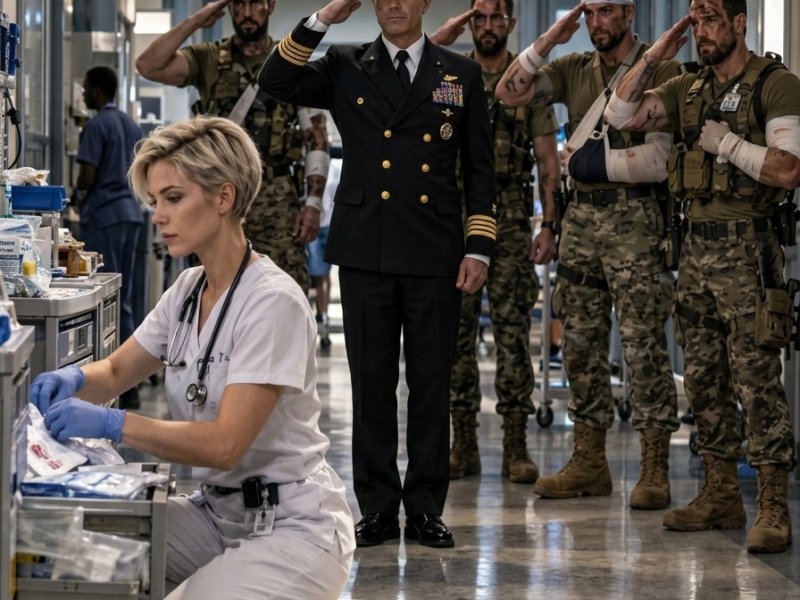
“She’s just a student,” the doctors said as I stood frozen outside the trauma bay at Naval Medical Center San Diego, until three bleeding SEALs suddenly looked at me
The sterile smell of antiseptic, blood, and burnt neoprene hung heavy in Trauma Bay Three at Naval Medical Center San Diego. It was a cold Tuesday night, and the fluorescent lights hummed with a low, irritating vibration. I pressed my back against the tiled wall, tugging nervously at the sleeves of my oversized navy-blue scrubs.
I was twenty-two years old, officially a second-year nursing student from San Diego State University on a passive observation rotation. That was all anyone knew about me. I carried a plastic ID badge that read Student Observer – Clara Vance, spent my shifts quietly restocking supplies, taking vitals, and staying out of the way of senior staff. To the doctors and trauma surgeons, I was a ghost—unremarkable, invisible, and harmless.
Until the heavy double doors smashed open.
“Trauma incoming! Active military personnel, explosion during a live-fire exercise off Coronado!” the triage nurse shouted.
A team of paramedics and corpsmen burst into the bay, pushing three gurneys at a dead sprint. The air in the room instantly turned electric with panic. Blood was everywhere—soaking through uniforms, dripping onto the white linoleum floor.
On the first gurney lay a man whose face was pale from shock, his left leg mangled and heavily bandaged. On the third gurney, a man was entirely unconscious, his cardiac monitor beeping at a erratic, dangerous rhythm. But it was the man on the second gurney who drew every eye in the room. He was built like an iron beam, covered in soot, with a deep arterial laceration across his neck that two corpsmen were desperately trying to compress.
Despite the excruciating pain, his eyes were wild, darting around the room in a frantic, animalistic search. His lips were moving, repeating the same raspy, desperate words through a mouthful of blood.
“Find her… you have to find her…”
Dr. Nathan Mercer, the chief trauma surgeon on call, leaned over him, slamming a fresh pack of sterile sponges against the man’s neck. “Calm down, son! Who are you looking for? Is there another casualty?”
The wounded SEAL didn’t answer the doctor. His bloodshot eyes swept past the surgeons, past the nurses, and locked directly onto me standing in the shadowed corner.
His entire body went rigid. The panic in his eyes vanished, replaced by a look of sheer, disbelieving relief.
“Rook,” he whispered.
The word wasn’t loud, but in the chaotic noise of the trauma bay, it hit like a gunshot.
The room went dead silent for a fraction of a second. The charge nurse beside me froze, her hands hovering over a tray of IV lines. She slowly turned her head, staring at me with a mixture of confusion and shock.
“Did he… did he just call you Rook?” she asked.
I couldn’t answer. My throat felt as though it had filled with sand.
Before I could step back into the shadow of the supply cart, the wounded SEAL reached out with a hand slick with dark blood, grabbing my wrist with a iron grip that made my bones ache.
“You came,” he rasped, his voice trembling with an emotion so intense it gave me goosebumps. “They said you were dead. They said the network scrubbed you.”
I tried to pull my arm back, my heart slamming wildly against my ribs. “Let go of me! I don’t know you! You have the wrong person—I’m just a student!”
His expression shattered. “That’s… that’s what they told you to say, isn’t it? That’s the protocol.”
“Enough!” Dr. Mercer barked, trying to pry the man’s fingers off my wrist. “He’s delirious from blood loss! Nurse, pull her back!”
Suddenly, the second SEAL—the one with the mangled leg—pushed himself up against the restraints of his gurney. His teeth were stained red as he glared straight at Dr. Mercer, then at me.
“She’s not delirious, Doctor,” the second SEAL growled, his voice deep and gravelly. “Rook wasn’t a student. She never was.”
Dr. Mercer stepped between us, his face hardening. “I said that’s enough! This bay is under emergency surgical protocol! Student, get out—”
“She saved our team!” the first SEAL shouted, coughing violently as blood spilled over his lips.
I stared at him, paralyzed by a sudden, sickening wave of vertigo. “Saved your team? What are you talking about? I’ve spent my whole life in San Diego! I’ve never been near a military operation!”
The SEAL swallowed hard, his dark eyes burning into mine. “Three years ago. The border sector near Tecate. The safehouse warehouse.”
A warehouse.
The moment he said the word, a violent spike of pain shot through the back of my skull. It hit me like a flash of lightning piercing a dark room.
Fragmented images flooded my mind—not memories, but violent, jagged nightmares that had plagued my sleep for years. Cold concrete floors. The deafening, rhythm of automatic gunfire echoing in a enclosed space. Smoke so thick it burned the throat. A small boy crying under a steel worktable. And my own hands—covered in dark blood, holding a tactical radio, kneeling beside wounded men while heavy boots kicked open a door outside.
I had spent three years believing those images were just lingering night terrors from a childhood car crash my aunt had told me about.
“You pulled us out, Rook,” the SEAL whispered, his grip finally weakening as his blood pressure plummeted. “You took three round bursts to the shoulder and kept the frequency open until the choppers arrived.”
I slowly lifted my trembling left hand, pulling back the sleeve of my scrub top. Beneath the thin blue fabric, running from my collarbone down to my shoulder blade, were three distinct, jagged white scars. My aunt had always told me they were from shattered windshield glass.
My breath hitched. The world seemed to tilt beneath my feet.
Dr. Mercer didn’t order the nurses to give blood. He didn’t ask for a crash cart. Instead, he slowly backed away from the gurney, his face entirely unreadable. He walked to the heavy double doors of Bay Three, flipped the manual lock, and drew the thick privacy curtains shut, sealing us off from the rest of the hospital.
He turned back to face me. The warm, professional demeanor of a military surgeon was completely gone, replaced by something cold, calculated, and terrifying.
“Who sent you here, Clara?” Dr. Mercer asked softly.
“No one…” I stammered, backing toward the wall. “I applied through the standard university placement portal! My coordinator assigned me here!”
Dr. Mercer smiled faintly—a cold, lifeless gesture. “That’s not what your classified file says.”
He reached into his lab coat, pulled out a thick Manila folder stamped with a bold red seal, and dropped it onto the stainless steel counter.
Printed across the top in crisp black letters was my legal name: CLARA VANCE.
But directly beneath it, printed in bold, classified routing code, was a single word: ROOK.
And pasted to the inside cover was a surveillance photograph. It showed me—three years younger, wearing tactical gear, my hair tied back, covered in dust and mud—standing shoulder-to-shoulder with the very three SEALs currently lying bleeding on the gurneys in front of me.
I had no recollection of that photo being taken. No memory of the men. No memory of the uniform.
Before I could scream, the third SEAL—the one who had been completely unconscious—suddenly reached out and took my hand. His eyes snapped open. They were clear, bright, and terrifyingly lucid.
“Rook,” he whispered, his voice smooth and steady despite his shallow breathing. “You don’t remember us. That’s because someone made sure you wouldn’t. The memory suppression drugs… they wiped your operational slate.”
He glanced toward the locked doors of the bay. “They put you in cold storage as a student to hide you. But they knew we were coming back.”
At that exact moment, somewhere in the quiet corridor outside Trauma Bay Three, a cell phone began to ring.
The sound cut through the silence of the room. It was a sweet, music-box melody—a quiet, mournful lullaby.
My blood ran ice-cold. It was the exact melody my mother used to hum to me late at night, right before she vanished from my life when I was nine years old. I had never heard that song anywhere else in the world.
Dr. Mercer reached into his pocket, pulled out a sleek black satellite phone, and looked at the caller ID.
“She’s awake, Director,” Mercer said into the receiver. “The trigger phrase was spoken. The asset is remembering.”
The air in Trauma Bay Three seemed to freeze.
Dr. Mercer held the satellite phone to his ear, his eyes locked onto mine like a predator observing prey. The three SEALs on the gurneys didn’t look at Mercer with surprise—they looked at him with pure, venomous hatred.
“Mercer is CIA, Rook,” the lead SEAL—whose name tag read KENT—gritted out through his teeth. “He wasn’t trying to save us. He was waiting for us to bleed out so the paper trail died with us.”
“Silence, Sergeant Kent,” Dr. Mercer said calmly, lowering the phone. “You were given a simple mandate: complete the interdiction in the border sector and do not return to San Diego. Bringing yourselves to a naval hospital was a direct violation of executive protocol.”
“We didn’t have a choice!” Kent barked, coughing as blood pooled in his throat. “The package we recovered on Coronado wasn’t a tactical weapon! It was the original neural-scrub ledger! It had her name on it! It had all our names on it!”
I backed away until my spine hit the cold metal of the supply cabinet. My head was pounding, a deafening drumbeat behind my eyes. Neural-scrub ledger. Asset. Rook. The words clashed violently against everything I thought I knew about my life.
“I’m Clara Vance,” I whispered, my voice shaking so hard I could barely form the words. “I grew up in La Jolla. I went to Bishop’s High School. My aunt raised me—”
“Your ‘aunts’ name is Agent Sarah Miller,” Kent interrupted, looking directly at me. “She’s a psychological handler assigned to keep you compliant. Your memories of high school, your childhood, your car accident—they’re synthetic overlays. You were recruited into Special Activities Section at nineteen. You were the top forensic analyst in the Southwestern division. Your call sign was Rook because you were the piece they used to secure the king.”
“Stop talking to her, Kent,” Dr. Mercer commanded, reaching into his coat lining.
When his hand emerged, it wasn’t holding a scalpel or a stethoscope. It was a suppressed 9mm pistol.
“Dr. Mercer, don’t!” I gasped, raising my hands.
“I’m sorry, Clara,” Mercer said smoothly, aiming the barrel straight at my chest. “You were an extraordinary operative. But when the program was decommissioned three years ago, leaving you active in the wild was deemed an unmanageable risk. Your memories were suppressed, and you were placed in a controlled containment loop as a nursing student so we could monitor you. But now that these men have breached containment, the protocol is clear. The asset must be retired.”
“Not today,” a voice growled from the third gurney.
The unconscious SEAL—the one named Jax—didn’t move like a wounded man. In one explosive, fluid motion, he ripped the cardiac leads off his chest, swung his legs over the edge of the bed, and lunged across the narrow space.
He slammed his forearm directly into Mercer’s wrist just as the doctor pulled the trigger.
THWACK.
The suppressed gunshot was a muted pop. The bullet shattered a glass IV bottle on the wall behind me, showering the floor with saline and glittering shards.
Mercer stumbled back, but he was trained. He brought the gun around to shoot Jax, but Kent grabbed the doctor’s coat from his gurney, dragging him backward.
“Rook! Grab the folder!” Jax yelled, kicking Mercer’s knee with a sickening crack.
My body moved before my conscious mind could even process the command. It wasn’t thought; it was instinct—deep, muscle-memory reflex that slept beneath my artificial identity.
I vaulted over a medical cart, snatched the red-stamped Manila folder off the stainless steel counter, and jammed it into the waistband of my scrubs.
Mercer screamed in pain as his knee gave way, but he managed to press a red emergency button on the wall near the door. Red strobe lights instantly began flashing across the ceiling, and a loud, pulsing alarm echoed through the hospital.
SECURITY BREACH. SECTOR FOUR LOCKDOWN. ARMED RESPONSE TEAM EN ROUTE.
“We have thirty seconds before the perimeter guards hit this bay!” Jax shouted, prying the suppressed pistol out of Mercer’s trembling hand and tossing it straight to me.
I caught the gun out of habit. My fingers automatically found the grip, checked the slide clearance, and verified the magazine seating without me even looking down at my hands. I stared at the weapon in horror—I had never held a gun in my life, yet my hands knew its weight, its balance, its mechanical heart intimately.
“See?” Kent gasped from his bed, a pale, bloody smile on his face. “You never forgot how to fight, Rook. They just hid the keys.”
“We can’t leave you!” I said, looking at the three heavily wounded men. “You can’t run!”
“We were never meant to leave this room, Clara,” Kent said softly, holding out a tiny, silver USB drive covered in dried blood. “This drive holds the decryption key for the folder. Get out of the hospital. Find the address in the file under ‘Safehouse Zero.’ Your real life is waiting there.”
“I can’t leave you!” I repeated, tears blurring my vision.
“GO!” Jax roared, throwing his shoulder against the locked door frame, snapping the lock mechanism with a heavy metallic crunch. “That’s an operational order, Rook! EXECUTE!”
The double doors smashed open.
I didn’t look back. I bolted into the crowded, panicking hallway just as armed tactical officers in black fatigues rounded the far corner. I ducked behind a row of rolling linen carts, slipped through a staff service door, and plummeted down the dark, echoing concrete steps of the emergency stairwell.
My chest was heaving, tears streaming down my cheeks, the suppressed pistol heavy against my ribs.
I wasn’t Clara Vance. I had never been Clara Vance.
And as I burst out of the hospital’s rear basement exit into the pouring San Diego rain, the satellite phone in my pocket began to ring again.
I pulled it out with shaking fingers and pressed it to my ear.
A woman’s voice came through the speaker—soft, elegant, and chillingly familiar.
“Hello, my sweet girl,” my “aunt” Sarah said gently over the line. “I see you’ve broken your leash. Come home, Clara. Before we have to put you down.”
The rain felt like needles stinging my skin as I ran through the dark, slick alleyways behind the medical center. My blue scrubs were soaked, clinging to my body, turning heavy and cold.
Every shadow looked like a tactical operative; every engine revving on the street sounded like an approaching strike team.
I finally stopped in the recessed doorway of a closed pharmacy three blocks away from the hospital. I was gasping for air, my hands trembling violently as I pulled the red-stamped Manila folder out from beneath my scrub top.
The paper was damp from the rain, but the red ink remained sharp: PROJECT LETHE – ASSET RECOVERY & MENTAL RESTRUCTURING.
I opened the folder.
Inside were dozen of documents—medical charts, psychological evaluations, brain-scan printouts, and wiretap transcripts spanning three years.
I flipped through the pages, my heart sinking lower with every line I read.
Subject: Operative ‘Rook’ (Real Name: Clara Vance).
Status: Active Suppression.
Notes: Subject’s traumatic background utilized for synthetic identity overlay. Memory wiped following Tecate warehouse incident. False narrative inserted: Parents killed in civilian auto accident at age nine; raised by aunt Sarah Miller; pursued nursing to fulfill empathetic drive.
Containment Assessment: Subject demonstrates zero awareness of tactical capability under baseline conditions. However, muscle memory and deep-tier operational reflexes remain intact beneath the neural block.
I stared at the words. Synthetic identity overlay. Everything I believed about myself—my childhood memories, my favorite foods, my irrational fear of dark water, my love for classical piano—they weren’t mine. They were lines of code written by a team of military psychologists to keep a lethal asset dormant in a suburban cage.
My fingers turned to the back of the file, where a folded piece of paper sat tucked into a plastic sleeve.
It was a handwritten letter, dated four days before the Tecate warehouse operation three years ago. The handwriting was neat, sharp, and unmistakably mine.
If you are reading this, Clara, it means they succeeded in wiping you.
They told us this program was created to protect the country. They lied. Lethe is a rogue black-budget extraction unit designed to eliminate domestic whistleblowers and frame foreign actors. When we tried to walk away, they turned the weapon on us.
Don’t trust Sarah. Don’t trust the agency.
If you need to remember who you are, go to 1402 Harbor Drive, Apartment 4B. The mirror in the bathroom holds the key.
Remember: You are not their soldier. You are the one who burns it down.
A sob tore from my throat. I pressed my back against the brick wall, closing my eyes as the rain washed over my face. I wasn’t just a victim of this program—I had anticipated my own destruction. I had left myself a breadcrumb trail through the fog of my wiped mind.
A heavy vehicle turned slowly into the alleyway.
Headlights cut through the rain, illuminating the brick walls in stark white light. It was a black suburban SUV with tinted windows—the exact type of unmarked vehicle the agency used for quiet extractions.
The vehicle stopped twenty yards away. The driver’s side door opened, and a woman stepped out holding a large black umbrella.
She was dressed in a sharp gray trench coat, her blond hair pulled back into an elegant bun. She looked like a loving, middle-aged aunt who worked in real estate.
It was Sarah Miller. The woman who had packed my school lunches, hugged me when I cried over exam stress, and tucked me into bed for three years.
“Clara,” Sarah said softly, her voice filled with gentle, maternal concern. “Put the gun down, sweetie. You’re having a severe psychological episode. The stress of the trauma bay triggered a dissociative break.”
I slowly stepped out of the recessed doorway, raising the suppressed pistol with both hands, aligning the sights directly onto the center of her chest.
Sarah didn’t flinch. She took a step closer, a sad, sympathetic smile on her face.
“Look at you,” Sarah murmured softly. “Holding a gun like a monster. That isn’t you, Clara. You’re a nurse. You care about people. You save lives. Remember the garden we planted last summer? Remember the cake we baked for your twenty-first birthday?”
For a second, the words hit my brain like a physical weight. My hands wavered. The synthetic memories surged forward—warm, comforting, filled with light and safety. I wanted to believe her. I wanted so desperately to put the gun down, fall into her arms, and wake up tomorrow as a normal student again.
“They were real to you, Clara,” Sarah whispered, taking another step. “And they can be real again. Just give me the folder. Let Dr. Mercer fix the block. We can go home.”
Then I looked down at the handwritten letter in my hand.
I looked at the three scars on my shoulder.
“You didn’t bake that cake because you loved me, Sarah,” I said, my voice dropping an octave, losing all its youthful hesitation, turning razor-thin and deadly sharp. “You baked it to administer the quarterly dosage of the neural suppressant.”
Sarah’s sympathetic expression vanished in an instant. Her eyes went completely cold, her maternal warmth evaporating like steam off hot pavement.
“You always were too smart for your own good, Rook,” Sarah said, her voice entirely devoid of affection.
She reached into her coat.
Before she could pull her weapon, I squeezed the trigger twice.
THWACK. THWACK.
The bullets struck the pavement directly between her feet, shattering the concrete, spraying sharp rock fragments against her shins. She stumbled back in shock, dropping her umbrella into the mud.
“The next two go through your knees, Sarah,” I said coldly, stepping toward her. “Where is the master key for the Harbor Drive apartment?”
Sarah stared at me, her teeth gritted in rage, realizing that the frightened student she had managed for three years was gone. The operative had returned.
“In the vehicle,” Sarah spat. “Glove box.”
I didn’t lower the weapon. I walked up to her, used the butt of the heavy pistol to strike her behind the ear with precise, non-lethal force, and watched her collapse unconscious into the rain.
I grabbed the keys from her hand, opened the SUV’s glove box, snatched a leather wallet containing an encrypted keycard and a stack of cash, and climbed into the driver’s seat.
As I sped out of the alley into the San Diego night, I looked in the rearview mirror.
The girl in the blue scrubs was gone. In her eyes burned a dangerous, cold fire that no drug could ever extinguish.
The apartment building at 1402 Harbor Drive was a weathered, six-story brick structure overlooking the industrial docks of the San Diego bay. The rain was coming down harder now, the wind howling off the dark water, whipping the metal signs along the pier into a rhythmic, metallic screech.
It was 4:15 a.m.
I rode the creaky, ancient elevator up to the fourth floor, the suppressed pistol hidden beneath the gray trench coat I had taken from Sarah’s SUV. Every sound in the hallway—the hum of a refrigerator behind a closed door, the creak of floorboards—registered in my mind with heightened tactical clarity. My brain was automatically mapping escape routes, blind spots, and entry points.
I reached Apartment 4B.
I slid the encrypted keycard I had taken from Sarah into the electronic lock. The light blinked green, and the heavy bolt retracted with a soft click.
I pushed the door open, stepping inside, raising my weapon to sweep the dark room.
The apartment was entirely empty. No furniture. No rugs. No pictures on the walls. Dust covered the hardwood floors in a thick, undisturbed blanket. It looked like a place that had been abandoned for decades.
I walked down the narrow hallway toward the bathroom, my sneakers squeaking softly on the wood.
I opened the bathroom door and turned on the light.
It was a small, tiled room with a pedestal sink and a large, gold-framed medicine cabinet mirror hanging above it. I approached the glass, looking at my reflection.
The person looking back at me looked like a stranger. My skin was pale, my hair soaked and plastered to my skull, dark circles ringing my eyes. But beneath the exhaustion, there was a sharpness in my posture that hadn’t been there eight hours ago.
The mirror in the bathroom holds the key.
I reached out, touching the gold frame. I felt around the edges until my fingers caught on a small, recessed mechanical latch at the bottom right corner. I pressed it.
With a soft pneumatic hiss, the entire mirror swung outward on hidden hinges, revealing a shallow, steel-lined wall safe built directly into the studs behind the wall.
Inside sat three items:
First, a sleek silver laptop equipped with a biometric fingerprint scanner.
Second, a heavy tactical harness holding two spare magazines and a military-grade combat knife.
Third, a small glass vial containing a clear, amber liquid labeled: REVERBAL-9 (NEURAL BLOCK ANTAGONIST).
Taped to the vial was a final note in my handwriting:
This is the antidote. It reverses the neural suppression instantly. But be warned: when the block shatters, every memory—every mission, every death, every piece of pain you ever experienced—will hit you all at once. There is no going back to Clara.
I stood in the quiet bathroom, holding the cold glass vial in my hand.
I knew what choosing this meant. If I drank the antidote, Clara Vance—the innocent student who wanted to save lives, who dreamed of a simple, peaceful future—would cease to exist. I would become the weapon they designed. I would carry the full, crushing weight of a past I didn’t yet understand.
A sudden, sharp noise echoed from the living room.
The front door of the apartment was kicked open with explosive force.
“SWAT! FEDERAL AGENTS! DOWN ON THE GROUND!” voices roared through the hallway.
Heavy, armored boots stomped across the hardwood floor. Through the open bathroom door, I saw the red laser sights of four tactical rifles cutting through the darkness, sweeping toward the hallway.
Dr. Mercer stepped into the apartment behind the tactical team, wearing a heavy bulletproof vest over his surgical scrubs.
“Rook!” Mercer called out, his voice echoing in the empty space. “There is nowhere left to run! The entire building is surrounded! Give us the drive and the folder, and we can still preserve your life!”
I looked at the glass vial in my hand.
I looked at my reflection in the open mirror.
I didn’t hesitate. I popped the rubber stopper off the vial, tilted my head back, and swallowed the bitter, amber liquid in a single gulp.
For three seconds, nothing happened.
Then, my world exploded into white-hot agony.
It felt as though someone had driven a red-hot iron rod directly into the center of my brain.
I fell to my knees on the cold tile floor, clutching my head as a violent, deafening roar filled my ears. The world spun out of control, colors smearing into blinding light.
And then, the dam broke.
Three years of suppressed memories didn’t return as a sequence—they hit me like a tidal wave tearing through a paper house.
I saw the black-budget training facility in the mountains of Utah. I remembered the endless months of hand-to-hand combat, the tactical marksmanship drills, the language immersion programs. I remembered my real name—Clara Vance was real, but my parents hadn’t died in a car crash; they were intelligence officers who had been executed by the very agency Mercer served.
I remembered Tecate. I remembered finding the classified ledger that exposed the agency’s illegal human experimentation network. I remembered saving Kent, Jax, and their team because they refused to execute innocent civilians.
I remembered choosing to let Sarah wipe my mind because I needed a biological safehouse—a quiet, innocent place to store the decrypted data until the team could recover the key.
I wasn’t a victim hiding from the agency.
I was the trap.
The excruciating pain in my head vanished, replaced by a cold, crystalline clarity so sharp it felt like ice in my veins. My heartbeat slowed. My breath became deep, steady, and effortless.
I stood up from the floor.
Outside the bathroom door, a tactical operative rounded the corner, his rifle raised, his red laser sight landing on my chest.
“DON’T MOVE!” he shouted.
I didn’t move. I reacted.
In one seamless, blindingly fast motion, I grabbed the barrel of his rifle, drove it upward into the ceiling, and slammed the palm of my hand directly into his chin, knocking his head back into the doorframe. As he collapsed, I stripped the rifle from his hands, pulled his sidearm from his holster, and stepped out into the hallway before his body even hit the floor.
The second operative fired two rounds down the hall.
I ducked beneath the fire, swept his legs with a low kick, and drove the butt of the rifle into his helmet, neutralizing him instantly.
I stepped into the living room.
Dr. Mercer was standing near the front door, flanked by his two remaining private security guards. When he saw me step out of the dark hallway—moving with a terrifying, fluid grace, carrying two military weapons, her eyes entirely devoid of fear—his face turned deathly pale.
“You… you took the antagonist,” Mercer whispered, backing toward the door. “It was supposed to cause lethal brain trauma…”
“Your math was wrong, Doctor,” I said. My voice was no longer Clara’s—it was deep, calm, and laced with absolute authority.
The two security guards raised their weapons, but I fired four precise rounds before they could align their sights. The bullets struck their shoulder joints and knees, dropping them to the floor screaming in pain.
Dr. Mercer fell to his knees, throwing his hands above his head, staring up at me as I stopped two feet away from him.
“Clara… please…” Mercer begged, his voice trembling violently. “I was just following orders! The director… he’s the one who authorized the Lethe program!”
I reached into my trench coat, pulled out the blood-stained USB drive Kent had given me at the hospital, and tossed it onto the floor in front of Mercer.
“That drive doesn’t just contain the decryption key, Nathan,” I said softly, leaning down until my face was inches from his. “It contains a dead-man’s switch. The moment I swallowed the antagonist, a signal was sent to every federal oversight committee, the Department of Justice, and six international news outlets.”
I pulled the silver laptop from the bathroom wall safe, flipped it open, and typed in a 16-digit administrative code.
On the screen, a progress bar reached 100%.
PROJECT LETHE: ALL FILES PUBLISHED WORLDWIDE.
Mercer stared at the screen, his jaw dropping in horror as he realized that fifty years of dark-budget secrets, illegal assassinations, and psychological torture programs were currently being downloaded by every major news organization on the planet.
“You destroyed everything…” Mercer gasped. “You destroyed the entire network…”
“No,” I said, sliding my pistol back into the tactical holster. “I cleaned it.”
Sirens began wailing in the streets below—not agency vehicles, but dozens of federal marshal and municipal police cars rolling onto Harbor Drive, their red and blue lights flashing across the wet windows of the apartment.
I walked past Mercer, stepping over the fallen guards, and walked out onto the fire escape into the cool morning air.
The rain had finally stopped. The sun was rising over the San Diego bay, casting brilliant golden light across the water.
Down on the street below, three men were standing near a civilian vehicle surrounded by federal agents.
Kent, Jax, and the third SEAL looked up at the fire escape. Even from five stories up, I could see them smiling. Kent gave a sharp, crisp military salute.
I raised my hand, returning the salute.
Clara Vance, the frightened nursing student who hid in the shadows of the trauma bay, was gone forever.
I was Rook. And for the first time in my life, the board was entirely mine.
The end.









