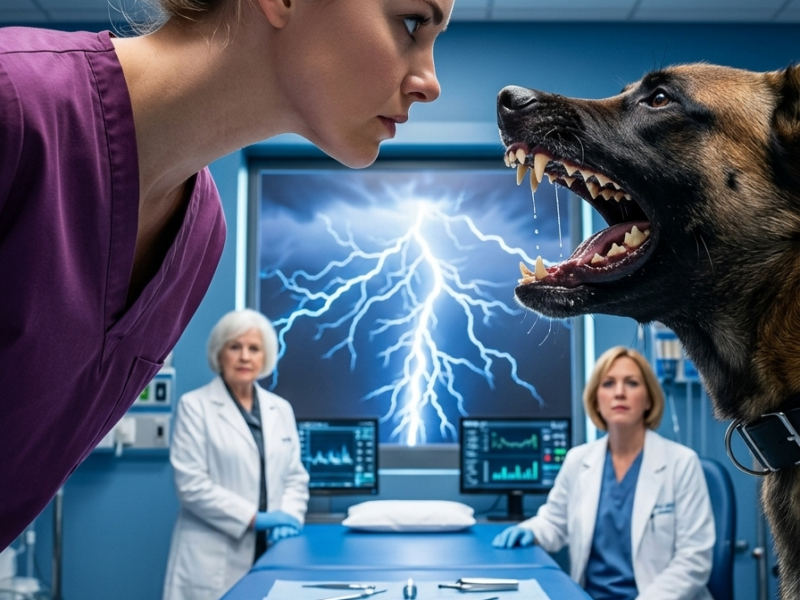
“She’s a nurse, not a soldier,” the doctor snapped as my K9 was restrained outside the trauma ward
I had worked twelve-hour shifts at St. Mary’s Hospital for almost six years, but I had never seen a room go silent the way it did that night.
The storm outside pounded against the glass doors of the emergency entrance, sheets of rain blurring the harsh yellow streetlights into smeary streaks. Inside, the usual ambient nightmare of an urban trauma center—the rhythmic chirping of cardiac monitors, the frantic squeak of rubber soles on freshly bleached linoleum, the groans of the forgotten in the waiting room—seemed to vanish instantly.
My K9, Duke, a seventy-five-pound Belgian Malinois with a silver-flecked muzzle and eyes like polished obsidian, had never been allowed past the security desk before. Tonight, no one had the courage to stop him.
He followed me through the double doors with blood on his paws and an uncharacteristic, frantic panic in his amber eyes. I was dragging my left leg, my dark blue scrub top soaked through with a heavy, metallic-smelling crimson that wasn’t entirely my own. The hallway seemed to stretch into infinity, tilting at a nauseating forty-five-degree angle with every step I took.
“Get that dog out of here!” a voice barked, slicing through the ringing in my ears.
It was Dr. Marcus Vance, the attending trauma surgeon on duty. He stepped out from Trauma Bay 2, snapping off a pair of latex gloves, his eyes wide with an aggressive mixture of shock and authority.
“She’s a nurse, not a soldier,” Vance snapped as my K9 was restrained outside the trauma ward by two burly security guards who looked terrified to touch his collar. Vance turned his gaze to me, his brow furrowing as he noticed the state of my uniform. “Nurse Clara, what in the hell happened out there? And why is a service animal breaching a sterile zone?”
“He’s… he’s trained,” I rasped, my throat feeling as though it were lined with broken glass. I leaned heavily against the registration desk, my fingers leaving smudged red prints on the white laminate surface. “He’s trained to detect changes… in my breathing, heart rate… neurological responses. After my deployment overseas… he stays.”
“I don’t care about your military record or his certifications,” Vance said coldly, striding toward me. “This is an emergency department, not a combat outpost. He belongs outside. Security, hold him in the lobby.”
Duke let out a low, guttural growl that vibrated through the floorboards. The sound didn’t carry the raw, aggressive pitch he used when confronting an intruder. It was tighter, choked with urgency.
He didn’t look at Dr. Vance. He didn’t look at the security guards holding his tactical harness.
He looked directly at me.
I froze. In the four years since we had both been discharged from the U.S. Army’s 34th Military Police Detachment, I had only heard Duke use that specific vocalization twice. Both times were in the Arghandab River Valley. Both times, someone died seconds later.
“Duke, heel,” I whispered, but my voice lacked conviction.
With a sudden, explosive burst of power, Duke jerked free from the guards’ grip. The heavy metal buckles of his harness clattered against the floor as he lunged forward. Nurses gasped, and Dr. Vance instinctively took a step back, raising his hands.
But Duke ignored everyone else. He rammed his broad head against the left side of my abdomen, pressing his wet, black nose firmly into the soft tissue just below my ribcage. He held it there for three excruciating seconds, his entire body trembling. Then, dropping to his front paws, he began frantically scratching at the linoleum floor right beneath my feet, letting out high-pitched, desperate whines.
“I don’t understand,” I whispered, feeling a wave of ice wash over my skin despite the feverish heat pounding in my skull. “Duke… leave it.”
“She’s in shock,” Dr. Vance declared, stepping back in with a pair of trauma shears in hand. “Look at her skin—she’s pale, diaphoresis is severe. She was involved in a motor vehicle collision on her way into her shift, wasn’t she? Get her on a gurney immediately.”
“It wasn’t a crash,” I tried to say, but my vision was beginning to vignette into static. “The ambulance… we were ambushed…”
“She’s confused and suffering from acute psychological distress,” Vance interrupted, overriding me completely. He reached out to grab my left arm to guide me onto the gurney that two technicians had rushed into the hallway.
The moment Vance’s fingers made contact with my sleeve, Duke moved.
He didn’t bite, but he threw his massive frame directly between us, his shoulder striking Vance’s hip hard enough to send the surgeon stumbling back into a crash cart. Duke planted all four paws, his lips curling back to expose sharp, gleaming teeth, a wall of pure muscle standing between the medical team and my collapsing body.
“Ma’am, control your dog!” Vance yelled, his face turning an angry, mottled red. “This is an absolute violation of protocol! He is endangering medical staff!”
“I am… trying…” I slurred. My knees finally buckled.
I hit the cold floor, the impact jarring my spine. Instantly, Duke was over me, hovering, his warm breath fanning across my face as he continued to nudge my left side, whining incessantly.
“Get the snare pole from animal control,” Vance ordered the head of security, who was standing back nervously. “Or call the police department. We need him incapacitated now.”
Before it could come to that, Sarah, a senior triage nurse and one of my closest friends at St. Mary’s, darted forward with a thick wool blanket. “Clara, look at me,” she pleaded, kneeling beside me while keeping a cautious eye on Duke. “Let us help you. Tell him it’s okay.”
I looked into Duke’s dark, intelligence-filled eyes. “Stand down, boy,” I managed to choke out. “Break.”
Recognizing the command, Duke reluctantly eased his aggressive stance, though he refused to take his eyes off my torso. Taking advantage of the brief window, three security guards stepped in, wrapping a heavy lead leash through his harness and dragging him toward the double doors. Duke didn’t fight them physically, but as they pulled him out into the hallway, his agonizing, desperate howls echoed back through the glass, cutting straight to my core.
They lifted me onto the gurney. The bright overhead LED panels spun wildly above my head as they wheeled me into Trauma Bay 1.
“Standard trauma workup,” Vance called out, his voice returning to its sharp, clinical cadence. “Complete blood count, comprehensive metabolic panel, FAST ultrasound, and get a portable X-ray in here. Let’s see where all this blood is coming from.”
For twenty minutes, the trauma bay was a whirlwind of activity. Scissors cut away my ruined scrubs. IV lines were punched into my veins. Cold gel was slathered across my stomach as the ultrasound probe glided across my skin.
I lay there, staring at the drop-ceiling tiles, the sound of Duke’s muffled barking echoing faintly from the far end of the hallway outside the ER doors.
One sharp bark.
Then another.
“Ultrasound is clear,” the sonographer reported, wiping the gel off my abdomen. “No free fluid in the pericardium, no fluid in Morrison’s pouch. Spleen and liver look entirely intact.”
“Vitals are holding,” another nurse added. “Blood pressure is 118 over 76. Heart rate is slightly elevated at 92, but completely understandable given the circumstances.”
Dr. Vance folded his arms, looking down at me with a mix of irritation and pity. “Just as I thought. Superficial lacerations on the arms from shattered windshield glass, severe contusions, but no life-threatening internal injuries. The blood on your uniform isn’t even primarily yours. You’re exhausted, Clara. You’ve been working too many back-to-back shifts, and your PTSD is blurring the lines between past and present.”
He picked up a syringe filled with a light sedative. “We’re going to clean up these cuts, give you something to help you sleep, and hold you for observation overnight.”
I wanted to argue. I wanted to tell him that Duke didn’t mistake PTSD triggers for physical trauma. Duke had been trained by the military’s top canine handlers to recognize the subtle volatile organic compounds (VOCs) released by human skin when deep internal damage occurred—a sense so refined it rivaled advanced laboratory equipment.
Then silence fell outside.
The distant barking stopped completely.
A cold heavy weight settled in the pit of my stomach. Duke had stopped barking not because he was calmed, but because he knew he had lost his window to stop them.
A second later, a junior nurse burst through the doors of Trauma Bay 1, her face drained of all color.
“Dr. Vance!” she gasped, holding a strip of telemetry paper in her trembling hand. “Something’s wrong with the central telemetry monitor. We pulled Nurse Clara’s continuous feed from the bedside hookup.”
Vance frowned, snatching the paper from her hands. “What are you talking about? Her bedside monitor shows a normal sinus rhythm.”
“Look at the lead II printout from the secondary board,” she whispered. “The bedside monitor is glitched. It’s playing an automated loop.”
Vance glanced down at the paper, then instantly snapped his head up to look at the bedside display. The digital green line was bouncing in a steady, reassuring rhythm—118 over 76, heart rate 92.
He reached out and manually placed two fingers against my carotid artery.
His expression transformed instantly from smug condescension to sheer terror.
My pulse wasn’t 92. It was barely a flutter, racing at over 180 beats per minute, soft, thready, and fading fast.
“Her pressure is dropping through the floor!” Vance screamed, dropping the paper as the bedside monitor suddenly caught up with reality, emitting a piercing, continuous alarm. The screen flashed bright crimson: CRITICAL HYPOTENSION – VENTRICULAR TACHYCARDIA.
“How is that possible?!” the sonographer yelled, frantically grabbing the ultrasound probe again. “The scan was completely clear five minutes ago!”
“It wasn’t a solid organ bleed,” Vance said, his voice shaking as he ripped open a central line kit. “It’s retroperitoneal. The blood was pooling behind her abdominal lining where the standard ultrasound couldn’t pick it up… She’s bleeding out internally. Get her to Operating Room 4 now! Call the blood bank, prep six units of O-negative!”
The world exploded into motion. The ceiling lights blurred into a single streak of blinding white as they sprinted my gurney down the surgical corridor. The doors smashed open, the cold air of the operating room hitting my bare skin like a wave of ice.
As they slapped an oxygen mask over my face, the anesthesiologist began counting down.
“Count backward from ten, Clara,” a voice whispered above me.
My eyes fluttered toward the small observation window in the OR door. For a fraction of a second, before the darkness swallowed me whole, I saw a dark, fur-covered shadow standing outside the double doors, watched over by no one.
The anesthesia didn’t feel like sleep. It felt like falling down an endless, airless well, surrounded by the dull, metallic echoes of clinking surgical tools and hushed, panicked voices.
“…clamp that artery! She’s losing too much…”
“…where is that blood coming from? This isn’t from a car crash…”
“…look at the tissue tearing… this looks like…”
Then, silence.
When I finally clawed my way back to consciousness, the first thing I registered was the smell. It wasn’t the sharp, sterile scent of rubbing alcohol or the burnt-flesh odor of electrocautery. It was the scent of damp wool, cedar, and dry earth.
It was Duke.
I blinked heavily, my eyelashes sticky and stiff. The harsh fluorescent lighting of the Intensive Care Unit had been dimmed to a soft twilight hue. The rhythmic beep… beep… beep… of my heart monitor was slow, steady, and deep.
I couldn’t move my arms; thick plastic IV lines were taped securely to the backs of both hands, delivering a steady drip of saline and red blood cells. My throat felt like it was coated in sand from the endotracheal tube that had recently been pulled from my lungs.
I shifted my head slightly to the left, every muscle in my abdomen screaming in agony.
Lying flat on the cold linoleum directly beneath my hospital bed, his massive chin resting on his front paws, was Duke.
He wasn’t leashed. He wasn’t wearing his tactical harness. He was just lying there, his dark eyes fixed intently on the door of my room, his ears twitching at every distant noise in the hallway.
“Duke…” I tried to speak, but the word came out as a ragged cough.
At the sound of my voice, the dog didn’t leap up frantically. He moved with practiced, gentle precision. He raised his head, stood up softly, and rested his chin against the edge of my mattress, right next to my left hand. I managed to extend two fingers, hooking them over the soft fur behind his ears. He let out a long, shuddering exhale, his tail giving a single, slow thump against the floor.
“You’re not supposed to be in here, big guy,” I whispered.
“Nobody had the heart to tell him that,” a soft voice replied from the corner of the room.
I turned my head to the right. Sitting in a faux-leather recliner was Sarah. She looked exhausted, her eyes rimmed with red, a cold cup of coffee held loosely in her hands.
“Sarah…” I croaked. “How… how did he get up here?”
Sarah let out a tired, weak laugh, setting her coffee cup down on the bedside table. “After they took you into surgery, he broke out of the holding room in the lobby. He didn’t bite anyone, Clara. He just threw his entire weight against the hollow-core door until the latch snapped. Then he walked up three flights of stairs, stood right outside Operating Room 4, and laid down.”
She leaned forward, her face turning serious. “When the surgical team brought you out to ICU, Dr. Vance tried to have security remove him again. But the night supervisor told Vance that if he touched that dog, half the nursing staff would walk off the shift. So… he stayed.”
“How long was I under?”
“Nearly eight hours,” Sarah said quietly. “It was bad, Clara. Really bad. You lost over three liters of blood. Dr. Vance had to perform an emergency laparotomy. He said a small, sharp piece of metal had punctured your retroperitoneal cavity, nicking a minor branch of your abdominal aorta. It acted like a one-way valve—bleeding internally, but trapped behind the tissue wall so it didn’t show up on the initial ultrasound.”
She paused, staring at Duke, who was still resting his chin near my hand.
“If Duke hadn’t forced us to look twice… if he hadn’t delayed us from just throwing a blanket over you and giving you a sedative… you would have gone to sleep in an observation room and never woken up. He smelled the micro-hemorrhaging, didn’t he?”
“He smelled the change in blood chemistry,” I said, my voice gaining a tiny bit of strength. “In the military, they taught us that deep internal bleeding releases specific proteins through the pores long before systemic shock sets in. Duke was trained to detect it in wounded soldiers on the battlefield.”
Sarah shivered slightly, crossing her arms. “It’s terrifying. And miraculous.”
“What about the ambulance?” I asked, memory fragments slowly stitching themselves back together in my mind. “I was coming in on my shift… I flagged down the county transport unit because they were pulled over on Route 9…”
Sarah’s eyes flickered with something uneasy. She shifted in her chair, looking toward the heavy glass door of the ICU room before looking back at me.
“The county unit reported a hit-and-run,” Sarah said slowly, her tone suddenly cautious. “They said their vehicle was sideswiped by an unmarked black SUV. They said you stopped to assist them, and in the chaos, you were struck by flying debris.”
I frowned, a deep chill settling in my chest. “That’s not what happened.”
Sarah froze. “What?”
“There was no hit-and-run, Sarah,” I said, the fog in my mind clearing, replaced by the sharp, terrifying reality of what I had experienced hours earlier. “The ambulance was parked on the shoulder with its hazard lights off. When I pulled over to check on them, the back doors opened. It wasn’t county paramedics inside. There were two men in tactical gear… they were trying to unload unmarked wooden crates into a van.”
Sarah’s breath hitched. “Clara, stop…”
“When they saw me, one of them grabbed me,” I continued, the memory flashing vividly behind my eyes. “Duke jumped out of my truck. He hit the man who grabbed me. There was a struggle… a shot was fired. I felt something tear in my side, but I thought it was just a blunt blow from the crate handle. I managed to get back into my vehicle and drive straight here… Duke was covered in blood because he tore through the driver’s jacket.”
“Clara, listen to me very carefully,” Sarah whispered, leaning in so close I could smell the stale coffee on her breath. “You need to be quiet about this.”
“Why?”
Instead of answering, Sarah reached into her scrub pocket and pulled out a thick, white glassine envelope. It was unsealed, slightly crumpled at the edges.
“Before you woke up,” Sarah whispered, “a man in a dark suit came to the nurse’s station. He claimed he was from the state police internal affairs division. He asked if you had regained consciousness or if you had spoken to anyone about the incident. He left this for you.”
She handed the envelope to me.
My fingers were trembling as I pulled out the contents. It wasn’t a police report. It wasn’t medical paperwork.
It was a glossy, 8×10 photograph.
The image was grainy, bleached out by the harsh glare of a desert sun. It showed a younger version of me, wearing desert digital camouflage, standing alongside a much younger Duke in the dusty courtyard of a compound near Kandahar. We were standing beside the twisted, blackened carcass of an armored vehicle.
I remembered that day. It was the day my unit was hit by an IED, the day I received my Purple Heart, and the day Duke was officially retired from active military service after sustaining a shrapnel injury to his leg.
I turned the photograph over. Written on the back in thick, black permanent marker was a single sentence:
Your dog saved your life once before. Don’t let him ruin it now.
My heart plummeted into my throat. The steady beep… beep… beep… of the heart monitor spiked instantly, doubling in tempo.
“Who gave this to you?” I demanded, my voice shaking with rage and fear. “What did he look like?”
“I didn’t get a good look at him,” Sarah admitted, her face pale. “He had a cap on, kept his head down. Clara, what is going on? What was in those crates?”
I didn’t answer. I couldn’t.
At that exact moment, the heavy glass door of my ICU room slid open with a soft, pneumatic hiss.
Dr. Marcus Vance stepped into the room. He was no longer wearing his surgical scrubs. He was dressed in a crisp, dark navy suit, his hair neatly combed back. His surgical mask was gone, revealing a tight, unreadable expression.
The moment Vance crossed the threshold, Duke didn’t growl.
He didn’t bark.
Instead, the Malinois slowly slid out from under my bed, his body dropping into a low, predatory crouch. His ears pinned back flat against his skull, and his upper lip retracted completely, exposing every tooth in his jaw in a silent, lethal menace.
Duke wasn’t staring at the door. He was staring directly at Dr. Vance’s right hand—the hand holding a small, unlabelled glass vial and an empty 10cc syringe.
Dr. Vance stopped in his tracks, staring down at the dog. He didn’t look afraid. He looked calculated.
And this time, when Duke locked eyes with him, the doctor wouldn’t look back.
“Nurse Sarah,” Dr. Vance said, his voice entirely devoid of the panicked authority he had displayed in the trauma bay hours earlier. Now, it was flat, cold, and eerily calm. “I need you to step outside and complete the shift handover logs in the central station.”
Sarah looked between Vance, the syringe in his hand, and the terrified expression on my face. She hesitated, her hand hovering near my gurney. “Dr. Vance, I’m scheduled to stay with Nurse Clara until her post-operative vitals stabilize. Her heart rate just spiked to 140—”
“I am the attending surgeon on this case, Nurse Sarah,” Vance interrupted, turning his cold gaze onto her. “Her heart rate is spiking because of acute anxiety and foreign stimuli in the room. I am here to administer a mild, intravenous anti-anxiety agent to stabilize her cardiac load. You are needed in Triage. Now.”
Sarah looked at me, a silent question in her eyes. I shook my head as subtly as I could, my knuckles white as I gripped the bedsheet.
“Dr. Vance,” I said, trying to keep my voice steady despite the adrenaline coursing through my veins. “I don’t want any sedatives. My pain is manageable, and I want my mind clear.”
“It wasn’t a request, Clara,” Vance said, taking a step further into the room.
The moment his shoe touched the tile inside the room, Duke let out an explosive, violent bark that rattled the glass walls. The dog didn’t back down an inch; he shifted his weight, preparing to spring directly at Vance’s throat if the man took another step.
“See?” Vance said, pointing at Duke with his free hand. “The animal is a hazard to your recovery. He is escalating your sympathetic nervous system response. Sarah, call security to have the dog removed, then clear the room.”
“No!” I snapped. “Sarah, stay right there!”
Sarah stood frozen in the middle of the room, caught in a terrifying deadlock. She looked down at the envelope in my lap, then at the photo, and finally at the unlabeled glass vial in Vance’s hand.
“Dr. Vance,” Sarah said, her voice trembling slightly. “Where is the pharmacy label on that ampoule? Hospital policy requires all bedside IV pushes in the ICU to be pre-scanned and labeled by the central pharmacy.”
Vance’s eyes narrowed slightly. “Are you questioning my medical directive, Nurse?”
“I’m following hospital protocol,” Sarah replied, standing her ground. “I’ll go to the central station, but I’ll be bringing the charge nurse and the pharmacy supervisor back with me to verify the medication.”
For a split second, a crack appeared in Vance’s icy demeanor. His jaw tightened, and his fingers twitched around the barrel of the syringe.
“Fine,” Vance said softly. “Go fetch the supervisor.”
Sarah gave me a rapid, meaningful look, turned on her heel, and quickly exited through the sliding glass doors, her rubber soles squeaking rapidly down the hallway.
The moment she was gone, the atmosphere in the room turned suffocatingly heavy.
Vance didn’t leave. He slowly reached behind his back, grabbed the handle of the sliding glass door, and pulled it shut, clicking the lock into place. He pulled the privacy curtain across the glass window, blocking the view from the central nursing desk.
“You always were too smart for your own good, Clara,” Vance said, turning back toward me. He didn’t look at Duke, though the dog was practically vibrating with tension, a low rumble echoing from his chest. “You should have just taken your night off. You shouldn’t have pulled over on Route 9.”
“What was in those crates, Marcus?” I asked, my voice dropping an octave. “What is a senior attending trauma surgeon doing involved with an armed convoy in the middle of the night?”
Vance let out a soft, humorless chuckle as he tapped the side of the syringe, clearing a tiny air bubble from the tip of the needle. “Do you have any idea how much money passes through this hospital, Clara? Not from insurance payments or county grants. From pharmaceutical trials. Unregulated, high-yield biological precursors.”
He took a slow, deliberate step forward. Duke’s muscles coiled tight, his ears pinned back, his claws digging into the linoleum for traction.
“The military spent millions researching rapid-clotting agents and synthetic neurological stimulants during the war,” Vance continued smoothly. “Agents that could keep a soldier fighting even after losing two units of blood. The Department of Defense abandoned the project because of… volatile side effects. But private defense contractors? Foreign interests? They pay millions for raw, unrefined samples.”
The pieces connected instantly in my mind with horrifying clarity.
“The ambulance…” I gasped. “It wasn’t a medical transport. You were using county emergency vehicles to smuggle military-grade pharmaceutical compounds out of the hospital’s research division.”
“And you stumbled right into the middle of a transfer,” Vance said. “If you had just died on that operating table from the internal bleeding, it would have been a tragic complication from a hit-and-run. A brave nurse succumbing to her injuries. Clean. Simple. No questions asked.”
He looked down at the syringe. “But your damn dog kept you alive. He forced me to open you up. He forced me to repair the laceration. And now… I have to fix the mistake.”
“What’s in the needle?” I demanded, trying to pull myself up, but a sharp, blinding pain shot through my abdominal incision, forcing me back down onto the pillows.
“Succinylcholine,” Vance whispered, taking another step. “A powerful neuromuscular blocking agent. In thirty seconds, your muscles will paralyze. You won’t be able to breathe. Your heart monitor will show sudden respiratory failure—a tragically common post-operative complication following severe retroperitoneal trauma. And by the time Sarah comes back with her supervisor… it will all be over.”
“He’ll kill you, Marcus,” I rasped, pointing at Duke. “If you come one inch closer, he will tear your throat out.”
Vance smiled—a cold, sickening expression. He reached into his suit jacket with his left hand and pulled out a small, heavy black object.
It wasn’t a gun. It was a high-frequency acoustic cattle prod—a tactical livestock taser designed to instantly bypass a dog’s nervous system and drop them with thousands of volts of electricity without making a sound loud enough to alert the hallway.
“I came prepared, Clara,” Vance said. “I know what military working dogs can do. But a dog is just a machine made of meat and nerves. And machines can be shut down.”
He raised the taser in his left hand and the syringe in his right, stepping directly into Duke’s strike zone.
“Duke! ATTACK!” I screamed with every bit of air left in my lungs.
Duke launched himself into the air.
The impact was deafening in the small, enclosed ICU room.
Duke’s seventy-five pounds of solid muscle slammed into Vance before the doctor could react. The sheer force of the leap sent both men crashing hard into the heavy stainless-steel crash cart, sending trays of sterile gauze, scalpel packs, and glass vials shattering across the floor.
Zap!
A bright, blinding blue arc of electricity illuminated the room as Vance fired the acoustic prod directly into Duke’s flank.
Duke let out a agonized, strangled yelp as his muscles seized from the high-voltage surge. The dog collapsed onto his side, his legs twitching violently as the electric current disrupted his nervous system.
“You useless brute!” Vance hissed, scrambling to his feet, his suit jacket torn at the shoulder, a deep streak of blood running down his forearm where Duke’s teeth had grazed him before the prod made contact.
“Duke!” I sobbed, struggling desperately against the IV lines hooked into my wrists. I yanked my left arm with all my strength, tearing the medical tape free. The intravenous needle ripped out of my vein, blood spurting onto the white bedsheets, but I didn’t care. I reached across the bed, trying to grab anything I could use as a weapon.
Vance ignored the twitching dog on the floor and turned his attention back to me. His face was twisted in a mask of pure, murderous rage. The syringe of Succinylcholine was still tightly clamped in his right hand.
“It’s over, Clara,” Vance growled, stepping over the fallen dog and grabbing my collar with his left hand, pinning my head back against the pillow. He raised the needle, aiming directly for the port on my central neck line. “No more distractions.”
I thrashed against his grip, but in my weakened, post-surgical state, I was no match for his strength. The cold tip of the needle pressed against the plastic injection port at the base of my throat.
Thump.
A heavy sound echoed from the floor.
Vance froze.
I opened my eyes and looked down.
Duke was no longer twitching. His incredible military conditioning, honed through years of surviving explosions and extreme physical trauma, had allowed his body to absorb the shock.
With his teeth bared and his eyes burning with an unholy, primitive fury, Duke raised his massive head. He didn’t stand up—his back legs were still partially paralyzed from the shock—but he used his powerful front paws to drag himself forward across the blood-slicked tile.
Before Vance could plunge the plunger down, Duke clamped his jaws shut around Vance’s right ankle.
His teeth sank deep through the leather shoe, crushing the bone underneath.
Vance let out a blood-curdling scream of agony. The sudden, agonizing pain forced his hand to jerk violently, sending the syringe flying out of his fingers. It shattered against the metal frame of my gurney, the clear, lethal liquid spraying harmlessly across the blanket.
“Get him off me! Get him off!” Vance shrieked, dropping the taser as he lost his balance, falling backward onto the floor.
Duke didn’t let go. Even with his hind legs compromised, he locked his jaw in a death grip, shaking his head with savage, calculated force, dragging the surgeon down into the broken glass and blood covering the floor.
“Clara! Help!” Vance screamed, his composure entirely shattered as he frantically struck at Duke’s face with his fist. But Duke didn’t flinch. A military K9 in defense-of-handler mode felt no pain, recognized no surrender, and stopped for nothing short of a direct command or death.
I leaned over the edge of the bed, my abdomen feeling as if it were being torn apart by hot iron, and snatched the fallen acoustic taser off the floor.
I pointed it directly at Vance’s chest.
“Move one inch,” I gasped, my finger hovering over the activation switch, “and I’ll discharge this entire battery directly into your heart.”
Vance stopped hitting Duke. He lay on the floor, panting heavily, his face pale with pain and terror, his right foot pinned securely in the mouth of the growling Belgian Malinois.
“You’re… you’re crazy,” Vance choked out, sweat pouring down his forehead. “You think anyone will believe a traumatized nurse and her rabid dog over an attending surgeon?”
“They won’t have to take my word for it,” a voice called out.
The sliding glass doors of the ICU room were violently thrown open.
Standing in the doorway was Sarah. Behind her were two armed officers from the city police department, their guns drawn and aimed straight at Vance, along with the hospital’s Chief of Medical Services.
“Drop your weapon, Dr. Vance!” one of the officers commanded. “Hands where we can see them!”
“He tried to kill her!” Sarah yelled, pointing at the shattered syringe and the pool of clear liquid on the bed. “I checked the central research vault on my way back—the military compound vials are missing, and Vance was the only one with access codes tonight!”
Vance looked at the officers, then at the blood on his hands, and finally up at the barrel of the taser I was holding steadily at his chest.
He slowly raised both hands into the air. “Don’t shoot,” he whispered, his voice trembling. “Just… get this dog off me.”
I looked down at Duke. His dark eyes flickered up to mine, waiting for the only order that mattered.
“Duke,” I said softly, my chest heaving with relief. “Release. Out.”
Duke’s jaw unlocked instantly. He stepped back, his back legs finally regaining their strength, and stood tall between my bed and the police officers, his broad chest rising and falling in steady, powerful rhythms.
The officers rushed in, slamming Vance onto his stomach, pulling his arms behind his back, and snapping heavy steel handcuffs onto his wrists.
As they dragged the disgraced surgeon out of the room, the Chief of Medicine looked at the destroyed ICU bay, the blood on the floor, and the massive dog standing guard beside my bed.
“Nurse Clara,” the Chief said quietly, bowing his head in shame. “I… I don’t even know what to say. We had no idea what Marcus was doing…”
“Save it,” I whispered, reaching down to stroke Duke’s head. “Just get me a clean IV. And bring my dog a bowl of water.”
Three days later, the rain had finally stopped, giving way to a crisp, bright autumn morning.
The sunlight streamed through the window of a private corner room on the hospital’s top floor—a room that had been personally assigned to me by the board of directors, complete with a formal, written exemption allowing Duke to stay by my side twenty-four hours a day.
The story had exploded across the national news.
The investigation triggered by Vance’s arrest had uncovered a massive, multi-state illegal trafficking ring operating out of several major hospital research facilities. Unmarked military pharmaceuticals, stolen blood products, and experimental trauma drugs were being funneled to black-market buyers through compromised emergency transport networks.
The “state police officer” who had delivered the ominous photograph to my room had been identified as a former security contractor linked to Vance’s ring; he was arrested at an airfield two counties away attempting to leave the country.
The hospital had issued a public apology, paid for all my medical expenses, and promised a full restructuring of their security protocols. But none of that mattered to me.
I sat in a wheelchair by the window, wearing comfortable sweatpants and a soft cotton sweater over my bandaged abdomen. The physical pain was fading, replaced by a deep, quiet sense of peace that I hadn’t felt since before I was discharged from the military.
Beside me, resting his broad head on my knee, was Duke.
His coat had been washed, his paws cleaned, and his silver-flecked muzzle glinted in the warm morning sun.
A soft knock sounded at the door.
“Come in,” I called out.
Sarah stepped into the room, carrying a large tray covered with a silver serving dome. She smiled warmly, her eyes bright and rested for the first time in days.
“Morning, hero,” Sarah said, setting the tray down on the bedside table. “Compliments of the executive chef in the hospital cafeteria. They insisted on sending up breakfast.”
She lifted the silver dome. On the plate was a perfectly cooked stack of pancakes, fresh fruit, and, sitting right next to it, a massive, twelve-ounce pan-seared prime rib steak, completely unseasoned.
Duke’s ears perked up instantly, his nose twitching as the scent of fresh beef filled the room.
“Is that for who I think it’s for?” I laughed.
“The Chief of Surgery said if Duke doesn’t get prime rib every day for the rest of his life, the hospital board will never sleep again,” Sarah joked, setting the plate down on a rubber mat on the floor.
She looked at Duke, who looked up at me patiently, waiting for permission.
“Go ahead, boy,” I said with a smile. “Take it.”
Duke didn’t hesitate. He devoured the steak in three massive, contented gulps, before letting out a satisfied breath and returning to his spot right by my knee, leaning his heavy shoulder against my legs.
Sarah watched us for a moment, her expression turning soft and thoughtful.
“You know,” she said quietly, leaning against the window frame. “When you first brought him through those ER doors, covered in blood, barking like a madman… I really thought he was just a confused, dangerous animal reacting to chaos.”
She reached out and gently patted Duke’s back.
“I didn’t understand what he was trying to do. None of us did. We looked at him and saw a threat. He looked at you and saw the only thing in the world worth protecting.”
“People look at diagnostic machines, Sarah,” I said, looking out the window at the city skyline below. “They look at blood pressure cuffs, ultrasound screens, and lab results. They trust numbers because numbers are easy to quantify. But machines don’t know you. They don’t know the sound of your breathing when you’re terrified. They don’t know the exact smell of your skin when your body is failing.”
I reached down, running my fingers through the coarse fur on Duke’s neck, finding the small, raised scar behind his ear—the memory of a blast in Afghanistan that we had both survived.
“A machine measures life,” I whispered. “A dog guards it.”
Sarah smiled, wiping a tiny tear from her eye. “Are you going to come back to St. Mary’s when you heal up? The ER won’t be the same without you.”
I looked at Duke, whose dark, intelligent eyes were watching me with absolute devotion.
“I’m coming back,” I said softly. “But on one condition.”
“Name it,” Sarah said. “I think the board would agree to give you the hospital if you asked for it.”
“I want Duke on the staff,” I said, my voice firm and clear. “Not as a service animal sitting in a breakroom. As a full-time therapy and early-detection canine in the trauma unit. He showed us that there are things human medicine misses. I want him there to make sure we never miss them again.”
Sarah chuckled, shaking her head. “I’ll make sure the badge gets printed today. What title should we put on it?”
I looked down at my partner, my protector, the guardian who had dragged me back from the edge of death twice in one lifetime.
“Put ‘Chief of Detection,'” I said. “And make sure his badge is bigger than Dr. Vance’s ever was.”
Sarah laughed, nodded, and quietly walked out of the room, leaving the door open to the warm, humming hallway of the hospital.
I leaned back in my wheelchair, feeling the cool morning air against my face. Duke let out a long, contented sigh, curling his massive body around the base of my chair, resting his nose directly against my shoe.
I closed my eyes, resting my hand on his head, feeling the steady, unbroken beat of his heart echoing against my own.
We were home. We were safe. And as long as he was beside me, the shadows would never touch us again.
The end









