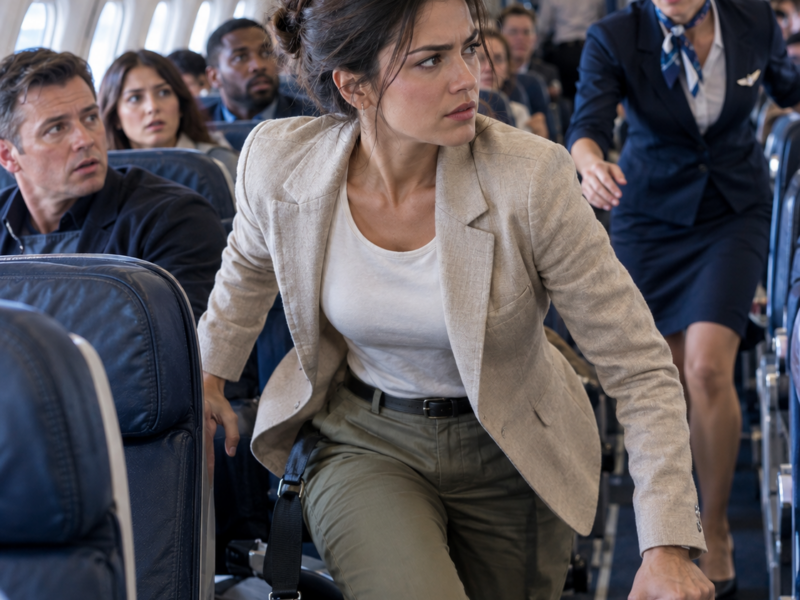
SHE SLEPT PEACEFULLY — UNTIL THE CAPTAIN SCREAMED: “ANY FIGHTER PILOTS ON BOARD?!”
I was asleep in seat 22A when the captain’s voice exploded through the cabin.
“Ladies and gentlemen, is there any military fighter pilot aboard this aircraft? If there is, please identify yourself immediately!”
I opened my eyes.
The cabin lights flickered overhead. A flight attendant clutched the back of a seat, and a businessman across the aisle was frantically trying to call someone on his phone.
Then the aircraft lurched violently to the left.
A baby screamed.
Someone shouted, “We’re going down!”
I reached instinctively for the armrest, my body reacting before my mind could catch up.
Three years.
Three years since I had last felt an aircraft shudder beneath my feet. Three years since I had heard the warning tones of a fighter cockpit, watched missiles streak across a night sky, and listened to the voices of my squadron disappear one by one.
I had promised myself I would never fly again.
But the sound coming from the aircraft’s left side wasn’t ordinary turbulence.
It was a deep, uneven roar, followed by a vibration that traveled through the cabin floor.
Something was wrong with our aircraft.
And something outside was making it worse.
I unbuckled my seat belt.
A flight attendant hurried toward me.
“Ma’am, please remain seated!”
“Tell the captain I need to speak with him.”
She stared at my faded sweatshirt and worn sneakers.
“Are you a pilot?”
“I used to be.”
Before she could ask another question, the captain’s voice returned.
“We have lost normal communication with air traffic control. An unidentified aircraft is approaching us. I repeat, we have an unidentified aircraft approaching us.”
The cabin erupted in panic.
I closed my eyes for one second.
Then I heard it.
A faint electronic tone, almost buried beneath the engine noise.
My blood turned cold.
I knew that sound.
It was the alert tone used by military aircraft when a radar system began tracking them.
Someone out there wasn’t simply following our passenger jet.
Someone was targeting it.
I pushed past the flight attendant and hurried toward the front of the aircraft.
“Ma’am, you cannot go in there!”
“Then tell the captain to open the door!”
The cockpit door swung open before she could stop me.
Captain Reynolds stood inside, gripping the controls with one hand while his copilot worked frantically over the communications panel.
His face was pale.
“Who are you?” he demanded.
“Someone who understands what you’re hearing.”
I glanced at the instruments visible from the doorway. The aircraft was struggling to maintain its course, and the captain’s attempts to establish contact with air traffic control had produced nothing but static.
“Is the engine failing?” I asked.
“We’re getting inconsistent indications, and I don’t know whether it’s a sensor problem or something more serious. Our normal communications are down, and that aircraft is closing in on us.”
“Have you visually identified it?”
“Not yet.”
“Then don’t assume you know what it is.”
He looked at me in disbelief.
“Do you have any idea what’s happening out there?”
I looked through the cockpit window.
Three dark silhouettes emerged from the clouds.
Fighter jets.
They were flying in a tight formation behind us.
And the aircraft at the front was moving closer.
My heart began to pound.
I knew that formation.
I had flown in it a hundred times.
The lead fighter’s markings were partially obscured by darkness, but I recognized the shape of its wings and the distinctive movement of its flight lights.
“No,” I whispered.
Captain Reynolds turned toward me.
“What?”
I couldn’t answer.
Because I had seen that formation on the night my squadron disappeared.
Three years earlier, I had been Captain Sarah Mitchell, call sign Eagle One, one of the youngest fighter pilots in my unit to lead a classified reconnaissance mission over hostile territory.
We had launched with six aircraft.
We had received coordinates from command.
We had followed our orders.
Then, halfway through the mission, our navigation data changed.
The valley ahead was filled with enemy radar signals. Communications began failing. One aircraft exploded, followed by another.
I remembered shouting into my headset.
“Eagle Two, break right! Break right!”
Then came the flash.
The impact.
The darkness.
I woke up days later in a remote medical facility, badly injured and alone.
The military told the world that my entire squadron had been lost.
My name appeared on the official casualty list.
A funeral was held without my body.
And the investigation concluded that I had disobeyed orders, abandoned my formation, and caused the deaths of my fellow pilots.
I knew the report was a lie.
I also knew the people who had written it had enough influence to make sure the truth never emerged.
So I disappeared.
I changed my identity, cut contact with former colleagues, and kept my family far away from anything connected to the military.
For three years, I had lived as though Sarah Mitchell had never existed.
Now, three fighter jets were flying outside my window.
And one of them was transmitting a signal I had hoped never to hear again.
Captain Reynolds followed my gaze.
“Do you recognize those aircraft?”
I swallowed.
“Yes.”
“Are they friendly?”
“I don’t know anymore.”
He stared at me.
“What’s your name?”
I reached into my bag and pulled out an old military identification card. Its edges were worn, and a crease ran across the photograph.
I handed it to him.
He read the name.
Then he looked at my face.
Then back at the card.
“Captain Sarah Mitchell?”
“Yes.”
His expression changed completely.
“But you’re dead.”
“That’s what they told you.”
For several seconds, neither of us spoke.
Then a burst of static came through the cockpit radio.
A man’s voice followed.
“Eagle One, do you copy?”
I stopped breathing.
I knew that voice.
It belonged to Daniel Cross, my former wingman.
The same man whose aircraft had exploded in the valley.
The same man whose name was engraved on a memorial wall.
“Daniel?” I whispered.
The radio crackled.
“Eagle One, we’ve been looking for you.”
My fingers tightened around the edge of the console.
“Daniel, identify yourself.”
A pause.
Then he answered with the private challenge phrase our squadron had used during training.
“The place where the sky went silent.”
My eyes filled with tears.
Only Daniel knew those words.
“Where are you?” I demanded.
“Behind the lead aircraft. Listen carefully, Sarah. You cannot trust Colonel Walker.”
Before I could respond, another voice cut across the frequency.
Calm. Controlled. Unmistakably familiar.
Colonel James Walker.
My former commanding officer.
The man who had signed the report declaring me dead.
“Eagle One,” he said, “you have thirty seconds to comply with my instructions.”
I leaned toward the radio.
“What do you want, Walker?”
“We need you to make a choice.”
“About what?”
“The aircraft behind you is armed. If you refuse to cooperate, it will shoot down your passenger plane.”
Captain Reynolds stared at me in horror.
I looked toward the three fighters.
“Why are you doing this?” I demanded.
Walker’s reply came quietly.
“Because your squadron wasn’t destroyed that night, Sarah.”
My entire body went still.
“What did you say?”
“They survived.”
I struggled to breathe.
“Where are they?”
“Look out your left window.”
I turned.
A fourth fighter emerged from the clouds below us.
Its silhouette was unmistakable.
My old F-22.
The aircraft the military had claimed was destroyed in the same explosion that supposedly killed me.
Beneath its cockpit was a call sign I had buried with my own hands.
EAGLE TWO.
The radio crackled again.
Daniel’s voice returned, softer this time.
“Welcome back, Sarah.”
Then the lead fighter shifted position.
A red warning flashed across the cockpit display.
TARGET LOCK CONFIRMED.
And the fighter’s nose turned directly toward our passenger plane.
The targeting warning continued to flash.
Captain Reynolds stared at the display. “Tell me that isn’t what I think it is.”
“It’s a targeting lock,” I replied. “But don’t panic. A lock doesn’t automatically mean a missile has been launched.”
“That’s supposed to make me feel better?”
“No. It’s supposed to keep you thinking clearly.”
I pulled on the spare headset and leaned toward the radio.
“Eagle Two, break formation! You’re pointing a weapons system at a civilian aircraft carrying hundreds of innocent people!”
Daniel’s voice returned through the static.
“Sarah, you need to listen to me. We’re not trying to kill you.”
“Then tell your lead aircraft to disengage!”
“We can’t. Walker controls the formation.”
I stared at the fighter outside the window. Its movements were precise, controlled, and almost mechanical. Whoever was flying it knew exactly how close they could approach without immediately colliding with our aircraft.
“Daniel, how many of you survived?”
“Four.”
My throat tightened.
“Four?”
“Four pilots made it out of the valley alive. The rest of the squadron’s fate is still classified.”
I gripped the console.
“Why didn’t you come home?”
“Because Walker made sure there was no home to return to.”
Before I could ask another question, Colonel Walker interrupted.
“Sarah, stop communicating with that aircraft. You are interfering with an active military operation.”
I almost laughed.
“You declared me dead, Colonel. You buried my name, blamed me for the squadron’s destruction, and now you’re threatening a passenger aircraft. Don’t talk to me about military procedure.”
His voice hardened.
“You have no idea what you’re involved in.”
“Then explain it.”
Silence.
Then Walker said, “The people aboard that aircraft are in danger because of you.”
I glanced through the cockpit doorway toward the cabin.
Passengers were huddled in their seats. A flight attendant was comforting an elderly woman, while a young father held his child against his chest.
They had bought tickets, boarded an ordinary flight, and expected to reach their destinations safely.
None of them had chosen to become part of my past.
“Whatever you think I know,” I said, “these people have nothing to do with it.”
“Then give me what I want, and they can go home.”
“What do you want?”
“The original mission recorder.”
I froze.
The mission recorder had disappeared after the crash. I had spent years believing it had been destroyed with the aircraft.
But if Walker wanted it, that meant someone had recovered it.
And if someone had recovered it, the official account of Silent Anvil could be exposed.
“Where is it?” I asked.
Walker ignored the question.
“Thirty seconds, Sarah.”
The transmission ended.
Captain Reynolds looked at me.
“What recorder is he talking about?”
“Evidence that could prove my squadron was deliberately sent into an ambush.”
“And do you have it?”
“No.”
I looked at the fourth fighter again.
Daniel was still flying.
Alive.
Somehow, that gave me hope.
I switched frequencies and tried the emergency channel.
“Any civilian air traffic control station receiving this transmission, this is passenger flight requesting immediate assistance. We have unidentified military aircraft in close proximity and are unable to establish normal communications.”
Static answered.
Then a faint voice broke through.
“Passenger flight, we read you intermittently. Maintain your present heading if safe to do so. We are attempting to verify the military activity.”
The signal vanished.
At least someone knew we were here.
“Captain,” I said, “we need to keep this aircraft stable and work with the crew. Don’t make sudden maneuvers because of anything those fighters do.”
Reynolds nodded, returning his attention to the instruments.
I keyed the military frequency again.
“Daniel, if you’re alive, prove it. Tell me what happened after the explosion.”
For a long moment, there was only static.
Then Daniel spoke.
“You dragged me away from the wreckage before the second blast.”
I closed my eyes.
I remembered the smoke, the heat, and the unbearable weight of his arm across my shoulders.
“You were unconscious,” I whispered.
“You kept telling me to stay awake.”
“I thought you died.”
“I know.”
His voice cracked.
“I heard them tell you I was gone. I couldn’t reach you. Walker’s people took us to a facility outside the country. We were interrogated, isolated, and told the others had all been killed.”
“Why didn’t you escape?”
“We did. Eventually. But by then, our identities had been erased, and the people who could prove what happened were either missing or dead.”
I looked at the fighter beside us.
“Where are you now?”
“Flying under orders I no longer recognize.”
“Then stop following them.”
“I can’t explain everything over this channel. Walker is monitoring us.”
“Let him listen.”
Daniel hesitated.
Then he said, “The mission coordinates were changed before we launched. The original route was safe. Walker redirected us into the valley, where enemy defenses were waiting. Someone paid for that information, Sarah. Someone wanted our squadron gone.”
My hands went cold.
“Who?”
“I don’t know yet. But the recorder has the original navigation data. It proves the changes came from command.”
Suddenly, the lead fighter moved closer.
Walker returned to the radio.
“Final warning, Sarah. Turn toward the coordinates I’m transmitting.”
A series of numbers appeared on the captain’s navigation display, sent through an external data link.
Reynolds shook his head.
“Those coordinates aren’t coming from air traffic control.”
“Don’t enter them,” I told him.
Walker continued.
“If you refuse, the consequences will be yours.”
I leaned toward the microphone.
“No, Colonel. The consequences will belong to whoever gives the order to attack a civilian aircraft.”
For the first time, his composure slipped.
“You still think this is about justice.”
“Isn’t it?”
“No. It’s about keeping a war from starting.”
The words chilled me more than the threat.
Walker continued, his voice barely audible.
“The mission recorder contains information that could implicate people in several governments. If it becomes public, thousands could die.”
“Then let investigators examine it.”
“They won’t get the chance.”
The transmission cut out.
I stared at the radio, realizing that Walker wasn’t simply trying to silence me.
He was afraid of what the truth would reveal.
Daniel’s voice returned one last time.
“Sarah, there’s something else. The recorder isn’t at the crash site anymore.”
“Where is it?”
“Someone brought it aboard a commercial aircraft three days ago.”
My heart hammered.
“What aircraft?”
A warning sounded from the communications panel.
Daniel’s signal began to break apart.
“Yours,” he said. “Sarah, the evidence is already on your plane.”
Then the channel went dead.
I turned slowly toward Captain Reynolds.
He had heard every word.
Neither of us spoke.
Behind us, two hundred passengers remained unaware that someone aboard their aircraft might be carrying evidence powerful enough to expose an international conspiracy.
And outside the window, the lead fighter was moving into position again.
This time, its targeting warning had disappeared.
A new message appeared on the cockpit display.
IDENTIFY THE PASSENGER CARRYING THE RECORDER.
Below it was a countdown.
05:00.
I looked toward the cabin door.
Someone on this plane knew exactly who I was.
And whoever carried that recorder had just become the most dangerous person aboard.
04:41.
The countdown continued across the cockpit display.
Captain Reynolds stared at it. “They want us to identify a passenger carrying some kind of recorder. How could they possibly know it’s aboard?”
“Because someone told them,” I replied.
“Someone on this plane?”
“Possibly.”
I looked through the cockpit doorway toward the cabin. Two hundred strangers sat beneath the dim overhead lights. Some were crying. Others stared at their phones, hoping for a signal. A businessman argued with a flight attendant, demanding to know why the captain hadn’t landed.
Any one of them could be involved.
Or none of them.
The mission recorder might have been planted to force me into revealing myself.
I had spent three years hiding from people who could make a military squadron disappear from the official record. I wasn’t about to let them turn a passenger flight into another battlefield.
“Captain, can you make an announcement asking whether anyone has information about the aircraft’s security situation?”
Reynolds shook his head. “If we announce that there’s a suspected recorder aboard, we’ll start a panic.”
“Then don’t mention the recorder.”
He reached for the cabin microphone.
“Ladies and gentlemen, we’re working with aviation authorities to resolve a communications problem. Please remain seated and follow all crew instructions. We appreciate your patience.”
His voice was controlled, but his knuckles were white.
I returned to the radio.
“Daniel, do you read me?”
Nothing.
“Eagle Two, respond.”
Static.
Then another voice broke through.
“Eagle One, this is Eagle Three.”
I froze.
Eagle Three had belonged to Lieutenant Michael Torres, the youngest pilot in our squadron. Before the mission, he had spent an entire evening telling me about his plans to open a flight school after completing his service.
I had attended his memorial three years ago.
“Michael?”
“Good to hear your voice, Captain.”
I fought to keep my voice steady.
“You’re alive.”
“Some of us are harder to kill than the reports suggest.”
“Where are you?”
“Close enough to see your aircraft. Not close enough to protect you if Walker gives the order.”
I glanced at the display.
03:58.
“Michael, what do you know about the recorder?”
“Only that Walker has spent three years trying to recover it. He believes it contains the original command transmissions from Silent Anvil.”
“And someone brought it aboard this flight?”
“That message came from a source inside his operation. We don’t know whether it’s true.”
I looked at Reynolds.
“We need to find out whether anyone has reported suspicious activity aboard.”
He contacted the cabin crew through the interphone. The lead flight attendant, Elena, answered immediately.
“Captain, one passenger has been acting strangely. He boarded late, after the gate agents had already begun closing the aircraft door. He told us he was a federal security officer, but his identification was never verified.”
My pulse quickened.
“Where is he now?” I asked.
Elena hesitated when she heard my voice.
“Who is this?”
“Someone trying to keep this aircraft in the air. Please tell the captain exactly where the man is.”
“He’s sitting in 23C.”
One row behind me.
I exchanged a look with Reynolds.
“Don’t confront him,” I said. “Keep the cabin calm. Ask another crew member to quietly observe him from a safe distance.”
Reynolds relayed the instructions.
I stepped back into the galley and looked through the narrow opening toward row 23.
A man in a gray jacket sat by the aisle. His hands rested on his knees. He wasn’t looking at the fighters outside.
He was watching me.
When our eyes met, he smiled.
Then he raised his right hand and tapped twice against his wrist.
A cold memory surfaced.
It was the signal Walker’s intelligence officers used when they wanted an operative to acknowledge an instruction without speaking.
The man wasn’t an ordinary passenger.
He stood.
“Captain Mitchell,” he said.
The flight attendant beside him went pale.
I kept my voice level.
“You have the wrong person.”
“No, ma’am. I have exactly the right person.”
He reached inside his jacket.
“Don’t,” I warned.
He stopped.
Around us, passengers began turning in their seats.
“I’m here to retrieve classified military property,” he said. “You need to come with me.”
“Show me your credentials.”
He produced a badge and held it up.
I studied it carefully.
The design looked convincing at first glance, but the issuing authority had changed its identification format two years earlier.
I had seen the updated documents during my time in military intelligence.
“This credential is obsolete,” I said.
His smile disappeared.
“Sit down, ma’am.”
“Not until you explain why Colonel Walker is threatening a civilian aircraft.”
The man’s eyes flickered toward the cockpit.
That was enough.
He wasn’t here to protect the passengers.
He was here because someone believed the evidence was aboard.
Suddenly, the aircraft shuddered.
The lights flickered again, and a collective gasp swept through the cabin.
Elena grabbed the nearest seat.
“What’s happening?”
I looked toward the cockpit.
The captain was already speaking over the interphone.
“We’re experiencing another flight-control warning. We’re coordinating with the flight crew and trying to establish a stable situation.”
I turned back toward the stranger.
He had moved closer.
“Last chance, Commander.”
I lowered my voice.
“If you have legitimate authority, you’ll cooperate with the captain and the appropriate authorities. If you don’t, you’re endangering everyone aboard this aircraft.”
For the first time, he looked frightened.
Not of me.
Of someone listening.
His earpiece crackled.
A voice emerged, loud enough for me to hear.
“Recover the recorder. Eliminate any witnesses who can identify the operation.”
The man went rigid.
Elena covered her mouth.
Several nearby passengers stared at us in horror.
The stranger touched his earpiece.
“Sir, there are civilians—”
“Do your job.”
The transmission ended.
I stepped between him and the cabin.
“Put your hands where everyone can see them.”
He hesitated.
Then a sharp voice rang out from the cockpit.
“Sarah! Get up here!”
I hurried forward.
Captain Reynolds pointed toward the radar display.
A fourth aircraft had appeared behind the fighters. Unlike the others, it wasn’t flying in formation. It was approaching the passenger plane from below.
A message flashed across the communications panel.
UNAUTHORIZED INTERCEPT. NO TRANSPONDER IDENTIFICATION.
Then Daniel’s voice came through the radio, strained and urgent.
“Sarah, we found the source of Walker’s orders.”
“Who is it?”
“Someone you trusted before the mission.”
My throat tightened.
“Tell me.”
Daniel took a breath.
“Your former intelligence officer. Colonel Adrian Voss.”
I remembered him standing beside Walker during the investigation, testifying that I had abandoned my wingmen.
The man whose testimony had destroyed my career.
Daniel continued.
“Voss is aboard the aircraft behind you. And Sarah, he isn’t trying to recover the recorder anymore.”
“Then what does he want?”
“To make sure nobody lands with it.”
Outside, the unidentified aircraft accelerated toward us.
The cockpit warning sounded again.
And from the cabin behind me, the man in the gray jacket shouted:
“Everyone get down!”
The unidentified aircraft surged closer.
Captain Reynolds gripped the controls. “Sarah, we cannot keep doing this! I need to know what we’re dealing with.”
“Then we stop reacting to their threats and start finding out what they want.”
I returned to the cockpit and contacted Daniel.
“Eagle Two, confirm what you said. Colonel Adrian Voss is aboard that aircraft?”
“Confirmed. His transport is transmitting a military identification code that was deactivated after Silent Anvil.”
“Can you prove he’s directing the interception?”
“I have fragments of his communications. Not enough to expose the entire operation.”
“Then we need the recorder.”
Daniel hesitated.
“Sarah, there’s something I haven’t told you.”
I stared at the radio.
“Now would be a good time.”
“The recorder wasn’t brought aboard by a random passenger. It was transferred to someone who knew you’d be on this flight.”
My stomach tightened.
“Who?”
“Your sister.”
For a moment, the cockpit seemed to tilt.
My younger sister, Emily, had been the last person I contacted before disappearing three years ago. I had told her I needed to leave for a while and that she shouldn’t ask questions.
She had respected my wishes.
Or so I believed.
“Emily is on this aircraft?”
“Passenger manifest lists an Emily Mitchell in row 31.”
I couldn’t speak.
I had deliberately kept my family away from the investigation. If Emily had somehow become involved, it meant the conspiracy had reached further than I ever imagined.
“Why would she carry the recorder?”
“Because someone contacted her after discovering that you were alive. They told her the evidence could clear your name.”
I looked through the cockpit doorway toward the cabin.
“Did they tell her what it would cost?”
“No.”
A burst of static interrupted us.
Then Colonel Voss’s voice filled the radio.
“Sarah Mitchell. You have spent three years hiding behind a false identity. You have no authority, no squadron, and no legal standing to interfere.”
I pressed the transmit button.
“And you have three years of explaining to do.”
“You don’t understand the consequences of releasing that data.”
“Then explain them to the investigators.”
“There will be no investigators.”
His answer was so immediate that I felt a chill.
Voss continued.
“The recorder contains communications implicating people who authorized the operation. If the information becomes public, the entire intelligence network will be compromised.”
“Were my pilots part of that network?”
Silence.
“Were they sacrificed to protect it?”
“Your squadron was lost in a classified operation.”
“You changed our coordinates.”
“I followed orders.”
“And you let the world believe I abandoned my wingmen.”
His voice hardened.
“You were the only survivor. Someone had to be held responsible.”
The words struck harder than I expected.
For three years, I had carried the names of my squadron like stones inside my chest. I had wondered whether I could have flown faster, reacted sooner, or saved one more person.
Now Voss had admitted that the official investigation had never been about the truth.
It had been about finding someone convenient to blame.
I took a slow breath.
“Your orders don’t absolve you of responsibility.”
“Perhaps not,” he replied. “But they do give me the power to finish this.”
The transmission ended.
Captain Reynolds turned toward me.
“What do we do now?”
I thought of Emily sitting somewhere in the back of the cabin, carrying evidence that could expose the people who had destroyed my squadron.
“We find my sister. And we make sure this aircraft reaches the ground safely.”
I contacted Elena through the cockpit interphone.
“Please locate Emily Mitchell in row 31. Tell her that Sarah is asking for her. Do not mention the recorder over the cabin system.”
A few minutes later, Elena returned.
“She says she knows you. She’s frightened, but she’s willing to come forward.”
Emily entered the galley with tears in her eyes.
For a moment, neither of us moved.
Then she threw her arms around me.
“I thought I’d lost you forever.”
I held her tightly.
“I’m sorry I made you believe that.”
She pulled away and opened her bag.
Inside was a small, sealed data case.
“They told me it contained proof that you were innocent,” she whispered. “They said I could finally bring you home.”
I looked at the case.
“Who gave it to you?”
“A man who said he had served with your squadron. He knew details about your last mission that nobody outside the military should have known.”
“Did he identify himself?”
“He called himself Eagle Four.”
My breath caught.
Eagle Four had belonged to Lieutenant David Chen, our squadron’s communications specialist.
His aircraft had vanished during the same operation.
Another man declared dead.
Another name on the memorial wall.
Before I could ask more, the cabin lights dimmed.
A warning sounded from the cockpit.
Reynolds called out, “Sarah! The unidentified aircraft is moving into our flight path!”
I rushed back to the controls.
Outside, the fighter had positioned itself ahead and below us. The three original aircraft had spread apart, their formation no longer coordinated.
Daniel’s voice returned.
“Sarah, Voss is losing control of his own pilots. Two of them have refused his latest order.”
“Can you get them to stand down?”
“I’m trying.”
I looked at the data case in Emily’s hands.
“Daniel, we have the recorder.”
A pause.
Then he answered, “That’s impossible.”
“Apparently, not.”
“Sarah, open it only when you have a secure connection to the investigators. The file contains the original mission transmissions, but it also contains something else.”
“What?”
“The name of the person who authorized the operation.”
Before he could continue, Voss broke into the channel.
“Destroy that case, Sarah.”
I stared at the radio.
“Why? Whose name is on it?”
His voice dropped to a whisper.
“Your father’s.”
The world seemed to stop.
My father had died when I was seventeen. He had been a decorated military officer who taught me to fly before I was old enough to understand what service demanded.
I had built my entire career trying to honor his memory.
Now Voss was telling me that my father had authorized the operation that killed my squadron.
I looked at Emily.
She was shaking her head.
“No. That can’t be true.”
I didn’t know what to believe.
Then Daniel’s voice returned, urgent and clear.
“Sarah, don’t let Voss manipulate you. The recorder contains the original orders, but the final authorization may have been forged. We need the complete file.”
Outside, the fighter ahead of us began to turn.
The captain called out that the aircraft was approaching its limits and needed immediate instructions from the flight crew.
I took the radio.
“This is Sarah Mitchell. All unidentified military aircraft, cease your approach and maintain separation from the civilian flight. We are transmitting our position to civilian authorities and preserving evidence for an independent investigation.”
For several seconds, nobody answered.
Then a voice came through from one of the fighters.
“Eagle One, this is Eagle Three. We are breaking formation.”
Another pilot joined.
“Eagle One, Eagle Five. We refuse further orders from Colonel Voss.”
One by one, the fighters began to separate from the passenger aircraft.
But Voss’s aircraft remained directly ahead.
Daniel’s voice crackled through the headset.
“Sarah, we’ve got one chance to expose him. The original transmission is still stored in the recorder’s backup memory.”
I looked at Emily, then at the sealed case.
For three years, I had wanted answers.
Now the truth was within reach, and it threatened to destroy the last thing I had left of my father.
The radio crackled.
Voss spoke one final time.
“Sarah, if you play that recording, you’ll learn why your father really died.”
The transmission ended.
Emily reached for my hand.
And for the first time since the night my squadron vanished, I was more afraid of the truth than of the people trying to bury it.
“Sarah, don’t let him decide what you believe about our father.”
Emily’s voice trembled, but her hand held mine firmly.
I looked down at the sealed data case.
For three years, I had lived with the belief that my squadron had died because I failed them. Now Colonel Voss wanted me to believe that my own father had been responsible.
Either possibility could destroy me.
But neither changed what I had to do.
“Captain Reynolds,” I said, “can we establish a secure connection with civilian authorities?”
“We have a partial connection. The emergency channel is working intermittently.”
“Then send our position, identify the military aircraft, and request immediate assistance. We are not following any military instructions until they can be independently verified.”
Reynolds nodded and returned to his communications panel.
I turned to Emily.
“Do you know how to access the recorder?”
“The man who gave it to me explained the basic procedure. He said the original audio was stored separately from the mission data.”
“Did he tell you why?”
“He said someone had tried to alter the flight records. The backup audio couldn’t be changed without leaving evidence of tampering.”
I examined the case. A small indicator glowed beside the locking mechanism.
“Then let’s hear what they tried to hide.”
Emily opened the case and connected the device to the cockpit’s isolated recording interface. I made sure the data remained untouched while Reynolds established a connection with the investigators through the emergency channel.
A woman’s voice answered.
“This is civilian aviation incident coordination. Identify yourself and describe your emergency.”
“This is Captain Sarah Mitchell, formerly of the United States Air Force. Our passenger aircraft is being intercepted by unidentified military aircraft. We possess evidence potentially connected to a prior military operation. We request immediate preservation of this transmission and independent investigation.”
“Captain Mitchell?” the woman replied, sounding startled. “Your identity is being verified. Please remain on the line.”
The recording began to play.
First came the familiar noise of radio interference.
Then Walker’s voice.
“Formation is approaching the designated valley. Confirm revised coordinates.”
Another voice answered.
Colonel Adrian Voss.
“Coordinates confirmed. The formation will enter the engagement zone in ninety seconds.”
Then a third voice appeared.
My father’s.
“Negative. Those coordinates were never approved. Abort the operation immediately.”
I stopped breathing.
Emily covered her mouth.
The recording continued.
My father spoke again, more urgently.
“Someone has altered the mission plan. I am ordering an immediate recall. Do not proceed until the original route is restored.”
Walker’s voice followed.
“Recall request denied.”
Then came Voss.
“Authorization has been confirmed by command.”
My father’s response was unmistakable.
“You forged that authorization.”
Silence.
Then the recording captured the words that changed everything.
“If this operation proceeds, every pilot in that formation will be sacrificed. I will report this directly to the oversight committee.”
A sharp burst of static swallowed the next few seconds.
When the signal returned, Walker was speaking.
“Proceed with the operation.”
The recording ended.
I stared at the screen.
My father hadn’t betrayed my squadron.
He had tried to save us.
Emily began to cry.
“They told everyone he died in an accident,” she whispered. “They never told us he had tried to stop them.”
I squeezed her hand.
“Because the truth would have exposed them.”
The civilian investigator returned to the channel.
“Captain Mitchell, we have received your transmission. The recording has been copied to our secure incident archive. Please do not alter or transmit the original file further. Independent authorities are being notified.”
I felt a weight lift from my chest.
For the first time in three years, the truth was no longer mine alone to carry.
Then Daniel’s voice broke through.
“Sarah, did you hear it?”
“Yes.”
“Your father tried to stop them. We found fragments of that transmission after the crash, but we never had the complete recording.”
“Where is Walker now?”
“His aircraft is turning away. Voss is still trying to reach him.”
I looked through the window.
The fighters that had surrounded us were now separating from the passenger aircraft. Their movements were cautious, and the threatening formation had dissolved.
But one aircraft remained close.
Voss’s.
“Sarah,” Daniel said, “he’s transmitting on an open channel.”
I switched frequencies.
Voss’s voice filled the cockpit.
“You think a recording will change anything? There are people who will spend fortunes ensuring it disappears.”
“Then they’ll have to explain why they’re afraid of it.”
“You have no idea how many lives this will affect.”
“I know how many lives your decisions already destroyed.”
He fell silent.
I continued.
“You took my squadron from me. You erased Daniel’s identity. You made the world believe I had abandoned my pilots. And you used my father’s name to keep your lies alive.”
“You cannot prove I authorized the final attack.”
“The investigators can decide what the evidence proves.”
For several seconds, the radio remained silent.
Then Daniel spoke on the same channel.
“Adrian, it’s over. Your own pilots have refused your orders. The recording is secured, and civilian authorities have received our position.”
Voss’s aircraft began to turn away.
But before the signal disappeared, he delivered one final message.
“You still don’t understand, Sarah. Walker was never the highest-ranking person involved.”
The channel went dead.
Captain Reynolds looked at me.
“Do you believe him?”
I considered the recording, the threats, and the three years of lies.
“I believe the investigation will uncover whatever remains hidden.”
A few minutes later, the emergency channel confirmed that air traffic control had reestablished contact with the passenger aircraft. The flight crew received verified instructions and began preparing for a controlled diversion to the nearest suitable airport.
No dramatic maneuver.
No impossible aerial battle.
Just a careful return to safety.
As the aircraft descended through the clouds, the passengers began to relax. Some applauded when the runway appeared beneath us. Others cried quietly, grateful simply to be alive.
When the wheels touched the runway, I closed my eyes.
I had spent years believing I would never hear that sound again.
The aircraft slowed and turned toward the terminal.
Emergency vehicles stood nearby, but no one rushed the plane. The captain followed the ground crew’s instructions, and the aircraft came to a complete stop.
Then Reynolds turned toward me.
“Captain Mitchell, I don’t know what happens after this. But I want you to know something.”
I looked at him.
“You helped bring every one of these passengers home.”
“I was just trying to keep them safe.”
“Sometimes,” he said, “that’s what courage looks like.”
When the cabin door finally opened, Daniel was waiting beyond the security cordon.
He had landed separately with the other pilots after refusing Voss’s orders.
For a moment, we simply stared at each other.
Then he walked toward me.
“You look terrible, Eagle One.”
I laughed through my tears.
“You look dead.”
“Apparently, we’ve both had a difficult three years.”
We embraced, and I felt the last of the loneliness I had carried begin to loosen.
Behind him, two more members of our squadron emerged from the security area. They were older, thinner, and marked by the years they had spent in hiding.
But they were alive.
Not every missing pilot had returned. Not every question had been answered. Walker’s superiors remained unidentified, and the investigation would take months, perhaps years.
Yet the official story had finally begun to unravel.
Weeks later, the authorities confirmed that the mission coordinates had been deliberately altered and that my father had attempted to stop the operation. The recorder became central evidence in the investigation into the deaths and disappearances connected to Silent Anvil.
My name was formally cleared.
The memorial listing me among the dead was corrected.
And for the first time since that terrible night, I was able to visit the memorial wall without feeling that I had betrayed the people whose names were carved into it.
I stood before their names and placed my hand against the stone.
“I tried to come back,” I whispered. “I’m sorry it took so long.”
Above me, aircraft crossed the sky in the late afternoon sunlight.
I thought about the young women who would one day climb into cockpits, face impossible decisions, and discover that courage was rarely as simple as the stories made it sound.
I hoped they would never have to disappear to survive.
I hoped they would never be forced to choose between the truth and the people they loved.
And I hoped that when someone questioned whether they belonged, they would remember that skill, integrity, and courage had never belonged to one gender alone.
I had boarded that passenger plane hoping to remain invisible.
Instead, I had found my squadron, reclaimed my name, and learned that being presumed dead was not the same as being defeated.
The sky had never forgotten me.
And I was finally ready to return.
THE END.









