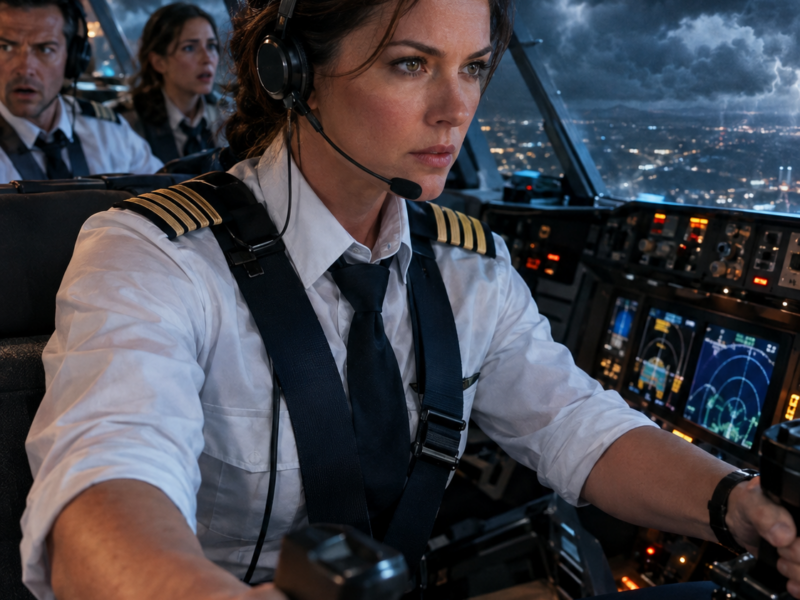
SHE HID HER FIGHTER-PILOT PAST FOR TWENTY YEARS—UNTIL BOTH ENGINES DIED OVER THE ROCKIES
SHE HID HER FIGHTER-PILOT PAST FOR TWENTY YEARS—UNTIL BOTH ENGINES DIED OVER THE ROCKIES

The passengers screamed when both engines died over the Rocky Mountains.
I didn’t.
I was sitting in row 18, holding my daughter’s hand and pretending to be an ordinary mother.
Then the captain announced there was no runway in range.
And I realized the life I had buried for twenty years was about to save hundreds of people.
The cabin lights flickered.
Once.
Twice.
Then went dark.
A flight attendant stumbled into the aisle as the aircraft dropped through a layer of clouds.
The Boeing’s wings shuddered.
Overhead bins rattled.
Someone screamed that the plane was going down.
A baby started crying.
Then the captain’s voice came over the speakers.
“Ladies and gentlemen, remain calm.”
His voice was steady.
Almost.
But I heard what was underneath it.
The tiny pause between words.
The controlled breathing.
The clipped cadence.
I knew that tone.
It was the voice of someone counting seconds.
I looked toward the cockpit.
Something was wrong.
My daughter squeezed my hand.
“Mom?”
I turned toward her.
“What’s happening?”
I forced a smile.
“Stay buckled.”
“Are we going to crash?”
I didn’t answer.
Because at that exact moment, the aircraft lurched violently to the left.
The second engine had stopped.
The cabin erupted.
Oxygen masks dropped from the ceiling.
People prayed.
People cried.
A man across the aisle grabbed his wife’s shoulders and shouted her name.
The flight attendants were moving quickly now, checking seat belts and trying to keep passengers from standing.
I could smell the sharp metallic odor of hot electrical equipment.
And beneath it, something else.
Fuel.
Faint.
But unmistakable.
My fingers tightened around the armrest.
For twenty years, I had refused to think about engines.
Altitude.
Instruments.
Flight controls.
For twenty years, I had made sure nobody knew.
Not my neighbors.
Not my coworkers.
Not even my daughter’s teachers.
I had become someone else.
New city.
New job.
New name on the mailbox.
No photographs.
No stories.
No military memorabilia.
Nothing that could connect me to the woman I used to be.
Because twenty years earlier, I had been sitting in a fighter cockpit at thirty thousand feet when everything went wrong.
Two pilots died that night.
I survived.
And I never flew again.
Until now.
The captain’s voice returned.
“We have control problems.”
My stomach dropped.
Not because of the words.
Because of how he said them.
I knew exactly what he meant.
The aircraft was no longer behaving the way it should.
I unbuckled my seat belt.
My daughter stared at me.
“Mom?”
“I’ll be right back.”
A flight attendant immediately stepped in front of me.
“Ma’am, please remain seated.”
“I need to speak with the captain.”
“Everyone needs to remain seated.”
“Tell him I can help.”
She stared at me.
“You’re a passenger.”
“Yes.”
“Then please sit down.”
I pointed toward the cockpit.
“He needs an emergency landing site.”
Her face tightened.
“There are no airports nearby.”
“I know.”
“Ma’am—”
“Tell him to look for an old military strip.”
She blinked.
“What?”
“Between the ridges.”
I looked through the window.
The clouds were breaking.
Snow-covered mountains filled the horizon.
Jagged peaks.
Deep valleys.
Frozen lakes.
And then I saw it.
A narrow strip of dark pavement between two ridgelines.
My heart stopped.
I knew that place.
I had trained there.
Years ago.
Before the crash.
Before the secrets.
Before I became a mother sitting in row 18.
“Tell him about the strip,” I said.
The flight attendant hesitated.
Then another violent drop threw her against the seats.
She grabbed the armrest.
I caught her.
“What’s your name?” she asked.
“Anna.”
She looked toward the cockpit.
Then back at me.
“Anna, if you’re wrong—”
“I know.”
She disappeared through the cockpit door.
I stood there.
The entire aircraft seemed to be falling around me.
Then the cockpit door opened.
The captain appeared.
His face was pale.
“Who told you about the airstrip?”
I pointed toward the window.
“There.”
He looked.
His expression changed.
“How do you know that’s there?”
I hesitated.
Twenty years of silence came down to one sentence.
“I used to fly fighters.”
He stared at me.
“You?”
I nodded.
His eyes moved over my plain sweater.
My jeans.
My daughter’s backpack.
The faded jacket hanging from my seat.
He looked almost offended by the idea.
“Military?”
“Yes.”
“What aircraft?”
I didn’t answer.
“Captain,” I said quietly, “you don’t have enough altitude for questions.”
That got him.
He stepped aside.
“Come in.”
I followed him into the cockpit.
The smell hit me first.
Pressurized air.
Warm electronics.
Aviation fuel.
Sweat.
Fear.
The instruments glowed against the dark windshield.
Warnings flashed across the displays.
The captain’s hands were tight around the controls.
His copilot was working through checklists.
“Altitude?”
“Twenty-two hundred feet above terrain.”
“Speed?”
“Dropping.”
“Landing gear?”
“Hydraulic pressure is unstable.”
I looked at the runway ahead.
Then at the mountains.
Then at the wind data.
“What’s your crosswind?”
The copilot gave me the number.
I shook my head.
“Don’t use the normal approach.”
The captain looked at me.
“Why?”
“The ridge is channeling the wind.”
He looked back at the instruments.
I pointed.
“You’ll get a sudden yaw correction when you cross it.”
The copilot frowned.
“How do you know?”
I looked through the windshield.
“The snow.”
“What?”
“Look at the ridge.”
He did.
The snow was streaming sideways.
The wind was stronger than their onboard data indicated.
“The weather station is giving you valley wind,” I said. “You’re about to hit ridge wind.”
The captain swallowed.
“What do you recommend?”
“Approach from the south.”
“That’s a longer turn.”
“You don’t have enough altitude for the northern approach.”
He stared at the mountains.
Then at me.
Then back at the runway.
“Can we make it?”
I studied the aircraft’s speed.
Weight.
Altitude.
Distance.
Wind.
Runway length.
There was no room for optimism.
Only mathematics.
“Yes.”
The captain exhaled.
“How?”
“Keep the nose down.”
His eyebrows lifted.
“You’re telling me to dive toward the runway?”
“I’m telling you to stop trying to fly like you still have engines.”
Silence.
The words hung in the cockpit.
Then the captain nodded.
He understood.
A powerless aircraft wasn’t flown like a normal aircraft.
Every degree mattered.
Every knot mattered.
Every second mattered.
I pointed through the windshield.
“Turn left.”
He turned.
“More.”
The mountain filled the windshield.
“Hold it.”
The aircraft banked.
My daughter was somewhere behind us.
I could hear passengers screaming.
The captain’s hands trembled.
Mine didn’t.
Not anymore.
I had spent twenty years running from this feeling.
The cold air.
The vibration.
The instruments.
The impossible geometry of terrain and altitude.
But now it felt familiar.
Almost painfully familiar.
“Runway in sight,” the copilot shouted.
I looked.
There it was.
Broken pavement.
Snow across half the surface.
A rusted perimeter fence.
No lights.
No tower.
No rescue vehicles.
Nothing.
The captain whispered:
“We won’t make it.”
I looked at him.
“Yes, we will.”
“There’s too much snow.”
“Touch down beyond the first marker.”
“There isn’t a marker.”
“There used to be.”
He stared at me.
“How could you possibly know that?”
I didn’t answer.
Because suddenly I wasn’t sitting in a passenger jet anymore.
I was twenty years younger.
I was wearing a flight helmet.
I was strapped into a fighter.
And I was hearing the voice of an instructor telling me:
*Trust the runway.*
The ground rushed toward us.
“Lower.”
The captain lowered the nose.
“Left.”
The aircraft corrected.
“Hold.”
The mountains seemed to rise around us.
Then—
**THUD.**
The landing gear struck.
The aircraft bounced.
Once.
Hard.
Then again.
The cabin screamed.
The captain fought the controls.
I grabbed the side of the seat.
“Keep it straight!”
The tires screamed against frozen pavement.
The aircraft slid.
Snow exploded across the windshield.
The captain pushed the nose down.
The jet crossed the runway.
One hundred yards.
Fifty.
Twenty.
Then the aircraft slammed into a snowbank and finally stopped.
Silence.
Absolute silence.
For three seconds, nobody moved.
Then the cabin erupted.
People cried.
Prayed.
Hugged strangers.
Someone began applauding.
Another person shouted that everyone was alive.
I closed my eyes.
For the first time in twenty years, I breathed.
My daughter came running toward me.
“Mom!”
I turned.
She threw her arms around me.
“You saved us.”
I held her tightly.
“No.”
I looked through the cockpit window at the ruined runway.
“I just remembered who I was.”
Outside, snow whipped across the aircraft.
I stepped onto the frozen ground.
The captain followed.
He stood beside me.
“You saved hundreds of people.”
I shook my head.
“No.”
He looked confused.
“I was just a passenger.”
Then my daughter appeared behind us.
She was holding my old flight jacket.
The one I hadn’t worn in years.
Something had fallen from the inside pocket.
A photograph.
She picked it up.
Turned it over.
Her face changed.
“Mom?”
I took the photograph from her.
And everything inside me went cold.
It was the picture I had spent twenty years trying to forget.
My fighter sat broken and burning on that same mountain airfield.
Two helmets lay in the snow.
Two names had been written beneath them.
Both men were officially listed as dead.
But there was something else in the photograph.
A figure standing beside the wreckage.
A man.
Alive.
My daughter looked from the photograph to me.
“Who is he?”
I couldn’t speak.
Because I knew him.
And according to every military record in existence…
**he had died twenty years ago.**
Then my daughter’s eyes dropped to the passenger manifest she had found beside the captain.
She whispered:
“Mom…”
I looked at her.
“He’s on our flight.”
I turned toward the aircraft.
And for the first time in twenty years, I was afraid of what would happen if that man saw me.
Because the crash hadn’t killed him.
It had only made him disappear.
And now…
he had found me.
The man was sitting in row 31. Alive. Breathing. Watching me through the shattered doorway of the aircraft.
I knew him before I could clearly see his face. Some people leave memories behind. Others leave scars. His belonged to the second kind.
“Mom?”
My daughter’s voice pulled me back. I folded the photograph and slipped it into my jacket.
“Stay with the other passengers.”
“But—”
“Please.”
Something in my voice made her stop arguing. I walked toward the aircraft, where the captain was speaking with emergency responders who had finally reached the abandoned airstrip. There were no functioning runway lights, no control tower, and no modern rescue equipment. Only a handful of military buildings buried beneath snow, their rusted roofs groaning under the wind. The air smelled of cold metal, jet fuel, and scorched rubber.
I stepped through the aircraft door. Passengers were still crying, praying, and calling their families. A flight attendant checked the injured while emergency workers moved between the seats. Then I saw him.
Row 31. Window seat. Gray hair. Weathered face. A scar crossing his left eyebrow.
He looked exactly as I remembered him.
Twenty years had passed, but his eyes hadn’t changed.
He looked at me.
For several seconds, neither of us spoke.
Then he whispered my old name.
“Mara.”
My blood went cold. Nobody had called me that in twenty years. Not since the night my fighter went down. Not since the military declared me missing and sealed the details of the accident behind classified files.
I stared at him.
“Daniel.”
He smiled faintly.
“I wondered how long it would take.”
“You were dead.”
“So were you.”
His words hit harder than the crash itself. I glanced around to make sure nobody was listening.
“Why are you here?”
Daniel looked toward my daughter, then back at me.
“Because I’ve been looking for you.”
My hands tightened. The instincts I’d spent two decades suppressing began to return. Observe. Measure. Assess. His right hand trembled slightly, and a fresh scrape crossed his knuckles. His left boot was cleaner than his right, suggesting he’d been outside before the emergency landing. He had arrived prepared for something, and whatever it was, it hadn’t surprised him enough.
“You knew this aircraft was going down,” I said.
His expression changed.
“No.”
“You weren’t surprised.”
“I’ve been through worse.”
“That’s not an answer.”
He leaned closer.
“You still notice everything.”
I stepped back. A man sitting beside him looked between us.
“Do you two know each other?”
Daniel gave him a reassuring smile.
“Old friends.”
I didn’t correct him. There were too many questions and too little time. Outside, the captain called my name.
“Anna!”
I turned. He was standing beside the cockpit door.
“We need you.”
I followed him inside. The emergency systems were still flickering, and warning messages remained scattered across the navigation displays. The captain pointed toward the engine data.
“Both engines failed almost simultaneously. That’s not supposed to happen.”
“No,” I replied. “It isn’t.”
The copilot handed me a tablet containing the recorded telemetry. I scanned the numbers, looking for the sequence that had led to the loss of thrust. The first engine’s failure appeared consistent with a mechanical malfunction. The second showed a similar pattern, but the timing was wrong. Too close. Too precise.
Then I noticed a pressure anomaly buried beneath the primary warnings.
“Show me the auxiliary readings.”
The captain pulled them up. I leaned closer, tracing the data with my finger. A control signal had appeared just before the engine failures, an unexplained interruption that demanded investigation.
“Someone sent a shutdown command,” I said.
The cockpit fell silent.
The copilot stared at me.
“That’s impossible.”
“No.” I pointed at the display. “It’s unlikely. That’s different.”
The captain looked increasingly pale.
“Who could do that?”
I didn’t answer. Instead, I looked through the cockpit window. Daniel was standing outside in the snow, watching me. He had known something. Perhaps not the precise sequence of events, but enough to put him on this flight.
I left the cockpit.
The captain followed me into the freezing air.
“Where are you going?”
“To talk to someone.”
I crossed the snow toward an abandoned maintenance building. Daniel was waiting beside its rusted doors, his coat snapping in the wind.
“You knew,” I said.
He glanced at the aircraft.
“I suspected.”
“Someone interfered with the engines.”
“I know.”
“You knew before takeoff?”
“No.”
I stopped a few feet away from him.
“Then why were you on this flight?”
His expression hardened.
“Because someone wanted me on it.”
The wind howled between the buildings. I stared at him, trying to determine whether he was lying.
“Who?”
Daniel reached inside his coat. My body reacted before my mind could intervene. I shifted my weight and stepped out of his reach.
“Don’t.”
He slowly withdrew an envelope and held it toward me.
“Look at this first.”
I took it and opened the flap. Inside was a photograph of the same mountain airstrip, taken twenty years earlier. My fighter lay broken and burning across the snow. Flames climbed the fuselage, and thick black smoke curled into the storm.
But this photograph had been taken from another angle. It showed details the official investigation had never released.
Daniel stood beside the wreckage.
Alive.
And behind him, partially obscured by smoke, was a second aircraft with its landing gear collapsed.
I turned the photograph over. Six words had been written on the back.
**YOU WERE NEVER SUPPOSED TO SURVIVE.**
My fingers went numb.
“What does this mean?”
Daniel’s expression was grim.
“It means the crash wasn’t an accident.”
I looked up sharply.
“You told me the investigation found mechanical failure.”
“They did.”
“Then why would you—”
“Because that’s what they wanted everyone to believe.”
The mountain wind seemed to disappear. For a moment, I could hear only the echo of the warning alarms from that night twenty years ago.
“Who?” I demanded.
Daniel looked toward the ridgeline.
“The people who ordered us into that storm.”
Before I could question him further, a distant helicopter appeared above the mountains. Its rotors chopped through the freezing air as it descended toward the airstrip. Daniel’s expression tightened.
“That isn’t a rescue helicopter.”
I turned toward the approaching aircraft. It was painted dark gray, without civilian markings or visible emergency insignia. It was coming directly toward us.
The captain hurried across the snow.
“Do you know who they are?”
Daniel answered without looking away from the helicopter.
“Yes.”
The aircraft descended, blasting snow across the runway. Armed men jumped from its side door. Four, then six. They wore dark tactical clothing, carried rifles, and displayed no recognizable military insignia.
The captain froze.
“Who are those people?”
Daniel finally looked at me.
“They’re here for us.”
“For us?”
“For you.”
My gaze swept across the scene. Distance. Angles. Exits. Cover. Weapons. Wind direction. The same calculations I’d once performed instinctively inside a fighter cockpit began arranging themselves in my mind.
I studied the abandoned buildings surrounding the airstrip.
“There are cameras,” I said.
Daniel nodded.
“Three.”
“Two,” I corrected. “The western one hasn’t worked since 2008.”
He looked at me with something close to admiration.
“You remember.”
“I remember everything.”
The armed men began advancing toward the passenger aircraft. One raised his weapon and shouted across the snow.
“Ms. Vey!”
The name struck me like a bullet.
My daughter appeared near the aircraft door.
“Mom!”
She stood beside the captain, her face drained of color. I wanted to run to her, but the man with the rifle was already approaching.
“Step away from the aircraft!” he shouted.
I looked at Daniel.
He lowered his voice.
“They know who you are.”
Twenty years of hiding had vanished in a single morning. The new name, the quiet life, the careful distance from everything that had once defined me—all of it was gone.
I stepped forward, keeping myself between the armed men and the passengers.
Then the captain’s voice came from behind me.
“Anna?”
I turned. He was holding the aircraft’s emergency radio, his face suddenly white.
“What is it?”
He handed me the headset.
Static crackled in my ear. Then a voice emerged, calm and unmistakably familiar.
“Mara Vey.”
My entire body went rigid.
I knew that voice.
I had heard it over military communications on the night my fighter crashed. I had spent twenty years trying to forget it.
The voice continued.
“Welcome home.”
I slowly lowered the headset and looked at Daniel.
He wasn’t surprised.
That was when I understood the truth. Daniel hadn’t simply been searching for me. He had been trying to bring me back to the place where everything began.
And whatever had happened twenty years ago was beginning again.
This time, there were hundreds of witnesses, my daughter was standing in the middle of it, and six armed men were blocking our only way out.
For the first time since the crash, I stopped asking myself whether I could survive.
I began wondering who would survive if I uncovered the truth.
The voice on the radio was still in my head when the first gunshot cracked across the airstrip.
Everyone ducked.
Snow exploded from the ground beside the aircraft.
“Get inside!” the captain shouted.
Passengers screamed and rushed toward the fuselage. Flight attendants pushed people down between the seats. Emergency responders scattered behind the landing gear and abandoned vehicles.
I grabbed my daughter and pulled her behind the concrete wall of an old maintenance shelter.
“Mom, who are they?”
“Stay here.”
“Are they going to hurt us?”
I looked toward the armed men.
“I won’t let them.”
Daniel crouched beside us.
“They’re not here to kill everyone.”
I looked at him.
“How reassuring.”
“They want the flight recorder.”
My eyes narrowed.
“Why?”
“Because it captured what happened before the engines failed.”
I glanced toward the aircraft.
The flight recorder.
Of course.
The engines hadn’t simply died.
Someone had made them die.
And whatever had been recorded in the final minutes could expose them.
I looked at Daniel.
“You knew.”
“I suspected.”
“You keep saying that.”
“Because I don’t know everything.”
Another shot struck the metal fuselage.
The captain shouted from behind the aircraft.
“Mara!”
I looked at him.
He pointed toward the cockpit.
“We still have power!”
I understood immediately.
The aircraft couldn’t fly normally.
But it still had enough electrical power to operate some systems.
And there was another aircraft nearby.
I looked toward the old hangar.
“What’s inside?”
Daniel answered.
“Nothing that should still work.”
I almost smiled.
“That’s not what I asked.”
He stared at me.
“You really haven’t changed.”
We ran.
The hangar doors were half buried in snow. Daniel forced one open while I searched the interior.
Rusty equipment.
Old fuel drums.
Maintenance vehicles.
Then I saw it.
A faded silhouette beneath a canvas cover.
I pulled the cover away.
A military training aircraft.
Old.
Damaged.
But intact.
The cockpit canopy was cracked.
One landing gear was partially collapsed.
The aircraft hadn’t flown in decades.
But beside it sat a portable maintenance generator.
I looked at Daniel.
“Can it start?”
He shook his head.
“No.”
I opened the cockpit panel.
“Wrong answer.”
I pulled a loose access panel free.
The wiring beneath it was corroded, but the essential circuits were still recognizable.
Daniel stared at me.
“You’re serious.”
“I always was.”
The generator coughed.
Once.
Twice.
Then the cockpit lights flickered.
I climbed inside.
The smell hit me immediately.
Dust.
Oil.
Old hydraulic fluid.
And memory.
My hands moved across the controls almost automatically.
For twenty years, I had dreamed about this cockpit.
Sometimes I dreamed I was flying.
Sometimes I dreamed I was falling.
I had never understood the difference.
Now I did.
The difference was choice.
I strapped myself into the seat.
Daniel climbed into the other side.
“You can’t fly this.”
I looked at him.
“Then don’t get in.”
He closed the canopy.
Outside, gunfire continued.
My daughter was still behind the concrete shelter.
The passengers were trapped.
The armed men were closing in.
I looked at the dead instrument panel.
“Power.”
Daniel switched the generator.
The gauges flickered.
“Fuel?”
“Unknown.”
I checked the mechanical indicator.
“Enough.”
“Hydraulics?”
“Partial.”
I nodded.
“Then we have one chance.”
Daniel stared at me.
“Where are you going?”
I looked through the hangar doors toward the airstrip.
“Up.”
The old engine coughed.
Smoke filled the hangar.
Then the turbine caught.
A deep metallic roar rolled across the abandoned base.
Outside, everyone turned.
The armed men stopped.
One of them shouted something into his radio.
I pushed the throttle forward.
The aircraft lurched.
The hangar doors shook.
Snow blew across the concrete.
My daughter appeared in the doorway.
“Mom!”
I looked at her through the canopy.
For a moment, I saw the little girl she’d been years ago.
Then I remembered why I had buried my past.
Not because I was ashamed.
Because I was afraid.
Afraid that the person I used to be would eventually come looking for me.
She had.
And now she was sitting in a cockpit again.
I opened the canopy.
“Stay with the captain!”
She shook her head.
“I don’t want you to go!”
“I have to.”
“Why?”
I looked at her.
“Because someone is trying to hurt these people.”
She started crying.
I wanted to climb out.
Instead, I closed the canopy.
Daniel looked at me.
“She’ll never forgive you.”
“Maybe.”
I tightened the harness.
“But she’ll be alive to hate me.”
The aircraft rolled forward.
The old tires screamed against the frozen concrete.
I guided it through the hangar opening.
Snow hammered the canopy.
The runway stretched ahead.
Broken.
Short.
Covered in ice.
Impossible.
I smiled.
It reminded me of the old days.
Daniel looked over.
“You’re enjoying this.”
“No.”
I pushed the throttle farther.
“I’m remembering.”
The aircraft accelerated.
The runway disappeared beneath us.
At the final moment, I pulled.
The nose rose.
The aircraft lifted.
For a few seconds, we were barely above the runway.
Then the old engine surged.
The aircraft climbed into the gray sky.
Below us, the abandoned airfield shrank into the snow.
Daniel looked down.
“They’re moving.”
I checked the tactical display.
Six vehicles had entered the airstrip.
More men were arriving.
I banked.
“Where are they going?”
Daniel pointed toward the mountains.
“The old command bunker.”
My eyes narrowed.
“The bunker still exists?”
“Yes.”
“Then that’s where the recorder is.”
He looked at me.
“How do you know?”
“Because that’s where they took us after the crash.”
His face went pale.
“You remember that?”
“I remember everything.”
A burst of static filled the radio.
Then a voice.
“Mara.”
I froze.
The same voice.
The same calm tone.
“You should have stayed buried.”
Daniel reached for the radio.
I stopped him.
“Don’t.”
The voice continued.
“You have one hour.”
I stared at the mountains.
“One hour for what?”
“To remember who you really are.”
The transmission ended.
Daniel looked at me.
I checked the fuel gauge.
Then the weather.
Then the mountains.
A storm was building ahead.
The same kind of storm.
The same valley.
The same place.
Twenty years ago, it had taken two lives.
This time, someone wanted to finish what they had started.
I pushed the nose down.
Daniel grabbed the side of his seat.
“What are you doing?”
“Going back.”
“Into that storm?”
“Yes.”
“You could die.”
I looked at the clouds ahead.
“That’s what they were counting on twenty years ago.”
The aircraft disappeared into the storm.
And for the first time since my fighter crashed, I heard my old call sign on the radio.
Not from an enemy.
Not from a commander.
From someone who had been waiting for me.
“Raven.”
I closed my eyes for half a second.
Then opened them.
“I’m listening.”
The voice answered.
“Then come find out why you survived.”
The storm swallowed us whole.
One second, I could see the mountains beneath us.
The next, everything outside the canopy became white.
Snow struck the glass like gravel.
The aircraft shook violently.
Daniel grabbed the instrument panel.
“We’re losing visibility!”
“I know.”
“Altitude?”
I checked the gauge.
“Dropping.”
“We need to turn around.”
“No.”
He stared at me.
“Mara, we’re flying into the same weather that nearly killed us twenty years ago.”
“That is exactly why we’re going in.”
I adjusted the throttle.
The old engine protested.
A warning light flashed.
I ignored it.
The mountain ridge appeared on the radar.
Too close.
I banked hard.
The aircraft rolled through the storm.
Daniel’s shoulder slammed against the harness.
“How are you doing this?”
I kept my eyes on the instruments.
“I’m not.”
He frowned.
“The aircraft is telling me.”
He looked at the gauges.
“You trust that old equipment?”
“I trust patterns.”
The radar showed a gap between two ridges.
I remembered it.
Twenty years earlier, that gap had been hidden beneath clouds.
Our formation had entered from the west.
Then the weather had changed.
One aircraft disappeared.
Then another.
My wingman had shouted something over the radio.
Then silence.
I had ejected seconds before impact.
Everyone believed I had died.
But someone had found me.
Someone had taken me from the wreckage.
Someone had made sure I never spoke.
I suddenly remembered a detail I hadn’t thought about in decades.
A red light.
A bunker door.
And a man standing behind it.
Daniel noticed my expression.
“You remember.”
“Yes.”
“What?”
“The bunker.”
He leaned forward.
“Where?”
I pointed through the storm.
“There.”
A faint structure appeared on the radar.
Buried beneath the mountain.
I pulled the aircraft lower.
Daniel stared at me.
“We’re going underground?”
“Not yet.”
I spotted a narrow plateau.
An abandoned landing area.
I brought the aircraft down.
The tires touched.
The aircraft bounced.
I held the nose steady.
Snow exploded around us.
We rolled to a stop beside an old concrete shelter.
For a moment, neither of us spoke.
Then Daniel opened the canopy.
Cold air rushed inside.
“We’re here.”
I looked toward the bunker entrance.
“No.”
He followed my gaze.
“Not yet.”
A light blinked beneath the snow.
I walked toward it.
Daniel followed.
We reached a metal hatch.
There was a keypad.
Still powered.
I stared at it.
Four numbers.
My hand moved before I consciously decided.
I entered the date of the crash.
The lock opened.
Daniel looked at me.
“How did you know?”
“Because whoever built this wanted me to come back.”
The door opened.
Darkness waited below.
We descended.
The air became colder.
The smell changed.
Dust.
Concrete.
Old electrical equipment.
And something else.
Fresh gun oil.
Someone had been here recently.
We moved through the corridor.
Then the lights came on.
One by one.
At the end of the passage stood a man.
Older now.
Gray hair.
Scarred face.
Military posture.
I stopped.
Daniel whispered behind me.
“That’s him.”
I stared at the man.
He was the voice from the radio.
The man who had been watching me for twenty years.
The man whose orders had sent us into the storm.
He smiled.
“Mara Vey.”
I felt something inside me go still.
“You’re dead.”
He laughed.
“So was I.”
Daniel stepped forward.
“You killed them.”
The man looked at him.
“No.”
He looked back at me.
“You did.”
My jaw tightened.
“You sabotaged the aircraft.”
“Not yours.”
He pointed toward the surface.
“The passenger jet was never the target.”
I understood.
Daniel’s face changed.
“Then who was?”
The man smiled.
“You.”
Silence.
He continued.
“We needed to know whether Raven was still alive.”
I stared at him.
“You caused an emergency with three hundred civilians just to find me?”
“No.”
He stepped closer.
“We needed to force you into the cockpit.”
My blood ran cold.
The entire crash.
The dead engines.
The abandoned airstrip.
The photograph.
Daniel’s presence.
All of it.
A trap.
“You planned everything.”
“Yes.”
“Why?”
The man’s expression hardened.
“Because the people who ordered your death are coming.”
I looked at Daniel.
He nodded slowly.
“They’ve been cleaning up the old operation.”
The man pointed toward a monitor.
A satellite image appeared.
Several aircraft were approaching the mountain.
Military aircraft.
I recognized their silhouettes immediately.
Fighters.
Transport aircraft.
Helicopters.
My old world had found me.
The man looked at me.
“You have one decision.”
“What?”
“Run.”
He pointed toward another corridor.
“Or fight.”
I stared at the screen.
The approaching aircraft were closing fast.
Daniel stepped beside me.
“You know what I’d choose.”
I looked at him.
“You were always reckless.”
He smiled.
“And you were always better.”
For the first time in twenty years, I smiled back.
Then the alarm sounded.
The bunker shook.
A distant explosion rolled through the mountain.
The lights flickered.
Someone had arrived.
I grabbed the flight jacket hanging beside the doorway.
Inside the pocket was the old photograph.
I looked at it one last time.
Then folded it carefully.
The woman in the photograph had been afraid.
The woman standing in that bunker wasn’t.
I walked toward the command room.
Daniel followed.
Behind us, the bunker doors slammed shut.
Above us, aircraft screamed through the storm.
And somewhere in the mountains, someone gave the order I had been waiting twenty years to hear.
“Find Raven.”
I stopped.
Then turned toward the tactical display.
“Let them come.”
The first fighter appeared on radar.
Then the second.
Then six more.
I looked at Daniel.
“Open the hangar.”
He stared at me.
“For what?”
I smiled.
“For my aircraft.”
The hangar doors opened into the storm, and for a moment I thought I was looking at a graveyard. Three aircraft sat beneath layers of dust and snow, their bodies scarred by decades of abandonment. Then the lights came on. One cockpit glowed. Daniel stopped beside me.
“You kept this?”
The older man shook his head.
“We kept her.”
I climbed the ladder.
My hand rested on the side of the aircraft.
For twenty years, I had tried to forget the shape of a cockpit, the smell of aviation fuel, the weight of a helmet in my hands.
But my body remembered.
I strapped in.
The canopy closed.
The storm disappeared behind glass.
For the first time since the crash, I heard my old call sign over the radio.
“Raven, this is Control.”
I pressed the transmitter.
“Go ahead.”
“You have eight hostile aircraft inbound.”
I looked at the radar.
Eight contacts.
Closing fast.
Daniel’s voice came through another channel.
“You don’t have to do this.”
I looked at the mountains ahead.
“Yes, I do.”
The engine came alive.
The aircraft shook beneath me.
Then I pushed forward.
The runway disappeared behind us.
Snow erupted from the ground.
The aircraft lifted into the storm.
For several seconds, there was nothing but white.
Then the clouds opened.
The mountains appeared below.
And six aircraft emerged from the darkness.
They were waiting for me.
The first fighter turned toward me.
I rolled away.
Another came from above.
I dropped beneath it.
The warning tone screamed.
A missile had locked on.
I didn’t panic.
I remembered the old rule.
Don’t fight the aircraft.
Fight the person flying it.
The enemy pilot expected me to run.
I didn’t.
I turned toward him.
Daniel shouted over the radio.
“Mara!”
“I see him.”
“You’re flying directly at him!”
“I know.”
The distance collapsed.
The other pilot broke first.
His aircraft pulled away.
I followed.
He expected another turn.
Instead, I disappeared into the clouds.
The radar contact vanished.
For three seconds, there was nothing.
Then I came out behind him.
He never saw me.
The aircraft broke away.
Another fighter moved in.
Then another.
The sky became a maze of metal, snow, and noise.
I wasn’t thinking about twenty years ago anymore.
I wasn’t thinking about the crash.
I wasn’t thinking about the people who had died.
I was simply flying.
Every movement felt familiar.
Every warning had a meaning.
Every aircraft in front of me was a decision.
One of the hostile fighters came straight at me.
I waited.
Closer.
Closer.
At the last possible moment, I rolled hard and dropped.
The fighter passed overhead.
I pulled back into the clouds.
Silence.
Then Daniel’s voice.
“You still have it.”
I smiled.
“No.”
He paused.
“What?”
“I never lost it.”
I looked toward the mountain.
The command bunker was directly below.
Then the radar lit up.
A larger aircraft was approaching.
Not a fighter.
A transport.
I recognized it immediately.
The same model used twenty years earlier.
My hands tightened around the controls.
The voice from the bunker came over the radio.
“Raven, that’s the aircraft.”
“What aircraft?”
“The one that carried the people who ordered your death.”
I stared at the approaching silhouette.
For twenty years, I had believed the crash was the end of my story.
It wasn’t.
It had been the beginning.
The transport opened its rear ramp.
Several armed figures appeared.
Then something dropped from the aircraft.
A small black container.
It fell toward the mountains.
Daniel’s voice came through.
“What’s that?”
I knew.
“The original flight recorder.”
The same recorder that had disappeared twenty years ago.
The evidence that could prove what happened.
I turned the aircraft.
The storm closed around me again.
The transport disappeared.
But I followed the falling container.
The mountains rushed toward me.
The aircraft shook violently.
The warning system screamed.
I ignored it.
The container dropped between two cliffs.
I followed.
Daniel shouted.
“You’re too low!”
“I know.”
“You’re going to hit the mountain!”
“I know.”
The gap narrowed.
Snow filled the windshield.
Then, at the last second, I pulled upward.
The aircraft climbed through the canyon.
The container fell below me.
I turned sharply.
The aircraft’s shadow passed over the snow.
Then I saw it.
The container had landed beside the wreckage of my old aircraft.
The wreckage from twenty years ago.
I landed nearby.
The engine shut down.
For a moment, there was only silence.
I climbed out.
Daniel was already there.
We walked through the snow together.
Then I saw the tail section.
Half buried.
Still carrying the faded number I remembered.
I knelt beside it.
My hand touched the metal.
“This is where they said I died.”
Daniel crouched beside me.
“No.”
He pointed toward the snow.
“This is where they wanted you to die.”
We found the recorder beneath the wreckage.
It was damaged.
But intact.
Daniel connected it to a portable reader.
The screen flickered.
Static filled the air.
Then a voice emerged.
My own voice.
Twenty years younger.
“Flight control, Raven Two. We have a problem.”
Another voice answered.
“Raven Two, continue mission.”
My younger self responded.
“Negative. Weather is deteriorating.”
The other voice became colder.
“Continue mission.”
Daniel looked at me.
The recording continued.
Then came a sentence that made my blood turn cold.
“Raven Two is not expected to return.”
Silence.
Then another voice.
“Confirmed.”
I closed my eyes.
There it was.
Proof.
They hadn’t lost us.
They had sacrificed us.
Daniel looked toward the sky.
More aircraft were approaching.
“We have to go.”
I stood.
“No.”
He looked at me.
“This ends here.”
We carried the recorder back toward the aircraft.
Above us, the fighters circled.
But they didn’t attack.
One of them broke formation and landed on the frozen runway.
A pilot climbed out.
He removed his helmet.
I recognized him.
My daughter.
She ran toward me.
“Mom!”
I stared at her.
“What are you doing here?”
She hugged me.
“I followed the emergency team.”
I held her tightly.
For twenty years, I had tried to protect her from the woman I used to be.
Now she was standing beside her.
She looked at the aircraft.
“Is that yours?”
I smiled.
“It was.”
She looked at me.
“Are you going to fly again?”
I looked toward the storm.
Then toward the mountains.
Then at the people gathering behind us.
The old commander stepped forward.
“You saved hundreds of lives today.”
I shook my head.
“No.”
He waited.
“I remembered how.”
My daughter took my hand.
And for the first time, I didn’t pull away from the past.
The military investigation that followed exposed the operation that had been buried for twenty years. The recordings cleared the names of the pilots who had been blamed for the crash. The passenger-jet sabotage revealed the people who had tried to force me back into the open.
Daniel disappeared before the hearings began.
Some people said he went into witness protection.
Others said he was still hunting the people responsible.
I never learned which story was true.
But six months later, I received an envelope.
Inside was the photograph my daughter had found.
On the back, someone had written four words.
**YOU WERE NEVER FORGOTTEN.**
I kept it.
Not because I wanted to remember the crash.
Because I wanted to remember what came after.
Years earlier, I had believed being a fighter pilot was something I had survived.
I finally understood.
It was something I had never stopped being.
I was a mother.
I was a daughter.
I was a woman who had spent twenty years trying to live quietly.
But when the engines failed and everyone else looked for someone to save them, my hands remembered what my heart had buried.
I didn’t become Raven again that day.
I simply stopped pretending she was gone.
And somewhere above the Rocky Mountains, whenever an aircraft disappeared into the clouds, I would look up.
Not with fear.
With recognition.
Because sometimes the person you spend your whole life running from isn’t your past.
Sometimes…
it’s the part of you that was waiting to come home.
**THE END**









