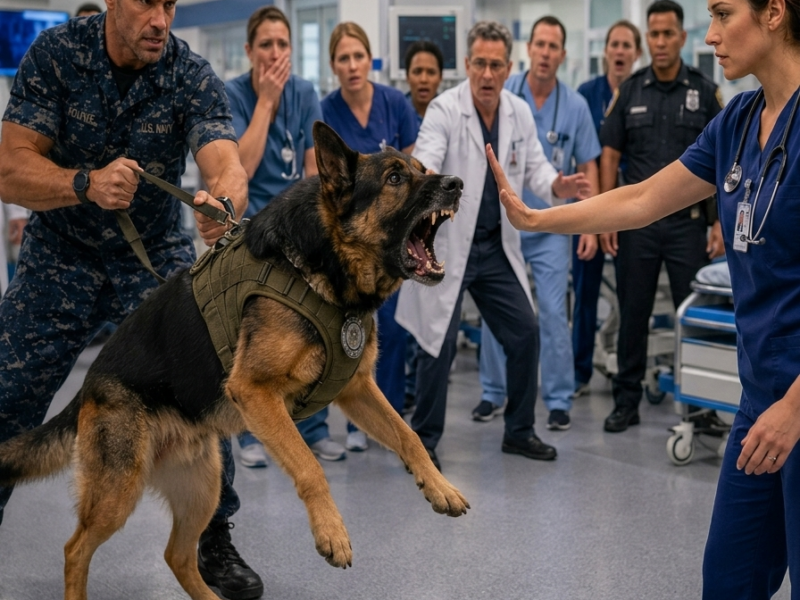
Seven armed handlers failed to control the snarling military K9 inside a Virginia hospital, and when the arrogant colonel ordered me to stay back because I was “just a nurse,”
The fluorescent lights of the Walter Reed emergency department buzzed with an unrelenting, sterile glare that cut through the humid night air. To the medical staff, I was just Emily—a quiet, hardworking ER nurse who never took sick days, never talked about her personal life, and always worked the graveyard shifts no one else wanted. For four long years, I had hidden my past behind scrub tops and surgical masks, burying my ghosts beneath the cold routine of blood pressures, IV drips, and charting.
Until 9:17 p.m., when the double doors burst open and the nightmare I thought I had left in the Hindu Kush walked right back into my life.
“Clear the bay! We’ve got an aggressive working animal and an unconscious handler incoming!” the triage nurse yelled over the blare of approaching sirens.
The stretcher rolled in hard, surrounded by five armed military handlers in tactical fatigues. But it wasn’t the wounded soldier on the gurney that had sent the waiting room into a blind panic. It was the massive, seventy-pound Belgian Malinois attached to a steel lead. The dog was a terrifying blur of muscle, dark fur, and bared teeth, thrashing wildly against his restraints. Two base security officers were already on the floor nearby, clutching bleeding forearm wounds.
“Keep him back! Get the tranquilizer gun from the armory!” yelled one of the handlers, his knuckles white as he strained against the heavy leather leash.
“We don’t have time for a trans gun!” a sharp, authoritative voice boomed through the room. Colonel Richard Hayes, the hospital’s Chief of Staff, stepped into the hallway, his pristine dress uniform stark against the blood-stained linoleum. He took one look at the thrashing animal and sneered. “Get that beast out of my emergency department! He’s a liability. If he can’t be restrained, put him down!”
“Sir, he’s a multi-purpose military working dog!” a young corporal pleaded, sweat dripping down his face. “He’s in full shock—his handler collapsed in the transport vehicle!”
Diesel’s teeth flashed beneath the harsh lights. His ears were pinned back flat against his skull, and a low, guttural growl vibrated through his chest, silencing every patient within twenty feet. The room was suffocating with fear.
I stood near the central nursing station, watching the dog with a strange, aching knot tightening in my chest. To the security guards, he was a wild, untamable monster. But I had spent three years attached to a Joint Special Operations unit in the Helmand Province. I knew that look. It wasn’t unprovoked malice. It wasn’t rabid aggression.
It was pure, unadulterated terror.
He wasn’t attacking; he was defending his downed teammate.
“Everyone, step back,” I said, my voice cutting through the noise.
Colonel Hayes turned toward me, his brow furrowing in sharp disbelief. “Excuse me?”
“Give him space,” I repeated, stepping around the counter. “You’re crowding him. The uniforms, the shouting, the restraint poles—you’re escalating his defense drive.”
Hayes let out a bitter, condescending laugh. “Nurse Carter, return to your station immediately. I am not risking seven more casualties because a floor nurse thinks she understands high-drive military assets.”
I ignored him entirely.
Diesel had begun pacing in tight, erratic circles, his breath coming in ragged, painful wheezes. His dark, intelligent eyes kept darting toward the unconscious soldier on the stretcher, his body trembling with high-frequency tremors.
I slowly unhooked my stethoscope from around my neck and laid it quietly on a supply cart. I stripped off my latex gloves. Step by step, I closed the distance between myself and the snarling Malinois.
“Carter! That is a direct order! Stand down!” Hayes barked, reaching for his holster.
I didn’t stop. I lowered myself down until my knee rested on the cold floor, placing me at eye level with the panicked animal. I took a slow, deep breath, dropping my center of gravity, and let the quiet, authoritative voice of my former life return.
I spoke a single word in Pashto—the tactical verbal command used by covert JSOC handler units.
“Aram.” (Be still.)
The word was low, calm, and weighted with absolute certainty.
Diesel froze mid-growl.
The entire emergency room seemed to stop breathing. The handlers stared at me as if I had just commanded the sun to stop shining. The dog’s ears flicked forward. His body stopped trembling.
I didn’t reach for his collar. I didn’t make sudden movements. I simply turned my palm upward, extending my bare hand toward him, resting it six inches off the floor, and waited.
For three agonizing seconds, the only sound was the steady hum of the fluorescent lights. Then, slowly, cautiously, Diesel lowered his head. He took two hesitant steps forward, leaned over my hand, and sniffed my fingers. A shudder ran through his massive frame, and he pressed his wet forehead hard into my palm.
Then came a sound that broke my heart into a thousand pieces.
A low, whimpering cry—a sound of complete surrender and profound grief.
“I know, boy,” I whispered softly, tears pricking the corners of my eyes as my fingers wrapped gently around his neck. “I know. You did your job. You brought him home.”
Colonel Hayes stepped forward, his eyes narrowed with intense suspicion. “How did you do that? Where did you learn that operational dialect?”
I ignored the colonel and focused on Diesel’s neck. Beneath the thick nylon of his tactical collar, a dark streak of fresh blood matted his fur. I gently slid two fingers beneath the metal clasp to check for a laceration. My fingers caught on something rigid jammed into the buckle—a tiny, torn strip of heavy canvas fabric.
I carefully extracted it.
It was a piece of an old, faded unit patch. Stitched into its fraying edge was a distinct, silver-threaded eagle clutching a broken arrow.
My heart slammed against my ribs so hard I couldn’t breathe.
It was my patch. The exact insignia of Task Force 88—the covert reconnaissance team I had commanded four years ago, before a nightmarish night in the mountains of Kunar left my team dead, my career destroyed, and my name erased from military registries.
My hands began to shake violently.
“Ugh…” A faint groan echoed from the stretcher.
The unconscious soldier stirred. His head rolled to the side, his pale, blood-smeared face coming into the light. His eyes flickered open, unfocused and glazed with fever. They swept past the handlers, past Colonel Hayes, and landed directly on me.
His eyes widened in sheer, paralyzing terror.
“Captain… Carter…” he whispered through cracked, bloody lips.
The silence in the ER was absolute.
Nobody moved. I hadn’t heard that title—Captain—in four long years. To everyone in this hospital, I was just Nurse Emily.
Colonel Hayes stepped in, his hand clamping down tightly over my forearm, his fingers digging into my muscle. “You need to explain yourself right now, Nurse. Who are you?”
I wrenched my arm out of his grip with a sharp, practiced wrist-lock that made the colonel stumble back two steps. I didn’t look at him. I leaned over the soldier on the stretcher, my voice shaking with rising panic.
“What happened to your handler? Who gave you this dog?”
The soldier swallowed hard, his throat working dryly. “He… he found the recording, Captain…”
“What recording?” I demanded.
The soldier’s eyes darted nervously toward Colonel Hayes, then returned to me, filled with desperate urgency. “The black-box telemetry from the chopper… four years ago in Kunar. The one proving… proving your team wasn’t killed by enemy fire.”
My blood turned to ice.
For four agonizing years, I had lived with a crushing weight on my chest. I had been told that my team was ambushed by insurgent forces because I had miscalculated our LZ coordinates. I believed I was responsible for the death of my closest friend, Lieutenant Daniel Mercer. I had carried that soul-crushing guilt into every medical shift, using the pain of others to punish myself for surviving when my team didn’t.
Now, a dying soldier was telling me it was all a lie.
Diesel suddenly stood up. He placed one broad paw on my knee, whining softly.
That was when I noticed it. Tucked securely into a custom leather pouch stitched onto the underside of Diesel’s collar was a tiny, rectangular black audio receiver.
A small red light on the device began to blink rapidly.
CLICK.
A burst of static hissed from the miniature speaker, followed by a low, raspy voice that made my lungs lock up.
“Emily… if Diesel has found you… then they know you’re alive.”
I stopped breathing entirely.
It was Daniel.
The voice belonged to Lieutenant Daniel Mercer—the man I had buried in a closed-casket funeral four years ago.
Before the static cut out, Daniel’s voice whispered six final words that shattered the air in the trauma bay:
“Don’t trust the man beside you.”
In one fluid motion, Colonel Hayes reached for his sidearm.
The sharp metallic click of Colonel Hayes unholstering his weapon was the loudest sound I had ever heard.
“Down!” I roared.
I didn’t think. Instinct, refined through hundreds of hours of close-quarters combat training, took over. I slammed my shoulder into Hayes’s midsection before his gun could clear the leather. The colonel let out a breathless grunt as we crashed into a stainless-steel medical cart, sending trays of syringes, glass vials, and surgical tools scattering across the floor in a deafening cascade.
“Traitor!” Hayes spat, his face turning beet-red as he tried to bring his weapon to bear.
“Vance! Secure the dog!” I yelled to the young corporal.
Diesel didn’t wait for orders. The moment Hayes raised his arm, the Malinois lunged forward with terrifying speed, his jaws clamping onto Hayes’s heavy tactical sleeve, locking his forearm in a vise grip. Hayes screamed in pain, dropping his 9mm pistol onto the floor.
I kicked the gun under the heavy medication cabinet.
“Security! Arrest her!” Hayes shouted, clutching his torn sleeve as the handlers drew their tasers.
“Stand down!” I barked, standing tall, my hands raised in a clear, non-threatening posture, but my eyes locked onto the three security officers stepping forward. “Look at his collar! Look at the authorization seals! That recording came from a classified DoD frequency! You are being manipulated by a compromised officer!”
The security guards hesitated, their eyes darting nervously between the panicked Chief of Staff and the nurse who had just subdued a senior officer and a military working dog in less than thirty seconds.
Suddenly, the overhead fluorescent lights flickered once, twice, and died completely.
Emergency darkness fell over the trauma bay. A split second later, the backup generators kicked in with a low, heavy rumble, bathing the hallway in a eerie, deep crimson emergency light.
BEEP. BEEP. BEEP.
Every medical monitor in the ER began chiming violently as the hospital’s primary power grid was cut from the outside.
“The grid is down!” a nurse screamed from the hallway.
“He’s wiping the facility,” I muttered, my stomach plunging into a cold abyss.
This wasn’t an official military arrest. This was a clean-up operation. Hayes wasn’t trying to detain me; he was cutting the power to draw out the tactical team that had been waiting for Diesel to lead them to me.
I spun around toward the stretcher. The wounded soldier—whose name tag read SERGEANT MILLER—was trying to pull himself up, his chest rising and falling in rapid, shallow gasps.
“Miller, can you walk?” I asked, grabbing a roll of trauma wrap from my scrub pocket and securing Diesel’s leash to my belt loop.
“I… I think so, Captain,” Miller groaned, swinging his legs over the side of the bed. “They… they hit our convoy three miles out. They knew we were coming to Walter Reed.”
“Who hit you?”
“Task Force Omega,” Miller whispered, his eyes wide with fear. “The private contractors… Hayes’s off-grid unit.”
I grabbed a syringe of emergency epinephrine, jammed it into Miller’s thigh through his pants, and hauled him off the bed. He gasped as the adrenaline hit his system, his color returning slightly.
“Corporal Vance!” I called out to the young handler who was standing frozen in the red light. “Get the rest of the civilian medical staff out through the east ambulance bay! Now! Move!”
Vance didn’t ask questions. He recognized the absolute authority in my command posture. He began ushering the panicked nurses and junior doctors toward the emergency exits.
Hayes was struggling to his feet near the cart, pulling a secondary concealed weapon from his ankle holster. “You’re not leaving this building alive, Carter!”
“Diesel! Distract!”
Diesel barked violently, slamming his weight against the supply cart and knocking a heavy monitor onto Hayes’s foot. Hayes swore loudly as Miller and I slipped through the double doors into the pitch-black service hallway leading toward the hospital’s lower basement levels.
The red emergency lights cast long, twisted shadows along the walls. The hospital, usually bustling with the quiet hum of life-saving care, felt like a tomb.
“Where are we going?” Miller panted, leaning heavily on my shoulder as we navigated the dark maze of concrete corridors.
“Sub-basement 2,” I said, my teeth clenched. “The old morgue access. It’s the only corridor in the facility that doesn’t have digital card-readers. It was built during the Cold War.”
“What about Lieutenant Mercer?” Miller asked, his breathing labored. “Is he… is he really alive?”
My grip on Miller’s arm tightened. Four years ago, during Operation Silent Fall in the Kunar Valley, my four-man team was tasked with securing a high-value Taliban commander. We were told the LZ was cold. It wasn’t. The moment our helicopter touched the dirt, we were ambushed by heavily armed mercs wearing unmarked tactical gear.
I saw Daniel take two rounds to the chest before an RPG hit our bird. I was blown fifty feet down a rocky ravine, suffering a traumatic brain injury and broken ribs. When I woke up in a field hospital six days later, I was told that Daniel’s body had been recovered and buried, and that I was being honorably discharged due to tactical negligence.
They lied about everything.
“I don’t know,” I whispered, my voice trembling in the dark. “But if Daniel is alive, he’s been running for four years. And he used Diesel to find me.”
We reached the heavy steel fire door marked SUB-BASEMENT 2 – RESTRICTED.
I grabbed the mechanical push-bar and shoved it down. The door creaked open, revealing a dark, concrete stairwell that smelled faintly of damp earth and old bleach.
Before we could step inside, Diesel let out a sharp, silent warning tug on my belt. His fur stood on end, his ears locked forward into the shadows below.
From the bottom of the stairwell came the distinct, rhythmic heavy crunch of tactical boots on gravel.
They were already inside the building.
I pulled Miller back into the doorway, pressing my back against the cold concrete wall.
Diesel crouched low at my knee, his chest vibrating with a silent growl that I could feel through my boots. I reached down and rested my hand on his head, whispering the Pashto command for silence. He went instantly still, his body locked like a coiled spring.
Down in the darkness, two tactical flashlights cut through the mist of the stairwell, their narrow beams dancing across the walls.
“Target is a female, 5’7”, wearing dark blue scrubs,” a low, harsh voice echoed up the concrete shaft. “She’s accompanied by a wounded soldier and the Malinois. Command gave green-light rules of engagement. No witnesses.”
“Copy that, Lead,” a second voice replied. “What about the hard drive in the dog’s collar?”
“Extract the drive, burn the dog, clear the room.”
My blood boiled. These weren’t soldiers serving their country. These were hired clean-up crews—mercenaries operating under off-the-books DoD slush funds, erasing the loose ends of a corrupt military industrial machine.
I looked at Miller. He was leaning against the wall, pale, sweating, and completely unarmed.
“Miller,” I whispered, leaning in close. “How many men were in the team that hit your convoy?”
“Six,” Miller whispered back, his voice trembling. “Two at the gate… four inside.”
“That leaves two on this floor,” I calculated rapidly. “They think they’re hunting a civilian nurse who’s terrified in the dark. They don’t know I spent three years with the 24th STS.”
I unhooked Diesel’s leash from my belt. I looked into his deep, dark eyes and gave him three rapid hand signals: Flank left. Target rear operative. Silent takedown.
Diesel understood instantly. He melted into the pitch-black shadows of the hallway like a ghost, moving without making a single sound on the polished linoleum.
I waited five seconds.
One… two… three… four… five.
I stepped directly into the open doorway of the stairwell, raising a metal fire extinguisher I had pulled off the wall bracket.
“Hey!” I shouted into the dark.
The lead operative raised his weapon instantly, his flashlight beam pinning me against the frame. “Target acquired! Dropping her—”
Before he could pull the trigger, a ninety-pound streak of black and tan fur launched itself from the dark landing above.
Diesel slammed into the lead operative’s shoulders with the force of a freight train. The man let out a choked yell as he tumbled down four concrete steps, his rifle clattering against the metal railing.
“What the—!” the second operative screamed, swinging his weapon toward the thrashing pile of dog and body armor.
I didn’t give him the chance.
I vaulted over the handrail, dropping eight feet down onto the landing. I drove the heavy steel base of the fire extinguisher directly into the second operative’s helmeted face. The impact cracked his visor, snapping his head back against the concrete wall with a sickening thud. He slid down the wall, completely unconscious.
I grabbed his tactical belt, unholstering his suppressed SIG Sauer P226 pistol in one fluid motion, racked the slide, and pointed it down the stairs.
The lead operative was on his back, frantically trying to pull a combat knife while Diesel pinned his arm to the floor.
“Move and you die,” I said, my voice dead calm, the green night-sights of the P226 aligned directly between his eyes.
The mercenary froze. The flashlight lying on the stair tread illuminated his face. He was wearing an unmarked black tactical kit with a patch depicting a red scorpion—the signature emblem of Apex Security, a private contractor known for high-risk operations in warzones.
“Where is Colonel Hayes keeping the central server?” I demanded, stepping down the stairs and keeping the weapon locked on his chest.
The mercenary spat blood onto the concrete. “Go to hell, Nurse.”
I didn’t argue. I leaned down, retrieved his tactical radio from his vest, and pressed the push-to-talk button.
“Hayes,” I said into the radio, my voice icy steel. “This is Captain Emily Carter. Your two point-men are down. Your power outage didn’t work. If you want this hard drive, come down to Sub-Basement 2 and get it yourself.”
I smashed the radio under my boot, pulling Diesel back with a quiet command.
“Miller, take his tactical vest and ammo,” I ordered as Miller limped down the stairs. “We’re going to the old records archive.”
Ten minutes later, we reached the deep sub-basement of Walter Reed—a forgotten labyrinth of vaulted concrete rooms filled with rows of rusting file cabinets, old iron desks, and discarded medical equipment from the 1970s. The air here was ice-cold and smelled of damp decay.
I led Miller into a secure file vault with a three-foot-thick reinforced steel door. I helped him sit down against a stack of wooden crates, hand-feeding him a bottle of saline from my nursing pouch.
Diesel lay down at the door, his eyes fixed on the dark corridor outside, his ears flicking at every tiny sound of settling concrete.
I knelt beside Diesel, carefully unbuckling the small black device from his collar.
Up close, I could see it wasn’t just a receiver. It was a military-grade satellite transceiver fitted with a biometric thumbprint scanner. The small LED screen on top was flashing amber, waiting for an authorized input.
“He programmed it for you, Captain,” Miller said softly, his back resting against the crates. “Daniel… he spent two years tracking down the black box from your chopper. He knew if he tried to bring it to the Pentagon, Hayes’s people would intercept him. So he put it on Diesel and set the encryption lock to your biometric signature.”
My thumb trembled as I raised it over the small glass scanner.
For four years, I had believed I was dead to the world. I had lived like a ghost, running from a memory that tore at my soul every single day.
I pressed my thumb against the glass.
BEEP.
The amber light turned solid green.
A tiny projector on the side of the device flickered to life, casting a bright blue holographic screen onto the damp concrete wall of the vault.
A file directory appeared. There was only one audio-visual file listed.
Filename: OPERATION_SILENT_FALL_BLACKBOX.RAW
I pressed play.
The holographic screen flared with high-definition thermal video, recorded from the forward optic suite of an MH-47 Chinook helicopter. The timestamp in the corner read: 14-OCT-2022 / 02:14:09 UTC.
The audio cracked through the tiny speaker, loud and raw.
“This is Task Force 88, LZ is hot! Repeat, LZ is extremely hot!”
My own voice echoed from four years ago, filled with the desperate intensity of a commander trying to hold a perimeter under heavy mortar fire.
“Hold your fire! Those aren’t insurgents!” Daniel’s voice boomed through the speaker. “I’m seeing blue-force beacons! They’re American contractors! Why are American contractors firing on our LZ?!”
On the screen, thermal images showed four men in tactical gear advancing on our chopper, firing heavy automatic weapons into the cockpit.
Then came a voice over the helicopter’s primary command channel—a voice I recognized instantly.
“Task Force 88, this is Command Control,” Colonel Hayes’s voice rang out clear and cold through the recording. “Your unit has been compromised. Target asset must not be recovered. Executing Protocol Omega. Clean the site.”
“Hayes! What are you doing?!” my past self screamed over the radio. “There are six personnel on this bird! We have the intel!”
“The intel is the problem, Captain,” Hayes replied flatly. “Good luck.”
The video showed an unmarked strike drone dropping from the clouds, launching a laser-guided missile directly into the side of our helicopter. A blinding flash of white thermal light filled the screen, followed by deafening static, screaming, and the roar of exploding jet fuel.
The recording cut to black.
I stood there in the cold vault, unable to move, unable to speak.
It wasn’t a mistake. It wasn’t my bad call.
We weren’t ambushed by enemy fighters. We were executed by our own command structure because Task Force 88 had accidentally recovered evidence of a multi-million-dollar illegal weapons trade operated by senior military staff inside the Pentagon. Hayes had ordered a strike on his own soldiers to keep the network hidden.
“They… they murdered them…” I whispered, tears finally overflowing and tracing hot paths down my cold face. “They murdered Daniel… Jackson… Miller…”
“Not all of us,” a quiet voice echoed from the dark hallway outside the vault.
I spun around, raising my SIG Sauer P226 instantly, my finger resting lightly on the trigger.
Diesel didn’t growl. Instead, he stood up slowly, his tail giving a single, hesitant wag.
A tall figure stepped out of the deep shadows of the basement corridor.
He was wearing a dark, faded tactical jacket, his face weathered and scarred, a heavy dark beard covering his jaw. He walked with a slight limp, his right arm resting in a black sling. But his eyes—those fierce, intelligent blue eyes—were unmistakable.
“Daniel…” The gun trembled in my hands.
“Put the piece down, Em,” Lieutenant Daniel Mercer said, his voice cracking with emotion as he took a slow step into the vault light. “You’re gonna shoot the guy who drove three hundred miles just to give you your dog back.”
I dropped the gun onto a wooden crate and flew across the room.
I slammed into his chest, wrapping my arms around his neck so tightly I thought I would break his ribs. Daniel wrapped his good arm around my back, burying his face in my hair as we both stood in the dark vault, crying silently against the cold concrete.
“I thought you were dead,” I sobbed, pulling back to look at his scarred face. “I buried you, Daniel! I went to your funeral!”
“They buried an empty box, Em,” Daniel whispered, touching the scar on my cheek. “I was blown out of the bird before the missile hit. A local shepherd found me, hid me in a cave for three months until I could walk. When I finally made it back to a secure terminal, I realized Hayes had wiped our records. If I came forward, they would have finished the job. So I went dark. I spent four years gathering the telemetry files.”
“And Diesel?” I asked, looking down at the dog who was now leaning against Daniel’s leg.
“He was captured by Apex contractors after the crash,” Daniel said grimly. “They used him as a patrol dog at a black site in Virginia. I spent six months planning the raid to break him out. But during the escape, Miller took a round to the gut. I knew I couldn’t get Miller to a civilian hospital without Hayes flagging it. So I sent them here—to you.”
“Because you knew I’d be here,” I said.
“I always knew where you were, Em,” Daniel smiled softly. “I kept watch over you from the dark. But now… the game is over. We have the raw black-box file. It’s hardwired to broadcast to the Inspector General’s office the moment this device hits an open satellite link.”
Suddenly, a cold, metallic voice echoed through the vault’s intercom system.
“How touching,” Colonel Hayes’s voice sneered through the small wall speaker. “The ghosts of Task Force 88, reunited in a morgue. How poetic.”
The heavy steel vault door behind us suddenly slammed shut with a deafening CLANG.
The hydraulic locks engaged with a heavy, mechanical hiss.
“Hayes!” I screamed, rushing to the door and slamming my hands against the three-inch reinforced steel viewing window.
On the other side of the glass stood Colonel Hayes, flanked by four heavily armed Apex Security contractors. He held a digital control pad in his hand, a cold, triumphant smile plastered across his face.
“Did you really think I didn’t monitor the internal telemetry of this facility?” Hayes chuckled softly through the intercom. “This vault was designed in 1962 to store bio-hazardous waste. Once the seal is engaged, the ventilation shuts off entirely. In forty-five minutes, the oxygen in that room will drop to lethal levels.”
“You won’t get away with this, Hayes!” Daniel shouted, leaning against the glass. “The data is already queued! The moment a satellite link opens, your entire network goes down!”
“Which is why that link will never open,” Hayes replied calmly. “I have a signal jammer running on the roof. Once you all suffocate quietly down here, my team will retrieve the dog, destroy the drive, and cremate the remains. A tragic electrical fire in the old wing of Walter Reed. A tragic accident.”
Hayes turned his back on the window and began walking away. “Enjoy your reunion, Captain Carter. It will be your last.”
The red indicator light on the vault door turned solid lock.
Inside the vault, the heavy hum of the ventilation system cut out completely. The air instantly grew heavy, thick, and still.
“We have to blow the hinges!” Miller said, panic rising in his voice as he looked around the concrete room. “Is there any explosive material in here?”
“No,” Daniel said quietly, examining the steel doorframe. “These doors were built to withstand a nuclear blast. We can’t punch through three inches of hardened steel with 9mm sidearms.”
I stood by the window, my mind racing at lightspeed through tactical schematics.
I looked at the concrete walls, the iron support beams, the electrical conduit running along the ceiling… and then my eyes landed on Diesel.
“Daniel,” I said suddenly, turning around. “Where is the signal jammer located?”
“On the main communications tower above the roof,” Daniel answered, frowning. “Why?”
“The ventilation shaft,” I pointed to a small, eighteen-inch square steel duct near the ceiling corner of the vault. “It was designed for emergency air release. It runs straight up through the old laundry chute directly to the roof.”
“It’s eighteen inches wide, Em,” Daniel shook his head. “A human can’t fit in there. Not even you.”
I knelt down beside Diesel.
He looked at me, his dark eyes wide, intelligent, and completely trusting. He nudged my hand with his cold nose, giving a soft, firm huff.
“A human can’t,” I said, my heart pounding in my chest. “But a military working dog can.”
I reached into Miller’s tactical vest, pulling out the small black satellite drive. I secured it tightly into Diesel’s collar pouch, making sure the external antenna was extended. Then, I pulled out a small tactical beacon and attached it to his vest.
“Diesel,” I said, holding his face in my hands, looking directly into his eyes. “You have to take this to the roof. You destroy that jammer, and you broadcast this file. Do you understand me, boy?”
Diesel gave a low, sharp bark—a clear, unambiguous affirmative.
Daniel helped me unscrew the heavy metal grate covering the ventilation duct using the tip of a combat knife. The small square shaft was dark, steep, and covered in decades of dust, but it opened directly upward into the building’s core structure.
I lifted Diesel up toward the opening.
“Kala-na-meya, sheryan-zma,” I whispered in Pashto. (Hold the line, my blood.) “Go!”
Diesel scrambled into the narrow steel shaft, his powerful legs driving him upward into the darkness. The metallic sound of his claws scraping against the duct echoed through the vault, growing fainter and fainter as he climbed toward the roof.
Inside the sealed vault, twenty minutes passed in agonizing silence.
The oxygen level was dropping rapidly. My head began to throb with a dull, heavy ache, and Miller was struggling to stay conscious against the wall, his breathing ragged and shallow.
“Do you think he made it?” Miller whispered, his eyes fluttering shut.
“He’ll make it,” Daniel said, holding my hand tightly as we sat together on the cold floor. “He’s Task Force 88. He doesn’t fail.”
Above us, far up on the roof of Walter Reed, a storm was brewing.
Through the narrow ventilation pipe, we suddenly heard the faint, distant sound of gunshots echoing down from the roof.
CRACK! CRACK! CRACK!
Then came a high-pitched, metallic crash, followed by the deep, terrifying roar of a Belgian Malinois in full attack drive.
“He found the jammer,” I said, standing up despite the dizziness tearing through my head.
Suddenly, the satellite receiver in my pocket—linked to the hard drive on Diesel’s collar—vibrated violently.
The screen lit up with a bright green notification:
SATELLITE UPLINK ESTABLISHED.
BROADCASTING DATA TO DEPT OF JUSTICE… 10%… 45%… 89%…
TRANSMISSION COMPLETE.
“It went through,” Daniel whispered, tears streaming down his face as he looked at the screen. “It went through! The Inspector General has the file!”
A split second later, the heavy electronic locks on the vault door let out a loud, continuous warning alarm.
BEEP! BEEP! BEEP!
The red light on the door turned bright green, and the heavy hydraulic deadbolts retracted with a loud THUNK.
The vault door swung open.
Standing in the hallway was a full tactical team from the Federal Bureau of Investigation’s Hostage Rescue Team, their heavy rifles raised, their tactical uniforms bearing official federal insignias.
“Federal agents! Clear the room!” the lead team commander shouted, stepping inside and spotting Daniel and me. “Captain Carter? Lieutenant Mercer?”
“We’re clear!” I yelled, helping Miller to his feet. “Where is Colonel Hayes?!”
“Colonel Hayes was apprehended on the helipad two minutes ago,” the FBI commander replied, lowering his weapon. “His entire offshore account network was flagged by the Department of Justice three minutes ago based on a broadcast originating from this facility. Federal marshals are securing the building.”
I didn’t wait to hear the rest.
I pushed past the federal agents, running down the dark basement corridor, taking the stairs three at a time until I burst through the roof access doors into the cool, night rain.
Standing on the roof, surrounded by flashing blue police lights and hovering federal helicopters, was Colonel Hayes. He was in handcuffs, being shoved into the back of an unmarked black SUV by two armed marshals, his face pale, his career and his life completely destroyed.
And standing on top of the shattered remains of the signal jammer, his head held high against the wind, was Diesel.
The rain washed the dirt and blood from his dark coat. He looked across the roof, spotted me running toward him, and let out a loud, joyous bark that echoed across the entire city of Washington, D.C.
I dropped to my knees in the pouring rain, wrapping my arms around his neck as he covered my face with wet, happy licks. Daniel and Miller came out onto the roof behind me, leaning against each other, watching the sun begin to break through the dark storm clouds on the eastern horizon.
The four-year nightmare was over.
The truth was out. My team was cleared.
I looked up into the morning sky, feeling the cold rain on my face, knowing that I would never have to hide in the shadows again.
I was no longer a ghost nurse hiding from her past.
I was Captain Emily Carter—and I had finally brought my team home.
The end









