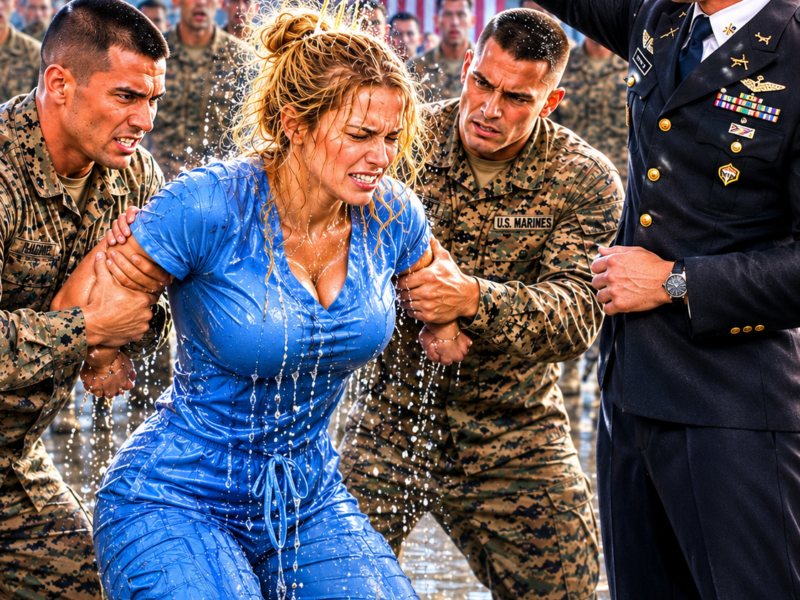
“Sergeant Whitcomb ordered me to step away from a dying gunshot victim in front of the entire emergency department
“She told me you’re alive.”
Daniel’s fingers tightened around my wrist.
I leaned closer, trying to hear him over the alarms and the voices filling the trauma bay.
“Who, Daniel? Who told you?”
His eyes drifted toward the ceiling.
“Commander Ford.”
Then his grip weakened.
“Don’t let them bury it again.”
The monitor continued sounding.
I looked at the emergency physician.
“He’s losing consciousness.”
The physician moved toward the head of the bed.
“Prepare for decompression. Now.”
I stepped back enough to give the team room, but I couldn’t stop looking at Daniel’s face.
Three years.
Three years of believing he was dead.
Three years of waking up in the middle of the night remembering the last time I had seen him.
And now he was lying in front of me, bleeding, asking me not to let someone bury something again.
The physician performed the emergency procedure while the respiratory therapist managed Daniel’s airway.
A rush of air escaped.
The monitor flickered.
“Wait. We’ve got a rhythm.”
Someone checked for a pulse.
“Pulse is back.”
The room began moving again.
“Blood pressure is coming up.”
I exhaled slowly.
Daniel was still in critical condition, but he was alive.
The emergency physician looked toward me.
“Torres, I need you to tell me exactly what you saw.”
I gave him the assessment.
He nodded and turned toward the trauma team.
“Get surgery on the phone. We’re moving him to the operating room as soon as they’re ready.”
Whitcomb stood near the doorway.
His face had lost its usual confidence.
He looked at Daniel, then at me.
“What’s going on here?”
I didn’t answer.
I was watching the surgical team prepare Daniel for transfer.
A paramedic approached with Daniel’s belongings.
His wallet, phone, and a small metal identification tag had been placed inside a clear evidence bag.
I recognized the tag immediately.
It was a Navy identification tag.
The engraving was worn, but I could still read it.
D. CRUZ.
I had given it to him three years earlier after his original tag had been damaged during deployment.
He had kept it.
I turned away before anyone could see my expression.
The operating room doors closed.
For the next four hours, I sat in the small waiting area outside the surgical department.
I didn’t check my phone.
I didn’t get coffee.
I barely noticed the people passing.
Every time a door opened, I looked up.
Eventually, a surgeon came toward me.
“Are you family?”
“No. I served with him.”
The surgeon nodded.
“He’s out of surgery. We controlled the bleeding, repaired the injuries we found, and stabilized him. He’s going to intensive care.”
I closed my eyes.
“Thank you.”
“He has a long recovery ahead. But he’s alive.”
I thanked him again.
Then I went to the ICU.
Daniel was surrounded by monitors and infusion pumps.
His face looked thinner than I remembered.
The scar near his temple was still there.
I stood beside his bed and watched the rise and fall of his chest.
A nurse entered to check his medication.
“Are you a relative?”
“No. We served together.”
She glanced at the chart.
“He’s sedated. You can stay for a few minutes, but don’t disturb him.”
I nodded.
Then I noticed the metal tag sitting in a belongings bag near the cabinet.
I picked it up.
The small inscription on the back had almost disappeared.
But I remembered what I had written there.
“Bring him home.”
I had written it before the mission.
Daniel had laughed when I gave it to him.
“You’re getting sentimental, Reyes.”
“Someone has to make sure you idiots survive.”
He had put it around his neck.
Now it was back in my hands.
I sat down.
For the first time in three years, I allowed myself to cry.
Not loudly.
Not dramatically.
Just enough for the tears to reach my chin before I wiped them away.
The following morning, Whitcomb summoned me to his office.
He was sitting behind his desk when I entered.
A folder lay open in front of him.
“Close the door.”
I did.
He pointed toward the chair.
“Sit.”
I remained standing.
He looked annoyed.
“Fine. I’ll get to the point.”
He tapped the folder.
“You’re suspended pending an investigation.”
I looked at him.
“On what grounds?”
“Unauthorized medical intervention. Insubordination. Misrepresentation of professional history.”
“My professional history?”
“You appear to have military medical training you never disclosed.”
I stared at him.
“I never claimed otherwise.”
“Your application says Maya Torres.”
“That’s the name on my license.”
He leaned back.
“Then perhaps you can explain why a gunshot victim recognized you by another name.”
I didn’t answer.
Whitcomb smiled faintly.
“Interesting, isn’t it?”
I looked at the folder again.
He had already printed something.
A photograph.
It showed me in a Navy uniform, standing beside a group of service members.
The picture was from a deployment ceremony.
I recognized the woman standing to my right.
Commander Alicia Ford.
Whitcomb watched my face.
“Who is Elena Reyes?”
I took a breath.
“Someone who used to serve.”
“And why are you pretending she doesn’t exist?”
I looked at him.
“Because I wanted to work somewhere without being reminded of what happened.”
His expression hardened.
“Well, you should have thought about that before creating a scene in my department.”
I almost laughed.
A scene.
A man had nearly died.
And Whitcomb was worried about the appearance of his department.
He slid a document toward me.
“Sign this acknowledgment that you acted outside your assigned role.”
I looked at the paper.
It stated that I had independently performed an unauthorized procedure without physician involvement.
That wasn’t what had happened.
The emergency physician had assessed Daniel and directed the intervention.
I pushed the paper back.
“I’m not signing something inaccurate.”
Whitcomb stood.
“Then your suspension will remain in effect.”
I nodded.
“All right.”
He seemed disappointed that I wasn’t arguing.
As I reached the door, he spoke again.
“Torres.”
I turned.
“Whatever happened in the military, it doesn’t make you untouchable here.”
I met his eyes.
“I never asked to be.”
Then I walked out.
By lunchtime, the entire department knew.
Some nurses avoided me.
Others approached quietly.
One of the younger technicians stopped me near the elevators.
“Is it true you were a Navy medic?”
I nodded.
“Yes.”
“Why didn’t you tell anyone?”
“Because I didn’t want it to be the first thing people knew about me.”
He looked at the floor.
“Well, it’s all anyone is talking about.”
I understood.
For three years, I had built a life around not being noticed.
Now the secret was moving through the hospital faster than any official announcement.
That evening, I returned to the ICU.
Daniel was awake.
His eyes opened when I entered.
For a moment, he looked confused.
Then he smiled faintly.
“Reyes.”
I pulled a chair beside him.
“Don’t start.”
He gave a weak laugh.
“Still bossy.”
“Still terrible at following instructions.”
He tried to move, then winced.
“Don’t move,” I said.
He looked at me carefully.
“You’re alive.”
I looked down.
“So are you.”
He swallowed.
“I thought you were gone.”
“I thought you were dead.”
His expression changed.
“Who told you that?”
I stared at him.
“After Ashcroft, the Navy told me there were no survivors from your vehicle.”
Daniel closed his eyes.
“They lied.”
I leaned forward.
“What?”
He opened his eyes again.
“I wasn’t in the vehicle when it exploded.”
I felt the room narrow around me.
“Then where were you?”
“Captured. Injured. They moved me before the extraction team reached the site.”
I stared at him.
For three years, I had replayed the moment I watched the vehicle burn.
I had believed I had failed to get him out.
“You were alive?”
He nodded slowly.
“Not for long, according to the people who found me.”
I gripped the chair.
“Why didn’t anyone tell me?”
Daniel looked toward the window.
“Because the report was changed.”
“By whom?”
He hesitated.
“Commander Ford knows.”
I sat back.
“Ford said you were dead.”
“She told me you were alive.”
“Daniel, you’re not making sense.”
He took a shallow breath.
“She visited me after the mission. Told me you had been transferred. Said you were under protection.”
I shook my head.
“I was never under protection.”
He looked at me.
“Then someone lied to both of us.”
I sat silently.
The memories of Ashcroft came back in pieces.
The smoke.
The radio.
The evacuation order.
The missing names.
And a final message from command telling me the mission had been compromised.
I had never known why.
Daniel’s voice interrupted my thoughts.
“There’s something else.”
I looked at him.
“What?”
He shifted his eyes toward the door.
“I wasn’t shot by enemy fire.”
I stared at him.
“What are you saying?”
He swallowed.
“Someone on our side knew where we were going.”
Before I could ask another question, a nurse entered.
“Mr. Cruz, you need to rest.”
Daniel closed his eyes.
I stood.
“Wait,” he whispered.
I leaned closer.
“Don’t trust the first person who comes looking for you.”
Then the nurse asked me to leave.
I walked out of the ICU with those words following me.
The next morning, I received a phone call from an unknown number.
I almost ignored it.
Then I heard a familiar voice.
“Elena?”
I stopped walking.
“Commander Ford.”
There was a pause.
“I heard about Daniel.”
“He’s alive.”
“I know.”
I gripped the phone.
“Then you know what he told me.”
Another pause.
“Where are you?”
“At Riverbend.”
“I’ll be there this afternoon.”
“Why?”
“Because there are things you deserve to hear from me directly.”
I looked through the glass toward the ICU.
“Three years is a long time to wait.”
“I know.”
“Did you know Daniel was alive?”
Her silence answered before she did.
“Yes.”
I closed my eyes.
“Then you’d better have a very good explanation.”
She arrived at 2:30 p.m.
A black government sedan pulled into the parking lot.
Commander Alicia Ford stepped out wearing her Navy dress uniform.
Her silver hair was pulled neatly back.
She looked exactly as I remembered.
But I noticed something different.
She seemed tired.
Not physically.
The kind of tired that comes from carrying something for too long.
Whitcomb appeared near the emergency department entrance.
He had apparently been waiting for her.
“Commander, thank goodness. I’m Sergeant Whitcomb, head of emergency services.”
Ford barely acknowledged him.
“Where is Elena Reyes?”
Whitcomb blinked.
“She’s currently suspended.”
Ford looked directly at him.
“That wasn’t my question.”
I stepped out from the hallway.
“I’m here.”
Ford turned.
For a moment, neither of us spoke.
Then she walked toward me.
“Petty Officer First Class Elena Reyes.”
Her voice carried through the waiting area.
“Two combat deployments. Navy Cross recipient. Credited with fourteen confirmed field saves under direct enemy fire.”
A few nurses stopped what they were doing.
Someone whispered.
Whitcomb looked from Ford to me.
“That’s impossible. She’s a nurse.”
Ford’s expression didn’t change.
“She’s a decorated combat medic who saved a man’s life in your emergency department while you questioned her judgment.”
Whitcomb opened his mouth.
“She acted outside protocol.”
Ford turned toward him.
“She recognized a life-threatening emergency. Your department’s response is what needs reviewing.”
The waiting area had become completely silent.
Whitcomb looked at me.
“Torres, you told me you were just a nurse.”
I held his gaze.
“I am a nurse.”
Ford stepped closer.
“And her name is Reyes.”
Whitcomb looked as if someone had pulled the floor out from beneath him.
Ford handed a document to the hospital administrator, who had just arrived.
“I am formally requesting an investigation into the circumstances surrounding Daniel Cruz’s injuries, the original Ashcroft incident report, and the handling of his medical records.”
The administrator frowned.
“What does this have to do with our hospital?”
Ford looked at me.
“Everything.”
Then she turned back to the administrator.
“Daniel Cruz was the only surviving witness to an incident that was officially reported as an enemy ambush. His medical records and transfer documents were altered after the event.”
Whitcomb stepped forward.
“This is a hospital. We don’t handle military investigations.”
Ford looked at him.
“Then perhaps you should be concerned about the civilian contractor whose name appears in both the military medical records and your hospital’s billing system.”
I felt my stomach tighten.
“What contractor?”
Ford handed the administrator another page.
“Northstar Surgical Services.”
The name meant nothing to me.
But Whitcomb reacted immediately.
It was small.
A tightening around his mouth.
A glance toward the administrator.
Then he looked away.
I noticed.
Ford noticed, too.
“Interesting,” she said quietly.
The administrator took the documents.
“We’ll need to review this.”
“You will,” Ford replied. “And you will preserve every relevant record.”
Then she turned toward me.
“Elena, we need to talk.”
I followed her into a private conference room.
She closed the door.
For several seconds, she simply looked at me.
Then she removed her uniform cap and placed it on the table.
“I owe you an explanation.”
I folded my arms.
“You owe me three years.”
She accepted that without argument.
“Operation Ashcroft was compromised before your team entered the extraction zone.”
I felt my jaw tighten.
“We knew that.”
“You knew there was a possibility. You didn’t know how far it went.”
She opened a folder.
Inside were copies of old mission documents, medical reports, and communications.
“The intelligence package your team received had been altered. The location of the convoy was leaked.”
I stared at the pages.
“Who leaked it?”
Ford shook her head.
“We’re still establishing the full chain. But Northstar had access to certain operational medical logistics contracts.”
I looked at her.
“A surgical contractor?”
“They were supposed to provide emergency evacuation support and medical equipment. Some of their personnel had access to restricted movement schedules.”
I remembered the mission.
The vehicle assignments.
The route change.
The strange delay before extraction.
“Why was Daniel’s survival hidden?”
Ford lowered her eyes.
“Because Daniel identified someone involved in the leak.”
“Who?”
“We didn’t know whether the information had reached everyone who needed to know. His medical evacuation was kept restricted while investigators worked to protect him.”
“And what about me?”
Ford looked at me.
“You were not supposed to be told he had survived until the investigation was secure.”
I stood.
“So you let me believe he was dead?”
“I believed that was the safest option.”
“For whom?”
She didn’t answer.
I looked down at the folder.
There were reports about the explosion, the casualties, and the investigation.
One page listed the names of the personnel recovered from the convoy.
Daniel’s name was marked as deceased.
But beneath it was a handwritten notation.
“Transferred under restricted medical status.”
I pointed at it.
“This is the original?”
Ford nodded.
“Yes.”
“Who changed it?”
“We’re still investigating.”
I stared at her.
“You knew.”
“I knew he had survived. I didn’t know who had altered the public record.”
I looked toward the door.
“Then why are you here now?”
“Because Daniel contacted me after he was attacked.”
I turned back.
“Attacked?”
Ford nodded.
“He was shot outside a secure residence two days before arriving at your hospital. He had been trying to deliver evidence.”
I remembered the paramedics.
The blood.
The missing information about the shooting.
“Where is the evidence?”
Ford hesitated.
“Daniel told me he had it.”
I felt the room grow colder.
“Does he?”
“He believes he does.”
I sat down slowly.
“Then someone knows he survived.”
Ford nodded.
“And someone knows he may have information that can expose the people behind Ashcroft.”
I looked at her.
“Are you telling me Daniel was attacked because of what happened three years ago?”
“That’s what we’re investigating.”
For the first time, I understood why he had whispered my name.
He hadn’t come to Riverbend by coincidence.
He had been trying to reach me.
And someone had nearly killed him before he could.
I looked at Ford.
“Why me?”
She leaned forward.
“Because Daniel says you were the only person who saw something important during the mission.”
I shook my head.
“I didn’t see anything.”
“You may not remember it that way.”
I looked at the old documents again.
Then I remembered a detail I had spent three years trying to forget.
During the evacuation, I had found a second radio inside the vehicle.
It wasn’t assigned to our unit.
It was already tuned to the frequency used by the extraction team.
And just before the explosion, I had heard someone say our exact location.
I had reported it.
The report disappeared.
I looked up.
“Ford, I heard someone give our coordinates before the convoy was hit.”
Her expression changed.
“What?”
“On a second radio. I reported it after the mission.”
Ford slowly opened another folder.
“That report was never included in the final investigation.”
I stared at her.
“Then somebody removed it.”
She nodded.
“Yes.”
The room went silent.
I looked down at my hands.
For three years, I had blamed myself for not recognizing the ambush sooner.
I had believed that if I had reacted faster, I might have saved more people.
Now I was beginning to understand that someone had known exactly where we would be.
And they had allowed us to walk into it.
Ford closed the folder.
“Elena, I need you to be careful. If this investigation is correct, the people involved have access to resources and information.”
I stood.
“I’ve been careful for three years.”
She looked at me.
“Not careful enough to stay away from Daniel.”
I met her eyes.
“I’m not leaving him.”
She didn’t argue.
That evening, I returned to the ICU.
Daniel was awake and sitting slightly upright.
His color was improving.
He smiled when I entered.
“Still stubborn.”
I pulled the chair closer.
“Apparently it runs in the family.”
He laughed, then winced.
“Don’t make me laugh.”
I sat down.
“Tell me about the evidence.”
His smile disappeared.
He glanced toward the door.
“Did Ford tell you?”
“Some of it.”
He reached toward the bedside table.
A nurse had placed his phone and personal belongings there.
He picked up the phone with difficulty.
“There’s a recording.”
“Of what?”
“Someone discussing the mission before we left.”
I leaned closer.
“Who?”
Daniel swallowed.
“I don’t know the name. But I recognize the voice.”
“Whose voice?”
He looked at me.
“Someone who was supposed to be on our side.”
Before he could continue, his monitor alarm sounded.
The nurse entered immediately.
“Mr. Cruz, you need to rest.”
Daniel handed me the phone.
“There’s a file. Don’t open it here.”
I took it.
Then he added something that made my hands tighten around the device.
“Reyes, if that recording is real, the people who buried Ashcroft are still working.”
I looked at the phone.
A single audio file was saved under an unfamiliar name.
ASHCROFT_FINAL_03.
I slipped it into my pocket.
I didn’t open it.
Not yet.
The next morning, I met Ford in a small office away from the hospital’s main entrance.
She brought a military investigator named Lieutenant Commander James Miller.
He was in his forties, wore plain clothes, and had the kind of expression that suggested he had learned not to trust first impressions.
Ford introduced us.
“He’s been assigned to the Ashcroft review.”
Miller shook my hand.
“Petty Officer Reyes.”
“Just Elena.”
He nodded.
“All right. Elena, I understand Daniel gave you a recording.”
I placed the phone on the table.
“He said it might identify someone involved in the mission leak.”
Miller didn’t touch it immediately.
“Did you listen?”
“No.”
“Good. We’ll make a forensic copy and preserve the original.”
He opened a secure evidence case.
I watched him carefully.
“Who has access to this?”
“Only the authorized investigative team.”
“Can you guarantee that?”
He met my eyes.
“I can guarantee we’ll document every person who handles it.”
It wasn’t the same as a promise that nobody could ever access it.
But it was an answer I could respect.
He secured the phone.
Then he asked me to describe the second radio.
I explained where I found it and what I heard.
Miller wrote everything down.
“Do you remember the exact words?”
I closed my eyes.
The memory came back slowly.
Static.
A burst of interference.
Then a voice.
“Convoy is entering the east approach. Confirmed.”
I opened my eyes.
“That was the phrase.”
Miller looked at Ford.
“Did the official report mention an east approach?”
Ford shook her head.
“The final report says the convoy was redirected after a navigation failure.”
I stared at them.
“That’s not what happened.”
Miller closed his notebook.
“Then we have a discrepancy worth investigating.”
For the next two days, I remained suspended from Riverbend.
The hospital administration began its internal review.
At first, I thought the worst consequence would be losing my job.
Then security called.
They had found a man in the parking garage attempting to access a restricted records room.
He claimed he was a contractor.
His badge was fake.
When security approached him, he tried to leave through the stairwell.
Police detained him before he reached the exit.
The hospital called Ford.
She asked me to come downstairs.
I arrived to find two officers speaking with a man in a gray jacket.
He was perhaps forty, with short hair and a small scar near his chin.
His eyes moved constantly.
He watched the doors.
The cameras.
The people walking through the corridor.
I recognized the behavior immediately.
It wasn’t the way a hospital contractor moved.
It was the way someone moved when he expected trouble.
Ford stood beside the administrator.
“Do you recognize him?”
I shook my head.
“No.”
The man looked at me.
Then his expression changed.
“That’s her.”
One officer turned.
“Who?”
“Reyes.”
The hallway became quiet.
Ford stepped forward.
“How do you know her?”
The man said nothing.
An officer removed a small device from his jacket.
A USB drive.
The administrator looked confused.
“What was he doing with that?”
The officer answered.
“Attempting to access the hospital’s records network.”
I stared at the device.
“Was he trying to access Daniel’s records?”
“We don’t know yet.”
Ford looked toward the officers.
“Secure it. Preserve everything.”
The man suddenly laughed.
“You think this is over?”
One officer guided him toward the exit.
He turned his head toward me.
“You’re making a mistake, Reyes.”
I didn’t move.
“I’ve made enough mistakes.”
He smiled.
“Then you should know when to stop.”
The officers took him away.
I watched the door close.
Ford turned toward me.
“That was not a random visit.”
“No.”
“We’ll increase security around Daniel.”
I nodded.
But I couldn’t stop thinking about the man’s expression when he recognized me.
He hadn’t looked surprised.
He had looked as though he had been waiting to find me.
Later that evening, I returned to Daniel’s room.
He was sitting up, reading a newspaper.
When he saw me, he lowered it.
“You’re supposed to be resting.”
“So are you.”
I pulled up a chair.
“They caught someone trying to access hospital records.”
Daniel’s expression tightened.
“Did he get anything?”
“Not that we know.”
He looked toward the window.
“They’ll keep coming.”
“Then we’ll keep the records protected.”
He shook his head.
“You don’t understand.”
I waited.
Daniel put the newspaper aside.
“The person behind this isn’t just trying to erase the past. They’re trying to prevent something from happening now.”
“What?”
He hesitated.
“The contractor is still operating. They’re getting medical supply and emergency response contracts through different companies.”
I frowned.
“How do you know?”
“Because I saw the documents.”
He looked at me.
“Northstar was only one part of it.”
I leaned forward.
“Who is running it?”
Daniel reached for the water on his bedside table.
“I don’t know the full structure. But I know the person who approved the Ashcroft logistics change.”
He paused.
Then he said the name.
“Colonel Richard Voss.”
I stared at him.
Voss had been a senior operations officer during my second deployment.
He had signed the final mission report.
He had also been the person who personally told me that Daniel was dead.
I felt my throat tighten.
“You’re sure?”
Daniel nodded.
“I heard his voice on the recording.”
I looked toward the door.
Ford needed to hear this.
But before I could stand, Daniel caught my hand.
“There’s one more thing.”
I looked at him.
“What?”
“He knew you survived.”
I stared at him.
“Who?”
“Voss.”
Daniel’s voice was weak but clear.
“He told someone to find you after the mission. They were supposed to make sure you never talked about the radio.”
I pulled my hand away slowly.
For three years, I had believed my disappearance was a choice.
Now I wondered whether it had also been something someone wanted.
The next morning, Miller returned with an update.
The recording had been authenticated.
The voice belonged to Colonel Voss.
The conversation contained references to the convoy’s location, the revised route, and an instruction to delay the extraction team.
The evidence was enough to reopen the investigation into Operation Ashcroft.
But there was more.
The contractor’s records showed payments to a network of shell companies.
Some of those companies had received hospital service contracts.
Including contracts at Riverbend.
The hospital administrator looked sick when Miller explained it.
“Are you saying we were involved?”
“Not necessarily,” Miller replied. “But your records show unusual payments and billing patterns connected to Northstar.”
He turned toward Whitcomb.
Whitcomb was sitting at the far end of the conference table.
His face was pale.
“What does this have to do with me?” he asked.
Miller opened a folder.
“Several trauma cases were redirected to Northstar-affiliated surgical facilities despite available in-house treatment. In some instances, the transfers caused significant delays.”
Whitcomb shifted in his chair.
“Those were administrative decisions.”
“Some of them were billed at rates that appear inconsistent with the services provided.”
The administrator looked at him.
“Sergeant, do you know anything about these arrangements?”
Whitcomb shook his head.
“I manage a department. I don’t manage billing.”
Miller placed another document on the table.
“This email came from your account.”
Whitcomb stared at it.
The message referred to a financial incentive for routing certain cases through a private contractor.
His face changed.
“I didn’t write that.”
Miller remained calm.
“Then we’ll investigate who did.”
Whitcomb looked toward me.
“She brought this into the hospital.”
I met his eyes.
“No. I found a patient who needed help.”
He pushed back his chair.
“This is ridiculous.”
The administrator stood.
“Sergeant, you’re being placed on administrative leave pending the review.”
Whitcomb looked stunned.
“You can’t do that.”
“We can, and we are.”
He turned toward me.
“You’ll regret this.”
I didn’t answer.
For once, I didn’t need to.
The evidence was speaking for itself.
Over the following week, the investigation expanded.
The man arrested in the parking garage was identified as a private security operative hired through a company connected to Northstar.
The authorities found communications showing that he had been instructed to locate Daniel’s medical records and determine whether the hospital had retained any evidence of his condition.
The attempted access was no longer just a suspicious incident.
It was part of a larger effort to interfere with an active investigation.
Daniel continued recovering.
His condition improved enough that he could sit in a chair and speak for longer periods.
One afternoon, I visited him after meeting with Miller.
He looked at me.
“How bad is it?”
“Bad enough that Voss is being investigated.”
Daniel nodded.
“I knew it.”
I sat beside him.
“There’s something I need to ask you.”
“Go ahead.”
“Why didn’t you contact me sooner?”
He looked down at his hands.
“I tried.”
I frowned.
“What?”
“After I got out of restricted medical care, I sent letters. Messages. I contacted the Navy office that handled your separation.”
I stared at him.
“I never received anything.”
“I know.”
He looked toward the window.
“I eventually found out your address had been changed in the records.”
I felt a chill move through me.
“By whom?”
“We don’t know.”
He looked back at me.
“But I knew you were alive. I just didn’t know where you were.”
I thought about the first year after I left the Navy.
The months when I moved from one apartment to another.
The times I changed phone numbers because I couldn’t stand hearing certain voices.
Maybe some of it had been my own decision.
Maybe some of it had been arranged.
Daniel reached toward the table.
“I have something for you.”
He picked up a small envelope.
It was old, creased, and sealed.
I recognized the handwriting.
Mine.
I opened it carefully.
Inside was a short note I had written during our final deployment.
“Bring him home.”
I looked up.
Daniel smiled faintly.
“You gave me the tag. I kept the note.”
I held it between my fingers.
“I thought you lost it.”
“I thought I had, too.”
He looked at me.
“Elena, you saved my life twice.”
I shook my head.
“I didn’t save you the first time.”
“You got me out of that vehicle.”
“Not everyone.”
His expression softened.
“No. Not everyone.”
The room became quiet.
I looked down at the note.
There were names I still remembered.
People whose families had never received a complete explanation.
People whose deaths had been written off as the result of an enemy attack.
I had carried their absence for three years.
Now, for the first time, I had evidence that the truth might finally be heard.
“I don’t know if I can go back to being Elena Reyes,” I said.
Daniel looked at me.
“You don’t have to go back to anything.”
I glanced at the note.
“Then who am I supposed to be?”
He smiled.
“You’re the woman who refused to let me die.”
I laughed softly through my tears.
“That’s not much of a job description.”
“It’s a start.”
Two weeks later, Commander Ford called me to a formal meeting.
The Navy investigation had uncovered enough evidence to arrest Colonel Voss on charges related to the compromised operation and obstruction of the subsequent inquiry.
Northstar’s leadership was also under investigation for fraud, illegal payments, and interference with medical and military records.
Several hospital contracts were suspended.
Whitcomb’s employment was terminated after the internal review confirmed that he had knowingly accepted financial incentives to direct certain emergency cases to Northstar-affiliated facilities.
The hospital also found evidence that he had falsified his own professional credentials and misrepresented his authority.
He had spent years demanding respect he had never earned.
When security escorted him out, he stopped near the emergency department entrance.
I was standing beside the nurses’ station.
He looked at me.
“Reyes.”
I turned.
He shook his head.
“You could have stayed quiet.”
I looked at the hallway.
A child was crying in one of the treatment rooms.
A nurse was calling for a physician.
A family was waiting for news.
Then I looked back at him.
“I did stay quiet. For three years.”
He didn’t respond.
“I know what that cost.”
Security escorted him through the doors.
I watched him leave.
I didn’t feel victorious.
I felt tired.
But it was a different kind of tired than the exhaustion I had carried when I first arrived at Riverbend.
For the first time, I wasn’t spending every day trying to disappear.
A month later, Daniel was discharged from the hospital.
He still needed rehabilitation, and his recovery would take time.
But he could walk short distances with assistance.
On the day he left, I stood beside his wheelchair while the transport team prepared to take him to the rehabilitation center.
He looked at me.
“You coming to visit?”
“Only if you promise not to complain about the food.”
He laughed.
“No promises.”
Then he reached into his pocket.
He pulled out the old Navy tag.
“I think this belongs with you.”
I shook my head.
“You kept it.”
“I did.”
He placed it in my palm.
“But you were the one who gave it to me.”
I closed my fingers around it.
For three years, I had believed that the tag was a reminder of failure.
Now it felt like something different.
A reminder that someone had made it home.
Daniel was taken away.
I watched until the elevator doors closed.
Then I returned to work.
The hospital administration offered to reinstate me immediately.
I accepted, but I requested a meeting with the medical director.
I didn’t want a special title or a public ceremony.
I wanted something practical.
A trauma response program with better emergency training, clearer escalation procedures, and a system that allowed nurses to raise concerns without fear of humiliation.
The hospital agreed.
They also invited Commander Ford and the Navy medical liaison team to help develop a joint training initiative.
Three months later, Riverbend opened its new rapid-response trauma unit.
The entrance carried a simple plaque.
THE REYES-CRUZ CRITICAL CARE PROGRAM.
I stood in front of it during the opening ceremony.
There were no cameras from national television.
No dramatic speeches.
Just hospital staff, local officials, a few veterans, and patients whose lives had been touched by the people working there.
Walt sat in his wheelchair near the front.
When he saw me, he raised his hand.
“Told you.”
I smiled.
“You did.”
He looked at the plaque.
“Still think you should have told us who you were.”
I laughed.
“Maybe.”
“People deserve to know who saved them.”
I looked around the room.
A young nurse was helping an elderly patient adjust his blanket.
A physician was explaining a test result to a frightened family.
Daniel stood near the back, leaning on a cane.
He had come for the opening.
When our eyes met, he nodded.
I nodded back.
Walt followed my gaze.
“That’s your friend?”
“Yes.”
“Good man.”
“Stubborn.”
“Usually goes together.”
I laughed again.
After the ceremony, I walked into the emergency department.
The familiar sounds greeted me.
Monitors.
Phones.
Footsteps.
Someone asking for a blanket.
Someone calling for a doctor.
The hospital was still imperfect.
The equipment was still older than it should have been.
The coffee machine still made a terrible noise.
But something had changed.
The nurses spoke more freely.
The physicians listened more carefully.
And nobody had to earn the right to raise a concern by being the loudest person in the room.
I stopped at the nurses’ station and looked down at the old Navy tag resting in my palm.
For a long time, I had believed that becoming Maya Torres meant leaving Elena Reyes behind.
I had thought that if I kept my head down long enough, the past would eventually stop following me.
But the past wasn’t something I could erase.
It was part of the person I had become.
I could honor the people I had lost without spending the rest of my life punishing myself.
I could be a nurse without pretending I had never been a medic.
And I could finally answer when someone called my real name.
A young nurse approached.
“Ms. Torres, room three needs help.”
I looked at her.
“Coming.”
She hesitated.
“Actually, I heard about what happened. Is it true you served in the Navy?”
I smiled.
“Yes.”
“Were you scared?”
I thought about the question.
I remembered the smoke over Ashcroft.
Daniel’s voice on the radio.
The faces of the people I couldn’t save.
Then I remembered the emergency department that night at Riverbend.
The monitor.
The gunshot wound.
The moment Daniel whispered my name.
“Yes,” I said. “I was scared.”
The nurse looked surprised.
“But you still helped him.”
I slipped the Navy tag into my pocket.
“Being scared doesn’t mean you stop doing what needs to be done.”
She nodded.
Then we walked toward room three together.
Behind us, the new trauma unit continued its work.
I no longer needed to make myself invisible.
I no longer needed to pretend my hands had never done anything extraordinary.
They had held wounded soldiers.
They had held grieving families.
They had held Daniel’s wrist while he fought to stay alive.
And now they were free to do what I had always wanted them to do.
Help people come home.
The End









