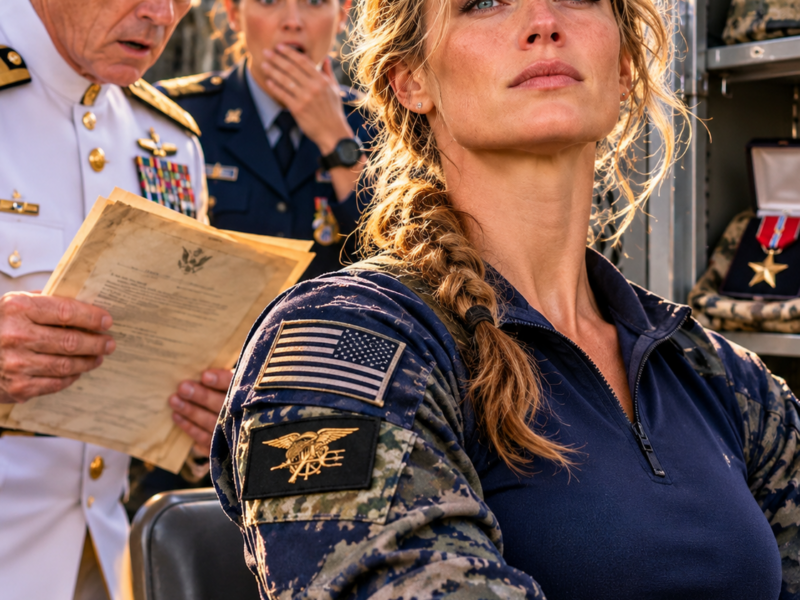
“Rear Admiral James Crawford ordered security to drag me off the Coronado shooting range in front of hundreds of military personnel2
General Thomas Mitchell stopped a few feet from the registration table.
He didn’t look at Crawford first.
He looked at me.
“Tara.”
“General.”
His eyes moved briefly to the old rifle case beside my chair.
“You still have your father’s rifle?”
“Yes, sir.”
He nodded, almost sadly.
Then he turned toward the man holding the classified folder.
“Close it.”
The man immediately obeyed.
Crawford cleared his throat.
“General Mitchell, I wasn’t informed that you would be attending.”
“That makes two of us.”
Mitchell placed the photograph on the table.
It was an old black-and-white image, slightly bent along one edge.
I recognized the building behind the people before I recognized the faces.
A concrete observation post in the mountains of Afghanistan.
There were six people in the photograph.
Five were standing.
The sixth was sitting on a low wall, his face turned away from the camera.
I knew every person in that picture.
And I knew why I had spent three years trying not to remember it.
Crawford leaned closer.
“What exactly is this?”
Mitchell didn’t answer him.
Instead, he looked at the television crew.
“Please turn off your cameras.”
One of the producers hesitated.
“General, this is a public competition.”
“I understand.”
“Then I need to know whether—”
“Now.”
The cameras went dark.
A few people in the crowd began whispering.
Crawford folded his arms.
“This is becoming unnecessarily dramatic.”
Mitchell finally looked at him.
“Admiral, you changed the competition rules twenty minutes after a retired Army master sergeant posted the highest score. You then attempted to obtain restricted personnel information without establishing the proper authorization.”
Crawford’s jaw tightened.
“I was protecting the integrity of the event.”
“From what?”
“An unverified competitor.”
Mitchell tapped the registration paperwork.
“Her credentials were verified before she arrived.”
“Not her complete background.”
“Her complete background is not yours to request.”
Crawford glanced at the man in the dark suit.
The man looked down at his folder.
I understood something then.
The Admiral hadn’t simply been curious about me.
Someone had told him there was something worth finding.
And he had decided to use his position to get it.
Mitchell picked up the photograph.
“Tara, do you remember the night this was taken?”
I stared at the image.
“Yes, sir.”
“Tell me what you remember.”
I took a breath.
“I remember six people. I remember the power going out. I remember the extraction being delayed.”
I paused.
“And I remember that we were supposed to bring seven people home.”
Mitchell nodded.
“That’s correct.”
Crawford shifted his weight.
“General, this is a competition, not a military inquiry.”
Mitchell didn’t turn around.
“Then you should have left military records out of it.”
He motioned toward the registration building.
“Ms. Wells, I’d like a private conversation.”
I looked at the leaderboard.
My name was still at the top.
“Can it wait until after the next round?”
For the first time that afternoon, Mitchell almost smiled.
“That’s why I’m here.”
I followed him into a small administrative office.
Denise came with us, carrying the original competition rules.
The general closed the door.
For several seconds, nobody spoke.
Then he placed the photograph in front of me.
“Three years ago, the Army received a formal request to declassify part of your operational record.”
I looked up.
“From whom?”
“An oversight committee reviewing the circumstances surrounding the loss of Sergeant Daniel Reeves.”
My fingers tightened around the edge of the table.
Daniel.
I hadn’t heard his name spoken aloud in months.
He had been twenty-nine years old.
He had a wife named Emily and a little boy who had been learning to ride a bicycle when we deployed.
He was also the man who had disappeared during the operation that ended my military career.
“What does the championship have to do with Daniel?”
Mitchell sat down.
“Nothing directly. But someone on the competition board received information suggesting that you had an undisclosed operational history.”
“Who?”
“We’re still determining that.”
I looked toward the closed door.
“Crawford?”
“I don’t know whether he initiated it or simply participated.”
That answer bothered me more than a direct accusation.
Mitchell continued.
“The committee has received a new statement from a former member of your unit.”
“Who?”
“Captain Robert Hayes.”
I looked at him sharply.
“Hayes was discharged.”
“Yes.”
“After the investigation?”
“Yes.”
I remembered Robert Hayes as a man who never raised his voice, never complained, and always seemed to know when someone was lying.
He had been my operations officer.
He had also been the last person to argue with me before Daniel disappeared.
“Where is he now?”
“At the hospital in San Diego.”
“Why?”
“He suffered a stroke two days ago. He’s conscious, but his doctors aren’t sure how much time he has.”
I lowered my eyes to the photograph.
“What did he say?”
Mitchell opened a second folder.
“He claims the official report of that night was altered.”
I didn’t move.
The room seemed suddenly smaller.
“Altered how?”
“He says the extraction order was changed after it had been transmitted.”
I stared at him.
That was impossible.
Or at least, it was something I had been told was impossible.
The mission had gone wrong because our position had been compromised.
That was the official conclusion.
Daniel had stayed behind to help a wounded interpreter reach the extraction point.
The rest of us had been forced to withdraw.
I had spent months believing I had made the wrong decision when I called the withdrawal.
I had spent three years trying to accept that there had been no other choice.
Now Mitchell was telling me that someone might have changed the order.
“Why didn’t you tell me sooner?”
He didn’t look away.
“Because the statement was submitted through a classified review process. I couldn’t discuss it until the proper authorization was granted.”
“And now?”
“Now I have authorization to tell you that the investigation has reopened.”
I pushed the photograph away.
“General, if Hayes is telling the truth, then somebody left Daniel behind deliberately.”
Mitchell didn’t answer.
He didn’t need to.
A knock came at the door.
Denise opened it.
A young Marine stood outside.
“General, the next round is ready.”
Mitchell looked at me.
“You don’t have to continue.”
I glanced at the competition paperwork.
Three hundred thousand dollars.
Two hundred sixty-eight thousand four hundred dollars for Mama’s treatment.
I had spent six weeks convincing myself that I could keep my past separate from the reason I was there.
That separation had just disappeared.
“I’m competing,” I said.
Mitchell studied my face.
“All right.”
He stood.
“But I want you to understand something. Whatever happened three years ago, you don’t have to carry the entire responsibility for it.”
I almost laughed.
“That’s easy to say when you weren’t the one who made the call.”
He held my gaze.
“I know.”
Then he opened the door.
Outside, the afternoon sun was bright enough to make the polished equipment shine.
The competitors were returning to their positions.
Crawford stood beside the officials’ platform.
When he saw us, he approached.
“General, I assume this matter has been resolved.”
Mitchell looked at the Admiral.
“Not remotely.”
Crawford’s smile tightened.
“Then perhaps we should postpone the next round.”
“Why?”
“Because the integrity of this competition is now in question.”
Mitchell glanced at the leaderboard.
“Only because you decided to make it so.”
The Admiral turned toward the chief judge.
“Proceed with the additional verification.”
The chief judge looked uncertain.
Mitchell stepped forward.
“The original competition rules remain in effect. Every competitor receives the same conditions. No additional requirements will be imposed on Ms. Wells.”
Crawford’s face reddened.
“You cannot simply override the event’s governing authority.”
“I can when that authority violates its own published procedures.”
He turned to the chief judge.
“Continue.”
The official nodded.
The competitors took their positions.
I checked the equipment assigned to me and settled into the designated lane.
The second round would be conducted under standard competition procedures.
The distance had increased to eight hundred yards.
The wind was moving steadily across the range.
I could hear Crawford speaking into a microphone behind me.
“Competitors, prepare.”
The starting signal sounded.
I focused on the target.
I wasn’t thinking about the photograph anymore.
I wasn’t thinking about Daniel.
For the next few minutes, there was only the range, the timer, and the work in front of me.
When the results came in, I had another perfect score.
The chief judge checked the figures.
Then he checked them again.
“Fifty out of fifty.”
A murmur spread through the crowd.
The Marine beside me offered a quiet nod.
“Well done, Sergeant.”
“Thank you.”
By the end of the round, my lead had widened.
Crawford looked as if he had swallowed something unpleasant.
But he didn’t approach me again.
Not immediately.
I called Mama from a quiet corridor.
She answered on the third ring.
“Did you win?”
“Not yet.”
“Well, don’t sound so serious. You have a whole day ahead of you.”
I leaned against the wall.
“How was your appointment?”
“Fine.”
“Did the doctor change anything?”
A pause.
“Tara.”
“What?”
“Don’t spend all your time worrying about me.”
I rubbed my forehead.
“That’s not really an option.”
She sighed.
“I know.”
Then she added, “Your father used to say you were stubborn enough to argue with a thunderstorm.”
“He wasn’t wrong.”
“No, he wasn’t.”
I could hear the television in the background.
A cooking show.
Mama always watched cooking shows even when she had no appetite.
“Come home safe,” she said.
“I will.”
When I returned to the administrative building, Mitchell was waiting with a phone in his hand.
“We have a problem.”
I looked at him.
“What happened?”
“Hayes has asked to speak with you.”
“Then let’s go.”
“There’s something else.”
He turned the phone toward me.
A message had appeared on the screen.
It was from an account associated with the competition’s private administrative system.
The message contained a photograph of the same old rifle case I had brought from Georgia.
Underneath it were six words.
SHE SHOULD NEVER HAVE COME BACK.
I read it twice.
“Who sent this?”
“We don’t know yet.”
“Does Crawford know?”
“He’s been informed that the message exists.”
I looked at the screen again.
The photograph had been taken from behind the registration building.
Someone had been watching me before the competition even began.
“General, I want to see Hayes.”
Mitchell nodded.
“Let’s go.”
The hospital was less than twenty minutes away.
Hayes was in a private room near the end of a quiet corridor.
He looked smaller than I remembered.
His right hand rested on the blanket.
An oxygen line ran beneath his nose.
His wife, Susan, was sitting beside him with a paperback book open in her lap.
She stood when we entered.
“Tara.”
I hadn’t seen her since the memorial service.
I hugged her carefully.
“How is he?”
“Some days are better than others.”
She looked toward the bed.
“He has been asking for you.”
Hayes opened his eyes.
It took him a moment to focus.
Then his mouth moved.
“Tara.”
I stepped closer.
“I’m here, sir.”
He tried to raise his hand.
I took it.
His grip was weak.
“Did you bring it?”
I frowned.
“Bring what?”
“The case.”
I glanced at Mitchell.
Then back at Hayes.
“My father’s rifle case?”
He nodded.
I hadn’t brought the rifle case into the hospital.
It was locked in the vehicle.
“Why?”
Hayes swallowed.
“Inside.”
My stomach tightened.
“What inside?”
He struggled to speak.
Susan leaned forward.
“Robert, don’t strain yourself.”
He shook his head.
“Inside the lining.”
I looked at Mitchell.
He understood immediately.
“Do you mean there’s something hidden in the case?”
Hayes nodded again.
“Daniel.”
The room fell silent.
I leaned closer.
“What about Daniel?”
Hayes closed his eyes.
When he opened them again, there were tears gathering at the corners.
“He didn’t die there.”
I couldn’t breathe properly.
I sat down beside him.
“What did you say?”
Hayes looked toward the general.
“Tell her.”
Mitchell remained still.
“Robert, you need to be careful.”
Hayes’s voice cracked.
“She deserves to know.”
I held his hand.
“Daniel was listed as killed in action.”
“I know.”
“No remains were recovered, but the Army closed the case.”
Hayes tried to shake his head.
“They lied.”
I stared at him.
“Who?”
His eyes moved toward the window.
Then back to me.
“Not who you think.”
Before I could ask another question, his breathing became labored.
Susan pressed the call button.
A nurse entered.
“Everyone needs to step outside.”
I stood reluctantly.
Hayes tried to speak again.
“Don’t trust…”
The rest disappeared into a cough.
Mitchell placed a hand on my shoulder.
“We’ll give them room.”
We stepped into the hallway.
I leaned against the wall.
“General, what does he mean?”
Mitchell rubbed his jaw.
“I don’t know.”
“You know something.”
He looked at me.
“I know the official investigation found no evidence that Daniel survived. I also know the investigation was closed unusually quickly.”
“Why?”
“Pressure from above.”
I thought about the photograph.
The altered order.
The message about my rifle case.
Then I remembered something my father had told me years ago.
He had repaired the case himself after the original lining began to peel away.
He had insisted on replacing the inner panel with a piece of dark canvas.
I had never asked why.
The case had been sitting in my garage for almost three years.
“General.”
He looked at me.
“I need to get my case.”
We returned to the competition site after dark.
The range was nearly empty.
A security guard stood near the equipment storage area.
He recognized Mitchell and opened the gate.
My rifle case was still locked in the vehicle.
I carried it into the small administrative room.
Mitchell closed the door.
I placed the case on the table.
For several seconds, I simply looked at it.
It was strange how an ordinary object could suddenly feel like a piece of your life you had never fully understood.
I turned it over.
The bottom panel was secured by four small screws.
I had never noticed them.
Mitchell found a screwdriver in a maintenance drawer.
I removed the screws one by one.
The panel came loose.
Behind the old foam lining was a thin waterproof envelope.
My fingers trembled as I pulled it free.
Inside were three folded pages and a small memory card.
The first page contained a handwritten note.
Tara,
If you’re reading this, then someone finally decided to look where they should have looked three years ago.
I recognized the handwriting.
Daniel Reeves.
I sat down.
Mitchell pulled a chair beside me.
I unfolded the second page.
It was a copy of a handwritten message log.
The final entry was dated the night of the operation.
It showed that our extraction order had been changed after the original command was transmitted.
The change had come from a temporary command channel.
The authorization code belonged to a senior officer who was not supposed to have access to our mission.
I read the name.
Then I read it again.
Rear Admiral James Crawford.
I looked up.
Mitchell’s face had gone still.
“That can’t be right.”
I pointed to the page.
“His name is here.”
Mitchell studied the document.
“An authorization code can be copied.”
“Then we verify it.”
He nodded.
I unfolded the final page.
It was a short statement.
Daniel had written that he believed our team had been deliberately redirected because we had discovered evidence of an illegal weapons diversion operation.
The shipment was being moved through a private logistics contractor.
Several military officials were involved.
The last line was underlined.
THEY DON’T WANT THE WEAPONS FOUND. THEY WANT THE PEOPLE WHO FOUND THEM GONE.
I leaned back.
For three years, I had believed Daniel was lost because I had made a decision under pressure.
Now I was reading evidence that the entire operation had been manipulated.
Mitchell inserted the memory card into a secure reader.
A video file appeared.
The image was grainy.
The camera seemed to have been placed on a shelf.
Then Daniel’s face appeared.
He looked tired.
There was dirt on his uniform.
But he was alive.
“Tara, if you ever see this, I need you to understand something.”
He looked directly into the camera.
“You didn’t leave me.”
I covered my mouth.
Daniel continued.
“The order changed. Hayes tried to get it corrected, but the command channel was already compromised.”
He glanced off camera.
“I got out with the interpreter. We made it to a local aid station.”
The recording shook.
“Someone helped us get away. I don’t know who. But if this message reaches you, don’t come looking for me until the evidence is safe.”
He paused.
“There’s a little boy in Georgia who still thinks his father is coming home.”
My vision blurred.
Daniel had known about my family.
He had known about my mother.
He had known how much I had wanted to get home.
Then he said something that made my hands go cold.
“Don’t trust the people who tell you the file is closed.”
The video ended.
For a long time, neither of us spoke.
Mitchell finally removed the card.
“Where did you get this case?”
“My father gave it to me before I deployed. He repaired it after I came home.”
“Did he know what was inside?”
“I don’t know.”
I looked at the photograph of Daniel.
“Why would he hide it?”
Mitchell closed the folder.
“Because whoever had access to that operation was powerful enough to make people disappear.”
A knock came at the door.
We both turned.
Denise stood outside.
“General, I’m sorry to interrupt.”
“What is it?”
“There’s been a development with the competition board.”
Mitchell opened the door.
“Go ahead.”
She looked at me.
“Admiral Crawford has requested an emergency meeting. He’s claiming Ms. Wells obtained restricted military material through unauthorized means.”
I almost laughed.
“That’s convenient.”
Denise swallowed.
“He also wants your competition entry suspended.”
Mitchell’s expression hardened.
“On what grounds?”
“An alleged violation of the equipment disclosure rules.”
I looked at my father’s old rifle case.
It had carried more than a rifle.
It had carried the truth.
“Tell him I’ll attend the meeting.”
Mitchell turned toward me.
“Tara, you don’t have to fight every battle tonight.”
I met his eyes.
“Three years ago, I walked away believing I had failed Daniel. I’m not walking away again.”
The emergency meeting was held in the main conference room.
Crawford sat at the head of the table.
Two competition officials were beside him.
The man in the dark suit stood near the door.
When I entered, Crawford didn’t bother hiding his irritation.
“Master Sergeant Wells.”
“Admiral.”
He pointed to a chair.
“Sit.”
I remained standing.
“I’ll be fine.”
His jaw moved.
“This meeting concerns the integrity of the competition.”
Mitchell placed the original registration documents on the table.
“Then let’s start with the integrity of the rules.”
Crawford ignored him.
“Ms. Wells, did you bring unauthorized military material onto the competition grounds?”
I looked at him.
“My rifle case was inspected during registration.”
“That wasn’t my question.”
“Then ask a question you have authority to ask.”
One of the officials shifted uncomfortably.
Crawford leaned forward.
“You appear to have forgotten your position.”
I held his gaze.
“I remember it very clearly.”
Mitchell opened the folder containing Daniel’s records.
“Admiral, do you recognize this authorization?”
Crawford glanced down.
His expression barely changed.
“I have signed thousands of documents.”
“Did you authorize a change to an Army extraction order three years ago?”
The room became quiet.
Crawford sat back.
“That is a classified operational matter.”
“Correct.”
“Then I suggest you stop discussing it in a civilian competition facility.”
Mitchell nodded.
“Agreed.”
He closed the folder.
“Which is why I have already contacted the appropriate investigative authority.”
Crawford’s eyes moved toward the man in the dark suit.
The man looked uncomfortable.
“General, this is an overreach.”
“No. It’s an investigation.”
Crawford stood.
“You have no evidence connecting me to anything improper.”
I looked at him.
“Your authorization code is on the record.”
He turned toward me.
“You’re making a serious accusation.”
“I’m asking for an explanation.”
He laughed once.
“You’re a retired master sergeant with a damaged rifle case and a suspiciously convenient story.”
I felt the familiar anger rise.
But I didn’t let it reach my voice.
“Then you should have no trouble answering the questions.”
He stared at me.
For the first time, his confidence seemed less certain.
Mitchell collected the documents.
“Until the review is complete, no one will access Ms. Wells’s service record without proper authorization.”
Crawford looked toward the officials.
“Is this meeting over?”
Mitchell stood.
“Yes.”
We left the room.
Outside, Denise was waiting.
She held a phone in one hand.
“Ms. Wells?”
“Yes?”
“I think you should see this.”
She showed me a message from the hospital.
Hayes had regained consciousness.
He wanted to speak again.
And this time, he had asked for the general and an investigator.
The following morning, we returned to the hospital.
Two federal investigators were waiting in Hayes’s room.
One introduced herself as Special Agent Laura Bennett.
The other was a man named Michael Grant.
Hayes looked exhausted, but his eyes were clear.
He motioned for me to come closer.
“Tara.”
“I’m here.”
He swallowed.
“I should have told you sooner.”
I sat beside him.
“Why didn’t you?”
He closed his eyes briefly.
“Because I was afraid.”
I waited.
“After the operation, I received a message telling me to submit the revised report. It said the original extraction order had been superseded.”
“Who sent it?”
“An intermediary. I never spoke to Crawford directly.”
“Then how do you know he was involved?”
Hayes turned toward Agent Bennett.
She opened a folder.
“Three years ago, a contractor’s communications server was seized during an unrelated investigation. It contained archived messages from the logistics operation.”
She placed a document on the bed.
“We found evidence that the extraction order was modified using credentials assigned to an office associated with Admiral Crawford.”
I looked at Hayes.
“Why didn’t you report it?”
“I did.”
His voice was barely audible.
“To the review officer.”
“What happened?”
“They told me the authorization was legitimate. Then they transferred me.”
He swallowed.
“Two weeks later, I received a warning.”
“What kind of warning?”
Hayes looked at me.
“They sent me a photograph of my wife leaving the grocery store.”
Susan began crying quietly.
Hayes turned his face toward the wall.
“I thought if I stayed silent, they’d leave my family alone.”
I squeezed his hand.
“You could have told me.”
“I know.”
He looked back at me.
“I watched you blame yourself for three years.”
His voice broke.
“That was the part I couldn’t live with.”
I lowered my head.
For a moment, I couldn’t find words.
Then I asked the question that had followed me through every night since the operation.
“Did Daniel survive?”
Hayes nodded.
“He made it to a medical station. An aid worker helped him get across the border.”
“Where is he now?”
Hayes looked toward Agent Bennett.
She answered carefully.
“We believe he is alive. His identity was protected while he cooperated with an investigation into the weapons diversion network.”
I stared at her.
“Why didn’t anyone tell his family?”
“Because the investigation involved active threats, and we didn’t have enough verified evidence to safely disclose his location.”
I thought of Emily.
Daniel’s wife.
His little boy.
For three years, they had lived with a death that might never have happened.
“Does Emily know?”
“Not yet.”
I looked at Mitchell.
“She needs to know.”
He nodded.
“Yes.”
Hayes began coughing.
Susan called the nurse.
Before I stood, he caught my hand.
“Tara.”
I turned back.
“Don’t let them make you carry this.”
I looked at the man who had once been my commanding officer.
“I won’t.”
The investigation moved quickly after that.
The memory card was authenticated.
The handwritten logs were compared with archived communications.
A second witness confirmed that the extraction order had been altered.
Within days, investigators obtained a warrant for records held by the private logistics contractor.
The evidence showed that weapons had been diverted from official supply channels and sold through intermediaries.
Several officials had received payments.
Crawford’s name appeared in communications discussing the operation.
He was not the only person involved.
But he had been one of the people who could have stopped it.
Instead, he had helped conceal it.
When the investigators confronted him with the authenticated records, his public explanation collapsed.
He claimed he had acted under orders.
He claimed he had never known that soldiers were placed in danger.
He claimed he had been protecting national security.
The evidence showed something different.
His office had received repeated warnings.
The extraction order had been changed after those warnings.
And the revised report had concealed the fact that Daniel and the interpreter had been left behind.
Crawford was removed from his competition duties pending a formal investigation.
Later, he faced military and federal proceedings.
The championship board also opened an independent review of its actions.
I didn’t feel victorious.
I felt tired.
The kind of tired that settles into your bones after years of carrying something heavy.
But there was one thing I still needed to know.
Daniel was alive.
And I wanted to hear his voice.
The call came four days later.
I was sitting in a hotel room when an unfamiliar number appeared on my phone.
I answered.
“Hello?”
A man’s voice came through.
“Tara?”
I stood up.
“Daniel?”
There was a long silence.
Then I heard him breathe.
“Hey, Angel.”
I pressed my hand against my mouth.
Nobody had called me that in three years.
“Where are you?”
“Somewhere safe.”
“Are you really alive?”
He gave a quiet laugh.
“Last time I checked.”
I sat on the edge of the bed.
“Daniel, I thought…”
“I know.”
My voice broke.
“I thought I left you.”
“You didn’t.”
“I made the call.”
“You made the only call you could make with the information you had.”
I closed my eyes.
“Why didn’t you contact us?”
“I tried.”
He paused.
“After I got out, the people helping me told me that the operation was still compromised. They said contacting my family could expose them.”
“What about Emily?”
“I sent a message through the investigators when I finally had a safe channel. I don’t know whether she received it.”
I swallowed.
“She didn’t.”
His breathing changed.
“She didn’t?”
“No.”
Another silence.
Then he asked, “How’s my boy?”
I remembered the photograph from the hospital.
A little boy with a missing front tooth, standing beside a bicycle.
“He’s taller.”
Daniel made a sound that was somewhere between a laugh and a sob.
“Of course he is.”
I looked out the hotel window.
The California sun was beginning to set.
“Daniel, I’m sorry.”
“Don’t.”
“I should have—”
“Tara, stop.”
His voice was gentle but firm.
“You brought everybody home that you could. Don’t turn that into a crime.”
I wiped my cheek.
“I missed you.”
“I missed you too.”
We spoke for almost an hour.
He told me about the medical station, the aid worker who had helped him, and the long investigation that followed.
He had been moved several times.
He had spent months recovering from an injury.
He had been told repeatedly that revealing his identity too soon could put his family in danger.
But he was alive.
And he wanted to come home.
The investigators arranged a reunion with Emily and their son.
I wasn’t invited to the first meeting.
That was right.
It belonged to them.
But a week later, Daniel called again.
“Can you come to Georgia?”
I smiled.
“That’s where I live.”
“I know. I mean, can you come to the house?”
“Which house?”
“Mine.”
I didn’t answer immediately.
Then he said, “I want to see you, Angel.”
I drove home two days later.
Mama was sitting on the porch when I arrived.
She looked thinner than she had before the diagnosis.
But she was wearing her favorite blue cardigan and holding a glass of iced tea.
“You look exhausted,” she said.
“Thank you.”
“That’s what mothers are for.”
I sat beside her.
She reached for my hand.
“Did you win?”
I smiled.
“Yes.”
Her eyebrows rose.
“Well, don’t just sit there. Tell me.”
I laughed.
I told her about the final round, the official review, and the prize money.
The competition committee had completed its independent investigation and confirmed that my entry had been valid from the beginning.
My scores stood.
I had won the championship.
The prize money was being processed.
Mama listened quietly.
When I finished, she looked toward the yard.
“Your father would have loved that.”
I nodded.
“He would have.”
Then I told her about Daniel.
She didn’t speak for several seconds.
Finally, she squeezed my hand.
“Somebody needs to bring that boy home.”
I smiled.
“He’s coming.”
The championship prize arrived three weeks later.
After taxes and required deductions, I had enough to cover Mama’s treatment and preserve the house.
I sat with her in the hospital when the financial counselor confirmed the payment arrangement.
She looked at the paperwork.
Then at me.
“You did all this with that old rifle?”
I shrugged.
“Apparently.”
She shook her head.
“Your father would never let you forget it.”
I laughed.
For the first time in months, the sound didn’t feel forced.
Mama began treatment the following Monday.
It was difficult.
There were days when she couldn’t keep food down.
There were nights when I slept in the chair beside her bed.
But she kept going.
And I stayed.
A month after I returned home, Daniel arrived in Georgia.
Emily and their son were waiting at the house.
I stood across the street when his car pulled into the driveway.
I didn’t want to take a moment that belonged to his family.
Daniel stepped out slowly.
He looked older.
His hair was thinner, and he walked with a slight stiffness.
But he was alive.
Emily covered her mouth.
Their son stared at him.
For a moment, neither moved.
Then Daniel knelt.
“Hey, buddy.”
The boy took one hesitant step.
Then another.
“Are you really Daddy?”
Daniel nodded.
“Yeah, little man.”
The boy ran into his arms.
Emily followed.
I turned away before they noticed me crying.
I heard Daniel call my name.
“Angel!”
I looked back.
He was standing with his family, one arm around Emily and the other resting on his son’s shoulder.
He smiled.
I smiled back.
There were no speeches.
No cameras.
No ceremony.
Just a family standing together in a driveway after three years of believing they never would again.
A few weeks later, I received a letter from General Mitchell.
It was short.
He wrote that the investigation had confirmed my original actions during the operation were justified.
He wrote that the record would be corrected.
He also wrote that the Army had approved a formal recognition of my service.
I read the letter twice.
Then I placed it in a drawer.
I didn’t need another medal to know what had happened.
But I was grateful that the truth would no longer be buried beneath an official report.
The championship organizers also sent an apology.
They offered to publish a statement acknowledging that I had been treated unfairly.
I accepted.
Not because I needed the Admiral to be embarrassed.
Because the young service members who had watched him humiliate me deserved to know that rank did not make his behavior acceptable.
At the next public ceremony, the competition director asked whether I wanted to speak.
I stood at the microphone.
The same microphone Crawford had used to call me the Walmart sniper.
I looked out at the crowd.
“I didn’t come here to prove that women can compete with men,” I began.
“I didn’t come here to prove that retired soldiers still have something to offer.”
I paused.
“I came because my mother needed treatment, and I had one opportunity to help her.”
A few people nodded.
“I also came carrying a mistake I believed I had made three years ago. I thought I had abandoned a friend.”
I looked toward Daniel, who was standing near the back with Emily and their son.
“Turns out, the truth was more complicated.”
I let the silence settle.
“Some people think strength is about never making mistakes. I don’t.”
I looked at the young Marines near the front.
“I think strength is knowing when to ask questions, when to admit you were wrong, and when to refuse to let somebody else decide your worth.”
I stepped away from the microphone.
That was all I wanted to say.
Later, Daniel found me beside the old rifle case.
“You know,” he said, “I always hated that nickname.”
I looked at him.
“Which one?”
“Angel.”
I raised an eyebrow.
“Why?”
“Because you never acted like one.”
I laughed.
“That’s because you were usually the one causing trouble.”
He smiled.
For a moment, we were back in the mountains.
Then he looked toward the range.
“Do you ever think about going back?”
I considered the question.
I thought about the years I had spent avoiding old memories.
I thought about the people who had made it home, the ones who hadn’t, and the ones whose stories had never been properly told.
“I don’t know,” I said.
“That’s fair.”
I rested my hand on the worn handle of my father’s rifle case.
For a long time, I had believed that carrying the past meant carrying guilt.
I finally understood that remembering wasn’t the same as blaming myself.
Some things were mine to carry.
Some things belonged to the people who had made the choices.
And some things needed to be brought into the light, no matter how long they had been buried.
Mama finished her first major round of treatment that spring.
The doctors said the response was encouraging.
Not a miracle.
Not a guarantee.
Just a reason to keep going.
I took her outside after the appointment.
She leaned on my arm as we walked toward the truck.
“What’s next?” she asked.
I opened the passenger door.
“Home.”
She smiled.
“Good answer.”
As I drove down the familiar Georgia road, the evening sun fell across the dashboard.
My father’s old rifle case sat in the back seat.
It looked exactly as it had before the championship.
The same duct tape.
The same worn handle.
The same scratches.
But I no longer saw it as a reminder of everything I had lost.
It had carried a truth that gave a family back its father, gave my mother another chance, and finally allowed me to forgive the woman I had been three years earlier.
I glanced at Mama.
She had fallen asleep, her hand resting on the folded hospital paperwork in her lap.
For the first time in a very long time, I wasn’t counting the days until something terrible happened.
I was simply grateful for the road ahead.
The end.









