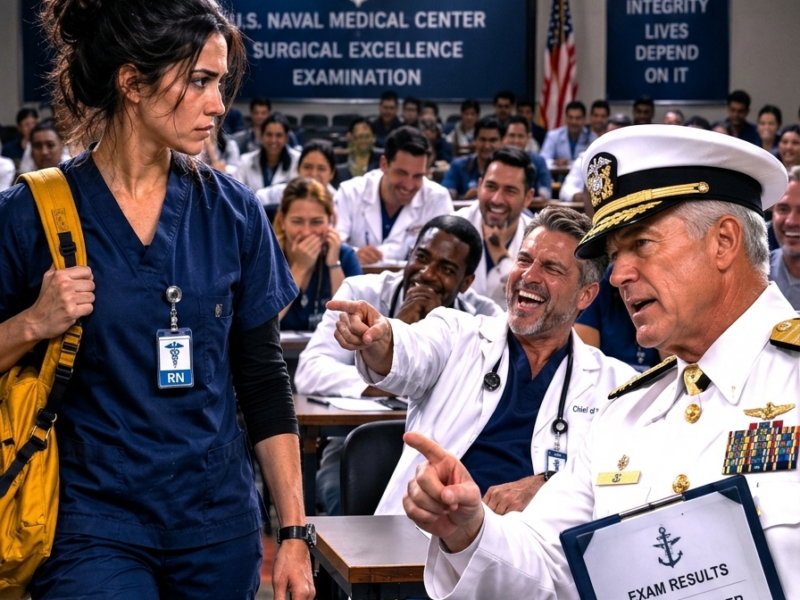
“Ready to Fail, Nurse?” the chief surgeon sneered in front of the entire medical team at Naval Medical Center San Diego, but when the admiral walked in
The air inside the main lecture hall of Naval Medical Center San Diego was crisp, sterile, and standard for a Tuesday morning. Rows of Navy medical personnel—surgeons, residents, anesthesiologists, and corpsmen—sat in tiered seating, their crisp uniforms reflecting the bright fluorescent lights above.
At the podium stood Dr. Richard Coleman. He was a man whose presence naturally commanded fear rather than respect. As the Chief of General Surgery, his reputation was legendary: precise with a scalpel, merciless with his staff, and utterly unyielding in his belief that medicine had a strict hierarchy. To Coleman, the world was divided into two distinct groups: surgeons who made life-and-death decisions, and nurses who carried out orders without question.
For the past six months, I had been his favorite target.
“Ready to fail, Nurse?” Coleman sneered, his voice projecting easily across the quiet room. He adjusted his spotless white coat, looking down at me as I sat near the front row. “Or did you actually believe that a few years of floor duty prepared you to compete against board-certified trauma surgeons?”
A soft ripple of quiet laughter drifted through the back rows where a few young surgical residents sat. I didn’t turn around to see who they were. Over the past three years, I had learned that reacting only gave men like Coleman more power.
My name is Emily Carter. I am a thirty-two-year-old Navy nurse, a petty officer who had spent the last three years living in the quiet, suffocating shade of grief. Three years ago, my husband, Lieutenant Mark Carter, died on an operating table right here in this hospital. The official Navy medical report called it an unavoidable surgical complication—a sudden, catastrophic allergic reaction to an anesthetic compound during what should have been a routine repair of a torn ligament.
I had tried to accept it. I had tried to believe that medicine was simply imperfect. But I could never erase the memory of Mark’s final moments in the prep room. He had held my wrist with a desperate, crushing grip, his eyes wide with an emotion I had never seen in him before: pure terror.
“Emily,” he had whispered, his breath ragged against my ear, “if anything happens to me today… promise me you’ll check the second file. Don’t let them archive it. Check the second file.”
At the time, I thought he was delirious from the pre-op sedatives. But months later, driven by an ache that refused to fade, I used my late-night access to the hospital’s deep digital archives. Buried under three layers of encrypted administrative logs, I found a duplicate record of Mark’s surgery—a “second file” that had been improperly synced before being deleted from the primary server.
In that file was a medication record showing a lethal dosage calculation of potassium chloride mixed into his IV bag—a dose five times higher than any safe protocol allowed.
And at the bottom of that digitized sheet was the clear, sharp electronic signature of Dr. Richard Coleman.
I didn’t rush to the authorities. In the military, accusing the Chief of Surgery without indisputable evidence was a career-ending move that would be dismissed as the irrational grief of a widowed nurse. Instead, I stayed quiet. I watched. I studied. For three straight years, while my colleagues went home to their families, I stayed awake in my small apartment, surrounded by medical textbooks, trauma manuals, and advanced pharmacology guides. I memorized every surgical procedure, every dosage metric, and every obscure emergency protocol used by the Navy.
When the Department of Defense announced a high-stakes, unified Clinical Trauma Assessment for all senior medical personnel—a notoriously brutal exam designed to test rapid decision-making, advanced surgical theory, and complex crisis management—Coleman had openly mocked my application.
“You should save yourself the embarrassment, Nurse Carter,” he had said to me in the crowded hospital cafeteria just a week prior, making sure his voice carried to nearby tables. “This assessment is designed for professionals who actually hold a scalpel. It isn’t a basic first-aid course for bedside comfort.”
I had looked at him, swallowed the bitter taste in my mouth, and said nothing. I spent the next three nights without sleep, drinking cold coffee while Mark’s photograph sat beside my open notebooks.
Now, on the morning the results were to be delivered, Coleman stood at the front of the hall, soaking in his own assumed victory.
“Let’s see how our little nurse performed,” Coleman announced, wearing a thin, cruel smile that made humiliation feel like a sport he played professionally. “Perhaps we can use her exam as a teaching tool for what not to do under pressure.”
Before anyone could reply, the heavy double doors at the back of the auditorium swung open with a sharp metallic clatter.
The room immediately went dead silent. Everyone stood to attention as Vice Admiral Thomas Vance walked down the aisle. Vance was a decorated medical commander whose stern, weathered face rarely showed emotion. Clutched in his gloved right hand was a thick, official red-folder envelope sealed with red security tape.
Admiral Vance walked past the rows of standing officers and stopped at the central table. He didn’t offer a polite greeting. He simply placed the sealed envelope on the polished wooden surface and swept his sharp gaze across the room before settling on Coleman.
“Sit,” Vance commanded quietly.
The entire room sat in unison. The air grew so tight you could hear the rhythmic hum of the ventilation system overhead.
“The exam administered three days ago was the most demanding clinical evaluation the Navy has conducted in a decade,” Admiral Vance began, his voice deep and solemn. “It tested real-time crisis management, advanced surgical intervention tactics, and complex pharmacology under simulated battle conditions. Out of forty-two senior medical officers tested across the region, forty-one failed to reach the ninety percent threshold.”
Coleman straightened his posture, adjusting his military ribbons. A self-assured smirk returned to his lips.
“Excellent,” Coleman said smoothly, leaning forward. “Which surgeon achieved the top mark, Admiral? I assume it was Dr. Harrison or myself?”
Admiral Vance turned his head slowly away from Coleman and looked directly at me.
“One candidate achieved a perfect score,” the Admiral said. “One hundred percent. Not one error, not one missed complication, not one incorrect dosage calculation under the most extreme simulated trauma scenarios.”
Coleman’s smirk faltered slightly. “Who?”
“Petty Officer Emily Carter,” Admiral Vance announced clearly.
Silence swallowed the room whole.
It was a silence so absolute that it felt heavy, almost suffocating. Coleman’s face froze. The color drained from his cheeks in a visible wave, leaving his skin a pale, sallow gray. The surgical residents behind me exchanged bewildered, terrified glances.
I sat still, my heart hammering against my ribs like a trapped bird. I felt no surge of pride, no sudden rush of triumph. All I felt was the cold, heavy realization that the quiet war I had been fighting in the dark was finally stepping into the light.
Admiral Vance reached inside his dress uniform coat and produced a second, smaller envelope—this one unsealed, made of heavy cream cardstock.
“Nurse Carter,” the Admiral said, his eyes locking onto mine with an unreadable expression. “Your flawless performance on the pharmacology and surgical override sections of the exam raised severe administrative questions about a historical case in this facility. Questions that our internal board of medical auditors have been trying to answer for three years.”
Coleman’s hands began to visibly tremble on the table. He tried to speak, but his voice caught in his throat. “Admiral… what is the meaning of this? This is an administrative briefing, not—”
“Quiet, Dr. Coleman,” Vance snapped without breaking eye contact with me. He stepped toward my seat and handed me the cream envelope. “Inside is a document recently unsealed from the hospital’s primary vault following an automated audit triggered by your test parameters.”
With fingers that trembled despite my best efforts to stay composed, I pulled the paper from the envelope. It was an original, physical copy of my husband’s pre-operative evaluation sheet. But attached to the back of it with a rusting metal paperclip was a piece of yellow lined notepad paper—a handwritten note that had never appeared in any digital database or official military inquiry.
The handwriting was unmistakable. It was slanted, precise, and signed with the familiar flourish of my late husband, Mark.
My eyes blurred as I read the words written in dark blue ink:
Emily, if you’re reading this, someone finally looked closely enough. They didn’t just check the dosage—they checked who modified the order before the tray left the pharmacy. Coleman didn’t act alone. Ask him about the order from the Chief of Naval Logistics.
I lifted my eyes slowly from the paper and stared directly at Coleman.
He was already backing away from the podium, his boots sliding against the floor as he edged toward the side exit of the lecture hall.
“Security,” Admiral Vance ordered calmly into his lapel radio.
Two armed Navy Master-at-Arms officers stepped out from the back hallway, blocking the exit doors. Coleman froze, his eyes darting frantically between the armed guards, the Admiral, and me. The arrogance that had sustained him for years was completely gone, replaced by a raw, naked panic.
“You don’t understand!” Coleman suddenly shouted, his voice cracking with desperation as he raised his hands in defense. “You think you know what happened that night, Emily? You think this was about a simple medical mistake?”
“You killed my husband,” I said, my voice barely above a whisper, yet it echoed through the silent hall. “You signed the lethal order.”
“I signed it because I had no choice!” Coleman screamed back, his eyes wild. “Your husband wasn’t the patient I was trying to save that night! He was the man who found out the truth!”
Cold ice poured through my veins. “What truth?”
Coleman looked at Admiral Vance, then back at me, tears of genuine terror gathering in the corners of his eyes.
“Your husband didn’t die because of an accidental overdose,” Coleman whimpered, his chest heaving. “He discovered who actually ordered the dosage change on the supply manifest. He was going to expose the entire logistics chain!”
Admiral Vance didn’t flinch. Slowly, deliberately, the Admiral reached into the red folder on the table and pulled out a final, single page. He turned it over and laid it flat under the bright lights for everyone to see.
At the bottom of the directive authorizing the altered medication shipments three years ago was a signature I had recognized since I was a child.
It was the signature of Rear Admiral Arthur Vance—the man standing right in front of me, and my own godfather.
The silence in the room transformed from mere shock into an oppressive, terrifying weight.
I stared at the black ink on the official naval document resting on the table. Rear Admiral Arthur Vance. The name burned into my retinas. This was the man who had sat at my family’s dinner table when I was a young girl. The man who had stood beside my father during his military retirement. The man who had held my hand at Mark’s funeral and promised me that the Navy would always take care of its own.
“Arthur…?” I whispered, the word feeling like ash in my mouth.
The Admiral’s face didn’t break. His composure was absolute, a terrifying shield of military discipline. He looked down at the paper, then up at the two Master-at-Arms officers standing by the door.
“Take Dr. Coleman into custody,” Vance said smoothly, his tone as cold and level as ice. “He is exhibiting signs of extreme psychological distress and making unfounded accusations against flag officers. Secure him in the brig under suicide watch immediately.”
“No! Wait!” Coleman shrieked as the two burly guards seized his arms, pulling him toward the heavy double doors. “He forced me to sign the floor clearance, Emily! He threatened my license! He threatened my family! The altered cardiac meds weren’t just for this hospital—they were being swapped out across the entire Pacific Fleet!”
“Silence the prisoner,” Vance commanded sharply.
One of the guards dragged Coleman out into the corridor, the heavy doors slamming shut behind them, cutting off the surgeon’s desperate screams.
The auditorium remained dead quiet. Dozens of medical officers sat frozen in their seats, terrified to move or make eye contact with either Vance or myself.
“Dismissed,” Vance announced, his voice echoing off the high walls. “All personnel will return to their assigned wards immediately. Today’s test results are placed under an immediate security hold pending administrative review. Anyone speaking to the press or unauthorized personnel regarding this morning’s events will face immediate court-martial under Article 92.”
The doctors and nurses scrambled to leave, gathering their notebooks and shuffling out of the room as quickly as their feet could carry them. Within two minutes, the grand lecture hall was empty, save for three people: Admiral Vance, myself, and the heavy shadow of my husband’s memory.
Vance walked slowly over to where I was standing. He looked down at me with an expression that almost resembled pity, but his eyes remained sharp, calculation gleaming behind them.
“Emily,” he said softly, using my first name for the first time in years. “You are an extraordinary nurse. Your father would have been remarkably proud of your score today. But you are walking into waters far deeper than you understand.”
“You signed it,” I said, my voice steady despite the tremor in my chest. “You authorized the medication transfer that killed Mark.”
“I signed a fleet-wide logistical reorganization document,” Vance corrected gently, though his eyes never left mine. “Three years ago, a massive batch of counterfeit cardiac pharmaceuticals entered the military supply chain through an offshore defense contractor. If that news had broken publicly, it would have grounded three aircraft carrier strike groups in the middle of a strategic deployment. The Navy could not afford that chaos.”
“So you covered it up,” I said, step by step putting the horror together. “Mark was working in the central pharmacy inventory that month. He noticed the batch numbers didn’t match the purity certificates. He realized the drugs were toxic.”
“Mark was a fine young man, but he was impulsive,” Vance replied coldly. “He was going to go straight to the civilian press. He refused to follow the chain of command. Dr. Coleman was ordered to isolate those medications, but a mix-up occurred on the night of Mark’s emergency procedure.”
“A mix-up?” I spat, taking a step closer to the man I had trusted my entire life. “Or did Coleman give him that dosage deliberately to make sure he never spoke to the press?”
Vance didn’t answer immediately. He adjusted the gold stars on his collar. “What matters now, Emily, is what happens next. You have proven yourself to be one of the sharpest minds in this command. But a brilliant mind is useless if it belongs to a dead woman. You will pack your locker today. I am transferring you to a quiet shore facility in Bremerton, Washington. You will receive a promotion to Lieutenant, a full pension bump, and a clean slate.”
“And if I refuse?”
Vance leaned in closer, his voice dropping to a harsh whisper. “If you refuse, the physical evidence of your husband’s ‘second file’ will vanish from the naval servers forever, and you will spend the rest of your life in a federal brig for accessing classified military logistics networks without authorization. Think very carefully, Emily. Your husband is gone. Do not throw your own life into the grave beside him.”
He turned on his heel and walked out of the auditorium, his polished shoes clicking against the tile until the heavy doors swung closed once more.
I stood alone in the empty hall. My hands were cold, but for the first time in three years, the fog in my mind had completely cleared. The grief that had weighed me down for so long didn’t disappear—it transformed into something hard, sharp, and lethal.
They thought I was just a nurse following orders. They thought that by offering me a promotion and a quiet exile, I would fold. But they forgot one simple detail: I hadn’t spent the last three years just reading medical books. I had spent three years learning every square inch of this hospital, every administrative loophole, and every network back-door that kept this facility running.
I walked out of the auditorium and headed straight for the basement level—the location of the hospital’s central pathology archives and pharmacy distribution vault.
If Coleman and Vance were telling the truth, the counterfeit medication logs weren’t just sitting in a digital server. In military medical facilities, high-risk pharmaceutical disposals required physical paper manifests signed in triplicate, stored in locked bio-hazard vaults for five years before destruction.
As I turned down the quiet, dimly lit basement corridor, my radio chirped at my hip.
It was Sarah, my closest friend and a fellow ICU nurse who had worked the night shifts with me for years.
“Emily? Where are you?” Sarah’s voice was panicked over the tiny speaker. “Something crazy is happening upstairs. Federal agents just arrived at Dr. Coleman’s office. They’re seizing his hard drives! And Emily… people are saying you aced the board exam?”
“Sarah, listen to me very carefully,” I said, stopping near the heavy steel door of Archive Room 4. “I need you to do something for me, but it’s dangerous. If anyone asks where I am, tell them I left the building to go home.”
“Emily, what’s going on? You’re scaring me.”
“Did Coleman keep a personal log in the ICU floor safe?” I asked, swiping my security badge against the card reader beside Archive Room 4. The light flashed yellow, then green, and the heavy door unlocked with a loud hydraulic hiss. “The safe where we store the emergency schedule II narcotics?”
“Yes,” Sarah hesitated. “He has a private locker inside it. Only he and the head nurse have the key code.”
“The master code is the date of the hospital’s founding—1988,” I said, remembering a detail Coleman had casually mentioned two years ago during an audit. “Inside that locker, there should be a blue leather binder marked ‘Fleet Operations.’ I need you to get it before Vance’s security detail sweeps the floor.”
“Emily, that’s illegal! If I get caught—”
“Sarah, Mark didn’t die from a medical mistake,” I said, my voice tight with emotion. “They killed him. And they’re going to cover it up unless we find the original paper manifests.”
There was a long pause on the other end of the line. I could hear Sarah’s breath catching in her throat.
“Two minutes,” Sarah whispered firmly. “I’ll get the binder and meet you in the sub-basement stairwell.”
“Thank you,” I said, cutting the connection.
I stepped inside Archive Room 4. The air was freezing, maintained at a low temperature to preserve paper records and biological samples. Tall metal shelves stretched into the dim darkness, filled with thousands of boxed files.
I walked straight to the back section marked Logistics & Hazardous Disposals: 3 Years Prior.
My heart hammered in my ears as I pulled down a dusty grey storage box labeled Q3-PHARM-SUPPLY. I set it on a metal table, opened the lid, and began flipping through the yellowing pages.
Shipment numbers. Batch codes. Purity percentages.
And then I found it.
A thick sheaf of pink carbon-copy receipts showing hundreds of thousands of units of defective, contaminated heart medication delivered not just to San Diego, but to naval hospitals in Guam, Japan, and Pearl Harbor. Attached to the top of the stack was a hand-written directive on official flag-officer stationery.
It wasn’t just Vance’s signature at the bottom.
There was a second signature—one that made my breath lock in my throat. It belonged to the current Undersecretary of Defense for Health Affairs.
This wasn’t a local hospital cover-up. It was a multi-billion-dollar military defense corruption scheme that reached to the highest levels of the Pentagon. Mark hadn’t just stumbled upon a bad batch of drugs; he had discovered a massive treasonous ring that was putting the lives of thousands of active-duty sailors and Marines at risk for profit.
Suddenly, the heavy steel door of the archive room clicked shut behind me.
The loud magnetic lock engaged with a deep, echoing thud.
I whirled around. Standing in the doorway, keycard in hand, was not Admiral Vance, nor the military police.
It was Dr. Harrison—Coleman’s senior surgical assistant, the man who had sat in the front row during this morning’s exam and laughed at Coleman’s jokes.
In his right hand, he held a pre-filled syringe.
“You really should have taken the transfer to Washington, Nurse Carter,” Harrison said, a chillingly calm smile spreading across his face as he stepped toward me in the cold room. “The Admiral knew you wouldn’t let it go. You’re just like your husband—too smart for your own good.”
The air in the basement archive room felt instantly colder. The metallic scent of paper and preserved biological slides hung thick between us as Dr. Harrison took another slow, deliberate step forward.
“Stay back, Harrison,” I said, my voice remaining remarkably firm as I backed up slowly until my spine touched the cold metal edge of the archive table.
“Or what, Emily?” Harrison sneered, holding the clear plastic syringe up to the harsh fluorescent lights. He tapped the glass barrel with his finger, sending a small squirt of clear liquid into the air. “You’ll report me? You think anyone is going to listen to a grieving nurse who just had a nervous breakdown after receiving her exam results?”
I glanced at the syringe. “What is that? Succinylcholine?”
Harrison chuckled, a dry, lifeless sound. “You really did ace that assessment, didn’t you? Yes. Paralytic agent. Works in under sixty seconds. Respiratory arrest follows shortly after. By the time they find you in this freezing room, the medical examiner will conclude you suffered a sudden, stress-induced cardiac event caused by the trauma of reopening your husband’s case.”
“Vance sent you,” I said, keeping my eyes locked on his hands, calculating the distance between us. Five feet.
“The Admiral protects the institution,” Harrison said coldly. “Coleman was weak. He panicked today because he’s a coward who thought his reputation could shield him. But the Admiral understands that some secrets are larger than individual lives. The Navy cannot survive a scandal of this magnitude. Millions of dollars, dozens of high-ranking careers—it all stays buried.”
“And Mark?” I asked, my fingers sliding silently behind my back, feeling along the edge of the metal work table until my hand brushed against a heavy stainless-steel tape dispenser. “Mark was a human being. He was a naval officer who trusted this system!”
“Mark was a low-ranking petty officer who didn’t know when to keep his mouth shut!” Harrison hissed, his face twisting into a mask of sudden rage.
He lunged forward, thrusting the needle straight toward my neck.
Years of working in high-intensity trauma units—where split-second reflexes mean the difference between life and death—kicked in instantly. I didn’t pull away. I stepped into his guard, grabbing his raised wrist with my left hand and swinging the heavy steel tape dispenser with my right with all the strength left in my body.
The heavy metal base smashed square into the side of Harrison’s jaw.
A sickening crack echoed through the small room. Harrison let out a muffled scream as he stumbled backward, dropping the syringe onto the hard linoleum floor. He clutched his face, blood pooling between his fingers, but his eyes burned with pure malice.
He recovered faster than I expected. Shaking off the blow, he tackled me hard, slamming me against the heavy metal shelving unit. Boxes of old medical files rained down on us as we crashed to the floor. His large hand clamped down on my throat, squeezing off my air supply, while his other hand reached frantically for the fallen syringe rolling near the table leg.
My vision began to spot with dark edges. The air in my lungs burned. I couldn’t beat him in raw physical strength, but I didn’t need to.
I reached down to my nurse’s utility belt, where my medical shears were clipped into a heavy leather sheath. I pulled the heavy stainless-steel shears out and slammed the blunt handle with full force into the open wound on Harrison’s shattered jaw.
Harrison shrieked in agony, his grip on my throat loosening instantly.
I kicked him hard in the chest, pushing him off me. Gasping for air, I scrambled to my feet, grabbed the pink carbon-copy records off the table, and shoved them deep inside my uniform jacket.
Harrison was on his knees, groaning and wiping blood from his face, trying to push himself up. I didn’t waste a second. I ran straight to the heavy steel door, swiped my master access card, and burst out into the dimly lit sub-basement corridor.
“Security!” Harrison’s voice screamed from behind the closing door, muffled and distorted by his shattered jaw. “Stop her!”
I ran through the winding maze of concrete hallways, my lungs screaming for oxygen, my boots thudding loudly against the floor. I knew the layout of this hospital better than any surgeon. I avoided the main elevators—Vance would already have guards posted there—and headed straight for the old maintenance stairwell that led up to the emergency department’s backup supply wing.
As I rounded the corner to the stairwell, a door creaked open. A hand reached out from the darkness and pulled me into the shadows of the utility closet.
I raised my shears, ready to strike, but a frantic voice stopped me.
“Emily! It’s me! It’s Sarah!”
I lowered my arm, leaning against the cold brick wall, gasping for breath. Sarah was holding a thick blue leather binder tightly against her chest. Her eyes were wide with terror.
“Emily, you’re bleeding!” Sarah whispered, looking at the blood on my sleeve.
“It’s not mine,” I panted, wiping my sweaty forehead with the back of my hand. “Did you get the binder?”
“Yes,” Sarah said, handing the heavy leather folder to me. “I grabbed it from Coleman’s safe just before two security officers came onto the floor. Emily, the entire hospital is going into lockdown. They’re telling everyone over the PA system that there’s an armed intruder in the building. They’re describing you.”
“Vance is trying to corner me before I can leave the base,” I said, opening the blue binder under the dim light of the closet bulb.
Inside were handwritten logs, offshore bank routing numbers, and dates of covert pharmaceutical shipments dating back five years. Coleman had kept a detailed record of every illegal order Vance had ever issued—a personal insurance policy to ensure he was never thrown to the wolves alone.
“This is it,” I whispered, tears of relief pricking my eyes. “This proves everything. The bad drugs, the altered dosages, Mark’s death… all of it.”
“What are we going to do?” Sarah asked, her voice trembling. “The base gates will be locked down. You can’t just walk out the front entrance of Naval Medical Center San Diego with that.”
I looked at the blue binder, then at the pink carbon copies tucked inside my coat.
“We don’t need to leave the base,” I said quietly, a realization washing over me. “Vance controls the local military security, but he doesn’t control the federal government.”
“What do you mean?”
“The Naval Criminal Investigative Service—NCIS—has a regional headquarters three miles from here, but they keep a permanent liaison office right inside the Federal Building downtown,” I explained, my mind racing through options. “And today, at two o’clock, the regional military press corps is holding a televised press briefing in the main auditorium upstairs regarding the new trauma center funding.”
Sarah stared at me in shock. “You’re going to crash a live media briefing?”
“It’s the only way,” I said firmly. “If I try to escape the base, Vance’s men will kill me in a ‘security incident’ and claim I was resisting arrest. But if I stand in front of live cameras with these documents… Vance won’t be able to erase it. The entire world will see what they did to Mark.”
“Emily… if you do this, your military career is over,” Sarah said softly. “You could still be prosecuted for stealing classified files.”
I pulled Mark’s small photograph out of my pocket and looked at his smiling face one last time before slipping it safely back inside my collar.
“My career ended the night Mark died,” I said, looking Sarah dead in the eye. “Now, I’m going to finish what he started.”
By 1:45 PM, the atmosphere inside Naval Medical Center San Diego was thick with tension. Armed Master-at-Arms personnel stood at every public exit, screening visitors and staff alike. The hospital’s internal intercom system periodically chime-announced a “Code Silver” in the sub-basement—a subtle warning to security staff that a high-risk search was underway.
Inside the main administrative conference wing, however, the mood was vastly different.
The grand briefing room was packed with local news crews, civilian journalists, and high-ranking military dignitaries. Bright studio lights beamed down on the blue velvet stage backdrop, where microphones were set up for the afternoon press conference. Admiral Arthur Vance stood near the side curtain, chatting smoothly with a local television anchor, his polished brass buttons gleaming under the lights.
He looked completely calm, a picture of absolute military authority. But if you looked closely at his hands, you could see a slight, tense twitch in his fingers every time the side doors opened.
Standing near the back of the room, disguised in a loose-fitting blue surgical scrub set and wearing a surgical mask and paper cap, I blended seamlessly into the crowd of standby medical staff. Beside me, Sarah acted as a lookout, her hands shaking slightly inside her coat pockets.
“Security just cleared the main hallway,” Sarah whispered, her voice barely audible over the noise of chatter and camera setups. “Vance’s personal aide is standing near the stage. If he spots you—”
“He won’t,” I replied calmly behind my mask. “Keep your eyes on the doors. If Vance tries to cut the press feed early, tell me immediately.”
At exactly 2:00 PM, the hospital’s public affairs officer stepped up to the lectern.
“Good afternoon, ladies and gentlemen,” the officer announced. “Thank you for joining us today. Before we begin our updates on the new trauma center expansion, Vice Admiral Arthur Vance has a brief statement regarding recent administrative changes within our surgical command.”
Vance stepped up to the lectern, offering a warm, confident smile to the television cameras.
“Thank you,” Vance said, his voice deep and reassuring. “Today is a day of tremendous pride for Naval Medical Center San Diego. As we push the boundaries of modern military medicine, we continue to uphold the highest standards of integrity, excellence, and care for our service members…”
I felt a cold surge of disgust watching him stand there, preaching about integrity while my husband rested in a cold grave and Dr. Harrison was nursing a broken jaw in the basement.
“However,” Vance continued smoothly, adjusting his papers, “as part of our commitment to accountability, I must inform the public that earlier today, a former staff member, Petty Officer Emily Carter, suffered a severe emotional break following a routine clinical assessment. She is currently facing administrative discharge and psychological evaluation…”
That was his move. He was pre-emptively destroying my credibility on live television so that anything I said later would be dismissed as the rambling of a mentally unstable widow.
I didn’t wait another second.
I pulled off my surgical mask and paper cap, letting my hair fall down, and pulled the thick blue binder and the stack of pink carbon records out from under my lab coat.
“That’s a lie, Admiral!” my voice rang out like a gunshot through the quiet auditorium.
The entire room turned instantly. Camera operators spun their rigs toward the back aisle where I stood. Journalists gasped, whispering furiously to one another as they recognized my face from Vance’s sudden announcement.
Vance’s face hardened, his calm mask slipping for a fraction of a second, exposing a glimpse of pure, icy fury.
“Security, escort this woman out,” Vance ordered sharply into the microphone, trying to maintain control. “She is mentally unstable!”
Two armed guards rushed down the side aisles toward me, but I didn’t back down. I walked directly down the center aisle toward the stage, holding the blue leather binder high above my head for every television camera to capture.
“These are the original logistics manifests for the Pacific Fleet’s pharmaceutical supply!” I shouted, my voice carrying over the din of the room. “Signed by Vice Admiral Arthur Vance and Dr. Richard Coleman! Three years ago, hundreds of thousands of dollars of contaminated, lethal cardiac medications were distributed to our military hospitals!”
“Turn off those cameras!” Vance barked at the media crew, slamming his hand down on the lectern. “This is a security breach! Clear the room!”
“My husband, Lieutenant Mark Carter, discovered the counterfeit drugs three years ago!” I continued, reaching the front of the stage and slamming the blue binder down onto the table directly in front of the live news microphones. “And when he refused to stay silent, Dr. Coleman administered a lethal dose of potassium chloride under direct orders from Admiral Vance to ensure he never spoke!”
The room erupted into total chaos. Reporters shouted questions, flashbulbs exploded in a blinding fury, and news anchors frantically signaled their production control rooms to keep the live broadcast running.
“This is absurdity!” Vance yelled, his voice echoing through the PA system as he tried to push past the podium. “She has no proof!”
“Page forty-two!” I yelled back, pointing at the binder on the table. “Look at page forty-two! It contains the routing codes for Vance’s private offshore account in the Caymans, receiving wire transfers from the defense contractor who supplied the fake drugs!”
A senior reporter from a major national news network rushed forward, grabbed the blue binder, and flipped it open to page forty-two. His eyes widened as he read the documented account numbers, stamped official naval signatures, and bank transfer receipts.
“My God,” the reporter whispered into his microphone. “It’s all here. It’s all signed.”
The two Master-at-Arms officers who had been charging toward me stopped dead in their tracks. They looked at the documents on the table, then looked up at Vance, their faces filled with shock and disbelief.
“What are you waiting for?!” Vance screamed at the guards, his voice cracking with panic as he realized the entire nation was watching his fall in real time. “Arrest her! Seize those files! That’s an order!”
The senior guard looked down at his radio, then back at Vance. He didn’t move an inch toward me.
“Sir,” the guard said slowly, his voice heavy with quiet dignity. “With all due respect… we’re waiting for federal authorities.”
At that exact moment, the heavy double doors at the back of the auditorium were thrown open once more.
This time, it was not hospital security. A squad of federal agents wearing dark suits and gold federal badges pressed into the room, led by the Special Agent in Charge of the Naval Criminal Investigative Service.
“Arthur Vance!” the lead agent announced, his voice booming across the chaotic room. “Step away from the podium! You are under arrest for treason, grand fraud, murder, and conspiracy against the United States government!”
Vance stood frozen behind the microphone, his face completely drained of color. The powerful admiral, a man who had ruled this hospital with an iron fist for years, looked suddenly frail, small, and utterly defeated under the merciless glare of the media lights.
As the federal agents stepped onto the stage and forced Vance’s hands behind his back, placing him in heavy steel handcuffs, Vance looked over at me one last time.
“You ruined everything, Emily,” he whimpered, his voice barely a breath. “You destroyed the department.”
I stood tall at the base of the stage, my head held high, my heart finally at peace.
“I didn’t destroy anything, Admiral,” I said softly, as the camera lenses captured every second of his humiliation. “I just followed the medical record.”
Six months later.
The early morning sun was just beginning to crest over the horizon, painting the San Diego bay in brilliant shades of gold, orange, and purple. The water was calm, reflecting the clear blue sky like a massive mirror.
I stood on the deck of the USS Midway museum pier, wrapped in a warm wool coat against the cool morning breeze. The fresh ocean air felt clean—free of the sterile, suffocating smell of hospital bleach that had defined my life for so long.
Beside me sat a fresh cup of coffee, and next to it, a newly issued official document from the Department of the Navy.
The fallout from that afternoon press conference had shaken the military medical establishment to its core. The federal investigation sparked by Coleman’s binder and Mark’s second file led to the arrest of fourteen high-ranking military officials, including the Undersecretary of Defense for Health Affairs. Dr. Richard Coleman had accepted a plea bargain, agreeing to testify fully against Vance in exchange for avoiding the death penalty; he would spend the rest of his natural life in a federal penitentiary.
Dr. Harrison was facing severe charges of attempted murder, while Admiral Arthur Vance had been stripped of his rank, court-martialed, and sentenced to life imprisonment without the possibility of parole.
Every single sailor and service member who had been exposed to the counterfeit medications was traced, treated, and provided full medical compensation.
As for me, the Navy had offered to reinstate my service with a promotion to Chief Petty Officer and a full teaching post at the Naval Medical Academy. But I had politely declined. My time in uniform had come to a natural, necessary end.
My radio clicked beside my coffee mug. It wasn’t a hospital emergency this time—it was Sarah’s familiar voice calling from her car.
“Emily? Are you at the pier?”
“I am,” I smiled, holding the phone to my ear. “It’s beautiful out here today.”
“Did you read the morning news?” Sarah asked, her voice filled with warmth. “The Navy officially dedicated the new clinical research center in San Diego today. They put up a bronze plaque in the main lobby.”
I paused. “What does it say?”
“It says: ‘The Lieutenant Mark Carter Memorial Research Center—Dedicated to Truth, Integrity, and the Courage of Those Who Protect Others.'”
Tears welled in my eyes, but for the first time in three years, they were not tears of sorrow or bitter grief. They were tears of profound relief. The heavy weight that had rested on my chest since the night Mark died was finally gone, dissolved into the clean ocean breeze.
“Thank you, Sarah,” I whispered.
“What are you going to do now, Emily?” Sarah asked gently. “Now that it’s all over?”
I looked down at my hands. They were steady. The trembling that had haunted me for years was completely gone.
“I’m going to teach,” I said, looking out at the vast, endless horizon of the Pacific Ocean. “I’m going to teach young nurses how to be brave. How to look closely. How to make sure that no patient ever suffers in the dark again.”
I ended the call and pulled Mark’s small photograph out of my pocket. The morning sun lit up his smiling face. I pressed my thumb gently against the smooth glass of the frame.
“We did it, Mark,” I whispered into the quiet morning air. “It’s over. You can rest now.”
I tucked the photograph safely back into my coat, picked up my coffee, and turned around to walk toward my new life.
Behind me, the sun rose fully over the bay, washing away the dark shadows of the past, casting a warm, brilliant light over everything in its path. The long night was finally over, and a brand new day had begun.
The end.









