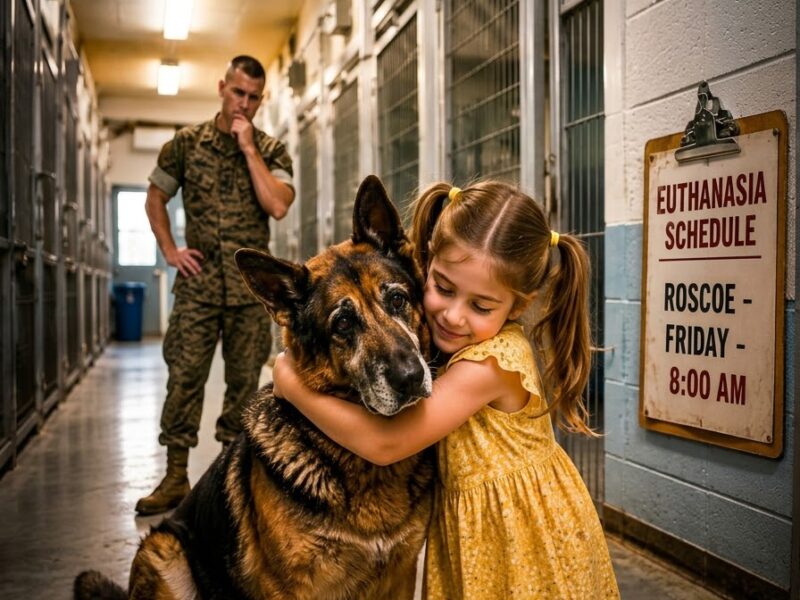
“Please don’t let him die, Daddy,” my daughter sobbed outside a Virginia highway diner
The deluge coming off the Blue Ridge Mountains turned the asphalt outside the highway diner into a sheet of black glass. Neon lights from the faded “Valley Diner” sign bled across the puddles, casting a harsh, crimson glare over the mud-splattered German Shepherd lying beside the dumpsters. The storm was deafening, cold rain driving straight through my canvas jacket as I dropped to my knees on the cracked concrete.
“Please don’t let him die, Daddy,” my eight-year-old daughter, Lily, sobbed. She was crouched beside me, her small hands clutching her yellow raincoat around her chest, her face pale with terror. “Please… he’s scared.”
“Stay back a bit, Lily,” I gritted out, pressing my folded flannel shirt hard against the gashes along the dog’s flank.
The wounds were nasty—deep, jagged tears that didn’t look like they came from a hit-and-run. They looked like he had forced his way through heavy razor wire or been mauled by something furious. His coat was a matted disaster of highway grime, burrs, and dark, coagulated blood. He was shivering violently, his ribcage expanding in shallow, rapid gasps. Yet, as I applied pressure to his side, he didn’t snap. His dark brown eyes shifted toward Lily, softened, and he let out a low, raspy sigh, resting his wet snout against her boots.
I swallowed down the cold lump in my throat. I had spent eight years in the Marine Corps as an infantry squad leader, surviving IED blasts and night firefights in Helmand, but watching this animal bleed out in a Virginia parking lot made my stomach twist into knots.
“He’s losing too much blood,” I murmured, sliding my arms beneath his heavy, emaciated frame. “Lily, open the back door of the truck. Right now!”
She scrambled up, running toward my worn Ford F-150. I lifted the Shepherd into my arms. He was heavy—built on a massive frame—but shockingly light for his size, his bones sharp beneath my hands. He let out a breathless whine as I hauled him into the cab, laying him across the back seat. Lily immediately climbed in beside him, gently resting his heavy head on her lap while wrapping her arms around his trembling neck.
I threw the truck into gear, spraying gravel as I tore out onto the highway toward the nearest 24-hour emergency vet in Harrisonburg.
The twenty-minute drive was a blur of sweeping windshield wipers and white-knuckle steering. In the rearview mirror, I watched Lily stroke the dog’s bloodied ears, whispering soft, rhythmic promises that everything would be okay.
When we hit the brightly lit bay of the animal clinic, I didn’t bother waiting for a stretcher. I carried the dog straight through the automatic glass doors.
A night-shift veterinarian rushed out from the exam rooms, taking one look at the bleeding Shepherd before barking instructions to his assistant. “Trauma room two! Get an IV started and prep a blood panel!” He checked the dog’s gums and shook his head grimly. “He’s lost a dangerous amount of blood. His temperature is dangerously low.”
“Do whatever you have to do, Doc,” I said, my hands covered in dark stains as I pulled out my wallet. I laid down every credit card I owned and the last remaining savings from my civilian construction job onto the counter. “Save him.”
The vet nodded once, sliding the gurney past the double doors.
For the next four hours, I sat in the plastic chairs of the waiting room. Lily eventually collapsed from exhaustion, her head resting against my shoulder, her small breath warm against my neck. I stared at the linoleum floor, my mind racing through the dark, quiet places it usually went when the world grew too still.
At four in the morning, the vet pushed through the swinging doors, pulling off his surgical mask. He looked exhausted, but his eyes were clear.
“He made it,” the vet said softly. “The lacerations were deep, but they missed the major arteries. He’s malnourished and bruised, but his heart is like iron. Frankly, I don’t know how he was still walking.”
I closed my eyes, letting out a long, ragged breath. For the first time since I left the Corps, I whispered a silent prayer into the quiet of the room.
We took him home two days later, officially naming him Bear.
Over the next month, our small, secluded farmhouse on the edge of the Shenandoah Valley transformed. Bear’s recovery was fast, his thick sable coat filling out, his gait regaining a powerful, fluid stride. Lily became his absolute center of gravity. She read her school books aloud to him on the porch, brushed his thick fur, and insisted he sleep on the braided rug right beside her bed.
Yet, despite his gentleness with Lily, Bear unsettled me.
There was an operational discipline in him that no civilian pet possessed. He never barked at the mailman, but he systematically swept the perimeter of our property every single morning. One afternoon, when I pulled my old Marine field jacket out of the hall closet, Bear instantly froze, dropping into a sharp, rigid military heel at my left side. Later that week, when a local radio station played a broadcast containing high-frequency tactical chatter, his ears pinned back, and he began to let out a low, desperate whine, staring directly at the speaker.
The mystery unravelled on a chilly Thursday evening.
Bear was sitting on the porch while I cleaned a small surgical drain wound on his neck. I gently pushed aside the thick fur near the base of his skull to apply antiseptic. My fingers struck something hard and metallic tucked tightly into the leather of his inner collar.
I parted the hair. A small, dull steel identification tag hung beneath the heavy leather.
I rubbed away the dried mud, tilting the metal toward the porch light. My breath hitched in my chest. The world went dead silent.
HAYES, MICHAEL R.
0311 / USMC
BLOOD TYPE: O POS
“No…” I whispered, my voice shaking so hard the word was barely audible.
engraved on the reverse side of the tag was a single word, crude and hand-stamped: GHOST.
I knew that name. I knew that tag.
Sergeant Michael Hayes had been my squad leader, my mentor, and my best friend in 3rd Battalion, 5th Marines. Five years ago, during a classified reconnaissance sweep along the Pakistan border, Michael’s unit had been wiped out in what the Department of Defense called a catastrophic mountain ambush. The official casualty report stated that Michael, along with his specialized K9 partner—a multi-purpose military working dog named Ghost—had been killed when an enemy rocket-propelled grenade struck their command post. No remains were recovered. I had spent five years grieving a brother, holding his folded flag at a dry memorial service in San Diego.
I stared down at the dog. The dog wasn’t named Bear. He was Ghost.
My hands trembled violently as I pressed my palms against his massive head. Ghost leaned into my chest, letting out a low, deep rumble that felt like a quiet recognition across a span of dark years.
“Where have you been, boy?” I whispered into his fur. “If you’re alive… what happened to Michael?”
The answer arrived eighteen hours later.
At seven the next morning, while Lily was upstairs getting ready for school, an unfamiliar Ford sedan pulled slowly up my gravel driveway. A man in his late forties got out. He wore a dark canvas jacket, pulled low over a weathered, scarred face. He held his hands out in the open—a classic military gesture of non-threat—and carried a weathered yellow envelope in his right palm.
Ghost immediately stood on the porch, his body going taut, letting out a low, vibrating growl that rattled the windowpanes.
“Easy, boy,” I called out, stepping down onto the gravel, keeping my hand near the concealed holster at my hip. “Who are you?”
The man stopped ten feet away. He looked at Ghost, then up at me, his eyes filled with a heavy, dangerous weariness.
“That dog shouldn’t be here, Miller,” the man said softly, recognizing me instantly. “He should never have been found.”
I stepped between the stranger and the porch, my voice turning to ice. “What does that mean?”
“It means,” the man said, pulling a photograph from the envelope and tossing it onto the hood of my truck, “that Michael Hayes didn’t die because of an enemy ambush.”
I looked at the photo. It showed Michael kneeling in the Afghan dust, smiling, his arm wrapped around Ghost. Standing directly behind them was a high-ranking officer wearing a private security contractor emblem on his tactical vest.
The stranger lowered his voice, stepping closer. “Michael discovered that his command element was staging fake insurgent attacks to cover up the theft of federal munitions. He was going to turn the evidence over to Internal Affairs. So they scrubbed the unit. They reported everyone dead, took the assets, and buried the files.”
My heart hammered against my ribs like a trapped bird. “Who are you?”
“Someone who was there when the fire started,” he said, handing me a sealed envelope from his coat. “Inside is a letter Michael left behind. He knew if Ghost ever made it out of the holding facility, he’d look for you.”
I snatched the envelope, tearing it open with shaking hands. Inside was a piece of yellow notebook paper, written in Michael’s familiar, aggressive scrawl:
Ethan—If Ghost finds you, it means the breach is total. Don’t trust the official reports. Trust the dog. He knows where I left the ledger.
Before I could ask another question, Ghost suddenly barked—a sharp, violent command that echoed off the mountainside.
A heavy black SUV backed down the access road, its tinted windows rolling down as it came to a halt at the edge of my driveway.
The stranger went pale. “They tracked the collar’s passive transponder. They found you.”
The rear window of the SUV cleared. A man inside held up a digital tablet, displaying a high-resolution photograph of Michael Hayes bound to a chair in a dark, concrete room, dated three weeks ago.
Michael was still alive.
The breath left my lungs in a cold, ragged gasp. The photograph on the screen was crisp, undeniable, and devastating. Michael looked gaunt, his face battered, but his eyes were open, staring into the camera with the same stubborn defiance I’d seen during our toughest days in Helmand.
“He’s alive?” I choked out, stepping toward the SUV.
“Step back, Sergeant!” the stranger yelled, grabbing my shoulder and dragging me behind the frame of my truck just as a sharp, muffled crack echoed from the treeline.
A high-caliber round slammed into the gravel three inches from my boot, kicking up a spray of stone and dust.
“Sniper! Down!” I roared.
Ghost didn’t hesitate. He didn’t run into the house or cower beneath the porch. He launched his body over the truck bed, taking up a tactical position beside me, his body coiled, his eyes locked on the dense tree line bordering my property.
“Lily! Stay inside!” I screamed toward the house. “Get under the bed! Now!”
“Daddy?!” her small voice echoed from the upstairs window, high and terrified.
“Do it now, Lily!”
The stranger pulled a suppressed 9mm pistol from beneath his jacket, firing two rapid shots toward the black SUV as it accelerated forward, attempting to block our driveway. “We have to move! If they pin us here, they’ll bring down the house!”
“Who are they?!” I yelled back, pulling my own service weapon from my hip holster and leaning around the rear tire of my truck to fire three rounds into the SUV’s radiator.
“Blackbriar Security!” the stranger shouted over the deafening engine noise. “Private contractors working for the guys who bought off Michael’s battalion commander! They’ve been holding Michael in a black site in West Virginia, trying to force him to unlock an encrypted ledger!”
The front windshield of the SUV shattered under my gunfire, forcing the driver to swerve into the ditch. Two men in full tactical gear spilled out of the side doors, raising suppressed rifles.
Ghost let out a deep, gut-wrenching war cry. He didn’t wait for my order. He flanked left, using the high grass near the drainage ditch as cover, moving with the terrifying speed of a combat-trained military working dog. Before the first contractor could bring his rifle to bear on my position, Ghost erupted out of the brush, his seventy-pound frame slamming into the man’s chest.
The contractor hit the ground hard, his rifle flying into the mud as Ghost locked his jaws onto the tactical vest shoulder strap, dragging him down and neutralizing his line of fire.
“Move!” I barked at the stranger, using the distraction to push forward. I fired two precise rounds into the second contractor’s leg, dropping him beside the ditch, then grabbed Ghost’s heavy tactical collar. “Ghost, heel! Heel!”
The dog released his grip instantly, stepping back into a tight heel at my side, his chest heaving, his mouth stained with mud and blood.
The stranger sprinted to the driver’s side of my F-150, slamming his fist against the hood. “We don’t have time! That was just the scout element! They have satellite tracking on this sector!”
I turned, sprinting up the porch steps into the house. Lily was huddled beneath the dining room table, her hands over her ears, tears streaming down her red cheeks.
I dropped to my knees, wrapping her in my arms. “I’m here, baby. I’ve got you.”
“Daddy, who are those men?!” she sobbed into my shoulder. “Why are they shooting at us?!”
“Listen to me, Lily,” I said, looking her straight in the eyes, holding her face between my hands. “Remember the game we played when we went camping? The quiet game?”
She nodded rapidly, her body shaking.
“I need you to be the quietest you’ve ever been,” I said firmly. “We are going to take Ghost, get into the truck, and go visit Uncle Jim at his farm. You are safe. I promise you on my life, you are safe.”
I grabbed a pre-packed bug-out bag from the hall closet—a habit I’d never managed to break after leaving the Marines—along with my rifle case and extra ammunition. I carried Lily out the back door, staying low beneath the line of the wooden fence, and loaded her into the floorboards of the truck’s extended cab, covering her with a heavy moving blanket.
Ghost jumped in right beside her, instantly draping his large body over her legs like a living shield.
The stranger slid into the passenger seat, sweating heavily, his hand pressed against a bleeding graze on his forearm. “Name’s Vance,” he panted as I slammed the truck into four-wheel drive and stomped on the gas, tearing through my own wooden fence into the back pasture to avoid the blocked driveway. “Former DIA.”
“You better start explaining fast, Vance,” I snarled, spinning the wheel as the F-150 smashed through a thicket of pine saplings and broke onto the county backroad. “Or I drop you out of this truck at sixty miles an hour.”
Vance pulled a heavily encrypted satellite phone from his pocket, tossing it onto the dashboard. “Five years ago, your friend Michael discovered that twenty million dollars in seized foreign currency and advanced munitions were being diverted out of Kandahar by a shadow network within the Department of Defense. They used Blackbriar to execute the logistics.”
“And Michael?”
“Michael stole the master digital ledger before they could execute him,” Vance said, staring out the rain-slicked side window. “He hid it. They’ve spent five years trying to break him to get the access key. They couldn’t. So they tried to use Ghost. They brought the dog to the site two months ago, hoping Ghost’s reaction would lead them to Michael’s hidden caches.”
I looked back through the rear window. Ghost was sitting vigilant over Lily, his head resting against her small knee, his eyes fixed on the road behind us.
“Ghost escaped,” I said.
“He didn’t just escape,” Vance replied softly. “He mauled three guards, ran seventy miles through the mountains, and tracked you down because Michael trained him to find you if the operational grid failed. That dog isn’t just a pet, Miller. He’s the only key to finding Michael before they decide he’s no longer useful and put a bullet in his head.”
I gripped the steering wheel so hard the leather groaned. The pain in my chest, the years of grief and quiet isolation on my farm, burned away into a singular, cold rage.
“Where are they keeping him?” I asked.
Vance looked at me, a grim, dangerous smile touching the corner of his scarred mouth. “In an old limestone quarry bunker near Spruce Knob, West Virginia. It’s a fortress.”
“Good,” I said, accelerating into the black storm rising over the mountains. “Then we don’t need a diplomatic solution.”
The storm followed us west into the rugged, high-altitude wilderness of the West Virginia panhandle. By midnight, the rain had turned into a thick, freezing sleet that clotted on the pine needles and slicked the narrow, unpaved logging trails.
I had left Lily at a secure, off-grid property owned by my former platoon sergeant, Jim—a man who had spent twenty years in Recon and owned enough firepower to hold off a battalion. She was safe, sitting by a woodstove with Jim’s wife, wrapped in a blanket, eating warm soup. Leaving her was the hardest thing I’d ever done, but the look in her eyes when I kissed her forehead gave me my absolute purpose.
“Bring Bear back, Daddy,” she had whispered. “Bring Bear and his daddy home.”
Now, sitting in the darkened cab of the truck two miles from the Spruce Knob quarry, I checked the action on my M4 carbine. The mechanical clack of the bolt chambering a round was the only sound inside the cab.
Vance was unfolding a topographical map across his knees, using a dim red lens flashlight to highlight the target sector.
“The facility is an abandoned subterranean limestone mine,” Vance explained, pointing to a deep gorge surrounded by sheer vertical rock faces. “Blackbriar bought it through a shell corporation three years ago. They built a high-security perimeter around the main portal, with motion sensors, thermal cameras, and a six-man tactical guard rotation.”
“Where’s Michael?” I asked.
“Sub-level two. The old administrative offices,” Vance replied. “They have him hooked up to medical monitors to make sure he doesn’t slip into shock during interrogations. They know their time is running out. Once they realize Vance’s team failed at your farmhouse, they’ll initiate a full data-wipe and execute all live assets.”
“Including Michael,” I said.
“Including Michael.”
I turned to look at Ghost in the rear seat. The dog was completely still. I had fitted him with an old tactical chest harness I’d retrieved from Jim’s armory—heavy nylon straps with a reinforced handle and magazine pouches. He looked like he had stepped right out of a forward operating base in Afghanistan. He stared back at me with dark, intelligent eyes that held no fear.
“Ghost,” I whispered, reaching back to rub his ears. “We’re going to get him, boy.”
Ghost let out a single, quiet huff of air, his tail thumping once against the seat.
“What’s the plan?” Vance asked, thumbing the safety off his pistol. “We don’t have the manpower for a direct assault.”
“We don’t need manpower,” I said, looking out at the frozen forest. “We have the weather, we have night optics, and we have a war dog who knows every inch of their perimeter defensive posture because he already broke out of it once.”
We abandoned the truck in a deep ravine, moving on foot through the thick, frozen underbrush. The wind was howling down the canyon, tearing through the pines with a high, screaming sound that perfectly masked our footsteps.
Ghost led the way. He moved like a ghost through the timber, his belly low to the ground, stepping only on silent moss and soft mud, avoiding dried twigs and loose gravel with incredible instinct.
Within twenty minutes, we reached the edge of the quarry cliff, looking down into the brightly lit basin below.
The facility was an industrial nightmare. High chain-link fences topped with razor wire enclosed a massive concrete portal carved directly into the mountain’s limestone face. Floodlights washed the yard in stark, blinding white, illuminating two armored vehicles and a small cluster of pre-fabricated administrative trailers. Three armed contractors in dark winter parkas walked the perimeter with slung rifles.
“Thermal cameras on the main gate,” Vance whispered, looking through a monocular. “Motion sweeps along the fence line.”
“Look at the drainage culvert,” I said, pointing toward the eastern wall of the quarry where a heavy steel pipe spewed water down into the ravine. “The grate at the end is bent outward.”
Vance adjusted his lens. “That’s how Ghost escaped.”
“And that’s how we’re going back in,” I said.
We descended the slippery rock face, dropping into the freezing water of the drainage creek. The water was waist-deep, numbingly cold, but my blood was burning too hot to care. Ghost swam effortlessly through the current, reaching the rusted iron mouth of the culvert first.
He stopped, turning his head back toward me, letting out a soft, low whine that pointed directly into the pitch-black tunnel.
“He smells them,” I murmured, pulling my night-vision goggles down over my eyes. The dark world bloomed into a sharp, luminescent green. “Keep your weapons low. Silent takedowns until we hit the sub-level.”
We crawled into the steel pipe. The smell of damp limestone, motor oil, and old rust was thick. Ghost moved ahead of us, his paws making no sound against the wet metal.
After fifty yards, the pipe opened up into a heavy drainage sump beneath the main concrete floor of the facility. A iron ladder led upward toward a heavy steel hatch.
Ghost dropped to his hindquarters at the base of the ladder, looking up, his nostrils flaring as he sniffed the warm air blowing down through the seams of the hatch.
He turned to me, giving a single, subtle head nudge toward the ladder.
“Michael’s up there,” I whispered to Vance.
I gripped the cold iron rungs, my heart slamming against my ribs in a steady, operational rhythm. Five years of mourning, five years of broken quiet on my farm, all narrowed down to this single, dark ladder in the heart of a mountain.
“Let’s go bring our brother home,” I growled.
I pushed the steel hatch up an inch, pausing as the low hum of an industrial generator filled my ears.
Through the narrow gap, I scanned the corridor. It was a narrow, concrete-walled hallway illuminated by flickering fluorescent tubes. Pipes and heavy electrical conduits ran along the ceiling. A single guard sat at a folding table thirty feet away, his back to the hatch, scrolling through his phone with an assault rifle resting lazily against his chair.
I opened the hatch fully, slipping out like a shadow onto the cold concrete floor. Vance followed instantly, his weapon raised, covering the far intersection.
Ghost emerged last, his body low, moving without making a sound.
Before the guard could even turn his head, I closed the distance in three long strides, wrapping my arm around his throat in a tight sleeper hold while driving my knee hard into the back of his chair. He struggled violently for four seconds, his feet kicking the metal legs of the table, before his body went limp in my arms. I lowered him quietly to the floor, stripped his keycards and radio, and bound his wrists with heavy zip-ties.
Vance leaned over the table, swiping the keycard through the terminal mounted on the wall. The screen flickered, displaying a floor plan of the subterranean level.
“Cell three,” Vance whispered, pointing to a highlighted section at the end of the western corridor. “They have two security details posted at the main bulkhead door.”
“Ghost,” I whispered, kneeling beside the Shepherd. “Where is he, boy? Where’s Michael?”
The moment I spoke his original handler’s name, Ghost’s eyes flared with a desperate, intense intelligence. He didn’t look at the doors or the hall; he turned his head toward the heavy steel double doors labeled SUB-LEVEL 2: MEDICAL.
He took two fast steps toward the doors, then stopped, dropping into a rigid, low crouch as the sound of heavy footsteps echoed from around the corner.
“Two coming!” Vance warned, backing up against the concrete wall.
Two Blackbriar contractors turned the corner, holding hot cups of coffee and sidearms holstered at their hips. They froze, their eyes widening in shock as they saw me standing in tactical gear in the center of the restricted hallway.
“Intruders—!” one shouted, reaching for his weapon.
Pfft! Pfft!
Vance’s suppressed pistol barked twice. The first contractor dropped instantly, his cup shattering against the floor. The second contractor managed to pull his weapon, but Ghost was already airborne.
The dog slammed into the man’s chest with brutal velocity, his jaws locking onto the contractor’s forearm, taking him down to the hard floor with a heavy thud. The man let out a stifled scream, dropping his gun as Ghost pinned him to the concrete with terrifying, absolute control.
I rushed forward, pressing the barrel of my rifle against the contractor’s forehead. “Where is the keycard for cell three?!” I snarled.
The man was sobbing, hyperventilating under the weight of the war dog standing on his chest. “In… in the desk! The red lanyard! Please don’t let him bite!”
Vance snatched the red lanyard from the reception desk nearby, sliding the master card through the heavy electronic lock of the bulkhead door.
The heavy steel door let out a loud, pneumatic hiss, sliding open to reveal a dark, sterile room filled with medical equipment, heart monitors, and a single metal gurney in the center.
My heart stopped in my chest.
Strapped to the gurney, hooked up to an IV line and an electrocardiogram, was a man. His hair was long, dark, and wild, his face covered in a ragged beard, his skin deathly pale beneath the harsh fluorescent lights.
“Michael…” I breathed, stepping into the room, my voice cracking.
The man on the table moved slowly. His eyelids fluttered open, heavy and sunken with exhaustion. He turned his head toward the door, his eyes bloodshot, struggling to focus on my face.
“Ethan?” he rasped, his voice sounding like dry paper rubbing together. “Am I… am I dreaming again?”
“You’re not dreaming, brother,” I choked out, rushing to the side of the gurney, pulling out my combat knife to slice through the heavy leather restraints binding his wrists and ankles. “I’m here. We’re getting you out.”
Michael let out a broken, shuddering breath, his hands trembling as he reached up to grab my tactical vest, holding on with the last remaining strength in his body. “You… you came…”
Suddenly, a loud, wet nudge hit Michael’s dangling hand.
Ghost pushed his heavy head onto the edge of the mattress, resting his snout directly against Michael’s palm. He let out a soft, high-pitched whine—a sound of pure, unadulterated joy and devotion that made tears burst from my eyes.
Michael froze. He looked down at the dog, his hand trembling uncontrollably as his fingers sank into Ghost’s thick fur.
“Ghost…” Michael sobbed, pulling the dog’s head into his chest, burying his face in the animal’s neck as his shoulders shook violently. “My boy… you made it… you found him…”
Ghost licked Michael’s face again and again, his tail thumping against the metal frame of the gurney with wild, relentless happiness.
“We have to move!” Vance suddenly yelled from the doorway, looking back down the hallway. “Alarm just tripped on the upper level! They know we’re inside!”
I helped Michael sit up. He was dangerously weak, his muscles wasted from five years of captivity, but as I draped his arm over my shoulder, the old, unbreakable Marine spirit returned to his eyes.
“The drive, Ethan,” Michael rasped, grabbing my collar. “The encrypted drive… it’s in the safe… behind the medical cabinet. You can’t leave it.”
I turned, using the butt of my rifle to smash open the glass doors of the medical cabinet. Tucked inside a small, fireproof wall safe was a heavy, military-grade black hard drive—the master ledger containing the evidence that could tear down an entire corrupt shadow empire.
I snatched the drive, shoving it into my chest pouch, and zipped it tight.
“Got it,” I said, pulling Michael to his feet. “Now let’s go blow this place to hell.”
The escape through the upper quarry was a chaotic, gunfire-filled blur.
Vance laid down suppressive fire along the main corridor, keeping the remaining Blackbriar contractors pinned down while I carried Michael across my shoulders, moving as fast as my legs could push me through the dark limestone tunnels. Ghost ran beside us, his teeth bared, sweeping every intersection, clearing our flank with absolute lethal perfection.
When we reached the drainage culvert, the storm outside was raging with terrifying beauty. Sleet pounded the valley, but the cold air felt like pure life blowing into our lungs after the suffocating darkness of the bunker.
We scrambled up the ravine, reaching the hidden truck just as the red emergency lights of the quarry facility began to flash in the distance, sirens wailing uselessly against the mountain gale.
I laid Michael across the back seat of the F-150, wrapping him in heavy wool blankets. Ghost immediately climbed in, curling his massive body around Michael’s frame, providing his former handler with warm, protective heat.
Vance jumped into the passenger seat, slapping the dashboard. “Drive, Miller! Drive before their air support clears!”
I slammed my foot onto the gas pedal, the heavy tires tearing through the mud as we launched onto the highway, leaving the limestone hell behind us forever.
Eight hours later, the sun broke through the clouds over the Shenandoah Valley, casting a brilliant, warm gold light across the rolling green hills of my farm.
The world had shifted completely.
Vance had used his high-level contacts within the Department of Justice to secure an immediate federal escort. By noon, three black sedans carrying federal prosecutors and the Inspector General of the Marine Corps had arrived at Jim’s secure farm, taking custody of the hard drive and initiating a sweeping, nationwide raid on Blackbriar Global. Within forty-eight hours, the men who had betrayed Michael, murdered his squad, and hidden him in a dark hole were in federal handcuffs, facing charges of treason, kidnapping, and murder.
My small farmhouse was quiet now, filled with the warm scent of coffee and fresh pine air blowing through the open windows.
Michael sat on the porch swing, wrapped in a blanket, holding a steaming mug in his trembling hands. His face was still pale, his body frail, but the hollow, lost look in his eyes had been replaced by a quiet, overwhelming peace.
Lily was sitting on the porch steps right in front of him, holding a picture book, pointing to the illustrations while Ghost lay between them, his head resting happily across Lily’s knee while his tail gently tapped against the wooden floorboards.
I walked out onto the porch, carrying two plates of food, and sat down on the railing beside Michael.
“They signed the official military restoration order this morning,” I said quietly, looking out over the mountains. “Your rank is reinstated. Your full back pay and medical pension are cleared. You’re a free man, Michael.”
Michael looked at me, a soft, genuine smile breaking through his ragged beard. He looked down at Lily, then at Ghost, who opened one brown eye to look up at his master.
“I didn’t think I’d ever see the sun again, Ethan,” Michael whispered, his voice thick with emotion. “For five years… the only thing that kept me breathing was hoping this dog made it out.”
He reached down, his thin fingers sliding gently through Ghost’s thick sable fur. Ghost let out a long, contented sigh, leaning his heavy skull against Michael’s leg.
Lily looked up, her blue eyes bright with pure happiness. “He’s not Bear anymore, is he, Daddy?”
I smiled, dropping to one knee beside my daughter, wrapping my arm around her shoulder while placing my hand over Michael’s and Ghost’s fur.
“He was always Ghost, Lily,” I said softly. “He was just waiting for the right moment to bring our family back together.”
Lily grinned, leaning forward to kiss the top of Ghost’s forehead. “Good boy, Ghost. Good boy.”
The war dog closed his eyes, resting his head between the two people he had fought three thousand miles and five long years to protect. The storm was over, the shadows had retreated into the light, and for the first time in a very long time, we were all finally home.
The end.









