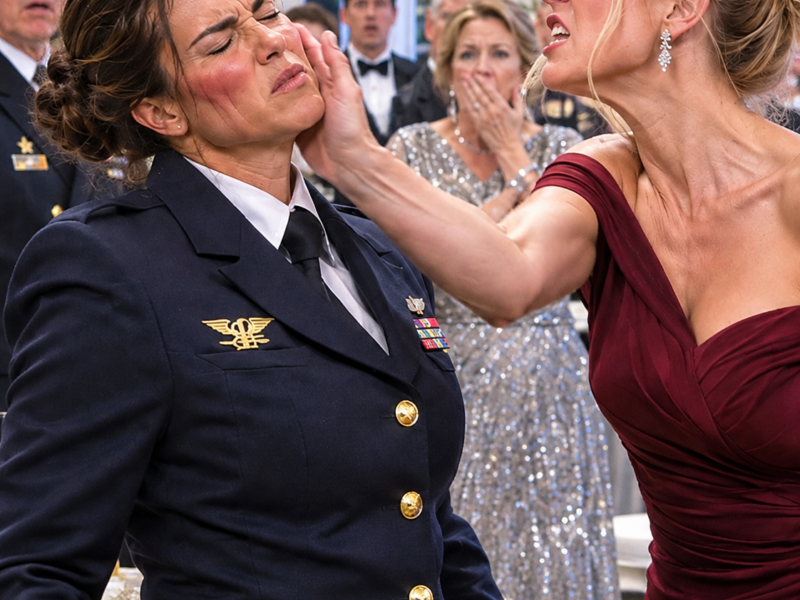
“Play soldier somewhere else, Tessa. Some of us have real lives.”
Tessa Ror had been awake for thirty-one hours when she pulled into her parents’ driveway in Ohio.
The drive from the airport had been quiet. Her duffel bag sat on the passenger seat, her uniform was folded carefully in the back, and the coffee in the cup holder had gone cold long before she reached the neighborhood.
She was thirty-six years old. A Lieutenant Commander in the United States Navy. A Navy SEAL officer who had spent eleven years learning how to make decisions when other people were frightened, exhausted, or running out of time.
But none of that mattered in the driveway of her childhood home.
Today, she was simply Tessa.
Her mother was turning sixty-five, and Tessa had promised she would be there.
She had made the promise months earlier, before her deployment schedule changed, before the long nights and difficult decisions, before she had learned that the mission would follow her even when she was thousands of miles away from it.
She had asked for one weekend.
One birthday.
One chance to sit at her parents’ table without a radio in her ear.
She stepped out of the car, stretched her stiff shoulders, and looked at the house.
The same white siding. The same flower beds her mother tended every spring. The same porch where she and her older sister, Colleen, had once sat through summer thunderstorms.
For a moment, Tessa allowed herself to believe that the weekend might be ordinary.
Her phone vibrated.
She glanced down.
STANDBY FOR MOVEMENT.
A short message. No explanation. No unnecessary details.
She read it twice, then locked the screen.
Her mission timeline had just moved forward by six hours.
That meant she needed to remain reachable. It meant that the people responsible for coordinating her team’s next movement might call at any moment.
It also meant that her weekend was already becoming shorter.
Tessa slipped the phone into her pocket and picked up her bag.
Inside, the house was full of noise.
Her mother, Judith, was in the kitchen arranging food. Her father, Frank, was carrying folding chairs into the dining room. Several relatives had already arrived, and more were expected before the birthday cake.
Colleen stood near the kitchen island, laughing with her husband, Grant.
At forty, Colleen had built a successful career in real estate. She was confident, polished, and comfortable in almost any room. She had two sons, a husband who supported her, and a life that seemed to match the picture their mother had always imagined for her daughters.
Tessa had never been particularly good at explaining her own life.
She couldn’t discuss most of her work. She couldn’t describe where she had been or what she had done. She couldn’t share the names of the people who had stood beside her or the things they had endured together.
So, over the years, her family had filled in the blanks.
As far as they were concerned, Tessa worked some kind of administrative job for the Navy.
A desk job.
A job involving paperwork, meetings, and classified documents.
She had tried correcting them a few times. Eventually, she stopped.
There were things she could explain, and things she couldn’t. She had learned that silence was often easier than trying to make people understand a world they had never seen.
Her mother greeted her with a quick hug.
“You made it,” Judith said.
“I promised.”
“You look tired.”
“Long trip.”
Judith looked at her for another moment, then turned back toward the kitchen.
“Colleen has been helping me all week. I don’t know what I would’ve done without her.”
Tessa nodded.
“I’m glad she could help.”
Colleen turned at the sound of her name.
“Well, look who finally made it.”
She smiled, but there was something sharp underneath it.
Tessa put down her bag.
“Happy almost birthday, Mom.”
“Thank you, sweetheart,” Judith said.
Colleen looked Tessa up and down.
“Still wearing those military clothes everywhere?”
“I’m not wearing military clothes.”
“Whatever they are.” Colleen laughed. “I guess when you spend all day behind a desk, you have to keep the uniform nearby so people remember you’re important.”
Grant gave a small laugh.
Tessa didn’t respond.
She had been home less than five minutes.
She wasn’t going to spend the weekend fighting.
The afternoon moved forward.
Relatives arrived with gifts, food, and stories. The living room filled with conversation. Children ran through the hallway. Someone turned on music in the kitchen.
By the time everyone gathered, there were nineteen relatives in the house.
Tessa found a chair near the end of the dining room table.
She listened more than she spoke.
People asked about her work, but their questions rarely went beyond the surface.
“How’s the Navy?”
“Busy?”
“Still doing paperwork?”
Tessa answered politely.
“Busy.”
“Can’t complain.”
“It’s important work.”
She never lied about what she did. She simply didn’t explain what she wasn’t allowed to explain.
Colleen, meanwhile, seemed determined to make the subject entertaining.
At one point, she raised her glass.
“To Tessa,” she said.
Several people turned toward her.
“To our family’s mysterious Navy desk jockey. The only person I know who can make a classified spreadsheet sound like a national emergency.”
A few relatives laughed.
Tessa looked down at her plate.
Colleen continued.
“Seriously, though. I don’t know how you do it. All those meetings, all that paperwork. I could never sit behind a desk all day.”
Grant smiled into his drink.
Tessa took a sip of water.
“It’s a little more complicated than that.”
“Oh, I’m sure,” Colleen said. “Very classified.”
More laughter.
Judith gave her older daughter an approving smile.
“Colleen, leave your sister alone.”
But there was no real reprimand in her voice. It sounded more like an invitation for the joke to continue.
Tessa felt the familiar weight of it.
The small dismissals. The assumptions. The way her work became a punchline because she couldn’t defend it with stories.
She had spent years carrying responsibilities her family would never know about.
She had accepted that.
What she had not expected was how easily the people closest to her could mistake silence for insignificance.
Then her phone rang.
The sound cut through the room.
Tessa reached for it immediately.
The screen displayed a contact name:
COMMANDER NSW
Her expression changed.
Not dramatically. Not enough for anyone unfamiliar with her to understand.
But her attention sharpened.
She stood.
“Excuse me.”
Colleen leaned forward.
“Who’s calling? Your office?”
Tessa didn’t answer.
She was already moving toward the hallway.
Colleen reached across the table and grabbed the phone before Tessa could get to it.
“Hey!”
Tessa turned.
“Give it back.”
Colleen held the phone up, looking at the screen.
“Commander NSW? What is that supposed to be?”
“Colleen. Give me my phone.”
“Oh, come on. We’re having a family party. You can answer your little office call later.”
“It’s important.”
Colleen laughed.
“Everything is important with you. Every call, every message, every mysterious little emergency.”
Tessa stepped closer.
“I need that phone.”
Colleen pulled it away.
“Play soldier somewhere else. Some of us have real lives.”
The words landed harder than Tessa expected.
She had heard versions of them for years.
But this time, the phone was still ringing.
And somewhere beyond the walls of that house, people were waiting for her to answer.
“Colleen,” Tessa said, her voice low and controlled. “This is not a joke. Give it back.”
Colleen’s expression tightened.
“Why? So you can pretend you’re saving the world again?”
Tessa reached for the phone.
Colleen struck her.
The slap cracked across the room.
For a second, everything stopped.
Tessa’s head turned with the force of it. Her phone slipped from Colleen’s hand and hit the floor.
The screen remained lit.
The call continued.
No one moved.
Tessa slowly brought her face forward again.
Her cheek burned.
She could feel the beginning of a swelling beneath the skin.
She looked at her sister.
She did not raise a hand.
She did not shout.
She did not step forward.
She simply stood there, breathing through the shock.
Colleen looked almost as surprised as everyone else.
Then she tried to recover.
“Maybe now you’ll listen.”
Tessa looked down at her phone.
The call had ended.
She picked it up.
Eleven missed calls.
A message appeared on the screen.
ROLLING TO YOUR LOCATION. 8 MINUTES.
Tessa read it.
Her stomach tightened.
She knew what it meant.
She looked at the room.
“I need everyone to stay out of my way.”
For the first time all afternoon, no one had a joke.
A few minutes earlier, the birthday party had been full of laughter.
Now, nobody seemed to know what to say.
Tessa moved toward the front window.
Outside, across the street, a neighbor named Mr. Okafor had seen what happened through the window. He had witnessed Colleen strike her younger sister, and he had already called the sheriff.
Tessa didn’t know that yet.
She was watching the street.
Her phone vibrated again.
She checked the screen.
No new message.
She stood near the window, her injured cheek facing away from the family.
Behind her, someone quietly moved a chair.
Then another car passed.
And then, eight minutes after the message arrived, a black SUV turned into the driveway.
It stopped in front of the house.
Tessa recognized the vehicle before the driver had fully opened the door.
Her posture changed.
The front door opened.
A woman stepped out wearing Navy dress blues.
She was fifty-eight years old, with a composed expression and the bearing of someone accustomed to being listened to without having to demand it.
Two silver stars marked her rank.
Rear Admiral Dolores Keane.
Behind her came a Master Chief with a gold trident, a junior officer, and two men in plain clothes.
They walked toward the house together.
The family watched through the windows.
Judith’s face had gone pale.
“Who is that?” she whispered.
Tessa opened the door before anyone else could reach it.
“Admiral.”
Keane looked at her.
Her eyes moved immediately to Tessa’s cheek.
“Lieutenant Commander Ror.”
“Ma’am.”
Keane glanced at the phone in Tessa’s hand.
“Your phone has been ringing for eleven minutes.”
“I know, ma’am.”
“We’ve been trying to reach you.”
“I apologize.”
Keane held her gaze.
“Are you ready?”
“Yes, ma’am.”
The admiral paused.
Then she looked past Tessa into the house.
“May we come in?”
Tessa stepped aside.
Keane entered.
The Master Chief followed, his gold trident visible on his uniform. The junior officer remained close behind. The two men in plain clothes took positions near the entrance.
The room had become so quiet that the sound of their footsteps seemed unusually loud.
Keane looked around at the relatives gathered in the dining room.
“I apologize for interrupting the gathering,” she said. “But I need to speak with Lieutenant Commander Ror.”
Judith stared at Tessa.
“Lieutenant Commander?”
Tessa didn’t answer.
Keane turned toward the family.
“I understand this is a birthday celebration.”
Judith nodded slowly.
“My sixty-fifth.”
“Happy birthday.”
“Thank you.”
Keane’s voice remained calm.
“I came because Lieutenant Commander Ror’s schedule has changed. Her team is waiting, and we need her available for movement.”
Colleen crossed her arms.
“Her team?”
Keane looked at her.
“Yes.”
Colleen gave a short laugh.
“I think there’s been some confusion. Tessa works in an office.”
The admiral did not smile.
“No. She does not.”
The room became even quieter.
Keane looked back at Tessa.
“Lieutenant Commander Ror leads one of the most capable teams under my command.”
Tessa lowered her eyes slightly.
“Ma’am.”
“Eleven weeks ago, she and her team brought forty-one people home.”
Nobody spoke.
Keane continued.
“I won’t discuss the operation or the circumstances surrounding it. Those details are not appropriate for this room. But I can tell you that the mission was difficult, the stakes were high, and the people who came home owe a great deal to the officers and sailors who brought them back.”
Judith’s hand moved to her mouth.
Frank stood very still.
Colleen’s arms slowly lowered.
Keane continued.
“Three flag officers recommended Lieutenant Commander Ror for the Navy Cross. The award was presented in a closed ceremony.”
Tessa looked uncomfortable.
“Ma’am, that isn’t necessary.”
Keane gave her a brief glance.
“I believe it is.”
Then she faced the family again.
“The Navy Cross is the second-highest military decoration for valor in the United States Navy and Marine Corps. It is not awarded casually.”
The words seemed to settle over the room.
Tessa’s mother looked at her daughter as though she were seeing her for the first time.
Her father stared at the floor.
Colleen didn’t move.
Keane took a breath.
“I came in person because the timeline changed. Her team is waiting. I wanted to make sure she was ready, and I wanted to meet the family she had asked to spend this weekend with.”
Judith looked at Tessa.
“You asked for this weekend?”
“Yes, Mom.”
Keane answered before Tessa could say more.
“She requested time off for her mother’s birthday. She did not ask for anything beyond that.”
The admiral’s eyes moved toward Colleen.
Then to Tessa’s cheek.
“Who struck her?”
Nobody answered.
Keane waited.
Colleen swallowed.
“I did.”
The admiral looked directly at her.
“You did?”
Colleen’s voice had lost its earlier confidence.
“Yes.”
Keane did not raise her voice.
“I am not a law enforcement officer. I have no jurisdiction over what happened in this house, and I am not here to tell anyone how to handle a criminal matter.”
She paused.
“But I can tell you this. Your sister has carried people out of places that do not appear on ordinary maps. She has taken responsibility for people whose names she may never be able to tell you. She came home exhausted and asked for a weekend with her family.”
Keane looked at the swollen side of Tessa’s face.
“And this is how that request ended?”
Colleen opened her mouth.
No words came.
A knock sounded at the front door.
The deputy had arrived.
Mr. Okafor had called the sheriff after witnessing the assault.
Tessa looked toward the door.
“I’ll speak with him.”
Keane stepped aside.
The deputy entered and asked what had happened.
Tessa gave him a straightforward account.
She told him Colleen had taken her phone, refused to return it, and struck her across the face.
The deputy asked whether she wanted to press charges.
Tessa looked at her sister.
Colleen stood near the dining table, pale and silent.
“No,” Tessa said. “I don’t want to press charges.”
The deputy nodded.
“But I want the assault recorded.”
“Of course.”
He took down the information and spoke with the people who had witnessed the incident.
The party was over.
Relatives began collecting their belongings. Some offered awkward apologies. Others avoided Tessa’s eyes. Grant gathered the boys and led them toward the door.
The birthday cake remained untouched on the counter.
The balloons still hung near the living room window.
The house that had been full of laughter less than an hour earlier now felt strangely empty.
When the last guests left, Judith approached Tessa.
“Sweetheart.”
Tessa turned.
Her mother looked from her swollen cheek to the phone in her hand.
“Can we talk?”
“Of course.”
Judith glanced toward Colleen.
“She didn’t mean for things to go this far.”
Tessa didn’t respond.
“She has been under a lot of stress,” Judith continued. “The boys, the business, everything. You know how she gets.”
Tessa listened.
“She’s your sister,” Judith said. “Families have moments. We say things we don’t mean. We get upset.”
Tessa looked at her mother.
“Mom, she hit me.”
Judith’s expression tightened.
“I know.”
“She took my phone when I told her it was important. She mocked my work. And then she hit me.”
“I know, sweetheart.”
“Do you?”
Judith looked away.
Tessa felt something inside her settle.
Not anger exactly.
Something quieter.
Something she had been trying not to acknowledge for a long time.
“I can’t just go back to how things were,” she said.
Judith’s eyes filled.
“Tessa—”
“I don’t want to.”
Her mother fell silent.
Tessa had spent years trying to preserve the appearance of family peace. She had allowed jokes to pass, ignored comments, and accepted the explanations that always seemed to arrive after someone hurt her.
But this time, she could not pretend nothing had happened.
Not because of the admiral.
Not because of the uniform.
Because her sister had hit her, and the people in the room had watched.
She needed to leave.
Before she did, she went into the garage to find her father.
Frank was standing near the workbench.
The garage smelled of old tools, motor oil, and the coffee Judith always sent him out with in the morning.
He looked up when Tessa entered.
For a moment, neither spoke.
Then he said, “I’m sorry.”
Tessa leaned against the doorframe.
“Dad.”
“I should’ve said something.”
She waited.
Frank rubbed his hands together.
“I should’ve stopped it.”
Tessa looked at him.
He had always been a quiet man. He wasn’t someone who filled a room with opinions or interrupted arguments. When the family disagreed, he often stepped back and let Judith handle it.
When Colleen spoke, he usually listened.
When Tessa came home, he asked whether she was eating enough and whether she needed anything for the road.
He had never been cruel.
But he had been silent.
And silence had its own consequences.
Frank looked toward a shelf.
“There’s something I never told you.”
He reached up and pulled down a small shoebox.
It was old and worn, with the corners softened from years of handling.
He placed it on the workbench and opened it.
Inside were newspaper clippings and printed articles.
Tessa leaned forward.
Some of them were about Navy operations. Others were photographs and short reports mentioning military officers, though many details were missing.
Her name appeared in a few.
Not always prominently.
Not always with much information.
But it was there.
“You kept these?”
Frank nodded.
“Over the years.”
Tessa picked up one of the clippings.
“Why?”
He gave a small, embarrassed smile.
“Because I was proud of you.”
She looked at him.
Frank continued.
“Four years ago, a retired Master Chief came through town. He recognized your name when I mentioned you were my daughter.”
Tessa waited.
“He told me you were the finest officer he’d ever served under.”
Her throat tightened.
“I didn’t know that.”
“He said you were steady. That you looked after your people. That when things went wrong, everyone wanted you in the room.”
Frank glanced down at the box.
“I kept thinking I should tell you. But I didn’t know how to bring it up without asking questions you couldn’t answer.”
Tessa ran her fingers over the edge of the clipping.
“I couldn’t have told you much.”
“I know.”
Frank took a breath.
“But I could’ve told you I was proud.”
The words were simple.
They hurt more than she expected.
He looked toward the house.
“When your sister hit you, I froze. I saw it happen, and I froze.”
Tessa didn’t try to make him feel better.
She didn’t tell him it was all right.
Because it wasn’t.
Frank nodded, as if he understood.
“I should’ve stood up.”
“Yes,” Tessa said softly. “You should have.”
He looked at her, accepting it.
Then he reached toward a shelf and picked up a worn silver thermos.
“Your mother made coffee.”
Tessa took it.
The thermos had scratches along its side. The lid was slightly dented. It was the kind of thing that had been used so often that nobody thought about replacing it.
“Take it with you,” Frank said.
“She’ll want it back.”
“She can make more.”
Tessa smiled faintly.
“Thanks, Dad.”
Frank looked at her for a long moment.
Then he stepped forward and hugged her.
It wasn’t a long embrace.
It didn’t need to be.
Tessa held him tightly for a few seconds before letting go.
For the first time that day, she felt something loosen in her chest.
When she stepped out onto the porch, Colleen was waiting.
The late afternoon light had begun to fade.
The street was quiet now. Most of the cars had gone, and the birthday decorations inside the house were visible through the windows.
Colleen stood near the railing with her arms crossed.
“Can we talk?”
Tessa stopped.
“Okay.”
Colleen looked down at the porch boards.
“I didn’t know.”
Tessa waited.
“I didn’t know what you actually did.”
“You didn’t ask.”
Colleen looked up.
“You never told us.”
“I couldn’t tell you everything.”
“Still.”
Tessa held the thermos in one hand.
Colleen glanced at it, then back at her sister.
“I didn’t think it was like that.”
Tessa nodded slowly.
“That doesn’t change what happened.”
“I know.”
Colleen took a breath.
“I was angry. You came in and everything became about you. Mom was excited, and then you had some call and suddenly—”
“Stop.”
Colleen fell silent.
“That’s not an apology.”
“I said I was angry.”
“You’re explaining why you hit me.”
Colleen looked away.
Tessa’s voice remained steady.
“I am not pressing charges. I told the deputy that. But I am not going to pretend this didn’t happen.”
Colleen’s eyes filled.
“Tessa, we’re sisters.”
“I know.”
“We’ve always had each other.”
Tessa looked at her for a long moment.
“Have we?”
Colleen flinched.
Tessa continued.
“I don’t need you to understand my job. I don’t need you to know where I’ve been or what I’ve done. I know there are things I can’t share.”
She paused.
“But you don’t get to decide that my life isn’t real just because you can’t see it.”
Colleen said nothing.
“You laughed at me in front of everyone. You called my work a joke. I asked you to give me my phone because the call mattered, and you hit me.”
“I shouldn’t have.”
“No. You shouldn’t have.”
Colleen looked down.
Tessa continued.
“I won’t speak to you until you can give me an apology that doesn’t mention the admiral, my rank, or how stressed you were.”
Colleen’s face changed.
“What?”
“You heard me.”
“I just said I shouldn’t have.”
“Because you found out who I was.”
“That isn’t fair.”
Tessa shook her head.
“You didn’t know my rank when you hit me. You didn’t know about the Navy Cross. You didn’t know what happened eleven weeks ago.”
She held her sister’s gaze.
“But I was still your sister.”
Colleen’s lips parted.
“And I was still a person.”
The words hung between them.
Tessa looked toward the street.
“I love you, Colleen. But I won’t stay in a room where someone hits me and then expects me to smile because we’re family.”
Colleen wiped at her eyes.
“Are you really going to leave like this?”
“Yes.”
“Without fixing anything?”
“I’m not the one who hit you.”
Colleen had no answer.
Tessa stepped past her.
At the front door, Judith was waiting.
Her mother looked at the thermos in Tessa’s hand.
“Your father gave you that?”
“He did.”
Judith nodded.
“He always thought that one kept coffee hotter than the others.”
Tessa smiled.
“He’s right.”
Judith reached toward her daughter’s cheek, then stopped.
“May I?”
Tessa nodded.
Her mother touched the swollen skin gently.
“Oh, sweetheart.”
For a moment, Judith seemed unable to speak.
Then she whispered, “I’m sorry.”
Tessa looked at her.
Judith’s eyes were wet.
“I should’ve stopped it. I should’ve said something before it got that far.”
“Yes,” Tessa said.
Judith nodded.
“I know.”
Tessa took a breath.
“I love you, Mom.”
“I love you too.”
“I’ll call when I can.”
Judith nodded again.
Tessa turned toward the door.
Behind her, the house remained quiet.
She stepped outside.
The admiral and the others were waiting near the SUV.
Keane glanced at Tessa’s cheek but did not comment.
“Ready, Lieutenant Commander?”
“Yes, ma’am.”
Tessa looked back once.
Her mother stood in the doorway.
Her father was visible behind her.
Colleen remained somewhere inside.
Tessa lifted her hand in a small goodbye.
Then she walked toward the vehicle.
The drive to the airfield was quiet.
Keane sat beside her. The Master Chief and the junior officer were in the front.
Tessa held the silver thermos between her hands.
The admiral looked at her.
“Your father shook my hand.”
Tessa turned.
“He did?”
“He did.”
“What did he say?”
“He thanked me for taking care of you.”
Tessa looked down at the thermos.
Keane continued.
“He seemed like a good man.”
“He is.”
There was a pause.
“Your mother?”
“She was trying.”
Keane nodded.
“Families aren’t always good at understanding what we do.”
Tessa looked out the window.
“They don’t have to understand everything.”
“No,” Keane said. “They don’t.”
The vehicle continued down the road.
After a while, Tessa spoke.
“I wanted to hit her.”
Keane turned toward her.
“Your sister?”
Tessa nodded.
“When she slapped me. I wanted to hit her back.”
Keane didn’t look surprised.
“That’s not unusual.”
“I’ve spent years training myself not to react.”
“Training doesn’t make you stop being human.”
Tessa looked at her hands.
“I thought about it for a second.”
“And then?”
“I didn’t.”
Keane watched her.
“Restraint isn’t the absence of anger, Lieutenant Commander.”
Tessa looked up.
“It’s choosing what to do with it.”
The words stayed with her.
They reached the airfield as the sky began to darken.
The transport plane waited under the lights.
Her team was already there.
Tessa recognized them immediately.
They stood near the aircraft, waiting with the quiet discipline of people who understood that a mission did not pause simply because someone’s day had become difficult.
The Master Chief climbed out first.
The junior officer followed.
Tessa stepped onto the tarmac with the thermos in her hand.
One of her team members approached.
“Ma’am.”
“What’s our status?”
“Ready when you are.”
She nodded.
“Good.”
No one asked about the family gathering.
No one asked about her cheek.
They had seen enough in the way she moved to know that something had happened, but they also knew when not to ask.
Tessa looked toward the aircraft.
For eleven years, she had measured her life in missions, briefings, movements, and the people who depended on her.
She had learned how to stay calm when everything around her became uncertain.
She had learned how to make difficult decisions without knowing whether they would be understood.
But standing there with her mother’s coffee in her hand, she realized that the hardest part of the day had not been the slap.
It had been seeing how little her family knew about the person she had become.
And how little some of them had cared to find out.
She had spent so long protecting the people she loved from the details of her work that she had sometimes forgotten to protect herself from their assumptions.
The Navy Cross did not change what happened in that dining room.
The admiral’s uniform did not make the slap hurt less.
The people who had witnessed the assault did not erase the years of jokes and dismissals.
But her father’s shoebox had shown her something she hadn’t expected.
Someone had been paying attention.
Someone had been proud.
Someone had seen her even when she couldn’t explain herself.
Tessa looked down at the thermos.
Her father had given her something ordinary.
A worn silver container filled with coffee.
It was not a medal.
It was not a speech.
It was not an apology that could repair everything.
But it was something she could carry with her.
Keane approached.
“Lieutenant Commander.”
Tessa straightened.
“Ma’am.”
“Your team is ready.”
“Yes, ma’am.”
Keane looked at the thermos.
“Your father?”
“Yes.”
“Keep it close.”
Tessa nodded.
She walked toward the aircraft.
At the foot of the stairs, she stopped for one last moment and looked back toward the lights of the airfield.
She thought about her mother standing in the doorway.
Her father opening that shoebox.
Colleen standing on the porch, still unable to understand why knowing her sister’s rank did not erase what she had done.
Tessa had not pressed charges.
That had been her decision.
But she had also refused to pretend that forgiveness was automatic, or that family ties gave anyone permission to hurt her.
She had chosen to walk away.
Not because the slap didn’t matter.
Not because she wasn’t angry.
And not because she believed everything would be fine the next time she came home.
She walked away because she finally understood that loving someone did not mean giving them unlimited chances to disrespect her.
The aircraft door opened.
Tessa climbed aboard.
Her team followed.
She took her seat and placed the thermos beside her.
As the aircraft prepared to move, she thought about the words her admiral had spoken.
Restraint wasn’t never wanting to strike back.
It was choosing not to, even when every part of you wanted to.
Tessa closed her eyes for a moment.
She had spent years learning how to bring people home.
Perhaps now she needed to learn how to stop returning to places where she was not treated with care.
The plane began to move.
And as the lights of the airfield slipped farther away, Tessa held on to the one thing from that day she wanted to keep.
Her father’s coffee.
Her father’s apology.
And the quiet reminder that someone had been proud of her all along.
She did not know when she would see her family again.
She did not know whether Colleen would ever offer the apology she had asked for.
And she did not know whether her mother would understand why things could not simply return to normal.
But she knew one thing.
She would not spend the rest of her life trying to prove that her life mattered.
She already knew it did.
What do you think? Was Tessa right to walk away without pressing charges, or should Colleen have faced the full consequences of what she did?
The end.









