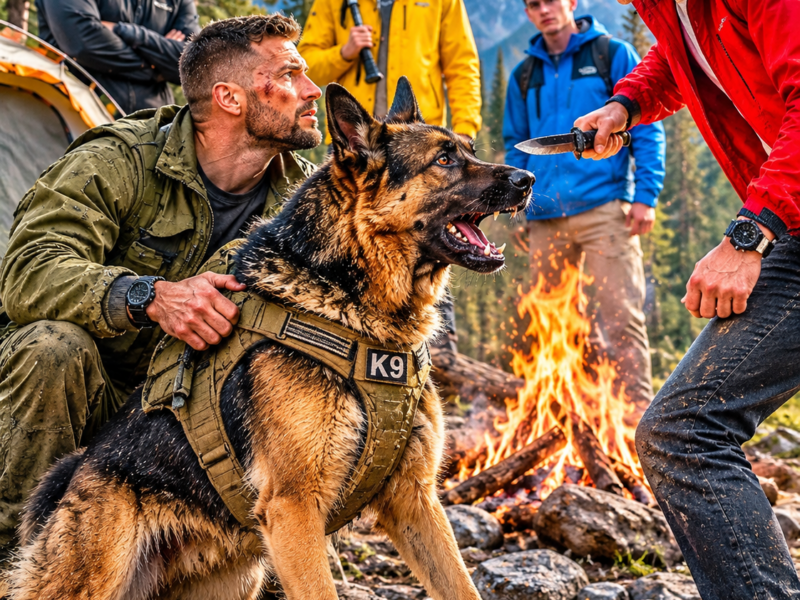
“One of the four rich kids pressed a hunting knife against my throat at a remote Idaho campsite while his friends laughed and my dog growled beside me
“Son, DROP THE KNIFE.”
Brandon stared at his father.
For the first time that evening, the confidence disappeared from his face.
“Dad, what are you talking about?”
“Put it down. Right now.”
The knife remained against my neck for another second.
Then Brandon slowly lowered his hand.
I stepped away from him and reached for Ranger’s collar.
“Easy, buddy. I’ve got you.”
Ranger continued growling, his eyes fixed on Brandon, but he stayed beside me.
The older man approached without taking his eyes off me.
His name was Richard Whitmore.
I would learn that before the night was over.
But at that moment, I was more interested in why a wealthy developer from Idaho seemed to recognize a military identification tag I hadn’t worn in years.
“Jack Morrison,” he repeated.
I nodded.
“Richard Whitmore?”
His expression changed.
“You remember me?”
“Not particularly.”
He looked down.
“That’s fair.”
Brandon glanced between us.
“Can somebody explain what’s going on?”
Richard turned toward his son.
“You pulled a knife on a retired Navy SEAL?”
Brandon scoffed.
“He’s just some camper.”
Richard looked at him with an expression I hadn’t seen from a father in a long time.
It wasn’t anger alone.
It was disappointment.
“That man served his country for eighteen years. He has more discipline in one finger than you have in your entire body.”
Brandon’s friends exchanged uncomfortable looks.
The boy with the phone slowly lowered it.
I picked up the knife from the dirt where Brandon had dropped it and placed it on the table.
“Your son needs to learn that a knife isn’t a toy.”
Richard nodded.
“I know.”
Then he looked at Ranger.
“And you need to know that my son is going to answer for what he did.”
I didn’t respond.
I had heard too many promises from powerful men to trust them immediately.
Richard gestured toward the other boys.
“Get your things. All of you. Nobody touches anything else.”
Brandon protested.
“Dad, come on. We were just having fun.”
“Fun?”
Richard pointed at the knife.
“Does that look like fun?”
Nobody answered.
The four boys began collecting their belongings.
But Tyler, the quiet one, remained near the truck.
He was looking at me.
Not with fear.
With something closer to recognition.
“Sir,” he said.
I turned.
“Yes?”
He swallowed.
“Can I talk to you for a minute?”
Brandon snapped his head around.
“Tyler, get in the car.”
Tyler ignored him.
“I think you should know something about what happened to your teammate.”
The night suddenly seemed colder.
I looked at Richard.
His face had gone pale again.
“Tyler,” he said quietly, “not here.”
I stepped toward the boy.
“What do you know?”
Tyler glanced at Richard, then at Brandon.
“His dad knows.”
Richard closed his eyes.
And just like that, the campsite wasn’t about four spoiled boys anymore.
It was about something I had spent seven years trying to put behind me.
“Everybody stays,” I said.
Richard looked at me.
“Jack, we need to discuss this privately.”
“No. You recognized my name. Your son threatened me with a knife. And now this kid says you know something about my teammate.”
I paused.
“I’m done having conversations where everybody else decides what I get to hear.”
Richard looked toward the dark tree line.
Then he nodded.
“All right.”
He turned to the boys.
“Get in your vehicles. Nobody leaves the area.”
Brandon shook his head.
“This is ridiculous.”
“Get in the vehicle, Brandon.”
For once, his father didn’t raise his voice.
He didn’t need to.
Within minutes, the music was off, the bottles were collected, and the campsite became quiet again.
Richard sat across from me near the fire.
Tyler remained standing.
Ranger lay at my feet, his body still tense.
Richard stared into the flames.
“Seven years ago, I was vice president of operations at a defense contractor called Whitmore Systems.”
I frowned.
“Whitmore Development?”
He nodded.
“The company started as a construction business. Later, my father and I expanded into government logistics and equipment contracts.”
I said nothing.
Richard continued.
“One of our contracts involved supplying communications equipment to military units operating overseas. There was a shipment that went missing.”
I felt my shoulders tighten.
“Which shipment?”
“Communications components, field radios, and replacement systems. They were supposed to reach a forward operating location.”
I leaned forward.
“Where?”
Richard named the location.
My jaw tightened.
It was the same region where my teammate, Daniel Carter, had died.
Daniel had been thirty-one.
He was married, had a daughter who was barely two years old, and had been the kind of man who remembered everybody’s birthday.
He could make a miserable day feel manageable simply by making fun of the coffee.
During our final deployment, our team had been assigned to a mission that depended on reliable communications equipment.
The equipment failed.
We lost contact with supporting personnel.
A firefight followed.
Daniel never made it back.
The official investigation attributed the failure to a technical malfunction and unfavorable conditions.
I had never believed the report fully explained what happened.
But I had never found evidence to challenge it.
“What does your company have to do with Daniel’s death?” I asked.
Richard looked down at his hands.
“Those replacement systems were never delivered.”
I stared at him.
“Why?”
“Because the shipment was redirected.”
“By whom?”
He hesitated.
“People inside the company. And people who had access to the military procurement process.”
I stood.
“You’re telling me your company sent defective equipment to my unit?”
“No. I’m telling you the equipment never arrived at all.”
I looked toward the dark forest.
For seven years, I had replayed that mission in my head.
Every radio call.
Every movement.
Every decision.
I had spent nights wondering whether I could have done something differently.
Now a man was telling me that the equipment we depended on had been diverted before we ever reached the field.
“Did you know?” I asked.
Richard shook his head.
“Not at the time.”
“That’s a convenient answer.”
“I understand.”
“No, you don’t.”
I pointed toward the ground.
“Daniel died because we couldn’t communicate. Men were injured. We spent hours trying to get help through equipment that was supposed to have been replaced.”
My voice became quieter.
“And now you’re telling me that somebody may have stolen the equipment?”
Richard didn’t look away.
“Yes.”
I sat down again.
Ranger rested his head against my knee.
I ran my fingers through his fur.
“How do you know?”
Richard reached into his jacket and removed a folded document.
He placed it on the table.
It was a photocopy of an internal shipping manifest.
A shipment marked as delivered had been rerouted to a private warehouse in Boise.
The date was three days before our mission.
At the bottom was an authorization signature.
Richard Whitmore.
I looked at him.
“Your signature.”
He nodded.
“I signed the original authorization for the equipment to be delivered to the military depot.”
“Then who changed it?”
“An employee named Gregory Sloan. He had access to our shipping system and was working with a private buyer.”
“Why?”
“Money.”
I laughed once.
It was a dry, unpleasant sound.
“Daniel died because somebody wanted more money.”
Richard didn’t defend himself.
Instead, he said something I wasn’t expecting.
“I tried to report it.”
I looked at him.
“What?”
“After I discovered the missing shipment, I ordered an internal audit. Within days, my office was searched, several documents disappeared, and I received a warning that my family could be harmed if I continued.”
He rubbed his forehead.
“I was told the shipment had been recovered and the military had accepted the replacement equipment.”
“Did you believe that?”
“No.”
“Then why did you stop?”
His eyes moved toward the vehicles where Brandon and the others were sitting.
“Because I had a wife, two children, and a company with hundreds of employees. I convinced myself that if I waited, I could fix it quietly.”
He swallowed.
“I was wrong.”
Tyler finally spoke.
“He’s been trying to fix it for years.”
Richard looked at him.
“Tyler.”
The boy took a breath.
“My mother works in the company’s accounting department. She found payments to a company that didn’t exist. She told Mr. Whitmore.”
Richard nodded slowly.
“Your mother helped me locate the missing records.”
Tyler continued.
“Then somebody broke into our house.”
I looked at him.
“Did they hurt anyone?”
“No. But they took her laptop and all the papers she’d collected.”
“Did she report it?”
“Yes.”
Richard looked toward the fire.
“That was when I realized the problem was bigger than an internal accounting fraud.”
I leaned back.
I wasn’t sure whether to believe everything I was hearing.
But there was one thing I knew.
If someone had diverted equipment before our mission, I needed to know who authorized the change and whether the failure had been deliberate.
“Why didn’t you contact me?” I asked.
Richard looked at the military tag hanging from my backpack.
“Because I didn’t know where you were. And because I was afraid that involving you would put you in danger.”
I shook my head.
“Seven years, Richard.”
“I know.”
“Daniel’s wife still thinks the equipment failed because nobody could have predicted it. His daughter is growing up believing her father died because of bad luck.”
Richard lowered his eyes.
“I know.”
I looked toward Tyler.
“Why did you bring this up tonight?”
He hesitated.
“Because Brandon told us to scare you.”
I turned toward the vehicles.
“What?”
Tyler’s voice shook.
“He said his father was coming to the campsite and that he wanted you gone before he arrived.”
Richard stood abruptly.
“Brandon said that?”
Tyler nodded.
“He told us to make the old guy pack up. He said if you refused, we’d make you leave.”
I stared at Richard.
He looked genuinely stunned.
“Why would he do that?”
Tyler glanced toward Brandon’s vehicle.
“Because Brandon found some documents in your office.”
Richard’s face changed.
“What documents?”
Tyler looked down.
“The ones about the shipment.”
For a moment, nobody spoke.
Then Richard walked toward the vehicles.
I followed him.
Brandon was sitting in the driver’s seat of a black SUV, looking at his phone.
His friends were inside the other vehicles.
Richard opened the driver’s door.
“Get out.”
Brandon looked up.
“Dad, seriously?”
“Get out.”
Brandon stepped onto the dirt.
Richard held out his hand.
“Your phone.”
“What?”
“Give it to me.”
Brandon laughed nervously.
“You can’t be serious.”
“Your phone. Now.”
Brandon looked at me.
Then at Tyler.
He understood.
He slowly handed it over.
Richard checked the screen.
A series of messages appeared.
One was from a contact saved as G.S.
The message read:
“Make sure the camper leaves before I arrive. I don’t want him seeing the documents.”
I felt a chill move through me.
Richard read the message twice.
Then he looked at his son.
“Who is G.S.?”
Brandon didn’t answer.
“Who?”
“Greg Sloan.”
Richard’s hand tightened around the phone.
“Why are you talking to him?”
Brandon looked away.
“He’s helping me with the business.”
“He’s been under investigation for years.”
Brandon’s expression changed.
“He’s not a criminal.”
Richard stared at his son.
“Did you give him access to my office?”
Brandon didn’t answer.
I understood something then.
The four boys hadn’t simply stumbled onto my campsite.
Brandon had known I was there.
He had been told to remove me.
And the older man had come to stop him.
But the reason was no longer just about family embarrassment.
It was about evidence.
Richard stepped away from his son.
“Where are the documents?”
Brandon shook his head.
“I don’t know what you’re talking about.”
Tyler spoke quietly.
“They’re in the back of his SUV.”
Brandon turned on him.
“Shut up!”
Richard opened the rear door.
Inside was a black leather briefcase.
He pulled it out and set it on the hood.
The lock was already broken.
Inside were several folders.
I recognized the shipping manifest immediately.
There were also photographs, payment records, and copies of military correspondence.
One document had a handwritten note attached.
“Final disposal authorization.”
The signature at the bottom belonged to Gregory Sloan.
But the date was different from the one on the original manifest.
It had been signed two days after Daniel’s death.
I read it carefully.
The shipment had not simply been redirected.
The equipment had been sold to a private buyer after the mission.
I looked at Richard.
“Did you know this existed?”
He shook his head.
“No.”
Brandon finally spoke.
“I was just holding the papers for Greg.”
Richard turned toward him.
“You stole confidential company records?”
“I was helping him.”
“Helping him do what?”
Brandon’s voice rose.
“Keep the company from falling apart!”
Richard stared at him.
“You think stealing records and threatening people is saving the company?”
Brandon threw his hands up.
“You don’t understand! You were going to lose everything!”
Richard looked suddenly older.
“Perhaps I should have lost everything.”
He turned toward me.
“Jack, I need to call the authorities.”
“Yes.”
I looked at the documents.
“But don’t touch anything else.”
I had spent enough years around investigations to know that evidence could be damaged by good intentions.
Richard called the local sheriff’s office and explained that there had been a confrontation involving a knife, stolen company records, and potential evidence connected to an old military procurement investigation.
While we waited, I asked Tyler to sit near the fire.
He looked exhausted.
“How old are you?”
“Twenty-one.”
“You don’t have to get involved in this if you’re afraid.”
He shook his head.
“My mother told me if I ever found proof, I should tell somebody.”
“She sounds like a smart woman.”
Tyler smiled faintly.
“She is.”
“Why didn’t you tell Richard earlier?”
He looked toward the SUV.
“Because Brandon was my friend. Or I thought he was.”
I nodded.
“Sometimes it’s difficult to accept that someone you care about is doing something wrong.”
Tyler stared at the ground.
“He’s going to hate me.”
“Maybe.”
I let that sit for a moment.
“But doing the right thing doesn’t guarantee people will like you.”
He nodded.
The sheriff’s deputies arrived about twenty-five minutes later.
They separated everyone, photographed the scene, and collected statements.
Brandon was arrested on suspicion of aggravated assault with a deadly weapon.
The actual charges would depend on the investigation and the prosecutor’s review.
His friends were questioned.
Tyler cooperated and handed over the messages he had saved.
Richard gave the deputies the briefcase and explained the history of the missing shipment.
Before leaving, one of the deputies approached me.
“Mr. Morrison, are you comfortable giving a statement about the knife incident?”
“Of course.”
He glanced at Ranger.
“Your dog did a good job staying under control.”
I looked down.
“He’s better trained than most people I know.”
The deputy smiled.
“That may be true.”
When the last vehicle pulled away, the campsite was quiet again.
The fire had burned low.
I sat beside it, watching the remaining embers.
Richard approached.
“Jack.”
I looked up.
“I owe you an apology.”
“You do.”
He nodded.
“I can’t undo what happened to Daniel.”
“No.”
“But I can make sure the truth doesn’t disappear again.”
I stared at him.
“Don’t make promises you can’t keep.”
“I won’t.”
He extended his hand.
This time, I shook it.
Not because everything was forgiven.
Because he had finally started taking responsibility.
The investigation took several months.
The evidence recovered from Brandon’s vehicle led investigators to additional records stored on a private server.
Gregory Sloan was eventually charged with fraud, conspiracy, and theft involving government property.
The investigation also uncovered falsified delivery records and payments made through several shell companies.
Richard cooperated fully.
He turned over the company’s records, resigned from his executive position, and testified about the internal warnings he had ignored.
His company lost several contracts.
Some employees were laid off.
He sold two properties to cover legal costs and help compensate for losses associated with the fraudulent contracts.
He never asked me to defend him.
I respected that.
The military reopened its review of the equipment failure connected to Daniel’s mission.
The investigators could establish that the missing shipment had been diverted and that false records had concealed the shortage.
They could not prove that Sloan had specifically intended to cause the deaths or injuries that followed.
But they confirmed that the equipment failure was not simply an unavoidable technical accident.
The official record was amended.
Daniel Carter’s family received the updated findings.
I traveled to North Carolina to see his wife, Sarah.
She opened the door with their daughter, Lily, standing behind her.
Lily was nine now.
She had Daniel’s eyes.
For a moment, I couldn’t speak.
Sarah looked at the folder in my hand.
“Is it about Daniel?”
I nodded.
She invited me inside.
We sat at the kitchen table.
I explained everything carefully.
I told her about the missing equipment, the altered shipping records, the investigation, and the people who had finally been held accountable.
I didn’t make promises about things the evidence couldn’t prove.
I didn’t tell her that Daniel’s death had been deliberately arranged.
Because we didn’t know that.
But I told her the truth.
When I finished, Sarah stared at the papers.
Then she covered her mouth.
“So he wasn’t careless.”
“No.”
“He didn’t make some stupid mistake?”
“No, Sarah.”
She began to cry.
I sat beside her.
For years, she had lived with the suspicion that Daniel’s final decisions had somehow led to his death.
Now she finally had an answer.
Lily came closer.
“Did my dad know you were going to tell us?”
I looked at her.
“I think he would’ve wanted you to know what really happened.”
She studied my face.
“Was he brave?”
I smiled sadly.
“He was the bravest man I ever knew.”
“More than you?”
I laughed softly.
“Much more.”
She looked at the photograph of Daniel on the mantel.
Then she returned to her mother.
I stayed for dinner.
Before I left, Sarah handed me a small envelope.
“I found this in his old deployment box. I think he meant you to have it.”
Inside was a photograph of our team.
Daniel stood beside me, one arm around my shoulders.
Both of us were muddy, exhausted, and grinning.
On the back, he had written:
“To Jack. If we ever make it home, you owe me a fishing trip.”
I stared at those words for a long time.
I had forgotten the promise.
But Daniel hadn’t.
I folded the photograph carefully and placed it in my wallet.
Months passed.
I returned to Idaho.
I went back to fishing.
I repaired the old fence behind my house and spent long mornings walking Ranger through the woods.
Life didn’t become perfect.
Some nights, I still dreamed about the mission.
Some mornings, I woke up hearing Daniel’s voice on the radio.
But the guilt had changed.
I no longer spent every quiet moment wondering whether I had failed him.
I knew what had happened.
And I knew that the failure hadn’t belonged to the men who had gone into the field trusting their equipment.
It belonged to the people who had treated those men’s lives as numbers on a spreadsheet.
One afternoon, I received a call from Richard.
He asked whether I would meet him at a small diner outside Boise.
I almost declined.
Then I remembered that accountability was more than accepting punishment.
Sometimes it meant showing up afterward.
When I arrived, Richard was sitting in a booth near the window.
He looked different.
No expensive watch.
No tailored jacket.
Just a gray sweater and a cup of coffee.
He stood when he saw me.
“Jack.”
“Richard.”
We shook hands.
He slid a photograph across the table.
It showed Brandon standing beside a volunteer group at a local veterans’ support center.
I looked up.
“What’s this?”
“He’s been volunteering there as part of his rehabilitation and community service requirements.”
“Is he working with veterans?”
“Yes.”
I studied the photograph.
Richard continued.
“He pleaded guilty to a reduced assault charge after the court reviewed the evidence and his record. He also completed the required counseling and community service.”
I nodded.
“How is he doing?”
“Not particularly well.”
I looked at him.
Richard smiled sadly.
“He’s finally learning that consequences don’t disappear because you’re wealthy.”
I took a sip of coffee.
“That’s a useful lesson.”
Richard hesitated.
“Would you consider speaking with him?”
I looked out the window.
“Why?”
“Because he has asked to apologize.”
I thought about the knife.
The laughter.
The way Brandon had looked at Ranger as though the dog were something he could use to intimidate me.
I wasn’t interested in making his life easier.
But I also knew that holding on to anger forever wouldn’t bring Daniel back.
“I’ll think about it,” I said.
Richard nodded.
“That’s all I can ask.”
A month later, I agreed to meet Brandon at the veterans’ center.
He was waiting outside when I arrived.
Without the expensive clothes and arrogant smile, he looked like a different person.
He stood when he saw me.
“Mr. Morrison.”
I nodded.
“Brandon.”
He looked down at his hands.
“I owe you an apology.”
I waited.
He swallowed.
“What I did at the campsite was wrong. I thought I could make people do whatever I wanted because my father had money and connections.”
He glanced at Ranger.
“I shouldn’t have threatened you. I shouldn’t have brought a knife into it. And I definitely shouldn’t have gone near your dog.”
Ranger sat beside me.
Brandon looked at him.
“I’m sorry, too.”
The dog sniffed his shoe, then turned away.
I almost smiled.
“Ranger isn’t interested in speeches.”
Brandon gave a nervous laugh.
“I understand.”
I studied him.
“Do you?”
He nodded.
“I think I do now.”
“Then here’s something you should remember. Respect isn’t something your father can buy for you. And fear isn’t the same as respect.”
He looked at the ground.
“I know.”
I took a breath.
“Your actions could have ended with someone badly hurt. You need to understand how close you came to ruining several lives.”
His eyes filled.
“I do.”
I didn’t offer him friendship.
I didn’t tell him everything was fine.
But I accepted his apology.
Sometimes that is all a person can honestly give.
Before leaving, I asked him one question.
“Why did you keep going that night after Tyler told you to stop?”
Brandon took a long time to answer.
“Because everybody was watching.”
I nodded.
There it was.
Not money.
Not power.
Not even anger.
He had been afraid of looking weak in front of his friends.
I had seen grown men make terrible decisions for the same reason.
“Next time,” I told him, “be more afraid of doing something wrong than looking foolish.”
He nodded.
I left him standing outside the center.
The Idaho mountains were visible in the distance.
Ranger trotted beside me toward the truck.
I opened the passenger door and helped him climb in.
Then I reached into my wallet and pulled out Daniel’s photograph.
The two of us were still grinning at the camera.
I touched the edge of the picture.
“Got that fishing trip, buddy,” I whispered.
That weekend, I drove to a quiet lake outside town.
I brought two fishing rods, a thermos of coffee, and enough food for Ranger.
The morning was cold.
Mist drifted across the water.
I sat on the bank and cast my line.
Ranger settled beside me, his ears moving whenever a bird called from the trees.
For a long time, neither of us moved.
Then my phone buzzed.
It was a message from Sarah.
She had sent a photograph of Lily holding Daniel’s old team picture.
Underneath, she had written:
“She wants to grow up and do something that helps people, just like her dad.”
I smiled.
I looked across the water.
For seven years, I had carried Daniel’s death like a debt I could never repay.
Now I understood that remembering him didn’t mean spending the rest of my life trapped in the worst day we’d shared.
It meant carrying forward the parts of him that had made life worth protecting.
Ranger rested his head on my boot.
I scratched behind his ears.
“Looks like we’ve got a few more mornings to enjoy, old boy.”
The sun slowly rose above the mountains.
And for the first time in a long while, the silence felt like peace.
The End.









