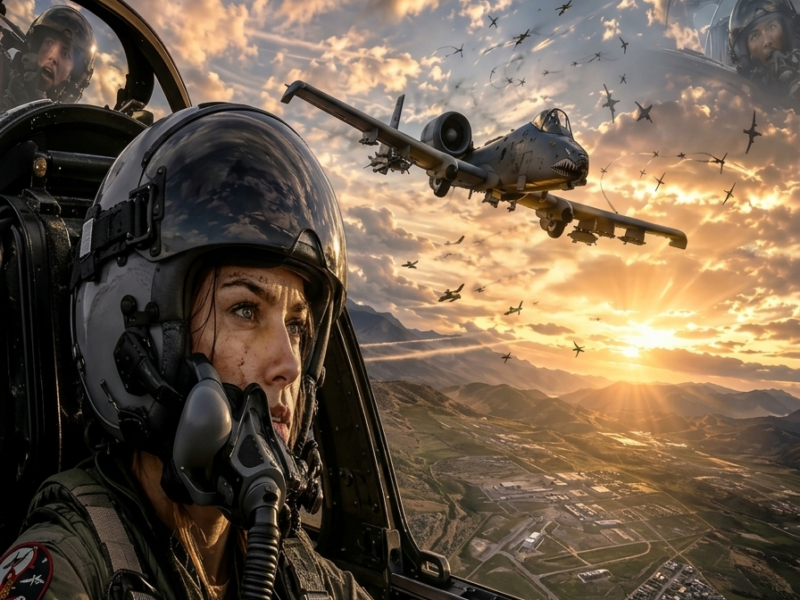
“One A-10?” the enemy pilots laughed over the radio as my battered Warthog crossed the dawn sky alone, but their laughter died when I turned toward their entire formation
The sky above the jagged ridge line was the color of a fresh bruise, fading into a pale, dusty amber as the sun cut across the desert horizon. Inside the tight, titanium-armored bathtub of my A-10C Thunderbolt II, the air was cold, smelling of stale oxygen, hydraulic fluid, and my own dried sweat.
My callsign was Spectre 1-1, but to the boys on the ground, the aircraft was simply the “Warthog”—a heavy, ugly, twin-engine flying tank built around a massive 30mm GAU-8 Avenger rotary cannon. It was an aircraft designed for grinding close air support, not dogfighting. Yet here I was, cruising at twelve thousand feet, isolated and completely outmatched.
Behind my left tail fin, thirty miles to the west, three C-130 Hercules transport planes were lumbering through the mountain passes. They were fat, slow, and loaded to capacity with nearly two hundred exhausted American troops, medical staff, and wounded contractors evacuating a fallen forward operating base. They had no defensive escorts. The air support network in the sector had collapsed hours ago under a coordinated surprise assault.
My fuel gauge was sitting on a quarter tank. My weapons management display showed a depleted store: no heavy Maverick missiles left, four heat-seeking AIM-9 Sidewinders, and roughly eight hundred rounds of armor-piercing 30mm ammunition remaining in the drum.
Suddenly, my Radar Homing and Warning system let out a harsh, rhythmic chirp that quickly accelerated into a solid, ear-splitting tone.
Sixteen high-fast radar contacts were sweeping in from the east, flying in a tight, aggressive wedge formation. Modern, twin-engine Su-35 fighters. Superior speed, superior radar, superior missile range.
I flipped my radio to the open tactical frequency.
“One A-10?” a voice crackled through my helmet speakers, spoken in sharp, heavily accented English followed by a round of coarse, mocking laughter from his wingmen. “The Americans are sending a lawnmower to fight a storm? Where is the rest of your squadron, pilot?”
I adjusted my flight helmet, my eyes darting over the analog gauges and illuminated HUD glass. My fingers tightened on the flight stick, feeling the familiar, mechanical resistance of the controls.
“You’re looking at it,” I said, my voice flat, stripped of all emotion.
The open channel erupted in another burst of laughter. “Turn around, Warthog. Save your fuel. You cannot protect the transports.”
“Try me,” I muttered.
Before the last word left my lips, my threat receiver screamed a lock-on alert. A bright white plume ignited in the distant morning haze—an R-73 infrared missile coming straight for my intake.
“Here we go,” I gritted through my teeth.
I slammed the throttle back, dumped my airbrakes, and kicked the left rudder pedal hard. The heavy A-10 shuddered violently as it dropped like a stone out of the sky, nose-diving toward the razor-sharp granite cliffs below. The missile shot over my canopy, missing by less than thirty yards before detonating against the canyon wall behind me in a massive blossom of orange fire and shattering rock.
“Target broke lock!” my automated voice system chimed.
“Not for long,” I whispered.
A second missile streaked out of the glare of the rising sun. I pulled hard into the turn, rolling the forty-thousand-pound aircraft inverted as I skimmed the contour of a desert peak. The sheer G-force pulled at my cheeks, pressing my body deep into the seat harness. My heart hammered against my ribs, but my hands remained locked, steady, and precise on the controls.
If I died here, those three transport planes wouldn’t last two minutes. Two hundred soldiers would bleed out into the sand.
I pulled out of the dive at six hundred feet above the floor, popping bundles of glowing flares that scattered into the shadow of the mountain. The second missile took the bait, veering off into a rock face and exploding in a rain of metallic sparks.
I didn’t keep running. I leveled the wings, shoved the twin General Electric turbofans to maximum continuous power, and pulled the nose up into a steep, aggressive climb—pointing the heavy snout of the Warthog straight back into the middle of the sixteen enemy jets.
“She’s coming straight at us!” an enemy pilot yelled over the unencrypted channel, his voice dropping its arrogant tone.
“Let her,” their commander snapped back. “Form up! Guns only! Show this bird how a real fighter flies!”
They thought I was panicked. They thought I was committing suicide in a desperate, blind head-on charge.
I watched the distance counter tick down on my HUD.
Two miles. One mile. Eight hundred yards.
“Eat this,” I grunted, squeezing the heavy two-stage trigger on the control stick.
The GAU-8 Avenger cannon didn’t roar; it produced a terrifying, guttural, continuous shredding sound—like giant sheets of thick canvas being torn apart by thunder. The entire aircraft vibrated so violently my vision blurred for a fraction of a second as hundreds of depleted uranium rounds tore through the sky at nearly four thousand feet per second.
The lead Su-35 caught the burst directly across its radome and cockpit. The high-explosive shells ripped through the enemy jet’s titanium frame, detonating its primary fuel cell in a brilliant, fireball explosion that scattered wings and burning engine turbines across the sky.
Without breaking my line of flight, I rolled the Warthog ninety degrees onto its side, slipping through the floating vortex of burning wreckage, and lined up on the trailing wingman.
BRRRRRRRRRRRRRRRRRRRRRRRRRRRRT!
A second continuous stream of 30mm fire caught the second jet in the right wing root. The wing sheared completely off, sending the fighter into an uncontrollable, screaming flat spin down into the canyon wall.
The remaining fourteen aircraft broke formation in utter chaos, diving in every direction to avoid the lethal arc of my nose cannon.
I reversed my bank, keeping the pressure on, searching the sky for the next target. “Who’s next?” I growled into the mask.
To my surprise, the radar tracks weren’t turning back to engage me. They were scattering, pulling hard toward the eastern border, fleeing the engagement area.
I pushed the stick forward, tracking the enemy commander’s tail section as he fled toward the heavy cloud deck. “Stand and fight!” I demanded over the radio.
A heavy pause hung over the airwaves before the commander’s voice returned, breathless and shaken. “Who are you? What kind of pilot stays in a dying plane against sixteen guns?”
I looked down at my tactical display. The three C-130 transports were crossing the mountain pass, their green icons blinking safely as they entered the secure airspace guarded by allied long-range SAM sites.
“Because they knew I wouldn’t leave,” I answered softly.
The enemy jet vanished into the white fog, leaving me alone in the vast, silent sky over the desert.
I took a deep, shuddering breath, my body shaking as the adrenaline rush began to recede. My fuel total was sitting at eleven hundred pounds—barely enough to make it back to the emergency dirt strip near the border. I reached for the radio selector to call in my mission complete report to Central Command.
Then, my radar screen flared again.
A solid, dense wall of new radar returns bloomed on the northern edge of the display. Twenty aircraft, flying low and fast beneath the radar horizon, sweeping in behind my flight path.
My fuel warning light turned a solid, glowing red. The ammo counter for the cannon read less than ninety rounds.
A new voice came over my secure helmet frequency—a clear, smooth voice with no static, speaking on an encrypted channel that only senior command officers were supposed to possess.
“Captain Miller,” the voice said calmly. “You have five minutes of fuel left.”
My hand froze over the throttle control. Cold air seemed to fill my cockpit. He knew my name. He knew my rank. He knew my exact fuel state.
“Identify yourself,” I demanded, my thumb resting heavily on the weapons selector switch.
The radio crackled. “Your father had five minutes too, Captain.”
Seventeen years ago, my father, Colonel James Miller, had vanished over this exact same sector during a routine reconnaissance mission. The Air Force had closed the investigation within a month, officially classifying it as an operational accident caused by pilot disorientation and engine failure. I had spent half my life believing he was dead at the bottom of an unnamed desert crater.
“What did you say?” my voice trembled, all the stoic military discipline evaporating in an instant.
“We know what really happened to him, Sarah,” the voice replied, chillingly intimate. “He didn’t crash. He was handed over. And you are flying the exact same route he took on the morning he was betrayed.”
The horizon expanded before me, cold and indifferent, as twenty unknown fighters swept across my radar screen, encircling my lone, helpless Warthog in the morning sky.
The cockpit fell into a suffocating, terrifying silence, broken only by the steady, rhythmic beep of my low-fuel warning indicator. Outside, the morning sunlight glinted off the sleek, dark hulls of the twenty incoming fighters as they settled into a tight, inescapable ring around my aircraft.
They weren’t taking firing positions. They were escorting me—or rather, herding me like a trapped animal.
“Talk to me,” I commanded into the radio, my knuckles white as I gripped the flight stick. “Who are you, and how do you know my father’s name?”
“Your father was a man of high principles, Captain Miller,” the voice on the encrypted channel responded. “A noble trait, but fatal in this theater of operations. He discovered something he wasn’t supposed to see during his flight seventeen years ago. Something regarding the men who currently sit in the high offices of your own Command structure.”
“You’re lying,” I snarled, though a cold knot of dread was tightening in my stomach.
Ever since I was a young girl, the official story of my father’s crash had felt hollow. No wreckage had ever been recovered. No emergency beacon had ever sounded. Just a clean, sudden deletion from the tactical map, followed by a swift rubber-stamp investigation overseen by the Pentagon’s senior staff.
“If I were lying, Sarah,” the commander replied smoothly, “how would I have the private encryption keys to your internal flight comms? How would I know that your father’s callsign was Gargoyle 6?”
My throat went dry. Gargoyle 6. That wasn’t in any public record. It wasn’t even in the redacted accident report my mother and I had spent a decade trying to unseal through freedom of information requests.
“Where is he?” I asked, my voice cracking despite my efforts to remain composed.
“Look to your left, Captain,” the voice instructed.
I turned my head toward the port side canopy. A large, twin-engine strike fighter floated less than fifty feet from my wingtip. Its black airframe bore no country markings, no squadron badges, and no serial numbers. The pilot’s helmet visor was mirrored, reflecting the golden rays of the rising sun and the battered silhouette of my own A-10.
“Your fuel state is at eight hundred pounds,” the unknown commander said. “In three minutes, your engines will flame out, and you will drop into the rocky terrain below. Or, you can change your heading to three-two-zero, descend to five hundred feet, and follow us to an unmapped dirt strip twenty miles north.”
“Why should I trust a ghost?” I countered, my eyes darting to my instruments. The fuel gauge needle was hovering precariously close to the red zero line.
“Because the man who ordered your father’s plane shot down seventeen years ago is currently sitting in the Operations Center at Ramstein Air Base, listening to this mission on a delayed satellite feed,” the voice said calmly. “And he is currently waiting for you to die so he can close the Miller file forever.”
A sudden tone beeped in my headset—a high-priority, direct satellite transmission from Allied Air Command.
I flipped my secondary radio switch. “Spectre 1-1, go ahead Base.”
“Spectre 1-1, this is Vanguard Control,” a stern, familiar voice boomed over the long-range comms. It was General Raymond Vance, Deputy Director of Air Operations—a long-time family friend who had personally attended my father’s memorial service and mentored me through the Air Force Academy.
“General Vance,” I said, my voice tight.
“Sarah, we are monitoring your position,” Vance said, his tone dripping with urgent authority. “Your transponder is flickering, and satellite telemetry shows you surrounded by unknown tracks. Break off immediately and head southwest toward the border! We have a SAR helicopter unit launching to recover you if you have to eject!”
“General,” I said, staring at the black jet flying beside me. “There are twenty aircraft here. They aren’t firing on me. The flight leader claims he knows what happened to my father in 2009.”
A heavy, unnatural pause stretched over the satellite link. For several seconds, the only sound was the faint hum of atmospheric static.
“Sarah, listen to me very carefully,” Vance’s voice returned, dropping an octave, sounding colder, harder. “You are experiencing extreme tactical fatigue and hypoxia. Those are hostile insurgents using stolen frequency bands to manipulate you. They want that aircraft intact for its avionics. I am ordering you as your commanding officer: slam your flight stick down, eject over the mountain ridge, and destroy the onboard computer systems.”
“He knew my father’s callsign, General,” I said quietly.
“Sarah! Execute the order immediately! That is a direct command!” Vance shouted, the calm facade completely shattering. “Do not engage with the enemy! Eject now!”
I looked back at the fuel gauge. Five hundred pounds left. The left engine gave a violent hiccup as a bubble of air passed through the fuel line.
If I ejected, I would land in enemy territory, dependent on a rescue team that might never come, while the truth vanished forever into a classified filing cabinet. If I followed the black jet, I was flying straight into the unknown with an empty cannon and dead engines.
“Spectre 1-1, do you copy?!” Vance demanded through the speaker. “Eject!”
“Negative, Vanguard Control,” I said softly, my decision settling heavy in my chest. “Spectre 1-1 is changing course.”
“Sarah, don’t do this!” Vance yelled.
I reached out and clicked the satellite radio off, cutting the link to Command.
I banked the heavy Warthog to the left, dropping the nose toward heading three-two-zero, sliding into formation behind the black lead jet as we descended into the dark, shadows of the northern canyons.
Ten seconds later, both of my General Electric engines sputtered, lost thrust, and flamed out completely. The cockpit displays went dark, leaving only the dim amber emergency backup lights.
The heavy, unpowered A-10 was now nothing more than a fifty-thousand-pound glider falling out of the sky.
“Engines flamed out,” I reported into the local comms, fighting the stiff, unassisted hydraulic flight controls to keep the wings level. “I’m coming in cold.”
“Hold your glide path, Captain,” the unknown commander replied. “Welcome to the real war.”
The landing was a bone-jarring ordeal. Without engine power, I had no reverse thrusters and limited hydraulic pressure for the wheel brakes.
The A-10 slammed onto the cracked, sun-baked concrete of an abandoned Soviet-era airbase tucked deep inside a narrow canyon fold. The tires shrieked, smoking violently as I fought the rudder to keep the heavy jet from sliding off the narrow runway into the rusting hulks of ancient radar trucks and collapsed hangars.
The aircraft finally ground to a halt at the far end of the strip, drifting sideways into a cloud of pale desert dust.
I sat in the quiet cockpit for a moment, listening to the metallic ticking of the cooling metal around me. The sky above was filled with the roar of the twenty black fighters as they orbited high overhead, establishing a protective defensive umbrella over the hidden valley.
I unbuckled my shoulder harness, popped the canopy seal, and manually cranked the heavy acrylic bubble open. The dry desert air hit my face, hot and smelling of sagebrush and old aviation gas.
A dark, olive-drab tactical vehicle drove up to the side of my aircraft. Three men stepped out. They were wearing tactical uniforms stripped of all nation patches, but their weapons and equipment were modern, professional, and maintained to immaculate standards.
The lead man stepped up to the side ladder of my cockpit. He pulled off his flight helmet, revealing a scarred face with graying hair at the temples and sharp, penetrating blue eyes.
“Captain Sarah Miller,” he said, offering a stiff, respectful salute. “I am Commander Alex Nikolai. Former intelligence director for the European Air Defense Coalition.”
I stayed in my seat, my hand resting near the holstered Beretta 9mm pistol on my tactical vest. “You have three minutes to explain why I shouldn’t treat this as an ambush, Commander.”
Nikolai let out a short, grim chuckle. “If I wanted you dead, Sarah, I wouldn’t have wasted twenty thousand gallons of jet fuel escorting a dead glider across forty miles of hostile airspace.”
He reached into his tactical vest, pulled out a worn, scuffed leather flight logbook, and handed it up to me.
My heart skipped a beat. The leather was embossed with silver letters that had faded over time, but were still clearly legible: COL. J. MILLER – USAF.
My fingers trembled as I touched the worn cover. I opened the book to the final entry, dated May 14th, 2009. The handwriting was unmistakable—my father’s precise, slanted script.
Mission: Deep Recon – Sector 4. Observed illegal weapons transfer at coordinates 34-North, 42-East. Transports bearing private contractor markings, escorted by unmarked assets. Transfer authorized by Vanguard-1.
“Vanguard-1,” I whispered, the words tasting like lead on my tongue. “General Vance.”
“Seventeen years ago, your father discovered that high-ranking officials within your own Military District were funding and arming local warlords to prolong the conflict in this region,” Nikolai explained, leaning against the A-10’s ladder. “It was a billion-dollar supply chain operated by private defense contractors, designed to justify endless military expenditures and secure mining concessions.”
“My father tried to report it,” I realized, the pieces finally slotting together into a terrifying picture.
“He didn’t just try to report it—he downloaded the full transaction ledgers onto an encrypted flight recorder,” Nikolai said grimly. “When Vance realized what your father had, he didn’t risk an air strike. He bribed a crew chief to sabotage your father’s primary oxygen line and fuel valves. Your father lost consciousness at twenty thousand feet. His aircraft was brought down over this valley.”
I gripped the logbook tight against my chest, tears pricking the corners of my eyes as years of lies melted away, replaced by a cold, burning rage. “Where is he, Nikolai? Did he survive the crash?”
Nikolai’s expression softened, filled with a deep, solemn regret. “He survived the impact, Captain. We pulled him from the wreckage. But he was critically injured. He lived for three days in our field hospital… long enough to pass his logbook and the location of the encrypted drive to my team.”
He gestured toward a rusted metal hanger at the edge of the tarmac. “His grave is behind that building, facing east toward the mountains. We buried him with full military honors.”
I lowered my head, letting out a long, shuddering breath. The man I had idolized, the father who had taught me how to throw a baseball and read a map, hadn’t died from incompetence or panic. He had died a hero, betrayed by the very nation he had sworn to defend.
Suddenly, a high-pitched alarm began to blare from the radio inside Nikolai’s tactical vehicle.
A young technician ran out of the passenger side, holding a portable radar screen. “Commander! High-altitude radar tracks incoming from the west! Two squadrons of F-15E Strike Eagles, flying at supersonic speed! They are forty miles out and arming air-to-ground ordnance!”
Nikolai swore under his breath, looking up at the sky. “Vance isn’t taking any chances. He knows you didn’t crash, Sarah. He’s sending a strike package to level this entire base and erase every scrap of evidence.”
I looked down at my dead Warthog, then toward the rusted hangar where my father lay resting in the desert dirt.
“Is there fuel on this airfield?” I asked, my voice dropping into a low, deadly register.
Nikolai looked at me in shock. “Yes, we have emergency fuel bladders. But Sarah, your plane has no ammunition left for the cannon! You can’t fight two squadrons of Strike Eagles alone!”
I stepped out of the cockpit, climbing down the ladder until my boots hit the hard concrete.
“I don’t need a cannon to finish my father’s war,” I said, looking Nikolai dead in the eye. “Refuel my plane. We’re going to broadcast the truth to every station in the Western Hemisphere.”
The air field erupted into chaotic activity. Nikolai’s ground crew dragged heavy rubber fuel hoses across the cracked asphalt, hooking them up to the refueling ports under the Warthog’s massive wings. The smell of high-octane JP-8 fuel filled the hot air as pumps groaned under maximum pressure.
“You have six minutes before those F-15s are in launch range!” Nikolai shouted over the roar of the fuel generators. “Their targets are locked on this coordinate grid! They will drop precision-guided bunker busters—nothing in this valley will survive!”
“I don’t need six minutes,” I said, adjusting my flight suit harness. I pulled a small, silver flash drive out of my survival vest—an encrypted military data bridge capable of tapping into global satellite comms. “Nikolai, give me the data drive your team recovered from my father’s crash.”
Nikolai reached into a metallic storage case in his vehicle and pulled out a heavy, hardened black flight recorder module. It was scuffed, burned around the edges, but its status light still blinked a faint, steady green.
“This contains every financial transfer, every illegal supply manifest, and the audio recording of Vance ordering the sabotage,” Nikolai said, placing the heavy module into my hands. “If you can patch this into an unencrypted broadcast channel while at fifteen thousand feet, the signal will hit the NATO satellite relay before Vance’s jamming stations can block it.”
“Then that’s what I’ll do,” I said.
“Sarah,” Nikolai grabbed my arm, his face pale with concern. “The pilots in those F-15s… they don’t know the truth. To them, you are a rogue pilot who has defected with a tactical aircraft. They will shoot you down without hesitation.”
“I know,” I said grimly. “I used to fly with those guys. That’s why I’m going up alone. If your black fighters engage them, it becomes a massacre on both sides. Stay on the ground, cover your men, and let me draw their fire.”
I hauled myself back up the side ladder into the cockpit. The fuel gauges slowly rose to three-quarters full—more than enough for what I had to do.
I hit the starter switches. The twin turbofan engines roared back to life with a comforting, high-pitched whine that shook the airframe. The amber warning lights vanished from my instrument panel, replaced by the crisp, green glow of the primary tactical HUD.
“Ground crew, clear the aircraft!” I ordered through the comms.
The refueling hoses were disconnected and dragged away as I slammed the acrylic canopy shut and sealed the pressure locks. I taxied the heavy A-10 out onto the runway without waiting for a full systems check.
“Good luck, Captain Miller,” Nikolai’s voice sounded over the local channel. “Finish what your father started.”
I shoved the throttles all the way forward into full military power. The Warthog surged down the short runway, bouncing violently over the cracked concrete before lifting off into the turbulent desert air.
I pulled into a steep, climbing turn, pushing the engines to their absolute limit as I spiraled up toward fifteen thousand feet.
On my radar display, eight F-15E Strike Eagles were closing in fast from the west, flying in two attack elements of four. They were less than twenty miles away, their long-range radar arrays locked onto my single, isolated track.
“Rogue aircraft, this is Eagle Leader,” a sharp, stern voice boomed through my helmet speakers—it was Major Dave “Buster” Ross, a pilot I had served with during my previous deployment in Incirlik. “Identify yourself immediately or you will be destroyed!”
“Buster, it’s Sarah,” I transmitted back, keeping my voice steady. “Stand down your flight. You are being used.”
A long pause hung over the tactical frequency. “Sarah?! What the hell are you doing out here? Command says you’ve been compromised by hostile forces! They say you turned on your escort!”
“Command is lying to you, Buster!” I yelled, pulling out the flight recorder cable and jamming it into the A-10’s central avionics bus. “General Vance ordered the murder of my father seventeen years ago, and he’s using you right now to cover up his crimes!”
“Sarah, that’s crazy!” Ross responded, his voice laced with confusion and stress. “We have orders from three-star authority to neutralize this airbase! Break off your course and drop your gear, or I will fire!”
“Look at your tactical displays, Buster!” I demanded, my fingers flying across the multi-function display buttons, overriding the security firewalls. “I am broadcasting the raw flight recorder files from Colonel James Miller’s plane right now on the open emergency frequency 121.5! Listen to it yourself before you pull that trigger!”
On my HUD, a progress bar began to fill: UPLOADING BROADCAST DATA… 30%… 50%…
“Eagle Flight, hold your fire!” Ross commanded his squadron. “Hold fire while I verify!”
“Eagle Leader, this is Vanguard Control!” General Vance’s voice suddenly cut through the channel, filled with frantic, rage-fueled authority. “Do not listen to her! It is a psychological warfare ploy using AI voice generation! Shoot that plane down NOW! That is a direct order from the Joint Chiefs!”
“Buster, look at the upload!” I pleaded, watching the progress bar hit 75%. “Two more miles! Give me thirty seconds!”
On my radar, I saw two of the F-15s break formation. They weren’t waiting for Ross’s command. They were Vance’s loyalists, hand-picked for this strike.
“Fox Two!” the rogue wingman called out over the radio.
Two AIM-120 Advanced Medium-Range Air-to-Air Missiles detached from the belly of the lead F-15, their rocket motors igniting with a blinding white glare as they locked onto my heavy, defenseless Warthog.
“Missiles incoming! Break left!” Ross yelled over the radio, his voice filled with sudden horror as he realized his own wingmen had fired without his authorization.
I didn’t have the speed or agility to out-maneuver AIM-120s in a straight chase. The A-10 was built to take ground fire, not survive high-speed radar-guided interceptors.
“Come on… upload!” I screamed at the instrument panel.
UPLOAD PROGRESS: 92%… 95%…
I slammed the flight stick into a hard, bank-angle turn, dropping the nose straight toward the rugged floor of the canyon while dumping every remaining bundle of chaff and flares from my lower dispensers. The night sky erupted in a brilliant fireworks display of magnesium blazes and metallic foil strips.
The first missile bit on the chaff cloud, detonating three hundred yards behind my tail in a massive shockwave that rattled my teeth and cracked the right side of my canopy glass.
The second missile was smarter. It came through the smoke, locked onto my heat signature, and struck the outer tip of my right wing.
BOOM!
The explosion tore away six feet of my right wing structure, severing the secondary hydraulic lines and setting the starboard engine compartment on fire. The Warthog rolled violently to the right, screaming into an inverted spin as warning alarms shrieked through my helmet.
“FIRE IN ENGINE TWO! HYDRAULIC SYSTEM B FAILURE!” the computer voice screamed.
I gritted my teeth against the mounting G-forces, fighting the stiffened flight stick with both hands, kicking the opposite rudder pedal with all the physical strength left in my legs.
“I’m not dying today!” I roared into the mask.
I hit the emergency fire extinguisher button for engine two, cutting off its fuel supply and smothering the flames, while using the manual trim tabs to counter the loss of the right wingtip. Slowly, agonizingly, the heavy aircraft leveled out just eighty feet above the canyon floor, scraping its belly against the tops of the desert trees before pulling back into level flight.
On my primary display, a bright green box flashed:
BROADCAST COMPLETE. SIGNAL SENT TO GLOBAL EMERGENCY NETWORK.
At that exact moment, every military radio receiver across three military districts, every intelligence monitor in Ramstein, and every news terminal connected to the global defense feed received the unencrypted audio file.
My father’s voice, clear, calm, and resonant, echoed out across the world:
“This is Colonel James Miller, Gargoyle 6. If you are listening to this, my aircraft has been sabotaged under the direct orders of General Raymond Vance. The financial records attached to this transmission prove his treason. Do not let them cover this up. Stand for the truth.”
The open radio channel went completely silent.
In the command center at Ramstein Air Base, three thousand miles away, Federal Marshals and Military Police officers were already stepping into General Vance’s office, presenting a federal arrest warrant as the General sat frozen at his desk, staring in utter disbelief at the speaker playing my father’s final words.
Over the desert, the two rogue F-15 pilots who had fired on me suddenly found themselves surrounded by the remaining six Strike Eagles of their own squadron, led by Major Ross.
“Eagle Flight, lock up the rogue elements!” Ross’s voice boomed over the channel, cold as ice. “If they move a throttle inch, paint the sky with them.”
The two rogue jets immediately raised their wings, cancelling their attack profiles and turning back toward the west in total surrender.
Ross dropped his F-15 down beside my smoking, battered Warthog, matching my slow speed as I limped through the canyon.
“Sarah…” Ross said softly into the radio, his voice thick with emotion. “We heard it. The whole tactical net heard it. I’m… I’m so sorry we didn’t know.”
I looked out through my cracked canopy at his sleek fighter jet flying alongside my broken, missing-wing aircraft.
“It’s over, Buster,” I said softly, feeling a wave of deep, profound peace wash over me for the first time in seventeen years. “It’s finally over.”
“Can you land that piece of junk?” Ross asked with a light, admiring laugh.
I looked at the emergency landing strip appearing in the distance, where Nikolai and his men were standing on the runway, waving smoke flares to guide me home.
“She’s an A-10, Buster,” I replied, leaning back in my seat and wiping a tear from my eye as the sun finally broke fully over the desert mountains, bathing the valley in warm, golden light. “You can tear off her wings, shoot out her engines, and cut her lines… but she always brings her pilot home.”
I throttled back the remaining engine, lined up the nose with the dusty runway, and brought my father’s legacy safely down to earth.
The end.









