“On the night I gave a little girl her first birthday present, the director of the children’s home took it from her in front of thirty other children
The beam of Director Vashra’s lamp swept across the snow beneath the old evergreen tree, and there she was.
Tibbet lay curled against the trunk, her tiny body tucked into a ball beneath her long ears. Snow had gathered over her back and around her feet. For one terrible second, she looked so still that I couldn’t make myself take another step.
Then I saw her fingers move.
“Tibbet!”
I dropped to my knees beside her, brushing snow away with both hands. Her fur was cold beneath my palms, and her little face was pale.
I slipped my arms beneath her and lifted her against my chest.
“Tibbet, sweetheart. Open your eyes for me.”
Her eyelids fluttered.
“Mr. Walter?” she whispered.
“I’m right here.”
She looked past my shoulder. When she saw Vashra, her ears twitched weakly.
“Director, I’m sorry.”
Vashra knelt in the snow beside us. Her silver ear clips had come loose, and one long ear hung freely against her cheek.
“Don’t apologize,” she said, her voice shaking. “Please, Tibbet. Just stay awake.”
I opened my coat and tucked the child against my shirt, trying to share whatever warmth I had left.
“What were you thinking, running out here in a storm?” I asked, keeping my voice gentle.
Tibbet swallowed.
“I wanted to find you a present.”
I glanced at Vashra.
“So you wouldn’t go away,” Tibbet continued. “I thought if I found you something nice, maybe the director would let you stay.”
She looked down at the snow caught in her fur.
“But I couldn’t find anything. And then I couldn’t see the house anymore.”
Her little voice faded.
“It was like my dream.”
I held her closer.
“Well, your dream got one thing wrong,” I told her. “You weren’t alone out here.”
Vashra reached up and unclipped her remaining silver clasp. Both of her long ears fell loose beside her face.
“No,” she whispered. “You weren’t alone.”
For a moment, she simply looked at the little girl.
Then she placed one trembling hand against Tibbet’s head.
“I am sorry,” she said. “I should never have made you believe that you had to earn someone’s staying.”
I had never heard Vashra speak like that.
Not once in the three days I had worked at Lantern House.
We started back toward the hill, with Tibbet tucked inside my coat. Vashra walked beside me, holding the lamp high and clearing branches from our path.
The storm seemed determined to push us backward. My socks were soaked, my legs ached, and the cold had begun to settle deep into my bones.
But every few steps I heard Tibbet whisper something against my chest.
“Are you still there, Mr. Walter?”
“Still here.”
“Promise?”
“I promise.”
When we finally reached Lantern House, every window was glowing.
The back door stood open, and thirty small Umbrari children crowded together in the doorway, wearing their gray nightshirts.
They had all woken up.
They had all noticed Tibbet was missing.
And every one of them looked as frightened as I felt.
A child near the front began to cry when she saw the bundle inside my coat.
“Tibbet!”
The others moved forward, but Vashra raised one hand.
“Give her room,” she said softly. “She’s cold.”
For once, nobody needed to be reminded twice.
I carried Tibbet into the dining room and sat beside the roaring fireplace. Vashra brought blankets, one after another, until the little girl was wrapped in a warm mountain of them.
The children gathered around us.
Some held each other’s hands. One little boy kept rubbing his eyes, as if he couldn’t believe she had really come back.
Tibbet slowly stopped trembling.
Her eyes opened fully, and she looked around at the circle of worried faces.
“I’m sorry,” she whispered again.
A little girl beside the fireplace shook her head.
“We were looking for you.”
Another child nodded.
“We thought you got lost.”
Tibbet looked down at the wooden bear clutched in her hand.
“I was trying to get Mr. Walter a present.”
Nobody laughed.
Nobody told her it was foolish.
They simply looked at me, then at the little bear, as if they were trying to understand something they had never been taught.
I felt the folded note in my pocket.
Mr. Walter, I am going to find you a present so you won’t go away. Love, Tibbet.
I thought about the little things the children had left outside my room: the gray pebble, the blue feather, the drawing, the knotted string, and the dried flower.
They had already been trying to give me something.
They had simply believed that what they had was not enough.
A few minutes later, Vashra left the room.
I watched her disappear down the corridor.
Something about the way she walked bothered me. Her shoulders were bent, and her hands were pressed tightly together.
I waited until Tibbet was warm enough to sit with the other children, then went looking for the director.
Her office door was open.
She stood beside the window, facing the storm. Her silver clips lay on the desk, next to the little wooden bear I had carved.
She didn’t turn when I entered.
“I grew up here, Mr. Pruitt,” she said.
I stopped in the doorway.
“I know,” I answered. “You mentioned it when I first arrived.”
“No. I mean I grew up here. In one of those beds. I ate in that dining room. I wore the same gray clothes those children wear.”
Her reflection appeared faintly in the dark window.
“When I was very small, a woman from Tessaby came to visit. She brought a little cloth rabbit for me. It was the softest thing I had ever touched.”
Vashra’s fingers moved against the windowsill.
“I slept with it every night. I gave it a name. I used to hide it under my blanket when the attendants came to check the rooms.”
She paused.
“Then the director found it.”
I didn’t interrupt.
“She said nothing in the house belonged to one child. She took the rabbit away in front of everyone. I remember reaching for it. I remember the other children watching me.”
Her voice became quieter.
“I cried for a week.”
Outside, snow slid from the roof in a soft white sheet.
“I promised myself that when I grew up, no child here would ever have to feel that way again.”
She turned toward me.
“I thought if they never had anything of their own, nothing could ever be taken from them.”
I looked at the wooden bear on her desk.
“And you never noticed what else they were losing.”
Vashra lowered her eyes.
“No,” she said. “I didn’t.”
I pulled the chair away from the desk and sat down.
“My wife used to tell me something,” I said. “Her name was Margaret. We were married thirty-eight years.”
Vashra waited.
“She believed you couldn’t protect a child from every hurt without protecting them from every joy, too. She said the two often came in the same box.”
I smiled faintly.
“She was usually right about things like that.”
Vashra picked up the wooden bear. She turned it slowly in her hands, studying its uneven belly and its two mismatched eyes.
“One bead,” she said. “One cross.”
“My grandfather taught me to carve. I never got very good at it.”
“It’s beautiful.”
“It’s a bear made from a broken shelf.”
“That doesn’t make it less beautiful.”
She looked at me for a long moment.
“I took it from her.”
“You did.”
“I made her feel that she had done something wrong by loving it.”
I didn’t tell her it was all right. It wasn’t.
But I also knew what it looked like when someone finally understood the harm they had caused.
Vashra held the bear out to me.
“I believe this belongs to Tibbet.”
I shook my head.
“I think it would mean more coming from you.”
We returned to the dining room together.
The children fell silent when they saw us. Their eyes moved from Vashra’s loose ears to the bear in her hands.
She walked slowly toward Tibbet and knelt beside her.
“Tibbet,” she said, “this belongs to you. Only you.”
The little girl stared at the bear.
“Forever?” she asked.
“Forever.”
Vashra swallowed.
“And I am sorry I took it away. You did nothing wrong by loving it.”
Tibbet reached out from beneath the blankets.
She took the bear carefully, as if someone might change their mind.
Then she hugged it against her chest.
Her ears began to rise.
First one, then the other.
And before I could say anything, she leaned forward and wrapped her small arms around Vashra’s neck.
She kissed the director’s cheek.
Vashra went still.
For several seconds, she didn’t move at all. Then she slowly put her arms around the child and held her close.
I looked away, pretending to be busy adjusting the fire.
There are moments a man should allow other people to have in private, even in a room full of thirty witnesses.
That night, nobody wanted to return to bed.
The children sat around the fireplace until the storm began to weaken. Vashra stayed with them, answering questions she had never allowed them to ask.
Could they keep a drawing?
Could they have a favorite cup?
Could they save a stone they found outside?
Could a book belong to just one person?
For each question, she gave the same answer.
“Yes.”
Some children asked twice, just to make sure.
I stayed beside the fire until the youngest ones began to fall asleep against one another.
Then I carried Tibbet back to her bed.
She placed the wooden bear beside her pillow and covered it carefully with the blanket.
“Mr. Walter?”
“Yes, sweetheart?”
“Are you still leaving tomorrow?”
I looked at her small face.
My shuttle was scheduled to depart in the morning. My suitcase was packed. My contract had been terminated, and I had already spent three days telling myself that leaving was the sensible thing to do.
“I don’t know yet,” I said honestly.
Tibbet nodded, though I could see the answer disappointed her.
“Good night,” she whispered.
“Good night, Tibbet.”
I returned to my room and sat on the edge of the bed.
Margaret’s photograph stood on the shelf. Beside it were the five little gifts the children had left for me.
I picked up the drawing of the round man with the enormous mustache.
The artist had made my head much too large.
I laughed quietly.
“Well, Maggie,” I said, “I seem to have gotten myself into something.”
The photograph offered no answer.
But I could almost hear my wife’s voice telling me not to be an idiot and leave just because things had become difficult.
At dawn, someone knocked on my door.
Vashra stood outside, holding a fresh contract.
“I reviewed your employment agreement,” she said.
“I thought you had already done that.”
“I did. I have also reviewed the part where I dismissed you.”
She held out the papers.
“Your dismissal is withdrawn. Your position, pay, and room will remain the same.”
I stared at the contract.
“Why?”
“Because I was wrong.”
She hesitated.
“And because I would like you to teach me how to carve.”
I looked at her.
“Carve?”
“Wood. Animals, perhaps. I have been practicing in my office.”
“How did that go?”
Her expression remained perfectly serious.
“I made a bird.”
“That’s good.”
“It looks like a potato.”
I laughed so loudly that a child down the hall called out to ask what had happened.
Vashra’s mouth moved at one corner.
It wasn’t quite a smile.
But it was close.
I signed the contract.
My shuttle left without me that morning.
For the first time in a long while, I didn’t feel as though I was staying somewhere simply because I had nowhere else to go.
I had a reason to stay.
The great midwinter festival of Pellaris was eleven days away. In Tessaby, everyone called it the Night of Long Lanterns.
Families hung colored paper lanterns in their windows, shared food, and stayed awake telling stories until dawn.
At Lantern House, the festival had always been treated like any other night.
Bed by the twentieth bell. Lights out. Routine unchanged.
Vashra looked at the calendar on her office wall.
“Perhaps,” she said, “this year should be different.”
“How different?”
She glanced toward the children.
“Different enough that they remember it.”
We began in the boiler room, where I set up a small workbench and showed her how to hold my grandfather’s old carving knife.
She was careful. Almost too careful.
Her first piece of wood became a lopsided bird. Her second looked like a fish that had swallowed something unfortunate.
By the fifth attempt, she had made a little animal with four legs and a recognizable head.
“That’s a rabbit,” she said.
“Could be.”
“It is a rabbit.”
“Then it’s a fine rabbit.”
She looked at me suspiciously.
“You’re being kind.”
“I’m being polite. There’s a difference.”
She laughed.
It was the first time I had heard her laugh.
The children began visiting the boiler room after lessons. At first, they stood in the doorway and watched. Then they asked if they could help.
I showed them how to sand small pieces of wood, how to tie ribbons, and how to fold paper without tearing it.
Tibbet was especially interested in the carving.
She sat beside me, holding a scrap of wood between her paws.
“Could I make one?”
“Of course.”
“What if it doesn’t look like an animal?”
“Then we’ll call it something nobody has discovered yet.”
She thought about that.
“Can I make a bear?”
I looked at the little wooden bear resting beside her.
“That seems like a good place to start.”
But thirty-one gifts were a lot of gifts, and eleven days weren’t many.
On the fourth day, I walked down the hill into Tessaby.
The old houses were built close together, their windows glowing against the snow. I knocked on the first door I came to.
An elderly Umbrari woman answered. Her fur was silver, and a knitted shawl rested around her shoulders.
I explained what we were trying to do.
She listened without interrupting.
Then she disappeared into her house and returned with a basket full of bright cloth scraps.
“I sew,” she said.
She looked down at the basket.
“I can make dolls. Rabbits. Little bags.”
She paused.
“Soft rabbits.”
I thanked her and walked to the next house.
The woodworker on Main Street gave us a box of offcuts and three good carving knives. The baker promised a cake large enough for all thirty-one children. A retired schoolteacher brought picture books, carefully chosen for different ages.
A family of musicians sent up a set of tiny wooden flutes.
The old woman with the silver shawl came every afternoon and sat in the kitchen sewing rabbits, dolls, and cloth bags with each child’s name stitched onto the front.
Word spread through Tessaby.
People who had barely spoken to the Lantern House in years began arriving with small offerings.
A father brought a bundle of colored pencils.
Two sisters delivered knitted scarves.
A young carpenter repaired the children’s toy cupboard, which had stood empty for so long that dust had settled inside it.
Nobody asked to be thanked.
They seemed to understand that the children had waited long enough.
On the first morning after the storm, Vashra had taken down the brass numbers from the coat hooks.
For years, the children had been identified by numbers instead of names.
Now every hook carried a name painted in careful letters.
Tibbet’s was at the end, low enough for her to reach.
She stood in front of it for a long time.
Then she touched the letters with one small finger.
“That’s mine,” she said.
“Yes,” Vashra answered. “It is.”
The children began to change in ways that were small at first.
They argued over which book to read. They chose favorite colors. They saved bits of ribbon and asked whether they could keep them for later.
One child cried when another accidentally broke a wooden flute, and Vashra helped them repair it instead of taking it away from both of them.
The rules didn’t disappear overnight.
There were still schedules to follow, lessons to attend, and chores to finish.
But the children had begun to understand that being cared for did not mean being controlled.
And Vashra was learning that being in charge did not mean never admitting a mistake.
On the evening before Long Lanterns, I found her alone in the workroom.
She was holding a small piece of pale wood.
“Something wrong?” I asked.
She shook her head.
“I want to make something for the children. Not one of the festival gifts. Something else.”
“What did you have in mind?”
She placed the wood on the table.
“A rabbit.”
I looked at her.
“Another one?”
She nodded.
“For the little girl I used to be.”
I understood.
She had spent so many years trying to protect that little girl by making sure nobody else could have anything that she had forgotten the child still needed something.
I sat beside her.
“Let’s make it together.”
We worked for an hour.
The rabbit wasn’t perfect. One ear was longer than the other, and its body leaned slightly to the left.
But Vashra refused to smooth away every uneven mark.
“I think it should look handmade,” she said.
I smiled.
“I think you’re right.”
She wrapped it in a small piece of blue cloth and placed it carefully in her desk drawer.
I didn’t ask who it was for.
The next evening, the snow fell softly over Lantern House.
Every window glowed.
Inside, the Great Hall had been transformed. Paper lanterns in red, gold, blue, and green hung from the ceiling. The fireplace roared, and a long table stood in the center of the room.
I had built it from leftover shelving.
On top sat thirty-one packages, each wrapped in brown paper and tied with a bright red ribbon.
The children came down the stairs in their gray nightshirts.
They stopped at the bottom.
Nobody moved.
Vashra stood beside me in a soft blue shawl the old woman from town had made for her. Her long ears hung loose and free.
“Children,” she began.
Her voice was not the crisp, distant voice I had first heard at the door.
“Tonight is the Night of Long Lanterns. Mr. Pruitt tells me that where he comes from, people sometimes give presents to the people they care about.”
She looked at the children.
“Not because they need them. Not because they have earned them. Simply because someone wants to make them happy.”
She gestured toward the table.
“These are for you. Each one has your name on it. Each one belongs to you. And nobody will take it away.”
For several seconds, the hall was silent.
Then Tibbet stepped forward.
She carried her wooden bear in one hand and searched the table until she found the package with her name.
She picked it up, but instead of opening it, she turned toward me.
“Mr. Walter?”
“Yes?”
“I have something else.”
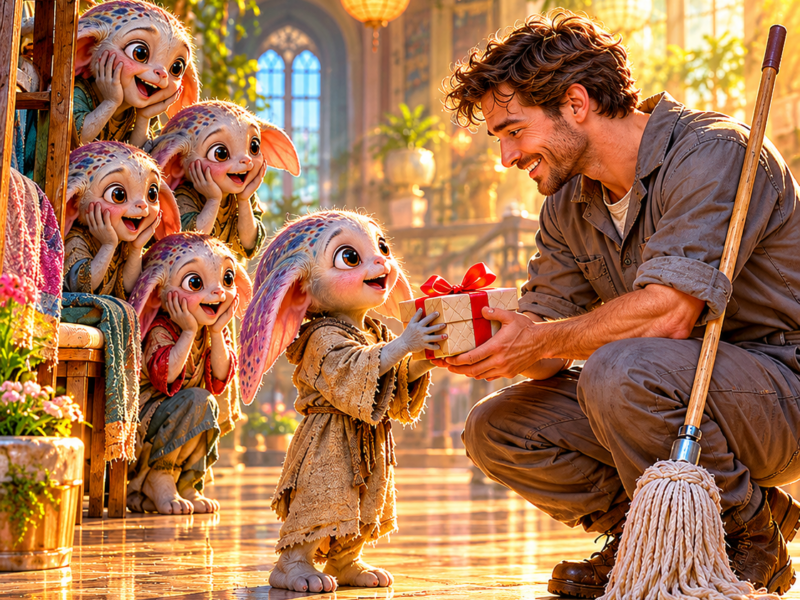
She brought a small package from behind her back.
The paper was crumpled, and the red bow was crooked.
“I made it with the director,” she said. “It’s for you, so you won’t go away.”
I crouched down, my knees creaking.
“Well, that’s a very serious responsibility for a little package.”
She smiled.
I loosened the ribbon and unfolded the paper.
Inside was a tiny wooden bear.
Its belly was round, its ears were uneven, and its smile was a little crooked. One eye was a polished black stone. The other was a small carved cross.
I ran my thumb over the little bear’s back.
It wasn’t perfectly carved.
It was better than perfect.
I looked up at Tibbet.
“You made this?”
She nodded.
“The director helped me with the eyes.”
Vashra stood behind her, looking almost shy.
I pressed the little bear against my chest.
For forty years, I had crossed the stars repairing engines and keeping cargo ships moving. I had spent most of my life believing that a man’s worth could be measured by the work he left behind.
Then Margaret died, and all those years of noise and motion became quiet.
I had come to Polaris thinking I needed somewhere to hide from that silence.
Instead, thirty-one children and one frightened director had given me a reason to hear laughter again.
I sat down on the floor.
I couldn’t speak.
Tibbet put her small hand on my sleeve.
“Is it okay?”
I nodded.
“It’s the finest thing anyone has ever given me.”
Around us, the children began opening their presents.
One found a soft rabbit and pressed it against her cheek. Another lifted a little wooden flute to his mouth and blew a note that came out crooked and breathy.
A boy held up his new picture book and asked whether someone would read it to him.
Vashra knelt beside a child who had received a knitted scarf and helped wrap it around his neck.
There were tears, laughter, and more than a few confused questions about why the packages were allowed to belong to them.
I watched their ears rise one by one.
For the first time, the Great Hall didn’t feel like a place where children were being kept.
It felt like a home.
Later, when the cake had been cut and the lanterns had burned low, I stepped outside.
Snow rested softly on the roof. The windows shone gold against the dark.
Vashra came to stand beside me.
“I used to think that if I never let anyone have something, nobody could take it away,” she said.
I held the little wooden bear in my palm.
“And now?”
She looked through the window at Tibbet, who was asleep in a chair with her first bear tucked beneath her chin.
“Now I think I should have trusted them with the joy.”
We stood quietly for a while.
Then Vashra asked, “Do you think Margaret would have liked this place?”
I looked at the lanterns, at the children gathered around the fire, and at the little bear in my hand.
“She would have loved it.”
Vashra nodded.
Inside, Tibbet stirred in her sleep and reached for her bear.
I watched her small fingers close around it.
The storm had passed.
The lanterns were still burning.
And for the first time in eleven years, every child at Lantern House had something that was theirs.
I went back inside, hung my coat beside the door, and listened to the sound of thirty-one children laughing.
I knew then that I had finally found my way home.
The End.









