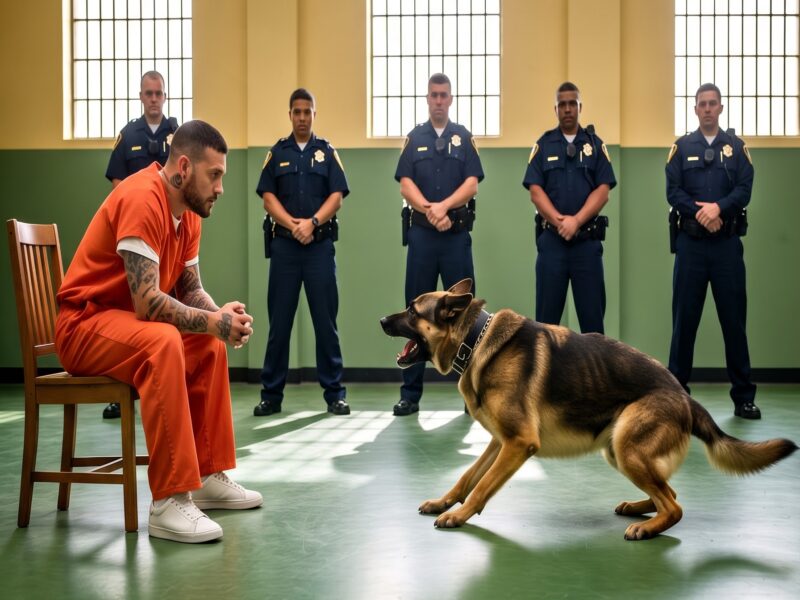
On the morning they led me down the execution corridor at Redstone State Prison, my final request was dismissed as sentimental nonsense
The execution corridor at Redstone State Prison smells of industrial bleach, wet concrete, and the distinct, coppery tang of old iron. It is a long, windowless hallway painted an aggressive shade of sterile white—a color meant to soothe, though it only amplifies the stark reality of what lies at its terminal end.
At 5:15 AM, my boots dragged across the cold concrete floor. The heavy steel chains wrapped around my waist clinked with every step, their rhythm matching the steady, unhurried cadence of the four guards surrounding me. My hands, numb and restrained in black leather mitts, felt entirely detached from my body. Seven years of appeals, seven years of concrete walls, seven years of screaming my innocence into the dark had brought me here. To this fifty-yard walk.
“Keep moving, Bennett,” Guard Sergeant Miller muttered behind me. His hand was firmly pressed against my shoulder blade. There was no hatred in his voice—only the flat, monotonous exhaustion of a man performing an administrative task at the end of a long night shift.
“I asked for Duke,” I said, my voice sounding thin and scraped, like dry leaves tumbling over pavement. “Three times, Miller. That was my last request.”
“Warden denied it,” Miller replied without breaking stride. “Prisoners on the death protocol don’t make demands regarding service animals or pets. It’s a liability issue.”
“He’s not a pet,” I whispered, staring straight ahead at the green steel door at the end of the hall. “He was my partner.”
Nobody answered. The guards maintained their steady, mechanical pace.
Duke had been an eight-month-old Belgian Malinois when the department paired us up eleven years ago. Together, we had spent nine years running down leads in the rain, tracking lost children through dense timber, dragging barricaded suspects out from beneath rotting floorboards, and, in one blinding moment of fire and twisted metal, dragging me out of a burning squad car before the fuel tank exploded. He knew the sound of my heartbeat better than any human being ever had. He could read the shift in my posture before I even realized I was tense.
Then came the night at the abandoned freight terminal near the river.
An anonymous tip had brought my human partner, Officer Ryan Cole, and me to Warehouse 4. We were told an illicit narcotics transfer was taking place. But when we stepped through the rusted side door, there were no drugs. There were no low-level dealers. There was only a single flash of light, a deafening report, and Ryan collapsing onto the cold concrete with a hole through his chest.
I remembered kneeling beside him, trying desperately to stem the bright red blood pooling over his badge. I remembered the sudden, heavy footfalls behind me, the cold steel of a heavy barrel striking the side of my skull, and the world blacking out into crimson and noise.
When I woke up in the county hospital three days later, handcuffed to the gurney, the world had changed.
The murder weapon—a unregistered .38 revolver—had been recovered forty feet from Ryan’s body. My fingerprints were printed crisply across the cylinder and frame. A key witness, a local informant named Marcus Vance, testified under oath that he had seen me arguing screaming with Ryan in the parking lot, seen me pull the weapon, and seen me sprint toward my vehicle after the shot echoed out.
The department turned on me with terrifying velocity. Within a week, the local media branded me a dirty cop who had killed his partner to cover up a botched theft of seized evidence. Two weeks later, Duke was quietly stripped of his badge and retired from service, handed over to a state foster handler.
I lost my badge, my reputation, my friends, and eventually, inside a quiet courthouse with red carpets and oak paneling, my freedom. I was sentenced to die by lethal injection.
The steel door at the end of the execution corridor groaned open.
We stepped into the holding chamber immediately adjacent to the execution room. The air was colder here, chilled by an industrial air processor that hummed continuously above our heads. A heavy pane of reinforced observation glass separated us from the gallery, where news reporters and state witnesses sat in silent, shadowy rows.
Warden Arthur Harris stood near the preparation table, holding a clipboard. He was a small man with thin rimless glasses and an immaculate uniform that smelled faintly of peppermint and starch.
“Officer Bennett,” Harris said, not looking up from his papers. “We have final procedures to complete. Do you have any final oral statement to register for the official record?”
“Where is Duke?” I asked, my voice holding firm despite the tremor in my chest.
Harris sighed, adjusting his glasses. “Bennett, I told your attorney. Bringing a retired police dog into an execution facility presents severe security risks. We don’t allow—”
Before Harris could finish his sentence, the heavy outer security door to the chamber clicked. The pneumatic seal hissed, and the door swung slowly inward.
A guard stood in the doorway, looking flustered, holding a frayed leather leash.
At the end of that leash was a dog.
Duke walked into the room. He didn’t run. He didn’t bark. He limped slightly on his right hind leg—the old hip dysplasia catching up with his aging frame. The thick black fur around his muzzle had turned entirely white, like frost covering a pine branch. His dark brown eyes were milky with early cataracts, but as his head turned toward me, those eyes locked onto mine with absolute, terrifying clarity.
He wore his old leather police collar, scuffed at the edges, the metal ID tag clinking softly against his brass ring.
“What is this?” Warden Harris demanded, his face flushing red. “I explicitly denied that entry!”
“Sir,” the guard at the door stammered. “The state commissioner’s office called down five minutes ago. They granted an emergency administrative exception for the animal’s handler.”
I didn’t care about the commissioner. I didn’t care about Harris. I dropped down onto my knees, the chains around my waist crashing heavily against the floorboards.
“Duke,” I rasped.
The old dog didn’t pause. He ignored the guards, ignored the warden, and ignored the sterile smell of the room. He walked straight up to me, leaned his heavy, warm head directly against my chest, and let out a long, shuddering breath.
I pressed my face against the rough coat of his neck. The familiar smell of cedar, dry rain, and old leather flooded my senses. For seven long years inside a windowless six-by-eight cell, I had kept my eyes dry, refusing to give the guards or the system the satisfaction of seeing me break. But in that cold holding room, with my chin resting against my dog’s grizzled fur, tears spilled silently down my cheeks, hot and burning against my cold skin.
“I’m sorry, boy,” I whispered into his ear. “I’m so sorry I couldn’t come home.”
Duke nudged my chin with his wet nose, his warm tongue licking the salt from my cheek. Then, suddenly, his entire body went rigid.
His ears, flopped slightly with age, perked straight up. His head snapped away from me, his head turning toward the far corner of the holding room near the low-mounted ventilation duct.
He let out a low, vibrating growl deep in his chest—a sound I hadn’t heard in over seven years.
“Control the animal,” Warden Harris warned, stepping back nervously. “Bennett, get your dog under control.”
Duke stepped away from me. He limped deliberately over to the heavy steel floor vent set beneath the concrete wall. He dropped his snout to the rusted iron grate, inhaling deeply, his nostrils flaring with rapid, rhythmic snorts.
Then, he raised his right paw and raked it violently across the metal grate.
CLANG. CLANG. CLANG.
“Get him out of here,” Harris ordered the guards sharply. “Sergeant Miller, remove that dog immediately.”
Miller stepped forward, reaching for Duke’s leash, but Duke turned his head and bared his teeth, letting out a sharp, ferocious bark that echoed off the hard white walls like a gunshot. He turned back to the vent and began scratching even harder, his claws tearing at the paint, leaving dark grey gouges in the iron.
“He’s alerting,” I said, my heart suddenly hammering against my ribs so hard it felt like it would break through my chest. “He’s giving a positive alert signal!”
“He’s an old, confused animal reacting to unfamiliar surroundings,” Harris snapped. “Guards, escort the prisoner to the chamber. Now.”
“No!” I shouted, struggling to stand, my chains rattling wildly. “Look at him, Harris! That is a certified evidence alert! He’s trained on scent containment! He’s not confused!”
Miller paused, looking from me to the dog, then to the warden. “Sir… the dog is working. I’ve seen K9s do this before. He’s locked onto something inside that air shaft.”
Harris looked at his watch. It was 5:22 AM. The execution was scheduled for precisely 5:30 AM.
“We don’t have time for this nonsense,” Harris said, his voice rising in irritation. “This is a stall tactic.”
“Call the maintenance technician,” Miller said firmly, crossing his arms, his eyes fixed on Duke. “If there’s something in that duct, Warden, and we ignore a positive alert from a retired police dog on live camera feed in front of state witnesses… we’ll both spend the rest of our lives in court.”
Harris stared at Miller, his jaw tightening so hard a muscle twitched in his cheek. He snatched a radio from his belt. “Send Facilities Tech Miller to Holding Bay B with an allen wrench set. Immediately.”
Three minutes passed in absolute, suffocating silence. Duke never moved. He sat perfectly still in front of the vent, his nose pressed against the iron grate, his chest rising and falling in fast, measured breaths. His dark eyes remained fixed on the darkness behind the metal.
At 5:26 AM, a young technician in grey overalls hurried into the room, holding a heavy toolbox. Under Miller’s watchful eye, he unscrewed the four heavy hex bolts securing the iron grate to the concrete wall.
He pulled the heavy grate away, setting it on the floor with a metallic clatter.
The technician shone a bright tactical flashlight into the dark, dust-choked air shaft. He frowned, reaching his gloved hand deep into the narrow duct, his fingers sweeping along the dusty sheet metal floor.
When he pulled his hand back out, he was holding a small, rectangular object.
It was a micro-SD memory card, wrapped meticulously inside a triple-sealed layer of heavy industrial plastic film, held in place against the interior duct wall by a small strip of magnetic tape.
The room went completely, terrifyingly silent.
Warden Harris stared at the tiny object in the technician’s gloved palm, his face draining of color until he looked as pale as the concrete walls around us.
“What is that?” Harris whispered, his official composure vanishing instantly.
I stared at the small black square, my breath catching in my throat. “I don’t know,” I said. “I’ve never been in this holding bay in my life.”
“Bring a secure media tablet from the administrative supervisor’s office,” Miller ordered the technician, his voice tight with sudden, intense authority. “Right now.”
Two minutes later, the technician returned with an encrypted department tablet. He wiped the heavy plastic wrap from the card, slid the tiny chip into the tablet’s side port, and pressed play on the single auto-run audio file stored on the drive.
A heavy hiss of static filled the cold room, followed by the sound of muffled breathing and the distinct rumble of an idling vehicle engine.
Then, a voice came through the small speaker.
It was thin, trembling, and whispered in a desperate rush, but I would have recognized it anywhere on earth.
It was Officer Ryan Cole.
“If you’re listening to this…” Ryan’s voice quavered over the speaker, punctuated by a wet, ragged cough. “If I’m dead… do not trust the official report. They set us up. It wasn’t a narcotics call. It was a sweep. They wanted the digital ledger from the harbor authority…”
My lungs seized. I stared at the small screen, my jaw hanging open.
The audio file paused for a fraction of a second, the sound of a vehicle door slamming echoing through the recording. Then, a second voice entered the track—cold, deep, and measured.
“Is it done?” the second voice asked.
“He’s hit,” a third voice replied—a voice I recognized instantly as my former shift supervisor, Captain David Sterling. “What about Bennett?”
“Bennett took a heavy blow to the crown,” Sterling’s cold voice continued smoothly on the recording. “He’s out cold. We’ll press his fingers onto the revolver, drop him near the door, and call it in as an officer-involved shooting. We’ll make Bennett take the fall.”
The recording cut off with a sudden, sharp pop of static.
Nobody in the room moved. Nobody drew a breath.
Warden Harris stood frozen, his eyes wide behind his glasses, staring at the tablet screen as if it were a poisonous viper resting on his desk. The guards stared at each other, their hands slowly falling away from their weapons.
My execution was scheduled to begin in precisely three minutes.
Sergeant Miller turned slowly, looking down at the warden. His voice was flat, cold, and heavy as lead.
“Warden,” Miller said, his thumb flicking the safety off his duty holster. “Pick up that phone and call the Governor. Right now.”
The stay of execution was signed at 5:38 AM, exactly eight minutes before the lethal drugs were scheduled to enter my bloodstream.
I was not returned to Death Row. Instead, I was moved to a high-security isolation cell in the administrative wing of the state capital’s federal holding facility. For three days, I sat under bright fluorescent lights while a special task force from the State Department of Justice and the Federal Bureau of Investigation systematically tore apart the conviction that had caged me for seven years.
The audio recording found inside the ventilation shaft was authentic. Forensic audio analysis confirmed the voices belonged to fallen Officer Ryan Cole and Captain David Sterling.
But as the initial shock of the discovery began to settle, a far darker, more complex puzzle began to emerge.
On the fourth morning, a tall woman wearing a sharp charcoal suit and carrying a dark leather briefcase walked into my interview room. She had sharp grey eyes, her dark hair pulled back into a tight, professional bun.
“Officer Bennett,” she said, extending a hand across the table. “I’m Special Agent Rachel Vance with the Department of Justice Public Integrity Section. Please, sit.”
I sat down, the heavy steel handcuffs around my wrists clinking softly. “Where is Duke?” I asked immediately. “Is he alright?”
“Your dog is currently being housed at the state veterinary headquarters in the capital,” Agent Vance replied, her expression softening slightly. “He’s being well looked after, Bennett. He’s receiving full medical care for his arthritis. He’s a hero.”
She opened her briefcase, pulling out a thick manila folder crammed with documents, crime scene photographs, and laboratory reports.
“I need to ask you a question, Bennett,” she said, leaning forward, resting her elbows on the table. “And I need you to think back very carefully to the morning of your scheduled execution.”
“I think about it every second,” I said quietly.
“How did that memory card get inside the air duct of Holding Bay B?” she asked directly.
“I told the investigators three times,” I replied, shaking my head. “I don’t know. I’ve never set foot inside that holding room before that morning. Death row inmates are kept in Building C until forty-five minutes before the execution time.”
“We know,” Vance said, tapping the folder. “We checked the security logs for Redstone Prison. That air vent was inspected six months ago during a routine duct cleaning. The card wasn’t there then. Someone placed it inside that duct within the last ninety days.”
She pulled out a high-resolution photograph of the micro-SD card before it was cleaned.
“Here is what troubles our forensic team,” Vance continued, pointing a long finger at the image. “Duke is an old dog. His sense of smell is degraded by age and cataracts. That memory card was sealed inside three layers of airtight polyethylene plastic and wrapped in magnetic tape. There was zero biological or organic scent leaking from that package.”
I frowned, looking closely at the photograph. “Then why did he alert on it? Duke was an accelerant and narcotics detection dog. He doesn’t alert on plastics or digital media.”
“Precisely,” Vance said, her eyes locking onto mine with intense focus. “So we sent the plastic wrapping and the interior of that duct to the state crime lab for chemical mass spectrometry.”
She slid a lab report across the table toward me.
“The plastic film wrapped around the card was saturated with a microscopic layer of Cyclohexanone,” Vance explained. “It’s a specialized chemical solvent used exclusively in forensic laboratories to wash, clean, and strip fingerprint residue from metallic evidence without damaging the underlying substrate.”
My blood ran cold. The air in the small room suddenly felt thin.
“Cyclohexanone…” I whispered. “That was the primary solvent used in the department’s central evidence division.”
“Yes,” Vance said grimly. “And when Duke was a young service animal on the force, before he was assigned to patrol with you, he spent two years cross-trained with the arson and evidence unit. He was specifically trained to detect trace amounts of industrial solvents—including Cyclohexanone.”
She leaned closer, lowering her voice.
“Duke didn’t find that recording because he smelled a story, Bennett. He found it because whoever hid that card used a chemical solvent straight from Captain Sterling’s evidence locker to clean off their own fingerprints before taping it inside that vent.”
I sat back in my chair, the metal cuffs dragging across the laminate table. My mind was racing, trying to piece together the terrifying logic of what she was telling me.
“Someone wanted that card found,” I realized out loud. “Someone knew Duke was being brought into that room.”
“Or,” Vance corrected sharply, “someone knew that if Duke was brought into that room, he would react to the solvent smell. But answer me this, Bennett: Who knew you had requested Duke as your final wish? Who had the authority to pull the strings at the last second to override Warden Harris’s explicit denial and bring that dog into the death house?”
I stared at her, my mind spinning into a dark, bottomless vortex.
The guard at the door had said it: The state commissioner’s office called down five minutes ago.
“The commissioner,” I breathed.
“Three hours ago,” Agent Vance said, pulling a fresh set of documents from her briefcase, “DOJ federal marshals executed an emergency search warrant on the central evidence facility at the 4th Precinct—and on the private residence of former Shift Supervisor, now Assistant Commissioner, David Sterling.”
She set four crime scene photos on the table face up.
The first photo showed a bottle of industrial Cyclohexanone sitting on a workbench inside Sterling’s private garage. The chemical lot number on the glass bottle matched the microscopic residue found on the plastic film wrapped around the memory card.
The second photo showed Captain Sterling standing in handcuffs beside a black sedan, his face pale, his eyes filled with cold, sullen fury as federal agents loaded boxes of sealed files into an unmarked van.
The third photo showed a massive, hidden wall safe behind a bookcase in Sterling’s home office. Inside were stacks of unmanifested cash, offshore bank ledgers, and three unregistered firearms.
“Sterling was arrested at 6:00 AM this morning,” Vance said flatly. “He’s currently being held in federal custody without bail under charges of murder, obstruction of justice, civil rights violations under color of authority, and racketeering.”
I closed my eyes, leaning my forehead against my clasped hands. A massive, crushing weight that had sat on my chest for seven long years seemed to fracture, falling away piece by piece.
“It’s over,” I whispered into the quiet room. “It’s finally over.”
Agent Vance was silent for a moment. She looked at me, her sharp grey eyes filled with an unreadable, complex light that made my chest tighten once again.
“The charges against you are being formally dismissed with prejudice by the State Supreme Court this afternoon, Bennett,” she said softly. “You are a free man. You’ll be processed out through the front doors of the federal courthouse at two o’clock.”
She paused, reaching down to slide the fourth photo across the table toward me.
“But before you leave,” Vance added, her voice dropping into a quiet, deadly whisper, “you need to look at this.”
I opened my eyes and looked down at the fourth photograph.
It was a high-magnification image of the micro-SD card taken under a laboratory microscope before it was processed for audio retrieval. Scratched crudely into the black plastic casing of the tiny chip, in letters no larger than the head of a pin, were two handwritten initials.
R.C.
Ryan Cole.
“Ryan hid that card,” I said, my voice shaking. “Before he died… Ryan recorded them, hid the card, and marked it with his initials.”
“Look closer at the scratch marks, Bennett,” Vance said quietly.
I leaned down, squinting at the blown-up photograph.
The white scratch lines cut into the black plastic were clean, sharp, and fresh. There was no oxidation, no dust, and no pocket lint buried inside the microscopic grooves of the letters.
“Those scratches weren’t made seven years ago,” Vance revealed, her words hitting me like a physical blow. “Our crime lab’s metallurgical examiner confirmed it yesterday. Those scratches were carved into that plastic less than forty-eight hours before your execution.”
I lifted my head slowly, staring at Agent Vance in horror. “What are you saying?”
“I’m saying Ryan Cole didn’t scratch his initials into that card seven years ago in Warehouse 4,” Vance whispered chillingly. “Someone else carved those initials onto that drive this week. Someone who had access to Sterling’s evidence, access to the prison, and access to the chemical solvent.”
She stood up, closing her leather briefcase with a heavy, definitive snap.
“You’re free to go home today, Officer Bennett,” she said, looking down at me with deep concern. “But keep your dog close. This story isn’t finished.”
The sunlight outside the federal courthouse was so bright it physically burned my eyes.
For seven years, my world had been composed entirely of muted greys, pale greens, and the harsh, flickering glare of industrial fluorescents. Stepping out onto the wide granite steps into the crisp, cool autumn air of late October felt like stepping onto the surface of an entirely different planet.
A crowd of reporters, news camera crews, and curious bystanders surged toward the bottom of the steps, a sea of flashing lenses, shouted questions, and thrust microphones.
“Officer Bennett! How does it feel to be cleared?”
“Bennett! Are you going to sue the state?”
“Do you blame the department for what happened?”
I ignored them all. I didn’t look at the cameras. I didn’t answer the shouted questions. I walked down the granite steps with a steady, measured stride, my eyes fixed entirely on a white utility van parked at the curb.
The van’s side door slid open.
A state veterinary officer stepped out, holding a thick leather leash. At the end of that leash was Duke.
The old dog saw me immediately. He let out a sharp, joyful bark—a high-pitched, exuberant sound that cut cleanly through the noise of the media circus. He trotted down the pavement as fast as his stiff hind legs would carry him, his tail thumping wildly against his flanks.
I dropped to my knees right there on the city sidewalk, throwing my arms around his neck, burying my face in his thick fur.
“Hey, boy,” I choked out, laughing and crying all at once as his wet nose pressed against my neck and his tongue wiped away my tears. “Hey, buddy. We’re going home. We’re going home.”
An hour later, we were sitting inside a modest, ten-year-old Subaru station wagon provided by my court-appointed civil attorney, driving west away from the concrete skyline of the city, heading out toward the quiet timber hills of Blackwood County.
My old house—a small, two-bedroom craftsman cottage nestled on two acres of pine forest near the edge of the state park—had been seized by the state following my conviction to pay for court costs and restitution fees. But three days ago, as part of the emergency exoneration package rushed through by the Governor’s office, the title had been quietly reinstated in my name, the locks replaced, and the utilities turned back on.
As I pulled the car into the gravel driveway, the engine idling softly, a deep, heavy quiet settled over us.
The house looked older, weathered by seven years of neglect. The white paint on the porch railings was peeling in long, curling strips; wild blackberries had overgrown the flowerbeds, their thorny vines crawling up the cedar siding toward the eaves. But the tall Douglas firs still swayed gently in the mountain breeze, and the air smelled rich with pine, damp earth, and woodsmoke.
I killed the engine.
Duke immediately leaned his head over the center console, pressing his cold nose against my shoulder, letting out a soft sigh.
“Come on, boy,” I said, opening my door. “Let’s see what’s left.”
We stepped onto the front porch. I pulled the new bronze key from my pocket, inserted it into the lock, and turned it. The heavy oak door groaned open with a soft click.
Inside, the house was frozen in time.
The state had auctioned off my vehicle and my bank accounts, but my personal belongings inside the house had been boxed, sealed, and left untouched in the center of the living room under thick plastic dust sheets.
I walked through the dusty rooms, my boots leaving clear footprints in the thin layer of grey dust covering the hardwood floors. I pulled the plastic sheet off the couch, sending a cloud of dust dancing through the shafts of golden afternoon sunlight streaming through the front window.
On the mantel above the stone fireplace sat a row of framed photographs.
I walked over, my fingers tracing the dust-covered glass of the central frame.
It was a photo taken eight years ago at the department’s annual awards banquet. In the picture, I was wearing my dark blue dress uniform, standing tall and proud, holding a silver commendation plaque. Beside me stood Officer Ryan Cole, his arm thrown over my shoulder, his broad, infectious grin showing a missing side tooth from his college football days. At our feet sat Duke, young, muscular, and alert, his dark fur gleaming under the banquet hall lights.
I stared at Ryan’s face in the photograph for a long time.
He had been thirty-two years old when he died in Warehouse 4. He had a wife, Sarah, and a four-year-old daughter named Lily. During my trial, Sarah had sat in the front row of the gallery every single day, wearing black, her eyes filled with an agonizing, silent hatred that cut deeper into my soul than any prosecutor’s speech ever could.
“I didn’t kill him, Sarah,” I whispered to the empty room, my finger resting on Ryan’s face in the photograph. “I swear to God, I didn’t kill him.”
Duke trotted into the living room, carrying an old, frayed tennis ball he had found beneath the side table. He dropped it at my feet with a soft thud, looking up at me with his milky eyes, his tail giving two slow, hopeful thumps against the floor.
I picked up the dusty ball, a soft, genuine smile touching my lips for the first time in seven years.
“Alright, boy,” I said softly, tossing the ball softly down the narrow hallway. “One round. Then we clean this place up.”
For the next three weeks, life settled into a slow, quiet, therapeutic rhythm.
I spent my days repair-staining the porch, clearing the blackberry vines from the yard, and re-painting the kitchen. I bought fresh groceries, cooked warm meals on the gas stove, and spent long hours sitting on the back porch in the cool autumn evenings, watching the sunset cast long red shadows across the pine forest while Duke lay peacefully at my feet.
The state state exoneration fund paid out an initial emergency stipend, allowing me to pay off my legal bills, buy a reliable truck, and stock the house with supplies.
To the outside world, the story of Officer Bennett was a closed chapter—a tragic miscarriage of justice rectified by a miraculous discovery at the eleventh hour, a rogue police captain brought to justice, and an innocent man returned to his quiet life.
But inside my chest, a dark, cold thread of tension remained pulled tight.
Every night, before I went to sleep, Agent Vance’s words echoed through my head:
Those scratches were carved into that plastic less than forty-eight hours before your execution.
Someone had planted that card. Someone had wiped it with Cyclohexanone. Someone had ensured Duke would smell it.
And that person was still out there.
On a cold Tuesday morning in mid-November, four weeks after my release, Duke’s behavior began to change.
It started subtly. He stopped sleeping soundly through the night on his padded orthopedic bed beside my frame. Instead, around 3:00 AM every morning, he would quietly stand up, his claws clicking softly on the hardwood floor, and walk into the living room.
He would sit in the center of the dark hallway, his body perfectly rigid, his head tilted slightly, his ears perked forward as he stared intently at the bottom of the heavy front door.
The first two times it happened, I woke up, walked out into the hall, flicked on the porch light, and peered through the window. There was never anything there—only the empty gravel driveway, the swaying pine trees, and the dark, quiet road stretching out into the mountain fog.
“Just the wind, boy,” I would tell him, patting his flank and guiding him back to his bed. “Just an old house settling.”
But on the twentieth morning after my return, at precisely 4:15 AM, Duke didn’t just walk into the hallway.
He let out a low, terrifying growl that rattled the doorframe of my bedroom.
I snapped awake instantly, my hand reaching out by pure muscle memory for the service weapon that was no longer sitting on my nightstand.
The house was freezing cold. The pilot light on the floor furnace had cut out, dropping the interior temperature down to a chilly forty degrees.
In the hallway, Duke was standing rigidly in front of the front door. His hair along his spine was stood straight up in a thick ridge; his head was lowered, his dark lips drawn back to reveal his sharp white teeth in a silent, deadly snarl.
I slid out of bed, grabbing a heavy steel crowbar I had left near the closet during the porch repairs. I stepped quietly into the dark hallway, my bare feet silent against the cold wood floor.
“Duke,” I breathed, keeping my voice down to a fraction of a whisper. “Stay.”
The old dog didn’t move an inch. His eyes were locked onto the narrow one-inch gap between the bottom of the oak door and the threshold.
A cold draft was blowing through that gap, bringing with it the crisp smell of wet autumn leaves, cedar… and a faint, sharp scent that made my blood run cold.
The smell of tobacco smoke. Fresh, high-grade menthol cigarette smoke.
Someone had been standing on my front porch less than thirty seconds ago.
I raised the heavy steel crowbar in my right hand, stepped up to the door, grabbed the deadbolt with my left hand, and yanked the door open in one violent, sudden motion.
“Freeze!” I yelled into the darkness.
The front porch was empty.
Cold fog was rolling off the pine trees, thick and white as milk, enveloping the gravel driveway and obscuring the road fifty yards away. The yellow light above the porch flickered once, hummed softly, and cast long, dancing shadows across the wet cedar planks.
There was no sound—no footsteps running across the gravel, no vehicle engine starting up in the distance, no rustle of branches in the treeline. Only the steady, rhythmic dripping of condensation from the wooden eaves onto the porch floor.
“Damn it,” I muttered, lowering the crowbar, my chest heaving as the adrenaline slowly began to clear from my blood.
I turned to step back inside, but Duke stepped past my legs, his nose dropping down to the threshold. He sniffed the floor once, then let out a sharp, urgent whimper.
I stopped. I looked down at where Duke was pointing his snout.
Taped neatly to the exterior oak panel of the door, precisely two inches above the floorboards, was a small piece of glossy paper, face down. It was held in place by a single strip of clear electrical tape.
My hand trembled as I reached out, peeled the tape away from the wood, and lifted the paper into the yellow light of the porch bulb.
It was a 4×6 color photograph.
The image was crisp, clear, and taken recently with a high-end telephoto lens.
It depicted a small, sunlit outdoor cafe located on a cobblestone plaza in a tropical city. Palm trees swayed in the background; colorful stucco buildings lined the perimeter of the square.
Sitting at a small iron table near the edge of the frame was a broad-shouldered man wearing a beige linen shirt, dark sunglasses, and a wide-brimmed straw hat. He was laughing, holding a glass of iced coffee in his right hand.
My heart stopped beating. The air was violently sucked out of my lungs as if I had been struck in the chest with a sledgehammer.
I dropped the crowbar. It clattered loudly against the wooden porch floor.
The man in the photograph had a distinct, jagged white scar running from the left corner of his lip down to his jawline—a scar from an old bar fight in college.
And on his left hand, resting on the tabletop, was a ring—a heavy gold signet ring engraved with the crest of the 3rd Infantry Division.
It was Officer Ryan Cole.
Alive. Well. Smiling under a tropical sun.
I stood on that freezing porch in my bare feet, staring at the photograph until the colors blurred before my eyes. My mind reeled backward, violently smashing through seven years of agonizing grief, seven years of trial testimony, seven years of concrete walls and death chamber preparations.
Ryan wasn’t dead.
The blood in Warehouse 4… the shooting… the missing body that the department had claimed was incinerated in a secondary explosion at the harbor three hours after my arrest… it had all been a staged execution.
I flipped the photograph over with trembling fingers.
Written across the clean white back of the paper, in precise, elegant handwriting using black India ink, were three short words:
Ryan is still alive.
Below those three words was a second line—a set of ten numbers written in standard international format:
GPS: 9.9325° N, 84.0800° W
I collapsed back onto my knees on the cold porch floorboards, my head spinning, the photograph clutching tightly in my hand.
Duke stepped up beside me, leaning his heavy chest against my shoulder, his warm, wet nose nudging my cold cheek. He looked down at the photograph in my hand, then looked out into the dense, white fog covering the driveway, letting out a long, quiet sigh.
Someone had framing me for murder wasn’t just Captain Sterling trying to hide an evidence theft.
It was a multi-million-dollar disappearance scheme. Ryan Cole hadn’t been the victim of a dirty cop. Ryan Cole had been the architect of his own death, using me—his loyal, trusting partner—as the perfect, disposable distraction to cover his escape with millions in seized cartel assets.
And someone—the person who had carved R.C. onto that micro-SD card, the person who had saturated the tape with Cyclohexanone, the person who had ensured Duke was brought into that death house at 5:15 AM—had just handed me the key to his hideout.
I turned the photograph back over, staring at Ryan’s smiling face in the tropical sunlight.
A cold, hard, terrifying stillness settled deep into my bones—a feeling I hadn’t felt since the night I wore a silver star on my chest and carried a loaded sidearm on patrol.
I looked at Duke. His dark eyes met mine in the dim porch light, unwavering, fierce, and ready.
“Pack your things, boy,” I whispered, my voice dropping into a register as hard and cold as iron. “We’re going on a hunt.”
The sun was blindingly bright over the cobblestone streets of San José, Costa Rica.
The humid air smelled of roasted coffee beans, diesel exhaust, and blooming bougainvillea. It was a sensory overload compared to the quiet, damp pine forests of Blackwood County, but as I walked down the narrow pavement of Calle 3 wearing a light linen jacket, sunglasses, and a dark cap pulled low, my focus was narrowed to a fine, razor-sharp point.
Beside me, walking comfortably on a short leather lead, was Duke.
He wore a light tactical service vest instead of his old police harness, his graying muzzle drawing warm smiles from passing tourists and local shopkeepers. But beneath his relaxed demeanor, every muscle in his aging frame was alert, his nose working the warm tropical air, taking in ten thousand scents every second.
It had taken me three weeks to arrange the travel, secure the necessary international clearance for a retired service animal, and trace the GPS coordinates provided on the back of the photograph.
The coordinates led directly to a quiet, upscale residential district near the Barrio Amón—a neighborhood of grand old colonial houses hidden behind high security walls and bougainvillea-draped iron gates.
We turned the corner onto Avenida 9.
Fifty yards down the quiet, tree-lined street sat a white two-story villa with terracotta roof tiles and a heavy wrought-iron gate. Parked in the driveway was a dark green Range Rover with local license plates.
Sitting on the open veranda overlooking the street, sipping an espresso and reading an English-language newspaper, was the man from the photograph.
Ryan Cole.
He looked older, his hair silvered at the temples, his skin tanned a deep, dark bronze from seven years under the Central American sun. He looked relaxed, wealthy, and completely at peace with the world.
I stopped at the base of the driveway steps. I took a deep breath, reaching down to unclip Duke’s lead from his collar.
“Go find him, Duke,” I whispered softly.
The dog didn’t bark. He didn’t rush. He walked up the stone steps of the veranda with a slow, deliberate cadence, his claws clicking rhythmically against the polished red tiles.
Ryan didn’t look up immediately. “No quiero nada, gracias,” he said in fluent, relaxed Spanish, assuming it was a local street vendor.
Duke walked straight up to his iron table, lowered his head, and rested his gray muzzle directly on Ryan’s linen-covered knee.
Ryan froze.
The coffee cup in his hand stopped mid-air, an inch from his lips. He looked down slowly, his eyes dropping from his newspaper to the old Belgian Malinois sitting beside his leg.
His face drained of color in a fraction of a second. The glass cup slipped from his trembling fingers, shattering against the red tile floor, spewing black coffee and white porcelain fragments across his polished leather sandals.
“D-Duke?” Ryan gasped, his voice barely a breath.
“He doesn’t forget a face, Ryan,” I said, stepping onto the veranda from the top of the stairs, taking off my sunglasses. “And neither do I.”
Ryan snapped his head up, his eyes widening in pure, unadulterated terror as if he were staring at a ghost rising straight out of the grave. He stumbled backward out of his chair, his body slamming hard against the villa’s stucco wall, knocking a small clay planter to the floor.
“Claire…” Ryan stammered, his hands shaking violently as he raised them in front of his chest. “Claire… how… how did you find me?”
“You left a trail, Ryan,” I said, taking two slow steps toward him, my voice flat, cold, and entirely devoid of emotion. “You left a recording. You left a memory card. And you left me to die in a steel chair at Redstone State Prison.”
“No! No, Claire, listen to me!” Ryan pleaded, his eyes darting frantically toward the front door of the villa. “It wasn’t supposed to go down like that! Sterling promised me you’d get acquitted on a self-defense claim! He promised me the evidence wouldn’t hold up in court!”
“You put my fingerprints on the gun, Ryan,” I said, stepping closer until I was standing less than five feet from him. “You took twelve million dollars from the harbor authority bust, staged your own murder, let them drag me through seven years of hell, and sat out here drinking coffee while they strapped me to an execution table!”
“I can give you half!” Ryan screamed, his voice breaking into a pathetic, desperate squeak as he reached toward his back pocket. “I have six million in a Swiss trust! It’s yours, Claire! Take it and walk away! Nobody has to know—”
Before his hand could reach his pocket, Duke let out a deafening, terrifying bark. The old dog launched himself forward with blistering speed, his jaws clamping onto Ryan’s wrist with absolute, unyielding force, slamming his arm against the stucco wall.
Ryan shrieked in pain, dropping a small, silver .22 caliber pocket pistol onto the floorboards.
I stepped forward, kicked the pistol off the veranda into the bushes below, and grabbed Ryan by his linen collar, slamming him face-first onto the iron table.
“I didn’t come for your money, Ryan,” I snarled into his ear, pulling his hands behind his back and securing his wrists with a heavy pair of steel zip-ties I pulled from my jacket. “I came to finish the arrest.”
The heavy front door of the villa swung open.
Stepping out onto the veranda was Special Agent Rachel Vance, flanked by four armed officers from the Organismo de Investigación Judicial—Costa Rica’s federal investigative police.
Agent Vance looked down at Ryan, who was sobbing hysterically on the table, then looked up at me, a rare, genuine smile gracing her sharp face.
“Clean arrest, Officer Bennett,” Vance said, stepping forward to flash her federal credentials. “The extradition papers were signed by the Costa Rican Supreme Court an hour ago. He’ll be on a federal transport flight back to the United States before sunset.”
I released my grip on Ryan’s collar, stepping back as the local federal officers hauled him to his feet and began leading him down the driveway in heavy iron chains.
I looked at Agent Vance. “It was you, wasn’t it?”
Vance paused, looking at me with her intelligent grey eyes. “What was me?”
“The photograph under my door,” I said softly. “The memory card in the air duct. The Cyclohexanone. You knew Sterling was dirty, but you couldn’t move against him without a federal leak. You used Duke to break the case open.”
Agent Vance looked down at Duke, who was sitting calmly beside my leg, looking up at her with his milky brown eyes.
“Let’s just say,” Vance said quietly, reaching down to gently pat Duke’s head, “that when a good cop is framed by bad men, the universe has a way of balancing the books. And sometimes, the best investigator on the team happens to have four legs and a badge.”
She turned and followed the officers down the driveway, leaving us alone on the quiet veranda.
I looked down at Duke. The old dog let out a soft, happy sigh, leaning his broad head heavily against my knee, his tail giving three slow, satisfied thumps against the red tile floor.
The sun was high in the sky now, burning away the last of the morning clouds, bathing the tropical square in warm, golden light.
I clipped the leather lead back onto his collar, reached into my pocket, and pulled out a small, shiny silver object—a brand-new, officially reinstated Senior Inspector’s badge from the Department of Justice.
I pinned it to my jacket, took a deep breath of the warm, clean air, and looked down at my partner.
“Come on, Duke,” I said, turning toward the stairs. “Let’s go home.”
The end.









