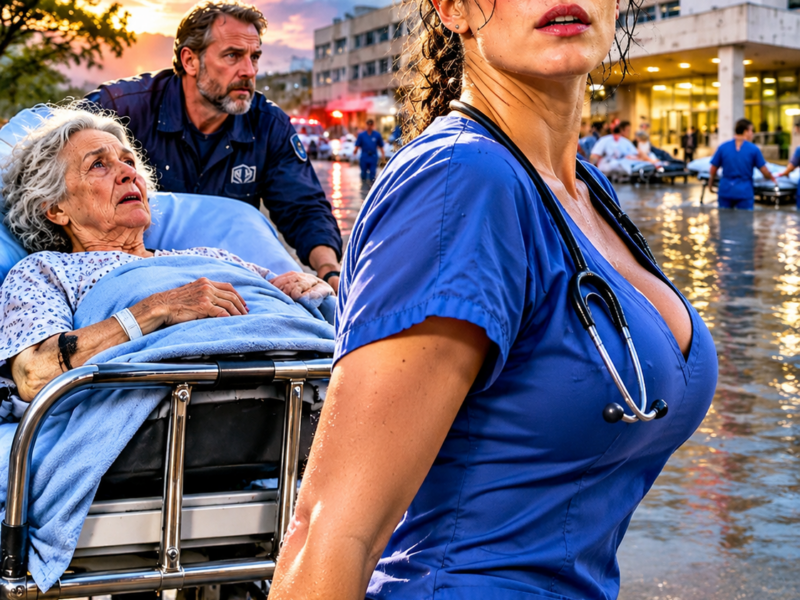
“On the fifth day of Hurricane Ingrid, with three feet of floodwater covering the hospital’s first floor
“Your husband left it,” the maintenance worker whispered.
I stared at him.
“My husband?”
The young man nodded, his eyes moving nervously toward the stairwell.
“His name was David Bennett, right?”
For several seconds, I couldn’t speak.
David had been dead for three years.
He had been a facilities engineer at St. Mary’s Regional Hospital, working there for nearly fifteen years before a heart attack took him one ordinary Tuesday morning.
He had known every pipe, electrical panel, service tunnel, and maintenance entrance in the building.
He had also been the kind of man who labeled everything, even the keys to our kitchen cabinets.
“What do you know about my husband?” I asked.
The maintenance worker swallowed.
“My name is Noah. I started here six months ago. Three days before the hurricane, I was checking the old facilities office when I found a sealed cabinet behind a storage shelf.”
He pointed to the envelope.
“Your name was on that cabinet.”
I looked at the photograph again.
David stood beside Thomas Reed and a man named Richard Cole, the hospital board chairman.
The delivery truck behind them had no company logo.
Its rear doors were open.
I recognized the basement loading entrance immediately.
“Why didn’t you give this to security?”
Noah looked at me as if I had asked something foolish.
“Because Mr. Reed told security to lock that office.”
A sudden crash came from the service corridor.
Kevin rushed toward the patient rooms.
“Rachel, we need to move. The water is coming through the west door.”
I folded the photograph and slipped it into my scrub pocket.
“Get the transport equipment ready.”
Noah grabbed my arm.
“There’s something else.”
I turned.
“The cabinet wasn’t empty. There were medical records inside. Old ones. And a list of patients.”
“Which patients?”
He looked toward the twelve beds.
“These twelve.”
The generator lights flickered.
I felt the floor shift beneath my shoes as another surge struck the building.
“Show me.”
Noah led me toward the facilities office.
It was only twenty yards down the corridor, but the water was already ankle-deep.
The office door had been forced shut with a heavy steel bar.
Noah pointed to a small ventilation opening beside it.
“I couldn’t get the door open.”
I looked at the lock.
It was an electronic system, but the power had failed.
“There’s a manual release.”
I remembered David showing me how it worked years earlier.
He used to joke that hospital doors were designed to keep everyone out except the people who knew how to open them.
I found the small metal cover beneath the keypad.
Inside was a mechanical override.
Noah watched as I turned it.
The lock clicked.
The door opened.
The smell hit us first.
Wet cardboard, dust, and something chemical.
The office had been partially flooded, but the shelves along the back wall remained dry.
A metal cabinet stood behind a stack of maintenance manuals.
I recognized David’s handwriting on a strip of masking tape.
RACHEL — OPEN ONLY IF THE LOWER LEVEL IS COMPROMISED.
My throat tightened.
He had written it.
I was certain.
I opened the cabinet.
Inside were three folders, a small portable hard drive, and a sealed envelope addressed to me.
The first folder contained building inspection reports.
The second contained patient transfer records from three years earlier.
The third contained photographs.
I picked up the first photograph.
It showed the same basement loading entrance, but the date was almost four years old.
A truck was parked outside.
Several men were carrying large medical containers into the building.
One of the men was Richard Cole.
Another was Thomas Reed.
The third was a doctor I recognized.
Dr. Alan Pierce, the hospital’s former chief medical officer.
He had resigned abruptly two years earlier.
At the time, the hospital had said he was relocating to care for his elderly mother.
I turned the photograph over.
David had written:
THEY ARE NOT MOVING MEDICAL SUPPLIES.
I opened the second folder.
Inside were copies of patient records.
Some patients had been transferred to other facilities, but the receiving hospitals had no record of them.
Others had been listed as deceased despite having no corresponding death certificates.
The names were different.
The dates were different.
But the handwritten codes beside them were familiar.
R.
T.
Exactly the same letters I’d seen on the evacuation order.
“Rachel,” Noah said quietly.
I looked up.
“These aren’t ordinary transfer records.”
He shook his head.
“They look like someone was moving patients without documenting where they went.”
I checked the dates.
Most of the records were from three to four years earlier.
Then I saw one dated only six weeks ago.
The patient’s name was Eleanor Brooks.
I felt the air leave my lungs.
Mrs. Brooks.
The seventy-eight-year-old woman in bed twelve.
Her file showed that she had been admitted for complications following a fall.
But someone had added a handwritten note:
REVIEW FOR SPECIAL TRANSFER.
I looked at the bottom of the page.
There was a signature.
Thomas Reed.
My husband had been investigating this long before the hurricane.
And somehow, Mrs. Brooks was connected.
A metallic bang shook the office door.
Someone was outside.
“Rachel Bennett?” a voice called.
It was Reed.
“Open this door immediately.”
Noah stepped backward.
I slipped the hard drive into my pocket.
Then I picked up David’s envelope.
My hands were shaking as I opened it.
Inside was a handwritten letter.
Rachel,
If you’re reading this, something has happened to the lower level.
I hope I’m wrong about what I found.
I tried to report it through the proper channels, but the people involved have access to every level of this hospital.
I don’t know who you can trust.
If Thomas Reed is still here, do not let him decide which patients are worth saving.
There are people in this building who have been treated as paperwork instead of human beings.
Find Eleanor Brooks.
She knows what happened.
I stopped reading.
The letter ended with a sentence that made me sit down.
I’m sorry I couldn’t tell you while I was alive.
I pressed the paper against my chest.
David had carried this secret alone.
He had known something was happening at the hospital.
He had been afraid.
And he had left me a warning that I hadn’t understood until now.
“Rachel!”
Reed’s voice came again.
“This is your final instruction. Come out and hand over everything you found.”
I folded the letter.
“How does he know we’re in here?” Noah whispered.
I looked at the ceiling.
A small red indicator light blinked above the door.
A security camera.
Someone was watching us.
I turned to Noah.
“Is there another way out?”
He nodded.
“There’s a maintenance passage behind the old boiler room. It connects to the surgical recovery wing.”
“Can it be opened?”
“If the emergency release still works.”
I looked at the water rising under the office door.
“Then that’s where we’re going.”
We gathered the folders and moved toward the passage.
Behind us, Reed shouted for security.
I heard the steel bar being removed.
Noah found the hidden access panel and pulled it open.
The passage was narrow, dark, and filled with the smell of damp concrete.
We crawled through one at a time.
I was halfway across when I heard the office door crash open.
“Find them!”
We reached the boiler room just as the first security guard entered the corridor behind us.
Noah pushed the panel shut.
For a moment, we stood in darkness, listening.
Then he switched on his flashlight.
“Are you okay?”
I nodded.
But I wasn’t.
I was thinking about David.
And Eleanor Brooks.
We returned to the patient unit to find Kevin preparing a manual ventilation bag.
The water had reached the bottom of the first patient’s bed.
Mrs. Brooks was awake.
She looked at me.
“You found it, didn’t you?”
I stopped beside her.
“Found what?”
She looked at the photograph in my hand.
Then she closed her eyes.
“I was wondering how long it would take.”
I pulled a chair beside her bed.
“Mrs. Brooks, did you know my husband?”
She nodded.
“David came to see me before he died.”
My fingers tightened around the bedrail.
“What did he tell you?”
“He said I had to remember what happened to my son.”
I stared at her.
Her son?
She reached toward the bedside table.
I helped her open the small drawer.
Inside was an old photograph of a young man wearing a hospital identification bracelet.
His name was Michael Brooks.
“That was my son,” she whispered.
“He was twenty-nine when he came here.”
She explained that Michael had suffered a severe brain injury in a car accident.
He had survived the initial surgery, but he required long-term care.
The hospital told Eleanor that he had developed complications and died several days later.
She had been devastated.
But the hospital never showed her a death certificate.
They never returned his personal belongings.
And when she asked to see his body, she was told that the remains had already been transferred to a funeral home.
The funeral home had no record of him.
For years, she had tried to find out what happened.
Nobody would answer her questions.
Then David had approached her.
“He told me that some patients were being transferred to places that didn’t exist on their medical records.”
I looked down at the old photograph.
“Did he say where?”
She shook her head.
“He said he was trying to find out.”
“Do you think Michael is still alive?”
She looked at me.
“I don’t know.”
Her voice broke.
“But if there’s even a small chance, I need to know.”
Before I could answer, the emergency lights flashed.
A loud alarm sounded from the east corridor.
Kevin ran toward us.
“Rachel, the water just breached the main electrical room.”
I looked toward the ceiling.
The building shuddered.
“We have to move now.”
The old surgical recovery wing was on the second floor, but the elevator was useless.
We would need to carry the patients up the emergency stairwell.
Twelve patients.
Four staff members.
One narrow staircase.
And water rising by the minute.
I gathered everyone.
“We move one patient at a time. Kevin, you handle respiratory support. Noah, help with the transfer equipment. I’ll coordinate the beds.”
Kevin looked at the stairwell.
“Some of these patients can’t survive the climb.”
“Then we make sure they don’t have to do it alone.”
We started with a woman recovering from abdominal surgery.
She was frightened and kept asking whether the hospital was going to collapse.
I held her hand as we transferred her onto the evacuation sled.
“No, ma’am. We’re getting you somewhere safer.”
The next patient was an elderly man with severe lung disease.
His oxygen supply was running low.
Kevin squeezed the manual ventilation bag while I monitored his breathing.
By the fourth transfer, my back was burning.
By the sixth, the water had reached my knees.
The generator failed.
The corridor went dark.
For several seconds, the only sounds were water and frightened voices.
Then Noah’s flashlight illuminated the stairwell.
“We’ve got emergency lighting upstairs,” he shouted.
I looked at the remaining patients.
Six still needed to be moved.
And then the building gave a violent shudder.
A section of the ceiling collapsed near the west corridor.
Water rushed through the opening.
One of the nurses screamed.
Kevin grabbed the bed of the nearest patient before it slid sideways.
“Rachel!”
I ran toward him.
The bed had become trapped against a wall.
The patient was an older man named Mr. Howard, who had suffered a stroke two weeks earlier.
His breathing tube had become disconnected.
I reattached it while Kevin held the bed steady.
“Stay with us, Howard,” I whispered.
His eyes opened.
He looked terrified.
I squeezed his shoulder.
“We’re not leaving you.”
We managed to free the bed.
But when we reached the stairwell, we found the door blocked by a fallen ceiling support.
Noah examined the debris.
“We can’t get through.”
“Is there another route?”
He shook his head.
“The service stairs on the other side, but they’re already flooded.”
I looked at the patients.
There were six of them.
The water was rising.
And we had no way upstairs.
Then Mrs. Brooks spoke.
“There’s a ramp.”
I turned.
“What?”
“Behind the old laundry room. My husband used to work in this hospital. He showed me the service ramp years ago.”
I stared at her.
“Where does it lead?”
“To the loading dock.”
I remembered the old basement entrance.
The same place shown in David’s photographs.
I looked at Noah.
“Can we get there?”
He nodded slowly.
“If the doors aren’t sealed.”
We turned the beds around.
The ramp was narrow, but it had been built for moving heavy equipment.
We began pushing the patients toward it.
When we reached the laundry room, I found the metal door partly submerged.
Noah pulled at the handle.
It wouldn’t move.
“Something’s blocking it.”
Kevin joined him.
Together, they pushed.
The door shifted an inch.
Then a second time.
With a final metallic groan, it opened.
Water rushed over our shoes.
Beyond the door was a concrete ramp leading upward.
At the top, a faint strip of daylight shone through the loading dock entrance.
For the first time that morning, I thought we might actually get everyone out.
Then I heard someone shouting behind us.
“Stop!”
Thomas Reed stood at the far end of the corridor.
Two security guards were with him.
He held a radio in one hand.
“Nobody leaves with those patients.”
I stepped between him and the beds.
“They need to get out of this building.”
“You don’t understand what you’re interfering with.”
“I understand that people are drowning.”
Reed looked toward the patients.
“Some of those patients cannot be transferred.”
I felt anger rise in my throat.
“They’re human beings.”
He shook his head.
“You’re making this personal.”
“It became personal when you told me to leave them here.”
One of the guards moved forward.
Noah stepped between us.
“Sir, the water is rising.”
Reed ignored him.
“Rachel, give me the folders and the drive. We can still resolve this.”
I looked at the patients.
Then at the man who had ordered us to abandon them.
“You can have them after they’re safe.”
Reed’s expression hardened.
“You’re not walking out of here.”
At that moment, the radio on his belt crackled.
A voice came through.
“Mr. Reed, the Coast Guard team has arrived at the east entrance. They’re asking for you.”
He grabbed the radio.
“Tell them the lower level is inaccessible.”
The voice responded.
“That’s not what they’re seeing.”
Reed went pale.
I turned toward the loading dock.
Outside, through the narrow glass window, I could see the flashing lights of emergency vehicles.
A Coast Guard rescue team was approaching.
And behind them stood a woman in a bright yellow rain jacket.
I recognized her immediately.
It was Deputy Director Susan Miller from the county emergency management office.
She had been coordinating hospital evacuations since the storm began.
I shouted her name.
She looked toward us.
Then she saw the patients.
“Get that door open!” she shouted.
The rescue team rushed forward.
Reed stepped aside.
He knew he couldn’t stop them now.
Within minutes, the first patients were being moved onto rescue stretchers.
A paramedic took over Mr. Howard’s airway support.
Another team began transporting the patients toward a temporary medical shelter established at a nearby school.
I stayed with Mrs. Brooks until she was safely transferred.
As we reached the loading dock, she grabbed my hand.
“Rachel.”
I leaned closer.
“Yes?”
“If Michael is alive, promise me you’ll help me find him.”
I squeezed her fingers.
“I promise.”
The last patient left the basement at 9:12 a.m.
All twelve were alive.
Some needed intensive care.
Others were exhausted, dehydrated, and frightened.
But none had been abandoned.
I thought the worst was over.
I was wrong.
Because when I finally stepped outside, Thomas Reed was standing beside an emergency vehicle.
He wasn’t being arrested.
He was speaking quietly with Richard Cole, the hospital board chairman.
Cole handed him a dry jacket.
Then Reed handed Cole something small.
A flash drive.
I looked down at my pocket.
The drive Noah and I had taken from David’s cabinet was still there.
So what had Reed just handed over?
I turned toward Susan Miller.
“That man is trying to destroy evidence.”
She followed my gaze.
Her expression changed.
“Which evidence?”
I pulled the flash drive from my pocket.
“Everything my husband left behind.”
Susan looked at it.
Then she looked toward Cole.
“Rachel, don’t move.”
She walked toward the board chairman and called for the Coast Guard security officer.
Cole tried to leave.
Two officers stopped him before he reached his vehicle.
Reed began shouting that the documents were hospital property and that he had authority to control them.
Susan didn’t argue.
She simply asked the officers to secure the drive he had just handed over.
Then she turned to me.
“Are you telling me your husband discovered this before the hurricane?”
I nodded.
“He died three years ago.”
She looked at the photograph.
“Then we need to find out why this is happening again.”
The investigation began that afternoon.
It uncovered something far worse than I had imagined.
The hospital had been using an unauthorized patient-transfer program to move vulnerable patients into private facilities that operated outside normal reporting systems.
Some transfers had been legitimate medical arrangements that were later badly documented.
Others involved patients whose families had been misled about their conditions and whereabouts.
The program had originally been approved as an experimental long-term care partnership.
But over time, it had become a way to conceal financial fraud and avoid oversight.
Patients with serious brain injuries, no immediate family, or limited ability to communicate had been especially vulnerable.
Their medical records were altered.
Their insurance payments were redirected.
And in several cases, families were told their loved ones had died when they were actually being treated elsewhere.
Thomas Reed had managed the hospital’s participation.
Richard Cole had arranged the financial agreements.
Dr. Pierce, the former chief medical officer, had signed off on the medical records.
David had discovered the discrepancies while investigating unusual maintenance access to the basement.
He had found that medical containers were being moved through the loading dock after normal operating hours.
At first, he thought they were unauthorized medication shipments.
Then he noticed that the security logs listed patient transport vehicles entering the building without corresponding patient-transfer orders.
He began collecting evidence.
When he tried to report it, he was warned to stop.
He had planned to go to federal investigators.
But before he could, he suffered the heart attack that killed him.
I sat in the temporary medical shelter that evening, reading his letter again.
I had spent three years believing that my husband had left me without warning.
Now I understood that he had been trying to protect people even when he could no longer protect himself.
But there was still one question.
What had happened to Michael Brooks?
Susan Miller arranged for investigators to review the records.
They found a transfer entry from six weeks earlier.
It listed Michael as being at a private rehabilitation center in western Virginia.
The facility had since changed ownership.
Its current administrators claimed they had never treated anyone by that name.
But the investigators found a billing record connected to a different identity.
The patient was listed as Michael Bennett.
I stared at the name.
Bennett.
My last name.
It was the same name I had seen on the envelope.
“Why would they use my name?” I asked.
Susan looked through the paperwork.
“Possibly because someone wanted to make the transfer appear connected to an authorized employee.”
The next morning, investigators located the facility.
It was a small building surrounded by trees, nearly an hour from the nearest town.
They found Michael in a private room on the second floor.
He was alive.
His condition was serious, but he had received ongoing care.
He had limited movement and could not speak clearly.
But he was conscious.
And when Eleanor Brooks was brought into his room, he recognized her.
She stood beside his bed, holding the photograph from the basement.
For several seconds, she couldn’t move.
Then she reached for his hand.
“Oh, sweetheart.”
Michael’s fingers moved against hers.
It was a small movement.
But it was enough.
Eleanor began to cry.
I stood near the doorway, watching a mother reunite with a son she had been told was dead.
There were no speeches.
No dramatic explanations.
Just a woman holding the hand of her child.
After a while, she looked at me.
“David knew,” she whispered.
I nodded.
“He tried to tell people.”
She touched the photograph.
“Then he helped bring my boy home.”
I couldn’t answer.
I had to look away.
The following weeks were difficult.
The hospital remained closed while structural engineers inspected the damage.
The basement was eventually declared unsafe.
Several employees were suspended.
Thomas Reed and Richard Cole were charged with multiple offenses related to fraud, falsified medical records, and unlawful patient transfers.
Dr. Pierce was located in another state and questioned.
The investigation continued for months.
Some patients were reunited with their families.
Others had no relatives to claim them, and social workers worked to establish proper care.
The hospital’s board was replaced.
An independent patient advocacy office was created.
Every transfer record was reviewed by an outside team.
And the phrase “non-transferable assets” disappeared from every official document.
I was offered a senior nursing position when St. Mary’s reopened nearly a year later.
I accepted, but only after asking for one change.
Every patient, regardless of condition, financial status, or family situation, would have a documented advocate responsible for making sure their rights were protected.
The hospital agreed.
Noah stayed on as a maintenance technician.
Kevin returned to respiratory care.
Mrs. Brooks visited us every few weeks.
Michael eventually moved to a rehabilitation center closer to her home.
He still had a long recovery ahead of him, but his mother no longer had to wonder where he was.
One afternoon, she brought me a small wooden box.
Inside was a photograph of David standing beside her son during one of his early hospital visits.
I hadn’t seen it before.
David was smiling.
Michael was looking toward the camera.
On the back, David had written:
EVERY PATIENT HAS SOMEONE WHO WOULD MISS THEM.
Even if we don’t know who that person is.
I read the words several times.
Then I closed the box.
A few months later, Lily came to visit me at the reopened hospital.
She had grown taller, and her hair was shorter.
She walked with me through the second-floor corridor while sunlight came through the windows.
“Mom,” she said, “were you scared during the hurricane?”
I thought about the rising water.
The powerless generator.
The twelve patients.
The administrator standing in front of me with an evacuation order.
And the letter my husband had left behind.
“Yes,” I told her.
“Then why didn’t you leave?”
I stopped outside room twelve.
It had been renovated, and the walls were painted a soft blue.
I looked at my daughter.
“Because there were people who couldn’t leave without help.”
She nodded slowly.
Then she took my hand.
We stood there for a moment, listening to the ordinary sounds of a hospital beginning another day.
A monitor beeped in the next room.
Someone laughed near the nurses’ station.
A nurse pushed a cart down the hallway.
Life, continuing.
I still think about Hurricane Ingrid sometimes.
I remember the water rising through the basement.
I remember the twelve patients who were almost reduced to a line on an evacuation form.
And I remember the moment I realized that the hospital had not simply been flooded by a storm.
It had been flooded by years of silence, fear, and people believing that authority was the same thing as being right.
David never got to see what happened afterward.
But I like to think he would have been proud that the evidence he protected finally helped bring people home.
On the anniversary of the storm, I visited the memorial garden behind St. Mary’s.
I placed a small photograph of David beside the flowers.
Then I returned to work.
Room twelve was occupied again.
An elderly man was sleeping beneath a white blanket while his daughter sat beside him, holding his hand.
I checked his chart, adjusted his blanket, and made sure his call button was within reach.
Before leaving, I glanced back at them.
His daughter looked up and smiled.
“Thank you for taking care of him.”
I smiled back.
“That’s what we’re here for.”
And this time, I knew exactly what those words meant.
The End.









