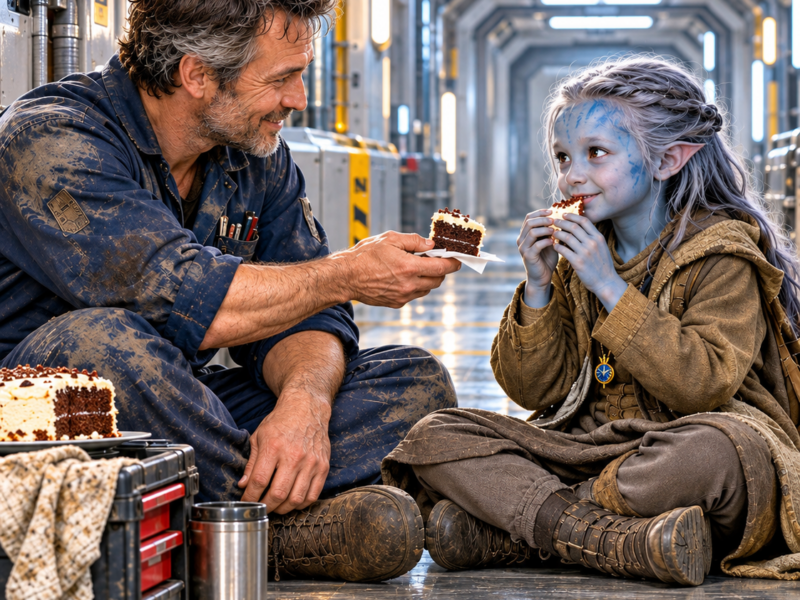
“On my 46th birthday, I was sitting on the cold metal floor of Kelmaro Station, sharing my only slice of homemade cake with a terrified little girl
I looked at Asendra, then at the folded napkin in Vessie’s hands.
For a moment, I thought I’d misunderstood her.
“My family?” I repeated. “Ma’am, my mother was a baker on Earth. She never left the planet as far as I know.”
Asendra didn’t respond immediately.
She glanced at Vessie, who was standing beside her with one hand wrapped around her mother’s fingers.
“Captain Velms, would you take Vessie to the observation corridor with the other officers for a few minutes?”
Vessie looked up.
“But I wanted to say goodbye to Alden.”
“I know, sweetheart. We won’t be long.”
The little girl looked at me as if she needed confirmation that I wasn’t disappearing.
I gave her a reassuring nod.
“I’ll be right here.”
She reluctantly followed the captain.
When their footsteps faded, Asendra turned back toward me.
“May I see the recipe?”
I frowned.
“What recipe?”
“The one your mother used for the cake.”
I laughed a little, mostly from confusion.
“I don’t carry it around with me. It’s in my quarters.”
“Would you be willing to bring it to me?”
There was something in her voice that made me stop smiling.
“Why?”
Asendra lowered her eyes.
“Because the ingredients you described, the particular combination of honey, ground nut seed, and the preparation method, are not common in human cooking.”
“Maybe not, but my mother made it every year.”
“Do you know where she learned it?”
“She said her mother taught her.”
Asendra took a slow breath.
“Then I believe we should talk about your grandmother.”
I leaned back against the maintenance wall.
“My grandmother died before I was born.”
“Did your mother ever tell you where she came from?”
“Earth.”
“Where on Earth?”
“Pennsylvania, mostly. She grew up outside Pittsburgh.”
Asendra nodded slowly.
“And her name?”
“Elena Thresmore.”
The queen closed her eyes.
It was such a small movement, but it carried the weight of someone who had just heard a name she had spent years trying not to forget.
“Elena,” she whispered.
I stared at her.
“You knew my mother?”
“I never met her.”
“Then how do you know her name?”
Asendra looked toward the corridor where Vessie had disappeared.
“Because I knew the woman who gave her that name.”
I felt the cold metal wall against my shoulder.
“You’re going to have to explain that.”
“I will. But not here.”
She glanced toward the open maintenance panel and the diagnostic tablet still lying on the floor.
“Have you finished your shift?”
“No.”
“Then I won’t ask you to abandon your responsibilities. I can arrange a meeting tomorrow, somewhere private, if you’re willing.”
I considered refusing.
I was a maintenance technician. She was the head of a political alliance spanning dozens of inhabited systems.
People like us did not usually have unexplained family conversations in the middle of a station corridor.
But she had recognized my mother’s name.
And I had spent most of my adult life knowing surprisingly little about the woman who had raised me.
“I’ll come,” I said.
Asendra inclined her head.
“Thank you.”
Then she paused.
“One more thing, Alden.”
“Yes?”
“Please don’t assume that whatever I tell you will be easy to hear.”
That night, I barely slept.
I sat at the small counter in my quarters with the remaining cake crumbs on a plate and my mother’s handwritten recipe spread beside them.
The paper was old, softened along the folds.
At the bottom, beneath the measurements, my mother had written something I had never paid much attention to.
For birthdays, departures, and anyone who needs reminding that they have a place at the table.
I had always thought it was simply one of her sentimental notes.
Now I wondered whether it meant something else.
At 0800 the next morning, my communicator displayed an invitation from the royal office.
The meeting would take place in a private conference room overlooking the station’s outer observation ring.
I arrived ten minutes early.
Captain Velms was waiting outside.
“Mr. Thresmore.”
“Captain.”
“Her Highness is expecting you.”
He opened the door.
Asendra stood beside the window, holding a small rectangular case.
There was no crown, no ceremonial clothing, and no entourage.
Just the same woman I’d seen holding her frightened daughter in a maintenance corridor.
“Thank you for coming,” she said.
I took the seat she indicated.
She remained standing for a moment, looking out at the planet below.
Then she placed the case on the table.
“Before I explain anything, I want you to understand that I am not asking you for anything.”
“All right.”
“And I don’t intend to offer you money, a title, or a position in the royal household.”
“That’s good,” I said. “I wouldn’t know what to do with any of those.”
A small smile appeared and vanished.
“I suspected as much.”
She opened the case.
Inside was a photograph.
It showed two young women standing in front of a greenhouse filled with flowering vines.
One was unmistakably Asendra, though considerably younger.
The other was human.
She had dark hair, a narrow face, and a familiar way of smiling that made my throat tighten.
I picked up the photograph.
“That’s my mother.”
“Yes.”
I looked again.
My mother appeared to be in her early twenties.
She wore a simple white shirt, and one hand rested on the shoulder of the young Asendra.
On the back, there was a handwritten inscription.
To my little sister, who keeps forgetting that home is something we build for each other.
I read it twice.
“Why did my mother call you her little sister?”
Asendra sat opposite me.
“Because she was.”
I put the photograph down.
“That’s impossible.”
“Not biologically. But Elena and I were raised together.”
She folded her hands.
“Before I became queen, before the Varing Compact became the political union it is today, my family lived on a colony world called Meridia.”
I listened without interrupting.
“My mother was a diplomat. My father was a physician. We had people working in our household, including a human woman named Clara Thresmore.”
“My grandmother?”
“Yes. She was a medical technician assigned to the colony’s hospital. She became close to my mother during a difficult period in our family’s history.”
Asendra paused.
“When I was nine, my mother became seriously ill. My father was traveling, and I was terrified. Clara spent several nights with me in the medical wing. She told me stories, taught me human games, and made a honey cake whenever I refused to eat.”
I looked down at the photograph.
“That sounds like her.”
“Clara eventually became my mother’s closest friend. When your grandmother had a daughter, she named her Elena.”
Asendra’s expression softened.
“My mother treated Elena as another child in the family. We grew up together for several years. I was older, but not by much. She was my sister in every way that mattered.”
I tried to absorb it.
“Then why did my mother never tell me?”
Asendra’s expression changed.
“She may have intended to.”
“She never mentioned you. Not once.”
“Perhaps she was protecting you. Perhaps she was protecting herself.”
I shook my head.
“That doesn’t explain why she left.”
Asendra looked down at her hands.
“Elena left Meridia after a political crisis.”
“What crisis?”
“An accident at the colony’s atmospheric processing facility. Several workers died. Your grandmother was among those blamed for the failure.”
I sat forward.
“My grandmother caused an accident?”
“No.”
The answer came so quickly that I looked up.
“No,” she repeated. “She was one of the people who tried to prevent it.”
Asendra opened the case again and removed a thin data wafer.
“The official investigation concluded that Clara had ignored a warning in the facility’s maintenance system. The resulting pressure failure killed six workers.”
“That’s what happened?”
“That’s what the official report said.”
She slid the wafer toward me.
“But the report was altered.”
I stared at it.
“By whom?”
“At the time, my father was leading the colony administration. He believed that revealing the truth would destabilize the settlement and destroy his political career.”
Her voice grew quieter.
“He chose to protect the administration rather than the people who had been harmed.”
I felt my jaw tighten.
“And my grandmother?”
“She was dismissed. Her professional credentials were suspended. She and Elena returned to Earth shortly afterward.”
“You’re telling me my grandmother was framed?”
“I’m telling you that I have evidence she was blamed for something she did not do.”
I looked at the data wafer.
“Why didn’t you stop it?”
The question came out harsher than I intended.
Asendra accepted it without flinching.
“Because I was seventeen. Because my father controlled the investigation. Because I believed him when he told me there was nothing I could do.”
She paused.
“And because I was afraid.”
For a moment, the room seemed smaller.
“What happened to your relationship with my mother?”
“We exchanged letters for several years. Then my father discovered them. He ordered the correspondence stopped because he believed Elena’s continued association with our family could become politically embarrassing.”
“And you listened?”
“I was twenty-three. I had just been appointed to my first diplomatic position. I thought I could repair things later.”
She looked at me.
“Later became a very long time.”
I sat silently.
My mother had always been private about her childhood.
When I was young, I had asked why we never visited her family.
She’d told me there wasn’t anyone left.
I remembered her saying it while washing dishes, her back turned toward me.
At the time, I hadn’t questioned it.
Now I wondered how much loneliness had been hidden inside those ordinary words.
“Did she know you became queen?” I asked.
“Yes. I sent her the announcement.”
“Did she reply?”
Asendra shook her head.
“She sent one letter.”
“Can I see it?”
She nodded and removed another item from the case.
The paper had been folded carefully.
I recognized my mother’s handwriting before I even opened it.
Asendra,
I am glad you are alive and that you have found a place in the world where you can do good.
But I cannot bring myself to return to a family that allowed my mother to be destroyed and then called it necessary.
I have a son now. His name is Alden.
I want him to grow up believing that kindness does not require permission from powerful people.
Please don’t contact us again unless you are prepared to tell the truth about what happened to Clara.
Elena.
I read it slowly.
Then I read it again.
My mother had never told me any of this.
I placed the letter on the table.
“She was protecting my grandmother’s name.”
“Yes.”
“And you never answered?”
Asendra looked away.
“I wanted to. But my father had forbidden any reopening of the case. I told myself that waiting until I had enough authority would make the eventual correction more effective.”
“Did it?”
“No.”
The answer was quiet.
“By the time I became queen, Clara had died. Elena had built a life on Earth. And I had spent years convincing myself that silence was patience.”
I looked at the photograph again.
Two young women smiling in a greenhouse.
One of them had become a queen.
The other had raised me in a small house on Earth and baked honey cake every year.
“Why are you telling me now?”
Asendra glanced toward the window.
“Because when Vessie described the cake, she mentioned the taste. She said it reminded her of something she’d eaten when she was very young.”
I frowned.
“She tasted it before?”
“Not this exact recipe. But the traditional honey cake was once served at our family’s annual remembrance gathering. Clara made it every year.”
She opened a second compartment in the case.
Inside was a small metal seal bearing an unfamiliar symbol.
“This belonged to my mother. Clara was given one before she left Meridia.”
She turned it over.
On the back were two engraved words.
Still family.
I felt something move inside my chest.
My grandmother had apparently carried a piece of that family with her.
And my mother had continued making the cake.
All those years, without telling me why.
“Do you have the original investigation records?” I asked.
“Some of them. Others were sealed.”
“Can they be reopened?”
“They can now.”
“Then reopen them.”
Asendra looked at me.
“I intend to.”
I hesitated.
“But I don’t want my grandmother’s name cleared just because you feel guilty.”
Her expression became serious.
“Nor should it be.”
“I want evidence. I want the people who altered the records identified. And I want the families of those six workers to know what really happened.”
Asendra nodded.
“That is exactly what should happen.”
For the first time since entering the room, I felt that we were discussing something larger than a family secret.
There were six people who had died.
There was a woman who had lost her career.
And there was a daughter who had carried a wound she had never fully explained.
I stood.
“Thank you for telling me.”
Asendra rose too.
“I owe your family more than an explanation.”
“Maybe. But let’s start with the truth.”
She nodded.
And for the first time, I saw tears in her eyes.
The investigation took almost four months.
I returned to my maintenance shifts the morning after our meeting.
I didn’t request time off, and I didn’t tell my coworkers that I was suddenly involved in a royal inquiry.
I had no interest in becoming the station’s most interesting gossip.
But I did begin receiving messages from the royal investigation office.
They asked for copies of my grandmother’s employment records, my mother’s old correspondence, and any family documents that might establish Clara’s movements during the final months on Meridia.
My sister Marin was the first person I called.
She listened in silence while I explained everything.
When I finished, she didn’t speak for several seconds.
Then she said, “Mom knew all of this?”
“Apparently.”
“Why didn’t she tell us?”
“I don’t know.”
Marin exhaled.
“Do you remember how she used to get upset whenever someone called her cake an old colony recipe?”
I frowned.
“She said it was our grandmother’s recipe.”
“Yes, but she never let anyone call it a colony recipe. She said it was a family recipe.”
I leaned back in my chair.
“Maybe that’s what she wanted us to remember.”
Marin was quiet.
Then she asked me to send her the photograph.
She called back an hour later, crying.
“That’s Mom,” she whispered. “Look at her smile.”
I looked at the image again.
“Yeah.”
“She looks so young.”
“She was.”
Marin took a shaky breath.
“Do you think she missed them?”
I didn’t answer immediately.
“I think she missed a lot of people.”
Over the following weeks, the investigation uncovered the first major contradiction.
The atmospheric processing facility had suffered a pressure-control failure because an emergency valve had been manually disabled.
The official report claimed Clara had ignored the warning.
But the maintenance logs showed that Clara had submitted three separate repair requests during the previous six weeks.
All three had been marked as completed.
None had actually been performed.
The signatures belonged to a senior administrator named Darius Venn.
He had been responsible for approving maintenance expenditures.
At the time, the colony was facing severe budget restrictions.
Replacing the faulty valve would have delayed a major expansion project.
Venn had chosen to postpone the repair.
When the accident occurred, he altered the records to make it appear that Clara had failed to follow procedure.
The investigation also uncovered an archived communication between Venn and my great-uncle, who had been serving as the colony’s administrative director.
The message was brief.
If Clara’s report becomes part of the public record, the entire expansion contract will collapse. We cannot allow that.
My grandmother had been silenced because the truth threatened a project worth billions.
Six workers had died.
And the woman who had tried to prevent their deaths had been made responsible.
When Asendra called me with the findings, I was standing beside a coolant junction in ring four.
I had grease on my fingers and a wrench in my hand.
I listened without interrupting.
Finally, I asked, “What happens now?”
“The report will be released publicly. The convictions and disciplinary findings against Clara will be formally overturned.”
“And Venn?”
“He is still alive. He will face a criminal investigation for falsifying records and obstructing the original inquiry.”
“What about the families of the workers?”
“We have contacted all six families. The Compact will issue a formal apology and establish compensation for the losses they suffered.”
I closed my eyes.
For years, my grandmother had existed in my mind as a woman who died before I was born.
Now she was becoming someone I could almost picture.
Someone who had stood in a room full of officials and insisted that a dangerous valve needed replacing.
Someone who had tried to do her job properly.
Someone who had lost everything for refusing to sign away her conscience.
“Thank you,” I said.
Asendra was quiet.
“No, Alden. Thank you for refusing to let this become another quiet family matter.”
The official announcement took place on Meridia.
I watched it from Kelmaro Station during my lunch break.
Asendra stood before the old colony assembly building, wearing formal robes and the royal insignia.
Behind her was a large display showing the names of the six workers who had died.
She spoke carefully, without theatrical language.
She explained the original investigation, the falsified evidence, and the decision to restore Clara Thresmore’s professional reputation.
Then she said something that made me put down my cup.
“Clara Thresmore did not fail the people entrusted to her care. The administration failed her, and the families who trusted us.”
She bowed her head.
“I cannot return the years she lost. I cannot return the people who died. But I can refuse to let the lie survive another generation.”
The broadcast ended.
Around me, people in the mess hall returned to their conversations.
Someone complained about the coffee machine.
A technician at the next table asked whether the next maintenance rotation had been posted.
Life continued.
But I sat there for several minutes, staring at the empty screen.
For the first time, my grandmother’s name had been spoken publicly without shame attached to it.
That evening, Marin called.
She had been watching from Earth.
“Mom would have liked that,” she said.
“I think so.”
“She would have pretended not to cry, though.”
I laughed softly.
“She was terrible at pretending.”
We talked about our mother for nearly an hour.
Not just the painful things.
We remembered the little house, the old kitchen, the way she’d hum while measuring flour, and how she’d always cut the first slice of cake crooked.
Marin promised to send me another recipe.
I told her I already had enough cake for one man.
She said that had never stopped Mom.
A week later, Asendra sent another message.
She asked whether I would be willing to attend a small remembrance gathering on Meridia.
It would be held in the greenhouse where she and my mother had once taken the photograph.
I almost declined.
Not because I didn’t want to go, but because I wasn’t sure what I would do when I arrived.
I had never met Asendra before that birthday.
I had no memories of Meridia.
And I had spent most of my life thinking my family history began and ended with two people on Earth.
But Marin encouraged me.
“Go,” she said. “You don’t have to become part of their world. Just go and see where Mom came from.”
So I took four days of leave.
The greenhouse was larger than I’d imagined.
Its glass ceiling curved over rows of flowering plants, and the air smelled of damp soil, citrus, and something sweet I couldn’t identify.
Asendra met me at the entrance.
She wasn’t wearing royal clothing.
She wore a simple dark jacket and held a small paper bag.
“Welcome, Alden.”
“Thank you for inviting me.”
She glanced at the bag.
“I brought something.”
“What is it?”
“Honey cake.”
I smiled.
“Yours?”
“Vessie’s, actually.”
From behind her, the little girl appeared.
She was wearing a blue dress and holding a small mixing spoon.
“I helped,” she announced.
“Should I be worried?”
“Only a little,” Asendra said.
Vessie grinned.
She had changed since the day I’d found her in C19.
She still had the same enormous eyes, but she no longer looked at every adult as though she needed to calculate whether they were safe.
She ran over and hugged me.
“You’re here!”
“I promised I’d come if I could.”
“You came.”
“I did.”
She grabbed my hand and pulled me toward a table near the greenhouse windows.
There were several photographs arranged on it.
One showed Clara.
Another showed my mother.
A third showed Asendra and Elena together as teenagers, laughing with flour on their faces.
I picked it up.
“What happened here?”
Asendra smiled.
“Your mother decided I was measuring the ingredients incorrectly.”
“Was she right?”
“Almost certainly.”
Vessie giggled.
“Mother says you have to be careful with recipes.”
“Your mother is a wise woman,” I said.
Asendra looked at the photograph for a long moment.
“Your mother used to tell me that a recipe was more than instructions. It was a way of remembering someone.”
I set the photograph down carefully.
“She never told me that.”
“Perhaps she didn’t need to. You kept making the cake.”
For a while, we stood together in the greenhouse.
There were other people present, including several families of the workers who had died in the accident.
The gathering wasn’t a celebration.
There were tears, difficult conversations, and moments when people had to step outside because the memories became too heavy.
Asendra spoke with every family.
She didn’t hide behind officials or allow someone else to apologize on her behalf.
At one point, an elderly man approached her.
He had lost his daughter in the processing accident.
He listened to her apology without interrupting.
When she finished, he said, “I don’t know if I can forgive the people who did this.”
Asendra nodded.
“I wouldn’t ask you to.”
“Then what do you want from me?”
“Nothing. You deserved the truth whether you forgive us or not.”
The man looked at her for a long time.
Then he turned toward the photograph of his daughter.
It wasn’t forgiveness.
But it was the beginning of something more honest than the silence he’d been given for decades.
Later, Vessie found me sitting near the greenhouse window.
She had a small plate with two slices of cake.
“Which one is better?” she asked.
“That’s a dangerous question.”
“Mine has more honey.”
“Then yours probably wins.”
She placed a slice beside me.
“Do you still have the napkin?”
I looked at her.
“The one from your birthday cake?”
She nodded.
“Yes. I kept it.”
“Really?”
“It’s in my quarters.”
She looked pleased.
“I thought you might.”
I watched her eat for a moment.
Then she asked, “Do you think your mother would have liked me?”
I set down my fork.
“I think she would have loved you.”
“How do you know?”
“Because she always had room for one more person at the table.”
Vessie considered that.
Then she smiled.
“I think I would have liked her too.”
I looked out through the glass.
The same planet that had turned beneath Kelmaro Station was visible beyond the greenhouse dome, pale blue beneath the afternoon light.
For a long time, I had thought my mother’s cake was simply a way to keep a birthday from passing unnoticed.
Now I understood that it had been carrying something much older.
A family story.
A friendship.
A promise that had survived distance, silence, and years of being misunderstood.
Asendra came to stand beside us.
“Vessie has asked whether we can invite you back next year.”
I looked at the girl.
“Next year?”
“On your birthday,” Vessie said. “We could make cake together.”
I glanced at Asendra.
“I usually work that day.”
“Then perhaps we can plan around your schedule,” she said.
I laughed.
“That’s a very complicated diplomatic negotiation.”
“I have experience with complicated negotiations.”
Vessie raised her hand.
“I can make the cake.”
“That may be the most important part of the agreement,” I said.
We all laughed.
When I returned to Kelmaro Station, I went back to my ordinary maintenance schedule.
The coolant lines still leaked occasionally.
The air scrubbers still clogged.
My supervisor still complained about budget restrictions.
Nothing about the station had become magical.
But something had changed in the way I thought about birthdays.
For forty-six years, I had treated mine as a day to get through quietly.
A slice of cake before work.
Another slice during lunch.
A call from Marin if our schedules happened to line up.
That was enough.
And it still was.
But the following year, on the morning of my forty-seventh birthday, I found a small package outside my quarters.
Inside was a handwritten card from Vessie.
The letters were uneven, and several words had been crossed out.
It read:
Dear Alden,
I remembered your birthday.
Mother says the cake is supposed to be made with the person you want to share it with, so we made one for you.
I hope you aren’t lost in Ring 3 again.
Love, Vessie.
Beneath the card was a photograph of her standing beside Asendra in the greenhouse, holding a slightly lopsided cake.
I laughed so hard that a neighbor opened his door to see what had happened.
Then I carried the photograph inside and placed it beside my mother’s recipe.
That evening, I called Marin.
I told her about the cake, the card, and the photograph.
She listened, then said, “You know, Mom always said that food tastes better when you stop saving it for the perfect occasion.”
I looked at the photograph.
“She was right.”
I didn’t work that birthday.
For the first time in twelve years, I had arranged my schedule so I could take the day off.
I spent the morning making my mother’s honey cake.
I made enough for myself, enough for Marin when she visited, and enough to share with anyone who happened to stop by.
The cake wasn’t perfect.
The edges were a little too dark, and I had probably added more honey than the recipe required.
But when I cut the first slice, I didn’t wrap it in a napkin and save it for later.
I put it on a plate.
Then I set another plate beside it.
Somewhere in the station, a little girl who had once been lost in a maintenance corridor was growing up with a different understanding of what it meant to be important.
And somewhere in the quiet spaces between birthdays, I had learned that family wasn’t always limited to the people whose names appeared on your birth certificate.
Sometimes it was the people who remembered your birthday.
Sometimes it was the people who finally told the truth.
And sometimes it began with a frightened child, a forgotten corridor, and one piece of cake that wasn’t supposed to be shared.
I raised my cup toward the photograph of my mother.
“Happy birthday to me,” I said.
Then I sat down and enjoyed the cake while it was still warm.
The End.









