On her fifth day at Cedar Harbor Naval Medical Center, a senior doctor handed a new nurse a mop and humiliated her in front of 40 people
The conference room at Cedar Harbor Naval Medical Center had never been so quiet.
Senior Chief Bear Lindgren stood at the front of the room, his uniform immaculate, his expression unusually solemn. Beside him sat Coda, the German Shepherd whose arrival had turned an ordinary night shift into something nobody at the hospital would ever forget.
Across the table, Dr. Trevor Ashford stared at the small nurse in oversized blue scrubs.
Paige Sutton stood near the door, her hands folded in front of her.
She had spent six years trying to become invisible.
Now, for the first time since arriving at Cedar Harbor, there wasn’t a single person in the room who wasn’t looking at her.
“Chief Sutton,” Captain Neil Ferrante repeated quietly. “Is everything Senior Chief Lindgren has told us accurate?”
Paige glanced at Bear.
Then she looked down at Coda.
The dog lifted his head and rested his chin against her knee.
“Yes, sir.”
Her voice was barely above a whisper.
Captain Ferrante leaned back.
“Then I think we need to understand why someone with eleven years of service in Naval Special Warfare is working here under an incomplete personnel record.”
Dr. Ashford immediately opened his folder.
“That’s exactly what I’ve been trying to establish, Captain. Her qualifications are unverifiable. She has no documented experience that would justify the actions she took last night. She administered emergency care outside the authority granted to her, disregarded direct orders, and assumed control of a department she does not run.”
Bear turned toward him.
“Doctor, you were standing there when she saved Hayes.”
“I was attempting to coordinate a trauma response.”
“You were telling her to stop.”
Ashford’s jaw tightened.
“Because she was a probationary nurse.”
Bear looked at him for several seconds.
“Then perhaps you should ask yourself why a probationary nurse was the only person in that ambulance bay who understood what needed to happen.”
“That’s enough,” Captain Ferrante said.
He closed the folder.
“Doctor Ashford, I will review the incident separately. For now, I want to hear from Nurse Sutton.”
Paige swallowed.
“Captain, I don’t want special treatment because of something I did years ago.”
“Nobody is offering you special treatment.”
“Good. Because the patients last night didn’t need my old rank. They needed someone to help them.”
For a moment, Bear almost smiled.
That was the Paige he remembered.
Not the decorated corpsman. Not the call sign Sparrow.
The woman who had always been more concerned with the person in front of her than with what anyone thought of her.
But the captain wasn’t finished.
“Then tell me why you left.”
Paige’s expression changed.
Her fingers tightened around each other.
The question opened a door she had kept locked for six years.
And behind it was a cold hillside, a dying man, and a promise she had never managed to forget.
Six years earlier, Paige Sutton had been a different person.
She was twenty-nine, physically stronger than most people realized, and accustomed to operating in places where a mistake could cost several lives.
Her official designation was Chief Hospital Corpsman.
Her teammates called her Sparrow.
The nickname had started as a joke.
She was small, quiet, and rarely spoke unless she had something important to say. During training, some of the larger operators had wondered how someone her size could carry medical equipment over difficult terrain.
They stopped wondering after the first field exercise.
Paige had learned early that confidence wasn’t the same as competence.
She didn’t need to announce what she could do.
She simply needed to do it when the moment arrived.
Her work with Naval Special Warfare involved providing medical support in dangerous environments. She had treated injuries far from hospitals, stabilized wounded teammates, and learned how to make decisions when there was no time to wait for someone else.
She had also learned that the most important part of emergency medicine wasn’t the equipment.
It was recognizing that someone needed help before everyone else realized how serious the situation had become.
Senior Chief Eli Marsh understood that about her.
He was a broad-shouldered man with a dry sense of humor and a habit of checking on everyone else before looking after himself.
He had served alongside Bear Lindgren for years.
When Paige joined their operational circle, Eli became one of the first people to treat her like a teammate rather than someone who needed protecting.
“You know what your problem is, Sparrow?” he once asked her during a quiet moment after training.
Paige looked up from her medical kit.
“What?”
“You think being quiet means nobody notices you.”
She raised an eyebrow.
“Is that a problem?”
“Only when people mistake quiet for weak.”
He smiled.
“Don’t help them make that mistake.”
Paige never forgot those words.
Eli had a German Shepherd named Coda.
The dog was trained to work alongside military personnel and had developed a particularly strong bond with his handler.
Coda was serious on duty, playful when the work was finished, and remarkably protective of Eli.
He tolerated most people.
He trusted very few.
But he trusted Paige.
She had treated a minor injury on his shoulder during a training exercise, and from that day forward, the dog seemed to consider her part of his small circle.
Whenever Paige entered the training area, Coda would approach her and wait for her to scratch the spot behind his left ear.
Eli pretended to be offended.
“He’s supposed to be my dog.”
Paige laughed.
“Maybe he has better judgment than you.”
“Careful, Sparrow. I can still assign you the worst watch.”
Those were ordinary days.
They didn’t know how much they would miss them.
The mission that changed everything happened on a cold hillside six years before the storm at Cedar Harbor.
The details remained classified.
Paige remembered the weather more clearly than anything else.
Cold wind.
Damp earth.
The distant sound of aircraft.
And the strange silence that followed when the immediate danger had passed.
Their team had suffered casualties.
Several men were wounded, and the situation required rapid medical treatment while evacuation arrangements were being coordinated.
Paige moved between them, assessing injuries and helping the team prioritize care.
She remembered Bear calling for additional medical supplies.
She remembered the sound of Coda barking somewhere nearby.
And she remembered finding Eli.
He was badly wounded.
Paige dropped beside him immediately.
“Eli, look at me.”
His eyes found hers.
She began working to stabilize him.
Her training took over, guiding her through the familiar sequence of assessments and decisions.
But she knew the injury was serious.
She continued anyway.
There was no room for despair.
Not while he was still alive.
Eli reached for her hand.
“Sparrow.”
“Don’t talk. Save your strength.”
He gave her a faint smile.
“Still giving orders.”
“Somebody has to.”
His expression softened.
For a brief moment, the noise around them seemed distant.
“Bear?”
“He’s coming.”
“Good.”
Paige continued working.
She had seen men recover from injuries that initially seemed impossible. She had also seen people die despite every reasonable effort.
She refused to decide which outcome was coming.
Eli’s condition continued to deteriorate.
Paige stayed with him until the medical team arrived and took over the evacuation effort.
But the damage was too severe.
Senior Chief Eli Marsh died before he could be transported to definitive care.
Paige remained beside him for several moments.
She had treated countless wounded people.
She had delivered difficult news.
She had watched teammates grieve.
But losing Eli felt different.
He had been more than a colleague.
He had been a friend who understood the quiet parts of her.
Coda approached slowly.
The dog was shaking.
He pressed his nose against Eli’s shoulder, then looked at Paige.
She reached out and held the side of his face.
“I’m sorry, buddy.”
Coda whined.
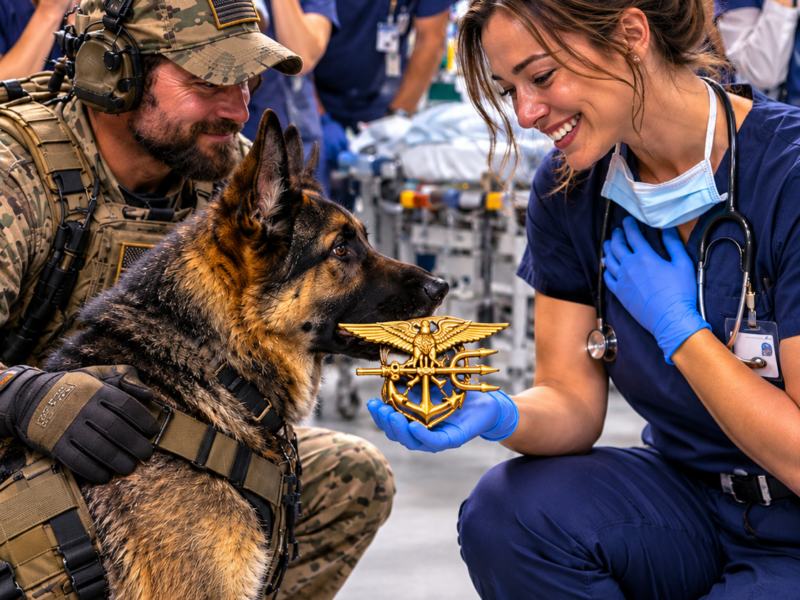
Paige looked down at the golden Trident attached to Eli’s uniform.
The insignia represented years of service, sacrifice, and belonging to a brotherhood that had shaped his life.
She carefully removed it.
For a moment, she held it in her palm.
Then she attached it to Coda’s harness.
The dog stood still.
Paige leaned close to him.
“Take him home.”
It wasn’t a command that could bring Eli back.
It was a promise that the part of him that remained would not be abandoned.
When the evacuation team arrived, Coda was taken with the surviving personnel.
Paige watched until the dog disappeared from sight.
She never saw him again.
Not until the night he walked into Cedar Harbor.
The months after the mission were difficult.
The official records documented what needed to be documented.
The people who had been there remembered what the reports could never fully describe.
Paige continued serving for a time.
She returned to medical duties, completed assignments, and performed her responsibilities.
But something had changed.
She found herself avoiding conversations about the mission.
She became uncomfortable when people praised her.
The number of lives she had helped save seemed less important than the names of those she couldn’t bring home.
Bear noticed the change.
He tried speaking with her more than once.
Sometimes she answered.
Sometimes she simply nodded.
Eventually, Paige requested a transfer away from operational duties.
Her decision was accepted.
Her service record remained intact, but sensitive portions of her work were restricted.
She spent time away from the environment that had defined most of her adult life.
She eventually left active operational service.
For a while, she didn’t know what she wanted to do.
She considered leaving medicine altogether.
But whenever she imagined a life without caring for people, she felt as though she would be abandoning the one thing she still understood.
So she returned to nursing.
She studied, completed the necessary civilian requirements, and began rebuilding her career.
It wasn’t easy.
Her old experience didn’t automatically translate into civilian hospital employment.
Some credentials required additional verification.
Some records could not be released through ordinary channels.
She had to start over in ways that felt almost absurd after everything she had done.
She accepted it.
She didn’t want anyone hiring her because of a military title.
She wanted to work.
Eventually, she applied to Cedar Harbor Naval Medical Center.
She submitted the documentation she was authorized to provide.
The hospital processed her civilian qualifications and placed her in a probationary nursing position.
Her file looked incomplete.
To someone unfamiliar with the restrictions surrounding her previous service, it looked suspicious.
Paige didn’t argue.
She thought the best way to establish herself was to do the job.
She had no intention of telling everyone about her past.
She didn’t want special attention.
She wanted ordinary days.
She wanted patients who needed help and colleagues who treated one another with respect.
Most importantly, she wanted to stop remembering the hillside.
But memories don’t always disappear because someone changes their uniform.
Back in the conference room, Paige finished explaining the circumstances surrounding her departure.
Nobody interrupted.
Even Dr. Ashford had stopped turning pages in his folder.
Captain Ferrante studied her.
“Why didn’t you tell us any of this when you were hired?”
Paige considered the question.
“Because I wasn’t applying for a position as a former service member, sir. I was applying for a nursing job.”
“Your previous experience could have been relevant.”
“Some of it is. Some of it isn’t transferable to this setting. I didn’t want people making assumptions about what I could do because of a title.”
Bear looked at her.
He understood.
Paige had never wanted her past to become the center of every conversation.
Captain Ferrante nodded slowly.
“That’s a reasonable answer.”
Then he turned toward Ashford.
“Doctor, do you have anything further to add?”
Ashford looked down at the folder.
For the first time, the confidence that usually filled his expression had disappeared.
He had built his reputation around being the most knowledgeable person in the emergency department.
He was used to people listening when he spoke.
He was also used to believing that experience gave him the right to judge others quickly.
The night before had challenged that belief.
But pride was difficult to surrender.
“I still believe proper procedures matter,” he said.
“They do,” Ferrante replied.
“An emergency department cannot function if everyone decides to do whatever they want.”
“Agreed.”
“Then we cannot simply overlook what happened.”
“We won’t.”
The captain paused.
“But we will examine the circumstances honestly. That includes your conduct.”
Ashford stiffened.
“My conduct?”
“Yes. I have statements from staff members describing your public treatment of Nurse Sutton before the emergency. I also have reports concerning your instructions during the rescue.”
Ashford opened his mouth.
Ferrante raised one hand.
“Last night, you had a nurse capable of responding to a life-threatening emergency. Instead of assessing the situation and supporting the response, you attempted to silence her. During the power failure, you failed to provide effective leadership while patients and staff were in danger.”
“I was waiting for the generator.”
“And she was moving patients.”
The captain closed his folder.
“Effective immediately, you’re relieved of your position as chief of emergency medicine pending a formal review.”
Lorraine Keating, seated near the end of the table, looked down.
Her coffee cup slipped from her fingers.
It struck the floor and shattered.
Nobody moved to help her.
Ashford stared at the captain.
“You cannot be serious.”
“I am.”
“This is based on one night.”
“No, Doctor. It is based on what that night revealed.”
The meeting ended shortly afterward.
Ashford left without looking at Paige.
She didn’t celebrate.
She didn’t feel victorious.
She simply watched him walk out and wondered whether he had finally understood what he had done.
The next morning, Cedar Harbor looked different.
The storm had passed.
Sunlight came through the windows, illuminating the same corridors where Paige had been mocked only hours earlier.
The mop was gone.
Someone had returned it to the housekeeping closet.
But the memory of that moment remained.
The staff had gathered near the central nurses’ station.
The young resident who had run for the AED stood with them.
His name was Daniel Price.
He was in his second year of residency and had spent much of the previous night replaying the events in his head.
He had seen Hayes stop breathing.
He had seen Paige begin CPR.
He had seen Dr. Ashford shout at her.
And he had seen how quickly the situation changed when someone finally gave clear instructions.
Daniel approached her.
“Nurse Sutton?”
Paige turned.
“Yes?”
“Could I ask you something?”
“Of course.”
He looked uncomfortable.
“Last night, when Hayes stopped breathing, I froze.”
Paige said nothing.
“I knew what to do in theory. I’d studied it. I’d practiced it. But when it happened in front of me, I couldn’t move.”
He swallowed.
“You didn’t hesitate. How?”
Paige looked at him carefully.
She recognized the expression.
It was the face of someone who believed a moment of fear had revealed something terrible about his character.
She had worn that expression herself.
“Daniel, being afraid doesn’t mean you’re incapable.”
“But I should have done something.”
“Yes. And next time, you need to know what to do.”
He nodded.
“Will you teach me?”
Paige smiled faintly.
“Of course.”
She walked with him toward the training room.
There, she reviewed the basics of responding to a drowning emergency.
She explained the importance of scene safety, emergency activation, opening the airway, and recognizing abnormal breathing.
She discussed rescue breaths and CPR, emphasizing that drowning-related cardiac arrest requires particular attention to oxygenation.
She reminded him not to waste time attempting to drain water from the lungs.
She showed him how to use the training AED and explained how the machine guides rescuers through its instructions.
Daniel practiced.
His first attempt was awkward.
His second was better.
By the third, he was moving with more confidence.
Paige watched him carefully.
“Don’t confuse speed with panic,” she told him. “You want deliberate actions. Clear decisions. If you don’t know something, ask for help. But don’t stand there waiting for someone else to notice the emergency.”
Daniel nodded.
“Understood.”
She placed a hand on his shoulder.
“Everyone starts out afraid. The trick is to learn enough that fear doesn’t stop you from helping.”
He smiled.
For the first time that morning, he looked relieved.
Meanwhile, Hayes was recovering in a monitored room.
The medical team continued evaluating him after the near-drowning event.
Paige had been right to insist on observation.
Even when someone begins breathing again after being rescued from the water, complications can develop later.
His oxygen levels, breathing, and overall condition needed careful monitoring.
By noon, he was awake enough to speak.
Coda was lying beside his bed.
The dog had refused to leave.
A staff member had tried to move him earlier, but Bear had explained that Coda was a trained military working dog and was not likely to cooperate unless he trusted the person asking.
Paige entered the room carrying a chart.
“Good afternoon, Hayes.”
He turned his head.
For a moment, he looked confused.
Then his eyes settled on her.
“Sparrow?”
Paige stopped.
“That’s not my name here.”
He gave a weak laugh.
“Senior Chief told us stories.”
“Bear talks too much.”
Hayes smiled.
“I thought you were a legend.”
“I’m a nurse.”
“Sure.”
He glanced toward Coda.
“That dog hasn’t left me alone since they brought me in.”
Paige moved closer.
“He worries.”
“About me?”
“About everyone.”
Hayes scratched Coda behind the ears.
The dog closed his eyes.
“He’s got good taste in people,” Hayes murmured.
Paige checked his monitor and reviewed his condition.
“You need to rest. Don’t try to prove anything today.”
“Yes, Chief.”
She gave him a look.
He laughed, then coughed.
“Sorry.”
“Save your energy.”
Before leaving, she paused beside the bed.
“Hayes?”
He looked up.
“Thank you.”
He frowned.
“For what?”
“For coming back.”
His expression softened.
Then he reached down and touched Coda’s harness.
“We’re all glad you did.”
Later that afternoon, Paige walked through the emergency department.
The atmosphere was quieter than usual.
Not because the hospital had suddenly become peaceful, but because something in the staff had shifted.
People greeted her.
Some smiled.
Others simply stepped aside to let her pass.
Nobody called her weak.
Nobody made jokes about her oversized scrubs.
Lorraine Keating stood near the medication station.
When Paige approached, Lorraine looked uncomfortable.
“Nurse Sutton?”
“Yes?”
“I wanted to apologize.”
Paige stopped.
Lorraine glanced down at her hands.
“I saw what happened when Dr. Ashford mocked you. I knew it was wrong. I should have said something.”
Paige waited.
“I laughed,” Lorraine continued. “I didn’t think about how humiliating it must have been. I just went along with everyone else.”
Her voice became quieter.
“I’m sorry.”
Paige studied her.
For a moment, she remembered the crowded hallway.
The laughter.
The mop.
The feeling of being reduced to a joke.
But she also remembered how easily fear and silence could turn ordinary people into participants in someone else’s cruelty.
“Thank you for saying that,” Paige replied.
Lorraine looked up.
“Can we start over?”
“We can start by treating everyone who works here with respect.”
Lorraine nodded.
“I’d like that.”
Paige continued down the hall.
She didn’t need an elaborate apology.
She needed the workplace to become better than it had been.
Dr. Ashford’s apology came later.
It happened in the same hallway where he had humiliated her.
He stood near the central desk, waiting until Paige finished speaking with another nurse.
When she turned, he approached.
Several staff members noticed.
He looked uncomfortable.
“Nurse Sutton.”
“Doctor.”
He took a breath.
“I owe you an apology.”
Paige remained still.
“I treated you disrespectfully. I used your appearance and your quiet manner to embarrass you in front of the staff. I had no justification for doing that.”
His voice was stiff, but the words were clear.
“I was wrong.”
For several seconds, neither spoke.
Then he added something else.
“I also made assumptions about your abilities without taking the time to understand your experience.”
Paige looked at him.
“Yes, you did.”
Ashford nodded.
“I understand that saying sorry doesn’t undo what happened.”
“No, it doesn’t.”
He seemed surprised by her answer.
She continued.
“But it can be a beginning. What matters is what happens next.”
He lowered his eyes.
“I understand.”
Paige gave him a small nod.
That was all.
She didn’t forgive him because he was embarrassed.
She didn’t need to punish him to prove she was strong.
His professional future would be decided through the hospital’s review process.
Her responsibility was to continue caring for patients.
And she intended to do exactly that.
A few days later, Captain Ferrante asked Paige to meet him in his office.
Bear was there too.
Coda sat beside the door.
The captain gestured toward a chair.
“Please sit.”
Paige did.
“I’ve reviewed the initial findings from the storm response. I’ve also received confirmation of your previous service.”
She nodded.
“I understand that some portions of your record cannot be made available through ordinary hospital channels. We can work with the appropriate offices to verify the credentials necessary for your current position.”
“Thank you, sir.”
Ferrante studied her.
“I also want to discuss something else.”
He placed a document on the desk.
“Your actions during the blackout demonstrated considerable leadership. Your ability to organize the evacuation, coordinate with the SEAL personnel, and prioritize patient care was exceptional.”
Paige looked at the paper.
“What is this?”
“A recommendation.”
“For what?”
“An expanded clinical leadership role. We have a shortage of people who can remain calm during complicated emergencies and help others function effectively.”
Paige shook her head slightly.
“Captain, I appreciate that, but I don’t want a position because of one night.”
“Then don’t accept it because of one night.”
He leaned forward.
“Accept it if you believe you can help make this department better.”
Paige considered the offer.
She had spent years avoiding leadership because leadership reminded her of the people she had lost.
But perhaps she had been thinking about it the wrong way.
Being responsible for others didn’t mean she had to return to the past.
It meant she could use what she had learned to help the people standing in front of her.
“I’d be willing to discuss it,” she said.
Ferrante smiled.
“That’s all I’m asking.”
Bear looked pleased.
After the captain finished speaking, he walked Paige toward the door.
For a while, neither said anything.
Then Bear spoke.
“You know, Eli would have liked seeing you here.”
Paige stopped.
The words landed harder than she expected.
“I wish he could have.”
“Me too.”
Bear looked down at Coda.
“That dog has been carrying his memory around for six years.”
Paige crouched and scratched the German Shepherd behind his ear.
Coda leaned into her hand.
“He’s older,” she whispered.
“Getting there.”
“He still has that same look.”
Bear smiled sadly.
“He still thinks he’s in charge.”
Paige laughed softly.
It was the first time she had laughed without feeling guilty about it in a long while.
Two days later, Bear invited Paige to visit the old pier.
The storm had left debris along the shoreline.
Several sections of the wooden walkway needed repair, and the water still carried the gray color of the previous night’s weather.
But the morning itself was beautiful.
The lake stretched toward the horizon.
Sunlight reflected across the surface.
Hayes came along in a wheelchair, accompanied by a member of the medical staff who had cleared him for the short outing.
He was still recovering.
His movements were slower than usual, but his color had improved.
Coda walked beside him.
The dog kept looking toward the water as if remembering the storm.
At the end of the pier stood a small gray memorial stone.
It was simple.
No grand monument.
No elaborate decoration.
Just the name of a man who had mattered deeply to the people standing there.
Senior Chief Eli Marsh.
Paige approached slowly.
She had not expected to feel so nervous.
She knelt beside the stone and placed one hand against its cool surface.
For a long time, she said nothing.
Bear stood several feet behind her.
Hayes lowered his head.
Coda sat beside Paige.
The wind moved through the dog’s fur.
Finally, Paige reached into her pocket.
The golden Trident rested in her palm.
She turned it over.
On the back were the same scratched initials and words she had read during the storm.
EM.
Hold the line.
She remembered the hillside.
Eli’s voice.
The promise.
And the way Coda had looked at her when the evacuation crew carried him away.
She placed the insignia against the stone.
“I kept my promise, Eli.”
Her voice trembled.
“I got him home.”
Coda pressed his nose against her hand.
Paige looked at him.
“You did your part, buddy.”
Then she stood and carefully attached the golden insignia to Coda’s new harness.
It rested over his chest.
Bear watched the gesture.
“You’re giving it back?”
Paige nodded.
“It belongs with him.”
Bear looked at the insignia.
“Eli would have wanted you to keep it.”
“Maybe.”
She adjusted the harness so the gold sat securely.
“But Coda carried it all this time. He deserves to wear it.”
The dog looked up at her.
For a moment, it seemed as though he understood.
Bear turned toward the lake.
His jaw tightened.
“Eli was the best man I ever served with.”
Paige stood beside him.
“I know.”
“He trusted you more than anyone.”
“I trusted him too.”
Bear was quiet.
Then he said something he had been thinking about since the night Coda found her.
“There’s a place for you on my team, Paige. If you ever want to come back, we can make it happen.”
She looked at him.
The offer was sincere.
It was also something she could never have imagined hearing again.
For a moment, she considered what returning might mean.
The familiar environment.
The people who understood her past.
The work that had once defined her life.
But then she looked back toward the hospital.
She thought about Daniel learning CPR.
She thought about Hayes breathing on his own.
She thought about the frightened patients who had reached for her hand during the blackout.
And she realized something.
She didn’t have to return to the life she had left in order to honor the people who had been part of it.
“Thank you, Bear.”
He nodded.
“But I think I’m where I need to be.”
“Are you sure?”
She smiled.
“If someone comes through those doors drowning, bleeding, or terrified, I want to be there.”
Bear looked at her for a long moment.
Then he nodded.
“That’s a mission worth keeping.”
The following Monday, Paige returned to work.
She wore the same blue scrubs.
They were still a little too large.
Her hair was still tied back.
Her name tag still read:
PAIGE SUTTON — REGISTERED NURSE.
But something had changed.
She no longer walked through the emergency department with her eyes fixed on the floor.
She greeted the security guard.
She asked the housekeeping staff how their morning was going.
She stopped to help a new nurse who was struggling with a supply cart.
Nobody made a big announcement about her return.
Nobody organized a ceremony.
And Paige preferred it that way.
The department continued its work.
Patients arrived.
Phones rang.
Monitors beeped.
The ordinary emergencies of an ordinary hospital never stopped.
But the people who worked there had learned something important.
A person’s value couldn’t be measured by how loudly they spoke, how confidently they carried themselves, or how impressive their personnel file appeared.
Sometimes the most capable person in the room was the one nobody had bothered to understand.
Daniel approached Paige later that morning.
“Chief Sutton?”
She looked at him.
“Daniel, if you keep calling me that, people are going to think I’m in charge.”
He smiled.
“Sorry. Nurse Sutton?”
“Better.”
“I practiced the rescue sequence again.”
“Good.”
“I think I finally understand what you meant.”
“What did I mean?”
He considered his answer.
“That knowing what to do isn’t enough if you don’t move when someone needs you.”
Paige nodded.
“Exactly.”
Daniel glanced toward the training room.
“Would you help me teach the other residents?”
“Of course.”
They walked away together.
And for the first time in a long while, Paige felt something she hadn’t expected.
Purpose without pain.
That afternoon, Hayes was discharged from the hospital after completing his evaluation and recovery.
Bear came to collect him.
Coda accompanied them.
Before leaving, Hayes stopped near the emergency department.
He found Paige reviewing a patient’s chart.
“Hey, Sparrow.”
She looked up.
“You’re supposed to be resting.”
“I’m going home. That’s different.”
She smiled.
“Take care of yourself.”
Hayes nodded.
Then he looked at Coda.
“Come on, partner.”
The dog didn’t move.
He was watching Paige.
Bear sighed.
“Apparently, we have a problem.”
Paige crouched.
“Go on, Coda.”
The German Shepherd approached and placed his head against her shoulder.
She wrapped her arms around his neck.
“You’re a good boy.”
Coda made a soft sound.
For six years, he had carried the memory of Eli Marsh.
He had carried the golden insignia through the storm.
And somehow, when he found Paige, he had brought a piece of her old life back with him.
Paige kissed the top of his head.
“See you soon.”
This time, when Coda turned away, she didn’t feel as though she was losing him.
She knew where he belonged.
And she knew where she belonged too.
The first sunny afternoon after the storm, Coda returned to Cedar Harbor with Bear.
They had come to check on Hayes and deliver some paperwork.
The dog sat outside the sliding entrance, the golden Trident gleaming against his chest.
Inside, Paige was helping an elderly patient walk down the hallway.
She was moving slowly, matching the patient’s pace.
The woman held her hand tightly.
“Are you going to be here tomorrow?” the patient asked.
Paige smiled.
“Yes, ma’am.”
“Good. I like having you around.”
“Then I’ll see you tomorrow.”
When Paige finally stepped outside, Coda stood immediately.
His tail began to move.
She crouched and held out her hand.
The dog walked straight toward her.
Behind him, Bear watched from the parking area.
He smiled.
There was no ceremony.
No speech.
No audience.
Just a nurse, a German Shepherd, and a gold insignia that had traveled through six years of grief before finding its way home.
Paige touched the Trident.
Then she looked at Coda.
“Still keeping an eye on me?”
The dog wagged his tail.
She laughed.
And when she returned to the hospital, she walked through those doors with her head held high.
She had not forgotten the people she lost.
She had not erased the past.
She had simply found a way to carry it without letting it decide who she could become.
Dr. Ashford’s lesson about looking at the patient had turned out to be more important than he ever understood.
Because Paige had always looked at the patient.
Even when nobody looked at her.
And that was what made her extraordinary.
She never needed the room to know her rank.
She only needed someone in that room to need help.
The End.









