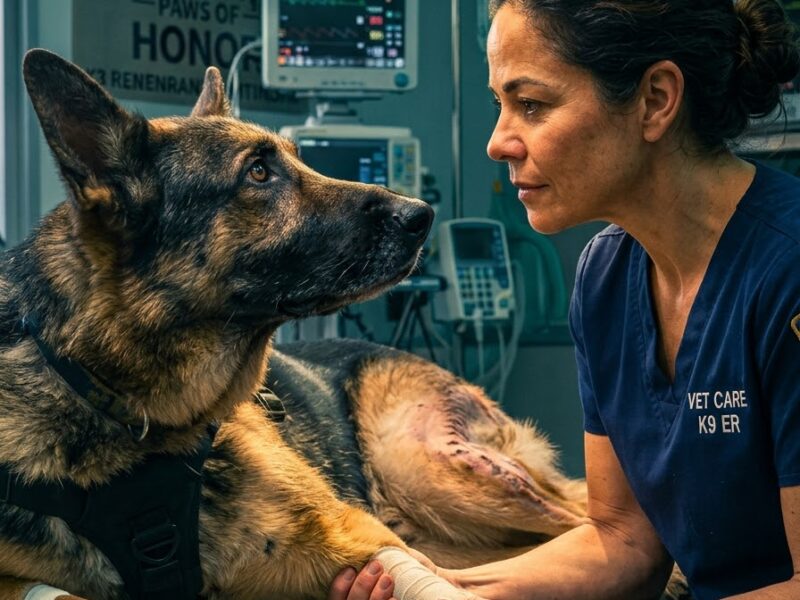
Nobody wanted the broken military K9 at Fort Liberty, and when I knelt beside his bloodstained kennel
Nobody wanted the broken military K9 at Fort Liberty. Standing outside the rusted chain-link enclosure of Kennel 4, I could smell the harsh tang of antiseptic masking the deeper, older scents of damp concrete, sweat, and copper. When I knelt beside his bloodstained kennel, the commanding officer, Colonel Vance, coldly told me to stop wasting time on a dog that would never serve again. Vance didn’t even slow his pace as he marched down the breezeway, his polished jump boots clicking rhythmically against the stone, completely unaware that the animal’s final mission had exposed a dark secret someone powerful wanted buried.
The dog’s name was Duke. He was a seven-year-old German Shepherd whose once-majestic coat was now matted, dull, and marred by jagged silver scars. His left ear was torn near the tip, his right eye had a cloudy, milky haze from an old blast injury, and a deep limp made every single step look like agonizing labor. He sat entirely alone in the far corner of the shadowed cell, his rear wedged into the angle where two cinderblock walls met. He refused his food bowls—untouched mounds of dry kibble sat rotting in the corner—and he flinched violently, flattening his skull against the floor, whenever anyone so much as brushed a hand near the mesh wire.
“He’s done,” Sergeant Miller, the chief kennel handler, told me softly as he rested his heavy forearms on the crossbar. Miller’s face was drawn with exhaustion, deep dark circles carved beneath his eyes. “He hasn’t responded to a single handler in three months, Specialist. No eye contact, no drive, no obedience. He just stares at the back wall like he’s waiting for a bullet. Command signed off on his medical discharge. In forty-eight hours, they’re putting him down.”
I didn’t answer right away. I crouched low beside the gate, lowering my center of gravity, keeping my hands resting flat on my own knees so I appeared as small and non-threatening as possible. “Then I won’t ask him to respond,” I whispered.
Duke didn’t look at me. His good eye remained fixed on a patch of peeling grey paint near the floor drain. His breathing was rapid, shallow, and ragged, the desperate panting of an animal trapped in a perpetual flashback.
I unzipped my tactical jacket, pulled out a small, faded wool blanket from my duffel bag, and placed it quietly on the cold concrete floor just outside his door. I sat down on it, crossed my legs, and pulled my knees into my chest.
For nearly an hour, I said nothing. The air grew colder as the sun dipped behind the pines surrounding the base, casting long, razor-sharp shadows across the motor pool. Handlers came and went, keychains jingling, boots crunching on gravel, but I remained motionless. Duke remained frozen.
Then, almost unconsciously, I began humming a slow, rhythmic lullaby—a song my father used to sing to my brother and me on our porch in eastern Tennessee when the summer storms rolled over the mountains. It was an old Appalachian ballad, low and repetitive.
Duke’s ears moved. Just slightly. The torn left ear twitched forward, angling toward the sound.
I stopped humming instantly, freezing my breath in my throat.
Slowly, agonizingly, his heavy head lifted from the concrete. The milky glaze of his right eye caught the fading orange light, and for the first time in weeks, the ghost of Kennel 4 looked directly at someone. He didn’t growl. He didn’t flinch. He just watched me with a profound, crushing sorrow that felt intensely human.
The next morning at 0500, I returned to the kennels. When I turned the corner into the hallway, I caught my breath. Duke wasn’t cowering in the corner. He was standing right beside the kennel door, his nose pressed against the lower wire gap, waiting.
Colonel Vance walked in five minutes later, flanked by two sidearms-wearing MPs. He paused, his sharp grey eyes flicking from me to the dog, his jaw tightening into a hard, rigid line. “Don’t get attached, Specialist Vance,” he warned, his voice like grinding stones. “The final medical evaluation is tomorrow morning. He’s operational dead-weight.”
“I understand, sir,” I replied, standing at attention. But I had already started asking questions—questions that felt like pulling at loose threads on a frayed uniform.
Why did Duke panic into a thrashing frenzy whenever a UH-60 Black Hawk flew over the airfield? Why did he wake up whining and biting at his own hindquarters whenever someone accidentally brushed against his left shoulder? And most importantly, why did his official veterinary and service records contain a complete, unredacted six-month gap between October and March of last year?
That afternoon, I brought his file to the administrative clerk at the base logistics center, requesting the full mission deployment log linked to his handler identification tag. The clerk typed for ten seconds before a bright red security wall flashed across his screen. Before I could read the header, the office door swung open, and Colonel Vance stepped inside, taking the printed paper directly out of the tray.
“That’s classified, Specialist,” Vance said coldly, crumpling the paper in his fist. “Return to your assigned duties immediately.”
That night, well past midnight, I snuck back into the dimly lit kennel wing. The facility was quiet, saved for the occasional bark of a younger patrol dog down the hall. As I approached Duke’s cell, I heard a rhythmic, frantic scraping sound.
Duke was on his knees, his front paws furiously digging at the rear corner of his enclosure, tearing away at the thin rubber bedding he had dragged over from his sleeping pad. I unlocked the gate with a master key I’d borrowed from Miller’s office and knelt beside him.
“Easy, boy. Easy,” I breathed.
Duke didn’t snap. He moved aside, whining softly, nudging my hand with his cold nose toward a loose section of the wall baseboard. Hidden beneath the edge of the rubber flooring was a thin, rectangular metal plate, roughly the size of a dog tag, tucked into a hairline crack in the mortar. It was covered in dried grime.
I pried it loose with my pocketknife. It was an old aluminum serial plate, stamped with an alphanumeric sequence: DEV-9904-BK.
My hands shaking, I pulled out my secure military tablet, logged into the restricted maintenance registry, and ran the serial number. My stomach tightened into a hard, cold knot as the database loaded a archived file that hadn’t been fully purged from the local server.
Duke had been deployed six months earlier during an unsanctioned, off-the-books extraction operation in a mountainous border region of Niger. His entire six-man Special Forces team had been listed as killed or missing in action following a devastating ambush.
Except one soldier.
I scrolled down to the bottom of the manifest. A single line of text had been struck through, the digital print blurred, the soldier’s name quietly removed from the final public casualty report given to the press.
My chest caved in. I knew that service number. I had memorized it when I was fifteen years old.
It belonged to Staff Sergeant Thomas Vance—my older brother.
He had reportedly died overseas three years earlier in an entirely different theater of war—or at least, that was what the Department of Defense had told my family when they delivered a closed casket to our doorstep in Tennessee.
The air in the kennel room felt instantly suffocating, thick with the scent of old damp concrete and the phantom stench of betrayal. I stared at the glowing tablet screen, my eyes burning as I read my brother’s name over and over again. Thomas hadn’t died three years ago in a routine convoy accident in Iraq. He had been alive six months ago, breathing, fighting, and leading a unit alongside this broken dog in a dusty gorge halfway across the world.
Duke nudged my knee, his wet nose pressing hard against my forearm, bringing me back from the edge of a panic attack. I closed the tablet, shoved the metal plate deep into my pocket, and sat on the floor with my back against the wall, wrapping my arms around the dog’s thick neck. He leaned his entire weight into me, letting out a long, shuddering sigh that shook his entire frame.
The following morning, the atmosphere in the facility changed drastically. Two armed Military Police officers were posted at the entrance of the kennel barn, their hands resting casually near their sidearms. When I stepped into Duke’s cell to prepare him for his scheduled evaluation, he refused to move more than an inch from my left leg. He moved like a shadow, his head low, his cloudy eye fixed entirely on the main corridor.
Footsteps echoed off the high rafters. Colonel Vance walked in, accompanied by a civilian contractor wearing a dark tactical polo and carrying a stainless-steel medical kit.
The moment Colonel Vance crossed the threshold, Duke changed.
The docile, grieving animal vanished. The fur along Duke’s spine erupted into a violent ridge. His lip pulled back over yellowed teeth, exposing gums dripping with saliva, and a low, guttural growl vibrated deep within his chest—a sound so filled with pure, unadulterated hatred that even the two MPs outside reflexively reached for their holsters.
“What’s he reacting to?” I asked, standing my ground, though my heart was hammering against my ribs like a trapped bird. I looked straight into Vance’s eyes.
The Colonel’s face hardened, turning a ghostly, chalky shade of grey before he quickly masked it with an expression of cold authority. “He’s rabid. Brain damage from the concussive blast in the field. He’s unpredictable and dangerous.” He turned to the contractor. “Prepare the lethal injection. We’re ending this now. No evaluation.”
“No!” I stepped directly between Colonel Vance and the dog. “He’s not rabid, sir. He’s reacting to you.”
“Step aside, Specialist,” Vance sneered, his voice dropping an octave, razor-sharp with an explicit threat. “You are bordering on insubordination. You don’t know what you’re interfering with.”
Duke backed closer against the back of my legs, his heavy body trembling with violent tremors. As he shifted his stance, his thick leather duty collar twisted around his neck. Something small, stiff, and square caught the dim fluorescent light hanging overhead. It was tucked tightly into a hidden, hand-stitched compartment on the inside lining of the collar—a pocket no standard equipment inspector would ever check.
I lowered my hand behind my back, my fingers moving cautiously. Duke felt my touch and held perfectly still, his growl dropping to a low whistle. With shaking fingers, I pried open the frayed leather flap and pulled out a tiny item wrapped in yellowed, heavy-duty waterproof plastic.
I kept my body angled away from Vance, unfolding the plastic beneath the shadow of my thigh.
Inside was a small, creased photograph. I opened it.
My breath caught in my throat. The photograph showed my brother, Thomas. He was thinner than I remembered, his face smeared with dark camouflage paint and dirt, wearing an unbadged tactical vest. He was kneeling beside Duke in a sun-baked desert compound, one arm wrapped tightly around the dog’s chest, both of them looking directly into the lens. Thomas was smiling—that same reckless, crooked smile he always had before a football game in high school.
I turned the photograph over. On the back, written in thick, faded black ink, were seven words in my brother’s unmistakable, jagged handwriting:
If anything happens, trust the nurse. -T
A cold wave of dread washed down my spine. I raised my head slowly, staring at Colonel Vance. The man who shared my last name—the uncle who had cut himself off from our family a decade ago after climbing the high-ranking ranks of JSOC—was staring back at me. He had gone completely pale, his eyes darting down to my hand hidden behind my leg. He knew what was in that collar. He had been searching for it for six months.
“Give it to me, Ethan,” Vance said, his voice dropping the formal military tone for the first time, using my given name. It wasn’t a command; it was a desperate, panicked demand.
Behind us, the heavy iron door of the kennel wing slid shut with a loud, metallic CLANG. The bolt snapped into place. The two MPs stepped inside, locking the exit behind them.
Duke, who had spent three months refusing to allow a single human being within arm’s reach, suddenly pressed his heavy head firmly against my chest, wrapping his snout under my arm as if trying to shield my heart with his own body.
“You left him,” I whispered, the realization hitting me like a physical blow. “You didn’t just lose his unit. You left Thomas and his team out there to die.”
Vance reached for his sidearm holster. “You have no idea what was at stake in that desert, boy.”
The silence in the locked hallway was suffocating. The tension was so thick I could hear the steady drip-drip-drip of a leaky faucet down the hall mixing with the raspy breathing of the dog at my waist. Colonel Vance’s hand hovered over the leather flap of his holster, his eyes locked on mine with a cold, predatory intensity.
“Drop the weapon, Uncle,” I said quietly, keeping my hands visible, though my left hand still clutched the plastic-wrapped photograph tightly against my thigh. “You bring MPs in here to execute a dog, but you can’t erase a paper trail. The serial plate under his kennel floor—I already pinged the network. The logs are cached.”
That was a bluff—a dangerous, desperate bluff. The tablet had only shown me the local manifest, but Vance didn’t know that.
Vance’s jaw twitched. He glanced at the two MPs standing by the locked steel door. Their faces were uncertain; they were young soldiers, assigned to routine security detail, completely unaware that they had walked into a cover-up involving a covert operations commander and a dead man’s secret.
“Specialist Vance is confused,” Colonel Vance said smoothly to the guards, his voice instantly regaining its calm, command-presence composure. “He’s grieving his brother and projecting onto an unstable animal. Escort him to the brig for insubordination and breach of secure medical protocol. The dog will be dispatched immediately.”
The MP on the left, a tall corporal named Miller, took a hesitant step forward. “Sir? Should we call the Officer of the Day to process—”
“I said now, Corporal!” Vance roared.
Before Miller could touch me, Duke moved. The old Shepherd didn’t attack; instead, he hurled his heavy frame sideways, slamming his weight into Miller’s knees. The corporal stumbled backward into his partner, sending both men crashing against the chain-link gates of Kennel 3. The metallic rattle echoed through the high-ceilinged room like a gunshot.
“Run!” I screamed.
I grabbed Duke’s harness strap, kicked open the side fire-exit door—the emergency crash bar giving way with a loud alarm chime—and burst out into the blinding glare of the afternoon sun.
We threw ourselves into the dense pine woods surrounding the northern perimeter of Fort Liberty. Duke ran beside me, his agonizing limp magically suppressed by a surge of pure adrenaline. His heavy paws pounded the damp pine needles, his cloudy eye fixed on the path ahead as if he had executed this exact escape route a thousand times before. Behind us, sirens began to wail across the installation—a sharp, rising tone signaling a perimeter breach.
We ran for two miles through the muddy ravines and thick brush, avoiding the main service roads, until we reached the abandoned quartermaster supply yards near the edge of the base boundary. I dragged myself and Duke under the rusted floorboards of an disused maintenance shed, collapsing into the dry dirt, both of us gasping for air.
Duke curled around my body, panting heavily, his warm head resting directly over my racing heart. I pulled out the photograph again, my fingers trembling so badly I almost dropped it into the dirt.
If anything happens, trust the nurse.
What nurse? Thomas hadn’t been in a military hospital in years. The only medical facility connected to his last deployment was the Wounded Warrior recovery wing at Womack Army Medical Center, situated right on the main post of Fort Liberty.
I looked at Duke. “Ward 4,” I whispered. “The long-term psychiatric care unit.”
Duke let out a soft whine, his ears flattening against his skull. He recognized the words.
We waited in the shadows under the floorboards until nightfall fell over the base. The search helicopters circled high overhead, their bright white spotlight beams slicing through the canopy of the pine trees, but they were searching the outer highways, expecting me to flee off-base. They didn’t expect me to double back into the heart of the installation.
At 0200 hours, draped in an old grease-stained canvas tarp I found in the shed to cover Duke’s distinct silhouette, we crept toward the rear entrance of Womack Medical Center. The loading dock was quiet, illuminated only by the dull yellow glow of sodium vapor lights.
Duke led the way, his nose low to the asphalt. He wasn’t just following me anymore; he was hunting. He knew these corridors. He had walked them before during his six-month blacked-out window.
We slipped through the automatic linen-service doors and navigated the labyrinthine basement pipes. Duke paused at the base of the central elevator shaft, his tail giving a single, subtle thump against the wall. He nudged my hand toward the stairwell door marked LEVEL 4 – RESTRICTED ACCESS / BRAIN TRAUMA UNIT.
I pushed the door open an inch. The hallway was bathed in soft blue night-lights. Standing at the central nurse’s station was a middle-aged woman in teal scrubs, her dark hair pulled back into a tight, practical bun. Her name tag read CAPTAIN M. RYAN, RN.
Duke let out a low, barely audible huff.
Captain Ryan turned her head toward the stairwell door as if she had been expecting the sound for months. She didn’t reach for the panic button. She didn’t call security. She simply walked over, opened the door, looked down at the scarred, limping German Shepherd, and then looked at me.
“You took your sweet time, Specialist,” she whispered, her eyes shining with unshed tears. “He’s been waiting for you.”
Captain Ryan stepped back into the stairwell, quietly catching the heavy steel door before it could latch shut. She looked over her shoulder at the empty, quiet hallway of Ward 4 before locking eyes with me. There was no fear in her expression—only a profound, desperate relief.
“You’re Thomas’s little brother,” she said softly, her voice trembling slightly. “Ethan. He talked about you every single night before they moved him.”
My chest seized up, the air refusing to enter my lungs. “Moved him? Thomas is alive? Where is he?”
“He was alive three days ago,” Ryan answered, pulling a small silver keycard from her scrub pocket. “Colonel Vance brought him here six months ago under a false name—classified as an unidentified, comatose foreign operative. Vance kept him sedated in the sub-basement psychiatric ward, isolated from the rest of the hospital staff. They told us he was a high-value prisoner. But Duke knew better.”
She looked down at the dog. Duke was sitting tightly at her side, his tail sweeping across the concrete landing in a slow, rhythmic motion.
“Duke escaped his pen down here three months ago,” Ryan continued, her hands moving fast as she unlocked a hidden utility elevator tucked behind the linen chute. “He dragged himself up four flights of stairs on three good legs just to sit outside Thomas’s cell door. That’s why Vance had him beaten and transferred to the execution list. Duke was the only witness who kept trying to tell the truth.”
“What truth?” I demanded, stepping into the dim, stainless-steel elevator alongside Duke and Captain Ryan.
The elevator descended deep below the hospital’s public levels, the mechanical hum echoing loudly in the shaft.
“Thomas’s unit wasn’t ambushed by insurgents in Niger,” Ryan said, her voice dropping to an urgent whisper as the floor indicator lights counted down into the negative numbers. “They were sent to secure a rogue weapons cache owned by a private defense contractor—a contractor whose board of directors includes Colonel Vance. When Thomas realized Vance had set up the operation to cover up an illegal arms sale, Thomas refused to destroy the evidence. Vance ordered a strike on his own men to silence them. Thomas survived, but he secured the hard drive containing the financial transfers before he was captured.”
The hard drive.
The elevator doors chimed and slid open into a damp, windowless basement hallway that smelled of mold, standing water, and ozone. Heavy power cables snaked along the concrete floor toward a single reinforced steel door at the far end of the corridor. Standing guard outside the door was a tall man in civilian tactical gear—one of Vance’s private security contractors.
Before the contractor could raise his suppressed carbine, Duke lunged.
Despite his cloudy eye and shattered hind leg, the old war dog moved with terrifying, explosive speed. He launched his seventy-pound frame through the air, hitting the guard square in the chest. The man slammed against the wall, dropping his rifle with a loud clatter. Duke pinned the man’s arm to the floor, his jaws clamped firmly around the tactical sleeve, growling with a deep, deadly vibration that froze the contractor in place.
“Don’t move,” I rasped, picking up the fallen rifle and aiming it at the guard’s chest. “Keycard. Now.”
The guard slowly slid a black security card from his vest. I snatched it, swiped it through the wall scanner, and the heavy pneumatic lock on the door released with a sharp hiss of air.
The heavy door swung open.
The room inside was small, dark, and freezing cold, lit only by the green pulse of a heart monitor. In the center of the room sat a low hospital bed. A man lay there, hooked up to an IV drip and an oxygen monitor, his face thin, pale, and covered in a rough dark beard.
“Thomas…” I breathed, dropping the rifle to my side as I rushed to the bedside.
His eyes fluttered open. They were bloodshot, unfocused, but as I leaned over him, the hazy pupils slowly tightened.
“Ethan?” his voice was a dry, broken whisper, barely louder than the hum of the heart monitor.
Duke dragged his heavy body up onto the side of the mattress, resting his scarred head directly onto Thomas’s chest. Thomas’s trembling, emaciated hand lifted slowly from the sheet, his fingers burying themselves deep into the dog’s thick, matted fur. Duke let out a long, shuddering whine, closing his eyes as his entire body relaxed for the first time in months.
“You found him…” Thomas croaked, his eyes turning to me, filled with tears. “I buried the drive… under his collar plate… but Vance… Vance knows you’re here, Ethan. You have to get out.”
Before I could answer, the emergency lights in the corridor turned bright red. A loud, piercing klaxon began to blare throughout the sub-basement.
The elevator doors at the end of the hall slammed open, and the heavy footsteps of half a dozen armed men echoed down the concrete passageway.
The metallic sound of weapons being racked reverberated down the narrow concrete corridor. Colonel Vance’s voice cut through the blaring red alarm lights, amplified by the heavy acoustic echo of the sub-basement.
” Ethan! You have nowhere to go!” Vance yelled, his voice cold, calculated, and entirely devoid of mercy. “The facility is locked down! Put down the weapon and walk out with your hands up! Don’t throw your life away for a ghost and a broken dog!”
Inside the small medical cell, Captain Ryan quickly slammed the heavy steel security door shut, throwing the mechanical deadlock into place. The thick iron deadbolts slammed into the frame, but we both knew it was a temporary stall—Vance’s men had thermal torches and breaching charges.
“How long will that door hold?” I asked, checking the magazine of the captured tactical carbine.
“Ten minutes. Maybe less if they use plastic explosives,” Ryan said, her hands moving with practiced efficiency as she disconnected Thomas from the stationary IV pumps and unlocked the wheels of his mobile hospital gurney. “There’s an old utility drainage tunnel at the back of the sub-basement. It leads out into the storm basin near the creek outside the perimeter fence. But it’s locked from the outside.”
Thomas sat up slowly on the edge of the gurney, clutching his ribs, his body shaking from months of forced chemical sedation. “Ethan… the photo… did you look at the back?”
“I saw the note, Thomas,” I said, leaning down to help him stand. “It said to trust the nurse.”
“No… not just the ink,” Thomas gasped, breathing hard as he pressed his hand against Duke’s back to steady himself. “The paper… peel the corner.”
I pulled the plastic-wrapped photograph from my pocket. My thumb worked at the corner of the heavy photographic paper. It wasn’t a single print—it was two thin sheets laminated together. I peeled them apart. Tucked seamlessly between the layers was a ultra-thin, micro-sized black flash drive.
“That’s it,” Thomas whispered, his eyes flashing with a spark of his old, fierce intelligence. “Every offshore account, every illegal transport manifest, every signature Vance used to sell out my unit. It’s all on there.”
Suddenly, a massive EXPLOSION shook the room. The concrete dust rained down from the ceiling as a thermal charge detonated against the outer hinges of the steel door. Sparks rained into the dark room, and the smell of burning metal filled the air.
“Go! Move!” I shouted.
Captain Ryan and I grabbed the handles of the gurney, pushing Thomas down the narrow rear service hallway toward the utility tunnel access point. Duke limped right beside us, his teeth bared toward the burning door behind us, acting as our rearguard.
We reached the end of the hall. A heavy iron grate blocked the entrance to the drainage pipe, secured by an industrial padlock and a heavy steel chain.
Behind us, the main security door collapsed inward with a deafening metallic crash. Footsteps surged into the hallway.
“Ethan!” Vance shouted, stepping through the smoke, his sidearm raised, backed by four heavily armed private security contractors. “It ends here!”
I raised the carbine and fired three rounds into the ceiling lights, plunging the narrow corridor into near-total darkness, broken only by the flashing red strobe of the emergency alarms. Vance’s men returned fire, bullets spackling against the concrete walls, spraying chips of stone and dust through the air.
Duke didn’t hesitate. He didn’t run from the gunshots this time. The sounds that had traumatized him for three months weren’t a nightmare anymore—they were a call to battle.
The old German Shepherd charged straight into the darkness, leaping into the center of the tactical team. He slammed into the lead contractor, tearing the weapon from the man’s hands, creating absolute chaos in the tight corridor. The contractors screamed, firing wildly into the shadows, terrified of hitting each other as the scarred dog moved like a violent specter among them.
“Duke! Heel!” I roared, squeezing off two more suppressive shots toward Vance.
I spun around, raised the carbine directly at the heavy padlock on the drainage grate, and pulled the trigger three times at point-blank range. The lock shattered into pieces.
Captain Ryan shoved the grate open. “Get him through! Hurry!”
Together, we slid Thomas onto the concrete floor of the drainage pipe. I turned back to the corridor. Vance was scrambling up from the floor, his face covered in soot, aiming his pistol straight at my chest.
“You ruined everything, kid!” Vance screamed, his finger tightening on the trigger.
Before he could fire, Duke hit him from the side.
The weight of the old dog threw Vance off balance, his shot wildly hitting the ceiling pipes, causing a high-pressure cloud of white steam to burst into the hallway, blinding the remaining guards. Duke held Vance down for three crucial seconds before I grabbed the collar of his tactical harness with both hands and hauled him backward into the pipe.
“Seal it!” I yelled.
Ryan slammed the heavy iron grate back into place and jammed a steel rebar pipe through the frame, locking it from the inside.
We dragged Thomas through three hundred yards of dark, wet concrete pipe, pushing through ankle-deep water until light appeared at the end of the tunnel. We burst out into the cool midnight air, tumbling down a muddy embankment into the dense brush of the creek bed—fifty yards beyond the perimeter fence of Fort Liberty.
Waiting in the treeline was an unmarked civilian ambulance—arranged by Captain Ryan’s contacts in the state federal prosecutor’s office hours before we entered the building. Two federal marshals stepped out, their weapons drawn, securing our perimeter as we loaded Thomas into the back.
I collapsed onto the rear bumper of the ambulance, totally exhausted, covered in mud, blood, and gunsmoke.
Duke dragged himself up onto the bumper beside me. His tail gave a single, slow thump against the metal floor. The cloudy glaze in his right eye seemed to fade under the bright starlight. He leaned his wet head heavily onto my lap, letting out a long, peaceful breath.
Three days later, the micro-drive was turned over to the Department of Justice. Colonel Vance and eight high-ranking officers were arrested on federal treason, embezzlement, and war crimes charges. The public records were corrected, and Thomas Vance’s name was officially restored to active service honor rolls before his honorable medical discharge.
Six months later, on a quiet, sunlit porch overlooking the Blue Ridge Mountains in eastern Tennessee, the air was warm and smelled of sweet pine.
Thomas sat in a rocking chair, his health slowly returning, a cup of coffee resting in his hands. Down in the green grass of the front yard, Duke was lying under the shade of an old oak tree. His limp would never completely leave him, but he no longer flinched at sudden sounds. He no longer hid in the shadows.
I walked down the porch steps and sat beside him in the grass. Duke opened his eyes, lifted his ears, and gently rested his heavy, scarred snout across my knee. I reached out, stroking the soft fur behind his torn ear, listening to the quiet rustle of the wind through the trees. The broken military dog had finally finished his mission—and he was finally home.
The end.









