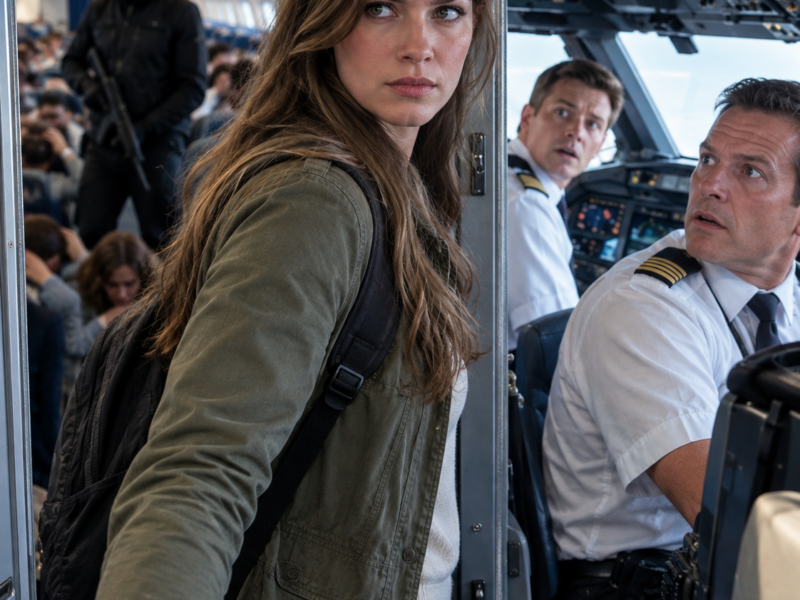
Nobody Noticed the Tourist Woman — Until She Saved 320 Lives and Shocked the Pilots
The captain laughed when the woman in the faded blue jacket warned him about his aircraft. Minutes later, when Flight 718 began losing power above Los Angeles, air traffic control heard a name that made veteran pilots fall silent: “BLACKBIRD.”
My name is Claire Bennett, and I had learned that sometimes the most dangerous mistake a person could make was deciding what someone was capable of by looking at them.
That morning, I looked like an ordinary tourist.
My blue jacket had faded at the elbows. My sneakers were scuffed from years of walking, and the small canvas bag hanging from my shoulder contained little more than a phone charger, a paperback novel, and a sealed envelope I had carried for seven years without finding the courage to open.
I stood near Gate 42 at Los Angeles International Airport, watching passengers file toward Flight 718, a long-haul passenger aircraft bound for New York. Beyond the terminal windows, the California sun glinted off wet patches of concrete left by an overnight shower. Ground crews moved beneath the aircraft, their reflective vests flashing in the morning light as baggage carts rattled past.
The familiar smell of jet fuel drifted faintly through the service corridor whenever a door opened. Somewhere outside, another aircraft’s engines rose into a deep, vibrating roar that seemed to travel through the floor beneath my feet.
I should have been thinking about my own flight.
Instead, I was listening to Flight 718.
The aircraft’s right engine had just started.
Most people would have heard nothing unusual. There was the normal whine of the starter, the rising rumble of the turbine, and the steady increase in noise as the engine approached idle.
But beneath that familiar sound was a faint, uneven shudder.
It came twice.
Then stopped.
Then came again.
My fingers tightened around my coffee cup.
I had heard that rhythm before.
Seven years earlier, I had spent hundreds of hours testing aircraft systems under conditions most pilots would never encounter. I had learned to distinguish a harmless vibration from a warning that arrived before an instrument had time to acknowledge a problem.
The sound coming from Flight 718 wasn’t proof of an impending engine failure. Engines vibrated for countless reasons, and a sound heard from a terminal was no substitute for a proper inspection.
But it was enough to justify stopping and checking.
I set down my coffee and approached the boarding podium.
“Excuse me. I need to speak with the captain before this aircraft departs.”
The gate agent glanced at my boarding pass.
“Are you traveling on Flight 718?”
“No. But I need someone to inspect the right engine.”
Her smile faded slightly.
“Ma’am, if there’s an issue with the aircraft, maintenance will handle it.”
“Has maintenance signed off on the engine start?”
She blinked.
“I’m sorry?”
“Was the vibration reported after startup?”
Before she could answer, a man in a crisp captain’s uniform emerged from the jet bridge. He was in his early fifties, with silver at his temples, polished shoes, and the relaxed confidence of someone accustomed to being the most important person in a room.
His name badge read CAPTAIN DANIEL MERCER.
“What seems to be the problem?” he asked.
The gate agent gestured toward me.
“This passenger says she heard something unusual from the right engine.”
Mercer looked at me, then at the boarding pass in my hand.
“You’re not on my passenger manifest.”
“I’m not flying with you.”
“Then how can I help you?”
“I heard an irregular vibration during startup. It repeated several times. You should have maintenance check it before departure.”
He studied my worn jacket and scuffed shoes.
“Are you an aircraft mechanic?”
“No, Captain.”
“An airline engineer?”
“No.”
“Then what exactly qualifies you to evaluate my aircraft?”
I could have told him about the experimental flight-test program at Edwards Air Force Base. I could have explained the hours spent listening to test telemetry through headphones while an aircraft shook around me at speeds where a minor mechanical fault could become a fatal one.
I could have told him about the flight that ended my career.
Instead, I answered calmly.
“I know what I heard.”
A man waiting nearby chuckled.
Mercer smiled as if I had delivered a joke.
“Ma’am, modern commercial aircraft have multiple monitoring systems, trained maintenance personnel, and strict departure procedures. We don’t cancel flights because a stranger dislikes the sound of an engine.”
“I didn’t ask you to cancel the flight. I asked you to have it checked.”
His smile disappeared.
“And I’m telling you that the aircraft is cleared for departure.”
He turned toward the gate agent.
“Let’s continue boarding, please.”
The conversation was over.
Or so he thought.
I stepped away from the podium without raising my voice. There was no point arguing with a man who had already decided that listening to me would cost him more dignity than ignoring me.
Through the windows, I watched passengers settle into their seats. Ground personnel removed the wheel chocks, and the aircraft began its slow taxi toward the runway.
I tried to convince myself that the vibration had been nothing.
Perhaps it was a panel resonating at a particular engine speed. Perhaps a sensor had registered an ordinary transient. Perhaps the sound had traveled strangely across the wet tarmac.
Those were reasonable possibilities.
But the rhythm continued to replay in my mind.
Two uneven pulses.
A pause.
Then another.
I remembered sitting in a test aircraft seven years earlier, listening to a similar vibration while my closest friend, Rebecca Shaw, spoke over the radio.
“Claire, tell me you’re seeing this too.”
I had been looking at the same numbers she was.
I had been certain we had time.
We hadn’t.
The memory arrived so sharply that I had to grip the edge of a nearby counter.
For seven years, I had avoided cockpits, flight-test reports, and the sound of engines starting in enclosed hangars. I had changed cities, abandoned old contacts, and learned to live with a silence that followed me everywhere.
But silence couldn’t change what I knew about aircraft.
And it couldn’t make me forget what happened when people ignored a warning.
I approached an airport operations employee standing beside a service entrance.
“Could you contact the operations center and report a possible abnormal engine vibration on Flight 718?”
He frowned.
“Did you report it to the captain?”
“Yes.”
“And?”
“He dismissed it.”
The employee hesitated, caught between procedure and the possibility that he was about to make unnecessary trouble.
“Do you have any evidence beyond what you heard?”
“No instrument readings. No inspection. That’s why I’m asking for one.”
He studied me for a moment, then reached for his radio.
Before he could speak, the airport announcement system crackled overhead.
“Flight 718, cleared for takeoff.”
My stomach tightened.
I turned toward the windows.
The aircraft rolled onto the runway, engines roaring as it accelerated. Its nose rose, the landing gear left the pavement, and the plane climbed into the bright California sky.
For several seconds, everything looked normal.
Then my phone vibrated.
An airport employee beside me was staring at his screen.
“What’s that?” I asked.
He didn’t answer immediately.
Across the terminal, a departure monitor changed from ON TIME to a flashing red message.
EMERGENCY RETURN — FLIGHT 718.
The airport’s public-address system erupted with a request for emergency response vehicles to stand by.
A woman near the windows covered her mouth.
Someone dropped a suitcase.
I pushed closer to the glass.
High above the airport, Flight 718 was turning back toward the coast. It wasn’t plunging from the sky, but its bank looked tighter than I expected, and its climb had flattened. A faint gray trail appeared behind the right side of the aircraft before disappearing into the haze.
My pulse hammered against my ribs.
The sound had been real.
A supervisor hurried through the terminal doors, speaking urgently into a radio.
“Get me the operations center. Now. I need the aircraft’s status and the available runways.”
A second employee ran up behind him.
“We’ve got an emergency declaration. They’re reporting severe engine trouble, and the crew is requesting immediate assistance.”
The supervisor looked around at the growing crowd.
“Does anyone here have flight-test experience? Anyone who can help interpret the aircraft data?”
Nobody answered.
I stepped forward.
“I can.”
He looked at my jacket, then at my face.
“Who are you?”
For a moment, I considered giving him the same answer I had given Captain Mercer: nobody important.
Then I remembered Rebecca.
I reached into my canvas bag and withdrew the identification card I had carried for seven years. The edges had softened from being handled too often, but the photograph remained clear.
“Claire Bennett. Former experimental test pilot.”
The supervisor took the card.
His eyes moved across the photograph, the credentials, and the line of text beneath my name.
He looked up so quickly that the card nearly slipped from his hand.
“Get her into operations,” he said. “Immediately.”
The room beyond the security doors was cold enough to raise goose bumps along my arms. Banks of displays covered the walls, showing aircraft positions, runway conditions, wind direction, and emergency response locations. Several controllers spoke at once, their voices clipped and controlled.
At the center of the room, a large screen displayed Flight 718’s projected track.
I ignored the faces turning toward me and studied the information.
The aircraft’s return path was narrowing. The wind was shifting across the runway complex, and the crew had limited time to evaluate its remaining options. The reported engine trouble needed to be understood before anyone could recommend a safe approach.
“Do we have direct communication with the cockpit?” I asked.
A controller nodded.
“Air traffic control is talking to the captain. We’re relaying the emergency coordination.”
“Can I hear the transmission?”
He looked toward the supervisor.
The supervisor nodded once.
A speaker crackled.
“Los Angeles Tower, Flight 718. We have a serious engine malfunction. Aircraft performance is deteriorating. Requesting priority handling and emergency services.”
Captain Mercer’s voice sounded nothing like it had at the gate.
The easy confidence was gone. In its place was the tight, controlled strain of a man trying to keep fear from entering his words.
I leaned toward the display.
“Ask the crew to confirm their indications and current aircraft configuration. Don’t assume the source of the vibration is the only problem.”
The controller relayed the request.
Seconds passed.
The response came back fragmented by static.
“…right-side engine indications abnormal… power response inconsistent… assessing controllability…”
I closed my eyes briefly.
Not to pray.
To remember.
I pictured the aircraft’s climb, the sound of the engine, the way the vibration had repeated. I thought about the possible explanations and the danger of committing to one without sufficient evidence.
Then I opened my eyes and studied the available landing options.
“What’s the wind doing at the primary runway?”
“Shifting. We’re updating the approach plan now.”
“Then keep the alternate available until the crew confirms what the aircraft can safely manage.”
The supervisor stared at me.
“You’re making recommendations based on a sound you heard from a terminal?”
“I’m making recommendations based on the information in front of us. The sound is one piece of it.”
Another transmission broke across the room.
“Flight 718 reporting further loss of thrust. We need assistance immediately.”
Every conversation stopped.
The captain came back on the radio, breathing hard.
“Tower, we’re struggling to maintain our profile. We need the safest available approach. Tell us what you’ve got.”
I reached for the headset.
The supervisor caught my wrist.
“You are not authorized to transmit instructions to a commercial aircraft.”
“Then put me in contact with the person who is.”
He released me.
The controller switched the communication channel, and I heard Captain Mercer again.
“Flight 718, we’re working on your return.”
I pressed the transmit control.
“Captain Mercer, this is Claire Bennett. I need you to listen carefully.”
Silence.
Then, unmistakably, his voice.
“Claire?”
“Yes, Captain.”
“How are you in the operations center?”
“That’s not important right now. I need you to focus on the aircraft and confirm what your instruments are telling you.”
His reply came after a long pause.
“You’re the woman from the gate.”
“Yes.”
“You said you heard something.”
“I did. But we need to work with what you can confirm now. Tell me exactly what the aircraft is doing.”
For the first time that morning, Captain Mercer didn’t interrupt me.
He began reporting the indications. I listened, compared his words with the information on the screens, and asked the controller to relay specific questions through the proper channel. No dramatic promises. No impossible guarantees. Only facts, options, and the next decision.
Then a warning sounded from the far end of the room.
A new data feed appeared on the central display.
The supervisor went pale.
“What’s happening?” I asked.
“Flight 718’s latest report is worse than the last one.”
The captain’s voice returned over the speaker.
“We’re running out of options.”
I looked at the projected track. The available margin was shrinking, and the emergency crews were already moving into position.
I took a slow breath.
“Captain, stay with us. We are going to work through this one decision at a time.”
He answered in a whisper.
“Claire, I don’t know if I can get them down.”
The words struck harder than they should have.
Seven years earlier, Rebecca had asked me to tell her we had time.
Now another pilot was asking whether he could bring his passengers home.
I tightened my grip on the headset.
“You don’t have to solve the entire emergency at once. Give us the information, and we’ll evaluate the next step.”
The supervisor was watching me with an expression that had shifted from suspicion to something close to disbelief.
Then he noticed another detail on my identification card.
His face changed.
He looked at the controller, then at me.
“Wait,” he whispered. “You’re that Claire Bennett?”
I didn’t answer.
A burst of static filled the room.
Then a senior flight-test liaison, listening from a secure terminal on the other side of the operations center, stood so abruptly that his chair rolled backward.
He stared at my identification card.
“Is that really her?”
The supervisor nodded.
The liaison reached for his radio, his voice suddenly urgent.
“Operations, verify the identity of the woman advising Flight 718.”
“Identity verified,” the supervisor replied.
The liaison swallowed.
“Then use her registered callsign.”
The room went silent.
I closed my eyes for half a second.
I hadn’t heard that callsign spoken aloud in seven years.
The liaison pressed his transmit button.
“All stations, be advised. Claire Bennett is on the emergency coordination channel.”
He paused, as if the next words required permission from the past.
“BLACKBIRD IS BACK.”
Every head turned toward me.
The armed security officers at the operations center entrance snapped to attention. Two veteran pilots standing beside the rear console straightened and rendered a rigid salute. Even the supervisor, who had questioned my presence only minutes earlier, raised his hand to his brow.
Over the radio, Captain Mercer said nothing.
For the first time since I had met him, he was completely speechless.
Some legends disappear. Others return when every second counts.
For three seconds, nobody in the operations center moved.
The name BLACKBIRD hung in the air like the echo of an explosion.
Captain Daniel Mercer was still connected through the emergency channel, and I could hear his breathing over the radio. Somewhere above Los Angeles, 320 passengers were trapped inside an aircraft that was no longer behaving as its designers had intended. Yet the captain who had laughed at me less than half an hour earlier seemed unable to form a single sentence.
Then he finally spoke.
“Blackbird?”
I adjusted the headset against my ear.
“I’m here, Captain.”
“That’s impossible.”
I glanced at the aircraft’s projected position on the main display.
“Your passengers don’t have time for a history lesson. Tell me what your instruments are showing.”
The words came out sharper than I intended, but I didn’t apologize. I had spent seven years learning how to live with the past. I wasn’t going to let it steal another minute from someone else’s future.
Across the room, the operations supervisor, a broad-shouldered man named Robert Hayes, leaned toward me.
“Claire, I need to understand something. The Blackbird callsign belonged to an experimental flight-test pilot who disappeared from the program after a fatal incident at Edwards. The official reports said—”
“Mr. Hayes, with respect, the aircraft is still in the air.”
He stopped.
I turned back to the screen.
Flight 718 was approaching the outer boundary of the airport’s controlled airspace. Its altitude was decreasing, and the latest reports suggested the crew was having difficulty maintaining its intended flight profile. Emergency vehicles were assembling near the runway, their flashing lights reflecting off the damp pavement.
A controller read out the latest weather conditions.
“Wind shifting from the southwest. Gusts increasing. Visibility remains acceptable, but we’re monitoring the cloud base.”
I studied the numbers.
“Keep the crew informed of the actual conditions at each available runway. Don’t assume the first plan remains the best plan if the wind shifts again.”
Hayes watched me for a moment.
“You’ve done this before.”
I kept my eyes on the display.
“Not this exact emergency.”
“That isn’t what I asked.”
“No,” I said. “It isn’t.”
A new transmission crackled through the speaker.
“Los Angeles Tower, Flight 718. We’re experiencing fluctuating engine indications and reduced performance. Aircraft handling remains difficult. Request immediate guidance.”
Captain Mercer’s voice was strained but controlled. He was doing what experienced pilots did when fear threatened to overwhelm judgment: narrowing his attention to the next task.
I respected him for that.
A mistake at the gate didn’t erase the fact that he was now responsible for hundreds of people.
“Captain,” I said, “I want you to report what you can verify, not what you suspect. Give the controller your current configuration, your confirmed indications, and your assessment of controllability.”
“Understood.”
He answered immediately this time.
I listened carefully as the cockpit crew relayed their situation. The details were incomplete, and several explanations remained possible. The sound I’d heard at the terminal was a clue, not a diagnosis. Without a maintenance inspection or the aircraft’s full technical data, I couldn’t honestly tell them exactly what had failed.
But I could help them avoid letting uncertainty turn into panic.
“Keep the communication clear,” I told the controller. “One instruction at a time. Make sure the captain has acknowledged each transmission before moving to the next.”
Hayes gave a short nod to the air traffic team.
The atmosphere began to change. The people who had initially looked at me as though I had wandered into the wrong building were now listening to every word.
I didn’t notice their expressions for long.
I was watching the aircraft.
On the far side of the room, a young communications officer hurried toward Hayes with a tablet.
“Sir, we’ve received a request from the airline’s emergency operations team. They want to know who’s advising the cockpit.”
Hayes looked at me.
“Tell them a former experimental test pilot is assisting with the assessment.”
The officer hesitated.
“Sir, they asked for her full name.”
“Give it to them.”
He glanced at his tablet.
“There’s something else. The airline’s chief pilot recognized the callsign. He’s requesting a secure connection.”
Hayes turned toward me.
“Do you want to take it?”
“No. Not until the aircraft is on the ground.”
The answer surprised him.
“You don’t want to speak with him?”
“Not while the people in that cockpit are trying to land.”
I heard a chair scrape behind me.
One of the veteran pilots who had saluted earlier approached the console. He was tall, with a silver beard and the kind of weathered face that came from years spent squinting into sunlight beyond a cockpit canopy.
His name tag read COLONEL THOMAS REED, RETIRED.
He stopped beside me.
“Seven years,” he said quietly.
I didn’t look at him.
“Colonel.”
“Seven years, Claire. No calls. No visits. Not even a letter.”
“I didn’t know what to say.”
“You could have said you were alive.”
My jaw tightened.
For a moment, I could hear something other than the radios: the wind against a hangar door, the metallic vibration of a test aircraft, Rebecca’s laugh coming through my headset.
Then the memory vanished.
“Colonel, please.”
He followed my gaze to the screen.
“All right,” he said. “We’ll talk later.”
He remained beside me, saying nothing more.
That was how I knew he understood.
Some questions could wait.
Some couldn’t.
The first real sign of trouble came when Flight 718’s projected approach had to be revised.
A controller called out a change in the wind. Another reported the updated runway conditions. The emergency response coordinator confirmed that fire crews, ambulances, and airport rescue personnel were in position.
The room moved faster now, but the atmosphere remained controlled.
I watched the aircraft symbol advance across the display.
“What’s the latest from the captain?”
The controller listened, then answered.
“He reports the aircraft remains difficult to manage. The crew is working through the available options.”
I nodded.
“Keep them talking. If they become overloaded, simplify the information.”
Hayes moved closer.
“Claire, you understand that we can’t hand you control of a commercial flight.”
“I haven’t asked you to.”
“You’re giving recommendations.”
“I’m helping interpret what we’re hearing. The captain remains responsible for his aircraft, and air traffic control remains responsible for its instructions.”
He studied me.
“Then why does everyone in this room seem to be waiting for you to tell them what happens next?”
I looked at him for the first time.
“Because everyone is frightened.”
He didn’t answer.
“Fear makes people want certainty,” I continued. “But aviation doesn’t reward certainty when the facts don’t support it. It rewards discipline. We establish what we know, acknowledge what we don’t, and make the safest decision available.”
Hayes glanced toward the main display.
“And if there isn’t a safe decision?”
“Then you work to make the best remaining option as safe as possible.”
The answer wasn’t comforting.
It was the truth.
A radio transmission interrupted us.
“Flight 718 reporting further deterioration. Requesting priority for immediate return.”
The controller responded, and the room shifted into another phase of emergency coordination.
I moved closer to the display, tracking the aircraft’s reported position and the changing weather data. Outside the windows, the sky had darkened over the western horizon. A band of gray cloud was advancing inland, making the morning look older than it should have.
I recognized the pattern.
Not the precise storm, but the behavior: the gust fronts, the uneven movement of the cloud line, the way the wind could change before the most dramatic weather arrived.
“Keep updating the wind,” I said. “I don’t want the crew relying on a report that’s already several minutes old.”
The weather officer acknowledged the request.
For a moment, I thought about the sealed envelope in my bag.
It had been written in my father’s handwriting.
Seven years ago, shortly before the accident, he had left it with a colleague and asked that it be delivered to me if anything happened to him. By the time I received it, Rebecca was dead, my flight-test career had collapsed, and I had convinced myself that opening the letter would only uncover another reason to hate myself.
So I had carried it everywhere.
I had never read a word.
A sudden burst of radio static pulled me back.
“Tower, Flight 718. We have a new warning indication. Requesting immediate confirmation of the approach conditions.”
The controller answered.
I leaned toward the speaker.
“Captain, listen carefully. Your crew should continue to report what the aircraft is doing and follow the appropriate emergency procedures. We’ll keep the runway and weather information current. Don’t let anyone in this room distract you from flying the aircraft.”
A pause followed.
Then Mercer answered.
“Understood, Claire.”
He sounded different now.
Not submissive.
Focused.
That was better.
I had no interest in humiliating him. A cockpit was not a courtroom, and an emergency wasn’t an opportunity to settle an argument.
If Flight 718 landed safely, he would have plenty of time to think about the woman he had dismissed.
If it didn’t, none of our opinions would matter.
The aircraft’s position changed on the screen.
The supervisor spoke quietly.
“Estimated time to the airport is decreasing.”
“How are the rescue teams?”
“Ready.”
“Medical teams?”
“Standing by.”
“Runway status?”
“Being confirmed.”
I nodded and turned back to the communications officer.
“Tell the airline that the crew’s immediate needs take priority. Any additional requests should go through the emergency coordination channel. We cannot afford multiple people calling the cockpit with competing instructions.”
The officer relayed the message.
Hayes folded his arms.
“You speak as though you’ve been running emergency rooms like this for years.”
“I’ve spent years in situations where people had to make decisions with incomplete information.”
“And you walked away from all of it.”
I looked at him.
“After someone died.”
His expression softened slightly.
“I read the summary of the Edwards incident. It said the test aircraft experienced a catastrophic failure during a high-risk evaluation. It said you attempted to assist the other pilot.”
“That’s what the report said.”
“But it didn’t explain why you left.”
I looked at the screen again.
“Because reports can describe what happened without explaining what it feels like to survive it.”
For once, Hayes had no response.
Then the communications officer returned.
“Sir, the airline chief pilot is on the secure line.”
Hayes gestured toward the phone.
“He says it’s urgent.”
I shook my head.
“Tell him to wait.”
“Claire,” Hayes said, “he specifically asked for you.”
“And I specifically said not until the aircraft is on the ground.”
I returned to the radio.
“Flight 718, confirm your latest assessment.”
Mercer responded after several seconds.
“We’re continuing toward the airport. The crew is working together. We can hear your transmissions clearly.”
“Good. Keep your attention on the aircraft. We’ll continue coordinating the available support.”
I paused.
Then I added something I had not planned to say.
“Captain, you asked earlier how I ended up here.”
“Yes.”
“I didn’t come to the airport looking for an emergency.”
“I understand.”
“No,” I said quietly. “You don’t. But you will.”
The radio remained silent for a moment.
Then Mercer answered.
“Understood.”
I released the transmit control.
The aircraft was still in danger. The wind was still changing. The emergency teams were still waiting, and nobody could promise that the next few minutes would end well.
But for the first time since the engines had started, I felt the familiar clarity returning.
Not confidence that everything would be fine.
Confidence that I could keep thinking even when everything wasn’t.
Colonel Reed leaned toward me.
“Rebecca would have been proud of you.”
My hand froze over the console.
“Don’t.”
“Claire—”
“Don’t say her name as though you know what she would have thought.”
He stepped back.
I regretted the sharpness immediately, but I couldn’t take the words back.
The memory of Rebecca had never been a clean, noble tragedy. It was a tangle of anger, grief, unanswered questions, and the unbearable knowledge that one person had returned while another had not.
I stared at the aircraft symbol.
“I’m sorry,” I said quietly.
Reed shook his head.
“You don’t owe me an apology.”
A warning tone sounded from one of the displays.
The weather officer called out another change.
The controller acknowledged a new transmission from the aircraft.
And then Captain Mercer said something that made every person in the operations center stop what they were doing.
“Claire, I need to tell you something.”
I pressed the transmit control.
“Go ahead.”
“Before we took off, I received a maintenance note that mentioned an intermittent vibration. It had been reviewed before departure.”
My blood went cold.
“What did the note say?”
“I don’t have the full report in front of me.”
“Captain, did it identify the right engine?”
“Yes.”
I stared at the screen.
The sound I had heard at the gate had not been my imagination. Someone had documented a concern, and the aircraft had departed anyway.
But I still didn’t know whether that concern was related to the emergency unfolding now.
“Listen to me,” I said. “Don’t try to diagnose the original fault from memory. Give the relevant information to the people coordinating the emergency, and focus on the aircraft in front of you.”
“Understood.”
Hayes had heard the exchange.
He turned to the airline liaison.
“I want the complete maintenance record and the departure inspection documentation. Now.”
The liaison began making calls.
The operations center grew even quieter.
The captain had laughed at me because I looked like a tourist.
Someone else had apparently seen a warning in a report and decided it was acceptable to proceed.
And somewhere between those decisions, 320 lives had become part of a problem nobody could yet fully explain.
I watched the aircraft symbol move toward the airport.
Then I heard a sound I had dreaded for seven years: a transmission breaking apart just as the person on the other end tried to speak.
“Tower, Flight 718… we need—”
Static swallowed the rest.
The controller called for confirmation.
Nothing came back.
“Flight 718, say again.”
More static.
My heart began to pound.
I grabbed the headset with both hands.
“Flight 718, this is Claire Bennett. Can you hear me?”
For two agonizing seconds, there was no answer.
Then the captain’s voice returned, faint and distorted.
“Claire… we have a serious problem.”
I looked at the main display.
The aircraft was still moving toward us.
But the information coming from the cockpit had just changed everything.
And before I could ask the next question, Captain Mercer spoke again.
“Blackbird, you need to know what the maintenance report said about that engine.”
The aircraft was losing performance. The weather was closing in. And the woman who had spent seven years running from the sky was about to face the one thing she feared more than death: another chance to save someone.
“Blackbird, you need to know what the maintenance report said about that engine.”
Captain Daniel Mercer’s voice crackled through the operations center speakers, interrupted by static and the distant beeping of cockpit warnings.
I leaned toward the microphone.
“Captain, tell me what you know. Slowly.”
“The report mentioned an intermittent vibration during the previous flight. Maintenance inspected the aircraft, but the issue wasn’t reproduced during the ground checks.”
“Did the report identify a confirmed mechanical fault?”
“No.”
“Did it require the aircraft to be grounded?”
“I don’t know. I haven’t seen the complete documentation.”
I glanced at Robert Hayes, who was already speaking urgently with the airline liaison.
“Get the maintenance record,” I told him. “We need the actual wording, not somebody’s recollection of it.”
Hayes nodded to the communications officer.
Across the room, a printer began spitting out pages. Someone pulled up the airline’s electronic maintenance records on a secure terminal. The air felt colder than before, and the steady ventilation seemed suddenly loud against the silence.
Then the weather officer spoke.
“Storm activity is developing west of the airport. Wind conditions are changing faster than forecast.”
I looked at the radar display.
A broad band of rain was moving toward the Los Angeles basin. The leading edge wasn’t directly over the airport yet, but the wind readings were becoming less predictable.
“How much time before the conditions deteriorate?”
“Difficult to say. The latest observations suggest the front is advancing faster than expected.”
I studied the aircraft’s position.
Flight 718 was still airborne, but every new report made it clearer that the crew was managing a complicated emergency with limited time to spare.
“Keep the captain updated on the actual conditions,” I said. “And make sure the available runway information is current.”
Hayes approached me with several pages in his hand.
“The maintenance entry confirms that a vibration was reported on the previous flight. The inspection didn’t reproduce it, and the aircraft was returned to service under the applicable procedures.”
“Does the report establish that the vibration caused this emergency?”
“No.”
“Then we don’t pretend it does.”
He nodded.
I returned to the radio.
“Captain, we’ve confirmed that a vibration was documented on the previous flight. We don’t yet know whether it’s connected to your current problem. Focus on the indications you’re seeing now, and continue coordinating with air traffic control.”
“Understood.”
His voice was steadier than before, but I could hear the strain beneath it.
I knew that sound.
It was the voice of a pilot trying to keep 320 people from hearing the fear in his breathing.
And I knew what it felt like to be the person everyone expected to have an answer.
Seven years ago, I had believed that having an answer was the same as having control.
Rebecca’s death had taught me otherwise.
The secure telephone rang again.
Hayes picked it up, listened for several seconds, and looked at me.
“It’s the airline’s chief pilot. He says he knows you.”
“Tell him I’m busy.”
“He says this concerns the Edwards accident.”
My fingers went still.
For seven years, I had avoided conversations about Edwards Air Force Base. I had ignored letters from former colleagues, refused invitations to memorial ceremonies, and stopped answering calls from people who insisted that I should forgive myself.
I had become very good at surviving by refusing to look backward.
But now the past had followed me into an airport operations center, and it was demanding to be heard.
“Put him on speaker,” I said. “But keep the aircraft channel open.”
Hayes pressed a button.
A man’s voice filled the room.
“Claire Bennett?”
“Yes.”
“This is Martin Cole, chief pilot for Pacific Meridian Airlines. I knew your father.”
The room seemed to tilt.
My father had been a civilian aerospace engineer who worked on experimental propulsion systems. He had disappeared from my life shortly before the accident at Edwards, leaving behind unanswered questions and a sealed letter I had never opened.
I had spent years telling myself that he had chosen his work over his family.
Now a stranger was telling me he knew him.
“What do you want, Mr. Cole?”
“I need you to understand something about the aircraft you’re helping.”
“Then tell me.”
“The maintenance report isn’t the only document associated with this engine.”
I looked at Hayes.
“What other document?”
“A technical review was conducted after the previous flight. It raised questions about the intermittent vibration, but it didn’t establish a definitive cause. The report was forwarded for further analysis.”
“And?”
“The follow-up review was never completed before the aircraft’s next scheduled departure.”
My jaw tightened.
“Why not?”
“I don’t have the complete administrative history yet.”
“Then you don’t know.”
“No,” he admitted. “I don’t.”
I respected the honesty, even if I hated the answer.
“Mr. Cole, I need you to send every relevant record to the investigators and the airline’s emergency team. Right now, the cockpit needs accurate information, not speculation.”
“I understand.”
“And don’t contact the crew directly. Everything goes through the established emergency channels.”
“Understood.”
I ended the call.
Hayes watched me carefully.
“Your father worked on propulsion systems?”
“Yes.”
“Was he involved in the Edwards accident?”
I stared at the screen.
“I don’t know.”
It was the first time in seven years that I had said those words without immediately trying to bury them beneath another explanation.
And somehow, that frightened me more than the emergency.
“Flight 718, report your current situation.”
The controller’s voice was firm.
A burst of static followed.
Then Captain Mercer answered.
“We’re continuing to assess the aircraft. The engine indications remain abnormal, and we’re coordinating our return.”
I listened carefully.
There was no room for heroics now. No single person in the operations center could reach through the radio and physically control the aircraft. Our job was to support the crew, maintain accurate information, coordinate the emergency response, and avoid adding confusion to an already difficult situation.
I moved closer to the main display.
“Captain, confirm that you have the latest runway and wind information.”
“We do.”
“Good. Keep reporting any changes in controllability or system indications. Don’t let the maintenance history distract you from the immediate emergency.”
“Understood, Blackbird.”
The callsign sounded strange coming from him.
Seven years ago, people had spoken it with excitement. It had appeared on flight schedules, test-program briefings, and the informal messages exchanged between pilots who trusted one another with their lives.
Then Rebecca died.
The callsign vanished from official conversations, and I made sure nobody had a reason to use it again.
Now it was coming through a commercial aircraft’s radio as the crew fought to bring its passengers home.
I closed my eyes for a moment.
Rebecca’s voice returned.
“Blackbird, you’re overthinking it again.”
I could almost hear her laughing.
“You always think three moves ahead. Sometimes you just have to fly the airplane.”
I opened my eyes.
“I know, Rebecca,” I whispered.
Hayes glanced at me but said nothing.
The controller called for another update.
The captain responded.
The aircraft continued toward the airport.
Then the weather officer announced that the rain band was moving closer, and the room shifted back into urgent activity.
“Wind observations are changing,” she said. “We’re monitoring the runway conditions.”
Hayes looked at me.
“What do you need?”
“Current information. No assumptions. And I need the crew to have enough time to consider the options without being overwhelmed by unnecessary transmissions.”
He relayed the instructions.
For several minutes, the operations center functioned like a single organism. Controllers communicated with the aircraft. Emergency teams confirmed their positions. Weather specialists updated the data. Airline personnel worked to retrieve the aircraft’s records.
I remained at the center of it, not because I had taken command, but because the people coordinating the emergency understood that my flight-test experience could help them interpret the developing situation.
I wasn’t going to promise a safe landing.
I was going to help them give the crew the best chance possible.
Then Captain Mercer said something that made my blood run cold.
“Claire, I need to ask you a question.”
“Go ahead.”
“If we get this aircraft down, will you tell me what happened at Edwards?”
I stared at the screen.
“If we get this aircraft down, I’ll answer what I can.”
“That’s all I’m asking.”
He paused.
“I’m sorry I laughed at you.”
I swallowed.
“Save the apology for after we land, Captain.”
“Yes, ma’am.”
The transmission ended.
For the first time, I allowed myself to imagine that Flight 718 might actually make it.
Then the aircraft’s reported condition changed again.
The controller called for an immediate update, and the captain responded with a strained account of worsening performance.
The room tightened around us.
I studied the information as it appeared.
The situation was deteriorating, but the available data still didn’t justify a confident diagnosis. I could not know whether the initial vibration, the maintenance report, and the current engine trouble all had the same cause.
What I knew was simpler.
The crew needed support.
The emergency services needed accurate information.
And 320 people were depending on everyone involved to remain calm.
I turned to Hayes.
“I need to speak with the airline’s emergency coordinator.”
He nodded.
The connection was established.
I explained what the crew had reported, what the available records did and did not establish, and why the immediate priority had to remain the aircraft’s current condition.
The coordinator listened, then asked a question I had heard many times during my career.
“Would you be willing to fly it yourself if the captain became unable to continue?”
I went completely still.
Seven years ago, I had walked away from a test aircraft with Rebecca’s voice still echoing in my headset.
I had promised myself I would never sit in a cockpit again.
Not in a simulator.
Not in a training aircraft.
Not even in the back seat of an aircraft flown by someone else.
I had built my life around that promise.
Now someone was asking me to break it.
“I am not a member of this aircraft’s operating crew,” I said carefully. “Any decision about flight operations has to be made by the responsible authorities, with the aircraft’s condition and crew capability fully assessed.”
“That isn’t an answer.”
“It’s the only responsible answer I can give you.”
I disconnected.
Hayes had heard everything.
“Claire, nobody is asking you to do anything reckless.”
I looked at him.
“Seven years ago, someone told me almost exactly that.”
He said nothing.
I turned back toward the aircraft display.
Flight 718 was still approaching the airport.
The storm was still advancing.
And the past was no longer something I could keep locked inside a sealed envelope.
The next transmission came through weakly.
“Los Angeles Tower, Flight 718. We have a further deterioration in performance. Requesting priority handling.”
The controller responded immediately.
The operations center moved into another wave of activity. Emergency vehicles adjusted their positions. The medical coordinator confirmed that additional teams were standing by. The airline’s emergency personnel continued relaying information through the appropriate channels.
I listened to the captain’s voice.
He was still there.
Still working.
Still trying to bring the aircraft home.
I took a breath.
“Captain, this is Claire. Can you hear me?”
A burst of static.
Then his answer.
“Loud and clear.”
“Good. Keep communicating with the controller. Tell them what you can verify, and ask for clarification whenever an instruction isn’t clear.”
“Understood.”
I looked at the rain moving across the weather display.
Then I glanced down at my faded blue jacket.
My hand found the envelope inside my bag.
The paper had softened at the corners. My father’s handwriting was still visible through the thin surface, his name written across the front in dark ink.
For seven years, I had believed that opening it would force me to confront something I wasn’t prepared to understand.
But I had been wrong about many things.
I had mistaken guilt for responsibility.
I had mistaken silence for healing.
And I had mistaken walking away from the sky for leaving the accident behind.
The radio crackled again.
“Flight 718 requesting an update.”
I raised my head.
The aircraft was approaching the final phase of its return, and the emergency teams were waiting on the ground.
I slipped the envelope back into my bag.
Whatever my father had written could wait a few more minutes.
The people on that aircraft couldn’t.
“Flight 718, we hear you,” I said. “We’re here with you.”
The captain answered immediately.
“Thank you, Blackbird.”
I looked toward the main display and watched the aircraft symbol advance.
For the first time in seven years, I wasn’t thinking about how to escape my past.
I was thinking about how to help someone else survive theirs.
And then, from the secure communications station behind me, a voice spoke in a tone that made the entire room turn.
“Claire, we’ve just received the original technical review from Edwards.”
I turned.
The communications officer held up a newly arrived document.
“The report has your father’s name on it.”
My heart seemed to stop.
“What does it say?”
He swallowed.
“There’s a section marked restricted. But the summary contains a reference to your final test flight with Rebecca Shaw.”
I stared at him.
“Read it.”
He looked down at the page.
Then he lifted his eyes to mine.
“Claire, the report says the aircraft’s emergency warning system had been giving intermittent false readings before the accident.”
The room went silent.
“That can’t be right,” I whispered.
“The report also says your father requested an independent review.”
I gripped the edge of the console.
“Did they conduct one?”
The officer looked at the document again.
“No.”
For seven years, I had blamed myself for surviving the flight that killed Rebecca.
For seven years, I had believed that one decision, one missed indication, one moment of hesitation had cost my closest friend her life.
Now I was being told that the accident might have involved a technical issue nobody had fully investigated.
I wanted to ask a hundred questions.
I wanted to demand every page of the report.
I wanted to know why my father had never told me.
But Captain Mercer’s voice came through the radio again, pulling me back to the emergency unfolding in front of us.
“Blackbird, Flight 718. We’re ready to proceed with the approach.”
I looked at the aircraft display.
The runway was ahead.
The storm was closing in.
And the next few minutes would decide whether 320 people would walk away from this morning or become names on an incident report.
I pressed the transmit control.
“Flight 718, we hear you. Continue coordinating with the tower. We’re standing by.”
Then I turned to Hayes.
“Get every page of that report preserved. No one edits it, summarizes it, or removes anything. I want the original documentation secured for the proper investigation.”
“Understood.”
I looked at the sealed envelope in my bag one last time.
My father’s handwriting seemed darker than I remembered.
For the first time, I wondered whether he had left me that letter because he knew something about Rebecca’s accident that nobody else wanted me to discover.
The thought frightened me.
But it didn’t change what I had to do.
I put the envelope away, straightened my faded blue jacket, and returned my attention to the aircraft.
Seven years ago, I had lost someone I loved.
Today, I had a chance to help 320 strangers make it home.
And I wasn’t going to turn away.
The storm had arrived early. The aircraft was struggling. And as 320 people waited for a miracle, the woman who had sworn never to fly again faced the one decision she could no longer escape.
“Flight 718, confirm your current status.”
The controller’s voice cut through the operations center.
For several seconds, the only response was static.
Then Captain Daniel Mercer came back on the radio.
“Los Angeles Tower, Flight 718. We’re continuing toward the airport. The aircraft remains difficult to manage.”
I watched the radar display as the weather officer updated the wind observations. The approaching storm was changing the conditions faster than anyone had hoped, and the emergency response teams were preparing for several possible outcomes.
Behind me, phones rang. Controllers exchanged concise updates. On the main screen, Flight 718’s symbol moved toward the airport while a separate display showed rescue vehicles positioned along the airfield.
Three hundred and twenty people were waiting for the crew to bring them home.
I leaned toward the microphone.
“Captain, this is Claire. Keep communicating with the tower. Tell them what you’re experiencing, and ask them to repeat anything you don’t understand.”
“Understood.”
His voice was strained.
But he was still thinking clearly enough to answer.
That mattered.
I turned toward the supervisor.
“Have the airline confirm that the cabin crew has received the appropriate emergency instructions. Keep the medical teams informed, and make sure the runway and weather information continues to be updated.”
Hayes nodded and passed the instructions along.
Then he looked at me.
“Claire, the airline’s chief pilot is asking whether you can come to the airport’s flight simulator after the emergency is resolved. He wants your assistance with the investigation.”
“Tell him we’ll discuss it after everyone is safe.”
“You really believe you can help them land this aircraft?”
I met his eyes.
“I believe they deserve every bit of support we can give them.”
That was all I could promise.
Captain Mercer came back on the radio.
“Claire, I need you to know something.”
“Go ahead.”
“The first officer thinks we’ve identified the problem, but we’re not certain. The aircraft isn’t responding the way we’d expect.”
I glanced at the latest technical information on the screen.
“Don’t commit to a diagnosis until you’ve confirmed it. Report what the instruments show and continue following the appropriate emergency procedures.”
“Understood.”
I heard another voice in the cockpit, too faint to distinguish.
Then Mercer returned.
“We’re working through it.”
“Good. Keep working together.”
I knew what he was feeling.
Every pilot learned to live with uncertainty. Training taught us to recognize danger, evaluate information, and make decisions before hesitation became its own hazard.
But an emergency could strip away the comfortable illusion that experience guaranteed control.
When that happened, the temptation was to search for one extraordinary answer.
A brilliant maneuver.
A forgotten procedure.
A voice on the radio promising that everything would be all right.
The truth was less cinematic and more difficult.
There was no magic sentence that could repair an aircraft in flight.
There was only disciplined flying, sound information, clear communication, and the willingness to abandon an assumption when the evidence no longer supported it.
“Flight 718,” the controller said, “updated weather information is available.”
Mercer acknowledged the transmission.
I watched the data change.
Then I heard the sound that had haunted me for seven years: an electronic warning tone, faintly audible through the cockpit microphone.
The captain spoke rapidly to his first officer.
The transmission cut out.
“Flight 718, say again.”
Static.
I felt my fingernails press into my palms.
Not again.
The words appeared in my mind before I could stop them.
Not again.
I forced myself to breathe.
Rebecca’s final flight had taught me how dangerous it was to let memory replace evidence. The fact that this emergency resembled the past did not mean it would end the same way.
I looked at the screen.
“Tower, keep trying to establish contact. Don’t assume the crew has lost communications just because the signal has broken up.”
The controller tried again.
For two seconds, nothing happened.
Then Mercer’s voice returned.
“Tower, Flight 718. We can hear you.”
I released a breath I hadn’t realized I was holding.
“Captain,” I said, “we’re still here.”
He answered quietly.
“I know, Claire.”
A few minutes later, the operations supervisor approached me with a telephone in his hand.
“It’s Colonel Reed. He says there’s something you need to know before this aircraft lands.”
I looked at the phone.
“Put him through.”
The retired colonel’s voice sounded unusually hesitant.
“Claire, I’ve been reviewing the documents the liaison sent over.”
“And?”
“Your father’s name appears in more places than the original summary suggested.”
I closed my eyes briefly.
“What does that mean?”
“It means he was involved in the technical review after your accident. It doesn’t prove he knew what caused the failure, but he clearly believed the investigation was incomplete.”
I looked toward the sealed envelope in my bag.
“Did he ever tell you why?”
“No.”
“Did he try to contact me?”
There was a pause.
“Yes.”
My chest tightened.
“When?”
“Several times during the months after the accident.”
I stared at the wall.
“I never received anything.”
“I know.”
“Why didn’t you tell me?”
“I thought you needed time. Then you stopped answering calls, and I convinced myself that bringing it up would only make things worse.”
I almost laughed.
For seven years, everyone had been protecting me from something. My father had left a letter unopened in my hands. My colleagues had allowed me to disappear. People had decided what I could bear without ever asking me.
“Colonel, I can’t deal with this now.”
“I understand.”
“No,” I said, more softly. “I don’t think anyone does.”
I ended the call.
For several seconds, I stood motionless beside the console.
Then the radio crackled.
“Flight 718, reporting continued difficulties. Requesting updated approach information.”
I straightened.
“Let’s get them home,” I said.
And the room moved again.
The aircraft appeared on the approach display.
The controller relayed the latest available conditions. Emergency vehicles remained ready, and medical personnel waited for instructions from the ground coordinator.
I could hear the tension in every voice.
A young officer near the door was rubbing his hands together. Another controller had stopped drinking his coffee altogether. Even Hayes, who had seemed unshakable when I first entered the room, kept glancing between the radar screen and the communications panel.
I understood why.
Nobody wanted to be the person who had missed something.
Nobody wanted to make the wrong call.
And nobody wanted to hear a voice over the radio announcing that Flight 718 could not continue.
I turned toward the controller.
“Keep the communication with the captain simple and direct. Let him ask for clarification whenever he needs it.”
The controller nodded.
Mercer’s voice came through again.
“Tower, Flight 718. We have the runway in sight.”
A murmur moved through the operations center.
The aircraft was close enough that everyone could feel the outcome approaching.
I gripped the edge of the console.
“Captain, continue working with the tower and your first officer. Stay focused on the aircraft.”
“Understood.”
His voice was almost calm now.
Then he said something that caught me off guard.
“Claire, I owe you more than an apology.”
I stared at the radio.
“Captain, not now.”
“I need to say it.”
“No. You need to fly.”
Silence.
Then, after a moment, Mercer replied.
“Yes, ma’am.”
I closed my eyes for one heartbeat.
The sound of his acknowledgment brought back a memory I hadn’t allowed myself to revisit in years.
Rebecca and I had been sitting in the briefing room before our final test flight. She had been laughing at something I said, one boot hooked around the leg of her chair.
“You know what your problem is, Bennett?”
I had raised an eyebrow.
“I have several. You’ll need to be more specific.”
“You think everything is your responsibility.”
“Someone has to be responsible.”
She had smiled.
“There’s a difference between doing your job and believing you can control the whole world.”
I remembered rolling my eyes.
I remembered promising her that we would talk after the flight.
I remembered the empty chair afterward.
My throat tightened.
I opened my eyes.
Flight 718 was still there.
Still approaching.
Still alive.
I refused to let the memory pull me away from the present.
The aircraft descended toward the runway.
The weather officer announced another change in the wind. The controller acknowledged it, updated the information, and relayed it through the established channel.
I watched the display.
The crew had reached the stage where the smallest distraction could become a serious problem. There would be no benefit in filling the radio with speculation, and no responsible way to promise that the aircraft would land safely.
All we could do was keep the information accurate and the emergency response ready.
“Flight 718, confirm you have the latest conditions.”
Mercer responded.
“Confirmed.”
I leaned toward the microphone.
“Captain, you have everyone here supporting you. Stay with your crew and the tower.”
For a moment, the radio remained silent.
Then he answered.
“Thank you, Blackbird.”
The aircraft crossed the next marker on the display.
Hayes stood beside me, his arms folded tightly across his chest.
“You know,” he said quietly, “when you walked into this building, I thought you were a passenger who had heard something she didn’t understand.”
“I know.”
“I was wrong.”
I didn’t look away from the screen.
“Yes.”
He seemed to wait for something else.
An acknowledgment.
A gracious acceptance of his apology.
Perhaps a reassurance that I held nothing against him.
But I had no room for any of those things.
Not yet.
The radio crackled.
The controller spoke.
Mercer acknowledged.
Then the aircraft’s symbol reached the final segment of its projected approach.
Every person in the room seemed to stop breathing.
I could hear the low hum of the ventilation system, the faint click of a keyboard, and the distant rumble of aircraft engines beyond the walls.
I thought of Rebecca.
I thought of my father.
I thought of the sealed letter waiting in my bag.
And I thought of 320 people who had boarded a plane that morning expecting to reach New York.
They had packed bags, said goodbye to loved ones, checked their phones, and complained about delays. They had no idea that a woman in a faded blue jacket had heard a sound that reminded her of the worst day of her life.
They didn’t know my callsign.
They didn’t know my history.
They didn’t need to.
They only needed the people around them to do their jobs.
“Flight 718,” the controller said, “we’re standing by.”
Mercer’s answer came through clearly.
“Understood.”
I gripped the edge of the console.
The aircraft descended.
The operations center waited.
And then the radio erupted with a sound that made my heart stop.
A sharp warning tone.
A burst of static.
A shouted instruction from the cockpit.
Then silence.
“Flight 718?” the controller called.
No answer.
“Flight 718, confirm your status.”
I leaned toward the microphone.
“Daniel, this is Claire. Can you hear me?”
Nothing.
I could feel every eye in the room turning toward me.
For one terrible moment, I was back at Edwards, staring at an empty section of sky and waiting for a voice that would never return.
I forced my fingers to remain steady.
“Flight 718, respond if you can hear us.”
Static crackled.
Then, faintly, a voice emerged.
“Tower… Flight 718…”
I stopped breathing.
The captain was still there.
But his next words changed everything.
“We’ve lost the expected response from the right engine. We’re continuing the emergency approach.”
Hayes turned pale.
The weather officer stared at the display.
And I understood that the next few minutes would demand more from the crew than any of us could see from the ground.
I pressed the transmit button.
“Captain, we’re listening. Keep communicating with the tower. You are not alone.”
He answered with a single word.
“Copy.”
I released the button.
The aircraft continued toward the runway.
The rescue teams waited.
And for the first time since I had entered the operations center, I found myself wishing I could climb into the cockpit, take the controls, and carry every person aboard Flight 718 safely through the storm.
But wishing would not help them.
Only the next decision would.
I looked at the supervisor.
“Keep the channel open.”
He nodded.
I turned back toward the aircraft display.
“Come on, Daniel,” I whispered. “Bring them home.”
Three hundred and twenty lives depended on the crew of Flight 718. The woman who had warned them first was listening from the ground, carrying seven years of guilt and one question she had never dared to answer: What if this time, she could help bring everyone home?
“Flight 718, respond if you can hear us.”
The controller’s voice echoed through the operations center.
For several seconds, there was nothing but static.
I gripped the edge of the console so tightly that my fingers began to ache. The aircraft’s position continued to update on the display, but we had lost the steady flow of information that had guided us through the emergency.
Then a voice broke through.
“Tower, Flight 718. We hear you.”
A collective breath escaped the room.
Captain Daniel Mercer was still there.
“Flight 718, confirm your intentions and current status.”
Mercer’s response came slowly, broken by interference.
“We’re continuing the emergency approach. Aircraft response remains abnormal. The crew is working through the situation.”
I leaned toward the microphone.
“Daniel, this is Claire. Keep communicating with the tower. Don’t let the noise distract you from the information you need.”
He answered immediately.
“Understood, Blackbird.”
I glanced at the weather display. The storm had reached the airport’s western approaches, and the wind was changing. The controllers were updating the available information, while emergency crews remained ready on the ground.
There was no room for guesswork.
No room for anyone to pretend that the outcome was guaranteed.
“Keep the latest conditions coming,” I told the controller. “And make sure the captain acknowledges the information he’s receiving.”
“Understood.”
The room settled into a tense rhythm.
Transmission.
Acknowledgment.
Update.
Silence.
Then another transmission.
Every second felt longer than the one before it.
I remembered standing beside Gate 42 that morning, holding a paper cup of coffee while Captain Mercer looked at my faded jacket and dismissed my warning.
I remembered the way he had smiled.
I remembered the passengers boarding behind him, laughing and checking their phones, completely unaware that anything might be wrong.
And I remembered the sound of the right engine.
Two uneven pulses.
A pause.
Then another.
I had tried to tell someone.
I had done what I could.
Now all I could do was listen.
“Flight 718, we have your latest position,” the controller announced. “Emergency services remain standing by.”
Mercer acknowledged.
Then another voice came through the cockpit microphone.
The first officer.
“Tower, this is the first officer. We have the runway in sight.”
The operations center erupted in quiet activity. A controller relayed the update to the emergency coordinator. The medical teams confirmed their readiness, and the rescue crews remained in position.
Hayes stood beside me.
“Is that good news?”
“It’s progress,” I answered. “But we wait for confirmation.”
He nodded.
For once, he didn’t ask me to explain further.
The aircraft was close now.
I watched the display, trying not to imagine what the passengers could see from their windows. Perhaps they were gripping their armrests. Perhaps a parent was holding a child’s hand. Perhaps someone was praying.
Or perhaps most of them were simply waiting for the familiar bump of a landing, unaware of the extraordinary effort taking place around them.
I hoped it was the last.
“Flight 718,” the controller said, “continue communicating with the tower.”
“Copy.”
Then the radio went quiet again.
I could hear my own heartbeat.
I thought of Rebecca’s final flight.
I thought of the years I’d spent believing that surviving had somehow made me responsible for everything that followed.
And I realized something I had never allowed myself to consider.
I could regret what had happened without sentencing myself to a lifetime of punishment.
I could miss Rebecca without treating happiness as betrayal.
And I could return to the world without pretending the past had never happened.
Those thoughts didn’t erase my grief.
They simply made room for something else.
Hope.
The controller’s voice rose slightly.
“Flight 718, confirm runway environment.”
Mercer answered.
“Runway in sight.”
Hayes closed his eyes.
The weather officer checked the latest observations.
The emergency coordinator confirmed that the rescue teams were ready to respond once the aircraft was on the ground.
I stared at the display.
The aircraft was descending toward the runway, and everyone in the room was waiting for the next transmission.
Then came the sound of impact through the radio.
A heavy rumble.
A burst of static.
Someone shouted in the cockpit.
I felt my entire body tense.
“Flight 718, report.”
No answer.
“Flight 718, report.”
Still nothing.
I stepped closer to the console.
“Daniel, can you hear me?”
A second passed.
Then another.
My mind began to replay every moment I had spent waiting for Rebecca’s voice.
I could feel the cold air of the operations center against my face. I could smell coffee, warm electronics, and the faint trace of jet fuel that clung to my jacket.
I forced myself to stay where I was.
The controller tried again.
“Flight 718, confirm your status.”
Then the radio crackled.
“Tower, Flight 718. We’re on the ground.”
I didn’t move.
The captain repeated himself.
“We’re on the ground.”
For a moment, the words didn’t seem to make sense.
Then someone at the back of the room shouted.
“They’re down!”
The operations center erupted.
People embraced. A controller struck the desk with an open palm. Someone began applauding, and within seconds the entire room was filled with the sound.
I lowered my head.
My knees felt weak.
Three hundred and twenty lives.
Still alive.
Still with a chance to go home.
I pressed my hands against my face, and the tears came before I could stop them.
Not because I had done something extraordinary.
Because this time, the waiting had ended with a voice answering from the other side.
The first reports from the runway arrived minutes later.
Flight 718 had stopped, and emergency personnel were assessing the aircraft. The crew was communicating with the responders, while medical teams prepared to assist anyone who needed attention.
Nobody in the operations center was prepared to declare the incident over until the necessary checks were complete.
I understood that.
But when the supervisor received confirmation that the passengers were being accounted for and there were no immediate reports of life-threatening injuries, he turned toward me with tears in his eyes.
“Claire, they made it.”
I nodded.
“Good.”
He looked at me as though he expected a speech.
A triumphant declaration.
Some dramatic sentence that would make the morning feel like a story with a perfect ending.
Instead, I asked for the latest verified passenger and crew status.
He gave it to me.
I listened.
Then I sat down for the first time in nearly an hour.
My hands were shaking.
I looked at them with mild surprise.
For all those years, I had imagined that returning to an emergency would feel like stepping back into a nightmare.
I hadn’t considered that it might also feel like waking up.
A quiet voice spoke beside me.
“Claire?”
I looked up.
Colonel Thomas Reed was standing there.
His eyes were red, and he had removed his cap.
“You helped bring them home.”
I shook my head.
“The crew brought them home. The controllers helped. The emergency teams were ready. Everyone did their part.”
Reed nodded.
“That’s true.”
He paused.
“But you were the one who heard the warning.”
I looked through the window toward the airfield.
“I wish someone had listened sooner.”
“So do I.”
For a moment, neither of us spoke.
Then he placed a hand on my shoulder.
“Rebecca would have wanted you to keep going.”
I closed my eyes.
This time, I didn’t tell him not to say her name.
This time, I let myself remember her smile.
Captain Mercer found me outside the operations center later that morning.
His uniform was rumpled, and exhaustion had settled into the lines around his eyes. He looked older than he had at Gate 42.
For several seconds, he simply stood there.
Then he removed his cap.
“Claire.”
“Captain.”
He swallowed.
“I don’t know how to apologize for what happened this morning.”
I waited.
“I dismissed you because you didn’t look like someone who knew anything about aircraft. I judged you by your clothes, your appearance, and the fact that you weren’t part of my crew.”
He looked down at the floor.
“You gave me a warning, and I laughed at you.”
“Yes,” I said.
He flinched slightly.
“I deserved that.”
I didn’t answer.
He raised his eyes.
“Why didn’t you tell me who you were?”
I considered the question.
For years, I had believed that my identity was the problem. If people knew what had happened at Edwards, they would look at me differently. If they knew about Rebecca, they would see the guilt I carried everywhere.
So I had made myself smaller.
I had worn the faded jacket, avoided the old contacts, and let strangers assume whatever they wanted.
It had been easier than explaining.
“I didn’t want my past to be the first thing people saw when they looked at me,” I said.
Mercer nodded slowly.
“And today?”
“Today, I wanted you to listen.”
He looked as though he wanted to say more, but no words came.
Finally, he extended his hand.
I shook it.
His grip was firm, but his eyes remained lowered.
“I won’t forget this,” he said.
“You don’t need to remember me, Captain. Remember what happened when you dismissed a warning because you didn’t like the person delivering it.”
He nodded.
“I will.”
“And make sure the investigation establishes what actually happened to that engine. Nobody should guess at the cause because they want an easy answer.”
“I agree.”
He replaced his cap.
Then, just before he turned away, he said something that stopped me.
“Claire, there’s one more thing. About the Edwards accident.”
My heart tightened.
“What about it?”
“The technical report your father requested. Our chief pilot has been trying to obtain the original documentation. He says there’s a letter attached to the file.”
I stared at him.
“What letter?”
Mercer hesitated.
“A letter addressed to you.”
The document arrived that afternoon.
It was sealed inside a protective folder, accompanied by records that were being preserved for the appropriate investigators. Colonel Reed stood beside me as I opened it.
My father’s handwriting was unmistakable.
The first line read:
Claire, if you’re reading this, then I failed to find the right moment to tell you what I should have said years ago.
I stopped.
My vision blurred.
Reed stepped away, giving me privacy.
I continued reading.
My father explained that he had been involved in the technical review following Rebecca’s accident. He had raised concerns about unresolved questions in the aircraft’s warning system, but the available records had never established that those concerns caused the crash.
He had wanted an independent investigation.
He had wanted me to know that the official summary did not answer every question.
And he had wanted me to understand that the accident was not a verdict on my worth as a pilot or as a person.
The final paragraph was short.
You will spend years trying to find the exact moment when you could have changed everything. I know you, Claire. You will replay every decision until you convince yourself that there must have been one perfect choice you failed to make. But an accident is not always a story with one person to blame. Don’t let your grief become a life sentence. You are allowed to live.
I lowered the letter.
For seven years, I had believed my father had abandoned me.
Now I understood that he had been trying to reach me, even if he had failed to find a way through the silence I had built around myself.
I couldn’t know every reason he had stayed away. The letter didn’t answer every question about Rebecca’s death, and it didn’t establish what had caused the accident.
Those questions would require evidence, investigation, and time.
But the letter answered something else.
I didn’t have to keep punishing myself while I waited.
I pressed the paper against my chest and began to cry.
Reed stood quietly beside me.
After a long time, I wiped my face.
“I thought surviving meant I had failed her.”
He shook his head.
“Surviving means you’re still here.”
I looked toward the airport windows.
Outside, aircraft continued moving across the tarmac. Engines started. Ground crews guided vehicles beneath wings. Passengers boarded flights, carrying their ordinary worries into an ordinary day.
The world hadn’t stopped because I had.
And perhaps it was time I stopped asking it to.
Three weeks later, the airline invited me to attend a formal review of the Flight 718 emergency.
The investigation was ongoing. Engineers were examining the aircraft and its maintenance history, while specialists reviewed the recorded data to determine what had happened and whether the earlier vibration was related to the in-flight problem.
I attended because I wanted the answers.
Not revenge.
Not a dramatic confession.
Answers.
Captain Mercer was there, along with members of the flight crew, airline safety personnel, and representatives involved in the investigation.
When I entered the room, the conversations quieted.
Then the captain stood.
One by one, the pilots rose with him.
Several of the veterans saluted.
I stopped near the doorway.
“Please,” I said. “You don’t need to do that.”
Mercer lowered his hand.
“We know.”
He gestured toward an empty chair.
“We saved you a seat.”
I sat.
For the first time in seven years, I found myself in a room full of pilots without feeling the need to hide.
After the meeting, a young female first officer approached me.
“Captain Bennett?”
I smiled faintly.
“Claire is fine.”
She looked nervous.
“I wanted to ask you something. How did you know what to do when everyone else was panicking?”
I thought about the question.
“I was frightened,” I admitted.
She blinked.
“You were?”
“Of course. Courage isn’t the absence of fear. It’s the decision to keep thinking when fear tells you to stop.”
She considered that.
“Do you think you’ll ever fly again?”
I looked through the window toward the runway.
For years, I had imagined that returning to aviation would mean proving that I had never made a mistake, that I had been right all along, that I deserved to reclaim the person I used to be.
Now I understood that I didn’t need to prove any of those things.
I only needed to decide what kind of life I wanted to live.
“I don’t know,” I said honestly. “But I’m willing to find out.”
Her smile was immediate.
“That’s good enough for me.”
She walked away, leaving me alone beside the window.
I watched a passenger aircraft lift into the afternoon sky.
The engines rose into a deep, familiar rumble.
This time, I didn’t turn away.
I took the sealed envelope from my bag and folded it carefully into the inside pocket of my jacket.
Then I stepped toward the door.
My name was Claire Bennett.
I had been a test pilot.
I had been a grieving friend.
I had been a woman who spent seven years believing that one terrible day had taken away her right to have another life.
And on one ordinary morning at Los Angeles International Airport, I had discovered that my past didn’t have to disappear for my future to begin.
The passengers of Flight 718 would remember the emergency in different ways. Some would remember the sudden change in the aircraft’s movement. Others would remember the frightened faces of strangers or the calm voices of the cabin crew.
A few might eventually hear about the woman who had warned the captain before departure.
But they didn’t need to know my entire history.
They were alive.
That was enough.
As for Captain Mercer, he never again laughed at someone simply because they didn’t look the way he expected an expert to look.
And as for me, I finally allowed myself to imagine a cockpit without seeing the wreckage of the past.
I didn’t know when I would fly again.
I only knew that I was no longer running from the sky.
Because sometimes the person everyone overlooks is the one who notices the warning first.
Sometimes the bravest thing a person can do is listen.
And sometimes surviving isn’t the end of the story.
Sometimes it’s the beginning.
THE END.









