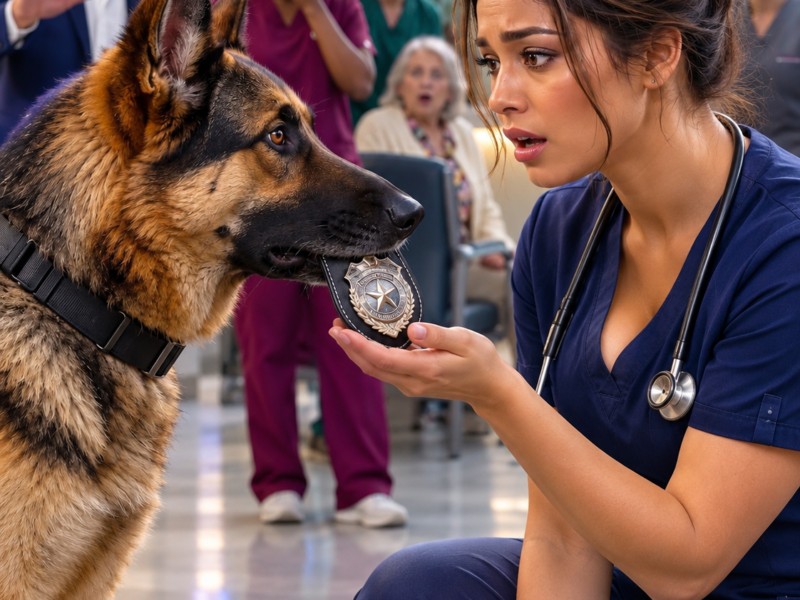
“Nobody in the emergency room knew I had once worn a federal badge, trained police K9s, and spent nine years hunting some of the most dangerous fugitives in the country.
The first person through the emergency room doors was a man I recognized before I could make out his face.
Deputy Colt Havford.
He had been my supervisor for nearly six years. He was the one who had signed off on Ranger’s final certification, the one who had stood beside me in the hospital after the shooting, and the one who had watched me hand in my badge three years ago.
He stopped just inside the room.
His eyes moved from the wounded deputy on the bed to Ranger, then finally to me.
For a moment, neither of us spoke.
“Tegan?”
I felt the old instinct rise in my chest. Stand straight. Give your name and rank. Report the situation. Keep your emotions out of it.
But I wasn’t wearing a uniform anymore. I had a hospital ID clipped to my scrubs and a pair of latex gloves tucked into my pocket.
“Hello, Colt,” I said.
He looked as though he had seen a ghost.
Behind him, two federal agents hurried toward the bed. One immediately began giving a report to the attending physician. The other moved to secure the area.
Colt didn’t follow them.
He kept looking at me.
“I heard there was a medical emergency,” he said slowly. “I didn’t expect to find you here.”
“I’m a nurse now.”
“I can see that.”
His gaze dropped to the silver badge resting in my palm.
I hadn’t realized I was still holding it.
Ranger stood beside me, his body pressed close to my leg. His ears were forward, his eyes fixed on my face. He hadn’t behaved this way with anyone else since arriving.
Colt crouched and held out a hand.
“Hey, partner.”
Ranger glanced at him but didn’t move.
That surprised me. Ranger had always been friendly with Colt. They had worked together during training exercises, and Colt had been one of the few people Ranger trusted without hesitation.
But right now, Ranger seemed to have only one concern.
Me.
Colt noticed.
“He remembers you,” he said.
I looked down at the dog.
“I know.”
“No,” Colt replied quietly. “I mean he remembers you. All of you.”
Something tightened in my throat.
I turned away before he could see it.
“Your deputy needs treatment,” I said. “He had a tension pneumothorax. I recognized the signs before the situation deteriorated.”
Colt’s expression changed immediately.
“Who treated him?”
“I initiated the emergency decompression after Dr. Ashby ordered a chest tube.”
“And the patient?”
“His breathing improved. He’s stable for now, but he needs continued evaluation and definitive treatment.”
Colt nodded, absorbing every word.
Then he looked toward Dr. Preston Ashby.
“Doctor, I’d like to understand what happened.”
Ashby stood near the foot of the bed, his arms folded tightly across his chest. His face had lost the confidence he usually wore like a second coat.
“We were managing a complex trauma case,” he began. “The nurse intervened before I had completed my assessment.”
Colt didn’t blink.
“Did she save his life?”
Ashby hesitated.
“The intervention was medically appropriate.”
“That isn’t what I asked.”
The room became very quiet.
Ashby looked toward the deputy, then back at Colt.
“Yes,” he said finally. “It appears her intervention prevented a fatal delay.”
Colt turned toward me.
“That’s what I thought.”
I wanted to tell him it wasn’t a miracle. It was training. It was observation. It was knowing what happened when pressure built inside a chest and the lungs could no longer expand.
But I also knew what he was really asking.
He was asking whether the woman who had once led a federal apprehension team was still in there.
I wasn’t sure I knew the answer.
Colt approached the bed and checked on the wounded deputy. He spoke briefly with the medical team, then stepped back toward me.
“Can we talk?”
“I’m working.”
“I know. Five minutes.”
I glanced at the patient.
Another nurse had taken over monitoring him. The emergency physician was preparing for the next stage of treatment.
I nodded.
Colt led me into the hallway.
Ranger followed.
The moment the doors closed behind us, Colt exhaled.
“Three years,” he said.
“Almost.”
“You never called.”
“I didn’t know what to say.”
“You could have said you were alive.”
“I was alive.”
“That isn’t the same thing.”
I looked down at the badge in my hand.
He wasn’t angry in the way I had expected. He sounded tired. Maybe he had been carrying the same unanswered questions I had.
“I couldn’t go back,” I said.
“I never asked you to.”
“You didn’t have to.”
Colt studied my face.
“You thought we were waiting for you to come back and lead another unit.”
“Weren’t you?”
“No. We were waiting for you to stop believing your injury made you useless.”
The words hit harder than I expected.
I tightened my fingers around the badge.
“My hand still shakes when I hold something too long.”
“I know.”
“I can’t shoot the way I used to.”
“I know that too.”
“I can’t run a field operation with the same confidence.”
Colt shook his head.
“Tegan, nobody is asking you to.”
I looked at him.
He continued.
“You trained Ranger. You built a program that other units copied. You taught handlers how to read a dog’s behavior under pressure, how to recognize the difference between aggression and fear, how to keep a partner alive when everything went wrong. Those skills didn’t disappear because you were shot.”
I swallowed.
“I resigned.”
“You did.”
“I gave up the badge.”
“You handed it in. You didn’t give up what it meant.”
For three years, I had told myself leaving was the only way to survive.
I had packed away my old photographs, stored my training manuals in boxes, and stopped answering calls from people who still called me Deputy Marsh.
I had thought that if I stopped being that person, I might stop remembering the day everything changed.
But memories didn’t work that way.
They followed me into quiet hospital corridors. They waited beside empty kennels. They appeared in the middle of the night when I heard a dog barking outside my apartment.
And now Ranger was standing beside me, his warm shoulder against my knee.
Colt followed my gaze.
“He’s been different since you left,” he said.
“Is he still working?”
“He was retired after the injury.”
I looked at Ranger.
“He wasn’t supposed to be retired yet.”
“He wouldn’t settle with another handler. We tried. He did the training, followed commands, passed every evaluation. But he never bonded the same way.”
I crouched and rested my hand against his neck.
His fur was slightly rougher than I remembered. There were a few pale hairs around his muzzle now. His body was still powerful, but age had softened some of the sharpness in his movements.
“I’m sorry,” I whispered.
Ranger leaned into my palm.
Colt waited before speaking again.
“He’s been with the unit as a support dog, mostly demonstrations and controlled exercises. The deputy you helped today was transporting him back from a training evaluation when they were ambushed.”
“An ambush?”
“Two suspects opened fire during an attempted arrest. One deputy was hit. Ranger helped locate cover and stayed with him until backup arrived.”
I closed my eyes briefly.
Even after everything, Ranger had done exactly what he had been trained to do.
He had protected his partner.
“He’s still good,” I said.
Colt gave a small smile.
“He’s exceptional.”
I looked at him.
“Why did you bring him here?”
“The deputy insisted on coming to this hospital. He was conscious enough to tell us he wanted the best trauma team available. We didn’t know you worked here until we arrived.”
“And Ranger?”
“He recognized your name when the deputy mentioned it. Then he saw you.”
I looked down again.
Ranger had crossed three years of separation in a single moment. I had spent those years convincing myself that the life I left behind was gone.
He had never forgotten.
Colt slipped a hand into his jacket and pulled out a thin folder.
“I didn’t come here only to check on the deputy.”
I eyed the folder.
“What is that?”
“An offer.”
I didn’t take it.
“Colt…”
“Listen before you say no.”
“I haven’t said anything.”
“You’re already preparing to.”
That was fair.
He opened the folder and handed me the top page.
It was an official proposal from the federal training division.
The position was based at a regional training center. It involved developing K9 handlers, revising apprehension procedures, evaluating dog-handler teams, and teaching field personnel how to work safely with service animals under extreme pressure.
No routine field assignments.
No firearms qualification requirement.
No expectation that I would return to the physical demands that had once defined my work.
I read the first page twice.
“You want me to train handlers?”
“I want you to lead the program.”
“I can’t be in the field.”
“You won’t have to.”
“My hand—”
“Will be accommodated.”
“I don’t know if I’m ready.”
Colt nodded.
“That’s the first honest thing you’ve said to me today.”
I looked up sharply.
He didn’t back away.
“You’ve spent three years telling everyone you’re fine,” he said. “You tell your coworkers you’re happy here. You tell me you don’t want anything to do with the old life. But when Ranger walked into that room, you looked like someone had finally handed her a piece of herself back.”
I wanted to argue.
I couldn’t.
Colt tapped the folder.
“You would have a full training appointment, appropriate federal credentials, and credit toward your service retirement for the nine years you already completed. The administrative team has reviewed your record. Your prior service can be recognized under the applicable rules.”
I stared at the page.
“Nine years?”
“That’s what you earned.”
“I thought all of that was gone.”
“Your resignation ended your active service. It didn’t erase your record.”
The words settled slowly.
I had imagined my old career as a door that had slammed shut. I had never considered that something might remain on the other side, waiting for me to decide whether I wanted to open it.
“And Ranger?” I asked.
Colt’s expression softened.
“He can stay with you.”
I looked down at the dog.
“What does that mean?”
“It means he’s retired. He doesn’t have to work another day. If you accept the position, he can live with you as your companion. We’ll make sure his medical records and retirement arrangements are transferred properly.”
I couldn’t speak for several seconds.
For three years, I had wondered where he slept, whether he was comfortable, whether he still searched doorways for me.
I had wondered if he thought I had abandoned him.
Now he was standing beside me, waiting.
“Would he be happy with me?” I whispered.
Colt gave me a look that was almost a laugh.
“Tegan, he hasn’t taken his eyes off you since he arrived.”
I lowered myself to one knee.
“Ranger.”
His ears lifted.
I touched the side of his face, then rested my forehead briefly against his.
“Would you like to come home?”
His tail moved once.
Then again.
And for the first time in three years, I let myself cry.
Not loudly. Not dramatically.
Just enough to release the weight I had been carrying.
Colt looked away to give me privacy.
When I stood, he was holding out a pen.
“You don’t have to sign today,” he said.
“I know.”
“Take the folder home. Read everything. Talk to whoever you need to talk to.”
I glanced through the open doors toward the emergency department.
My patients were still there. The nurses were still moving between rooms. The monitors were still sounding their steady alarms.
I had built a life here.
It wasn’t a mistake.
That mattered.
“I need to give notice,” I said.
Colt nodded.
“Two weeks?”
“That’s fair.”
“Then we’ll make the start date work.”
I handed the folder back.
“I’ll read it tonight.”
“Good.”
He smiled slightly.
“And Tegan?”
“Yes?”
“It’s good to see you.”
I looked at him for a long moment.
“It’s good to see you too.”
The rest of my shift passed in a blur.
I checked on the wounded deputy before leaving. His breathing had improved, and the emergency team had completed the next stage of his treatment. He was exhausted, but awake.
Ranger was lying beside his bed.
When I entered, the deputy turned his head.
“Marsh,” he said.
I stopped.
“It’s Tegan.”
He gave a weak smile.
“Sorry. Habit.”
“It’s all right. How are you feeling?”
“Like I got hit by a truck.”
“Technically, you were shot.”
“Feels worse than a truck.”
I laughed despite myself.
He looked at Ranger.
“He wouldn’t leave my side.”
“I know.”
“Then he saw you.” The deputy’s voice softened. “I’ve never seen him react like that. Not even when his old unit showed up.”
I reached down and scratched behind Ranger’s ears.
“He’s always been dramatic.”
The deputy chuckled, then winced.
“Colt told me who you are.”
I sighed.
“I was hoping that wouldn’t become a hospital-wide announcement.”
“Too late. Apparently, you trained half the people I know.”
“That’s an exaggeration.”
“Maybe. But everyone knows your name.”
I glanced toward the door.
“Get some rest.”
He nodded.
Then, just before I left, he spoke again.
“Thank you for not letting them wait.”
I looked back.
“You’re welcome.”
I didn’t tell him that the decision had felt frightening. That I had been terrified of being wrong. That for one second, when Ashby dismissed me, I had felt like the inexperienced nurse everyone believed me to be.
I didn’t need to tell him.
He was alive.
That was enough.
The next morning, I requested a meeting with Dr. Ashby.
He looked uncomfortable when I entered his office.
“I wanted to speak with you about yesterday,” he said.
“So did I.”
He gestured toward the chair.
I remained standing.
“I reviewed the chart,” he continued. “The timeline is clear. You recognized the signs of tension pneumothorax and recommended immediate decompression. I should have listened sooner.”
“Yes.”
“I also understand that my comments toward you were inappropriate.”
“Yes.”
He looked down at his desk.
“I’ve been thinking about how I handled the situation.”
I waited.
He seemed to expect me to make it easier for him. To tell him it was fine, that emergencies were stressful, that everyone made mistakes.
But it wasn’t fine.
“You don’t have to respect my past,” I said. “You don’t even have to know anything about it. But when a nurse tells you a patient is deteriorating, you need to listen to the evidence before deciding whether you respect the person speaking.”
He nodded slowly.
“That’s fair.”
“And the documentation needs to reflect what happened. Not what would make the department look better.”
“I’ll correct it.”
“Thank you.”
He looked up.
“Are you leaving?”
The question caught me off guard.
“I haven’t decided when.”
“Colt mentioned a possible position.”
I raised an eyebrow.
“He talks too much.”
Ashby gave a brief, uncomfortable smile.
“Whatever you decide, I hope you know your work here has mattered.”
I studied him.
“I do.”
It was the first time I had said those words without needing someone else to confirm them.
I left his office and returned to the nurses’ station.
No one applauded. No one gathered around to congratulate me.
The day continued.
A patient needed pain medication. Another needed help walking. A family member had questions about discharge instructions. Someone spilled coffee near the medication room.
Ordinary things.
Important things.
For the first time, I understood that I didn’t have to reject one life to honor another.
Being a nurse had never been a disguise.
It was work I believed in.
And being a marshal had never been the only thing I was.
I could carry both.
Over the next two weeks, I finished my shifts and prepared to leave.
I told my closest coworkers first.
Some were surprised. A few were disappointed. One of the younger nurses, Hannah, looked genuinely upset.
“Does this mean you’re going back to law enforcement?”
“Not exactly.”
“What will you be doing?”
“Training federal K9 teams.”
Her eyes widened.
“You know how to do that?”
I smiled.
“I used to.”
She shook her head.
“I knew there was something about you.”
I laughed.
“There’s nothing mysterious about me.”
“That’s what makes it mysterious.”
She hugged me before I could answer.
I promised to stay in touch, although we both knew schedules would make that difficult.
On my final shift, Dr. Ashby came to the nurses’ station.
He held out a small envelope.
Inside was a handwritten note.
It wasn’t elaborate. He acknowledged that he had underestimated me and said he hoped the department would learn from what happened.
I folded it and put it in my bag.
It wasn’t forgiveness.
It was a beginning.
That evening, I walked out of Harborview General for the last time as an employee.
Ranger waited in the passenger seat of my car.
He had been with me since Colt brought him home three days earlier. At first, he had followed me from room to room, refusing to sleep unless he could see me.
The first night, I woke to find him lying beside my bed.
The second night, he brought an old training toy from his bag and placed it near my feet.
By the third, he had begun to relax.
He was home.
I opened the passenger door.
“Ready?”
His tail thumped against the seat.
“Good.”
I drove away from the hospital without looking back.
Not because I was running from it.
Because I was ready to move forward.
The federal training center was quieter than I remembered.
The buildings had been renovated, the kennels expanded, and the old outdoor training field had been replaced with a larger complex.
But the smell was the same.
Grass. Leather. Wet dog.
And the faint metallic scent of equipment stored in the training rooms.
I stood at the entrance with my new credentials in my hand.
For a moment, I couldn’t make myself walk inside.
Ranger stood beside me.
His ears were alert.
A young handler approached from the main building. She had a training vest over her uniform and a notebook tucked beneath one arm.
“Deputy Marsh?”
I looked at her.
“That’s me.”
“I’m Officer Lena Ortiz. They told me you’d be arriving today.”
She glanced down at Ranger.
“And this must be Ranger.”
He sniffed her hand.
She smiled.
“I’ve heard a lot about both of you.”
I gave her a cautious look.
“Hopefully nothing too embarrassing.”
“Mostly that you built the original apprehension curriculum.”
I sighed.
“Colt really does talk too much.”
She laughed.
“I’m assigned to your first training group. We’ve got six new handlers starting this week.”
I looked toward the field.
Six people.
Six dogs.
Six partnerships that would depend on patience, trust, and the ability to understand one another when words weren’t enough.
It was a responsibility I recognized.
And one I had missed more than I wanted to admit.
“Let’s meet them,” I said.
Lena led me across the training center.
The handlers stood in a loose line near the equipment racks. Their dogs were restless, curious, and eager to move.
Some of the handlers looked nervous.
One young man kept adjusting his gloves. Another was trying to quiet a dog that had become distracted by Ranger.
I recognized the expressions.
I had worn them myself.
“Good morning,” I said.
They straightened.
“My name is Tegan Marsh. I’ll be working with you throughout your training.”
I paused, looking from the handlers to their dogs.
“I don’t expect you to know everything today. I don’t expect your dogs to behave perfectly. And I don’t expect either of you to be fearless.”
A few people relaxed.
“But I do expect you to pay attention. Your partner will communicate with you constantly. Sometimes through a bark. Sometimes through a movement you almost miss. Sometimes by refusing to do what you ask.”
I glanced at Ranger.
“And sometimes, your partner will know something is wrong before you do.”
The group grew quiet.
“Your job isn’t to force obedience. It’s to build trust. If you don’t understand your dog, you can’t safely lead it. If your dog doesn’t trust you, you don’t have a partnership. You have a risk.”
I walked toward the first handler.
“Let’s start with introductions.”
The young man with the restless dog stepped forward.
“Officer Daniel Price.”
His dog strained toward Ranger.
“What can you tell me about him?” I asked.
Price hesitated.
“He’s excited.”
“Maybe. What else?”
He watched the dog.
“His ears are forward. He’s leaning toward Ranger, but his weight is still back.”
“Good. What might that mean?”
“He wants to approach, but he’s uncertain.”
I nodded.
“Exactly. Give him space. Let him decide when he’s ready.”
Price relaxed his lead.
The dog stopped pulling.
A small thing.
But it mattered.
I moved down the line, asking questions, watching the dogs, and listening to the handlers.
The work came back naturally.
Not because I had forgotten it.
Because it had never left.
At the edge of the field, Ranger settled in the shade.
He watched me work.
Every so often, I glanced toward him.
He was older now. His muzzle had turned gray, and he no longer moved with the explosive speed he once had.
But when I looked at him, I didn’t see a retired working dog.
I saw my partner.
And I saw the one who had brought me back to myself.
At the end of the first week, Colt visited the training center.
He stood near the fence while I worked with the final group of handlers.
When the exercise ended, he approached.
“How does it feel?”
I removed my gloves.
“Different.”
“Good different?”
I considered the question.
“I’m not sure yet.”
He looked toward the dogs.
“That’s normal.”
I watched one handler kneel beside his partner and reward the dog for returning calmly.
A few weeks earlier, that same handler had been so nervous he could barely hold the lead.
Now he was learning to recognize the small signals that made a partnership work.
“I think they’re going to be good,” I said.
“They’re lucky to have you.”
I shook my head.
“They’re doing the work.”
Colt smiled.
“You always were better at giving credit away than taking it.”
I looked at him.
“Someone has to remind you that you’re not allowed to become unbearable.”
He laughed.
Then his expression softened.
“I’m glad you came back.”
I looked across the field.
“I didn’t come back to the same place.”
“No?”
“No. I came back as someone different.”
He nodded.
“That might be better.”
Ranger walked toward us, carrying his old training ball.
He dropped it at my feet.
I picked it up and rolled it gently across the grass.
He followed at an easy pace, not chasing it with the urgency of his younger years.
When he returned, he leaned against my leg.
Colt watched him.
“He seems happy.”
“He is.”
“And you?”
I looked at the training field.
At the handlers learning to trust their dogs.
At the dogs learning that their handlers would listen.
At the life I had thought was over.
For three years, I had believed that losing my ability to do the old job meant losing the person I had been.
I had mistaken a limitation for an ending.
My hand still hurt sometimes. I still couldn’t grip a firearm the way I once had. There were mornings when the memories came back without warning.
Nothing about the past had been erased.
But it no longer had to be.
I could be proud of the woman who had worn the badge.
I could be proud of the nurse who had saved a deputy’s life.
And I could be proud of the woman standing here now, teaching others to protect the partners who trusted them.
I bent and picked up Ranger’s ball.
“Come on, partner.”
He lifted his head.
We walked toward the field together.
This time, I wasn’t leaving anything behind.
The end.









