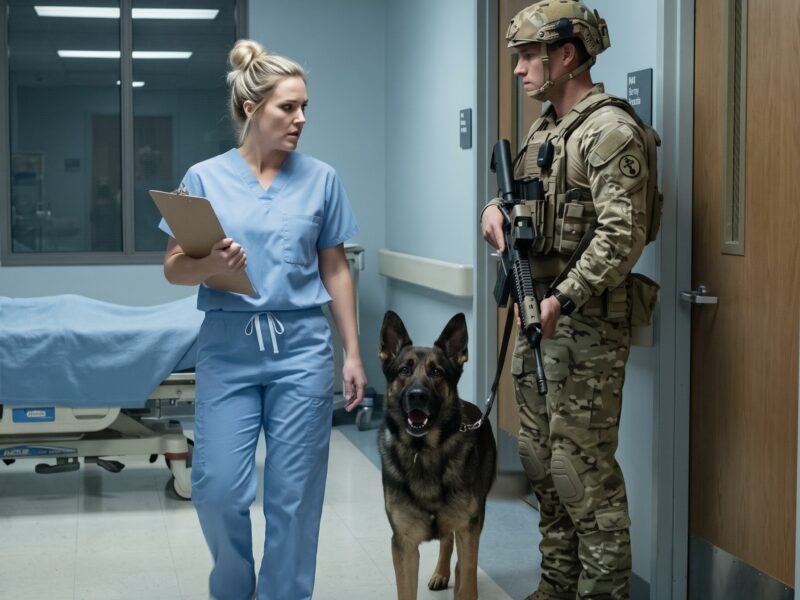
Nobody at the hospital knew I had once served in a classified military unit, until a Navy SEAL K9 broke formation in the emergency room
The air in the trauma bay of St. Jude Memorial always tasted of copper, dried chlorine, and cheap industrial wax. At 0214 hours, it carried something else: the high-altitude desert chill that clings to Kevlar when a rotor wash strips the sand off an extraction pad.
I knew that smell. I had scrubbed it from beneath my fingernails for nearly three thousand nights, yet my nervous system recognized it before the pneumatic doors had even hissed open.
“Inbound trauma, two minutes out!” Nurse Manager Higgins shouted, slamming a clipboard onto the nurses’ station. Her scrub cap was askew, revealing graying roots damp with sweat. “Gunshot wound, thoracic penetration, high blood loss. We have a federal escort coming through Bay 4. Clear the corridor!”
I didn’t move fast. In civilian medicine, speed was often mistaken for competence, but in the places I had come from, haste meant you had already lost your perimeter. I pulled a pair of nitrile gloves from the box on the wall, the snap of synthetic rubber against my wrist sharp and rhythmic. Underneath the blue cuff, my fingers checked the tension of my watchband—an old digital Casio, plain black plastic, hiding the irregular ridge of keloid tissue that ran from my pisiform bone three inches up my anterior forearm.
To the hospital directory, I was Donald Vance, RN. Steady, unremarkable, quiet. The kind of night-shift float nurse who never complained about weekend rotations, never drank at the pub down the street after a shift, and whose personnel file showed an unblemished nursing degree from a modest midwestern college. A ghost story printed on twenty-pound bond paper.
Then the bay doors blew inward.
The tactical paramedicine team didn’t look like our usual county flight medics. They wore non-standard arid digital trousers, ceramic-plated chest carriers stripped of morale patches, and tactical communications headsets resting behind their ears. Between them was a rolling transport gurney, moving so fast the heavy polyurethane casters shrieked against the linoleum.
On the gurney lay a man whose face had gone the color of damp parchment. A chest seal was taped over his right pectoral, bubbling with pink froth at the lower margin. His jaw was clenched so hard the masseter muscles looked like walnuts beneath his stubbled skin.
Behind the gurney came the handler. He was a broad-shouldered Master Chief with salt-and-pepper stubble, eyes rimmed with exhaustion, holding a heavy nylon lead. At the end of that lead was a Belgian Malinois.
The dog was wearing a lightweight desert-camo load-bearing harness. He wasn’t panting. His ears were upright, swiveling on independent axes, and his golden eyes cut through the emergency room with the calculated, predatory assessment of an animal trained to find explosive charges beneath three inches of hard-packed earth.
“Get him to Trauma 1!” Dr. Sterling barked, wheeling into the room with his hands held high in sterile fashion. “Vance, hang two units of O-negative on the rapid infuser. Let’s see what we’ve got beneath that dressing.”
I moved to the right side of the gurney, my shears already out to cut through the blood-soaked combat shirt. My movements were automatic, measured to keep my heart rate below sixty.
“Easy, Atlas,” the handler murmured, his voice a low gravel rasp as he shortened the leash. “Heel.”
The dog didn’t heel.
The moment my left hand came down toward the patient’s radial pulse, the Malinois went rigid. Every muscle along his eighty-pound frame locked into iron cords. His ears pinned flat against his skull, not in fear, but in pure, unmistakable recognition.
“Atlas, sit,” the handler commanded, his tone hardening with authority.
The dog ignored him completely. He broke his stance, leaned his weight forward against the braided lead, and stepped into my space. The handler jerked the strap, but Atlas was too determined; the nylon slipped through the Master Chief’s gloved palm.
My hands froze half an inch above the patient’s chest.
The Malinois crossed the two feet of linoleum separating us, his tactical collar clicking against the steel guardrail of the gurney. He didn’t bare his teeth. He didn’t bark. He lifted his black-masked snout, inhaled once—deep, shuddering—and pressed the wet, cold tip of his nose directly against the inside of my left wrist.
My blood turned to slush.
“Atlas! Back!” the handler barked, lunging forward to grab the dog’s vest. “What the hell are you doing?”
Atlas didn’t budge. He dropped his hindquarters onto the blood-spattered tile, sat squarely on my feet, and leaned his entire body weight against my shins. It was the designated post-search alert signal.
“That’s… that’s impossible,” the handler muttered, his eyes narrowing as he looked from the dog to my face. “He doesn’t break for strangers. Ever. He’s trained on three handlers in Coronado and two forward-deployed teams.”
“He’s probably confused by the blood, Chief,” I lied, forcing a dry, flat smile that didn’t reach my eyes. “The room smells like an abattoir. It happens with service animals.”
“He’s not a service animal,” the handler said, his voice dropping an octave, cold and analytical. “He’s a Multi-Purpose Canine with three combat tours. He doesn’t get confused.”
Atlas lowered his head. With agonizing precision, he nudged the blue cuff of my scrub sleeve with his teeth, pulling the fabric back two inches.
There it was.
The scar wasn’t a surgical line. It was a ragged, jagged starburst left by the fragment of an RPG-7 warhead that had detonated against a mud-brick wall in the Helmand Province nine years earlier, followed by three irregular incisions where I had taken a field scalpel to my own arm under red-lens flashlight to extract the copper casing before the sepsis took the limb.
The handler’s pupils contracted. His hand drifted down toward his tactical belt, hovering inches from his sidearm before he remembered he was in a civilian facility.
“Where did you get that?” the handler asked.
“Motorcycle accident,” I said without missing a beat, yanking the sleeve back down to my knuckles. “Eight years ago. Let’s focus on your boy here, Chief. His systolic is dropping into the seventies.”
Atlas whined. It was a strange, high-pitched vocalization that sounded completely unnatural coming from an animal that looked like a timber wolf. Then, slowly, the dog raised his left paw and brought it down against the waxed floor.
Tap.
He lifted it again.
Tap.
A third time.
Tap.
Three strikes. The old extraction signal. Green light. LZ secure.
The wounded man on the gurney let out a ragged, choking gasp. His hand, caked in desert grit and dried plasma, reached out blindly, grabbing the front of my scrub top with fingers like iron calipers. He hauled himself up two inches from the mattress, blood bubbling over his lips as his fevered eyes locked directly onto mine.
“Shadow?” he rasped.
The word hit the small trauma bay like a hand grenade.
The emergency room seemed to drain of all light, all ambient noise, leaving only the high-pitched whistle of my own pulse in my ears. Dr. Sterling looked up from the chest tube tray, bewildered. Nurse Higgins froze with an IV line in her hand.
“Shadow…” the wounded SEAL whispered again, tears cutting pale rivers through the soot on his cheeks. “They… they said you were burned inside the vehicle. They said nothing came out of the ravine.”
“Lie back,” I ordered, my voice dropping the flat midwestern cadence of Donald Vance and slipping, against every survival instinct I owned, into the harsh, clipped rhythm of a tier-one forward operator. “Keep your seal shut or your lung collapses, Miller. Breathe through your nose.”
His eyes widened in wild, desperate relief. “You were there.”
“I was there,” I whispered, pressing my gloved palm flat against his sternum, forcing him back down onto the mattress. “Now shut your mouth and let me patch the hole in your chest.”
His grip on my scrubs loosened, his head falling back as the sedation began to take hold. “You saved my life in the valley… but they’re hunting… they’re hunting what was left behind…”
Before I could ask what he meant, Atlas stood up, spun toward the locked utility supply room at the end of Bay 4, and let out an ear-shattering, percussive bark that rattled the ceiling tiles.
The dog wasn’t looking at the patient anymore. He had dropped his head low, his lips pulling back to reveal ivory fangs, snarling at the reinforced steel door of the supply closet—a room that was supposed to contain only sterile gauze, saline bags, and surgical trays.
“Security!” Nurse Higgins shrieked, backing away from the dog. “Someone get security down here!”
The handler didn’t call security. He drew a small, heavy folding knife from his pocket, flipped the serrated blade open, and walked directly toward the supply room door. “Step back, Vance. Or whatever your name is. Atlas smells cordite.”
The handler kicked the lock cylinder. The cheap hospital latch buckled instantly under his combat boot.
The door swung back into the darkness.
Inside, sitting squarely on top of an overturned stainless-steel laundry cart, was a battered, grease-stained black duffel bag. It was military issue, nylon-cordura, weathered by sun and salt. Stitched into the center of the flap, faded from black into a sickly charcoal gray, was an embroidered patch: an inverted trident gripped in the claws of an eagle without eyes.
Task Force Obsidian.
My stomach dropped into a void. I hadn’t seen that insignia since the night I walked away into the desert with a forged discharge paper, two fractured ribs, and thirty-four thousand dollars in serialized cash.
The handler turned to look at me, his eyes dead and cold. “That’s yours.”
“No,” I said, my voice barely a whisper, though my fingers were already drifting toward my pocket, checking for the small surgical scalpel I kept tucked behind my badge. “That’s impossible. I burned everything in the furnace behind the compound.”
“Then someone brought it back from the ash,” the handler said, reaching down with the tip of his blade and catching the brass zipper pull.
The heavy nylon parted with a dry rasp.
Inside lay no weapons, no ammunition, no classified satellite drives.
There was only a single, laminated photograph resting atop an unrolled poncho. Six men in arid camouflage, standing shoulder-to-shoulder in the blinding sun outside an unmapped hangar in Kandahar.
Five of the faces had been crossed out with thick, permanent red ink.
The sixth face—my face, eight years younger, with greasepaint around my eyes and a combat medic’s cross painted on my helmet—was circled in black.
Beneath the photograph, written in neat, mechanical handwriting using red grease pencil, were four words:
One survivor remains.
Atlas suddenly ceased his growl. He spun toward the glass entrance of the emergency room, his body dropping into an attack crouch, emitting a sound that was less a growl and more a seismic rattle of sheer hatred.
I turned my head.
Standing just beyond the sliding glass doors, beneath the buzzing yellow fluorescent tube of the ambulance bay awning, was a man in an expensive charcoal-wool overcoat. His silver hair was cropped in a precise military taper. His hands were tucked deep into his pockets, shielding him from the cold drizzle that had begun to fall.
He looked directly through the glass, through the bustling nurses, through the blood on the floor, and his eyes found mine.
A thin, razor-sharp smile touched his lips.
The air left my chest in a single, painful hitch. I knew that face. I had watched that face sign the authorization forms for the mission that had killed my entire squad.
Major General Arthur Cross. The man who had officially certified my death certificate eight years ago.
Cross didn’t make an aggressive move. He didn’t draw a weapon. He stood under the dripping awning like an executive waiting for a town car, but the stillness of his posture was the stillness of an executioner who had already checked the rope twice.
“Sterling,” I said, my voice low and level, not taking my eyes off the figure beyond the glass. “You need to take Miller into the OR right now. If that chest seal slips while you’re standing here staring, he bleeds out into his pleural space.”
Sterling blinked, torn between the surreal scene unfolding in his ER and his medical training. “Vance, what the hell is going on here? Who is that man? Why does this dog—”
“Now, Doctor,” the handler interrupted, stepping into Sterling’s peripheral vision. The Master Chief’s hand was inside his jacket now, resting on the grip of a concealed Sig Sauer. “Move the patient. The civilian staff needs to clear this wing. Official business.”
Sterling looked at the handler’s eyes, swallowed hard, and barked an order to Higgins. Within thirty seconds, the gurney was rolling again, tires screaming as they turned the corner toward the surgical suites. Atlas stayed where he was, his shoulder pressed against my leg, refusing to move with his handler.
The handler looked at the dog, then looked at me. “He thinks you’re the mission lead. His name is Master Chief Harris. Atlas hasn’t listened to a command from me since we took fire on the ridge six hours ago. Why does he know you?”
“Because I trained his mother,” I said, my voice flat. “Ten years ago at DEVGRU kennel operations in Dam Neck. Her name was Vesper. She had the same three-tap signal when she found a survivor in the rubble. He didn’t learn it from a manual; he inherited it.”
Harris’s face tightened. “Vesper was retired after the desert sweep in twenty-sixteen. The only handler who worked her line was Master Sergeant Nathan Drake.”
“Nathan Drake is dead,” I said, looking down at my hands. “Buried in Section 60 at Arlington. I’m Donald Vance.”
“Drake’s body was never recovered,” Harris countered, stepping closer. “They found his helmet and four liters of blood in the burned hull of a tactical transport outside Farah. The official report said the local insurgents incinerated the wreckage with white phosphorus.”
“Cross wrote that report,” I murmured, nodding toward the glass doors.
Outside, the man in the charcoal coat had not moved, but two other men had stepped out from the shadows of the ambulance parking structure. They wore black rain jackets, plain khakis, and had the thick necks and balanced gaits of private military contractors. They were positioning themselves at the northern and southern flanks of the sliding doors.
“They aren’t here for Miller,” Harris realized, his jaw setting into iron. “Miller was bait.”
“Miller wasn’t supposed to survive,” I said, the pieces of the puzzle snapping together with horrific clarity. “Cross didn’t know where I was. For eight years, I left no digital footprint. Cash only, no passport, no bank accounts, medical license obtained through a third-party paper mill in Delaware. But Miller… Miller was the only other man who knew my operational call sign was ‘Shadow.’ When Miller got hit on the ridge tonight, Cross knew he’d be brought to St. Jude’s. It’s the only Level 1 trauma center within sixty miles of the clandestine airfield at Fort Meade.”
“And if Miller survived the extraction,” Harris whispered, “Cross knew the medic on duty who specialized in military thoracic wounds would be pulled into Bay 4.”
“Cross didn’t just find me,” I said, looking back at the black duffel bag on the laundry cart. “He planted the bag before the ambulance even landed. He owns the private security firm that contracts this hospital’s night watch.”
Atlas let out a sharp, muted bark.
The glass doors slid open with a smooth mechanical hum. The cold night air rolled into the bay, carrying the smell of wet pavement and diesel exhaust.
General Cross stepped across the threshold, his Italian leather shoes clicking against the linoleum. The two contractors followed him, their hands tucked inside their jackets, eyes scanning the corners of the room for cameras and witnesses.
“Master Sergeant Drake,” Cross said, his voice cultured, resonant, like an academic lecturing a lecture hall. “Or do you prefer Donald? It seems remarkably uninspired for a man of your creative talents.”
“General,” I said, standing my ground. Atlas moved six inches forward, his black lips curling back to expose white teeth, a continuous, low-frequency growl rumbling in his throat. “You’re out of your jurisdiction. This is a civilian county hospital.”
“I have no jurisdiction, Nathan,” Cross said smoothly, stopping eight feet away. “I retired from the Agency two years ago. I am now simply a private consultant for several defense logistics firms. Firms that have a great deal of interest in ensuring certain… accounting discrepancies from our operations in Helmand remain permanently classified.”
“The thirty-four million in missing gold bullion from the provincial bank,” I said.
Cross sighed, an exaggerated, theatrical sound. “You always were so terribly pedestrian about the money. It wasn’t about the bullion, Nathan. It was about the network. The logistics chain we built through the border passes. But you and your little squad of moralists decided that intercepting that shipment was an act of treason. You threatened to report it to the Inspector General.”
“And you solved the problem by calling in an airstrike on your own men,” I said, every word like cold iron in my mouth.
“I called in an airstrike on a compromised position,” Cross corrected, his eyes devoid of any human warmth. “War is messy. Collateral damage is unfortunate. The tragedy was that you managed to drag yourself into the drainage ditch before the thermite could do its work. And then, instead of dying quietly like a good soldier, you stole a civilian identity and hid behind a nurse’s smock.”
“Five men died in that ditch, Cross,” I said, my voice dropping so low Harris had to strain to hear it. “Good men. Men who trusted you.”
“And they have lovely headstones in Virginia,” Cross replied. “Which brings us to the present dilemma. The photograph in the bag. You see, the other four survivors of the task force—the support personnel who weren’t in the vehicle—have all suffered unfortunate accidents over the past six months. A car crash in Bavaria. A drowning in Key West. A house fire in San Diego. It’s tidy. But you were the loose thread.”
“And Miller?” Harris barked, his hand clearing his holster now, revealing the matte-black slide of his pistol. “Miller is an active-duty SEAL, Cross! You don’t touch him!”
“Miller was an operational oversight,” Cross said, not even looking at Harris. “He should have died on the ridge. The fact that he lived long enough to say your name in this room was an inconvenience. But an easily rectified one.”
Cross raised his right hand, two fingers extended.
The two contractors behind him didn’t draw handguns. They reached into their rain jackets and pulled out compact, suppressed submachine guns—B&T MP9s, lightweight, lethal, and virtually silent.
“The entire wing’s surveillance system went offline three minutes ago,” Cross whispered. “The hospital will report an unfortunate shooting involving a deranged veteran and a rogue service dog. The tragic death of Nurse Vance will be noted on the local evening news. A ten-second segment.”
Atlas didn’t wait for a command.
He didn’t wait for me to speak, and he didn’t wait for Harris to raise his weapon. With an explosive, concussive leap that launched him five feet through the air, the eighty-pound Malinois hit the contractor on the left squarely in the chest.
The impact sounded like a car door slamming shut.
The contractor went down hard, his submachine gun discharging into the ceiling tiles in a muffled, sputtering burst of suppressed fire: pfft-pfft-pfft. Dust and fiberglass rained down on the gurneys.
“Take them!” Harris roared, firing two rounds directly at the second contractor.
The ER erupted into violence.
The second contractor was fast. As Harris’s first round punched through the heavy wool of his jacket, grazing his left shoulder, he spun behind the steel partition of the nurses’ station, his weapon spitting a controlled three-round burst that shattered the glass medication cabinets above my head.
Vials of potassium chloride, morphine, and sterile water detonated into a cloud of liquid and razor-sharp crystal shards.
I didn’t draw a gun; I didn’t have one. But an emergency room is not an office; it is an armory of biological and chemical hazards, high-pressure gases, and hardened steel blades.
Before Cross could react, I grabbed the heavy, five-liter pressurized steel cylinder of medical oxygen from the rolling cart beside me, twisted the main valve fully open with a violent snap of my wrist, and hurled the entire canister like a javelin across the linoleum.
The high-pressure gas roared out of the nozzle like a miniature jet engine, spinning the fifty-pound cylinder across the floor directly into Cross’s shins. The impact swept the retired General off his feet with a sickening crack, sending him crashing into the stainless-steel scrub sink.
“Harris, right flank!” I yelled, dropping to my stomach as the contractor behind the desk leaned out to line up a shot on the Master Chief.
Harris didn’t have the angle. But Atlas did.
The Malinois had already shredded the forearm of the first contractor, incapacitating the man’s weapon hand with the terrifying, bone-crushing efficiency of a military working dog. The moment he heard my voice, Atlas released his grip, scrambled over the fallen man’s body, and vaulted the four-foot counter of the nurses’ station like a shadow.
A choked, strangled scream echoed from behind the desk, followed by the clatter of a dropped weapon and the sound of eighty pounds of muscle thrashing a man against the computer terminals.
“Cross is on his feet!” Harris yelled, firing another round down the corridor to suppress the first contractor, who was crawling toward a fallen weapon with his left hand.
I lunged forward, sliding across the wet linoleum through the puddle of shattered saline and blood, my hand finding the heavy stainless-steel bone mallet that had been set out for Miller’s emergency orthopedic prep.
General Cross was struggling to rise, his face smeared with blood where he had struck the rim of the sink, his fingers fishing inside his overcoat for a backup piece.
I hit him.
I didn’t strike his head; that would have killed him too quickly. I brought the steel mallet down onto the radial nerve cluster of his right arm. The bone didn’t break, but his arm went completely dead, his fingers opening involuntarily to drop a titanium-framed compact .380 onto the floor.
I kicked the gun under the medication carts, grabbed Cross by the throat with my left hand, and slammed his skull back against the tile wall with enough force to crack the grout.
“Eight years,” I hissed into his ear, my breath hot against his bloody skin. “Eight years I cleaned bedpans and held the hands of dying grandmothers to wash the smell of your war out of my skin. And you bring it into my hospital?”
Cross coughed, a wet, bloody chuckle bubbling from his throat. Even pinned against the wall, his eyes held that impenetrable, sociopathic arrogance of men who believe they own the world because they have clearance badges.
“You… you never understood the mission, Drake,” Cross wheezed, his good hand clawing uselessly at my fingers around his throat. “You were an instrument. Just like the dog. Just like the boys in the ditch. Tools get dull. Tools get… replaced.”
“Nathan!” Harris shouted from the entrance of the bay. “We have company outside! Black SUV just pulled onto the ramp! Three more men, heavy gear!”
I looked through the shattered glass. The headlights of a Cadillac Escalade were blazing through the drizzle, cutting through the steam rising from the ambulance dock. The private security team had called in the cleanup crew.
“Miller,” I said, my mind calculating time, distance, and blood loss with the cold, crystalline precision of a combat medic on a hot LZ. “If they breach the surgical wing, Miller dies on the table. Sterling won’t survive the crossfire.”
“Atlas!” I barked.
The dog leaped back over the nurses’ station, his muzzle dark with blood, his chest heaving, but his ears locked forward, waiting for the directive.
“Guard the door,” I commanded, pointing to the double doors leading into the OR corridors.
The Malinois turned without hesitation, trotting to the threshold, planting his paws wide, and dropping his snout toward the gap beneath the doors. No one would pass him while he had breath in his lungs.
“Harris,” I said, turning to the Master Chief. “Strip their gear. Give me the submachine gun and the extra magazines. You take the General.”
Harris didn’t hesitate. He was an operator; he recognized when the chain of command had shifted. He snatched the dropped MP9 from the linoleum, kicked the unconscious contractor behind the desk, and dragged the second man toward the utility closet, stripping two tactical vests and four magazines in less than twenty seconds.
“What’s the play, Drake?” Harris asked, tossing me the weapon.
The weight of the polymer receiver felt horribly familiar in my hands. The mechanical memory returned instantly: the balance, the safety selector under my thumb, the sight alignment. Donald Vance was gone. The nurse had been executed the moment the glass shattered.
“There’s an old service tunnel beneath the emergency wing,” I said, checking the chamber of the MP9 with a crisp metallic snap. “It connects to the central utility plant three hundred yards to the north, outside the security perimeter. It was built during the Cold War for fallout transit.”
“And Cross?”
“Cross is our boarding pass,” I said, hauling the General to his feet by his collar, twisting his broken arm behind his back until he let out a sharp, breathless gasp of pain. “He’s going to walk us to his car, or I’m going to perform an un-anesthetized tracheotomy right here on this floor with a plastic pen.”
Cross stared at me, the arrogance in his eyes finally cracking, revealing the small, frightened bureaucrat underneath the general’s stars. “You won’t do it, Drake. You’re a medic. You took an oath.”
“I took two oaths, Arthur,” I whispered, pressing the muzzle of the suppressed weapon directly beneath his chin, forcing his head back until his spine arched. “And the first one had no expiration date.”
The glass doors at the ambulance bay shattered completely as a heavy tactical ram smashed through the center pane.
The second wave had arrived.
The first flashbang detonated in the center of the trauma bay with a concussive, blinding fury that blew the remaining ceiling tiles into confetti and turned the air into an opaque soup of white magnesium smoke.
If I had been Donald Vance, the sound would have left me paralyzed, deafened, and blind on the linoleum.
But Nathan Drake had lived in the breach.
The moment I saw the black canister roll through the shattered glass, I had already hauled Cross behind the heavy lead-lined partition of the mobile X-ray unit, pulling Harris down with me. I clamped my eyes shut, opened my jaw to equalize the tympanic pressure, and counted the microseconds: one-thousand-one.
BANG.
The shockwave tore through the room, setting off the shrill, mechanical screech of every patient monitor in Bay 4.
Before the smoke could clear, I was on my feet.
“Atlas, with me!” I yelled.
The dog was already beside me, moving low through the swirling gray haze, his senses unaffected by the flash because he had tracked the contractor’s trajectory by vibration alone.
Two men in black tactical uniforms, carrying shortened carbines with mounted lights, moved through the breach in a standard two-man stack. Their weapon lights cut through the smoke in two blinding white needles.
I stepped out from behind the lead shield, leveled the MP9, and squeezed the trigger.
The suppressed weapon made a series of sharp, rhythmic clicks: clack-clack-clack.
The first operator took three rounds to the center chest plate. The ceramic stopped the penetration, but the kinetic transfer of three heavy nine-millimeter rounds at ten feet was enough to crack his sternum and knock him backward into the shattered glass.
Atlas didn’t give the second man time to adjust his aim. The dog hit his knee with the force of an artillery shell, tearing the lateral collateral ligament with a single savage twist of his neck. The man shrieked, his carbine firing wildly into the floorboards as he collapsed into the blood-slicked linoleum.
“Move!” I barked, grabbing Cross by his overcoat and dragging him toward the back of the emergency wing, where the heavy freight elevator was recessed into the concrete core of the building.
Harris covered the rear, firing single, disciplined shots into the smoke to keep the third contractor pinned behind the ambulance bay pillars.
We reached the elevator. I didn’t use the call button; I took the universal fire-service key from my badge lanyard, jammed it into the maintenance slot, and twisted it two clicks to the right. The heavy steel doors groaned and parted, revealing the cavernous, unpainted interior of the hospital’s subterranean freight lift.
“Inside!” I yelled.
Harris shoved the bleeding General onto the ribbed aluminum floor. Atlas followed, spinning instantly to face the open doors, his teeth bared, ready for the next target. I slammed the emergency lower override, and the lift dropped with a sickening, hydraulic lurch just as three rounds punched through the exterior doors, leaving jagged, inward-curling holes in the steel.
The descent was dark and slow. The air changed instantly, leaving behind the antiseptic smell of the ER and replacing it with the damp, mineral chill of seventy-year-old concrete and decaying pipe insulation.
“They have the perimeter covered,” Harris said, panting heavily as he reloaded his sidearm from a captured magazine. “If they have three teams on site, they have spotters on the roof and vehicles blocking the main boulevard.”
“They don’t know the basement,” I said, pulling Cross up by his lapels and dropping him onto an empty equipment dolly. “The hospital was expanded three times since nineteen-fifty. The modern blueprints show this level as a dead storage crawlspace. But during the Cold War, St. Jude’s was designated as a secondary casualty station for the naval annex at Anacostia. There’s an auxiliary steam tunnel that runs straight through to the municipal storm runoff canal beneath the railway yards.”
The elevator shuddered to a halt with a heavy, metallic clunk.
The doors opened onto an unfinished corridor of rough-cast concrete, framed by massive, sweating iron pipes wrapped in peeling asbestos canvas. The only illumination came from a string of low-wattage yellow construction bulbs that stretched into the distance like a runway of dying stars.
“Nathan,” Cross choked out, clutching his broken arm against his ribs. His face was gray now, the shock of his injuries beginning to overcome his adrenaline. “You’re… you’re making a mistake. You think… you think killing me ends this? The files… the encrypted ledger for the Helmand transfers… it’s on a private cloud server. If my biometric check-in fails at zero-six-hundred, the entire cache is released to the federal repository.”
“Good,” I said, checking the action of my submachine gun.
“You don’t understand!” Cross spat, blood spraying from his lips. “It doesn’t name me! I was an intermediary! The signatures on those procurement orders… they belong to the Undersecretary of Defense! They belong to the Chairman of the Intelligence Oversight Committee! If that file drops, half the Pentagon gets subpoenaed by noon!”
Harris froze, his eyes widening in the dim yellow light. “Jesus Christ, Drake. Is that true?”
“Of course it’s true,” I said, walking down the concrete corridor with Atlas matching my stride inch for inch. “Why do you think he tried to burn us alive eight years ago? Why do you think he had to kill five men who did nothing more than verify the serial numbers on those crates? It was never about the bullion. It was about the people who bought it.”
I stopped at a rusted iron hatch set into the concrete floor, secured by a heavy brass padlock.
I didn’t have the key. I raised the MP9, pressed the muzzle against the hasp of the lock, and fired two rounds. The brass shattered in a shower of hot sparks.
I kicked the hatch open.
A wave of cold, rushing air surged up from the black void below, carrying the distinct, earthy roar of moving water.
“Drainage canal,” I said, looking down into the darkness. “It’s a twelve-foot drop into three feet of runoff. The current carries directly out to the marsh flats behind the train depot. From there, we have cover for two miles.”
“And him?” Harris asked, gesturing toward Cross with his pistol.
Cross looked at the black hole in the floor, then looked at me. For the first time, the cold, calculating mask of the bureaucrat was completely gone, replaced by the naked, primal terror of a man who realizes the rules he lived by have been permanently revoked.
“Drake… please,” Cross whispered, his voice cracking into a dry sob. “I have a family. I have grandchildren. We can reach an accommodation. The Swiss accounts… there’s six million in bearer certificates in Zurich. You can have the keys. All of them.”
I looked down at the old general.
I saw the five faces from the photograph. I saw Sergeant Miller lying on that gurney thirty feet above our heads, his lung shredded by a bullet that had been paid for by the men Cross protected. I saw eight years of my own life, spent hiding in the shadows of sickrooms, scrubbing blood from floors that weren’t mine, terrified of every knock on the apartment door, all because this man had decided our lives were line items in a private balance sheet.
“You should have left me dead, Arthur,” I said softly.
Atlas stepped forward. The dog didn’t growl. He placed his massive paws on the edge of the open hatch, lowered his head, and looked into the dark water below.
Then, from the elevator shaft behind us, came the heavy, mechanical sound of steel cables screaming under sudden tension.
The counterweights were rising.
The second elevator was coming down.
The steel cables in the shaft didn’t just sing; they screamed like tortured iron. The indicator light above the freight doors flickered from Sub-Basement 1 to Sub-Basement 2.
They were dropping five men into our pocket, fully kitted, with night-vision systems and heavy automatic fire. In this narrow concrete corridor, there were no angles, no defilade, and no cover. If the doors opened, we would be cut in half before the first shell casing hit the floor.
“Harris,” I said, my voice completely devoid of emotion. “Get in the hole.”
“Drake, we take him with us,” Harris insisted, his hand tightening on Cross’s collar. “He’s the only witness who can clear your name with the Provost Marshal! Without him, you’re an AWOL medic who just murdered two security contractors in an active emergency room!”
“My name was cleared eight years ago when they carved it onto a granite wall in Arlington,” I said. “I don’t need a pardon from a government that let this man wear three stars.”
I shoved Cross forward. The General stumbled, his knees buckling on the wet concrete, falling hard beside the open hatch.
“Nathan!” Harris shouted.
“Take the dog and drop!” I roared, the voice of the squad leader ripping through the subterranean tunnel with the concussive power of a thunderclap. “That’s an order, Master Chief! Keep Miller alive! Tell him… tell him Shadow held the perimeter!”
Harris looked at my eyes. He was a veteran of twenty years in the Teams; he knew the look of a man who had already stepped across the threshold of his own funeral. He didn’t argue. He hooked his arm through Atlas’s harness.
“Atlas, down!” Harris yelled, pulling the dog toward the dark opening.
The Malinois resisted for a split second, his head whipping back toward me, letting out a single, agonizing whine of protest. But the training held. Atlas lunged feet-first into the black void, followed instantly by Harris, their bodies disappearing into the rushing roar of the subterranean drainage current below.
A heavy splash echoed up through the hatch, followed by Harris’s voice, distant and distorted: “Clear! Drake, get down here!”
I didn’t answer.
I reached out with my boot and kicked the heavy iron hatch shut. The rusted slab slammed into its frame with a concussive clang that shook the rust from the surrounding pipes. I took the bent, broken shackle of the padlock, jammed it through the locking eyelet, and smashed it flat with the receiver of the MP9, mushrooming the steel until the mechanism was permanently seized.
They wouldn’t be able to follow them. Not without a cutting torch.
I turned back to the elevator.
General Cross was sitting against the concrete wall, clutching his broken arm, watching me with wide, disbelieving eyes. “You’re… you’re staying? You’re committing suicide for an enlisted dog handler?”
“You never understood the difference between a unit and a payroll, Arthur,” I said, walking to the massive, five-inch industrial steam main that ran parallel to the ceiling directly above the freight elevator doors.
The pipe was ancient, installed in nineteen-fifty-two, carrying superheated steam from the municipal central boiler to the hospital’s sterilization autoclave network at two hundred and fifty pounds per square inch. The cast-iron inspection valve was coated in thick white lime and flaking red paint.
I raised the MP9.
“What are you doing?” Cross shrieked, scrambling backward on his elbows through the foul water on the floor. “The thermal expansion… it will level this entire foundation!”
“Not the foundation,” I said, setting the selector switch to fully automatic. “Just this corridor.”
The freight elevator hit the bottom stops with a concussive, hydraulic thud.
The heavy outer doors began to part. Through the four-inch gap, the black barrels of three tactical carbines emerged, their weapon lights cutting through the steam in blinding, surgical shafts.
Cross opened his mouth to scream a warning to his contractors.
I squeezed the trigger.
I didn’t fire at the men in the elevator. I dumped the entire thirty-round magazine of high-pressure nine-millimeter ammunition directly into the rusted, calcified valve body of the main steam conduit four feet above their heads.
The cast-iron casing didn’t just crack; it shattered under the kinetic impact and internal pressure.
A blinding, deafening roar tore through the tunnel—a concussive eruption of three-hundred-degree superheated steam that exploded from the ruptured main like a volcanic fissure.
The men stepping out of the elevator didn’t have time to raise their weapons. The atmospheric displacement hit them like an iron wall, followed instantly by a white wall of vapor that peeled the paint from the concrete, melted the insulation off the wiring, and turned the entire sub-basement into an inescapable pressure cooker of roaring white death.
I didn’t look at the result.
The moment the valve cracked, I had already thrown myself into the small, reinforced concrete drainage alcove beside the sump pumps, pulling a heavy lead-lined radiation blanket—discarded from the old radiology archives—over my head and back, pressing my face into the cold, damp concrete where the air was coolest.
The roar lasted for thirty seconds. It sounded like the world was tearing along its geographic seams.
The screams were short, violent, and quickly drowned by the mechanical fury of the escaping pressure. Pipes groaned, structural brackets buckled, and then, with a deafening series of electrical explosions, every light in the subterranean corridor popped, plunging the ruined tunnel into absolute, velvet darkness.
The steam began to thin, pulled upward through the elevator shaft by the massive natural draft of the burning building above.
Silence returned.
It was a thick, wet, agonizing silence, broken only by the steady, rhythmic dripping of condensation from the cracked ceiling and the distant, muffled wail of city fire sirens three floors above.
I pushed the heavy lead blanket off my shoulders.
The heat was still oppressive, blistering the exposed skin on the back of my neck, but the air was breathable. I pulled my tactical penlight from my pocket and clicked it on.
The narrow white beam cut through the lingering fog.
The elevator was a charred, twisted ruin of melted aluminum and peeling paint. The three men who had been inside lay motionless on the threshold, their tactical uniforms scorched, their equipment useless.
Beside the wall, five feet from the hatch, lay General Arthur Cross.
His expensive wool coat was ruined, soaked in gray runoff and white lime dust. He was still breathing, but his respirations were shallow, wet, and rattling—the unmistakable sound of lungs that had drawn in superheated steam.
He opened his eyes as the beam of my light hit his face. The arrogance was gone. The power was gone. There was only the blank, uncomprehending stare of a dying man who had discovered that his money could not negotiate with physics.
“Drake…” he whispered, a thin trickle of bloody fluid escaping his nose. “The… the ledger…”
“The ledger doesn’t matter anymore, Arthur,” I said, standing over him, my nurse’s uniform shredded, my skin blackened with soot, the scar on my wrist burning like a live brand. “Because when the federal agents come down this hall, they aren’t going to find an accounting error. They’re going to find you. And they’re going to find your men.”
Cross’s eyelids flickered once, twice, and then settled into the dull, fixed stare of the dead.
I didn’t take his watch. I didn’t take his wallet.
I walked to the corner of the corridor where the old storm runoff conduit intersected with the foundation wall. The blast had cracked the brickwork around the secondary overflow pipe, revealing a jagged opening three feet wide that led out into the dark, rain-soaked ravine behind the hospital grounds.
I squeezed through the gap.
The rain hit my face like needles of ice. It was cold, clean, and smelled of the river.
Above me, the silhouette of St. Jude Memorial loomed against the gray morning sky, its upper windows dark, red emergency lights pulsing silently through the mist. Fire trucks were already lining the front boulevard, their sirens cutting through the pre-dawn quiet, but out here, in the tall cordgrass behind the railway tracks, there was only the sound of the wind.
A low, familiar sound drifted through the scrub twenty yards down the embankment.
A soft, rhythmic thump against the wet earth.
Tap.
Tap.
Tap.
I stopped.
Out from the shadow of an overturned boxcar stepped Master Chief Harris, his uniform soaked in black mud, his sidearm holstered.
And beside him, his black coat gleaming in the cold rain, his ears upright, his tail moving with steady, quiet purpose, was Atlas.
The Malinois didn’t bark. He walked up the muddy slope, his pads sinking into the gravel, stopped six inches from my boots, and sat down squarely in the rain. He lifted his head, looked into my face with those unblinking, amber eyes, and pressed his nose firmly against my left wrist, directly over the scar.
Harris walked up behind him, stopping three paces away. He looked at my soot-covered face, then looked back at the smoke rising from the hospital’s lower levels.
“Cross?” Harris asked quietly.
“Mission complete,” I said.
Harris exhaled a long, ragged cloud of vapor into the freezing air. He reached into his tactical vest, pulled out a small, waterproof plastic case, and held it out toward me.
Inside was a blank Department of Defense civilian identification card and a set of keys to an unmarked sedan parked at the rail depot.
“Miller is in recovery,” Harris said, his voice thick with unexpressed emotion. “He made it through the surgery. The flight surgeon said he’s going to walk again. His first words when the tube came out were… ‘Tell Shadow the team is home.'”
I looked at the plastic card, then down at Atlas, whose head was now resting comfortably against my thigh, his body heat cutting through the wet chill of my trousers.
“Where do I go, Harris?” I asked, my voice barely louder than the falling rain. “Donald Vance is dead. Nathan Drake died eight years ago.”
Harris reached down and unclipped the heavy nylon lead from his own belt, handing the handle to me.
“Atlas doesn’t work for Donald Vance,” Harris said, offering a faint, tired smile that held eight years of shared grief and quiet survival. “And he sure as hell doesn’t work for the Navy anymore. He’s retired as of zero-five-hundred hours. And according to his service record… he only takes orders from his handler.”
I took the lead. The nylon was cold and wet, but the connection was unbroken.
Atlas looked up at me, gave a single, soft whine, and then turned his body toward the north, down the long, empty line of the railway tracks that disappeared into the gray, limitless horizon of the morning.
“Let’s go, Atlas,” I whispered.
The dog fell into step beside my left knee, his pace matching mine stride for stride, as the shadows finally swallowed the two of us whole.
The end.









