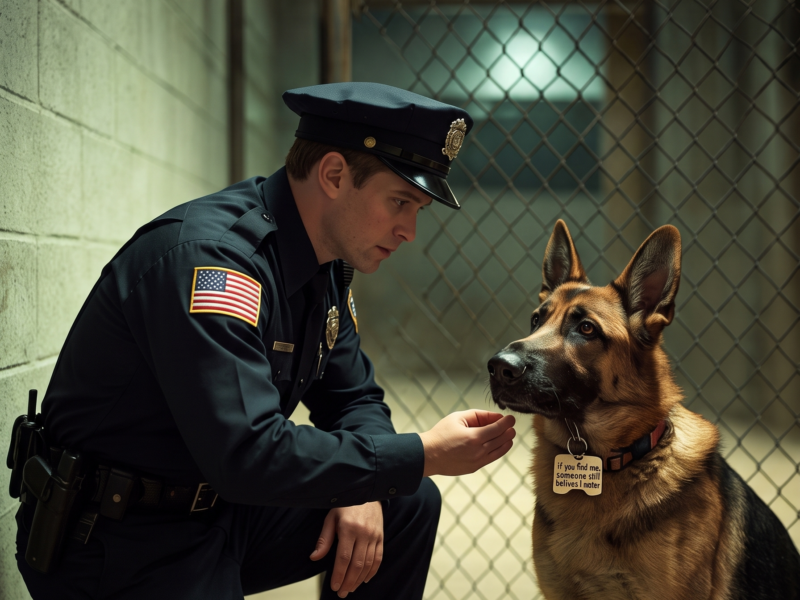
No one wanted the old police dog trembling inside a Los Angeles shelter, and when I walked past him, an officer coldly told me
The Los Angeles County animal shelter was a cacophony of desperate noise, a concrete hallway filled with the echoing barks of hundreds of dogs begging for a second chance. The smell of bleach and wet fur hung heavy in the stale air. I walked slowly down the long corridor, my hands shoved deep into my jacket pockets, looking into cage after cage. Most of the dogs jumped against the chain-link fences, their tails wagging frantically, their eyes wide with the hope of being noticed.
But I wasn’t looking for a hyperactive puppy. I was looking for a quiet companion, an older dog that society had forgotten. I walked past the row of loud, jumping animals until I reached the very last enclosure at the end of the darkest hallway.
He sat alone in the farthest kennel.
He was a large German Shepherd, but his massive frame was painfully thin. His muzzle was entirely white with age, his coat was dull and matted, and his left ear was jaggedly torn, folded over in a permanent droop. He didn’t bark. He didn’t pace. He just lay on the cold concrete floor, staring blankly at the wall. He barely lifted his head when I stopped outside his gate.
I looked at the faded index card slotted into the metal holder on the door. It read: Stray. Male. Approx 12 years old. Retired K9.
No one had adopted him. No one had even asked about him. The date on the card showed he had been here for three weeks, and in a crowded city shelter, three weeks usually meant a death sentence.
I gripped the chain-link fence. His dark brown eyes slowly shifted to meet mine. There was something painfully familiar in them—a deep, heavy exhaustion that I recognized from my own reflection in the mirror. It was the look of a soldier who had survived a war only to find that he had no home to return to.
I crouched down, bringing my face level with the bars, and whispered, “Hey, old man.”
His ears twitched. His tail, thick and heavy, moved exactly once against the concrete. A weak, rhythmic thump.
Behind me, heavy boots clicked against the floor. An animal control officer with a clipboard stopped a few feet away, shaking his head. “Don’t bother with that one, buddy.”
I looked up, keeping my hand near the mesh. “Why?”
The officer hesitated, his face softening with a mixture of pity and grim reality. “He’s been through too much. He’s institutionalized, or traumatized, or both. He doesn’t eat much, doesn’t engage. The vet says his hips are going. Honestly, he’s scheduled to be put down on Friday. You want a dog, look at the labs in the front row. This guy is just waiting for the end.”
I ignored the officer’s advice. I reached my fingers through the narrow gaps in the metal bars. For a long moment, the dog just stared at my hand. Then, with a slow, agonizing effort, he pushed himself up into a sitting position. He shuffled forward, lowered his massive, graying head, and gently placed his snout beneath my palm.
That was when I noticed his collar.
It was a thick, heavy-duty tactical collar, the kind used by military and police units, but it was ruined. It looked as though it had been dragged through mud, baked in the sun, and chewed by time. Most of the lettering printed onto the faded nylon had been aggressively scratched away, as if someone had taken a knife to it to hide its origin.
But one phrase remained barely legible near the heavy steel buckle. Property of…
The rest of the text was covered by thick layers of dried dirt and black grease. I rubbed my thumb over the fabric, using the damp sleeve of my jacket to wipe away the grime.
My hands froze. The air in my lungs suddenly felt cold.
The name underneath belonged to a police officer who had died eleven years earlier in a highly publicized, tragic accident.
Detective Michael Harris.
The officer behind me suddenly went silent. He stepped closer, peering over my shoulder at the collar. His face drained of color.
“You knew him?” I asked, my voice barely a whisper.
The officer looked away, swallowing hard. “Everyone in the department knew Mike. He was a legend in the narcotics division. Took down half the cartel distribution lines in the valley.”
“What happened to his dog?” I asked, looking back down at the graying shepherd.
The officer shifted his weight uncomfortably. “Mike died in a fiery car crash off the Pacific Coast Highway. They said his brakes failed. That dog… that dog was his partner. But he wasn’t in the wreck. He disappeared the exact same night Mike died. The department spent weeks looking for him. We all assumed he was stolen, or dead.”
I stared at the animal. The dog lifted his heavy head, his intelligent, sorrowful eyes locking onto mine. He hadn’t just been wandering. He had been surviving. For eleven years, this dog had navigated the brutal streets of Los Angeles, carrying the collar of a dead man. The shelter records said he had been found wandering in my neighborhood three weeks earlier, a neighborhood that happened to be only a few blocks from where Michael Harris used to live.
Nobody knew where he had spent the previous decade. Nobody knew what he had seen.
I stood up and looked the officer dead in the eye. “I’m taking him. Today.”
I adopted him that afternoon. I signed the paperwork, paid the fees, and walked him out of the shelter. I called him Shadow.
For the first few days, he barely ate. He would find the darkest corner of my living room and curl into a tight ball, his eyes tracking my every movement but offering no affection.
I had bought my house at a bank foreclosure auction five years ago. It was a mid-century craftsman that had belonged to Mike Harris. After his death, his estate was tied up in legal battles, and the bank eventually took it. The house had come with a dusty, locked attic full of old boxes that I had never bothered to throw away.
One night, while a heavy rain battered the windows, I finally decided to go through the attic. I brought down an old, heavy wooden box secured with a rusted brass padlock. I set it on the living room floor.
Suddenly, Shadow stood up. He walked over to the box, sniffed the wood, and began barking. It was a deep, chest-rattling bark that echoed through the quiet house.
I grabbed a pair of bolt cutters from the kitchen, snapped the rusted padlock, and threw open the lid.
Inside was Mike’s old LAPD police badge, tarnished and heavy.
Underneath it was a photograph.
Mike was standing beside a much younger, darker Shadow outside a crumbling industrial warehouse. A second man stood behind them, his hand resting on Mike’s shoulder. I recognized him immediately from the local news. He was now a retired police captain.
The same man who had signed the official report declaring Mike’s death a tragic accident.
I knelt on the living room floor, the photograph trembling in my hand.
Captain Robert Miller. His face was plastered across the city’s newspapers lately. He was the mayor’s top pick to be the next Chief of Police, a man celebrated for his tough-on-crime policies and pristine public record. But in this photograph, taken over a decade ago, there was something unsettling about the way Miller stood behind Mike. It wasn’t the proud stance of a mentor; it was the looming, possessive posture of a predator.
Shadow pressed his wet nose against my forearm. He let out a low, vibrating whine and pawed aggressively at the photograph, his sharp claws scraping across Miller’s printed face.
“What is it, boy?” I whispered, watching the dog’s sudden shift in demeanor. The lethargic, defeated animal from the shelter was completely gone. In his place was a highly trained K9, hyper-alert and driven by a purpose I couldn’t yet understand.
Shadow didn’t look at me. He turned and trotted down the hallway, stopping at the heavy door that led to the attached garage. He looked back over his shoulder, waiting for me. When I didn’t immediately follow, he barked again—a sharp, commanding sound.
I left the photograph on the floor and followed him. I flipped the switch, flooding the damp, cold garage with the harsh glow of fluorescent lights.
Shadow walked directly to the back wall, past my parked car and a stack of moving boxes, and stopped beside an old, heavy metal workbench cabinet. It was bolted to the concrete floor, a fixture that had been in the house long before I bought it. Shadow sat perfectly still in front of the cabinet, staring at the bottom drawer.
I walked over and pulled the heavy steel drawer open. It was filled with rusted wrenches, dried-out cans of WD-40, and old spark plugs. I looked down at Shadow. “It’s just junk, old man.”
Shadow let out a frustrated huff and used his gray snout to shove my hand aside. He pressed his nose against the back panel of the drawer.
I frowned, pulling the drawer entirely out of its tracks and setting it on the floor. I reached into the dark, empty cavity of the cabinet and ran my fingers along the back steel wall. Near the bottom corner, my fingertips brushed against a tiny, recessed latch. I pressed it.
With a soft metallic click, a false panel popped forward.
My heart began to hammer against my ribs. I reached into the hidden compartment and pulled out a small, black object. It was a microcassette tape, sealed inside a waterproof plastic bag.
I rushed back into the house, tearing through my own office desk until I found an old handheld voice recorder I used for taking notes. I ripped the plastic bag open, my hands shaking, and snapped the tiny tape into the player. I pressed play.
For ten agonizing seconds, there was only the loud, hissing sound of static.
Then, a man’s voice broke through the noise. It was hurried, breathless, and laced with absolute terror.
“This is Detective Michael Harris. Badge number four-two-seven-nine. If you are listening to this, I am dead. They are going to kill me.”
I stopped breathing. I stared at the tape player, the voice of a ghost filling my quiet living room. Shadow sat beside me, his ears pinned back, whining softly at the sound of his master’s voice.
“I don’t have much time,” the recording continued, the sound of papers shuffling in the background. “If anything happens to me, Shadow saw everything. He knows where I hid it. Someone inside the department is selling evidence. Millions of dollars in seized cartel cash and narcotics. They aren’t burning the drugs in the incinerator; they’re pushing it back onto the streets. The ringleader…”
Mike took a sharp, jagged breath.
“The ringleader is Captain Robert Miller.”
The room spun. The man poised to take over the entire Los Angeles Police Department was the head of a massive criminal syndicate. He hadn’t just signed Mike’s death certificate; he had ordered his execution.
“I copied the ledgers,” Mike’s voice rushed on. “I put the flash drives and the physical account numbers in a tactical pouch. I couldn’t trust anyone in the precinct. I gave the pouch to Shadow. I gave him the command to—”
Suddenly, a loud, metallic screech erupted on the tape. It sounded like the heavy deadbolt of the front door being forced open.
Mike’s voice instantly changed. The calm recitation of evidence vanished, replaced by sheer panic.
“Wait…” Mike stammered, his voice dropping to a frightened whisper. “You’re not supposed to be here.”
There was the sound of a struggle, a loud crash, and then the sickening crack of a gunshot. The tape hissed with static for another thirty seconds before clicking to an abrupt halt.
The recording ended.
I sat frozen in the silence of my house, the weight of the conspiracy crushing the air from my lungs. Mike hadn’t died in a car crash. He was murdered in this very house, and Miller’s men had staged the wreck on the highway to cover it up. But they never found the ledgers, because Mike had given them to his dog.
Shadow was staring intently at the door leading to the garage. The hair on the back of his neck suddenly stood up, forming a rigid ridge of gray fur. A low, vibrating growl started deep in his chest.
I listened carefully. Over the sound of the rain, I heard footsteps outside.
They were slow. Heavy. Deliberate. They were coming up the driveway, approaching the side door of the garage.
Then came three sharp knocks.
Shadow stood beside me, his body entirely rigid, his eyes locked onto the door. He didn’t bark. He was in full tactical mode, waiting for the breach.
I reached for the heavy iron fireplace poker leaning against the brick hearth, my knuckles turning white. I slowly walked toward the door, my heart pounding so hard it hurt.
Before I could reach the handle, a white envelope was pushed through the weather stripping, sliding quietly across the hardwood floor.
I stared at it. The footsteps outside slowly retreated, fading into the sound of the storm.
I dropped the poker, picked up the envelope, and tore it open.
Inside was a photograph. It was a picture of a man sitting in a dimly lit diner. He had a thick gray beard, a jagged scar across his jaw, and a worn baseball cap pulled low. But despite the age and the trauma, the eyes were unmistakable.
It was Mike. Alive.
I flipped the photo over. The timestamp printed on the back showed a date from six months after the department said he had died.
Beneath the date, someone had written a single sentence in heavy black ink.
Your dog remembers where we buried the truth.
I looked down at Shadow. The old dog was staring intensely at the photograph in my hand. And for the first time since I had brought him home from the shelter, his heavy gray tail began to wag.
Because somehow, he knew exactly who was coming next.
A sharp, authoritative knock echoed from the front door. It wasn’t the slow, creeping sound from the garage. This was the knock of someone who had nothing to hide, someone who demanded entry.
Shadow didn’t growl. Instead, he let out a sharp, high-pitched whine and trotted to the front door, his tail sweeping back and forth across the floorboards.
I grabbed the heavy fireplace poker again, my palms sweating. I moved to the door, peered through the peephole, and my breath caught in my throat. Standing on my porch, drenched by the Los Angeles rain, was the man from the photograph.
I unlocked the deadbolt and pulled the door open.
Michael Harris stepped inside. He looked older, weathered by a decade of hiding, his face lined with deep exhaustion and his eyes hardened by paranoia. He wore a heavy waterproof jacket and kept his right hand inside his pocket, gripping something heavy.
Before I could speak, Shadow let out a sound that broke my heart—a desperate, crying howl. The massive dog launched himself forward. Mike dropped to his knees on the hardwood floor, pulling his hand from his pocket to wrap both arms around the animal’s thick neck. He buried his scarred face in Shadow’s gray fur, his shoulders shaking as the dog licked his face frantically.
“I know, buddy. I know,” Mike choked out, tears mixing with the rain on his cheeks. “I thought I lost you. I thought they killed you.”
I stood in the entryway, lowering the iron poker, completely stunned. “You’re dead,” I managed to say. “The department buried you eleven years ago.”
Mike looked up at me, his eyes fierce. He stood, keeping one hand resting on Shadow’s head. “They buried a John Doe they pulled from the morgue. They burned the car so badly dental records were useless. Miller paid off the medical examiner.”
“But the tape…” I pointed toward the living room. “I just heard the tape. Someone broke in and shot you.”
“They missed,” Mike said grimly, stepping fully into the house and locking the door behind him. “Miller sent a hit squad. I managed to fight my way out of the back window, but I was badly wounded. I knew if I went to the hospital, Miller’s men would finish the job. If I went to the FBI, Miller had moles who would flag my name. I had to disappear. I spent a year recovering in an underground clinic in Tijuana. When I finally came back to LA, I was a ghost.”
“And Shadow?” I asked, looking at the dog who was now glued to Mike’s leg.
“The night they came for me, I knew I was compromised,” Mike explained, his voice tightening. “I had the ledgers—the physical proof of Miller’s drug ring. I put them in a waterproof tactical pouch. I gave it to Shadow and gave him the command to ‘Hide.’ It’s a specialized K9 protocol. It means take the asset, bury it in a secure location, and do not return until the handler calls you. Shadow ran into the night. Miller’s men tried to track him, but they lost him in the storm.”
Mike looked around his old house, a painful nostalgia in his eyes. “I’ve been hunting Miller ever since. Gathering intel, trying to build a case from the shadows. But without that ledger, it’s just the word of a dead man against the next Chief of Police. I spent years looking for Shadow. I thought he had been hit by a car, or put down. Until three weeks ago.”
“Animal control picked him up,” I said. “He was wandering this neighborhood.”
“He came home,” Mike said softly. “His hips are failing, he’s tired, and his instincts told him his time was short. He came back to the last place he saw me. When I hacked the county shelter database and saw his intake photo, I knew I had to get him. But by the time I bypassed Miller’s surveillance and made it to the shelter, you had already adopted him.”
I took a step back, my mind racing. “The guy at the garage door. That wasn’t you.”
“No,” Mike said, his expression darkening instantly. “That was me testing your perimeter, but I left the photo to warn you. Miller’s surveillance network flagged my movement. They know I’m alive, and they know I was looking for the dog. If they tracked me here…”
Before he could finish the sentence, the glass of my living room window shattered inward with a deafening crash.
A tear gas canister bounced across the hardwood, immediately spewing thick, burning white smoke into the room.
“Down!” Mike roared, tackling me to the floor as the staccato popping of suppressed automatic gunfire ripped through the walls. Splinters of wood and plaster rained down on us. Shadow hit the deck beside us, entirely silent, his combat training overriding his age.
“They tracked me!” Mike yelled over the chaos, pulling a heavy Glock 19 from his jacket. “We have to move, now!”
“My car is in the garage!” I shouted, coughing as the acrid smoke burned my eyes and throat.
“Move!” Mike ordered, firing three blind shots through the shattered window to keep the shooters’ heads down.
I scrambled on my hands and knees down the hallway, Shadow flanking me perfectly. We burst into the garage. I hit the automatic door opener, the heavy metal rising slowly, agonizingly loud.
A black SUV was parked horizontally across my driveway, blocking the exit. Two men in tactical gear were advancing toward the garage, raising their rifles.
“Get in the car!” Mike yelled. He stepped past me, raised his Glock, and fired rapidly. He hit the lead operative in the shoulder, dropping him to the concrete. The second operative dove behind the engine block of the SUV for cover.
I threw myself into the driver’s seat of my sedan. Shadow jumped into the back, his gray muzzle resting on the center console. Mike dove into the passenger side, slamming the door.
“Drive!” Mike commanded. “Ram the SUV!”
I slammed the car into drive, stomped the accelerator to the floor, and the sedan leaped forward.
The tires squealed against the slick concrete of the garage before catching traction. The sedan shot out into the pouring rain. I braced myself as we slammed violently into the rear quarter panel of the black SUV blocking the driveway. The sound of crunching metal was deafening, but the force of the impact spun the heavier vehicle just enough to clear a path.
I floored it, tearing across the wet grass of my front lawn, crushing my mailbox, and rocketing into the dark suburban street. Gunfire sparked off the trunk of the car, shattering the rear windshield. Glass rained down into the backseat, but Shadow didn’t flinch. He stayed low, completely silent.
“Keep your head down and take the next left!” Mike ordered, checking the side mirror. A second pair of headlights swung out from a side street, accelerating rapidly behind us.
“Who are these guys?” I yelled, my hands gripping the steering wheel so tight they cramped.
“Miller’s private cleanup crew,” Mike said, pulling a spare magazine from his jacket and reloading his weapon. “Off-the-books ex-military. He pays them out of the cartel slush fund. Take the highway on-ramp! We need to lose them in traffic.”
I swerved the car onto the wet asphalt of the 101 Freeway, weaving recklessly between late-night semi-trucks and terrified commuters. The rain smeared my vision, the wipers struggling to keep up with the downpour. The headlights behind us were relentless, gaining ground.
“Where are we going?” I shouted over the roaring wind tearing through the broken back window.
“The photo you found in the box,” Mike said, his eyes scanning the road ahead. “The old shipping warehouse in San Pedro. That was the last place Shadow and I worked a case before I was attacked. If he followed his protocol, he buried the ledger there.”
I pressed the gas pedal harder, the engine whining in protest. For twenty terrifying minutes, we engaged in a high-speed game of cat and mouse through the slick streets of Los Angeles. Finally, I killed the headlights and took a sharp, un-signaled turn down a narrow industrial alley in the port district, slipping into the shadows behind a row of rusted shipping containers.
The pursuing vehicle blew past the alley, their brake lights flaring in the distance before they disappeared around a corner.
“We bought ourselves a few minutes,” Mike breathed, lowering his gun. “But they’ll grid the sector. We don’t have long.”
I put the car in park, my hands shaking uncontrollably. Shadow sat up in the backseat, shaking the broken glass from his fur. He let out a low whine, staring out the window at the looming, dilapidated structure ahead of us.
It was the warehouse from the photograph. The roof was partially collapsed, the windows were boarded up with rotting wood, and the chain-link fence surrounding it was covered in razor wire and overgrown weeds. It looked like a tomb.
Mike opened his door and stepped out into the rain. He opened the back door for Shadow. “Alright, old man. It’s time to go to work. Find it.”
Shadow stepped out onto the wet gravel. He didn’t need to be told twice. The dog put his nose to the ground and began to move with a renewed, youthful energy. We followed him closely, slipping through a gap in the rusted fence and entering the dark, cavernous interior of the abandoned warehouse.
The air inside was thick with the smell of mildew, salt, and old engine grease. Water dripped steadily from the ruined roof, creating a hollow, echoing rhythm. I pulled out my phone, using the faint glow of the screen to navigate the debris.
Shadow led us deep into the facility, past rusted forklifts and towering stacks of decaying wooden pallets. He bypassed the main floor entirely, heading toward the back wall where an old concrete drainage trench ran along the foundation.
The dog stopped at a section of the floor where the concrete had cracked and buckled decades ago, exposing the dark earth underneath. Shadow began to dig. Dirt and gravel flew behind him as his massive paws tore at the ground with desperate urgency.
“He remembers,” Mike whispered, falling to his knees beside the dog to help him dig.
A few feet down, Mike’s fingers brushed against something artificial. He grabbed it and pulled hard. From the damp earth, he unearthed a heavy, black tactical pouch made of thick Kevlar. It was caked in mud, but the heavy-duty waterproof zipper was completely intact.
Mike ripped the pouch open. Inside were three black USB drives and a thick, leather-bound ledger. He opened the book, shining his small tactical flashlight over the pages. They were filled with hundreds of offshore account numbers, dates, and payout amounts—a detailed map of Miller’s entire corrupt empire.
“We have it,” Mike breathed, an eleven-year weight lifting from his shoulders. “We finally have him.”
Suddenly, the vast interior of the warehouse was illuminated by blinding white light.
Four heavy tactical vehicles had just crashed through the chained front gates, their high beams piercing the darkness and pinning us against the back wall. The screech of tires echoed off the concrete as a dozen heavily armed men piled out, forming a semicircle and raising their rifles.
From the center of the blinding lights, a figure slowly stepped forward.
Captain Robert Miller wore a tailored suit beneath a dark trench coat, a suppressed pistol resting casually in his right hand. He looked exactly like the man on the news, polished and confident, completely unfazed by the rain.
“I have to admit, Michael,” Miller’s voice echoed through the massive space, cold and steady. “I was impressed you survived the night at your house. I was even more impressed you stayed hidden for a decade. But digging up your dead dog’s toys? This is where your luck finally runs out.”
Miller raised his pistol, aiming directly at Mike’s chest. “Kill them both. Take the bag.”
The metallic clacks of a dozen assault rifles being chambered echoed through the warehouse like a death knell.
Mike didn’t flinch. He stood up slowly, holding the Kevlar pouch in one hand and his Glock in the other. He stepped in front of me, shielding my body with his own.
“You’re going to be the next Chief of Police, Bob,” Mike shouted over the rain hitting the tin roof. “You really think you can execute a former detective and a civilian in a warehouse and make it disappear? The world is watching you now.”
Miller smiled, a cold, empty expression. “The world watches what I tell them to watch, Mike. By tomorrow morning, the news will report that my brave task force disrupted a major cartel drug deal. Two unidentified suspects were killed in the crossfire. The mayor will pin a medal on my chest.”
He raised his gun higher. “Goodbye, Michael.”
Before Miller could pull the trigger, Shadow moved.
He didn’t bark. He didn’t growl. The old K9 simply became a gray blur in the darkness. Shadow launched himself off a broken concrete slab, soaring through the air, completely bypassing the armed mercenaries. He aimed directly for the man who had torn his life apart eleven years ago.
Shadow slammed into Miller’s chest with seventy pounds of pure, trained kinetic energy.
Miller screamed as the massive dog bore him to the wet concrete. The suppressed pistol fired wildly into the air, the bullet shattering a glass skylight above. Shadow’s jaws clamped down relentlessly onto Miller’s right forearm, the bone cracking audibly under the pressure of the dog’s bite.
“Shoot the dog!” Miller shrieked in agony, thrashing on the ground.
The mercenaries hesitated for a fraction of a second, afraid to hit their boss in the chaotic tangle of man and animal.
That fraction of a second was all Mike needed.
“Now!” Mike roared.
Mike opened fire, dropping the two closest mercenaries before they could acquire a target. I grabbed a rusted iron pipe from the debris, swinging it wildly, smashing the rifle out of the hands of a third man who tried to flank us.
The warehouse erupted into a deafening firefight. Mike grabbed my shoulder, dragging me behind the heavy steel chassis of a rusted forklift. Bullets sparked and pinged off the metal, tearing the concrete to shreds around us.
“Shadow! Here!” Mike whistled sharply over the gunfire.
Shadow released Miller’s bloody arm and scrambled back into the darkness, using his dark coat as camouflage. He darted through the shadows, appearing like a ghost, biting the leg of a mercenary before vanishing again. The tactical team was panicking, firing blindly into the dark corners of the warehouse.
Miller scrambled backward, clutching his mangled arm, his suit ruined. “Tear this place apart!” he screamed to his men. “Kill them!”
“We’re outgunned!” I shouted to Mike, covering my head as the forklift shuddered under a hail of bullets. “We can’t hold them off!”
Mike checked his magazine. “Two rounds left.” He looked at me, a grim acceptance in his eyes. “When they rush us, I’ll draw their fire. You take the ledger and run for the drainage pipe. It leads to the harbor.”
“I’m not leaving you!” I yelled.
Before Mike could argue, a sound cut through the chaos.
It started as a faint wail in the distance, but within seconds, it multiplied. Sirens. Dozens of them.
Red and blue lights suddenly strobed violently through the boarded-up windows, painting the interior of the warehouse in frantic colors. The screech of tires and the heavy thud of armored vehicles surrounding the building shook the ground.
A voice boomed over a massive police megaphone.
“LOS ANGELES POLICE DEPARTMENT! INTERNAL AFFAIRS AND FBI JOINT TASK FORCE! DROP YOUR WEAPONS IMMEDIATELY!”
Miller’s mercenaries froze. They looked at each other, realizing instantly that they were trapped. One by one, they lowered their rifles and raised their hands in the air.
Miller sat on the ground, his face pale, staring at the flashing lights outside. He looked at Mike, sheer disbelief in his eyes.
Mike stepped out from behind the forklift, keeping his gun leveled at Miller.
“I didn’t spend eleven years just hiding, Bob,” Mike said softly. “I spent it watching. Building contacts. When I found the dog today, I knew the endgame had started. I transmitted the encrypted digital copies of the ledger to the FBI Director three hours ago. They’ve been tracking my burner phone all night. They just needed you to show up with your hit squad to prove it.”
Armed federal agents and SWAT officers flooded into the warehouse, their weapons drawn. They bypassed Mike and swarmed Miller, pulling him to his feet and slamming him against a tactical vehicle. Handcuffs clicked shut over his bloody wrists.
I leaned against the rusted forklift, my legs giving out as the adrenaline finally crashed. The nightmare was over.
Shadow trotted out from the darkness. He was panting heavily, limping slightly on his bad hip, but his head was held high. He walked directly to Mike and sat by his side, leaning his heavy gray head against his master’s leg.
Mike dropped to his knees, burying his face in the dog’s fur, the tears flowing freely now. “Good boy,” he whispered. “You did it, buddy. You finished the mission.”
Three months later, the city was still reeling from the fallout. Miller and two dozen corrupt officers were indicted in the largest corruption sweep in LAPD history. Michael Harris was officially declared alive, his record expunged, and he was hailed as a hero.
I sat on the back porch of my house, drinking a cup of coffee and watching the morning sun break over the Los Angeles hills.
The screen door creaked open. Mike walked out, holding two mugs. He lived three houses down now—he had refused to leave the neighborhood he fought so hard to return to.
“How’s he doing?” Mike asked, handing me a mug.
I pointed to the yard. Lying in the warm patch of sunlight on the grass, snoring softly, was Shadow. He was retired for good now. He ate premium steak cuts, slept on an orthopedic bed, and spent his days chasing tennis balls at whatever speed his old hips would allow.
“He’s happy,” I said, smiling.
Mike looked at the dog, a profound peace settling over his scarred face. “He saved both of our lives.”
“No,” I replied, taking a sip of my coffee. “He just made sure we remembered who we were.”
Shadow opened one eye, looked at us, let out a long, contented sigh, and went back to sleep in the sun.
The end.









