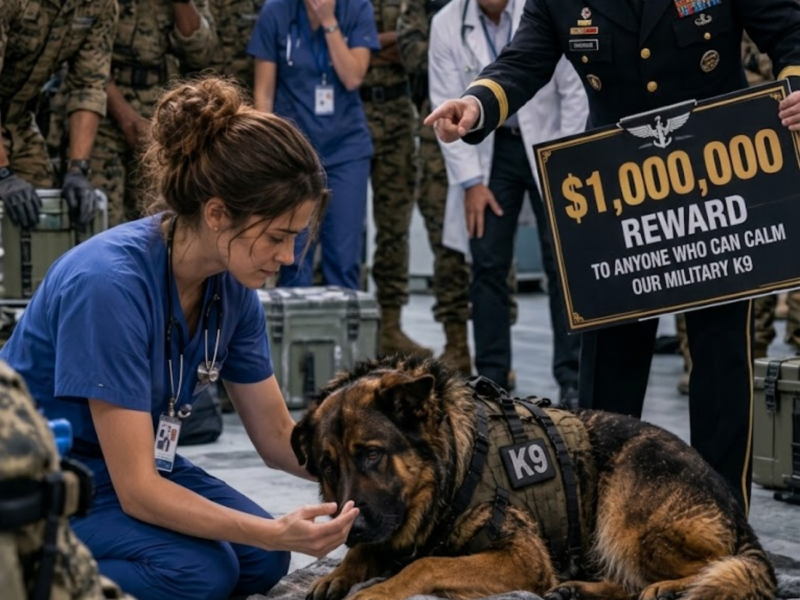
“No one can calm him,” the Navy captain laughed as his military K9 snarled at every nurse in the emergency ward
The fluorescent lights of the third-floor trauma ward at Harborview Memorial flickered with a sterile, monotonous hum. The air smelled of isopropyl alcohol, burnt coffee, and the sharp copper tang of fresh trauma dressings. It was two o’clock on a sodden Tuesday morning, the hour when the city usually gave up its broken and exhausted, but the hallway was wide awake and trembling.
Titan was a ninety-pound Belgian Malinois with a broad, scarred chest, ears notched from shrapnel, and teeth that clacked together like porcelain traps every time an orderly shifted his weight. He was harnessed in heavy tactical nylon lined with Kevlar plates, his handler’s leash wrapped three times around the gloved fist of Captain Ryan Cole.
“No one can calm him,” Captain Cole laughed, the sound hollow, vibrating with a nervous edge that did not match the sharp creases of his service dress or the row of ribbons pinned across his chest. He tugged at the lead, but the dog didn’t give an inch. Titan lunged forward, the rubber soles of the captain’s combat boots sliding half an inch across the waxed linoleum. “He’s been like this since the convoy attack outside Fallujah six weeks ago. He doesn’t trust anyone. He smells blood, he thinks it’s an ambush.”
Two orderlies, both seasoned men who had pinned down violent psych patients and meth addicts twice their size, backed up until their shoulders hit the medicine cart. Dr. Morrison, the attending physician on call, stood behind the nurses’ station with his hands half-raised, looking more like a hostage than a surgeon.
“Captain, you can’t have an unrestrained military working dog in an active surgical corridor,” Morrison said, his voice straining for authority and failing miserably. “We have infection control protocols. We have sedatives. If he’s injured, let us draw up twenty milligrams of acepromazine and put him down on a gurney.”
Titan let out a low, guttural vibration that made the glass panels of the chart rack rattle in their tracks. It wasn’t the bark of a backyard guard dog; it was the measured, bone-deep resonance of an animal trained to tear through windpipes and kevlar without blinking.
I had only been a nurse for six months.
To the rest of the staff, I was Emma Hayes: the quiet girl from the rural coast of Maine who worked the night shift because she didn’t like crowds, who ate her lunch out of a brown paper sack in the stairwell, and whose file listed no living immediate relatives. I had spent half a year keeping my head down, changing bedpans, titrating IV drips, and answering call lights without ever looking anyone directly in the eye for longer than three seconds. I wasn’t special. I wasn’t fearless. I had spent two years mourning the only person who had ever made the world feel safe, living in a cheap studio apartment where the only sound was the radiator ticking against the baseboard.
I set my clipboard down on the counter. The metal snapped against the formica, a small, distinct sound in the suffocating quiet.
“Emma, don’t,” whispered Sarah, the triage nurse behind me. She reached for my scrub top, but her fingers slipped off the cotton. “He’ll tear your arm off.”
I didn’t stop. I stepped out from behind the safety of the partition. The floor was cold through the thin rubber soles of my nursing clogs.
Titan’s ears flattened instantly against his skull. The coarse, sable fur along his spine rose like a row of bayonets. His eyes—pale amber, clouded with the reddish tint of broken blood vessels from concussion trauma—locked onto my throat. His lip curled upward, exposing pink gums and four inches of glistening ivory.
“Don’t,” Captain Cole warned, his voice losing its forced humor, replaced by genuine, panic-tinged anger. “Nurse, step back right now! I am not responsible if he breaks this lead. He’s classified as a lethal weapon!”
I ignored him. I didn’t look into Titan’s eyes; you never look a working dog directly in the pupils when he thinks he’s holding a defensive perimeter. Instead, I sank slowly to my knees, five feet away from his snapping jaws, letting my weight settle onto the hard floor. The linoleum smelled of pine cleaner and old wax. I lowered my chin, exposed the side of my neck, and let my hands rest open on my thighs, palms up.
I knew that stance. I had seen it in photographs sent from Kandahar, from Helmand, from dusty outposts whose names had been redacted with black grease pencil on the backs of letters that smelled of cordite and dried mud.
“You don’t have to protect me,” I whispered.
The words were barely louder than the hum of the air vents overhead.
Titan’s jaw clamped shut with a wet click. The growl died in his throat, choked off so abruptly it sounded like a sob.
The hallway held its breath. Dr. Morrison stopped reaching for the telephone. Captain Cole froze, his gloved fingers still strained against the nylon webbing.
Titan took a single, stiff-legged step forward. His nose twitched, drawing in great, shuddering lungfuls of air. He was smelling the hospital antiseptic, the dried sweat on my collar, but beneath that, he was smelling something else—something etched into the marrow of my bones, a genetic echo that had spent three years sleeping in the same barracks as him.
I held out my right hand, steady, three inches above the floor.
The dog walked toward me. He didn’t slink; he moved with a slow, deliberate grace, his massive head lowering until his whiskers brushed the skin between my thumb and forefinger. Then, with a heavy, trembling sigh that blew warm air against my wrists, he leaned his entire body against my knees and pressed his enormous, scarred head hard against the center of my chest.
A collective gasp went around the nurses’ station.
“That’s impossible,” Captain Cole breathed. The color drained from his face, leaving his skin the shade of dirty parchment. The false smile was completely gone. His eyes darted from the dog to my face, narrowing into sharp, suspicious slits. “He hasn’t let a civilian touch him since we brought him back stateside. He put three handlers in the naval hospital at Portsmouth.”
My hands were buried in Titan’s thick, coarse double coat. Beneath the heavy tactical collar, my fingers brushed against something hard, cold, and notched with age. It wasn’t the standard-issue brass disc issued by the Department of the Navy. It was a notched aluminum dog tag, worn smooth around the edges by months of sweat and sand, hanging from a length of parachute cord.
I slipped my index finger beneath the cord and turned the metal over in the palm of my hand.
Stamped into the dull silver were five lines of text:
HAYES, ETHAN M.
724-88-9102 O POS
USMC – RECON
NO PREF
My vision blurred. The air in my lungs turned to liquid lead. For two years, I had kept a duplicate of that exact piece of metal tucked inside a velvet jewelry box in my nightstand. The government had sent it to me in a padded manila envelope along with a folded flag, a bronze star with a combat ‘V’, and a letter signed by an adjutant general stating that Gunnery Sergeant Ethan Hayes had been lost at sea during a maritime interdiction operation in the Persian Gulf. No remains recovered. Case closed.
Captain Cole stepped forward, his boots loud and hurried, his hand reaching aggressively toward Titan’s neck. “Where did you see that name? What are you looking at?”
Titan didn’t growl, but his entire body went rigid beneath my hands. A warning vibration rippled through his ribs.
I looked up from the floor, my eyes locking directly onto Cole’s. The tears hadn’t fallen yet; they were burning behind my retinas like salt.
“He was my brother,” I said.
The silence that followed was absolute. It was the kind of silence that precedes an artillery strike—the sudden, vacuum-like stillness where all ambient sound is sucked out of the world.
Cole’s hand stopped three inches from the tag. His fingers twitched. “Your… brother?”
“Ethan Hayes,” I said, my voice dangerously steady, every syllable cutting through the quiet. “Third Recon. Assigned to Special Operations Command Central. You said Titan was injured in Fallujah six weeks ago. Ethan was supposedly lost in the Persian Gulf two years ago. Why is his personal tag around this dog’s neck?”
Captain Cole didn’t answer immediately. He looked over his shoulder at Dr. Morrison, then at the orderlies who were still watching from fifteen feet away. His posture shifted; the easy, swaggering military officer vanished, replaced by someone cold, calculating, and suddenly very tired.
He dropped his hand to his side and stepped between me and the nurses’ station, effectively blocking the line of sight from the front desk.
“Get up,” he said, his voice dropping to a harsh, gravelly whisper. “Get up off the floor, Nurse Hayes. Now.”
Titan stood with me, his flank pressed against my thigh like a living buttress. I wiped the moisture from my eyelashes with the back of my sleeve, refusing to show him the tremor running through my fingers.
“Tell me why you have his dog,” I demanded.
Cole leaned down, his eyes scanning the corridor behind him. “Your brother wasn’t killed in combat, Emma.”
The floor seemed to tilt beneath my shoes. The fluorescent lights danced, blurring into streaks of harsh white. “What?”
“He didn’t drown in the Gulf. He wasn’t on that interdiction craft.” Cole’s jaw was clenched so hard the muscles jumped against his cheek. “He disappeared. Forty-eight hours before his squad was hit at sea, Ethan broke off from the staging base in Bahrain. He took twenty pounds of encrypted tactical drives, four months of operational logs, and this dog.”
“Why wasn’t my family told?” My voice cracked, the grief of two long, empty years suddenly mutating into an icy, suffocating rage. “I signed the papers. I accepted the flag. I sat in a church with an empty coffin while two Marines stood at the end of the aisle! Why did you lie to me?”
“Because someone wanted him forgotten,” Cole whispered, his eyes dark with something that looked terrifyingly like dread. “Someone with three stars on their shoulder and a seat on the Joint Intelligence Committee. If Ethan was dead, there was no investigation. If Ethan was dead, the files he walked out with were officially listed as destroyed by salt water. They closed the book so they wouldn’t have to burn the library.”
Titan suddenly let out a sharp whine. His head jerked toward the far end of the ward, his nostrils flaring. He didn’t look back at either of us. With a sudden, violent surge of momentum, he ripped the lead entirely out of Cole’s slackened fingers.
“Titan!” Cole hissed, reaching for the trailing nylon.
The dog ignored him. He sprinted twenty yards down the hallway, his claws scrabbling against the slick linoleum, and threw his weight against the louvered wooden door of Supply Closet 3-B.
The door was locked with a standard push-button deadbolt, but the wood was old. Titan didn’t bother with the latch. He wedged his broad muzzle into the space between the jamb and the frame, whining frantically, his front paws tearing at the bottom panel until the white paint began to flake away in long, jagged strips.
“What is he doing?” I asked, running after him, Cole half a step behind me.
“He’s tracking,” Cole muttered, reaching into his pocket and pulling out a heavy steel multi-tool. “He’s got an alert scent. Not explosives. Personnel.”
Cole jammed the flat head of the tool into the door seam, levered his shoulder against the frame, and threw his weight forward. With a dry, splintering crack, the brass latch gave way. The door swung open into the dark, airless closet.
It was packed with boxes of sterile gloves, cases of normal saline, and rolls of blue hospital bedding. But Titan wasn’t interested in the shelves. He shoved his way past a stack of adult diapers and buried his head into the bottom-most recess of the metal shelving unit, his back paws kicking out boxes of gauze as he dug.
With a muffled grunt, he backed out, dragging something heavy by a thick nylon strap.
It hit the floor with a dull, leathery thud.
It was an old, faded olive-drab military duffel bag. The canvas was stained with grease, white salt rings, and dark, irregular patches of dried brown that could only have been blood. Across the side, stenciled in faded black spray paint through a cardboard template, was a serial number and a single word:
HAYES.
Captain Cole stared at the bag, his entire body going rigid. He reached out with his boot and nudged the heavy canvas. The metal zipper was sealed with a small, rusted padlock that had been clipped through the pull tab.
“That’s impossible,” Cole whispered. The blood had completely drained from his face; he looked like a corpse standing under the harsh ceiling lights. “I’ve been tracking this dog for three weeks. We arrived in this city six hours ago. That bag wasn’t here yesterday. It wasn’t in this hospital.”
My hands were shaking so violently I could barely grip the metal slider. I didn’t have a key for the padlock, but the brass teeth of the zipper had rotted from moisture. I grabbed the canvas with both hands and wrenched it sideways with all the strength in my shoulders.
The fabric tore with a loud, sickening rip.
Inside lay a folded, sand-colored desert combat blouse, stiff with dried salt and dark with old, oxidized blood across the right shoulder. Beneath the uniform were three disposable digital camera memory cards, two notebooks bound with heavy black electrical tape, and a thick, square manila envelope sealed with red wax.
Across the front of the envelope, written in the sharp, slanted handwriting I would have recognized anywhere in the world, was my name:
For Emma. Don’t go home.
I tore the wax seal. Inside was a single piece of lined notebook paper, torn from a logbook, covered in Ethan’s hurried, familiar scrawl.
Emma, it read. If Titan finds you, it means they finally know where I hid the evidence. They let him out to find me, but he’ll find you first. Cole is not what he seems. Run.
My breath stopped in my throat.
I looked up from the paper.
Captain Cole was staring down at me, but his face was no longer pale. The look of frantic confusion was gone, replaced by something smooth, flat, and chillingly devoid of emotion. His right hand had dropped beneath the left lapel of his service coat, his fingers curling around the textured black grip of a suppressed SIG Sauer pistol tucked into a concealed shoulder rig.
“What evidence?” Cole asked. His voice was utterly calm now, low and conversational, like a doctor discussing a routine blood draw. “What did he write, Emma?”
Before I could move, before I could scream, every single light in the hallway went out.
The hum of the transformers died instantly. The air handling units ground to a halt with a shuddering groan, plunging the third floor into absolute, ink-black darkness. The red emergency exit signs flickered once and died, their backup batteries severed at the main distribution panel in the basement.
In the dark, Titan let out a sound that didn’t belong in a hospital—a deep, lung-bursting war snarl that vibrated through the linoleum beneath my knees.
Then, from the heavy fire doors at the far end of the corridor, three distinct, rhythmic raps sounded against the steel.
A voice, muffled by the thickness of the door but carrying the unmistakable cadence of an operational command, drifted through the dark:
“Step away from the dog, Captain. We’ll take it from here.”
Titan threw his ninety-pound frame directly across my lap, pinning me into the recess of the supply closet, his teeth snapping at the empty air as Captain Cole’s gun cleared its holster with a dry, metallic click.
The darkness in the hospital was absolute, thick as wet velvet and smelling suddenly of ozone and damp plaster.
The silence lasted for three seconds. Then came the sound of the emergency doors being forced.
It wasn’t the slow, clumsy rattling of hospital staff trying to navigate a power failure. It was the sharp, mechanical crack of a hydraulic breaching tool biting into steel, followed by the hiss of expanding pneumatic fluid. The heavy fire doors that separated the trauma ward from the western stairwell gave way with a deafening groan, slamming back against the magnetic stops with enough force to send dust raining from the ceiling tiles.
Titan didn’t wait for a command.
He didn’t bark; a trained combat dog doesn’t waste air when the threat is inside twenty paces. He launched himself forward from my lap, the pads of his paws scrabbling for purchase against the slick floor before he found traction and shot down the center of the hallway like a ninety-pound cannonball.
“Titan, no!” I screamed, reaching into the dark, but my fingers only caught the rough trailing edge of his nylon leash as it whipped past.
A bright, blinding beam of white light cut through the gloom—ten thousand lumens from a tactical weapon-mounted flashlight, striking the walls and turning the linoleum into a mirror of polished glare. The light caught Titan mid-stride, his jaws wide, his amber eyes reflecting green like an animal from a nightmare.
Pfft. Pfft.
The sound was tiny, almost comical, like a heavy staple gun biting into thick cardboard.
Titan twisted mid-air with a sharp, choked yip. A spark danced off the steel baseboard as a ricochet whined down the corridor, followed by the heavy, wet thud of the dog hitting the floor and sliding several feet.
“Target down,” a flat, synthesized voice echoed through the dark. “Secure the hall. Find the sister.”
“Move!” Captain Cole’s hand seized the collar of my scrubs with brutal force, hauling me bodily to my feet. The fabric tore at my shoulder, digging into my neck. He didn’t look like a friend; he looked like a man whose escape hatch had just been welded shut from the outside. “Get that bag! Pick it up!”
“They shot him!” I fought against his grip, my feet kicking against the doorframe of the supply closet as I tried to reach the dark shape lying motionless in the center of the hallway. “They killed him!”
“He took a suppressed nine-mil to the ceramic plate on his vest, Hayes! He’s stunned, not dead! If you don’t pick up that bag, we’re both going to be dead in five seconds!” Cole wrenched his pistol from beneath his coat, stepped into the doorway, and fired three rapid, unsuppressed shots down the corridor.
The report of the SIG Sauer inside the narrow, enclosed hallway was catastrophic. The muzzle flash illuminated the world in three strobe-like bursts of brilliant blue-white fire: I saw two men in dark gray tactical gear, wearing panoramic night-vision goggles that looked like four-eyed insects, their submachine guns raised. I saw the ceiling panels disintegrating under Cole’s fire.
And I saw Titan, his chest heaving, his teeth bared, dragging himself behind an overturned food service cart.
The men in gray didn’t shout. They didn’t swear. They simply shifted their weapons, their suppressors chattering in rhythmic, synchronized pairs. Plaster exploded three inches from Cole’s head, peppering his hair with white grit.
I dropped to my knees, grabbed the frayed straps of Ethan’s duffel bag, and dragged it back into the supply closet. My fingers were slick with cold sweat, the envelope crumpled into my fist.
Cole backed into the closet, his boots kicking the door shut. He didn’t bother trying to latch it; the frame was already shattered. Instead, he slammed his shoulder against a six-foot-tall metal shelving unit loaded with cases of intravenous saline bags. With a roar of exertion, he tipped the entire five-hundred-pound steel rack against the door.
It collapsed with a thunderous crash of bending aluminum and bursting plastic. Liters of sterile salt water flooded the floor, soaking through my clogs and into the hems of my pants.
“Listen to me,” Cole panted, his chest heaving against his dress uniform. His face was gray in the weak light filtering through the door’s vent slats from the burning wreckage outside. “The freight elevator at the end of the utility hall has a manual brake release in the maintenance shaft. That stairwell is compromised. The lobby will be locked down by now.”
“Who are they?” I pressed my back against the damp concrete wall, the duffel bag clutched against my ribs like an infant. “Cole, you pulled a gun on me! You were going to shoot me before the lights went out!”
Cole stopped reloading his magazine, his thumb pausing over the brass casing. He looked at me through the darkness, the whites of his eyes wide and bloodshot.
“I was going to disarm you, Emma. If I wanted you dead, you would have died in the hallway before the dog even touched your hand.” He slammed the fresh magazine into the well of his pistol with the heel of his palm. Click. “Your brother didn’t just take operational logs. He took the biometric keys to the Aegis Vanguard contractor network. Every private military firm operating under black-budget defense contracts in the Middle East uses that encryption. The men in that hallway? They aren’t Navy SEALs. They aren’t Marines. They’re private contractors working for a company called Cerberus Global. They have domestic operating immunity under a classified DHS waiver.”
“And you?” I demanded, the paper of Ethan’s letter digging into my palm. “Ethan’s letter said you aren’t what you seem!”
“I’m the man who helped him steal it,” Cole said, his voice dropping into a harsh, ragged whisper. “I was his handling officer in Manama. When Ethan found out Cerberus was staging chemical munitions to justify extending the security contracts in the sector, he came to me. We tried to go through the inspector general. The inspector general died in a car fire three days later. Ethan went underground. I stayed in the uniform to keep their surveillance assets pointed in the wrong direction.”
“Then why bring Titan here?” I asked, tears finally spilling over my cheeks, hot and bitter. “Why bring him to me?”
“Because Titan is an imprinter,” Cole said, stepping toward the back wall of the closet where a narrow metal hatch led to the hospital’s laundry chute. “He was trained on a single behavioral protocol: if Ethan was compromised, Titan was conditioned to find the nearest biological match to Ethan’s pheromone profile. That wasn’t a military tracking operation, Emma. Titan wasn’t tracking Ethan. He was looking for you. Ethan knew that if the dog reached you, it meant the perimeter was closing in, and the fail-safe had to be triggered.”
Before I could answer, the door of the supply closet buckled inward.
The steel shelving unit groaned under massive hydraulic pressure from the hallway. A pair of heavy pry-bars punched through the wood, followed by the hiss of a gas canister being deployed.
A thick, sweet-smelling white fog began pouring through the vents.
“CS gas,” Cole cursed, coughing instantly as the chemical agent hit his mucous membranes. “Out! Through the chute! Now!”
He wrenched the brass handle of the laundry hatch, pulling it downward. The metal door opened to reveal a vertical shaft lined with galvanized sheet metal, plunging three stories straight down into the basement washrooms. It was thirty inches wide, dark, and smelling of sour linen and industrial detergent.
“I’m not leaving Titan,” I said, planting my feet in the pooled saline.
“Emma, the dog is either dead or captured!”
“No!” I pointed toward the floor vent near the baseboard.
From the other side of the wall, low and deliberate, came a rhythmic scratch. Two long scrapes, a pause, then three short ones.
It was a combat engineer’s tap code. Ethan used to do it on the kitchen table when we were kids to signal that our father had fallen asleep in the front room and it was safe to sneak out.
T-W-O.
Titan was alive. He was in the adjacent room—the clean utility room that shared an air duct with the closet.
“He’s flanking them,” I whispered, my heart slamming against my ribs like a trapped bird. “He knows the layout. Ethan taught him how to work structures.”
The supply closet door gave way with a deafening screech of tearing metal. The five-hundred-pound shelving unit was shoved violently aside, spilling boxes and bursting saline bags across the floor. Through the cloud of white gas, the dark silhouette of a mercenary stepped through, his rifle raised, the red dot of his holographic sight sweeping across the room.
Cole fired twice through the smoke, but the mercenary’s body armor absorbed the impacts; the man didn’t even stumble, his weapon coming up to align on Cole’s chest.
Then the drywall beside the mercenary’s head simply exploded.
Titan came through the wall like a missile of fur and fury, bursting through the brittle plaster and two-by-four studs. His jaws clamped around the shooter’s right wrist, the crunch of shattering bone audible even over the hiss of the gas. The man let out a high, strangled scream as his rifle discharged into the ceiling, blowing out the emergency sprinklers.
A torrent of freezing water rained down from the ceiling, mixing with the white gas and turning the room into a swirling, blinding vortex of mist, blood, and screaming metal.
Titan didn’t let go. He used his eighty-five pounds of momentum to drive the mercenary to the floor, his back paws kicking out with bone-crushing force.
“Go!” Cole roared, shoving me toward the open laundry hatch. “Go, Emma! Take the bag!”
I didn’t think. I couldn’t think. I threw Ethan’s duffel bag down the chute, hearing it hiss against the galvanized steel as it plummeted into the dark.
I looked at Titan. The dog had released the man’s arm and was standing over him, his face covered in white drywall dust and blood that wasn’t his own. His amber eyes found mine through the stinging chemical fog.
“Titan! With me!” I yelled, diving headfirst into the metal shaft.
As my fingers slipped over the smooth lip of the chute, I saw two things that froze my blood:
Captain Cole was shot twice in the side, his body slamming back against the water-slicked wall.
And from the ceiling vent above the doorway, a second canister fell—not gas, but the black, cylindrical shape of a thermite grenade, its fuse burning with a sputtering, magnesium-bright white spark.
The fall through the laundry chute was a three-second eternity of bruised elbows, cold galvanized tin, and the smell of industrial bleach.
I hit the collection bin at the bottom with a breath-stealing impact, landing in a four-foot mountain of soiled surgical scrubs, cotton sheets, and discarded isolation gowns. The duffel bag was wedged between two canvas hampers two feet away.
Above me, a muffled, concussive whump shook the vertical metal shaft.
A wave of intense heat followed, washing down the tin tube like the breath of an open furnace, carrying with it the sickening smell of burning electrical insulation and vaporized plaster. The thermite had detonated on the third floor. If anyone had been left in that supply room—man or animal—they would have been reduced to ash and slag within forty seconds.
“Titan!” I choked out, scrambling over the edge of the rolling bin, my knees crashing painfully onto the damp concrete floor of the hospital’s sub-basement.
The air down here was thick, cold, and heavy with the rhythmic, low-frequency thrum of the emergency generators that had failed to kick on for the upper wards. Water from the sprinkler system above was already beginning to trickle through the expansion joints in the ceiling, dripping into oily puddles along the central drainage trench.
A heavy, wet bundle dropped through the chute and hit the linen bin with a soft, leathery thud.
It wasn’t a body. It was a mass of dark fur, plaster dust, and blood.
Titan scrambled out of the hamper, his claws scrabbling for traction on the wet cotton, before tumbling over the edge onto the floor beside me. He didn’t rise immediately; he lay on his side, his ribs heaving like bellows, a thick line of bright crimson bubbling from a deep gouge along his left shoulder where a rifle round had grazed the muscle beneath his harness.
“Titan… oh God, Titan, hey,” I sobbed, dropping to my knees beside him.
My nursing instincts took over before my terror could paralyze me. I tore open the front of my scrub top, ripping a wide strip of cotton from the hem. The wound was six inches long, ugly and weeping, but the blood was dark and venous—no spurting, no arterial involvement. The ceramic plate on his tactical vest had deflected the primary mass of the bullet; the lead had merely skipped across the meat of his shoulder before exiting through the nylon webbing.
He didn’t snap at me. He didn’t even flinch when I pressed the cotton hard against the raw flesh to stem the flow. He simply turned his massive head, his tongue flicking out once to lick the salty mixture of rain and tears from my knuckles, his eyes clouded with a deep, ancient exhaustion.
“Good boy,” I whispered, my voice breaking in the dark. “Good boy. Stay with me. Please stay with me.”
I pulled two rolls of three-inch cohesive bandage from the pocket of my scrub pants—habits of a night-shift nurse who always stole supplies for her pockets—and wrapped the cotton strip tight against his chest, looping it under his front legs and over his withers until the pressure dressing was secure.
The dog let out a shuddering sigh, then slowly, painfully, pushed himself up onto all four paws. He shook his coat once, sending a shower of plaster dust and water flying into the gloom, and turned his nose toward the western end of the corridor.
We were in the belly of the facility. The sub-basement connected the main hospital to the old psychiatric pavilion that had been condemned five years earlier, a half-mile maze of concrete tunnels lined with high-pressure steam pipes, electrical conduits, and rusted freight tracks once used to haul coal to the boilers.
I grabbed Ethan’s duffel bag, slinging the heavy canvas strap across my chest. The weight of it was grounding; inside were the pieces of my brother’s life, the evidence that had turned him from an honored ghost into a hunted man.
Captain Cole is gone, I thought, a cold knot tightening in my stomach. I remembered the sound of the two suppressed shots catching him in the ribs before the thermite blew. Whether he was a hero or a traitor, he had bought us ninety seconds of life, and those seconds were already ticking away.
Titan moved forward with a stiff, limping gait, his head low, his senses cutting through the dark.
Every ten yards, he paused, his ears swiveling toward the ceiling. Through the concrete, I could hear the rhythmic, organized thud of boots moving through the floor above us. They weren’t searching room by room anymore; they were establishing a containment net. They knew the laundry chute led to the basement, and they would have the exterior storm drains and loading docks covered within minutes.
We reached the heavy fire door marked TUNNEL 4 – CLOSED TO ALL PERSONNEL.
The chain that usually held the crash bar was lying on the floor, its links sheared clean through by a pair of heavy bolt cutters. The metal was bright, unoxidized—cut within the last few hours.
Someone had prepared this route.
Titan didn’t hesitate. He nudged the door open with his uninjured shoulder, slipping through the gap into the freezing draft that blew from the abandoned pavilion.
The air here smelled different. It didn’t smell like hospital disinfectant; it smelled of sixty years of damp earth, black mold, and old limestone. The tunnel was long, narrow, and lit only by the faint, greenish glow of phosphor tape that someone had stuck along the central steam pipe at waist height.
Every twenty feet, a strip of tape. A trail.
“Ethan,” I breathed.
Titan pressed his nose against the wall, following the green markers with a relentless, mechanical focus. His tail gave a single, low thump against my leg. He wasn’t tracking an old scent; he was following a fresh path. The air carried the faint, sharp tang of gun oil and tobacco—the cheap Turkish cigarettes Ethan used to smoke when he couldn’t find American brands overseas.
We followed the green markers for four hundred yards, our footsteps muffled by the layer of silt and dried mud that covered the floor. The tunnel began to slope upward, the steam pipes giving way to exposed brick and ancient iron gas lines.
We came to a steel bulkhead door that had once sealed the psychiatric ward’s hydrotherapy basement from the main facility. The door was ajar, held open by an empty ammo crate.
Inside, the room was small, circular, and dry.
On a rusted iron cot against the far wall sat an olive-drab tactical radio, its frequency display glowing a faint, amber green. Beside it was a portable field satellite uplink, its dish pointed through a shattered ventilation grate toward the southern sky, its status light blinking a steady, rhythmic blue.
DATA TRANSFER: 84% COMPLETE.
On the floor beside the cot lay an empty ration pack, three spent nine-millimeter casings, and a clean, dry field dressing stained with iodine.
Someone had been here less than twenty minutes ago.
Titan walked over to the cot, laid his chin on the wool blanket, and let out a long, mourning whine that raised the hair on the back of my neck.
I set the duffel bag down on the cot and reached for the envelope again. My fingers were covered in plaster dust and dried blood, but the paper was still intact.
Beside the satellite terminal, tucked beneath the edge of the keyboard, was a second note, written on the same yellow legal pad Ethan had used since we were children.
Emma, the ink was fresh, the paper still slightly damp from the humidity of the tunnel. If you’re reading this, Cole did his job and Titan brought you through the line. I couldn’t come to the ward. If I entered the hospital, their drone surveillance would have locked the sector and they would have leveled the entire wing with an airstrike under the cover of a gas leak.
The drive in your bag contains the names of forty-two defense officials who took kickbacks from Cerberus to falsify chemical weapons intelligence in Iraq and Syria. My name is on that list, Emma. They put me on it to make sure I could never come home. If I turn state’s evidence, I spend the rest of my life in a federal supermax at Florence. If I don’t, they kill you to make sure the drives never surface.
I’m finishing the upload from the boiler room under the old power plant. When the green light turns solid, take the dog and walk out through the storm culvert into the river park. An FBI tactical team from the Boston field office is waiting at the boat ramp. They don’t report to the Pentagon. They report to the Attorney General.
Don’t look for me. Let them think I burned in the chute.
My vision blurred until the words swam into an illegible smear of blue ink.
“You idiot,” I whispered to the empty room, my chest hitching with a sob that tore through my throat. “You stupid, noble idiot.”
He had spent two years living like a rat in the walls of the world, letting his family believe he was at the bottom of the ocean, all to protect an encryption key that was slowly killing him anyway.
The satellite terminal let out a sharp, high-pitched chirp.
The amber light vanished.
DATA TRANSFER: 100% COMPLETE.
TRANSMISSION VERIFIED: US DEPT OF JUSTICE – PUBLIC INTEGRITY SECTION.
A mechanical relay clicked inside the terminal. The hard drive began to whir with an angry, screeching whine as an internal thermite charge was triggered to wipe the silicon clean. A thin plume of gray smoke rose from the vents of the casing, smelling of melted plastic and acid.
It was done. The evidence was out. The ghosts were officially on the record.
Titan suddenly stood up from the cot. His ears weren’t pointed toward the tunnel we had just traveled; they were turned toward the heavy iron grate that led out into the abandoned coal yard behind the pavilion.
Through the rain that was now drumming against the corrugated steel roof above, a sound cut through the night:
The rhythmic, heavy thumping of low-altitude rotor blades.
A helicopter—black, unlit, flying without transponders—was descending into the clearing fifty yards away. Its searchlight snapped on, a blinding column of blue-white xenon that cut through the rusted iron grates of the hydrotherapy room, illuminating the dust motes in the air like a cloud of silver needles.
And then, from the shadows of the coal chute directly above our heads, a familiar voice called down through the dark.
“Drop the weapon, Ethan. It’s over.”
It wasn’t a stranger’s voice.
It was Captain Ryan Cole.
The voice drifted down through the coal chute like gravel sliding down a dry chute. It was ragged, wet around the edges, punctuated by the sharp, whistling rasp of a man whose chest was filling with fluid.
I froze, the smoldering satellite terminal at my back, my fingers buried deep into the tactical nylon of Titan’s harness.
Titan didn’t bark. He looked up into the darkness of the coal chute, his tail motionless, his amber eyes reflecting the xenon glare that swept across the high brick arches of the abandoned pavilion. A low, confused rumble started in his throat—not the sharp snarl he had given the mercenaries in the hallway, but a sound of profound, wounded betrayal.
A boot scraped against rusted iron.
A figure dropped from the lower lip of the chute, hitting the concrete floor with a heavy, uncoordinated impact. He didn’t land on his feet; he tumbled onto his side, his service trousers tearing against the sharp edge of an old iron rail, before hauling himself up against the brick foundation with a strangled groan.
It was Captain Cole.
The dress uniform was ruined. The left side of his dark coat was soaked with a black, glistening sheet of blood that had saturated the fabric from his armpit down to his thigh. His right hand was pressed hard against his ribs, where a crude field dressing of white adhesive tape and gauze was already leaking pink froth—a sucking chest wound.
In his left hand, hanging loose and heavy against his knee, was the suppressed SIG Sauer. The slide was locked back; the weapon was empty, but he held it like a man who didn’t know how to let go of iron.
“He’s not here, Emma,” Cole panted, his head hanging between his shoulders, his breath coming in short, rattling wheezes. “He… he isn’t in this room.”
I reached behind me, my fingers closing around a twelve-inch iron pipe coupling that had been lying on the workbench beside the smoldering terminal. My knuckles went white around the rusted metal.
“You followed us,” I said, stepping between him and Titan. My voice didn’t sound like mine; it sounded like the voice of a stranger who had spent six hours learning how to kill. “You told me they shot you. You told me you were helping him.”
Cole let out a wet, bubbling laugh that ended in a violent coughing fit. A spray of dark red flecks hit the concrete between his boots.
“I was helping him,” Cole whispered, slowly raising his head. The harsh light from the helicopter outside cut across his face, carving deep, hollow shadows beneath his cheekbones. His eyes were milky with shock. “Who do you think… who do you think gave him the access codes to the Manama depot? Who do you think cleared the manifest for the transport that brought him back to the States?”
“You told Ethan that Titan would find me!” I yelled over the increasing roar of the helicopter blades outside. The glass in the high clerestory windows was vibrating in its frames. “You used the dog as a locator beacon!”
“No,” Cole said, his voice dropping into a desperate, broken register. “I used the dog… to keep him from committing suicide.”
The room seemed to shrink.
“What?”
“Ethan was never going to walk out of this, Emma,” Cole said, his fingers slipping off his sidearm. The gun hit the concrete with a dull clatter, sliding across the wet floor until it stopped against Titan’s front paws. Titan sniffed the metal once, then looked back at Cole with flat, unblinking eyes. “He didn’t want a trial. He didn’t want a witness protection deal in some dirt town in Nebraska. He was the team leader. He signed the operational orders that sent eight of his men into an ambush that Cerberus set up three years ago. He survived because he was fifty yards behind the lead Humvee. He watched them burn.”
Cole leaned his head back against the cold brick, his eyes fluttering toward the ceiling.
“He’s been dying since that day, Emma. The only thing… the only thing keeping him breathing was making sure the men who paid for those contracts went down with him. He brought the drives back to finish the file. But he knew Cerberus had people inside the Justice Department. He knew if he handed the drives over as an active fugitive, they’d bury the evidence in a sealed national security court and claim he was an unstable combat casualty suffering from paranoid schizophrenia.”
Cole coughed again, his whole frame shivering with a violent, systemic tremor. The wound in his chest was whistling now, the sound of air being drawn into his thoracic cavity through the torn flesh.
“He needed a civilian chain of custody,” Cole whispered, looking directly at me. “He needed someone with clean hands. Someone who wasn’t in the military database. Someone whose testimony couldn’t be discredited by a military tribunal. He needed you.”
“He sacrificed you,” I said, the realization settling into my chest like cold stone. “He let you take the fire in the hallway.”
“I chose it,” Cole snapped, the sudden flare of authority dying instantly into another ragged breath. “I was the intelligence officer who cleared the convoy route in Helmand. I didn’t know the route was compromised, but I signed the dispatch order. Those eight men… they were my responsibility too.”
The helicopter outside swung low over the roof of the pavilion, the downdraft from its massive rotors whipping through the shattered vents, blowing soot, old papers, and cold rain across the hydrotherapy floor.
A voice boomed through an external loudspeaker, amplified to a deafening, metallic roar that shook the very mortar of the walls:
“BUILDING IS SURROUNDED. OCCUPANTS WILL EXIT THROUGH THE WEST BAY DOORS WITH HANDS RAISED. YOU HAVE SIXTY SECONDS TO COMPLY BEFORE LETHAL FORCE IS AUTHORIZED UNDER EXECUTIVE ORDER 13-9.”
Cole closed his eyes. A faint, bitter smile touched the corners of his bloody mouth.
“That’s not the FBI, Emma,” he whispered. “That’s Cerberus’s tactical extraction unit. The Justice Department didn’t send a team to help you. They sent them to secure the site before the morning papers hit the presses.”
“The upload is finished,” I said, pointing toward the blackened, smoking shell of the terminal. “It went to the public integrity section. It’s on the federal servers.”
“It doesn’t matter what’s on the servers,” Cole said, his voice fading to a thread of sound. “If there are no surviving witnesses to authenticate the digital signatures, they can claim the files were planted by a foreign intelligence service. They’ll delete the records under the Espionage Act and call it a closed counter-intelligence operation.”
He reached into his pocket with trembling, blood-slicked fingers and pulled out a small, heavy brass key attached to a green plastic fob stamped with a number: LOCKER 114 – UNION STATION.
“Ethan’s original logbook,” Cole breathed, holding the key out toward me. “The handwritten operational logs with the signatures of the Cerberus liaisons. The physical ink. They can’t hack that. They can’t delete paper from a server.”
I didn’t take the key.
Titan had moved away from me. He was standing in the center of the room, his head tilted back, his nose pointed toward the ceiling.
Above us, through the rusted iron framework of the coal chute, came the slow, heavy, deliberate sound of combat boots walking along the cat-track of the old boiler room.
The footsteps stopped directly above the opening.
A shadow fell across the brick wall. A tall, broad-shouldered man wearing a shredded tactical vest, his arms blackened by soot, his face lined with the deep, hollow tracks of three years of desert wind and sleepless nights. In his hands, he held a heavy twelve-gauge combat shotgun, the slide racked back, a red shell visible in the ejection port.
Ethan.
He looked down through the iron grating. His eyes weren’t those of the brother who used to help me change the oil in my truck or teach me how to skip stones across the cold gray water of Penobscot Bay. They were the eyes of a man who had walked through the gates of hell, found them unlocked, and decided to burn the rest of the world down on his way back out.
“Ethan,” I cried out, the iron coupling slipping from my hand and hitting the floor with a hollow thud.
He looked at me. For a fraction of a second, the mask of the operator slipped, and I saw the boy who had promised he would come home.
“Emma,” he said down through the iron slats. His voice was lower than I remembered, scarred by smoke and dry desert dust. “You shouldn’t have come.”
“You left me!” I screamed, the rage and the grief finally exploding through my ribs. “You let them bury an empty box! You let me grieve for two years!”
“I had to make sure you weren’t on their radar,” he said, his voice flat, steady, and terrifyingly calm. “If you were mourning a dead hero, they didn’t watch your bank accounts. They didn’t tap your phone. You were safe.”
“I wasn’t safe!” I sobbed. “I was dead inside! Look at what you’ve done!”
I pointed at Cole, who was slumped against the wall, his chin resting on his bloody chest, his eyes barely open.
Ethan looked at Cole. His expression didn’t change; there was no sorrow, no surprise, only the cold, arithmetic calculus of a soldier who had seen too many men die in the sand.
“He knew the risks, Em,” Ethan said softly. “We all did.”
“The helicopter is outside, Ethan!” I shouted, wiping the cold rain from my eyes. “They’re going to level the building! Cole says the upload isn’t enough! They need the physical logs!”
“I know,” Ethan said.
He reached into his vest and pulled out a heavy steel flare—a military-grade white phosphorus signaling device. He twisted the cap, exposing the copper striker.
“The physical logs are in the boiler behind me,” Ethan said, his voice carrying clearly over the thumping of the rotors above. “Along with eighty gallons of industrial diesel and forty pounds of commercial mining explosive we pulled from the quarry yesterday.”
My heart stopped.
“Ethan, no.”
“They don’t want the truth to come out, Emma,” Ethan said, looking down at Titan. The dog was looking up at him, whining softly, his front paws resting on the bottom rung of the iron ladder that led to the upper catwalk. “They want a clean narrative. So I’m going to give them one. A rogue Gunnery Sergeant, cornered by private security, detonates his own stockpile. The contractor takes the credit. The Pentagon closes the inquiry.”
“And what about the files?” I screamed, stepping toward the ladder. “What about the forty-two men who murdered your unit?”
Ethan pointed the muzzle of his shotgun toward the smoldering terminal.
“The DOJ received the file twenty minutes ago,” he said, a cold, terrible smile touching his lips. “And I sent an unencrypted copy of the entire database to the editorial desk of the Washington Post and the New York Times three minutes before the dish melted. In six hours, every newspaper in the free world will have the names, the bank accounts, and the coordinates of the chemical dumps.”
He pulled the striker from the flare.
A blinding, hissing jet of brilliant white fire erupted from the casing, illuminating the entire upper gallery in a daylight brighter than noon, spitting sparks of molten magnesium down through the iron grating.
“Take the dog, Emma,” Ethan ordered, his voice suddenly roaring with the full, terrifying authority of a Gunnery Sergeant on an objective. “Take Titan through the storm culvert! Run!”
“I’m not leaving you again!” I reached for the bottom rung of the ladder.
From the high clerestory windows, the glass shattered inward in an avalanche of glittering shards.
Three grappling hooks bit into the masonry of the upper gallery.
The black-clad figures of the Cerberus breach team swung through the openings, their weapons already firing before their boots touched the catwalk.
The noise was not a sound; it was an amputation of the senses.
The shotgun in Ethan’s hands roared twice—deafening, percussive blasts that ripped through the catwalk above. A mercenary caught the heavy buckshot full in the chest, his body hurtling backward through the shattered window frame, vanishing into the darkness outside like a discarded rag.
Molten sparks from the phosphorus flare rained down through the iron grating, hissing as they struck the wet concrete around my shoes.
“Go!” Ethan’s scream was raw, shredded by smoke and the sheer volume of the gunfire.
He didn’t look down at me again. He turned toward the second breach point, racking the slide of the twelve-gauge with a rhythmic, mechanical fury. An automatic burst from a contractor’s submachine gun stitched a line of jagged craters across the brickwork behind his head, sending brick dust and mortar chips into his face.
Titan moved before I could touch him.
He didn’t run up the ladder toward Ethan; he knew the scent of white phosphorus. Every combat dog is trained on the smell of burning metal—it means the position is lost, the perimeter is gone, and the only order remaining is extraction.
The dog seized the strap of Ethan’s duffel bag in his massive jaws, backed away from the falling embers, and slammed his uninjured shoulder hard against my shins, driving me toward the rusted iron bulkhead at the rear of the hydrotherapy ward.
“Emma!” Cole’s voice was barely a rattle now, coming from the floor beneath the steam valves.
I turned. The captain had slid entirely down the brick wall. His eyes were half-closed, his hands slack in the pool of red water that covered the concrete. But his left foot was braced against the handle of an old brass wheel valve—the main emergency pressure release for the hospital’s high-pressure steam boilers.
“The culvert…” Cole choked out, a thin stream of pink foam bubbling from his lips with every syllable. “Behind the valve… iron grate… kick it…”
A mercenary dropped from the catwalk twenty feet away, landing in a combat crouch on the hydrotherapy floor, his weapon coming up to align on the back of Titan’s head.
Cole didn’t hesitate. With the last reserve of strength in his dying body, he threw his weight against the brass wheel valve.
The sixty-year-old iron pipe groaned, shivered, and then ruptured with a catastrophic, earth-shaking roar.
Four hundred pounds of superheated industrial steam erupted from the flange directly between the mercenary and us. The white, scalding wall of vapor expanded instantly, blinding the shooter, filling the circular room with a deafening hiss that obliterated all sound of gunfire, rotor blades, and human screams.
The contractor fired blindly into the steam, but the rounds went wild, ricocheting off the brick arches and burying themselves into the ceiling timbers.
Titan lunged. His teeth sank into the fabric of my scrub pants, dragging me violently backward into the low, arched drainage tunnel that opened behind the ruptured steam line.
I fell to my hands and knees in six inches of freezing, stagnant water. The duffel bag was dragged along beside me, its heavy canvas scraping against the slick moss of the masonry.
Behind us, in the white, blinding fog of the hydrotherapy room, a sound cut through the roar of the steam:
Ethan’s shotgun firing its final, empty round.
Then came the sharp, dry crack of a detonator cap striking home.
“Hold on!” I screamed, throwing my arms around Titan’s neck, burying my face into the coarse fur of his throat.
The world ceased to have form.
The forty pounds of commercial mining explosive in the upper boiler room went off with an absolute, universe-ending fury. The shockwave traveled through the concrete tunnel like a physical fist, lifting both me and the ninety-pound dog three feet off the floor and throwing us twenty yards down the dark culvert.
The ceiling of the psychiatric pavilion collapsed inward in a cascade of hundreds of tons of brick, steel girders, and burning timber. The roar was so vast it swallowed itself, leaving only a high, ringing silence in my ears that tasted of sulfur, pulverized limestone, and iron.
A wall of water and debris surged through the tunnel, sweeping us forward through the dark.
I tumbled through the blackness, my knuckles locked in the nylon webbing of Titan’s harness, the strap of the duffel bag tangled around my wrist. The current was fast, freezing, smelling of the river that ran three miles west of the city. We were dragged over broken shale, through rusted iron drainage screens that had long since rotted away, bouncing off the slime-covered walls like debris in a storm drain.
Titan was swimming, his powerful legs churning the black water, his head held high above the surface, his body acting as a shield between me and the jagged concrete edges of the culvert.
And then, the tunnel simply ended.
We were thrown out into the gray, freezing air of early dawn, tumbling down a five-foot gravel embankment into the slow, brown current of the Penobscot River.
The cold was instantaneous, cutting through my waterlogged scrubs like a thousand needles. I gasped, my lungs filling with the clean, sharp morning air that smelled of pine needles, wet granite, and the faint, distant salt of the Atlantic.
Titan’s head broke the surface three feet away. He wasn’t swimming for the far bank; he was swimming toward me. His teeth clamped down on the collar of my torn scrub top, his powerful strokes fighting the gentle tug of the river until my knees scraped against the coarse sand of the public boat ramp.
I dragged myself out of the water on my stomach, my hands sinking into the freezing, wet gravel.
Beside me, Titan collapsed onto his side, his ribs heaving, his breath coming in long, shuddering gasps. The bandage I had wrapped around his shoulder was gone, lost to the current, but the cold river water had washed the wound clean; the bleeding had stopped, replaced by the dull, purplish swelling of traumatized muscle.
I lay in the mud for a long time, unable to move, unable to feel my toes or my fingers.
The silence of the riverbank was vast and terrible. A gray mist was rising from the water, curling through the bare branches of the alders that lined the bank. Across the river, two miles to the east, a dense, black column of smoke was rising into the pale yellow sky of the dawn—the funeral pyre of the old psychiatric pavilion.
No sirens were wailing yet. The city was still asleep, unaware that forty-two names had just landed on every newsroom server from New York to London.
A sharp, metallic clink sounded beside my hand.
I turned my head.
Tangled in the wet nylon of Titan’s collar, held fast by the frayed parachute cord that had survived the fire, the water, and the blast, were the two notched dog tags.
HAYES, ETHAN M.
And beside it, caught in the same loop of cord where Ethan must have slipped it before he racked the slide on that catwalk, was a second tag, bright silver and untouched by the fire:
HAYES, EMMA R.
BLOOD TYPE A POS
NEXT OF KIN: NONE.
I pressed the two pieces of metal against my forehead, the cold steel biting into my skin, and finally, the tears came. They weren’t the quiet, shameful tears of the girl who hid in the hospital stairwell; they were the raw, tearing sobs of someone who had survived the grave and come out on the other side.
Titan shifted. He dragged his heavy body across the wet stones until his head rested across my shins. He didn’t whine. He didn’t shake. He simply closed his amber eyes, his warm breath rising in small, rhythmic clouds of white vapor into the freezing morning air.
Fifty yards up the boat ramp, sitting under the dripping pines on the edge of the access road, an unmarked dark blue sedan was idling, its parking lights glowing amber through the fog.
Two men in dark windbreakers stood beside the front fenders. They weren’t holding rifles. They weren’t wearing tactical goggles. One of them held a steaming cardboard tray of coffee cups; the other was holding a heavy wool blanket and an open satellite telephone.
The man with the blanket saw us. He didn’t draw a weapon. He nodded once—a slow, respectful gesture that had nothing to do with contractors or operational commands—and began walking slowly down the gravel ramp, his boots crunching softly on the wet stones.
Titan didn’t growl. His ears remained forward, calm and watchful.
I sat up slowly, my frozen fingers slipping into the thick fur behind the dog’s ears. The weight of Ethan’s duffel bag was still secure against my hip, its secrets safe, its silence broken forever.
I looked at the dog who had crossed an ocean, survived an ambush, and torn through an army just to lay his head across my feet.
“Come on, Titan,” I whispered, my voice clear and steady in the morning light. “Let’s go home.”
The war dog pushed himself up from the gravel, shook his scarred coat against the wind, and fell into step beside me, his shoulder pressed firmly against my leg, as we walked up the ramp to meet the morning.
The end.









