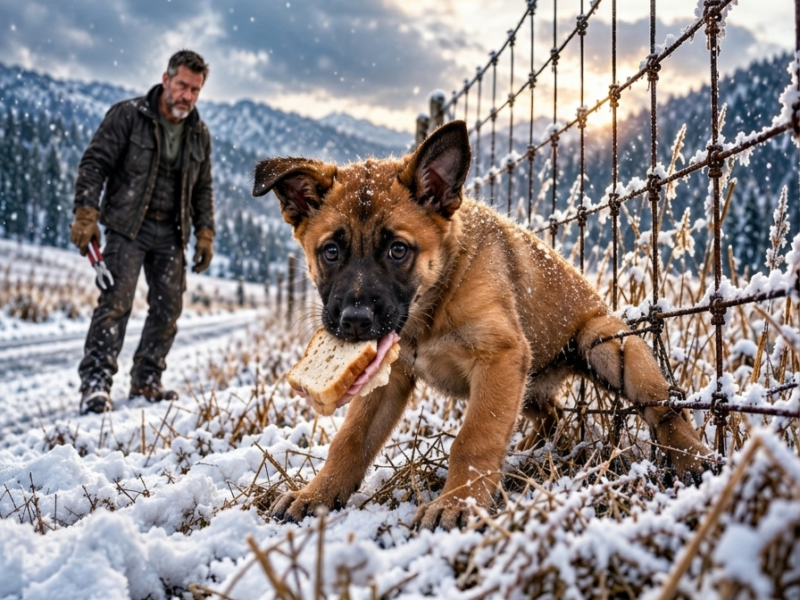
Navy SEAL Rescues a Belgian Malinois Puppy — Then It Leads Him Back to His Daughter
The storm raging over the Virigina countryside was relentless. Thick sheets of freezing water slammed against my truck’s windshield as I navigated the winding back roads outside of Richmond. It was past midnight. I was returning home from a support group meeting for Navy veterans—another evening spent sitting in a cold circle, drinking stale coffee, and pretending the ghosts of my past were staying downrange where they belonged.
As my truck crossed a narrow concrete bridge over a flooded drainage ditch, a high-pitched, desperate sound pierced through the heavy roar of rain and engine noise.
I slammed on my brakes. My tires skidded across the slick asphalt before coming to a stop on the muddy shoulder.
At first, I thought it was a child screaming. My pulse spiked. I killed the ignition, grabbed my heavy tactical flashlight, and stepped out into the freezing deluge.
I climbed down the steep, muddy embankment toward the culvert. The beam of my flashlight cut through the dark, turbulent water swirling around two massive concrete drain pipes. There, wedged tightly between the concrete lip and a tangle of drift branches, was a tiny Belgian Malinois puppy. He was no more than eight weeks old, his dark-masked face caked in mud, his legs shivering so violently he could barely hold himself above the rising water.
“Easy, little man,” I whispered, sliding down the slushy bank and reaching into the freezing torrent. “I’ve got you.”
Scared out of his mind, the puppy snapped his tiny jaws at my leather glove. But as soon as my hands wrapped around his ribs and lifted him free from the current, his defiance evaporated. He collapsed weakly against my chest, tucking his wet snout under my chin.
I hauled myself back up the embankment, carried him to the cab of my truck, and wrapped him in an old fleece jacket from the back seat. I cranked the heater up to high.
It was only then, under the warm glow of the dome light, that I noticed the red ribbon tied loosely around his neck.
My breath hitched in my throat. My thumb brushed over the faded satin fabric.
My daughter, Emily, used to tie ribbons just like that on everything she touched—her backpacks, her stuffed animals, even the service dog I had trained before my final deployment.
Emily hadn’t spoken a single word to me in eleven months.
Our relationship had shattered in my own driveway. I could still see her face through the tears—the utter disappointment in her eyes as she asked me why I could save strangers across the globe as a Navy SEAL, but couldn’t keep my own family from falling apart after her mother passed. I had stood there in silence, weighed down by my own trauma, unable to give her the words she needed.
She had driven away that afternoon. Three weeks later, she vanished.
The police found her car abandoned on a shoulder outside Richmond. No sign of struggle, no blood, no fingerprints, and zero leads. I had spent every waking hour for nearly a year searching street by street, flyer by flyer, until hope felt like a luxury I couldn’t afford without losing my mind completely.
Now, sitting in the quiet cab of my truck, I was holding a puppy with a knot tied exactly the way Emily tied her ribbons.
The Malinois puppy suddenly lifted his head. His dark ears shot forward. He scrambled off my lap, jumped onto the passenger seat, and began pawing frantically at the window glass, letting out sharp, demanding Yips.
“What is it, buddy?” I asked, my heart beginning to hammer against my ribs.
He whined, turning to scratch at the door handle. The moment I unlatched the door, the puppy leaped out into the pouring rain and took off down an unpaved logging trail leading deep into the pine forest.
“Hey! Wait!” I grabbed my flashlight and took off after him.
For nearly twenty minutes, the tiny dog sprinted through knee-deep mud, navigating overgrown farm tracks and dense thickets with an uncanny, unnatural purpose. Every dozen yards, he would stop, look back to make sure my flashlight beam was behind him, and then keep driving forward.
Finally, the trees cleared.
Nestled in a dark clearing beneath towering oak trees sat a small, decaying white farmhouse. Beside the leaning front porch lay a child’s blue bicycle, half-sunk in the mud and overgrown weeds.
My knees nearly gave out beneath me.
It was Emily’s old bicycle—the one I had bought her for her twelfth birthday, the one she had brought with her when she moved into her first apartment.
“Emily…” I gasped, rushing toward the porch.
Before I could reach the front steps, the puppy darted around the side of the house, barking frantically beside a low, iron-grated basement window.
A faint light flickered from deep within the cellar.
I sprinted to the window, dropped to my knees in the mud, and wiped the grime from the glass. I pressed my face against the pane.
Sitting on the cold concrete floor inside was a young woman, her back propped against a support pillar, hugging her knees to her chest. Her hair had been cut short, her clothes were filthy, and a dark bruise shadowed her left cheekbone.
My throat closed up. It was Emily.
“Emily!” I yelled, banging my fist against the glass.
She flinched at the sound, looking up slowly. For one agonizing second, her eyes were blank with terror. Then recognition washed over her face. She covered her mouth with both hands, letting out a ragged, sob-choked sound that pierced right through the glass.
“Dad?”
I didn’t think. I sprinted to the bulkhead cellar doors at the rear of the house, grabbed the rusted padlock holding them shut, and kicked the frame with everything I had. On the third kick, the rotted wood gave way with a loud crunch.
I threw the doors open, charged down the concrete steps, and pulled my daughter into my arms.
She clung to me with a desperate, frantic strength, her body shaking hysterically against my chest.
“I’m sorry,” I sobbed into her hair, burying my face against her neck. “I’m so sorry I didn’t find you sooner, Em. I’m so sorry.”
The Malinois puppy squeezed down the cellar steps, wiggling his way between us and licking Emily’s wet, trembling hands.
“His name is Scout,” Emily cried through her tears, pressing her forehead against mine. “He got out through the coal chute two days ago… I thought he was gone. He wouldn’t leave me, Dad. He kept me alive.”
I looked down at the little dog, a profound wave of awe washing over me. He hadn’t just been a lost puppy in a ditch. He was a lifeline. He had run miles through a raging storm to bring me to her.
I pulled off my heavy canvas jacket, wrapped it around Emily’s shoulders, and pulled out my phone to dial 911.
Before I could hit the call button, Emily reached out and grabbed my wrist with a iron grip.
“Please, Dad,” she whispered, her voice laced with absolute terror. “Don’t call the police yet.”
I froze, staring at her in total confusion. “What? Emily, you’re hurt. We need medical help. We need officers here now.”
She looked away from me, her eyes locking onto the dark, open wooden staircase at the far end of the basement that led to the ground floor of the house.
“Because the person who brought me here… he knows you’re coming,” she whispered.
Above our heads, a heavy floorboard creaked under the weight of slow, deliberate footsteps.
Scout’s ears shot back against his head. A low, fierce growl vibrated through his tiny chest as he stepped in front of us.
Emily squeezed my hand so tight her knuckles turned white.
“Dad,” she whispered, her voice trembling in the dark. “You need to know who really took me.”
The basement door at the top of the stairs creaked open, revealing a tall silhouette illuminated by the faint hallway light above. And as I looked up into the darkness, I realized our reunion was only the beginning of a nightmare.
The figure at the top of the stairs stood motionless in the doorway, framed by the pale yellow light of the upper hallway. A thick shadow obscured his face, but as he slowly stepped down onto the first wooden tread, his gait was unmistakable. He walked with a slight, rigid limp in his right leg—a combat injury from a mortar blast in Helmand Province five years ago.
“I wondered how long it would take the dog to find you, Arthur,” a calm, familiar voice echoed down into the damp cellar.
My blood ran colder than the rain outside.
“Miller?” I breathed, standing up slowly and placing myself firmly between my daughter and the stairs.
Major Thomas Miller. He had been my commanding officer during my last two deployments downrange. He was a man who had built a career on political connections, tactical ruthlessness, and an uncanny ability to make inconvenient problems disappear. Two years ago, he had been honorably retired following a high-level military audit involving missing supply manifests.
“You’re supposed to be in Texas,” I said, my voice hardening as years of tactical conditioning flooded back into my veins. “What is this, Miller? Why do you have my daughter?”
Miller reached the bottom step, stepping into the dim light of the single swinging bulb above us. He was wearing a dark rain jacket, his hands tucked casually into his pockets. He looked entirely untroubled, as if we were merely catching up at an old unit reunion.
“It wasn’t personal, Artie,” Miller said smoothly, glancing down at Scout, who was standing beside my boot, teeth bared in a fierce puppy snarl. “At least, it didn’t start out that way. Your daughter is a very talented investigative journalist, in case you didn’t know. She started digging into the old logistics ledgers from our 2021 deployment. She found the off-grid accounts.”
I turned my head slightly toward Emily. She kept her face hidden behind my back, but her grip on my coat tightened.
“She found out where the missing defense funds went, didn’t she?” I asked Miller, keeping my body square to his.
“She found enough to put me, two generals, and three defense contractors in federal prison for the rest of our natural lives,” Miller replied, his voice chillingly matter-of-fact. “I couldn’t let her publish. But killing a former SEAL’s daughter creates a massive law enforcement response. A missing person case? That fades away after a few months. People assume she ran off, had a breakdown, or got lost in the system.”
“You kept her in a basement for eleven months?!” I roared, taking a step forward.
Miller pulled his right hand from his pocket. In it was a sleek, black 9mm pistol fitted with a heavy tactical suppressor. He pointed it casually at my chest.
“Don’t do anything foolish, Arthur,” Miller warned softly. “You were the best breacher in the squad, but you’re unarmed, out of shape, and protecting two civilians. You don’t have the tactical advantage here.”
“I have everything I need,” I said, my voice dropping to a low, dangerous register.
“No, you don’t,” Miller smiled thinly. “You see, I knew the moment the dog broke out of the chute that he’d run straight for the main road. I knew he’d eventually attract attention. What I didn’t expect was that he’d find you. But honestly? This works out much better. One tragic house fire in the woods. A grieving, unstable veteran and his missing daughter found together. A tragic end to a sad family story.”
He raised the weapon, lining up the sight with my forehead.
From beside my boot, Scout didn’t hesitate.
Despite his tiny size, the Malinois puppy launched himself forward with explosive speed, burying his small, sharp teeth directly into Miller’s right ankle.
Miller hissed in surprise, his footing slipping on the wet concrete floor. The suppressor dipped three inches just as he squeezed the trigger.
THUMP.
The round punched a clean hole into the wooden support beam right beside my head.
I didn’t give him a second chance. I closed the distance instantly, grabbing Miller’s weapon wrist with my left hand and driving a brutal right elbow straight into his solar plexus.
Miller gasped for air, but he was a trained operator. He struck back, driving his forehead directly into my nose. Pain exploded behind my eyes, blinding me with red flashes. I stumbled backward, my boots sliding on the damp floorboards.
“Dad!” Emily screamed.
Miller recovered quickly, bringing the gun back up to center mass. But as he did, I grabbed a heavy iron wrench resting on a nearby worktable and swung it with everything I had.
The heavy metal struck his arm with a sickening crack. The pistol clattered across the concrete, sliding straight through the broken cellar chute into the pouring rain outside.
Miller snarled in pain, clutching his broken wrist. Realizing he had lost the tactical edge, he turned, sprinted up the stairs, and slammed the heavy wooden basement door shut behind him. A heavy brass deadbolt clicked into place.
Silence returned to the basement, broken only by the sound of our heavy breathing and the rain crashing against the foundation walls outside.
“Dad! Are you okay?” Emily rushed to my side, her hands wiping blood from my nose.
“I’m fine,” I gasped, wiping my face with the back of my sleeve. I looked down at Scout, who was standing over the spot where Miller had dropped the gun, panting heavily, his small tail wagging once. “Good boy, Scout. Good boy.”
I looked up at the locked basement door above us. Outside, through the broken chute, I heard the sudden, deep rumble of a high-horsepower SUV engine roaring to life in the driveway.
Miller wasn’t just running. He was going to cut the power, grab his backup gear from the truck, and burn the house down with us inside.
“We need to move now,” I told Emily, taking her hand. “The chute is too narrow for us, but it’s the only way out before he sets this place on fire.”
The smell of gasoline hit my nostrils before I even reached the top of the cellar chute.
Through the narrow iron grating at ground level, I saw Miller pouring fuel from a red plastic canister across the wooden wrap-around porch. The orange glow of a road flare flickered in his left hand, casting long, grotesque shadows across the front yard.
“He’s going to burn the whole structure,” I whispered, pulling Emily back into the shadows of the basement.
“Dad, there are no other exits,” Emily said, her voice shaking uncontrollably as she hugged Scout close to her chest. “The windows up top are all barred from the outside. He put those steel grates on himself when he brought me here.”
I scanned the dark basement with my flashlight beam. My SEAL training kicked in, filtering out panic and replacing it with raw, calculated survival instinct.
“Every old farmhouse in this county has a root cellar storage tunnel,” I muttered, sweeping the light across the rear stone wall. “They built them in the 1920s to store ice and produce below the frost line.”
I sprinted to the back corner of the basement, kicking away stacks of rotted cardboard boxes and rusted paint cans.
There, hidden behind a sheet of warped plywood, was a low, arched wooden door secured with a iron latch.
I threw the plywood aside, grabbed the latch, and yanked the door open. A rush of cold, damp, earthy air blew into our faces. The tunnel was narrow, walled with fieldstones, and snaked deep into the darkness beneath the back pasture.
“In! Now!” I ordered.
Emily crouched low, holding Scout tight against her stomach, and ducked into the dark stone tunnel. I followed right behind her, reaching back to pull the heavy wooden door shut and wedge a thick steel pipe beneath the handle to lock it from the inside.
Seconds later, a muffled EXPLOSION rocked the house above us.
Even through the thick stone walls, the heat wave was immediate. The wooden floorboards of the cellar above began to groan and pop as flames consumed the structure. Thick black smoke began seeping through the cracks in the ceiling joists.
“Keep moving!” I shouted over the growing roar of the fire. “Follow the draft!”
We crawled on our hands and knees through the damp earth tunnel for nearly fifty yards. The air was thick with the smell of wet soil and ancient stone. Scout led the way, his small nose sniffing the air, guiding us through a fork in the underground path with absolute certainty.
Up ahead, a faint, pale blue light filtered down through a tangle of pine roots and rotting wooden planks.
“There’s the exit!” Emily gasped.
I pushed past her, putting my shoulders against the rotten wooden hatch above us, and heaved upward with all my strength. The wood gave way with a loud snap, showering us in dirt and wet pine needles.
I climbed out into the freezing rain, scanning the tree line instantly.
We were in an overgrown drainage ravine fifty yards behind the burning farmhouse. The structure was completely engulfed in roaring, fifty-foot orange flames that lit up the stormy night sky like a massive bonfire.
Through the wall of rain, I saw Miller standing near his black SUV in the driveway, watching the flames with a pair of binoculars, waiting to see if anyone emerged from the inferno. He had a heavy tactical rifle slung over his shoulder.
“He thinks we’re trapped inside,” I whispered, pulling Emily into the thick pine brush beside the ravine.
“Dad, we need to get to your truck,” Emily urged, her teeth chattering from the freezing cold. “We need to get help.”
“My truck is two miles back down the logging trail,” I replied, checking my pocket. My phone had been smashed during the fight in the basement; the screen was completely shattered and dead. “We won’t make it on foot through this storm without him spotting our tracks in the snow.”
I looked at Miller’s black SUV. The engine was idling, white exhaust curling into the freezing air. The driver’s side door was unlocked.
“Stay here in the ravine,” I told Emily, looking deep into her eyes. “Keep Scout quiet. The moment you see that SUV move toward you, jump in.”
“Dad, no! He has a rifle!” she cried, gripping my arm.
“I spent ten years taking down high-value targets in conditions worse than this, Em,” I said, offering her a calm, confident smile I hadn’t felt in years. “I’m not losing you again. Not tonight. Not ever.”
I leaned down, patting Scout’s wet head. “Watch over her, little man.”
Scout let out a tiny, resolute huff, settling down beside Emily’s legs in the mud.
I slid out of the ravine, melting into the pitch-black shadows of the tree line, and began my approach on the burning house.
The heat from the burning farmhouse was intense enough to melt the falling sleet before it hit the ground. Thick clouds of steam rose from the wet dirt, creating a dense, shifting fog around the perimeter of the driveway.
I used the steam and the roar of the blaze as cover, moving from tree to tree with silent, practiced precision.
Miller stood twenty feet from the driver’s door of his SUV, holding his rifle at the low ready, his eyes locked on the front porch of the burning structure as it caved in with a shower of sparks. He believed he had won. He believed his secret was turned to ash.
He reached into his pocket and pulled out a satellite phone, holding it to his ear as he waited for a connection.
“It’s done,” I heard him say over the roar of the fire. “Problem solved. Clean up the paper trail on your end. I’m heading to the airpark in Richmond now.”
He lowered the phone, turned on his heel, and walked toward the open driver’s door of his vehicle.
He never saw me step out from the shadows behind the rear bumper.
I didn’t have a firearm, but I had momentum and two hundred pounds of combat-trained weight. I launched myself forward, driving my shoulder directly into Miller’s spine just as his foot touched the running board.
The impact slammed his head hard against the door frame. His rifle flew from his grip, landing five yards away in a mud puddle.
We both tumbled into the slush beneath the vehicle.
Miller scrambled frantically for his rifle, but I grabbed him by his tactical vest collar, yanked him backward, and drove a heavy right cross across his jaw. He grunted in pain, rolling over and drawing a heavy combat knife from his belt.
He slashed wildly in the dark. The blade caught my left forearm, slicing through my jacket and opening a deep, stinging line across my skin.
I ignored the pain, wrapping my right hand around his knife wrist and twisting it backward using an arm-bar joint lock. The steel knife dropped into the mud.
“It’s over, Miller!” I growled, pinning his arm behind his back and driving his face straight into the freezing mud.
Miller thrashed beneath me, panting heavily, his strength rapidly fading. “You… you can’t stop this, Artie… there are people above me… people who will never let her speak…”
“Then I’ll deal with them next,” I said, pulling a heavy zip-tie restraint from the SUV’s rear cargo pocket and securing his wrists tightly behind his back.
I stood up, breathing heavily, the rain washing the mud and blood from my face. I walked over, retrieved his satellite phone from the mud, and dialed 911.
“Emergency Services,” a dispatcher’s voice crackled through the speaker.
“My name is Arthur Pendelton, former Navy SEAL,” I said, my voice clear, steady, and commanding. “I am at an abandoned farm property three miles off Route 64 on Blackwood Logging Road. I have secured an armed kidnapper, Major Thomas Miller. I have recovered my missing daughter, Emily Pendelton. Send state police units, federal agents, and medical support immediately.”
“Sir, stay on the line—”
“We’re secure,” I cut in. “Just hurry.”
I dropped the phone onto the SUV’s hood, turned toward the tree line, and raised my hand.
“Emily! It’s clear!” I shouted into the night.
Through the steam and falling rain, Emily emerged from the ravine. She was running toward me, holding Scout securely against her chest.
When she reached the driveway, she didn’t look at Miller groaning in the mud. She threw her free arm around my neck, burying her face into my shoulder as the heavy sirens of state police cruisers began echoing in the far distance, cutting through the mountain storm.
Three months later.
The early spring sun shone brightly over the green rolling hills of the Virginia countryside. The air was soft, sweet with the scent of blooming apple blossoms and fresh-cut grass.
I sat on the wide wooden porch of my farmhouse, holding a warm cup of coffee, listening to the peaceful sounds of the morning.
Down in the front yard, Emily was sitting on a wooden bench, a tablet resting on her lap as she reviewed the final draft of her investigative series. The federal investigation sparked by her evidence had led to the arrest of fourteen high-ranking officials and defense contractors. Major Miller was currently awaiting trial in a federal maximum-security facility, facing charges of treason, kidnapping, and attempted murder.
Playing in the grass beside her bench was Scout.
In just three months, the starving puppy I had pulled from a flooded drain ditch had transformed into a broad-chested, sleek, and sharp-eyed five-month-old Belgian Malinois. His dark coat glistened in the sunlight, his ears stood straight up, and his intelligence shone clearly in everything he did.
He ran across the lawn, grabbed a red rubber ball in his jaws, and trotted proudly up the porch steps, dropping it right at my boots.
I smiled, leaning down to scratch him behind his ears. “Good boy, Scout.”
He let out a happy, sharp bark, resting his heavy head against my knee, his tail thumping steadily against the wooden porch floorboards.
Emily walked up the steps, leaning against the porch railing next to my rocking chair, looking out over the farm.
“The publisher accepted the final manuscript this morning, Dad,” she said softly, a genuine, radiant smile illuminating her face. “It’s over.”
“It’s just beginning, Em,” I said, reaching out to take her hand.
For eleven months, I had lived as a ghost in my own life—a man consumed by regret, convinced that every good thing he had ever cared about was lost forever downrange or in the dark. I had believed I was incapable of saving the people I loved.
But a tiny, fierce dog had refused to let me give up. He had dragged me out of my own dark storm, led me through the night, and brought my daughter back to my arms.
“Thank you, Dad,” Emily whispered, squeezing my fingers tightly. “For never giving up on looking for me.”
“Thank you for coming home,” I replied.
Scout let out a low, satisfied sigh, curling up across my boots in the warm sunlight. I leaned back in my chair, taking a sip of coffee, knowing that for the first time in many years, the storm was finally over, and our family was whole again.
The end.









