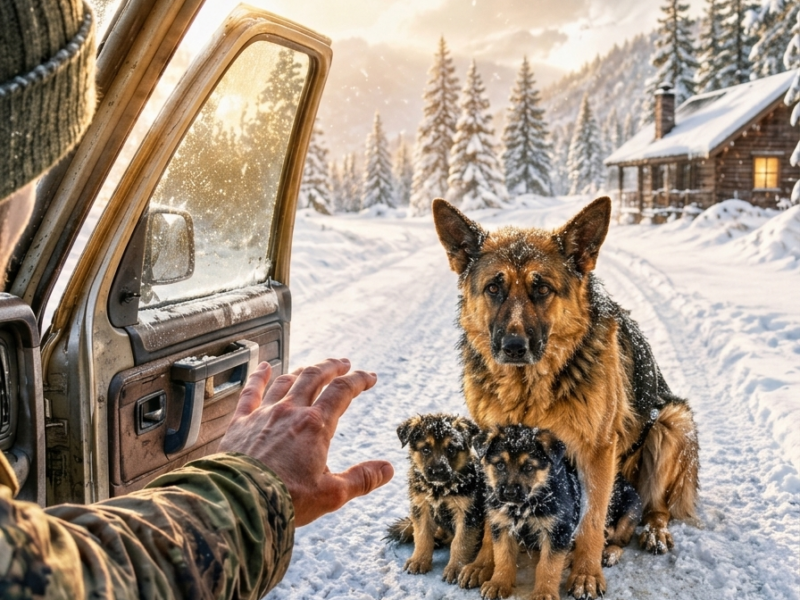
Navy SEAL Opens His Truck Door for FREEZING Dog Family in a Snowstorm — Her Next Move Broke Him Down
The brutal Colorado snowstorm howled across the desolate mountain highway, driving needle-sharp flakes against the windshield of my pickup truck. It was past midnight. I was driving home from a routine evaluation at the local veterans’ hospital, nursing the familiar ache in my knee and the far deeper, silent hollow in my chest.
Since leaving the Navy SEALs, my life had shrunk to quiet rooms, long drives, and a hollow routine. I had learned how to sleep with nightmares, how to eat alone, and how to tell people I was fine when silence was the only answer I had left.
As I rounded a bend near an abandoned, rust-eaten gas station, my headlights swept across a dark shape huddled against a concrete pillar.
I slowed down, squinting through the whiteout. Standing in the drift was a female German Shepherd. She stood squarely between her three tiny puppies and the howling wind, her coat matted with ice, her body trembling so violently that she could barely remain upright. The little ones were huddled beneath a torn cardboard box, their tiny paws completely buried in snow.
I slammed on my brakes and pulled off the shoulder.
“Come on, sweetheart,” I called out, opening the passenger door. Warm air rushed out into the freezing night. “Get your babies inside before you freeze!”
She stared at me suspiciously, her dark eyes hollow, her ears pinned flat back against her head—as if kindness had become a language she could no longer comprehend. Then one of the puppies let out a faint, piercing whimpering sound.
That was all it took.
The mother rushed toward the truck. But instead of climbing inside to save herself, she carefully picked up the first puppy by the scruff of its neck, carried it to the open door, and placed it gently on the warm floorboard. She repeated the process twice more, placing each shivering puppy onto the heater vents one by one.
Only after the last puppy was safe did she climb in herself.
I reached into the back seat, grabbed my heavy spare military blanket, and wrapped it gently over the puppies. I turned the heater up to high. For the first time in months, a small, genuine smile broke across my face.
Then the mother dog did something I will never forget.
She climbed across the center console, placed both of her front paws squarely against my chest, and pressed her face beneath my chin.
I froze. My breath caught in my throat. I hadn’t been touched like that in years.
That frightened, starving animal seemed to recognize something in me that I had spent years trying to bury—the broken soldier beneath the hardened skin. I reached up with a trembling hand and gently stroked the frozen fur on her head.
“You’re safe now,” I whispered into the quiet warmth of the cabin. “I’ve got you.”
Suddenly, she pulled away. Her head snapped toward the passenger window, and she began scratching frantically at the door panel, letting out sharp, anxious whines. When I unlocked the door, she jumped straight out into the deep snow and ran toward the dark silhouette of the gas station.
“Hey! Wait!” I grabbed my heavy flashlight from the glove box and jumped out into the storm, leaving the truck idling with the heater running for the puppies.
I tracked her paw prints through the fresh drifts. She stopped beside a rusted metal storage shed behind the main building, digging frantically at the frozen ground with her front paws.
“What’s wrong, girl? What is it?”
She barked once—a clear, echoing command—and looked directly into my eyes.
I dropped to my knees beside her and used my gloved hands to clear away the snow. Beneath a layer of black ice, my fingers brushed against fabric. I pulled it free.
It was a faded blue woolen scarf, wrapped tightly around a small, waterproof metal box.
My heart slammed against my ribs like a trapped bird. My breath stopped in my lungs.
I knew that scarf.
My younger sister, Emily, had worn that exact scarf the day she disappeared four winters earlier. Emily had fallen into deep depression after losing her husband—a Marine killed in an ambush overseas. While she was drowning in grief back home, I had been so consumed by my own deployments, my own operational stress, and my own pride that I hadn’t noticed how desperately she needed me.
When I finally returned from deployment, she was gone. Her car was found abandoned near a mountain trail. The police eventually closed her missing-person case, assuming she had walked into the wilderness and succumbed to the elements. I had never forgiven myself. I had carried her ghost in every dark room I entered.
With shaking, clumsy fingers, I popped the latches on the metal box.
Inside lay a photograph of Emily sitting on a porch, holding a floppy-eared German Shepherd puppy in her lap. Beneath the photo was a folded piece of paper bearing my name in her soft, familiar handwriting.
If you ever find her, please tell her I tried to come home.
My knees buckled completely, sending me spilling into the snow. I turned toward the dog.
She was standing over me, her tail motionless, her dark eyes filled with a strange, aching, human familiarity.
I raised my flashlight, shining the beam closer. There, behind her left ear, was a thin, star-shaped white scar. Emily had called me crying four years ago when she rescued an abused Shepherd puppy with that exact same scar. She had named the puppy Hope.
I sank into the snow, my tears burning hot against my frozen cheeks.
“Hope?” I choked out. “Hope… it’s you?”
The dog let out a heartbreaking whine, rushed forward, and buried her head firmly into my chest. I threw my arms around her, holding her tightly as the mountain storm raged around us. I wept harder than I had since the day I buried my brothers in arms—screaming my sister’s name into the empty wind.
After a long moment, my hands trembling uncontrollably, I pulled the photograph out to look at my sister’s face one more time.
That was when I noticed something written on the back of the print in fresh, black permanent marker.
It was a date: October 6. Three days ago.
And beneath the date were six handwritten words that made my blood run cold:
MICHAEL, YOUR SISTER IS STILL ALIVE.
My mind spun in sheer vertigo. Alive? How? Who wrote this?
Before I could process the words, Hope snapped her head around, her ears locked forward toward the highway. Far beyond the snow-covered pine trees, twin beams of headlights cut through the dark storm. A heavy vehicle was idling near my truck.
And from inside my idling pickup cab, the sudden, sharp ring of my cellphone echoed through the open door—a ringtone set specifically for a secure, unlisted landline number I hadn’t seen on a screen in four long years.
The ring of the phone sliced through the storm like a serrated blade.
I stood up, shoving the metal box and the photograph into my coat pocket. Hope pressed her shoulder against my leg, her lips curling back slightly over her teeth as she stared toward the highway.
I sprinted back to the truck, staying low against the snowdrifts, keeping the rust-eaten gas station building between myself and the strange headlights idling on the road. I threw myself into the driver’s seat, pulled the door shut, and grabbed the ringing phone from the dashboard console.
The screen glowed brightly in the dark cabin: UNKNOWN caller ID.
My thumb hovered over the glass. My heart hammered against my ribs. I pressed answer and put the phone to my ear.
“Michael?”
The voice was faint, raspy, and choked with static, but I would have recognized it anywhere on earth. It was Emily.
“Emily?!” I yelled into the receiver, my voice cracking. “Emily! Where are you?! Is that really you?!”
“Michael… oh God, Michael, you found Hope,” she sobbed softly through the speaker. Static hissed loudly over the line. “Listen to me… you can’t stay there. They tracked the dog. They’ve been watching the gas station waiting for someone to clear the cache!”
“Who is ‘they’, Emily?!” I demanded, looking into the rearview mirror.
The heavy vehicle on the shoulder of the highway—a blacked-out, lifted 4×4 SUV—had just turned its high beams on. The blinding white light flooded my side mirror. Two doors opened, and two men dressed in dark tactical winter parkas stepped out into the snow.
“It’s Marcus’s old unit, Michael,” Emily whispered frantically. “The mercenaries who were running illegal supply lines downrange before Marcus was killed. They think he left encrypted operational ledgers with me before he died! They’ve kept me locked in a cabin in the Blackwood Ridge for four years!”
My mind reeled. Marcus was Emily’s late husband—a Marine sergeant who had officially died in an IED explosion in Afghanistan.
“I escaped three days ago,” Emily continued, her voice breaking into panicked gasps. “Hope pulled the door pin while they were sleeping. I sent her down the mountain with the box… I prayed she would find someone who recognized her… I prayed she’d find you…”
“I’m here, Em,” I said, my voice hardening into pure, cold steel. The despair that had dragged me down for four years vanished instantly, replaced by the lethal, singular focus of a combat veteran. “I’ve got Hope, and I’ve got the pups. Tell me where you are.”
“The old logging ranger station at Blackwood Ridge… Mile marker 42… Michael, they’re coming for—”
A loud electronic tear cut the call. Static flooded the speaker, followed by three long beeps. The line went dead.
Outside my truck, the two men in tactical parkas were advancing through the snow, their hands tucked inside their heavy coats—a posture I knew all too well. They were drawing weapons.
“Hope, hold on!” I shouted.
I shoved the truck into drive, slammed my foot onto the accelerator, and cut the wheel hard to the left. The tires spun on the black ice, caught traction, and roared forward. I plowed through a wooden guardrail, spraying ice and splinters into the night, and launched the truck onto the snow-drifted asphalt of the mountain highway.
Behind us, a dull thump-thump echoed through the storm. Two suppressed gunshots punched clean holes through my tailgate, but the heavy steel body of the old truck held together.
I kept my foot pinned to the floor, driving blind through the whiteout condition.
In the passenger seat, Hope let out a low bark, looking back at her three puppies resting under my blanket. She turned back to me, pressing her wet nose against my forearm.
“We’re getting her back, Hope,” I gritted out, staring through the clearing sweep of the windshield wipers. “I swore I’d never fail her again. I’m getting my sister back.”
I drove five miles down the highway before pulling off into a dense thicket of pines to break line of sight. I killed the headlights, leaving the engine idling gently to keep the heater blowing for the dogs.
I reached under the driver’s seat, pulled out a dust-covered lockbox, and unlocked it with a small key on my ring. Inside lay my old military-issue sidearm, three loaded magazines, a tactical folding knife, and a handheld GPS unit.
I checked the magazine, chambered a round, and clicked the safety on.
For four years, I had been a shell of a man—a broken soldier waiting for the day my heart would finally stop pumping. But as I looked at my sister’s dog sitting beside me, and her puppies warm under my coat, the fire that had died downrange roared back to life with terrifying force.
They had taken my sister. They had locked her in the dark for four years while I grieved over an empty grave.
They had no idea who they had just poked awake.
I brought up the satellite map on my GPS unit, keying in Blackwood Ridge, mile marker 42. It was twelve miles further up the mountain trail—isolated, steep, and completely cut off by the storm.
I looked at Hope. Her ears were perked, her eyes locked on mine with absolute trust.
“Show me the way, girl.”
The road up Blackwood Ridge had long been decommissioned by the state. Snowdrifts piled three feet high across the trail, forcing me to abandon the truck two miles below the summit in a thick grove of aspen trees.
I wrapped the three puppies inside my thermal liner jacket, zipping them securely against my chest where my body heat would keep them alive. I strapped my tactical pack over my shoulder, pulled my dark beanie low over my ears, and stepped out into the knee-deep powder.
Hope jumped down beside me. She didn’t hesitate. She immediately took the lead, her nose close to the snow, forging a trail through the dark, frozen forest with incredible instinct.
The wind howled through the pine canopy above like a chorus of dying men. My knee throbbed with every step, the cold air burning my lungs like liquid nitrogen, but I ignored the pain.
After forty minutes of climbing through the freezing pitch-black wilderness, Hope suddenly stopped. She sank low into the snow, her tail dropping, her body going completely motionless.
I dropped to one knee behind a wide pine trunk, reaching down to gently pat her back. “Good girl,” I whispered.
Fifty yards ahead through the swirling snow stood the ranger station—a sprawling, two-story log cabin surrounded by a high chain-link fence. Two heavy snowmobiles were parked near the front porch, their engines ticking quietly as they cooled down in the freezing air. Light glowed yellow through the reinforced glass of the ground-floor windows.
I pulled my night-vision monocular from my pack and raised it to my right eye.
The green-hued lens brought the cabin into sharp focus. Standing on the covered porch was a tall man armed with an AR-15 rifle, holding a steaming mug of coffee. Through the window, I could see two more men sitting at a table covered in laptop computers and radio gear.
And in the far corner of the room, chained by her ankle to a heavy iron stove, was a woman. Her hair was matted, her face pale and thin, wrapped in a threadbare blanket.
Emily.
Seeing her alive—seeing the physical reality of her breathing after four years of crushing grief—nearly knocked the wind out of my chest. A knot tied itself in my throat, but I forced it down.
There were four men in total. Professional, disciplined, well-equipped. They weren’t street thugs; they were former private military contractors who knew how to set a perimeter.
I checked my watch. 02:14 AM.
“Hope,” I whispered, leaning down close to her ear. “I need you to stay right here with the babies. Do you understand? Stay.”
She whined softly, pressing her head against my knee, but she settled down into the snowbank, shielding the front of my jacket where her puppies slept soundly.
I drew my pistol, pulled my tactical knife from its sheath, and melted into the shadows of the tree line, circling around to the rear of the compound.
I reached the back of the chain-link fence where an old generator hummed softly, providing power to the cabin. I used my heavy wire cutters to snip a section of the chain link, slipping through the gap without making a sound.
I crept up to the wooden deck of the back porch. The wind was blowing toward me, muffling the sound of my footsteps on the icy steps.
I stood beside the back door, listening carefully. Inside, a voice was speaking over a radio transmitter.
“Commander, Team 1 lost the target’s truck near the highway junction. The storm is too thick… Understood. If he comes up this ridge, we neutralize him on sight.”
I didn’t wait for them to finish the thought.
I raised my boot and kicked the rear door frame directly at the deadbolt. The wood splintered with a sound like a grenade detonation.
I burst into the warm air of the cabin.
The man sitting nearest the rear hallway turned in shock, his hand reaching for his sidearm. I closed the distance before he could clear his holster, driving the butt of my heavy pistol straight into his jaw. He dropped to the floorboards like a sack of stones.
“CONTACT REAR!” the guard in the living room screamed.
I ducked behind a wooden support pillar as a burst of automatic gunfire tore through the drywall, showering me in plaster dust. I leaned around the frame, aligned my sights on the second shooter’s chest, and squeezed the trigger twice.
The gunshots echoed like thunder in the enclosed space. The second contractor collapsed back onto the laptop table, smashing a monitor as he went down.
“MICHAEL?!” a voice screamed from the corner.
I looked past the smoke floating in the air.
Emily was standing by the iron stove, her eyes wide with shock, tears streaming down her hollow cheeks as she held the heavy chain away from her body.
“I’ve got you, Em!” I yelled, stepping clear of the pillar.
Before I could reach her, a heavy shadow slammed into me from the side hallway.
A massive man—the commander I had seen on the porch—tackled me into the wall. My pistol clattered across the floorboards, spinning out of reach into the dark kitchen.
The collision knocked the breath entirely from my lungs. I hit the wooden floor hard, my head slamming against the baseboard.
The commander pinned me down, his massive hand clamping around my throat like a steel vise. He was a mountain of a man, easily two hundred and fifty pounds, his face covered in combat scars.
“You should have stayed buried, SEAL,” he growled, reaching down to pull a combat knife from his tactical vest.
Air choked in my throat. My vision flickered with red spots. I couldn’t reach my sidearm, and my strength was fading fast under his weight.
Suddenly, a streak of gray and black fur erupted through the shattered front window.
Hope flew through the air like a missile.
She hit the commander from the side, her jaws locking onto his shoulder with brutal force. The man screamed in pain, dropping the knife as the heavy Shepherd tore into his tactical jacket, throwing him off balance.
“Get off me, you crazy beast!” he yelled, flailing wildly to strike the dog.
The distraction gave me the split second I needed. I rolled to my left, drew my tactical knife from my belt, and drove the butt of the hilt hard into the side of his knee joint. A sickening crack echoed through the room.
The commander collapsed onto his side, howling in agony. I scrambled up, retrieved my pistol from the kitchen floor, and racked the slide.
“Don’t move,” I gritted out, aiming the barrel directly between his eyes.
The man froze, his chest heaving, blood soaking through his torn sleeve where Hope had clamped down. He slowly raised his hands.
“It’s over,” I said softly.
I walked over to the desk, grabbed a pair of heavy tactical handcuffs from a gear bag, and bound his hands tightly behind his back. I cleared the rest of the cabin to ensure no other threats remained.
When the building was secure, I dropped my weapon, ran across the room, and fell to my knees beside my sister.
“Emily…” my voice broke entirely.
“Michael… oh God, Michael!” she sobbed, throwing her thin arms around my neck.
I held her close, pressing my face into her hair, weeping openly as four years of unbearable guilt, sorrow, and grief poured out of me. She was alive. My little sister was alive in my arms.
“I’m sorry, Em… I’m so sorry I wasn’t there four years ago,” I whispered, clutching her tightly. “I’m so sorry I let you go.”
“You came for me,” she sobbed, pulling back to look at my face with her tear-filled eyes. “You found me…”
Hope trotted over, pressing her head gently into the space between us. Emily pulled the dog into our embrace, kissing the top of Hope’s head over and over again.
“She saved me, Michael,” Emily whispered. “When they brought me here, Hope stayed in the woods. She watched over this cabin for four years. She brought me food… she kept me alive.”
“I know,” I said softly. “She’s a hero.”
I unzipped the front of my heavy tactical liner. The three tiny German Shepherd puppies blinked up at the warm light of the cabin, letting out soft, squeaking whimpers as they tumbled out onto Emily’s lap.
Emily let out a breathless, joyful laugh through her tears, pulling the puppies into her arms. “They made it… oh sweet girls, you made it…”
I reached into my pocket, pulled out a heavy pair of bolt cutters from the station armory, and snapped the iron chain bound to Emily’s ankle. The heavy link hit the floorboards with a dull metallic clang—the sound of her four-year nightmare finally ending.
“Can you walk?” I asked softly, helping her to her feet.
“I can walk,” she said, her voice filled with a quiet strength I hadn’t heard in her since before her husband died.
I gathered the laptop hard drives from the desk—the ledgers containing all the evidence against Marcus’s corrupt former unit—and shoved them into my tactical bag. That evidence would ensure that every single man involved in this operation would spend the rest of their natural lives in a federal prison.
“Let’s go home, Em,” I said.
Six months later.
The warm morning sun poured across the green, rolling hills of our newly purchased ranch in southern Colorado. The air was crisp and clean, smelling of fresh pine and mountain rain, completely free of the cold ash that had defined my life for so long.
I sat on the wide wooden porch of the farmhouse, holding a steaming mug of black coffee in my hands.
Down in the green pasture, Emily was walking along the fence line, laughing as three half-grown German Shepherd pups chased each other through the tall grass, tumbling over one another in pure, unfiltered joy. Her face had regained its full color, her smile bright and clear under the mountain sun. She had started working at a local veteran support center, helping families navigate the painful terrain of grief and recovery.
Sitting right beside my wooden rocking chair, her dark eyes watching the puppies with calm maternal pride, was Hope.
Her graying muzzle rested comfortably on my knee. The white star-shaped scar behind her left ear glinted softly in the morning light.
I reached down and stroked her thick, soft fur. She let out a long, contented sigh, pressing her head firmly against my leg.
For four years, I had believed that war had destroyed every piece of my heart worth saving. I had believed that I was a broken tool, left behind to fade away in quiet, solitary rooms.
But a loyal dog had braved a frozen wilderness to teach me a truth I had forgotten downrange: that no matter how deep the snow buries you, love and duty never stop searching for a way home.
“Good girl, Hope,” I whispered into the warm morning breeze.
She thudded her tail twice against the wooden porch floor, looked up at me with her intelligent brown eyes, and leaned into my hand—knowing that the long, dark winter was finally over.
The end.









