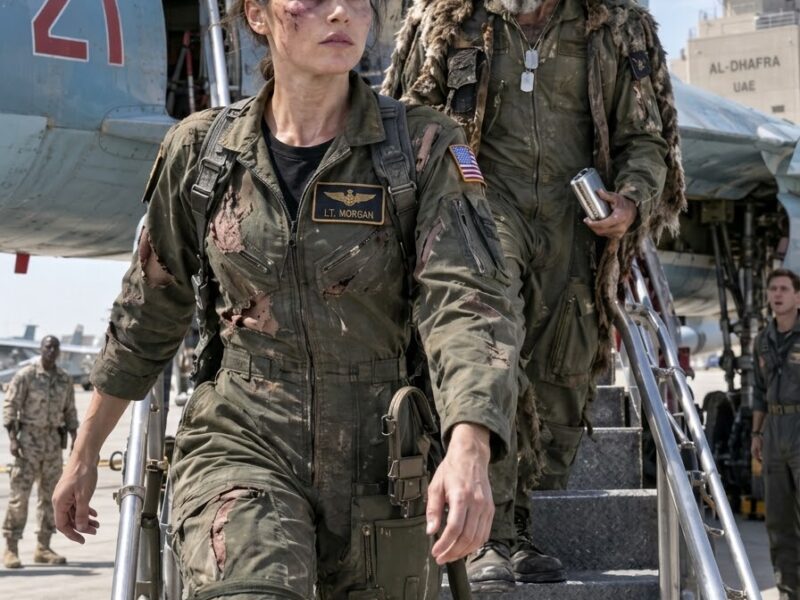
My squadron left me burning over enemy territory, and when I crawled into our airbase three days later
The sky was a canvas of bruised purple and blinding silver at thirty thousand feet. Inside the cramped cockpit of my F-16 Viper, the only sound was the rhythm of my own breathing through the oxygen mask and the quiet hum of the avionics. We were five miles above enemy airspace, flying a routine high-altitude sweep along the disputed eastern ridge.
It was supposed to be a low-risk reconnaissance flight. But in war, routine is just a shadow that hides the knife.
Without warning, the cockpit was flooded with an aggressive, high-pitched tone. My threat display lit up in flashing red text. Missile launch.
“Viper Two, this is Viper Leader,” I barked into my mask, pulling the stick hard to the left while dumping a swarm of flares. “I’ve got three radar locks coming from the valley! Breaking right!”
Below me, three fiery orange trails tore through the clouds, accelerating at impossible speeds. These weren’t standard surface-to-air missiles. They moved with a terrifying precision, adjusting their trajectories instantaneously.
“Viper Leader, I need cover!” I shouted, my heart hammering against my ribs. “I’m taking evasive maneuvers!”
For three seconds, there was only static over the radio. I strained my neck, looking back through the bubble canopy. Ahead of me, the five other jets in my squadron were flying in tight formation. They weren’t turning back. They weren’t dropping flares. They were accelerating away from me, their afterburners glowing like cold, distant stars against the darkening sky.
“All aircraft, retreat immediately,” the calm, unmistakable voice of my commanding officer, Colonel Vance, echoed in my helmet.
“Sir, I’m still here!” I screamed, pulling high Gs as the first missile streaked past my nose, detonating close enough to violently shake my airframe. “I’m engaged! Assist me!”
Static answered me, crackling like dry leaves underfoot.
Then Vance’s voice returned, dropping low, cold, and entirely devoid of emotion.
“She’s compromised. Leave her.”
“Colonel, wait! I can maneuver! Don’t leave me—”
Before I could finish the sentence, a second missile slammed into my starboard wing. The shockwave felt like a physical hammer blow to my chest. Metal tore apart with a deafening screech that sounded like a dying beast. The cockpit warning systems went wild, screaming in a chaotic chorus of alarms as hydraulic fluid sprayed across my canopy, instantly vaporizing into toxic smoke.
The jet lost all lift, tumbling uncontrollably into a violent, nose-down spin toward the jagged black mountains below.
“Eject! Eject!” the automated voice chimed.
I looked out one last time at the sky. My squadron was a distant streak, vanishing past the horizon. They hadn’t been cut off. They hadn’t been forced back. They were running away on purpose. They were letting me die.
I grabbed the ejection handle between my knees and pulled with everything I had.
The canopy shattered outward, and the roar of the freezing wind hit me like a solid wall. An explosive charge launched my seat into the abyss. The sheer force knocked the air from my lungs, blacking out my vision for a terrifying three seconds. When I regained consciousness, I was plunging through the freezing mist of the cloud layer, falling rapidly toward a dense, dark forest that looked like a carpet of needles.
My parachute deployed with a bone-snapping jerk, throwing me upward before letting me float down into the canopy of the forest. The nylon lines tangled violently in the thick branches of a towering pine tree. I swung like a pendulum, crashing through limbs and bark, until my body smashed hard against a thick trunk.
Pain flared bright and hot in my shoulder and leg, and then everything went pitch black.
When I woke up, the world was bathed in the pale twilight of dawn. Blood was drying on my forehead, matting my hair and gluing my left eyelid shut. My right arm hung limply, dislocated at the socket. High above, my parachute hung in shredded gray streamers from the treetops.
I gritted my teeth, grabbed a low-hanging branch with my left hand, and popped my shoulder back into its socket against my chest. The pain was so agonizing that I threw up stomach acid onto the moss below. But I couldn’t stop. Below me, far off in the valley, I could hear the faint, echoing sound of heavy diesel engines. Enemy ground patrols were searching for the crash site.
I pulled out my combat knife, cut myself free from the harness, and fell eight feet to the mud below.
For the next three days, I ceased to be a human being and became an animal driven by pure survival. I drank muddy rainwater collected from wide leaves. I chewed on bitter roots and stole half-eaten field rations from an abandoned enemy outpost. I crawled through thorn bushes and waded through icy mountain streams to cover my scent from tracking dogs.
My body was broken, but my mind was consumed by a single, burning question: Why?
Why had Vance ordered them to abandon me? I had served under him for three years. He had personally awarded me my wings. My father had served with him decades ago. There was no military doctrine that called for abandoning a pilot who was still airborne and fighting.
On the third night, a freezing rain began to fall, turning the forest floor into a swamp. Shivering violently and close to hypothermia, I dragged my bleeding body toward a ruined farmhouse at the edge of a deserted clearing. The roof had collapsed long ago, but beneath the rotten floorboards of the main room, I found a narrow flight of stone steps leading down into an underground bunker—an old, forgotten communications post from a conflict decades prior.
In the corner of the damp stone room, sat a surprisingly modern piece of military hardware: an auxiliary military communications terminal. Its screen was cracked and smeared with dirt, but a faint, rhythmic green light was still blinking in the center.
Someone had been using this post recently.
Weak and trembling, I slumped into the rusted metal chair. My hands were caked in mud and dried blood as I pulled an emergency data drive from my survival vest—a standard-issue military storage unit used to dump telemetry data from downed aircraft. I plugged it into the terminal’s open port, hoping to pull my flight logs so I could prove Vance left me behind.
The monitor flickered to life. The system automatically scanned the network, searching for local encrypted logs.
A sequence of raw audio files appeared on the screen, dated from the night I was shot down.
My heart hammered against my ribs as I hit play.
Static filled the damp bunker, followed by the muffled background noise of a tactical control room. Then, Colonel Vance’s voice echoed off the cold stone walls.
“Once she’s down, the investigation ends with her.”
My breath hitched in my throat. My hands began to shake violently.
A second voice spoke—a voice I couldn’t recognize, low and synthesized through a scrambled channel. “Are you certain she didn’t see the transport?”
“She was focused on the primary threat,” Vance replied coldly. “She doesn’t know about the second operation. She thinks it was just a surface-to-air ambush. Make sure the search teams reach the crash site before the local rebels do. I want her flight recorder buried.”
I sat in frozen silence. The room seemed to tilt beneath me.
It hadn’t been a tactical error. It hadn’t been fear of enemy fire. My squadron hadn’t abandoned me because I was compromised. They had abandoned me because I had accidentally flown into the path of a clandestine, unauthorized military operation—a phantom shipment passing through a combat zone where it shouldn’t have been. I had been a witness who needed to be silenced.
I reached out with trembling fingers to download the audio file to my drive. But as the system transferred the data, an unexpected prompt flashed on the screen.
RESERVED ARCHIVE FILE DETECTED. DIRECT MATCH TO OPERATOR BIOMETRICS.
A restricted folder opened automatically. The folder title was simply my full name and military ID number.
Inside was a single high-resolution image and a PDF report labeled: PROJECT GHOST – 2014.
I clicked the image. The breath was knocked entirely out of my lungs.
It was a photograph of my father, Captain Marcus Vance. He was standing in front of a nameless hangar, wearing his olive-green flight suit. My father had died twelve years ago in a classified helicopter crash during a training exercise over the Pacific—or so my family had been told by the Air Force.
I scrolled down to the PDF. It was an official casualty report bearing my father’s signature, dated two full days after his declared date of death.
Beneath his signature was a handwritten note from the base commander at the time: Subject successfully reassigned to Deep Black status. Family notified of fatal crash.
Tears welled up in my eyes, blurring the harsh green text on the screen. My father hadn’t died in a training accident. His entire death had been fabricated. He had been erased, wiped from the official record, just as Vance had tried to erase me three days ago.
A sharp snap echoed from the top of the stone stairs above me.
I froze, my thumb hovering over the screen. The sound of heavy combat boots crushing loose gravel echoed down the dark stairwell.
I immediately yanked the data drive from the terminal, plunging the screen back into darkness, and pressed my back hard against the cold, wet stone of the far wall. I drew my survival knife with my left hand, holding my breath as the footfalls grew closer, slowly descending the steps one by one.
A flash beam swept across the room, slicing through the dust-filled air.
“I know someone’s down here,” a rough, familiar voice whispered into the darkness.
I recognized the voice. It wasn’t an enemy soldier. It was Lieutenant Miller—my wingman, the pilot who had flown right beside me before the world went to hell.
I stepped out from the shadows, keeping the blade low but ready. “Miller.”
He spun around, raising his sidearm, but when the beam of his light caught my face—covered in mud, dried blood, and absolute fury—his hands began to tremble. He lowered the pistol, his mouth hanging open in sheer disbelief.
“Maya?” he breathed, stepping back as if he had just seen a phantom. “You… you’re alive? How are you alive?”
“No thanks to you or the Colonel,” I said, my voice rasping from days of breathing smoke and cold air. “You left me, Tommy. I called for cover, and you turned your back.”
Miller’s face went pale under his helmet. He looked away, unable to meet my eyes. “We were ordered to maintain radio silence and return to base. Vance said your jet was completely torn apart, that there was no seat deployment. He said… he said you died on impact.”
“He lied,” I hissed, stepping closer. “He didn’t just leave me to die, Miller. He set me up. The radar locks weren’t from an enemy battery. The signal came from inside our own tactical network.”
Miller shook his head frantically. “That’s impossible. You’re confused, you’ve got a concussion—”
“I have the audio logs right here,” I interrupted, slapping the emergency drive tucked securely beneath my torn flight jacket. “I have his voice ordering the squadron to abandon me to protect whatever illegal shipment was flying through Sector 4. And I know about the black operation.”
Miller took a step back, his eyes widening with genuine fear. “Maya… you don’t understand what’s happening back at the base. You can’t go back there. Vance has already written the official report. You were declared Killed in Action two days ago. Your belongings have been packed up. If you walk onto that base, you won’t make it to a military tribunal. You’ll just disappear.”
“Then I’ll make sure everyone sees me before he gets the chance,” I said, my jaw tightening. “Are you going to shoot me, Tommy? Or are you going to help me cross the border?”
Miller looked at his gun, then looked at my bleeding face. He swallowed hard, his hands shaking. Slowly, he re-holstered his weapon.
“My patrol vehicle is hidden a mile south,” Miller whispered, looking back toward the stairs nervously. “I was sent out to verify the crash site before the morning recon flights begin. If we leave now, we can reach the border checkpoint before the shift change at dawn.”
We moved through the forest like ghosts. Miller kept his flashlight off, navigating by the faint moonlight filtering through the heavy rain clouds. Every breaking twig made my heart leap into my throat, but we reached his military humvee without alerting the enemy patrols scouring the lower ridges.
For two hours, we drove in complete silence across the scarred, war-torn landscape. I sat in the passenger seat, my hand clutching the hard plastic of the drive hidden under my jacket. The pain in my shoulder was a burning fire, but the cold rage inside me was stronger.
At dawn, the low, grey perimeter fences of Forward Operating Base Blackwood loomed out of the mist.
The airbase was blanketed in a heavy silence. Searchlights swept rhythmically over the wet asphalt runways. A line of F-16s stood parked outside the primary hangar, their sleek metallic bodies glistening in the morning drizzle.
Miller slowed the humvee as we approached the main gate. The guard on duty, holding an assault rifle, stepped out of his booth, looking bored. But as Miller rolled down his window, the guard’s eyes drifted to the passenger seat.
He froze. His face drained of color as he looked at my torn, blood-soaked flight suit, the wild look in my eyes, and the soot smeared across my cheeks.
“Raise the barrier,” Miller said, his voice cold and commanding.
“Lieutenant… is that… is that Captain Vance?” the guard stammered, reaching reflexively for his radio.
“Raise the barrier now, Corporal, or I swear to God I’ll drive straight through it,” Miller snapped.
The guard swallowed hard, pressed the manual switch, and the heavy iron gate swung open.
Instead of heading toward the medical bay, Miller drove straight down the main taxiway toward Hangar 3—the central command hangar where the morning briefing was currently underway.
As the humvee screeched to a halt outside the open hangar doors, the sound of the engine echoed loudly through the massive concrete structure. Inside, dozens of pilots, mechanics, and ground crew personnel were lined up in strict formation. Standing on the elevated steel platform at the far end of the hangar was Colonel Vance, dressed in a sharp, spotless service uniform, delivering the morning operations update.
The entire hangar fell into a sudden, suffocating silence as the humvee door slammed open.
I stepped out into the bright fluorescent light of the hangar. Every eye turned toward me. Gasps echoed off the metal walls. Whispers spread like wildfire through the ranks of pilots who had sat in my memorial service just twenty-four hours earlier.
“Look at her…”
“Is that Maya?”
“My God, she’s alive…”
I didn’t look at any of them. I kept my eyes locked on Colonel Vance.
Vance stopped speaking mid-sentence. His hands gripped the wooden edges of the podium so tightly his knuckles turned white. For a fraction of a second, absolute, unadulterated terror flashed across his face. But just as quickly, his tactical discipline kicked in, and his expression hardened into a cold mask of command.
He stepped down from the platform and walked slowly toward me across the polished concrete floor, his boots echoing with every step.
“Captain Vance,” he said, stopping five feet away. His voice was steady, but his eyes were darting rapidly across my injuries, assessing the situation. “You were declared dead three days ago. This is… an unexpected miracle.”
“Was it a miracle, Colonel?” I asked, my voice cutting through the silent hangar like a razor. “Or was it just bad luck for you?”
Vance didn’t flinch. “You are clearly suffering from severe trauma and blood loss, Captain. Guards, escort her to the infirmary immediately.”
Two armed security officers stepped forward from the perimeter wall.
“Don’t touch me!” I snarled, reaching into my jacket.
me instantly, but I didn’t pull a weapon. I pulled out the black emergency data drive, covered in dirt and dried blood, and slammed it down hard onto the hood of his staff vehicle parked beside us.
“You told the squadron my jet was destroyed before I could eject,” I said, staring straight into his eyes. “You ordered them to turn back. You left me in enemy territory because I stumbled onto your unrecorded transport flight.”
The hangar went deathly quiet. Nobody moved. Nobody breathed.
“You are delirious, Captain,” Vance said, his tone low and warning. “You are making wild accusations under extreme physical duress.”
“Then explain this,” I pointed down at the drive. “Why does your voice appear on an encrypted log from an unregistered communications node in Sector 4? Why did you give the order to let the investigation end with my death?”
Vance’s jaw twitched. The color completely drained from his face. He looked at the drive, then looked up at the dozens of young pilots watching him in absolute shock.
Before Vance could speak, the heavy sound of approaching boots echoed from the rear of the hangar. A squad of Federal Military Investigators, wearing black armbands and accompanied by two high-ranking Generals from the Inspector General’s office, marched into the building.
The Lead Investigator stepped forward, looking between me and Vance. “Colonel Vance, by order of the Department of Defense, your command is suspended effective immediately. Hand over your sidearm.”
Vance slowly turned his head to look at the investigators. He knew it was over. The drive on the hood of the car was enough to trigger an automatic federal override of his authority.
He unbuckled his holster, handed his sidearm to the investigator, and turned back to face me.
As two guards stepped up to escort him out of the hangar, Vance leaned in close to my ear. His breath was cold against my battered face.
“You think you won today, Maya?” he whispered, a twisted, sinister smile touching the corner of his lips. “You have no idea what you’ve started. Your father wasn’t the only one who survived that crash.”
I froze, the blood running cold in my veins. “What did you say?”
Vance didn’t answer. He turned and walked away, escorted into the shadows of the military police vehicle.
The military hospital room was quiet, save for the steady, rhythmic beep of the heart monitor connected to my arm. For forty-eight hours, medical staff worked to mend my body. My shoulder was reset, my torn ligaments were treated, and seventeen stitches were sewn across my scalp.
Outside my door, two heavily armed Military Police officers stood guard, officially for my protection, but I knew the truth. I was no longer just a rescued pilot; I was the central witness in an intelligence scandal that was tearing the command structure apart.
Federal investigators had spent hours sitting at the edge of my bed, taking my statement, transcribing every detail of my three days in enemy territory, and analyzing the files from the black box drive.
The drive had proven Vance’s corruption beyond a shadow of a doubt. The unregistered transport flight was carrying high-grade military hardware off the books—a massive black-market operation running right through the heart of the war zone. Vance was the ringleader on the ground.
By the evening of the second day, the base was put under total lockdown. Vance was locked in a holding cell in the lower levels of the administrative building, awaiting transfer to a high-security military prison.
I thought it was over. I thought I could finally rest.
At midnight, while the base was cloaked in heavy fog, the screen of my personal satellite phone—which had been recovered from my gear locker—lit up on the bedside table.
It didn’t ring. It just flashed once.
I reached out with my uninjured arm, my hand trembling slightly, and picked up the device.
A single encrypted message had arrived from an untraceable, burner number. Attached was a high-resolution photograph.
My heart stopped.
The photograph showed the interior of a dimly lit, damp concrete hangar. Standing in the center of the frame was a man seen from behind. He was wearing an old, faded flight jacket—the iconic 1990s issue leather jacket that my father had worn in every family photo I had ever seen. On the right shoulder of the jacket was a hand-painted patch: 33rd Fighter Squadron – The Red Eagles.
It was my father’s custom patch. The one he had painted himself before his final flight.
Beneath the image were six simple, devastating words:
He has been waiting for you.
I stared at the screen, my pulse racing so violently that the heart monitor began to beep at a frantic speed.
My father was dead. He had been dead for twelve years. I had attended his military funeral. I had stood beside my mother as they folded the American flag and handed it to her. I had laid flowers on his headstone in Arlington National Cemetery.
Your father wasn’t the only one who survived that crash. Vance’s final whisper echoed through my mind like a ghost.
Was it a psychological trap? A game played by Vance’s remaining loyalists to lure me out into the open? Or had my entire life—my career, my identity, my grief—been built on a monstrous, calculated lie?
I threw off the hospital blankets, ripping the IV line out of the back of my hand. Pain shot up my arm, but I ignored it. I pulled my dark tactical pants and combat boots out of the storage locker, moving silently across the room.
I looked at the door. Through the frosted glass, I could see the silhouettes of the two guards standing in the hallway.
I walked to the bathroom, opened the small ventilation duct near the ceiling, and used a metal IV pole to pop the grate free. It was a tight squeeze, but my body was lean and trained for extreme conditions. I pulled myself up into the dark ductwork, crawling through the dusty metal shafts until I reached the outer maintenance access on the ground floor of the hospital.
Five minutes later, I dropped out into the cold night rain.
The airbase was vast, shrouded in swirling fog and illuminated by the faint orange glow of perimeter lights. I kept to the shadows of the maintenance buildings, moving toward the old south sector of the base—the abandoned portion of the airfield built during the Cold War, now used only for rusted storage containers and decommissioned aircraft.
That was where the photograph had been taken. The structural steel beams visible in the top corner of the image matched the architecture of Hangar 7, a long-abandoned structure marked for demolition.
I pulled my sidearm from my belt—a service pistol I had quietly taken from the locker room before escaping the hospital—and checked the magazine. Full.
I reached the rusted perimeter doors of Hangar 7. The wind howled through the cracked corrugated metal sheets, making a hollow, eerie sound. The massive sliding doors were cracked open just enough for a person to slip through.
I clicked off my safety, raised my weapon with both hands, and stepped into the pitch-black darkness inside.
“Dad?” my voice sounded impossibly small, swallowed instantly by the vast, empty space.
The only answer was the steady dripping of rainwater from the leaking roof onto the rusted concrete floor.
I clicked on my tactical flashlight, sweeping the narrow beam across the cavernous room. Old, stripped-down jet engines sat on wooden pallets like the skeletons of ancient beasts. Cobwebs hung thick between the iron rafters.
Then, the flashlight beam caught something hanging from a beam in the center of the hangar.
A single, thick rope hung from the ceiling. Swaying gently in the draft was an old military flight helmet. Painted on the side in faded red paint was the callsign: PHOENIX.
My father’s callsign.
My breath hitched. I took two slow steps forward toward the helmet.
Suddenly, a heavy steel door slammed shut behind me with a deafening bang. The mechanical latch clicked into place from the outside.
The lights inside the hangar snapped on all at once—blinding, harsh overhead halogen floodlights that buzzed with high voltage.
I raised my arm to shield my eyes, squinting into the glare.
“You always were too brave for your own good, Maya,” a deep, rasping voice echoed over the hangar’s old public address system. “Just like him.”
I spun around, aiming my gun at the high glass observation booth overlooking the floor. “Who are you? Show yourself!”
Through the dirt-smeared glass of the observation booth, a figure stepped forward into the light.
It wasn’t my father.
It was General Thomas Arthur—the head of the entire regional command, the man who had overseen the investigation into Vance just six hours ago.
I held my weapon steady, aiming directly at the glass box twenty feet above me. “General Arthur. You set up the transport flight. It wasn’t Vance running the show. It was you.”
Arthur smiled warmly down at me, a calm, grandfatherly expression that sent a chill straight down my spine. He adjusted his pristine uniform jacket, covered in rows of glittering medals.
“Vance was merely an operational manager, my dear,” Arthur’s voice echoed through the speaker system. “A capable officer, but prone to panic when things deviate from the flight plan. You, however… you have proven to be exceptionally troublesome.”
“Where is my father?” I demanded, my hands locked onto the grip of my pistol. “The files on that drive… Vance’s words… the photo… where is he?!”
Arthur sighed, resting his hands on the metal railing of the booth. “Your father was a brilliant pilot, Maya. But he possessed a fatal flaw. He believed that loyalty to the flag was more important than loyalty to the men who actually run the world.”
He stepped back from the railing and pressed a button on the control console inside the booth.
A high-definition monitor mounted on the hangar wall beside me hummed to life.
The screen displayed live surveillance footage from a dark, secure medical facility located somewhere underground. On the screen was an hospital bed surrounded by life-support machinery. Lying in the bed was an elderly man, his skin pale and weathered, his body hooked up to intravenous tubes and a mechanical ventilator.
Despite the age, despite the grey hair and the sunken cheeks, I recognized the structure of his jaw. The scar over his right eyebrow.
It was my father. He was alive. But he was a prisoner, kept in a medically induced coma.
A sob caught in my throat, threatening to choke me. “What did you do to him?”
“Twelve years ago, your father discovered the foundation of our operation,” Arthur explained calmly, his voice echoing off the concrete walls. “We were moving black-budget assets, funding unsanctioned military operations to maintain global stability where politicians lacked the spine to act. When he refused to join us, his aircraft was brought down. But he didn’t die. He was too valuable. His flight data, his clearance codes, his knowledge of deep-level protocols—we needed them.”
“You kept him captive for twelve years…” I whispered, my eyes burning with tears as I stared at the monitor. “You let my mother die thinking her husband was dead!”
“We gave him a choice every single year,” Arthur said coldly. “He chose silence over cooperation. And so, he remained in cold storage. A ghost.”
Arthur leaned closer to the microphone. “And then you came along. So talented. So like him. You joined the air force, rose through the ranks, and flew right into the middle of our grid. When you saw that transport aircraft three days ago, Vance panicked. He tried to kill you. I told him it was a mistake. I told him a Vance would not die so easily.”
“I’m going to tear your network down,” I snarled, taking a step toward the stairwell leading up to the booth. “I’m going to take this footage, I’m going to take those files, and I’m going to burn your life to the ground!”
“With what evidence, Captain?” Arthur asked, a subtle edge of pity in his voice. “The drive you gave the federal investigators? Look at your phone.”
I pulled my phone from my pocket with my left hand.
The screen was flashing blue text: REMOTE WIPING IN PROGRESS… FILE DELETED… DRIVE CORRUPTED.
My heart dropped into my stomach. “No…”
“Did you really think I would allow an external drive into my command structure without an automatic cyber-purge protocol?” Arthur chuckled quietly. “The drive you handed to the investigators wiped itself ten minutes ago. Right now, the federal team believes you fabricated the audio files using advanced AI voice synthesis to cover up your own pilot error during the mission.”
The magnitude of his trap closed around me like an iron cage.
I was an escaped hospital patient. I had broken out of isolation. I had pointed a gun at a three-star General. In the eyes of the military, I wasn’t a hero uncovering corruption; I was a unstable, shell-shocked officer having a psychotic breakdown.
“You have no proof, Maya,” Arthur said softly. “You have no witnesses. Vance is in a cell, and he will take the fall for a simple, mundane embezzlement charge. The shadow operation continues.”
He reached for a switch on his console.
“And as for you… an escaped officer, mentally unfit, who breached a secure facility and fired upon a senior officer… your death tonight will be a tragic footnote in a sad story.”
The heavy steel doors on the far side of the hangar slid open.
Three men walked into the bright light. They weren’t dressed in Air Force uniforms. They wore tactical gear with no insignia, black helmets, and carried suppressed submachine guns. Mercenaries. Cleaners.
“Kill her,” Arthur said simply over the intercom. “Make sure the body is burned beyond recognition this time.”
The three mercenaries raised their weapons.
I didn’t hesitate. I dropped to one knee, raised my sidearm, and squeezed the trigger three times.
The sharp cracks of my pistol echoed deafeningly in the enclosed hangar.
My first round struck the lead mercenary square in the chest plate, staggering him backward. The second and third rounds ricocheted off the heavy concrete floor, sending a spray of sparks into the dark.
I dove behind a heavy wooden crate just as a hail of suppressed automatic fire tore through the air where I had been standing a second before. Splinters of wood and chunks of concrete exploded around me.
“Spread out! Flank her!” a harsh voice shouted through a tactical headset.
I was down to nine rounds in my clip. Against three heavily armored, fully automatic professionals, I had zero chance in a prolonged firefight. I needed to move. I needed height.
I glanced up. Above my head was a rusty iron ladder leading up to the high crane tracks that ran along the roof of the hangar—connecting directly to the back of the observation booth where General Arthur was standing.
I waited for a lull in their fire—the two-second window when the lead shooter dropped his magazine to reload.
I popped up from behind the crate, fired two precise shots to force the second shooter behind a steel pillar, then sprinted for the ladder.
I climbed frantically, my boots slipping on the slick metal rungs. A volley of bullets punched holes through the corrugated metal wall right beside my head, sending hot metal fragments skimming across my cheek. I ignored the blinding pain, pulled myself onto the narrow catwalk twenty feet above the hangar floor, and kept running.
Below me, the mercenaries realized where I was going. “She’s on the upper catwalk! Take out the support beams!”
I reached the heavy reinforced door at the back of the observation booth just as bullets began to tear through the metal walkway behind me.
I raised my boot and kicked the door right beside the handle with everything I had.
The latch shattered, and the door burst open.
General Arthur turned around in shock, his hand reaching reflexively for a small snub-nosed revolver on his desk.
Before his fingers could touch the grip, I crossed the room, grabbed his wrist, and slammed his head down hard onto the glass control console. The glass shattered into a spiderweb of cracks. His revolver clattered to the floor, rolling away under a chair.
I grabbed Arthur by his collar, yanked him to his feet, and jammed the barrel of my pistol directly under his jaw.
“Tell them to hold their fire!” I screamed in his ear, my voice raw and savage. “Tell them now, or I swear to God I’ll splatter your brains across this glass!”
Arthur, bleeding from a cut on his forehead, panted heavily. His eyes were wide with genuine, desperate terror. He looked down through the broken booth glass at his three mercenaries, who were aiming their rifles up at the booth.
“Hold… hold your fire!” Arthur gasped into his chest microphone. “Do not shoot! Stand down!”
The mercenaries slowly lowered their weapons, though they kept their sights trained on the booth entrance.
“It’s over, Maya,” Arthur wheezed, his voice trembling against the cold steel of my gun. “Even if you kill me… you can’t escape this base. Every gate is locked down. Every guard is looking for you. You have nowhere to fly.”
“You’re wrong, General,” I whispered, my teeth bared in a cold smile. “I have a jet.”
I pulled a pair of heavy tactical zip-ties from his desk drawer, yanked his hands behind his back, and bound them tightly until the plastic bit into his skin. I dragged him out of the booth, down the rear stairwell, and out onto the tarmac where the night air hit our faces like ice water.
The three mercenaries followed at a distance, their weapons raised, but they couldn’t shoot with their boss held tightly in front of me as a human shield.
We stumbled through the fog toward the primary flight line. There, sitting beneath the floodlights of the main runway, was a pristine, fully fueled F-16 Fighting Falcon—prepared for the morning’s dawn patrol, complete with a full tactical payload.
“You’re insane…” Arthur sputtered as I dragged him toward the ladder of the cockpit. “You can’t fly out of here! The air defense radar will paint you the second you cross the perimeter! They’ll blow you out of the sky!”
“They won’t,” I said, shoving him hard against the side of the aircraft. “Because you’re going to give me your personal master command drive.”
I reached into his uniform pocket and pulled out his high-level encrypted flash drive—the master key used by regional commanders to override base defense networks and access black-budget archives.
I plugged the master drive directly into my flight suit’s transfer kit, linking it to my secure personal cloud account using the jet’s satellite uplink system.
TRANSFER COMPLETE. MASTER ENCRYPTION OVERRIDDEN.
Every black file, every secret operation, every record of my father’s imprisonment, and every node of Arthur’s illegal network was instantly uploaded to six international oversight agencies, three federal judges, and every major news network in the country.
The notification lit up on Arthur’s own wrist device.
He stared at the screen, his face turning as white as a sheet. His entire empire, built over twenty years of deception and murder, had just been exposed to the entire world in a single fraction of a second.
“It’s over, Arthur,” I said quietly, stepping up onto the ladder of the F-16. “Your ghost story is finished.”
Sirens began to wail across the base. Red alarm lights spun against the wet concrete buildings. Dozens of security vehicles were speeding down the taxiway toward us, their blue lights flashing through the thick fog.
I climbed into the cockpit, pulled down the heavy bubble canopy, and locked it into place.
I flipped the jet’s engine start switches. The powerful turbofan engine behind me let out a low, gut-rumbling whine that rapidly rose into a deafening, high-pitched roar.
I looked down through the glass one last time. General Arthur was standing on the asphalt, surrounded by military police officers who were kneeling beside him—not to help him, but to slap heavy steel handcuffs onto his wrists as the news of the leak broke across their command radios.
I pushed the throttle forward.
The Viper surged down the runway, accelerating rapidly into the darkness. 100 knots. 150 knots. 200 knots.
I pulled back hard on the control stick.
The jet tore away from the earth, pointing its nose straight into the black storm clouds above. The afterburners lit up the night sky with a blinding, triumphant trail of fire, breaking through the turbulence, through the fog, and into the clear, quiet starlight at thirty thousand feet.
Down below, the shadows were finally fading.
Ahead of me lay the path to the medical facility, to the truth, and to bringing my father home.
The end.









